Pastafarian Pin-Ups

dish_fsm

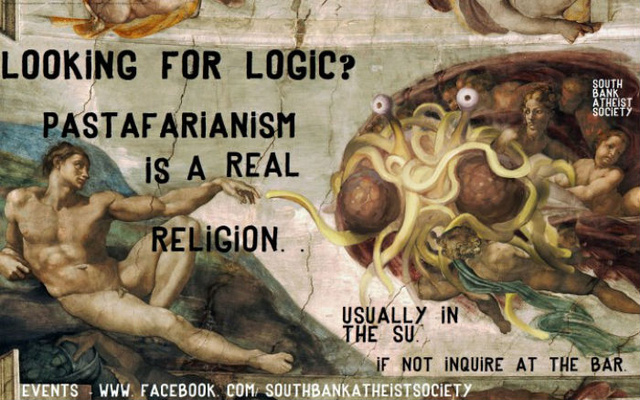
The South Bank University Atheist Society in the UK recently stirred controversy with a poster that replaced the image of God in Michelangelo’s The Creation of Adam with the flying spaghetti monster. The poster was banned for being “religiously offensive,” a charge Jonathan Jones finds preposterous:

The artist has not done anything to God. All that has been altered here is a painting by Michelangelo. OK, for some of us Michelangelo is as godlike as artists get – but that does not make his images sacred. … The first person to parody Michelangelo’s portrait of God was Michelangelo himself. While he was working in the Sistine chapel, standing … on a wooden platform suspended just under the ceiling, he wrote a poem lamenting his lot. He complains about the paint dripping down on his upturned face and beard, about having to twist his body monstrously as he reaches up all day and night. By the manuscript poem, he added a cartoon. A naked artist stretches up to paint God on the ceiling – but God is a crude graffito, an absurd caricature with long spiky hair. Not a million miles from the Spaghetti Monster, in fact.

In other words, Michelangelo did not think there was anything inherently sacred about his image: it was a picture of God made by a man; it was not a holy relic. Later in his life, he was attacked for this. Michelangelo, complained pious critics, put art before God.

On Wednesday, the student union at London South Bank University issued a statement apologizing for the censorship:

We have apologised to the Atheist Society for the actions taken and the distress that it has caused. From a Union perspective the ‘Flying Spaghetti Monster’ Poster has not been banned and we have agreed with the Atheist Society to reprint these posters and distribute them on campus for them. They will also be displayed inside the Union’s locked poster boards in order to prevent them being taken down by other students. … We remind students that the appropriate response to opinions they may find offensive is to engage in healthy debate respecting the rights of others to hold views or beliefs differing from their own.

Terry Firma is relieved by the apology, but Tom Bailey sees the poster ban as part of a broader trend:

While bans and acts of censorship on the grounds of religious offence are not justified, they are based on the idea that if something is offensive – actually or potentially – to certain segments of the student population, then it can rightfully be banned. Bans, whether on the basis of religion or sexism, are based on intolerance, an intolerance of certain things that some people may find objectionable, distasteful, uncouth or offensive, and which in turn compels them to be censored – whether it is Robin Thicke’s lewd lyrics or Photoshopped frescos.

Yet the faith-bashing warriors who raged against the censoring of t-shirts at the [London School of Economics] and the censoring of a poster at South Bank University will, for the most part, have little to say about the wider culture of bans and censorship at universities. The banning of the spaghetti-monster poster at South Bank is not a creeping resurgence of intolerant religion or a capitulation to Christian complainers by university officials. Rather, it is part of an increasingly intolerant climate at universities in which offence, religion-based or otherwise, is deemed a legitimate ground for something to be banned.

Previous Dish on the FSM here, here, and here.

(Image of offending poster via Facebook)
All Relationships Are “Interfaith”

That’s the argument of Susan Katz Miller, author Being Both, a book about interfaith families. She explains what she means:

Whether or not two people have the same religious or nonreligious label, they are never going to share identical beliefs, practices, culture, family history. Both partners could be Reform Jews and one could be an atheist, the other a mystic. Or both partners could be secular humanists, and one loves to celebrate a huge Christmas and the other, not so much. Or both partners could be Protestant, but one sees Jesus as the Messiah and the other sees Jesus as more of a teacher or rabbi or even as a metaphor. What we teach children in interfaith community religious education is that you cannot accurately determine anything about someone’s beliefs based on their religious label.

Her advice on making such relationships work:

[T]here are a significant number of atheists, agnostics and nonreligious people married to people who do maintain religious affiliations, or atheist couples from two different religious cultures, so there is an important overlap between secular and interfaith communities. For atheists in “interfaith” or faith/nonreligious relationships, I think the keys to success are the same as they are in any other interfaith relationship: listen to each other, be specific about the beliefs and practices that you want to share and why, be open and tender and loving, and above all, see interfaith or faith/nonreligious bridge-building as something that is inspiring, as a form of calling, rather than as an insurmountable problem.

Late last year, Katz Miller argued for raising children with two religions. One reason she gave? Doing so “promotes transparency about differences”:

Neither parent’s religion is being suppressed, so children are less likely to feel confusion, guilt or even resentment on behalf of the “out-parent.” Meanwhile, interfaith children trying to formulate an identity as solely Jewish or solely Christian often struggle against society’s assumptions about their religion, based on physical characteristics, name, and extended family. An interfaith child raised Jewish may be presumed otherwise because of brown skin or even blond hair. An interfaith child raised Catholic, but whose last name is Cohen, will be presumed to be Jewish. Children allowed to identify equally with both sides of the family may more easily integrate the reality of their hair, their name, and even their grandparents. And while the children must learn to integrate two worldviews, as rebellious teens and young adults, they often appreciate the respect their parents show them by allowing them to make their own decisions. “No one is dictating to me what to believe and what not to,” reports a thirteen-year-old girl in the Washington interfaith group.

Becoming A Moral Minority

Reviewing a number of recent books on the state of American Christianity, especially John Dickerson’s The Great Evangelical Recession, Jim Hinch tracks the decline of conservative religion:

[T]he chief problem facing conservatives is not simply demographic or cultural change in America but rather conservatism itself — a particular approach to Christian theology and practice that worked well for churches during a certain period in American history but now has become a serious impediment. That approach combined (selective) biblical literalism with American religious nationalism to produce a Christian worldview that was strong enough to withstand the cultural upheavals of the 1960s but flexible enough to embrace the Reagan-era turn toward free-market capitalism and cultural individualism. Conservatives already have begun shedding parts of this mix, as evidenced by evangelicals’ pivot on immigration reform. Biblical literalism, though, and its accompanying inflexibility on sexual issues, has proven harder to change. And therein lies the problem.

One of the biggest problems for conservative Christians? How they read the Bible:

[R]igid literalism makes it extremely difficult for conservatives to change course, even when compelling arguments are raised against their particular biblical interpretations. One of young people’s chief complaints about present-day Christianity, polls show, is that the faith is antiscience. Christianity itself is not antiscience, and many scientists (including Francis Collins, the current director of the National Institutes of Health) are practicing Christians. But biblical literalists are antiscience, and their inability to let go of the idea that Scripture trumps scientific evidence constitutes a needlessly self-inflicted wound.

In an interview about his book from last year, Dickerson explained data on how many evangelical Christians there are in the United States. You might be surprised by what he found:

The bottom line is that we are a much smaller movement than many of us have believed – certainly not a majority of the United States, and, I believe, a gradually declining minority. Many of us attend growing churches that are attracting folks from other churches, so we have the perception that “the Church” is growing, when she’s really just shuffling. Meanwhile, as we play musical churches, the broader population is growing.

The exact size of evangelicalism is probably impossible to calculate. Sociologically, the movement is broad and motley and scattered. Culturally, the terms “born again” and “evangelical” now mean different things to different Americans. … On this question of the actual size of the evangelical church, I discovered that four separate, credentialed researchers have recently used four separate methods to count U.S. evangelicals, in four completely independent studies. Interestingly, they all concluded that evangelical Christians are between 7 and 8.9 percent of the U.S. population.

You’ve Got Sexts

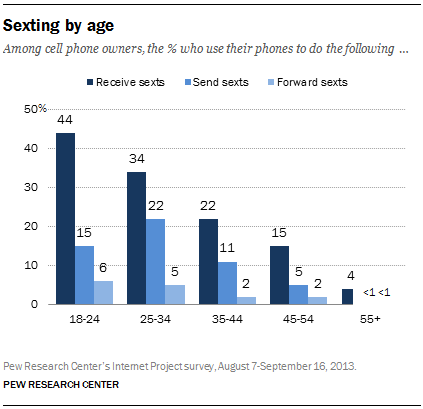
A new Pew study indicates that the prevalence sexting is rapidly rising:

In previous surveys, those in their mid-twenties through mid-thirties were dish_sextingchart the most likely to both send and receive sexts. For the first time, however, those ages 18-24 are the most likely of any age group to say they receive sexts (44%). This represents a significant increase from 2012, when 26% of those 18-24 said they received sexts. … Sexting … is not just for daters. Adults in marriages or committed relationships are just as likely to say they have sent sexually suggestive texts as single individuals. Some 9% of those in a  relationship have sent sexts, along with 10% of those not in a relationship.

The trend shows little signs of stopping:

Karen McDevitt, a communications lecturer at Wayne State University who specializes in new media, says she expects the sexting phenomenon to continue growing and attributed its increased popularity to the widespread availability of devices like smartphones. “The technology is in your hand,” McDevitt says, “I truly believe it’s just accessibility that makes the difference.”

Amanda Hess zooms out:

Could we be entering an era where using technology for titillation doesn’t mean opening ourselves up to exploitation?

In 2003, New Jersey made it a felony to distribute sexual photos of another person without his or her permission, but it took a decade for the campaign against nonconsensual pornography to begin to gain traction around the world. Last year, California made forwarding a sext without consent a misdemeanor crime. Steubenville, Ohio, football player Trent Mays was convicted in juvenile court of raping a 16-year-old girl but also of distributing images of the assault after the fact; his text messaging doubled his sentence from one year to two. Just last month, American revenge-porn king Hunter Moore was busted by the feds for allegedly hacking into email accounts to steal sexual photos, and Israeli legislators passed a bill banning the dissemination of sexualized images without the subject’s explicit consent. There, distributors now face five years in prison. …

[L]ooking at Pew’s new numbers … it’s increasingly clear that dialing up sexual experiences doesn’t come with the expectation that those experiences will migrate to a group text. Most people who receive sexts don’t share them with the class, and it’s not stupid to expect your sexting partners to keep your privates private. It’s simply humane.

The Future Of Film

A NSFW art exhibition explores Oculus Rift, the virtual reality headset:

Adi Robertson elaborates:

Long-running performance art installation The Machine to be Another is a literal, perhaps radical take on the Oculus Rift’s promise to let you simulate being anywhere or anyone. In what the artists call the “gender swap” experiment, two people stand in a room, each wearing a Rift headset. They agree on and synchronize their movements, rubbing hands over stomachs or taking off shoes. But while they feel their own bodies, they “see” out of each other’s eyes. … [T]he video … is an artistic example of how something like Sex with Glass can be done right.

Meanwhile, Hugh Hancock considers how virtual reality (VR) will come to be incorporated into mainstream movies:

There’s been a lot of research into “VR Sickness” recently, and the news isn’t good for movies-in-VR.

It turns out that one of the major causes of VR sickness is rapid or unexpected movement outwith the user’s control. Users seem to be able to cope provided there’s an obvious visual reason for the movement, but otherwise, movement you can’t control sends you right off to talk to Huey on the big porcelain telephone.

So, for a filmmaker, that means no tracking shots, certainly no rapid flythroughs, and worst of all – no cuts. Cuts – film editing as a whole – are one of the most fundemental tools of movie storytelling, and removing them sends us back in time to the dawn of cinema, before Eisenstein, back to 1910 and the Kuleshov Effect.

He suggests filmmakers seeking to embody the viewer in their narratives look to VR porn:

So far, all reasonably workable VR porn adopts a “breaking the fourth wall” approach, either by having performers perform to the viewer and treat him/her as a voyeur, or more dramatically by placing the viewer straight into the scene with his/her viewpoint positioned where one of the actors’ heads can be assumed to be. This ties in with both Oculus VR’s best practise document, which recommends giving the VR participant a visible body in the virtual space, and some of the more successful game experiences in VR.

Previous Dish on virtual reality here and here.

Speed Reads

Julie Bosman reports (NYT) that book publishers are now “encouraging a kind of binge reading, releasing new works by a single author at an accelerated pace”:

The practice of spacing an author’s books at least one year apart is gradually being discarded as publishers appeal to the same “must-know-now” impulse that drives binge viewing of shows like “House of Cards” and “Breaking Bad.”

Michelle Dean hopes binge-reading isn’t the new binge-watching:

The kind of trance that reading induces is qualitatively different from the experience of sitting down and watching 12 hours of television. This is true even if the television is really good, I think. It just uses a different part of your brain.

I’m aware that in a way I’m just quibbling with a label, with marketing, by saying I don’t think that “binge reading” is silly. But I just really, really don’t think this is a viable business model for imaginative work. Practically speaking, writing a “binge read” would mean writing entire epics on spec, all at once, before selling them. It also means that the slow accumulation of fans that something like Game of Thrones enjoyed would be a thing of the past. I don’t know: there’s just something about this whole idea that strikes me as the product of an industry feeling like the culture is accelerating away from it.

Gracy Olmstead considers the implications for libraries:

This scheme is an interesting study in venues and audiences. While Netflix may inspire the development, a book is different from a TV series, and a library different from an instant-watch website. With the caveat that writers’ style and quality should not suffer (due to the pressure of speed), it’s not a bad thing to release books in quick succession. It seems a wise and marketable scheme. But while all-at-once rollout may foster book buys, it may favor online sales over library or bookstore visits. If you want to buy the next book in your teen vampire series, will you wait for your local library to buy the latest copy—or will you grab the Kindle edition from Amazon? Netflix has drawn audiences away from the traditional television by offering endless hours of entertainment without the hassle. An onslaught of binge-targeted titles may have a similar effect on libraries.

Our Amazonian Future

George Packer’s lengthy investigation into the company sheds light on its rise to global dominance:

Amazon employs or subcontracts tens of thousands of warehouse workers, with seasonal variation, often building its fulfillment centers in areas with high unemployment and low wages. Accounts from inside the centers describe the work of picking, boxing, and shipping books and dog food and beard trimmers as a high-tech version of the dehumanized factory floor satirized in Chaplin’s “Modern Times.” Pickers holding computerized handsets are perpetually timed and measured as they fast-walk up to eleven miles per shift around a million-square-foot warehouse, expected to collect orders in as little as thirty-three seconds. After watching footage taken by an undercover BBC reporter, a stress expert said, “The evidence shows increased risk of mental illness and physical illness.” The company says that its warehouse jobs are “similar to jobs in many other industries.” …

None of Amazon’s U.S. workers belong to unions, because the customer would suffer. A company executive told the Times that Amazon considers unions to be obstacles that would impede its ability to improve customer service. In 2011, the Allentown Morning Call published an investigative series with accounts of multiple ambulances being parked outside a warehouse during a heat wave, in order to ferry overcome workers to emergency rooms. Afterward, Amazon installed air-conditioners, although their arrival coincided with the expansion of grocery services. In any case, Amazon’s warehouse jobs are gradually being taken over by robots. [Amazon founder and chief executive Jeff] Bezos recently predicted to a gobsmacked Charlie Rose that, in five years, packages will be delivered by small drones. Then Amazon will have eliminated the human factor from shopping, and we will finally be all alone with our purchases.

Reihan questions Amazon’s labor practices:

[S]hould Bezos be celebrated for investing in automation despite the fact that there are large numbers of people living in the United States who are willing, and in some cases even eager, to take on such jobs? One interpretation is that what Bezos really ought to do is raise wages and improve conditions in his fulfillment centers, regardless of cost or impact on delivery times for consumers, as this is the humane thing to do. Such a policy would presumably improve the relative position of firms that instead subjected their employers to harsher terms and conditions, or indeed firms that replaced such workers with machines. Bezos might be in a position to unilaterally redistribute resources from Amazon consumers to Amazon workers if he achieves a durable near-monopoly. It is not obvious that this is an outcome that Packer would celebrate, or that those of us in the broader public ought to celebrate either.

Andrew Leonard suggests broader cultural shifts have done more damage to the book industry than Amazon specifically:

Maybe Jeff Bezos executes his business plan better than all of his competitors, but what’s been happening to culture is a consequence of the digitization of content. If you can copy it digitally, you can distribute it more cheaply than it costs to produce it. An almost throwaway line in Packer’s piece –”None of Amazon’s U.S. workers belong to unions, because the consumer would suffer” — emphasizes the same point. The consumer is driving the bus. Low prices and convenience have been pushing forward the evolution of technocapitalism for many decades (and maybe all the way back to the beginning of the Industrial Revolution). And while we know that consumers want low prices and easy access, we do not necessarily know that they want a lot of serious literary fiction, or biographies that require five years of research, or hard-hitting investigations of how Wall Street and Silicon Valley have broken the back of organized labor. The democratization of distribution has perversely inverted that classic Rolling Stones maxim: In the Amazonian future, the people get what they want, but not, maybe, what they need.

Lauren Collins maintains that Amazon is indispensible for readers who lack a neighborhood bookstore:

George Packer is right to question Amazon’s effect on the publishing and book-selling industries, and those with a Three Lives or a Bonnie Slotnick or a Tattered Cover around the corner—or even across town—should peruse them or lose them. But for those of us who live in places where the books we want are not available—Packer touches on the point, writing, “Readers, especially isolated ones, adored Amazon”—the importance of Amazon cannot be understated. I live in Switzerland, and Amazon is a lifeline. No one else is coming to give us “French Lessons,” Alice Kaplan’s 1994 memoir of language assimilation, or Rebecca Mead’s “My Life in Middlemarch,” the day it comes out. I know I’m late to the Kindle game, but one showed up under the tree at Christmas, and, since then, I’ve been on a tear. Already I’ve bought, read, and been moved by more books than I did at the bookstore all of last year.

Carolyn Kellogg talked to Packer about his own consumer preferences:

Although Packer shines a critical light on Amazon, he said he believes that the company has provided a seductive level of customer satisfaction; he himself is a customer. “I try not to use it for books more than I have to,” he said, “because I see a real value in walking into a bookstore and seeing things jump off the shelves.”

What Rescheduling Marijuana Would Change, Ctd

Jacob Sullum recently made the case for rescheduling cannabis. Kleiman throws cold water:

There’s no legitimate doubt that some of the chemicals in cannabis have medical value. But “marijuana” doesn’t name a medicine, if a medicine is a material of known chemical composition that clinical trials have shown, at some specific dosage and route of administration, to be safe and effective in the treatment of some specific ailment. The huge variations from strain to strain, and from one means of administration to another, mean that clinical trials would have to be done on specific cannabis preparations, not on “marijuana” as a general category. And it’s only those specific preparations that would then qualify for “downscheduling.”

Even an arbitrary decision to move the plant itself from Schedule I to Schedule II (or even Schedule III) would have mostly symbolic effects. It would still be a federal offense to grow, sell or possess cannabis except as a Food and Drug Administration-approved drug available by prescription. Downscheduling would be a consequence of clinical trials leading to FDA approval and prescription availability, not a substitute for them.

In a follow-up, he adds:

That essay doesn’t include one item on which the discussion has been especially confused: the claim that the President, by himself, has the power to reschedule. In fact, the Controlled Substances Act gives that power to the Attorney General, and requires that the AG get medical advice from the Secretary of HHS and take that advice as authoritative.  The AG has delegated his responsibility to the DEA Administrator, and the HHS secretary has delegated hers to the FDA Commissioner.

Winter Storm What? Ctd

First, a moment of Zen from a reader: “A man finds the rarest thing in NYC for his toddlers: unspoiled snow”:

Other readers tackle our earlier post:

Put me in the category of those who believe that naming winter storms trivializes how serious they have become. Unlike hurricanes, which are given names based on an agreed upon format (used to be all female names, now they alternate between male and female, which probably pisses off someone on the right), giving snow storms names like “Snowmeggedon” is all hype, no information. While there is no question that this winter has been weird (I like to tell my conservative friends it’s a good thing that climate change is a hoax or we’d be in trouble) you’d think the media would take them more seriously then they do, because people are being hurt and some are dying.

Another agrees:

Naming storms that aren’t hurricanes is – excuse my French – bullshit. It’s a Weather Channel marketing ploy so people can use hashtags to talk about snow, driving search traffic to TWC’s web page. It’s click-bait, pure and simple.

The names are chosen to sound scary, but unlike the National Hurricane Center names, they don’t undergo any sort of peer review. That leads them to choose really insensitive names like XENIA. What’s wrong with calling a storm Xenia? Well, it’s a Greek word for hospitality … but it’s also the name of a town in Ohio (just outside Dayton) with a history of being hit by massive damaging tornadoes. Xenia is famous among meteorologists. Nobody with any understanding of American weather history would use that name to refer to a snowstorm, any more than Boeing would build a “Model 911” commercial passenger aircraft.

Maybe I’m biased because I grew up in hurricane country, but for me, if it doesn’t spin and come yowling off the ocean like an angry cat between August and October, it doesn’t deserve a name.

Previous Dish on Weather Channel click-bait here. Another reader:

Let’s be clear that WaPo and TWC are not competing to name storms.  WaPo, specifically the Capital Weather Gang (CWG), only names a few of the bigger winter storms and only after they’ve already hit.  It makes it easier to refer to these events in future discussion, rather than saying “Oh hey, remember the east coast nor’easter of February 12-13, 2014?”  Yeah, I don’t remember that one either.  They named one storm last year, March’s “Snowquester”, and that followed a two-year lull in naming following 2011’s appropriately titled “Commutageddon”.  Also, folks going to WaPo for weather news are likely those living the DC Metro area, so its names probably don’t resonate much beyond the Beltway.

What TWC is doing is far more debated in meteorological circles (CWG has a great blog post about it here, which explores both the good and the bad). The biggest beef held by most non-TWC meteorologists seems to be that such a large private, for-profit entity should not be the arbiter for naming winter storms, hoping that everyone just goes along with it.  The federal government does this duty for summer hurricanes, and many feel that if we DO need to start naming storms they should be in the lead so there’s no naming confusion across different media outlets. Hurricanes are also very distinct and dangerous storms systems, with a very clear need for uniformity of advance information and warning.

However, most seem to agree that we don’t need to name winter storms since they are totally different animals, often made up of the collision of multiple high and low pressure zones across vast areas.  Sure they can produce serious consequences, but TWC has named more than a few that had very little noticeable impact. You could even have multiple TWC-named winter storms combining to form one large event.  How do you apply the naming for that type of event without further confusing the public?

For The Love Of Chocolate

dish_tuxedostrawberries

Sadie Stein investigates the practice of dipping strawberries into layers of white and milk chocolate, or the “art of dressing strawberries in tuxedos”:

As we know, chocolate-dipped strawberries have long held a cherished place in the echelons of Romantic Signifiers. Apocryphal sources from around the Internet claim that a woman named Lorraine Lorusso invented them in the sixties, when she was a candy buyer for Stop & Shop in Chicago—she used to demonstrate new products at the front of the store, and as looked at the strawberries one day, it occurred to her that they ought to be dipped, immediately, in chocolate. But who was the genius who decided to dress the strawberry in formal wear? Google yields no results, although one suspects the eighties. Like the large martini glass filled with mashed potatoes, or the bed strewn with rose petals, its origins are lost in the mists of time. Like love itself, it simply Is. In the immortal words of James Baldwin, “Love is a battle, love is a war; love is a growing up.” Love is a strawberry dressed in a chocolate tuxedo.

Meanwhile, Meg Favreau notes that “from the time Spanish explorers brought chocolate to Europe all the way until the 1900s, chocolate was considered to be more medicine and less treat”:

Even when the humoral theory of medicine faded out of fashion, people remained convinced of chocolate’s cure-all properties. In an 1845 issue of The Magazine of Science, and Schools of Art, there’s this note:

Chocolate is a very important article of diet, as it may be literally termed meat and drink; and were our half-starved artisans, over-wrought factory children, and rickety millinery girls induced to drink it instead of the innutritious and beverage called tea, its nutritive qualities would soon develop themselves in their improved and more robust constitutions.

And of course, in the 1800s and early 1900s, there were chocolate tonics to cure all ills, some more legit than others – Dr. Day’s Chocolate Tonic Laxative and Hauswaldt Vigor Chocolate, among others.

Throughout all of this, people did also consume chocolate solely for pleasure – although not nearly to the extent that they do today. By some accounts, the wives of Spanish colonists were obsessed with drinking chocolate, and in The True History of Chocolate, writers Sophie D. Coe and Michael D. Coe state that, “There is a misconception among some food writers that solid chocolate confectionery is a fairly modern invention… Yet there is evidence that such sweets were being manufactured early on in Mexico… [and] They almost certainly graced many a banquet table in Baroque Europe.” But despite all of this eating of chocolate as sweet, it wasn’t until the 1950s that chocolate was solely marketed for pleasure, no medical claims attached.

(Photo from Flickr user kimberlykv)