What The Hell Is Happening In Bosnia?

Merdijana Sadović summarizes the latest:

What started earlier last week as peaceful demonstrations by unemployed workers in the town of Tuzla – one of the main industrial hubs in pre-war Bosnia – turned into the worst violence this country has seen since the end of the conflict. Within a few days, the unrest had spread to other cities in the Federation, the larger of Bosnia’s two administrative entities, which is populated mainly by Bosniaks and Croats. The other entity created by the 1995 Dayton Peace Agreement which ended the war is the Serb-majority Republika Srpska (RS), which largely escaped the protests.

While most Bosnians sympathized with the protesters’ fury about unemployment and rampant corruption, as well as their demands for local officials to resign, they were taken aback by the violence, as government buildings in Tuzla, Sarajevo, Zenica and Mostar were set ablaze. Dozens of people were injured, most of them police officers protecting these buildings.

Harriet Salem sheds some light on the reasons for the unrest:

Ostensibly, the protests can be linked to widespread public discontent over Bosnia’s rampant unemployment and beleaguered economy. Nationwide, joblessness stands at 44.5 percent; it is a staggering 60 percent in the 15-to-24-year-old age bracket. The average wage is around $545 per month – one of the lowest in Europe.

But these economic woes are fueled by a much more deep-seated problem: a political system mired in corruption and nepotism.

In the aftermath of the Bosnian War, dodgy backroom deals to dole out businesses nationalized during the socialist era – including the Tuzla factories – were some of the first examples of the long list of dubious tactics deployed by the political elite to line their own pockets. Often sold under favorable conditions to the cronies of politicians, the businesses had new bosses who were frequently either incompetent or outright crooked. The resulting combination of inefficient management, skimming, and the state turning a blind eye to it all drove several vitally important local industries to the point of collapse

Joshua Keating adds, “the political paralysis that led to the current crisis is certainly related to the compromise that ended the war”:

[T]he political paralysis that led to the current crisis is certainly related to the compromise that ended the war. The Dayton Accords, which ended the war in 1995, were designed to divide power among the Bosniaks, Croats, and Serbs. In practice, as a 2011 Reuters feature put it, the deal “split the country into two autonomous, ethnically based regions so decentralized and unwieldy that Bosnia barely functions at the state level.” …

The Dayton Accords may have been the best deal available at the time, and negotiators including the late U.S. diplomat Richard Holbrooke certainly deserve credit for helping to end the bloodshed. But in the name of stopping the fighting, the agreement put off questions of how the cobbled-together nation was supposed to function as a state. Twenty years later, those chickens seem to be coming home to roost.
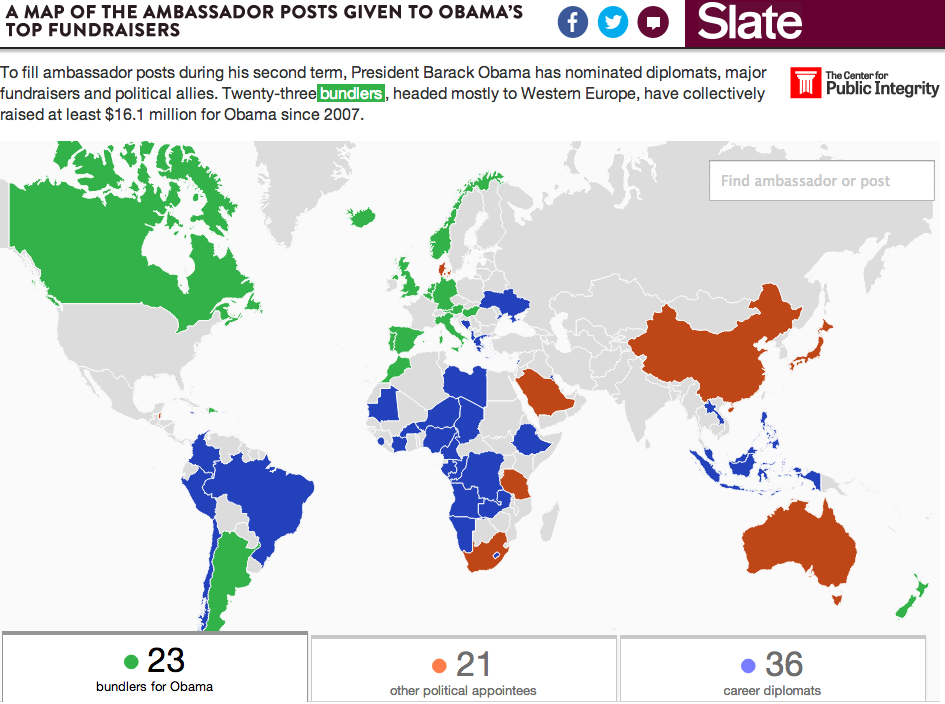
Ambassadorships For Sale

ambassadors-map

James Bruno laments that the US still hands out ambassadorial appointments as political prizes:

When hotel magnate George Tsunis, Obama’s nominee for Oslo, met with the Senate last month, he made clear that he didn’t know that Norway was a constitutional monarchy and wrongly stated that one of the ruling coalition political parties was a hate-spewing “fringe element.” Another of the president’s picks, Colleen Bell, who is headed to Budapest, could not answer questions about the United States’ strategic interests in Hungary. But could the president really expect that she’d be an expert on the region? Her previous gig was as a producer for the TV soap opera The Bold and the Beautiful. She stumbled through responses to Senator John McCain (R-Ariz.) like, well, a soap opera star, expounding on world peace. When the whole awkward exchange concluded, the senator grinned. “I have no more questions for this incredibly highly qualified group of nominees,” McCain said sarcastically. …

The reason a hotelier and a television producer, for instance, might be appealing choices is blindingly obvious: money. Bell raised $2,101,635 for President Obama’s re-election efforts. Tsunis, who flipped his affiliation from Republican to Democrat in 2009, embraced his new party with gusto, raising $988,550 for the president’s 2012 bid.

Henri J. Barkey takes Obama to task for what he calls “a disservice to diplomacy”:

The Obama administration’s appointments suggest that the president isn’t being honest when he says that diplomacy is important to him. Yet the administration clearly values diplomacy — officials, including the president, have emphasized that the ongoing negotiations with Iran are the way to resolve the nuclear impasse. Would Obama consider making Tsunis our negotiator? Of course not. Yet it’s illogical, and insulting, to presume that Norwegians are such wonderful and civilized people — and hence unlikely to cause any problems with Washington — that we can afford to send someone on a taxpayer-funded three-year junket to enjoy the fjords.

But Fisher, who passes along the above map from Slatesees a silver lining:

There may be an upshot to all this. Career diplomats are probably, in most circumstances, also going to be the best diplomats. They’re competing against campaign bundlers for assignments, though, and they seem to lose out for assignments like Belgium or Italy. Countries like Egypt and Russia are probably important enough that no administration would send a bundler there. But there’s a category of countries that are not Egypt-level difficult to demand a technocratic assignment, nor Portugal-level fun that a campaign bundler gets it.

You have to wonder if some number of really talented diplomats, who in a universe without campaign bundlers would get sent to Austria or Italy, are instead getting sent to countries like Malaysia or Peru. Countries they would otherwise be too experienced or talented to be sent to. And maybe, as a result, the United States has unusually good diplomatic representation in a lot of the blue countries in this map. That could maybe have helped a little bit in sub-Saharan Africa, where, as G. Pascal Zachary argued in The Atlantic, the United States has seen significant diplomatic gains.

Rand Paul vs The NSA

Rand Paul is suing the government over the NSA’s bulk data collection program, on behalf of every American with a phone:

The complaint charges Obama, as well as Director of National Intelligence James Clapper, National Security Agency Director Keith Alexander and FBI Director James Comey, with violating the Fourth Amendment to the U.S. Constitution by collecting and storing Americans’ phone data on a massive scale. … Joined by the conservative and libertarian non-profit FreedomWorks and former Attorney General of Virginia Ken Cuccinelli, Paul submitted the complaint to the U.S. District Court for the District of Columbia Wednesday morning.

Serwer explains the significance of a class action suit:

“A class action would be Rand Paul, not just suing on his own behalf, but on behalf all people, known and unknown, who are similarly situated,” said Stephen Vladeck, a law professor at American University. “Ostensibly, he could be suing on behalf of all Americans, or all Americans hypothetically affected by these court orders.”

By making his challenge to the NSA’s metadata program a class-action suit, Paul is reiterating his point that the metadata program amounts to a “general warrant,” or the government giving itself permission to search any person at any time without individual suspicion or evidence of a crime, in violation of Americans’ constitutional rights.

But Adi Robertson says the suit is “doomed” for that very reason:

Paul says he expects the case to quickly rise to the Supreme Court and that “the American people will win.” Unfortunately for the American people, he’s almost certainly wrong. So far, damages and injury from NSA data-gathering have been hard to establish even on an individual basis. Several groups have brought lawsuits against the administration by saying a particular individual organization or person has suffered because of surveillance. But even for Verizon customers, who have a leaked court order to back them up, there’s no definitive way to tell whether the NSA actually collected metadata from them, and the claim is too hypothetical for many judges. If Paul wants to go forward with the suit, he’ll need to calculate and prove similar damages for every single member of his class.

None of which, of course, have stopped Paul from trying to recruit 10 million people to “join the class action lawsuit” by sending their name, email address, and zip code. In theory, this shows that a large number of people have suffered similar harm and lets people opt into the suit, although nobody joining will be able to provide any information on whether they’ve been spied upon (and therefore qualify.) In practice, the charitable interpretation is that it’s essentially a petition of protest. The uncharitable interpretation is that it’s a fundraising and campaigning effort.

Allahpundit thinks it’s a smart political move:

Whether a Fourth Amendment suit will prevail depends on which judge they draw. Remember, within 12 days of each other in December, a federal district court judge appointed by Bush found the NSA’s data-mining program unconstitutional while another judge appointed by Clinton upheld it. Assuming both rulings are affirmed on appeal, it’s a cinch that this will end up in the Supreme Court. Paul’s shrewdly getting on board now, before it takes off, so that he’s in the middle of things as it moves up the legal food chain.

Massimo Calabresi, however, sees a big risk:

The risk for Paul is not so much the legal outcome as a potential change in the politics of the underlying issue. Where the law can be slow to develop and harden, political change can be rapid and unpredictable. Paul risks getting on the wrong side of an issue that is still playing out in the public mind. … For now, Paul’s play may work all the better for having mainstream Republican and Democratic opposition. But public opinion is fickle and it doesn’t take much to imagine a turn of events that could leave Paul exposed to charges he put politics ahead of national security.

Read the full complaint here.

Chart Of The Day

College Costs

Shaila Dewan passes along the latest from (pdf) Pew:

From 1965 to 2013, according to a new Pew report called “The Rising Cost of Not Going to College,” the typical high school graduate’s earnings fell more than 10 percent, after inflation.

“That is one of the great economic stories of our era, which you could define as income inequality,” said Paul Taylor, an author of the report. “The leading suspects are the digital economy and the globalization of labor markets. Both of them place a higher premium on the knowledge-based part of the work force and have the effect of drying up the opportunities for good middle-class jobs, particularly for those that don’t have an education.”

Even middle-class jobs that are still available increasingly require a college degree, either because they require more skill than they used to or because employers have become pickier.

Laurence Steinberg believes fixing high school is the best way to produce more college graduates:

The U.S. has one of the highest rates of college entry in the industrialized world. Yet it is tied for last in the rate of college completion.

More than one-third of U.S. students who enter a full-time, two-year college program drop out just after one year, as do about one fifth of students who enter a four-year college. In other words, getting our adolescents to go to college isn’t the issue. It’s getting them to graduate.

If this is what we hope to accomplish, we need to rethink high school in America. … If we want our teenagers to thrive, we need to help them develop the non-cognitive traits it takes to complete a college degree—traits like determination, self-control, and grit. This means classes that really challenge students to work hard—something that fewer than one in six high school students report experiencing, according to Diploma to Nowhere, a 2008 report published by Strong American Schools. Unfortunately, our high schools demand so little of students that these essential capacities aren’t nurtured. As a consequence, many high school graduates, even those who have acquired the necessary academic skills to pursue college coursework, lack the wherewithal to persevere in college. Making college more affordable will not fix this problem, though we should do that too.

Unfriending Facebook, Ctd

A reader can’t imagine leaving the site:

I am 27. My age is important because it tells you that pretty much everyone I know is on Facebook. All my friends, all my family (grandparents included). Every single person. I recently threw a party and realized that I had to send out annoyingly informal Facebook invitations because, other than by phone, I have no idea how to contact my friends. I’m sure they all have email addresses, but why would I know what they are? I haven’t emailed one of my friends in years. Email is for conversing with old people and writing to The Dish.

When my fiancé proposed, we were in Asia. We called parents to let them know and then changed our relationship status on Facebook. That was all we did. That is how all of our friends found out. That is how my uncles and aunts found out. I have one friend who quit Facebook and she was literally the last to find out several months later. I don’t want to be that out of the loop. A friend had a baby yesterday. Facebook let me know. It’s the society pages of our times. Quitting Facebook literally means quitting my friends’ lives. I just can’t do that and still have friends. I know all the research into how Facebook affects mood and outlook, but I would rather be a little unsatisfied with my life than have no idea what is happening in my friends’.

A few other readers are much less satisfied with the site:

I’ve been on Facebook for just over five years now and for most of that time I have dithered between staying on Facebook or closing my account. Why? I find myself more depressed since I got onto Facebook.

I attribute much of my depression to what I see on Facebook alone and I can’t help but use Facebook as a measure of my own life. Specifically, I hate seeing people I grew up with and worked with having seemingly better lives than me, according to what they post. I also get depressed by some of the same people I grew up with and worked with who are experiencing hard times and turn Facebook into their online pity party. Then there’s the high school friends who post something rather mundane who get many likes from many of my classmates while I get maybe two or three, which just demonstrates how you high school popularity (or lack of it) follows you for life. Another similar depressing fact: most of the handful of people who have defriended me were people I grew up with or went to high school. High school was 30 years ago!!

Another big reason for wanting to leave Facebook comes down to many of my Facebook friends who don’t exercise good editorial control: either don’t know when to keep their “Facebook mouths” shut, or don’t open their Facebook mouths at all.

I’m a news junkie and I find the Facebook newsfeed to be a good and valuable source of world, national, local, sports, art. political and other news, to the point that it has replaced the print newspaper. It is also a good source of news from friends, but only when they have something interesting to say and sadly, that occurs occasionally. More often, I get posts about my Facebook friends unsolicited political, religious and social views, constant memes on all those subjects, banal posts about the mundane things in their lives that interest only them. For those who don’t say anything at all, I wonder if something bad is going on in their lives and they stay off Facebook to avoid discussing it or to avoid lying about their circumstances by positing pictures of themselves as shiny, happy people.

I also find that you gotta close your account completely. I’ve tried deactivating for a couple weeks last year and that did not work.

Another called it quits:

I grew up with a mother who was a real life version of Hyacinth Bucket (“it’s pronounced Bouquet!”) from the BBC sitcom Keeping Up Appearances. Her life and the lives of her family were held up to relentless competitive comparison with the lives of neighbors, acquaintances and anyone else who came across her radar, always with the intent of reassuring herself that she was better than they were.

After some years of therapy connected, ostensibly, with other issues, I realized that the reason Facebook was so compulsive to me was because it allowed me to practice this delightful inherited behaviour all day long. It plays into some very unpleasant human social characteristics, foremost the temptation to evaluate one’s own worth based on a comparison with others: what they have, what they do, where they holiday, etc. It is a profoundly unspiritual experience.

I have no doubt that Facebook users are statistically less happy than non-users. I found that to use it for any length of time with any regularity was to risk being sucked into a very unpleasant world of comparison. And as anyone who’s attended AA will tell you, “Compare and despair!” It had to go. For the likes of me, it’s poison.

Marriage Equality Update

Nevada state officials have decided they can no longer defend the state’s same-sex marriage ban. Lyle Denniston explains what comes next:

The Nevada ban will get a continuing defense in the Ninth Circuit by the Coalition for the Protection of Marriage, the sponsors of the ballot measure against same-sex marriage.  Under a provision of federal rules for appeals, a case can continue to a decision even if the state involved drops out as a defender, leaving only a private party to support the state measure.

Meanwhile, another federal appeals court, the Tenth Circuit, based in Denver, has scheduled two hearings in April on the marriage controversy — on April 10, a hearing on the constitutionality of Utah’s same-sex marriage ban, and on April 17, a hearing on the constitutionality of Oklahoma’s similar ban.  In both of those cases, federal district court judges struck down the bans.

It is unclear at this point which of these cases, or some other case from another federal appeals court, would be the first to reach the Supreme Court.  But it now appears close to predictable that the Justices will be confronted with the underlying constitutional issue sometime later this year, in time for consideration at the next Term opening in October — if the Justices are ready then to take on the question.

In Praise Of The Hatchet Job

Maybe it’s because we have all become inured to “snark” that we’ve come to look down on brutal book reviews. And some are indeed irritating. There are few hatchet-jobs in TNR’s back-of-the-book that aren’t motivated by personal malice, bitter jealousy, or preening self-righteousness. But the classic hatchet-job – written by an arch, disinterested, yet vicious critic – is still a mercy. James Wood can still do this stateside, but it does seem a very English vocation. And as journalism slowly surrenders to public relations, and as criticism cedes to reader reviews, I’m glad that in Blighty, the Omnivore maintains its “Hatchet Job Of The Year” prize:

Camilla Long took the prize last year, for her write-up of Rachel Cusk’s memoir Aftermath, in which she dismissed Cusk as “a brittle little dominatrix and peerless narcissist who exploits her husband and her marriage with relish”, and who “describes her grief in expert, whinnying detail”. Adam Mars-Jones won the inaugural Hatchet for his review of Michael Cunningham’s By Nightfall, in the Observer. “The book’s pages are filled with thoughts about art, or (more ominously) Thoughts about Art,” wrote Mars-Jones.

But this year’s winner is an almost perfect match between reviewer and subject. It’s the brilliant A.A. Gill of the Sunday Times (where I write a weekly column on America) and Morrissey, whose pendulous autobiography was just published with a bulls-eye already attached – it was part of the Penguin Classics collection, up there with Aristotle and Jane Austen. Well, take it away, AA:

Morrissey’s most pooterishly embarrassing piece of intellectual social climbing is having this autobiography published by Penguin Classics. Not Modern Classics, you understand, where the authors can still do book signings, but the classic Classics, where they’re dead and some of them only have one name. Molière, Machiavelli, Morrissey. He has made up for being alive by having a photograph of himself pretending to be dead on the cover.

And the denouement:

There are many pop autobiographies that shouldn’t be written. Some to protect the unwary reader, and some to protect the author. In Morrissey’s case, he has managed both. This is a book that cries out like one of his maudlin ditties to be edited. But were an editor to start, there would be no stopping. It is a heavy tome, utterly devoid of insight, warmth, wisdom or likeability. It is a potential firelighter of vanity, self-pity and logorrhoeic dullness. Putting it in Penguin Classics doesn’t diminish Aristotle or Homer or Tolstoy; it just roundly mocks Morrissey, and this is a humiliation constructed by the self-regard of its victim.

With some cupcake icing added for effect by your humble reviewer.

The News According To Twitter And Facebook

Felix Salmon declares that the two social media companies “have become the new indispensable [news] bundles — and in doing so have changed the nature of what news is”:

The new dominance of social media in the news business is not depressing at all: it’s excellent news. Just as most news consumers were never avid enough to seek out blogs, most Americans were never avid enough to seek out news at all. They didn’t buy newspapers; they didn’t watch the nightly news on TV; it just wasn’t something which interested them.

But now the news comes at them directly, from their friends, which means that the total news audience has grown massively, even just within the relatively stagnant US population.

Globally, of course, it’s growing faster still — the ubiquitous smartphone is a worldwide phenomenon.We’re at an excitingly early stage in working out how to best produce and provide news in a social world. There are lots of business models that might work; there are also editorial models that look like they work until they don’t. But if you look at the news business as a whole, rather than at individual companies, it’s almost impossible not to be incredibly optimistic. Media used to be carved up along geographic grounds, because of the physical limitations of distributing newspapers or broadcasting TV signals. Now, there are thousands of communities and interest groups that gather together on Twitter and Facebook and share news with each other, which means there are thousands of new ways to build an audience…

One journalist recently told me that it has changed more in the past eight months than it changed in the previous five years, and I think he’s right about that.

Gorby agrees that the audience for news is growing rapidly and believes that this is “a fantastic business opportunity.” But Derek Thompson examines research on what is actually being shared on Facebook. It mostly isn’t news:

Independent studies of virality conducted out of Wharton, the National Science Foundation, and the University of South Australia have all reached the same conclusion. The stories and videos most likely to be shared, emailed, and posted on Facebook aren’t necessarily the newest stories, but they are the most evocative. The most famous of these studies, by University of Pennsylvania professors Jonah Berger and Katherine Milkman, concluded that online stories producing “high-arousal emotions” were more viral, whether those emotions were positive (e.g.: happiness and awe) or negative (e.g.: anger or anxiety).

The News Feed is perhaps the world’s most sophisticated mirror of its readers’ preferences—and it’s fairly clear that news isn’t one of them. We simply prefer stories that fulfill the very purpose of Facebook’s machine-learning algorithm, to show us a reflection of the person we’d like to be, to make us feel, to make us smile, and, most simply, to remind us of ourselves.

Yes, but that just suggests that the entire model of “news” – in which nothing that isn’t new should be part of journalism – is archaic. There is nothing new today that cannot be better understood without reference to yesterday. And now that we have an entire universe of content to use, mashup, recreate, re-tell and re-purpose, our task is to provide something actually new: a conversation about the world that brings past, present and future into a platform that engages our hearts as well as our minds. It’s what we find ourselves doing at the Dish every day. And it is empowered by the passion and loyalty of the Dish community, but also, increasingly, by Facebook and Twitter – as our readers reach out to new readers and they reach back to us.

Dissents Of The Day

Tizian_014

A reader writes:

Although I usually thoroughly enjoy the challenges to my assumptions you often enunciate in your postings, I was dismayed to see you write in your post “Christianists on the Left?” that tired old argument:

[T]here is no disputing Jesus’ teachings about the poor. But Jesus had no teachings about government‘s relationship to the poor, no collective admonitions for a better polity.

Jesus had no need to address our odd dichotomy between personal and collective responsibility. He knew his Isaiah well; indeed, one might say that his teaching and life was living commentary on Isaiah, and it is with Isaiah that he began his preaching in Luke 4. And in Isaiah 58, the command to do works of justice is a collective command, addressed not just to individuals, but to the nation of Israel. What Jesus calls one to do, he calls the community to do, just as Isaiah did. Need we go into the Pauline doctrine of the Christian community as body of Christ?

So let’s stop this nonsense that Christianity is only about one’s individual acts. It is about a community living in a way that is totally incomprehensible to “the world”. Now, you can argue that such a community is of necessity different from and not to be confused with any secular polity, but a community it is, and as a community it must take responsibility to follow the commands given in Isaiah 58, and by Jesus himself.

Another:

I’m a North Carolina teacher, and I’ve participated in one of the Moral Monday marches. I carried a sign with Isaiah 10:1-2 (“Woe to those who make unjust laws, to those who issue oppressive decrees, to deprive the poor of their rights and withhold justice from the oppressed of my people, making widows their prey and robbing the fatherless”). I’m a pretty big proponent of separation of church and state, but I don’t really see how Moral Monday is participating in Christianism.

I stand in agreement with Marcus Borg that the separation of church and state is not the separation of religion and politics – that all of our policy decisions are rooted in morality. Jimmy Carter was right when he said that one of the biggest mistakes the Democratic party made was ceding Christians to the right. All of this is to say that, for 30 years or more, the Republican party has been claiming as its divine duty the enacting of certain policies that are quite contrary to the Bible – or at least part of it.

I view the Moral Monday movement as a fine prophetic “Deuteronomic” counterpoint to the “Levitical” emphasis on sexuality that seems to be the primary hangup of the most vocal “Christianists” (see Walter Brueggemann for more on the Deuteronomy/Leviticus divide). The Bible has both interpretive strains, and it’s about time some other people with a religious sense of justice speak up. Martin Luther King, Jr. and other civil rights leaders certainly used the exhortations of scripture to move the nation toward the type of just society described in Isaiah, Deuteronomy, and Jeremiah.

And please, Dreher, et. al., don’t resort to an Ad Hominem Tu Quoque when people speak up for justice. If those in the state house in Raleigh claim to be enacting Christian principles, stop ignoring the part of our tradition exhorting us to systemic justice.

Another reframes the debate somewhat:

I’ve been a believer most of my life and a recovering fundamentalist for nearly half of it. That said, I’ve wondered if the “rend to Caesar” passage still applies in our day and age. Rome was a dictatorship; we’re a democracy. The people make the laws in our society, not a corrupt despot. I realize that Jesus only advocates for individual behavior, but maybe this changes the rules a bit? Perhaps the admonition to care for our neighbor can apply to the government because it is believers who (theoretically) make up that government. Rendering unto Caesar means rendering unto ourselves.

(Painting: a detail from Titian’s “The Tribute Money” when Jesus responds to a coin with Caesar’s head on it.)

The Final Debt Ceiling Battle?

Chait believes the “clean” vote in the House yesterday marks the end of an era:

We have probably seen the last, final gasp of debt ceiling extortion. In 2011, Republicans used the threat of default to pry unrequited spending cuts from Obama. Then Obama wised up and refused to pay any more ransoms. Republicans tried to go through the drama twice more — last winter, when they settled for “making” Senate Democrats pass a budget, which they planned to do anyway. And then last fall, when they combined their debt ceiling hostage demands with a government shutdown. This time, Republicans tried halfheartedly to attach the debt limit to some kind of popular change Democrats wanted, but didn’t even bother threatening not to lift the debt ceiling if they failed.

Now we can go back to regular gridlock.

Allahpundit’s not so sure:

Is this the end of Republican debt-ceiling brinksmanship, once and for all? In theory, the leadership might feel bolder next year after the midterms have passed; in practice, there’s simply no reason to believe that Boehner or McConnell will ever allow Treasury to hit the ceiling. They’ll always swallow hard and let Democrats pass a clean debt-limit hike instead. Better to abandon this method of negotiation than keep farking that chicken with phony standoffs whose outcome is a fait accompli.

Greg Sargent credits the Democrats for avoiding another crisis:

The crucial point about this outcome . . . is that it will be the direct result of the decision by Dems — in the last two debt limit fights — to refuse to negotiate with Republicans.

That was a major course correction on Obama’s part in which he learned in office from failure. After getting badly burned in the 2011 debt limit showdown — which left us saddled with the austerity that continues to hold back the recovery — Obama recognized what many of his supporters were pleading with him for years to recognize: There was no way to enter into a conventional negotiation with House Republicans.

Ed O’Keefe counts the “no” votes:

There were several notable Republican “no” votes, including the fourth-ranking Republican, Conference Chairman Cathy McMorris Rodgers (R-Wash.), House Budget Committee Chairman Paul Ryan (R-Wis.), Rep. Lynn Jenkins (R-Kan.), a leadership lieutenant, and Rep. Tom Cole (R-Okla.), a close Boehner ally. Rep. Tom Latham (R-Iowa), another retiring member and close friend of Boehner, was absent Tuesday and didn’t vote.

Democrats, meanwhile, demonstrated incredible unity. Just two members — Reps. John Barrow (D-Ga.) and Jim Matheson (D-Utah) voted no. Initially, Rep. Mike McIntyre (D-N.C.), a moderate who is retiring, also voted no, but eventually switched his vote. Barrow faces the most difficult reelection race of any Democrat this year, while Matheson is also retiring but expected to someday seek statewide office.

Benen wonders why the House Republicans picked this fight “knowing in advance failure was inevitable”:

Not to put too fine a point on this, but it’s generally the job of the Speaker of the House to steer clear of legislative icebergs. Boehner has a responsibility to see the challenges ahead and lead his chamber towards a responsible course. If he had the influence and leadership skills generally associated with House Speakers, Boehner never would have allowed this misguided hostage gambit to begin in the first place.

But the Speaker allowed it to unfold anyway, and both he and his party ended up with nothing to show for it except another round of public humiliation.

But, as Weigel recalls, Boehner never wanted this fight:

Really, he didn’t—though he saw it coming. At the end of 2010, as it became clear that Republicans would run the House of Representatives, people started to wonder whether the new members would agree to raise the debt limit. Boehner, in a December 2010 interview with The New Yorker, acknowledged that they’d have to. “For people who’ve never been in politics it’s going to be one of those growing moments,” he said. “It’s going to be difficult, I’m certainly well aware of that. But we’ll have to find a way to help educate members and help people understand the serious problem that would exist if we didn’t do it.”

The Tea Party PACs are already demanding the speaker’s head:

“A clean debt ceiling is a complete capitulation on the Speaker’s part and demonstrates that he has lost the ability to lead the House of Representatives, let alone his own party. Speaker Boehner has failed in his duty to represent the people and as a result, it is time for him to go… Fire the Speaker,” said Tea Party Patriots co-founder Jenny Beth Martin in a statement before the vote. The statement linked to a petition to “Fire the Speaker,” and the group’s Twitter account has been tweeting since the vote asking people to call Boehner and tell him to “resign.”

For Bernstein, this episode illustrates how little power the Tea Partiers have in the legislature:

The truth is that the Tea Party votes in the House have never been relevant to any must-pass legislation. After all, the real radical position is to oppose raising the debt limit regardless of what’s attached, and in the long run the radicals were never going to vote for whatever final deal emerged, even if it gave them some of what they wanted. See, for example, the Budget Control Act in 2011, which failed to win the votes of 66 Tea Party-leaning House Republicans.

The lesson of the shutdown for both moderates and mainstream conservatives in the House (and something they should have realized before the shutdown) was that many of them eventually were going to have to split from the radicals because, at the end of the day, something would have to pass, and they (along with Senate Democrats and President Barack Obama) would have to go along with it.

Kilgore thinks this chain of events reflects poorly on Boehner:

Boehner’s many defenders in the MSM will probably say he went through this doomed exercise in order to teach his troops a lesson, and/or to give conservatives every opportunity to come up with a workable debt limit formula. But when a party leader can’t be sure of getting 10% of his conference to back him on critical legislation, the “lesson” would seem to be that the leader just ain’t leading any more.

Chris Cillizza sums it up:

This, as has become clear over the past year or so, is Boehner’s fate as Speaker: To lead a group of Republicans who do not want to be led.