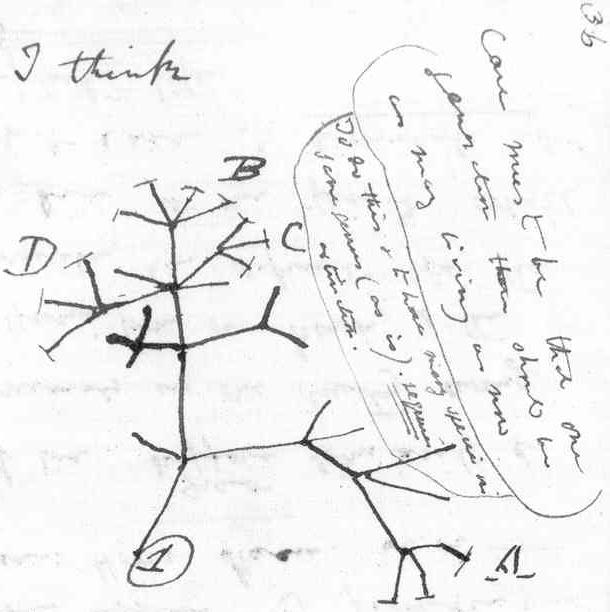
Happy Darwin Day!

Darwins_first_tree

Today is the famed naturalist’s 205th birthday, and Ian Chant is ready to celebrate:

[Darwin Day] is a day to be thankful for innovative thinkers, brave scientists of all stripes, and yes, evolution in general, because frankly, we take our opposable thumbs for granted 364 days of the year, and respect should be paid. If you’re looking for something to do in your neck of the woods to celebrate among like-minded lovers of evolution, the International Darwin Day Foundation has a guide to events at colleges, libraries and museums around the world that will be celebrating the life and work of Charles Darwin in the coming days.

Science-lovers around the world are hosting lectures, discussions, and exotic entertainments such as “phylum feasts” (dinners with a variety of species represented on the menu) in honor of the man. But perhaps the best way to pay tribute is with sober skepticism, like this professor of evolutionary ecology:

I’d be disappointed if this celebration of all things Darwinian began and ended with the great naturalist, because I think a focus on the person tends to undersell the science … The beauty of an idea like natural selection is that it is true, whether or not you choose to believe it. It is true, even if nobody has yet had the idea or written it down. If Darwin hadn’t done so, Alfred Russell Wallace’s version might have swayed the Victorians. Or perhaps a version discovered some 50 years later.

Humanity owes a great debt to Darwin, and the history of science followed the course that it did because of him. But he isn’t the reason for the season; science does not need deities and messiahs. Darwin was merely the guy who figured it all out first.

And what I admire about Darwin is not just his evident human-ness, nor his openness to new ideas, nor his magnificent beard, but his equally skeptical view of religion, which some of his contemporary followers would do well to note:

It seems to me absurd to doubt that a man may be an ardent Theist & an evolutionist.— You are right about Kingsley. Asa Gray, the eminent botanist, is another case in point— What my own views may be is a question of no consequence to any one except myself.— But as you ask, I may state that my judgment often fluctuates. Moreover whether a man deserves to be called a theist depends on the definition of the term: which is much too large a subject for a note. In my most extreme fluctuations I have never been an atheist in the sense of denying the existence of a God.— I think that generally (& more and more so as I grow older) but not always, that an agnostic would be the most correct description of my state of mind.

(Illustration: part of a page from Darwin’s notebooks around July 1837 showing his first sketch of an evolutionary tree.)

What’s The Best Way To Get Clean?

Maia Szalavitz profiles Dr. Lance Dodes, who considers the primacy of 12-step programs like Alcoholics Anonymous an impediment to more scientifically supported methods of addiction recovery:

Dodes shows that much of the research that undergirds AA is a conflicted mess that confuses correlation with causation. It’s true that people with alcoholism who choose to attend AA regularly drink less than those who do not—but it’s not proven that making people attend works better than other options, including doing nothing.

In fact, some studies find that people mandated into AA do worse than those who are simply left alone. … Contrary to popular belief, most people recover from their addictions without any treatment—professional or self-help—regardless of whether the drug involved is alcohol, crack, methamphetamine, heroin, or cigarettes. One of the largest studies of recovery ever conducted found that, of those who had qualified for a diagnosis of alcoholism in the past year, only 25 percent still met the criteria for the disorder a year later. Despite this 75 percent recovery rate, only a quarter had gotten any type of help, including AA, and as many were now drinking in a low-risk manner as were abstinent.

Last week, Dish readers offered impassioned defenses of the AA/NA approach. Another reader, who got sober without a 12-step program, pushes back:

Your reader’s contention that AA “works 100 percent of the time for people who are 100-percent committed to the program, while they maintain that level of commitment” is utter and total horseshit. AA’s effectiveness in promoting sobriety is hotly debated, but it’s far, far less than 100 percent, and blaming addicts for the failures of AA and related programs is delusional and cruel. Maybe all those dead friends and acquaintances should tip the reader that AA may not be a wonderfully successful treatment, as is often claimed.

I don’t believe that a full-blown addiction currently be “cured” in most instances, but it is certainly treatable. And that treatment needs to be personalized. Access to qualified medical professionals in developing a treatment plan is a necessity for most addicts. If AA meeting attendance provides some value or is appealing to the patient, then fine, but using a church basement full of old drunks as the first line of treatment in 2014 is just an appallingly bad idea. There is wisdom to be gained in the AA rooms but addicts have too many interrelated issues for a group of strangers to fully address.

I have just over ten months of complete sobriety, and my life is seriously better because I’m clean. It didn’t happen because I “bottomed out” or had some spiritual awakening. It happened because three years ago I owned the fuck up to my disease and started to address it as such. I didn’t get a good draw in this round of the genetic lottery but there are people who drew far worse maladies than “ethanol turns me into an asshole.”

Another:

From my experience, you would have a hard time convincing me AA helps anyone. My housemate was mandated to go to AA after getting a DUI. He says he was told at AA meetings that smoking and eating sugary foods would help him control his alcohol cravings. He now starts every day with two cigarettes, coffee and a pop tart. He smokes a pack of cigarettes a day (I saw all the empty cartons when I took out the recycling last week), and eats candy, ice cream and other sweets for breakfast, lunch and dinner, and snacks in between. He would often come back from meetings with package of cinnamon rolls or some other sugary sweet that a fellow AA attendee encouraged him to try. Our panty is now full of pop tarts, candy, cookies and other sweets, and our freezer has five cartons of ice cream in it. He has easily put on 30 pounds in the last year. I fail to see how hanging out and learning of people with bad lifestyles and bad personal habits is going to help anyone. Surely there must be a better way.

Update from an earlier emailer:

Well, since you’ve published my letter and one of your other readers has decided to attack me for it, I feel it’s only fair to respond. Clearly, this individual isn’t reading what I wrote: “AA works 100 percent of the time for people who are 100 percent committed to the program, while they maintain that level of commitment.” Someone who relapses is, by definition, committed to getting drunk over getting sober. It’s not delusional and cruel to point that out; it’s an empirical fact. If I go out and drink right now, it’s because I chose to abandon the program that lifts the desire to drink from me – but only lifts it conditionally, as I work the program and as I focus myself on spiritual recovery, and stops working when I stop doing those things. I’d retort that what’s delusional and cruel is to tell someone whom that program is keeping alive that they don’t need it anymore, especially if their use of the program isn’t adversely affecting you in the slightest.

I’m an alcoholic. I’m not supposed to be sober. I’m supposed to be drunk. Science and my own proclivities indicate I should be drunk right now. But when I go into a church basement and talk with a bunch of other drunks, a miracle happens – a miracle that science has never explained in any study I’ve read. The desire to drink is lifted from me.

Sociological studies of AA’s effectiveness have nothing to do with the fact that it works 100 percent of the time for people who work it 100 percent of the time. I don’t understand why your reader has so much difficulty understanding that, although given the eyeball-popping, vituperous rage of his or her response, I suspect an underlying bitterness toward recovery programs. No one is forcing AA on anyone (except for courts). If your reader found an easier, softer way, good for them. Me, I’d be dead doing it their way. So why do they begrudge me my success?

Recent Dish on AA and its alternatives here and here.

Why Does Marijuana Give You The Munchies?

Victoria Turk highlights the latest research:

new study published in Nature Neuroscience offers an answer: THC, marijuana’s active ingredient, acts on certain receptors in the brain related to your sense of smell. It essentially makes you smell food more, which increases your appetite, and leads you to eat more. That’s what seems to happen in fasted mice, at least.

Joseph Stromberg’s takeaway:

THC—and, by consequence, marijuana—does much of its work by manipulating the same pathways that the brain uses to normally regulate the senses. But perhaps most interesting is that the new study hints at a compelling metaphor for the way THC manipulates this natural system:

it mimics sensations felt when we’re deprived of food. As a final test, the researchers forced some mice to fast for 24 hours, and found that this drove up levels of natural cannabinoids in the olfactory lobe. Not surprisingly, these starved mice showed greater scent sensitivity and ate much more too.

Most intriguing, the genetically engineered mice with olfactory lobes that lacked cannabinoid receptors did not show increased scent sensitivity or appetite even when they were starved. This indicates that both THC and the natural cannabinoids that result from starvation are acting on the same neural pathway to allow us to smell and taste with greater sensitivity, and thus eat more. In other words, THC appears to give us the munchies by convincing our brains that we’re starving.

This discovery could have applications in medicine:

If the findings hold true in humans, they could yield novel approaches to treating eating disorders, by manipulating the link between smell and appetite in our brains. New obesity treatments could be possible, by interfering with cannabinoid signaling to reduce people’s hunger drive. (The drug company Sanofi-Aventis introduced just such a cannabinoid-blocking drug for obese patients in 2006, according to New Scientist, but it was withdrawn because it sometimes produced severe anxiety and depression.) Conversely, a drug could enhance cannabinoid signaling for people who suffer from appetite loss, such as cancer patients.

Digital Stakeouts Are Dirt Cheap

In the United States v. Jones “five Supreme Court justices held that a man’s reasonable expectation of privacy was breached after police tracked his movements on public roads for 28 days using a GPS device.” The case has spurred research on surveillance more broadly:

Using the Jones ruling as a baseline, [Kevin] Bankston and [Ashkan] Soltani calculated and compared the costs of different location tracking methods used by police. Traditional surveillance methods like covert foot and car pursuits cost $250 and $275, respectively, per hour per target, according to their estimates. Another common method, which the Supreme Court has approved, involves two agents tracking a suspect’s movements from their police vehicle through a radio-based transmitter affixed to a target’s car or slipped in his bag at a cost of $105 to $113 per hour.

Newer surveillance technologies were significantly cheaper, they found.

The total price tag of tracking a suspect using a GPS device, similar to the one in Jones, for instance, came out to $10 an hour over one day, $1.43 per hour over a week and $0.36 per hour over a month. Another relatively new technique, obtaining a suspect’s location through his or her cellphone signal with the carrier’s assistance, yielded similar results. As of August 2009, fees for obtaining cellphone location data from carriers ranged from $0.04 to $4.17 per hour for one month of surveillance. After tabulating their results, Bankston and Soltani concluded that the total cost of using a GPS device to track a suspect over 28 days (the method rejected in Jones) was roughly 300 times less expensive than the same tracking using a transmitter (technology approved by the Supreme Court) and 775 times less expensive than using the five-car pursuit method (also approved). Meanwhile, the cost of using transmitter-surveillance technology was only 2.5 times less expensive than undercover car pursuit.

Getting Customers To Do The IRS’s Job

Charles Kenny wants “to enlist American citizens to help audit some of the most consistent tax cheats: retail businesses”:

In the State of Sao Paulo in Brazil, customers who ask for a receipt can give their social security number to the cashier. Businesses have to submit their copy of those receipts—with or without social security numbers—to the tax authority. The authority creates an account for every social security number entered into the system and reports to customers which receipts have been entered with their social security number and how much they are for. Customers receive a rebate worth about 30 percent of their share of sales taxes paid through the business each month, and for every $50 of receipts they are entered into a lottery with a maximum payout of $500,000. They can complain online if they think receipts are missing or have the wrong price.

Joana Naritomi, a Harvard economist, studied the impact of the Sao Paulo experiment, which has been running since 2007. She found 13 million consumers enrolled in the receipts database at the end of 2011. The system registered more than 1 million complaints involving about 13 percent of the 1 million retail and wholesale establishments in the region. Most important, Naritomi finds that the program increased the reported revenues of retail firms by 22 percent over four years. She shows that reported revenues went up not because real revenues increased, but because reporting became more honest. The result was an additional $2 billion in tax payments. The system paid out $1.6 billion in rewards to consumers over that time, translating into a $400 million increase in net income for the region.

A Year After Benedict

His Holiness Pope Benedict XVI Pays A State Visit To The UK - Day 2

Today’s the anniversary of Benedict XVI’s resignation announcement. I will down a Jager in honor of the occasion, even though we still don’t fully know why he did what he did. Mathew Schmalz credits the pope emeritus with paving the way for his successor’s humility:

It’s easy to see how Pope Francis’s simplicity stands in stark contrast and how this would be a welcome change for some. And Francis has emphasized different themes — the church is more of a community and less of a hierarchical institution; Jesus is less of a priest and more of an itinerant preacher close to the poor.

But Benedict XVI did one thing that allowed everything new that we’ve seen from Pope Francis: he resigned the papacy. Benedict believed the papacy, “the Petrine ministry,” was important, but that he himself was dispensable: when the time came, Benedict had no problem letting go. As he promised, Benedict XVI has remained quiet and out of public view. Benedict’s acts of humility, more than anything else, have given Francis the opportunity to be pope in a new kind of way.

But Marcus O’Donnell points out that Francis still has Benedict’s decades of reactionary appointments to overcome:

The main factor mitigating against change in the church is that nearly all its current Bishops were appointed during the reigns of John Paul II and Benedict XVI, who, between them, had 35 years to install like-minded conservative leaders throughout the church. Virtually no progressive leaders from the Vatican II reform generation remain. While there are still small pockets of progressive resistance it has been hard to sustain against an active Vatican campaign to stamp out dissent.

And Dennis Coday reminds readers of the chaotic state in which he left the church:

Remember what we, in the U.S. Catholic church, had been through: an “apostolic visitation” of congregations of American women religious; a doctrinal investigation of the Leadership Conference of Women Religious and the appointment of overlords to help them “reform.” Maryknoll Fr. Roy Bourgeois had been excommunicated because he supported women’s ordination. Long established and trusted scholars, Mercy Sr. Margaret Farley and St. Joseph Sr. Elizabeth Johnson, had been censured. The chairman of the U.S. bishops’ National Review Board for child protection had warned the bishops that complacency threatened the continuing implementation of their policies and guidelines meant to keep children safe. The U.S. bishops seemed to be doing their best to scuttle health care reform over — of all things — artificial contraception; their campaign for religious freedom seemed petty and partisan. A clunky, ideologically driven translation of the Mass prayers had been thrust upon us.

In an interview with Reuters, Archbishop Georg Gänswein says Benedict’s conscience is clear:

Pope Benedict is at peace with himself  and I think he is even at peace with the Lord. He is well but certainly he is a person who carries the weight of his years. So, he is a man who is physically old but his spirit is very vivacious and very clear. … I am certain, indeed convinced, that history will offer a judgment that will be different than what one often read in the last years of his pontificate because the sources are clear and clarity springs from them.

Rocco Palmo reports on what Benedict has been up to in the past year:

Since stepping away, the now Pope-emeritus has broadly held to his plan for his retirement to be spent “hidden from the world.” From his base in the former Mater Ecclesiae convent in the Vatican Gardens, Benedict – who’ll be 87 in April – is said to spend his days with the books he once called his “old friends,” still engaged in theological study, though he’s not expected to write again. A midday walk in the Vatican Gardens is often followed by time at the piano. Company does come, but the invitations tend to be limited to a relatively tight circle of longtime allies, who can be sufficiently trusted to not leak what he says.

The mail is another story, however. A lengthy letter Benedict wrote an atheist author last November was published in La Repubblica with his consent, and in yesterday’s edition of the leftist daily, it emerged that Ratzinger had resumed correspondence with Hans Kung, his colleague-turned-rival of half a century, who he famously hosted for dinner months after his election.

(Photo: By Stefan Wermuth/WPA Pool/Getty Images)

Clinton’s Achilles Heels, Ctd

Masket doubts that Hillary’s thin record will prevent her from winning the White House:

As Barack Obama demonstrated, a lack of legislative accomplishments will prevent you neither from becoming president nor from accruing impressive legislative accomplishments once you’re there. And voters don’t really care much about rationale, probably aware that every presidential candidate’s true rationale is, “I’d like to be president and I think I’d do a pretty good job.” These are mainly issues that political journalists stew over, and not without cause! Writing about the same person in the same way for a quarter century is extremely tedious, particularly when that person is sitting on a large lead and her strategy is to say as few risky things as possible.

But voters, we know from a long line of research (PDF), don’t really focus on these things when deciding on their next president.

Their main concerns are the status of the economy, the presence or absence of war, and the perceived moderation of the candidates. If the economy is growing reasonably well in 2016, if we are not engaged in a massive bloody war, and if Clinton is not perceived as excessively ideological (relative to her Republican opponent), she’ll have a very good shot of winning the general election. A recession that year would likely doom her or any other Democratic presidential candidate.

Nevertheless, PM Carpenter is dreading the Clinton campaign:

The other day someone chastised me on this site for being ignorantly unenthused by another Clinton candidacy, since the alternative could only be–egads–a Republican president. On that point, I’m in full accord with the chastiser. Anyone is preferable to a Huckabee or a Paul or God forbid another Bush. To my mind, that goes without saying. But I guess, duly criticized, I should be saying that a lot, as we proceed to the presidential sweepstakes: Hillary is better than the ghastly alternatives.

That’s quite the rallying cry.

Heh.

Christianists On The Left?

After attending the massive Moral Mondays protest in Raleigh this weekend, Dahlia Lithwick considers the role of the faithful in the liberal coalition:

Progressives are not used to so much religion in their politics. I met someone who planned to avoid Saturday’s protest because of the God talk, and it’s clear that for many liberals, it’s easier to speak openly about one’s relationship with a sexual partner than a relationship with God or spirituality. But there are a lot of liberals who live on the seam between faith and politics. And one of the core messages of Moral Mondays is that ceding all talk of faith and morality to the political right in this country has been disastrous for the left. …

As discomfiting as it may be to hear the Bible quoted alongside the Federalist Papers, the truth remains that for most people of most faiths, kicking the poorest and most vulnerable citizens when they are down is sinful. Stealing food and medical care from the weakest Americans is ethically corrupt. And the decades long political wisdom that only Republicans get to define sin and morality is not just tactically wrong for Democrats. It’s also just wrong. This is a lesson progressives are slowly learning from nuns and the new pope. When we talk of cutting food stamps or gutting education for our poorest citizens, we shouldn’t just call it greed. We should call it what it is: a sin.

The question begging here is about that “we”. And it’s not as simple as Dahlia would have it. As Christians, it seems to me, our faith may inform our politics, but not dictate its contents or permit us to use theological claims in civil debate. So, for example, there is no disputing Jesus’ teachings about the poor. But Jesus had no teachings about government‘s relationship to the poor, no collective admonitions for a better polity. On the countless occasions he was asked about such issues, he was remarkably consistent: do not confuse Caesar with your own soul.

Now Catholic social teaching may look at a society and see grotesque inequalities and injustices, but it does not have a pre-made, uniform prescription for them.

What the Church can and must do is draw our attention to, say, soaring inequality or long-term unemployment or resilient poverty and challenge us to see if these evils can be prevented or ameliorated. What it should not do, it seems to me, is grant any political movement – let alone a political party – to represent in policy or political terms what our actual response should be. For that we need civil debate over political and policy ends – and Christians may well take different prudential positions in that debate and draw different conclusions.

It seems to me you can resist the politicization of religion by the right without committing the same category error on the left. In fact, it seems to me vital for the restoration of a living Christianity that it not be drawn into these political struggles. But if you do want to conflate Christianity with leftist politics, as Rod Dreher notes, you may come to regret it:

OK, fine. I don’t have a problem with using that kind of rhetoric in principle. But if you’re going to go that route, you lose your right to complain about religion interfering in politics.

No more griping about how conservative Christians are trying to impose their morality on the rest of us. That’s exactly what the progressive religious leaders in North Carolina are trying to do. And more power to them, sort of. I mean, I don’t know much about what’s going on in NC, and chances are I oppose most of what the Moral Mondays coalition is after. But I think they are doing the right thing in bringing their religious convictions to the public square to influence the political debate.

But let the Left be on notice: if you endorse this kind of thing, don’t ever open your mouth to complain about conservatives doing it. You can’t complain about the Religious Right bringing their faith to the public square when you don’t like their politics, and praise the Religious Left for doing the same thing when it suits your goals.

Switzerland Tightens Its Borders

On Sunday, Swiss voters narrowly approved a referendum to place a cap on immigration. What this means for its relationship with the European Union:

Switzerland is not an E.U. member, but it has a bilateral agreement on free movement with E.U. countries. European citizens can freely move and work in Switzerland, as can Swiss citizens in the E.U. The immigration cap is clearly incompatible with this agreement, and as all the agreements between the E.U. and Switzerland are tied together by a so-called “guillotine clause”, the E.U. could potentially revoke all of them, including crucial agreements on banking and taxation.

The vote’s outcome has severe economic consequences for the Swiss economy even aside from its relationship with the E.U. Switzerland is has one of the highest share of immigrants relative to all E.U. countries: 23 percent of the population does not have Swiss citizenship, and 63 percent of these residents come from E.U. or European Economic Area countries. Immigration from E.U. countries, particularly from Germany and Portugal, has played a large role in sustaining domestic demand in recent years.

Walter Russell Mead calls the vote irrational but understandable:

No other country benefits economically as handsomely from its migrant population as Switzerland does, but it would be misleading to try to view the vote in overly rational terms.

It is better understood as a primal scream rather than a calculated policy. The Swiss voted with their guts, not with their heads, and in so doing they followed a deeper instinct felt by many of their European peers. As German Finance Minister Wolfgang Schäuble perceptively commented on the outcome of the referendum: “Of course it shows that in this globalized world, people are increasingly uneasy about unrestricted movement. I think that’s something we must all take very seriously.”

Ryan Avent thinks it may have something to do with Switzerland’s expanding welfare state:

I’m more interested in, and perhaps worried by, the (possible) interaction of the Swiss immigration vote with a fledgling movement within Switzerland for a universal basic income.

The basic income plan is anything but a sure thing, and residence does not equal citizenship. But at a time at which economic conditions—like stagnant wages, falling employment rates, and declining labour share of income—make extension of the safety net look reasonable, a large foreign-born population may come to look like an obstacle to such extensions: either because making the safety net available to migrants is socially and financially impractical or because the idea of a second class of poor migrants is unappealing.

Cowen wonders if there is an upper limit to immigration levels:

In my view immigration has gone well for Switzerland, both economically and culturally, and I am sorry to see this happen, even apart from the fact that it may cause a crisis in their relations with the European Union.  That said, you can take 27% as a kind of benchmark for the limits of immigration in most or all of today’s wealthy countries.  I believe that as you approach a number in that range, you get a backlash.

Bryan Caplan draws the opposite conclusion:

Swiss anti-immigration voting was highest in the places with the least immigrants!  This is no fluke.  In the U.S., anti-immigration sentiment is highest in the states with the least immigration – even if you assume that 100% of immigrants are pro-immigration. The natural inference to draw, then, is the opposite of Tyler’s: The main hurdle to further immigration is insufficient immigration. If countries could just get over the hump of status quo bias, anti-immigration attitudes would become as socially unacceptable as domestic racism.

A big question is whether the referendum will embolden opponents of open borders elsewhere in Europe:

Other governments, including Norway, have suggested removing themselves from the Schengen Area, and there’s been widespread opposition to allowing recent EU members Bulgaria and Romanian to join.  EU leaders reportedly discussed scrapping Schengen and reimposing border controls in the event of Greece deciding to exit the eurozone—which for the time being appears to be a remote possibility.

The depth of anti-immigrant sentiment in Switzerland is a bit puzzling, given that with a quarter of its residents being foreign-born, it has the lowest unemployment rate in Europe at 4 percent and its economy is among the strongest. If a law like this can pass there, it seems like the dominoes could fall pretty fast for the rest of the continent and the days of passport-free borders might be numbered.

Another Obamacare Tweak

Yesterday the Obama administration announced that the employer mandate – the requirement that larger employers provide health insurance to all their full-time staff or pay a penalty – will be delayed for another year for companies with 50-99 employees. Cohn ponders what motivated the decision:

What’s the primary rationale? It’s impossible to say. The official explanation is the same as before—the move will give companies a little extra time and flexibility, easing the transition to the newly reformed health care system. That makes perfect sense. On the other hand, administration officials might also have other goals in mind. For example, they might be anxious about employers taking certain actions—like limiting the hours of workers, in order to avoid giving those workers health insurance. Administration economists have said they don’t see evidence this is happening on a large scale and the Congressional Budget Office just last week came to the exact same conclusion. But anecdotes of such decisions have been all over the media. (Jed Graham of Investor’s Business Daily has been tracking them.) Whether or not the problem is real, it might appear real.

Kate Pickert points out that the employer mandate “is not considered a central tenet of the law’s plan to expand health coverage”:

The vast majority of large employers already offer insurance and the mandate was mostly meant to shore up this system into the future. Still, every time more employers are exempted from the mandate for another year, the cost of the reform law increases. Before the mandate was originally delayed, budget experts had predicted the requirement would generate some $10 billion in revenue in 2014, in part, from penalties paid by employers opting not to provider insurance to workers. In addition, some workers who may have received health insurance through work in 2014 and 2015 will now instead be eligible for federal subsidies to buy coverage independently through the the law’s state-based insurance exchanges.

Kliff looks at Massachusetts’s example:

Massachusetts’ universal coverage law has an employer mandate–and, since it passed seven years ago, employer-sponsored coverage has been pretty much stagnant. Delays to the employer mandate can matter politically. But as for what they mean for who Obamacare covers, this delay will likely amount to a relatively small, if non-existent, change.

Avik Roy says “we should simply repeal the employer mandate”:

It’s a huge drag on hiring, because the mandate increases the cost of hiring someone (because on top of wages, you now have to pay for his costly, government-approved insurance plan). The House of Representatives has already proposed a bill to repeal the provision, and it would be quite easy for the Senate to do so as well.

But the Obama administration doesn’t want to do things the old-fashioned way, by actually passing a law through Congress. The President fears that by opening the Affordable Care Act to legislative changes, many more aspects of the law could get repealed or changed by Congress. So, instead he simply chooses to ignore the law. It’s up to the public to hold him accountable.

The way the administration is going about making these changes also bothers Philip Klein:

If Obama believes the employer mandate is a bad idea that needs to be repealed or severely changed, he should propose permanent changes rather than erratic piecemeal fixes. But for Obama, it isn’t acceptable for opponents of the health care law to seek changes through the constitutional legislative process. That’s sabotage. The only way to make changes to Obamacare is for him to do so unilaterally, no matter what the text of the law actually says.

Bob Laszewski argues that the piecemeal approach affects the law’s functionality:

No one has been more critical of the various requirements in Obamacare that I have. But to make an insurance system work you have to have a set of consistent and consistently applied rules. You can’t have some people choosing to be out today and in tomorrow. You can’t have a system where insurers price products based upon one set of conditions and then you keep backing off on the conditions consumers and employers have to follow.

Yuval Levin sees this as an outrageously expansive interpretation of executive powers:

We have here a written statute that levies a fine on large employers who fail to provide insurance coverage as a benefit to their employees. It defines a large employer as “an employer who employed an average of at least 50 full-time employees on business days during the preceding calendar year,” provides a relatively detailed set of criteria for applying that definition, and states that the provision “shall apply to months beginning after December 31, 2013.” We have already seen that latter date pushed back by a year without obvious legal authority, and now we see it pushed back by another year for some affected employers while the requirement is loosened for others. If this kind of selective enforcement of a public law is legitimate, then how exactly would the president describe the limits of his ability to engage in such selection? Is he bound in some definable way to the particulars of statutes as written and passed by Congress, or does he merely take them as suggestions for how he might proceed?

Gobry warns Obama’s supporters that if they are OK with this type of executive legislation now, they’ll have no standing to cry foul when a Republican president does it:

What’s striking here is that liberals have gone along with these moves from the White House. And it makes intuitive sense: they have so much invested in Obamacare’s success that, just like the Administration, they’re pretty much willing to do anything to get the law to work, no matter how far-fetched or, well, illegal.

The problem with this is that, of course, if it becomes accepted American Constitutional tradition that the President can apply whatever laws she wants, well, that tradition applies to Republicans as well as Democrats.