Why A Gay NFL Player Matters

This chart from Derek Thompson helps explain why Michael Sam coming out is so significant:

NFL Audience

Marc Tracy wonders who will draft Sam:

If you are an optimist … you believe that the 32 NFL franchises will be making their decision on Sam the same way they would any other player: analyzing his merits (his college play, his “measurables” at the upcoming combine, what their research says about his character) and then deciding how good a “system fit” he is for their rosters and defensive schemes. “I think that sports, at its best and purest, acts as a meritocracy,” NFL historian Michael MacCambridge emailed me Sunday night. “And what we’re seeing is simply another chapter in the realization that if someone can help you win, it doesn’t matter if that person is black or white… and ultimately, it won’t matter if the person is straight or gay.” …

“Much is made about football’s macho culture,” MacCambridge argued, “but you also have to remember that virtually every player in the NFL spent at least three years on a college campus, with the accompanying socialization and exposure to different lifestyles.” He added, “That heterogeneous college experience tends to supply people with lessons about diversity and tolerance, whether they’re conscious of it or not.”

Earlier thoughts from readers here. Nancy Goldstein tries to understand the squeamishness of NFL executives:

So what’s up with the tut-tutting from the NFL’s front office? It may be that the big difference between their panic and the NCAA College Football’s maturity is money—particularly the big money that corporate sponsors and advertisers bring to the NFL and don’t bring to the NCAA. When an anonymous official in Sports Illustrated says, “the league isn’t ready for this,” it’s likely code for “We’re afraid that having an openly gay player on board means that ticket sales will drop, or male viewers will be turned off, or that Bud Light and Marriott and Pepsi and GMC won’t want to pay top dollar to advertise with us.” In short, members of the NFL’s front office may be afraid that Sam will compromise their brand.

Lt. Col. Robert Bateman dismisses such concerns:

Really? Seriously? It has now been years — not weeks, not months, years — since gay men and lesbian women have openly laid down their lives for our nation in combat. And you, Mr. NFL executive who does not even have the slightest whiff of moral courage to even use your name, say that America is not ready for gay NFL players? Really? You think that the nation is cool with gay men dying in combat, in service to our nation, in desperate distant places, but you don’t think the country is cool with them playing in your game?

Are you on crack?

Kavitha Davidson joins the conversation:

As we saw with Branch Rickey and Jackie Robinson and baseball’s integration, management might be reluctant to progress, but eventually somebody will stop spitting in its face to open up a new pool of talent. Sam doesn’t need to be a Hall of Famer; he just needs to attract the eye of a team in need of a solid tackler and to work on translating his game from college to the pros. In the past decades, the conversation around homosexual athletes has shifted from whether gays can play sports in the first place to the slightly more palatable question of whether gays can be accepted in sports. Sam and his predecessors have already addressed the former — he just needs management to give him a chance to prove that the latter is no longer an issue.

Scott Shackford’s bottom line:

[A]ll eyes are on Sam because this is the final doorway in America for cultural acceptance. It marks the end of certain silly ideas about how masculinity informs sexuality that have had lasting impacts on the psyches of straights and gays alike for decades. It’s a huge deal, though the impact may not be fully grasped except in retrospect years from now.

Earlier Dish on Sam here and here.

Catholics, Contraceptives, And Their Church

A Univision poll (pdf) of 12,000 Catholics in 12 countries found that big majorities reject the logic of Humanae Vitae:

Screen Shot 2014-02-11 at 12.31.13 PM

The contraceptive question stands out to me. On other issues, there is a more equal division in the pews, or more support for the hierarchy’s position (two-thirds oppose civil marriage equality, for example), or huge differences between the developing and the developed world. But on contraception, massive majorities in Europe and Latin America and the US oppose the Vatican’s position.

And in some ways, contraception is the core issue, as Pope Paul VI recognized in his unilateral rejection of his own commission’s recommendation on the subject. If sex can be licit without procreation, the arguments shift tectonically on a whole host of other matters. Such a change would open the question of sex as purely expressive of love rather than instrumental for procreation, of whether gay sex can be licit, of pre-marital sex, of a whole universe of possibilities – and areas for moral thinking. That’s why Paul VI shut the debate down prematurely – he saw the potential consequences.

But he didn’t succeed and the hierarchy has ever since abjectly failed to make the case for its thirteenth century version of natural law. At some point, the church will have to stop preaching this or give up credibility in the Americas and Europe in favor of Africa and the Philippines, or remain resigned to promoting a core set of morals simply ignored by the vast majority of its members.

I think they should stop preaching this and begin thinking seriously about a new sexual ethic that is actually informed by science and by the experience of countless millions of lives. It’s also striking to me that the question of married priests – which Pope Benedict XVI dismissed as inconceivable (except when it meant snagging a few reactionary Anglicans) – so evenly divides the faithful.

It’s pretty close to 50-50. Unlike contraception, it requires no deeper shift in doctrine – and could well do more to revive the church in the West than any other single reform. It’s the lowest-hanging fruit for Francis to pluck, if he has a mind to. But check out the question of women priests as well. I would have expected a solid majority against, but in fact, the church is evenly divided on that as well: 45 – 51.

As for abortion, I agree with Morrissey, who thinks the top-line numbers are misleading:

[T]he striking figure here is the low number of Catholics who think abortion should be unrestricted. If, as the question suggests, abortion was restricted to only issues of the mother’s health and rape and incest, there may be considerable support for having just those limited options available as compared to the abortion-on-demand environment which currently dominates the US. Only 10% of American Catholics, and 20% of those in Europe, favor abortion on demand.

The questions of human sexuality are rightly deemed less grave than the termination of human life.

The View From Your Window Contest: Winner #191

vfyw_2-8

A reader describes the scene:

High-rise condos, barren trees, snow everywhere, a run-down brick building with graffiti on it. It could be any of the North Jersey bedroom communities across the Hudson from New York. I’m going with Fort Lee because it’s been in the news so much recently.

The window is themed on a recent news story, but not Bridge-gate. Another reader:

West Berlin, Germany. The graffiti: (“stark” = strong, mighty). Neighborhood: Lubensdorf. 9th floor, Rechenberger apartments …

Game of Thrones fan weighs in:

WINTERFELL, SEVEN KINGDOMS. Graffiti (“Stark”) gives it away, obviously.

Based on the relatively low number of entries this week, this reader wasn’t alone:

Oh my lord. How can anyone win this contest?? And then you have those damn tree branches covering that sign on top of the building!

Another:

That logo at the right looks soooo familiar, but my darned middle-aged memory won’t help identify it. So let’s call this the untouristed Basel, outside the center but near the Rhine.

Another:

The Bronx, no thonx. Although I know it intimately, I have never seen that sign on the right nor that hi-rise cantilevered structure in four parts. But to a native, it’s the first thought that comes to mind – and it seems impossible that it can be anywhere else on Earth.

Another:

Obviously, the key to this one is figuring out the logo obscured by the trees off to the right. Turns out, a LOT of companies have logos with stylized “P”s (or is that a rho?). Probably North America, far enough north for snow (so not Florida) and in a city with a lot of recent-vintage construction. The crisp blandness of the highrises screams Belltown, Seattle, to me, though I cannot pin down the exact location. Most likely because I’m wrong. But after all those P logos I just can’t bring myself to slog through Google images of “boring high rise condo buildings”.

Another gets the right country:

Well, I’m making a guess that’s a 180 from my original thoughts. At first glance it looks like my neighborhood on Chicago’s north side; the snow cover is just about right but the buildings are not 5familiar, and what is that logo on the building to the right? Perhaps another North American city, in Canada perhaps?

But I finally identified the logo using Google search: it’s from Rostelecom, the Russian long-distance service. It would be too predictable for it to be Sochi (it probably doesn’t have snow anyway) so I’ll go with a nice Baltic town like St Petersburg. But then where are the Soviet era buildings and why the American style grafitti? Still looks a lot like Chicago.

Another is more definitive about Russia:

Moscow. I’m not watching the Sochi Olympics but I’m sure anyone who is has seen that Cyrillic letter P everywhere. It an interpretation of an ear and belongs to Rostelecom, Russia’s leading long-distance phone company. I have scoured the web for images of the buildings in the distance in Russia with no luck.

Another nails the correct city:

For several months I’ve just given up without trying (there wouldn’t be enough to go on in a given view to justify the head banging that would accompany the futile search), but this week’s view offered a couple of clues that tempted me back in:

Rostov-na-Don

A quartet of distinctive glass skyscrapers together with a sign, obscured by a tree but just legible enough to indicate it was probably Cyrillic. Thus probably Russia, but probably not Sochi, because it’s not your style to be so obvious. Anyway, a quick couple of Google image searches for similar building in Russia bore fruit: about 360 miles north of Sochi in the port city of Rostov-na-Don.

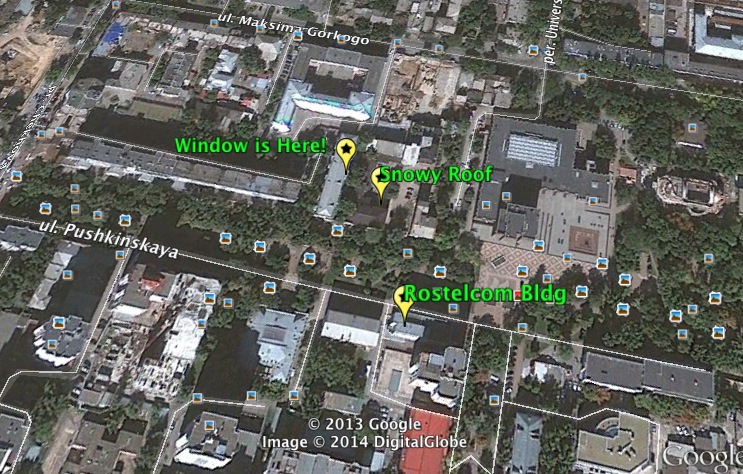
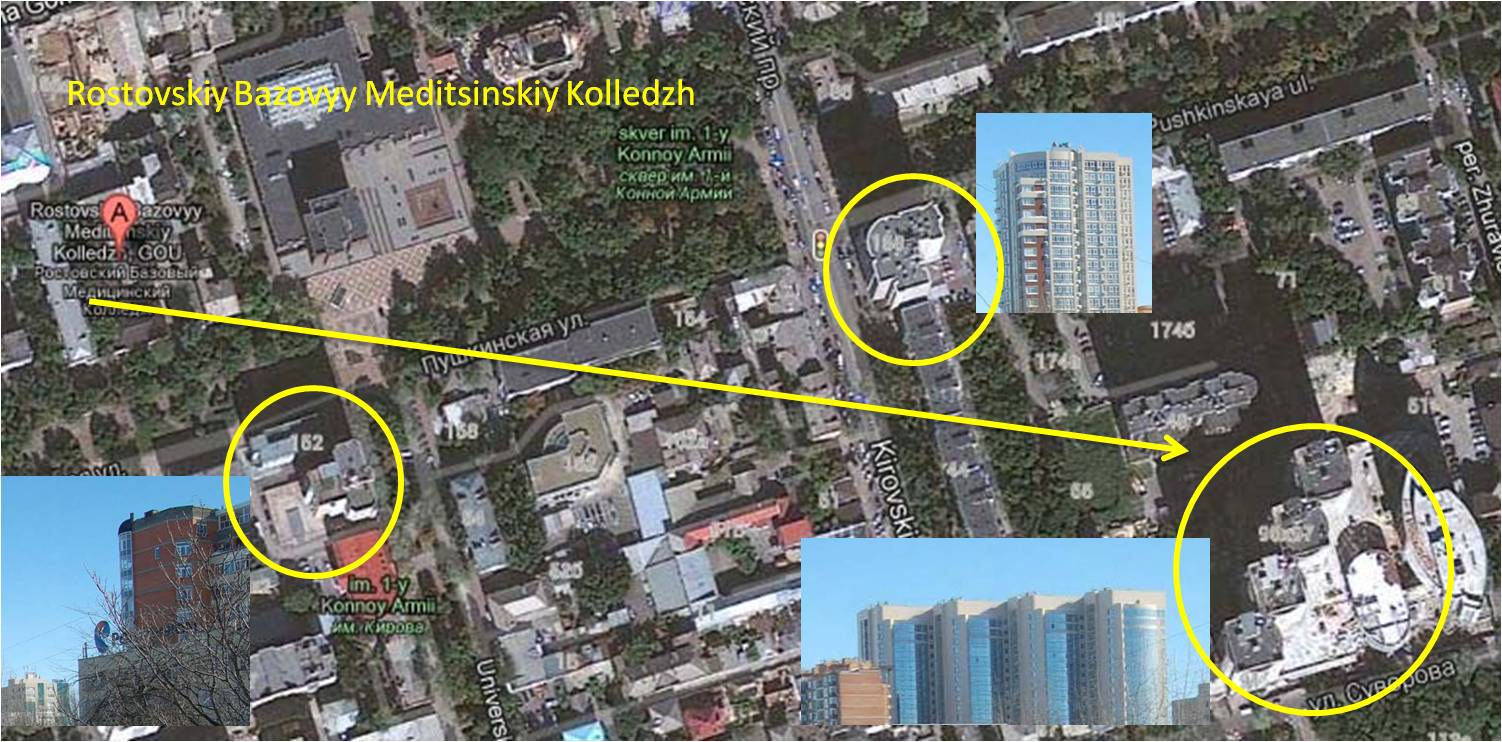
I then spent a pleasant hour or so touring the locale and nailing down the quasi-exact address, which is on Pushkinskaya (maybe 173b or nextdoor), seemingly on the campus of Ростовский базовый медицинский колледж (Rostov Medical College). It’s just southwest of the public library (the brick monolith to the left in the view), across Pushkinskaya from Rostelecom (the building with the blue sign to the right), and about a block and a half northwest of the Rostov City Towers (the glass buildings in the background). Thankfully, having won once already on contest #143, I don’t feel the need to drill any deeper to get this specific window. But it was fun to be back in the game.

Another imagines an Olympics tie-in:

I am guessing the person who sent this in was a ski jumper, injured in his warm-ups for the Sochi games and airlifted to Rostov-na-Donau for treatment. Specifically: Rostovskiy Bazovyy Meditsinskiy Kolledzh. Rostov-na-Donu, Pushkinskaya ul., 173b:
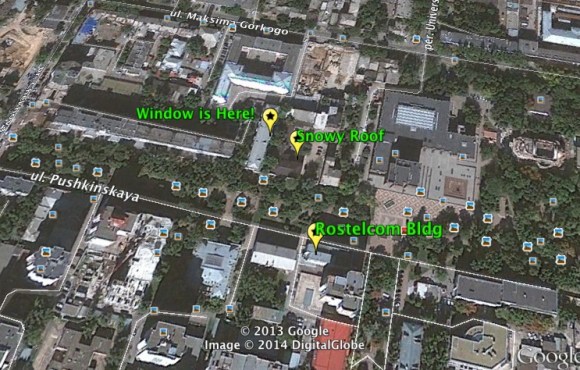
VFYW-Rostov-on-Don

I’m going to go with the fourth floor. I could not find a picture of the clinic, and it probably only has three floors.

Another Rostov-na-Don entry:

I wanted to tell you that since winning my very own VFYW book a couple years ago (back when the competition wasn’t quite as fierce), I’ve taken to posting the weekly contest photo on my Facebook wall to let my friends have a go at it. There is a small but determined group of us who tackle the contest each week, and I announce the winner, same as you, only among a smaller pool of brilliant people. One of my friends won your contest about two months ago.

Another regular player was stumped until turning on the TV:

I ignored my family all day Saturday with little to show for it, ultimately narrowing it down to Canada, England, China, Philadelphia, Belgium, Bosnia and Herzegovina, Poland, or Austria. Maybe the Netherlands or South Korea, or Japan. The vast majority of companies I could find that ended in ‘-kom’ were in Eastern European countries. Then, watching the Olympics and considering how Sochi is spelled in Russian: Cyrillic alphabet. I found Rostelecom. Maniacal laugh: Rostov-on-Don, Russia. I’m going to guess the picture was taken from this window:
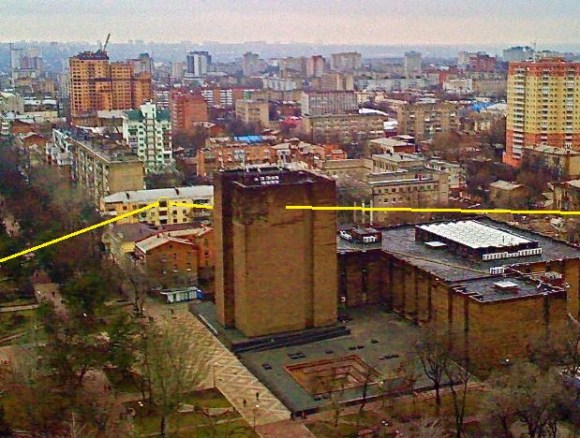
Rostov_lib_view

The smaller yellow building in front of it is part of a medical school, the website listing it as at 173-б (letter between A and B in the Russian alphabet). Google Maps includes the pic site as part of the college.

So after all this, Russia during the Sochi Olympics, huh?

Another hears our own maniacal laugh:

So I was expecting an easy one this week after a tough one last week. But no. You had to be especially evil and pick a view not from the obvious Sochi, but from a city just 250 miles away. The view this week comes from Rostov-on-Don, Russia, specifically the Rostov Medical College.

P_logoI identified the country fairly fast by figuring out what the sign above the building across the street said. I couldn’t read it through the trees other than P______KOM, but the logo was distinctive enough. Making a mock-up of the logo (attached), a Google image search identified it as belonging to Rostelecom, a Russian phone company. While they have offices outside of Russia, the sign was clearly written in Cyrillic, so I knew the country then.

I expected identifying the city would be easy. and I figured all I had to do was find the correct Rostelecom office building. Sochi was my first guess, but no, that wasn’t it. It wasn’t Moscow, Saint Petersburg or a dozen other major cities either. So then I had to turn to other clues in the picture.

The next big clue was the graffiti on the brick building in the foreground. It clearly says STARK, which I don’t think is Russian. It is the German word for strong though. This led me to research cities in Russia with large German populations (thanks to Wikipedia), but I still couldn’t find the right one.

Looking at a map then, I noticed Volgograd (one of the German cities) was fairly close to Sochi, so this put me on the “Andrew is being evil” track. Looking at nearby cities, I checked out Rostov-on-Don and bingo, that’s where the Rostelecom building was. Identifying other landmarks in the view was easy after that. Across the street from Rostelecom is the Medical School. All the street views are obscured by trees, but the satellite view makes it clear where the window is. The view is just south of due east and I’m guessing it’s on the 4th floor:

vfyw_140208-1

Another gets the exact address:

Unfortunately, Street View does not provide enough information for me to certify its exact address. It looks like the yellow brick building is #173 Pushkin St. (a medical college). But the building behind it, #171, frustratingly lacks description on Google Maps. However, a search of the Cyrillic address “171 пушкинская улица Ростов-на-дону” brings up a host of residential advertisements for this location. This website says that this building has 5 floors and 40 apartments. So, I’ll guess 3rd floor. No idea about apartment number, though.

The winner this week is the only Correct Guesser (of a previous difficult contest) to guess the right floor:

Cold in the winter (snow), hot in the summer (window air conditioners).  The P sign didn’t look like the Latin alphabet, and guessing it could be Cyrillic in a nod to the Olympic Games in Russia, I Googled and found a list of companies in Russia on Wikipedia, which led to Rostelecom.  Googling Rostelecom’s regional branch office locations, I picked the southeast one in Rostov, which is close-ish to Sochi (a guess, as a nod to the Olympics, but also the southeast area would be a place with cold winters and hot summers).

The Google Map for Rostelecom in Rostov led me to the right place, confirmed the tall building and group of four in the background, but the limited Street View and abundance of trees made it difficult to narrow down the correct window where the photo was taken.  The little dormer windows on the roof next door leads me to guess 171 Pushkinskaya St, Rosotov, Russia.  Northeast side of the building.

Which floor?  Well, the Rostelecom building is 7 stories high, and the view is not as high up as that (the view doesn’t rise over tree height and the building isn’t seen over the treetops in Google Street View), but it’s higher than the 2+ story building next door with the dormers.  The gray building directly ahead has 6 floors, and the view looks to be at eye level with the fourth floor.  I’m going to guess 4th floor, third window back.

Two hours later she amended her guess:

Oh wait! I just found a photo on Panoramio of the building next door, showing a sliver of the likely window.  The building has shorter stories, so I’d like to amend my guess to a window on the 5th (top) floor.  I also think it could be the first window back from the street.

From the photo submitter:

The address the picture was taken from is 171 Pushkinskaia ulitsa. The apartment number is 20. The apartment is on the fifth (top) floor. The latitude and longitude are 47 13 36 north, 39 43 24 E.

(Archive)

The Question Rubio Won’t Answer

This embed is invalid


He’s from the younger Latino generation but belongs to a party whose center of gravity is with the white elderly. Maybe that explains it. But let’s deconstruct his answer to the question: “Have you ever smoked pot?”:

“I’ll tell you why I never answer that question. If I tell you that I haven’t, you won’t believe me.”

‘Tis true. But if you told us you had, we’d believe you. And that is simply a function of the rank dishonesty in this debate. So why not challenge that dishonesty, simply tell the truth, grapple with the details of the argument, pro and con, and take a position informed by your own life and experience? That’s what elected representatives are supposed to do. So why are you refusing to do your job?

“And if I tell you that I did, then kids will look up to me and say, ‘well, I can smoke marijuana because look how he made it.’”

Well, duh. So – again – why the avoidance of the truth? Because you prefer propaganda to truth? Because your own life would illuminate one aspect of the debate? So for fuck’s sake, tell us if you did or didn’t. It’s not that hard. No one will be offended either way – and at least people will give you points for candor. After all, politicians have been asked that question regularly since Bill Clinton.

The last three presidents all smoked weed before they became president. And the truth is: smoking marijuana does not ruin the lives of the vast majority of those who smoke it. If you know that to be true (and it’s undeniable), why are you still dodging the question?

“I know I’m sounding like a 42-year-old dad, but here’s the problem. You can make mistakes at 17 that will be with you the rest of your life, OK? … People won’t get hired because of that stuff.”

But the only reason people don’t get hired is because of the Prohibition we’re discussing. So this is completely circular. As is completely obvious.

The one thing that has struck me most forcefully these past few months as the marijuana debate has finally really gone mainstream is how desperately unprepared the politicians are to grapple with it, and how transparently weak the arguments of the Prohibitionists are. Rubio just confirms what we already knew. He refuses to answer relevant questions about his own life, refuses to take a stand even on a clear ballot initiative in his home state, and reverts almost instinctively to a circular argument when forced into the open. He has essentially abdicated being an elected representative because his political interests – pandering to the white elderly – require him to sustain any number of untruths. I’m sorry, but I don’t have sympathy for him. Just contempt.

Rand Paul Dusts Off The Blue Dress

David Corn covers Paul’s fixation on Bill Clinton’s indiscretions:

On Meet the Press at the end of January, Paul accused Clinton of engaging in “predatory behavior” and taking “advantage of a girl that was 20 years old.” (Lewinsky was 22 years old, when she and Clinton hooked up.) And Paul griped, “the media seems to have given President Clinton a pass on this.” (Paul must have slept through much of the 1990s, for the media granted nonstop coverage to the affair and the subsequent investigation and impeachment.)

These were not random remarks; it seemed Paul was waging a one-man campaign to revive an old scandal. Afterward, he told New York Times columnist Maureen Dowd, “In my small town…we would in some ways socially shun somebody that had an inappropriate affair with someone’s daughter or with a babysitter or something like that.” Days later, Paul, during a C-SPAN interview, said that any Democrat who raised campaign money with Bill Clinton ought to return the donations because of Clinton’s dalliance with Lewinsky. In another interview, he called Clinton—who is scheduled to campaign later this month for Alison Lundergan Grimes, the Kentucky Democrat challenging GOP Senator Mitch McConnell—a repeat “sexual predator” and suggested that Hillary Clinton should return any campaign money gathered with Bill’s help.

Beinart’s take on what Rand is thinking:

Paul isn’t speaking to most Americans—he’s speaking to the Christian right.

Paul is presumably well aware that while economic conservatives loved his father, social conservatives did not. In the Iowa caucuses, for instance, Ron Paul won 28 percent among voters who said the deficit was their primary issue but only seven percent among those who said it was abortion.

For months now, Rand Paul has been trying to make inroads where his father did not. Last June, at a conference organized by former Christian Coalition Executive Director Ralph Reed, he put a new twist on his skepticism about foreign aid, arguing that America is funding Islamic regimes that oppress Christians. “There is a war on Christianity,” he insisted, “and your government, or more correctly, you, the taxpayer, are funding it.” Last October, he told students at the Jerry Falwell-founded Liberty University that “America is in a full-blown spiritual crisis.” And last week, he told the anti-abortion, anti-gay marriage American Principles Project that “‘Libertarian’ … doesn’t mean ‘libertine’ … I don’t see libertarianism as, you can do whatever you want. There is a role for government, there’s a role for family, there’s a role for marriage, there’s a role for the protection of life.”

Paul’s effort to revive Lewinsky-gate is best seen as part of this effort.

The Story Of Stax

Aaron Gilbreath reviews Robert Gordon’s Respect Yourself: Stax Records and the Soul Explosion, which offers insights into a groundbreaking Memphis studio:

[The book’s] absorbing scenes show the way original music gets made. Here, it’s often accidentally: musicians goofing around in the studio, tinkering with riffs they’d written or combinations of notes they find themselves drawn to. In this quiet way, Respect Yourself portrays the enigmatic workings of creativity — and the role of common, unplanned events — as with the way the chorus to Sam and Dave’s breakout hit “Hold On, I’m Comin’” resulted when Dave was sitting on the toilet, and Isaac Hayes kept telling him to hurry up and get back downstairs to the studio. The way Otis Redding came to Stax’s attention while working as a chauffeur for a visiting guitarist, and kept asking people at the session to let him sing. And how Rufus Thomas casually recorded his big hit “Walking the Dog” during a quick studio visit on the fly between church and Sunday dinner. Gordon wisely contrasts Stax’s loose “organic” approach with Motown’s assembly line, automaker approach. As Isaac Hayes put it, “Stax was down-to-earth, raw, very honest music.”

Reviewing the book in December, Elsa Dixler highlighted (NYT) what made Stax stand out from other labels:

As early as 1962, some of the qualities that made Stax unusual were apparent. The most important was the absence of racism in a Memphis that was still completely segregated. “Being treated like an equal human being . . . was really a phenomenon,” Al Bell, who later became the executive vice president of Stax, recalled. “The spirit that came from Jim and his sister Estelle Axton allowed all of us, black and white, to . . . come into the doors of Stax, where you had freedom, you had harmony, you had people working together.” An obvious symbol of that harmony was Booker T. and the MG’s, consisting of two black musicians and two white. Gordon makes clear how extraordinary this atmosphere was by following the stories of the effort to unionize Memphis’s mistreated sanitation workers and of the white flight that followed the city’s slow compliance with Brown v. Board of Education.

The Failure Rate In France

Claire Lundberg explores the ups and downs of the country’s state-subsidized university system. Among the downs:

[A]t France’s open-enrollment public universities, the dropout and failure rate after the first year is close to 50 percent. The most competitive majors, such as law and medicine, cull their student lists with more brutal testing. Future French doctors must pass a government-regulated subject test after their first year of college—a test for which the initial failure rate is 90 percent. Many students take the entire year a second time, but even these redoublants have an 80 percent failure rate. (The French minister of education is trying to implement reforms that redirect the weakest students into other professions after their first semester.)

People who want to be doctors or lawyers often retake the first year several times, in hopes of passage—each time, costing the government more money.

The Ministry of Education would like to limit the number of times these tests can be taken. In a way, this makes sense—the government is paying to train the doctors, they want to make the decisions about who will and won’t progress in the profession. But of course, there are other skills that go into being a doctor besides the ability to pass a government exam. The French system works beautifully if you’re extremely focused from a very early age, work well under pressure, and are great at taking tests. It works less well if you’re not sure at age 16 exactly what you might want to do with your life, or if your family members and peers aren’t already familiar with the system.

Tracing Jewish Surnames, Ctd

Dara Horn pours cold water on Bennett Muraskin’s theories about Jewish surnames:

[T]he immense attention paid to this article reveals the degree to which many American Jews are still fascinated to learn where they came from. Unfortunately, it also reveals how the members of a group so highly educated in other respects know so little about their own history that they will swallow any “fact” from the Jewish past that comes flitting across their screens. …

“Lieb means lion in Yiddish,” we are told. Actually, leyb means lion in Yiddish (with the vowel sound ey as in “hey”), while lib (the word that sounds like the German word lieb) is a verb form for “love”—as it is in German; this error requires an ignorance of two languages. We are told that Berliner means “husband of Berl,” despite the fact that Berl is a man’s name in Yiddish and Berliner is more recognizably derived from Berlin. We are told that Lieberman means “loverman”; it is actually a term of formal address, as in “dear sir.” We learn that Mendel is derived from Emanuel, when a rudimentary knowledge of Yiddish makes it clear that it is a diminutive of Menahem. There are more like this, but I needn’t bore you.

Agalmatophobia At Wellesley

Sculpture Exhibit At Wellesley College Causes A Stir

A hyper-realistic statue of a sleepwalking man in his underwear on display at Wellesley College has students demanding its removal, saying it serves as a trigger for victims of sexual assault:

Although the artwork would not likely be legally considered indecent, let alone obscene, student Zoe Magid is less interested in talking about it and more interested in removing it. She believes that, “while it may appear humorous, or thought provoking to some,” such qualities are invalidated by others’ readings of it. Magid asserts that the inanimate object is “a source of apprehension, fear, and triggering thoughts regarding sexual assault for some members of our campus community.” So, she started a petition demanding the university stick Sleepwalker inside the museum, away from the public eye. 722 people, about one-third the school’s student population, have signed.

Charlotte Atler urges the Wellesley women to chill:

There’s something spoiled about our knee-jerk reaction to abolish anything that could be considered even remotely insensitive. The message is, “it’s possible that someone somewhere might feel momentarily bad because of this, so get rid of it right this second! And by the way, you’re an asshole if you don’t agree.”

Marcotte offers a qualified defense of the over-the-top reaction:

I’m sure this story is on its way to a conservative media outlet near you, where some white, privileged man in tighty-whities will roll his eyes about the hysterical feminists, which, in this case, well—good call. Still, one thing I’ve been trying to keep in mind is that the women getting wound up about the statue are really young and just starting to explore the identity of “feminist.” College is a time for taking everything too far, from drinking beer to sports fandom to sexual drama to using your fancy new vocabulary words picked up in women’s studies courses. Which doesn’t mean that one should refrain from having a laugh over this, of course. Let’s hope Fred Armisen and Carrie Brownstein are taking careful notes for the next season of Portlandia.

Update from a reader:

Interesting post. While I sincerely sympathize with anyone who may consider this statue upsetting as a trigger from sexual assault, my first reaction to it was completely different. When I look at it, I see a confused, elderly man suffering from dementia or Alzheimer’s. My father has Alzheimer’s, and is increasingly confused and sometimes wanders off. Our family fears he may wander off and get lost someday, and who knows, it could be in the middle of his night, when he’s in his underwear. Just another way to view it …

(Photo: An onlooker views a sculpture entitled ‘Sleepwalker’ on the campus of Wellesley College on February 6, 2014 in Wellesley, Massachusetts. The sculpture is part of an exhibit by artist Tony Matelli at the college’s Davis Museum. By Darren McCollester/Getty Images)

Is Boehner Backpedaling On Immigration Reform? Ctd

Chuck Schumer has a simple solution to Republicans’ professed concern that Obama can’t be trusted to enforce a new immigration reform law:

Appearing on “Meet the Press” Sunday, Schumer, the Democratic senator from New York, floated a new proposal designed to win Republican support for an immigration bill—a proposal designed specifically to address concerns that Boehner raised last week, when the Speaker esssentially declared that efforts to pass reform were at an impasse. At a press conference, Boehner indicated that his fellow House Republicans won’t support an immigration bill because they don’t trust President Obama to enforce it. Fine, Schumer said on Sunday—let’s postpone the new law’s effective date until 2017, when Obama isn’t president anymore.

Tobin tips his hat to Schumer for outsmarting the GOP:

[B]y giving in to Republicans on this point and putting off implementation of the law until after Obama leaves the White House, all Schumer has done is to expose something that was already obvious: Republicans won’t vote for an immigration reform bill under virtually any circumstances.

Boehner immediately rejected the proposal, saying it would leave no incentive for Obama to enforce current law for the remainder of his term. Kristol suggests that Republicans use Schumer’s own logic to kill reform:

So even Schumer is willing to have no legislation go into effect until 2017. In other words, the main sponsor of the Senate immigration bill, who has previously pretended immigration reform is urgently important, is acknowledging that in fact there is no urgency to act. But if nothing needs to go into effect until 2017, then Republicans have an even simpler solution: Do nothing. Don’t enact legislation until 2017.

John Dickerson doubts the GOP can pass a reform bill, simply because the forces working against it are too strong:

Here is a key point: The conservative activists and grassroots groups who can punish members who vote for a bad immigration bill are stronger than the forces that are pushing for passage of the immigration bill. This is the shorthand Republicans use to explain the political balance of power. “The Chamber [of Commerce] and downtown [lobbyists] want it,” says one GOP leadership aide, “but they’re not going to primary anyone.” Absent the clarifying force of an outside group putting a lot of money or enthusiasm behind a challenger, Republicans in individual districts don’t face pressure from minority voters. There are 108 majority-minority districts and Republicans only hold nine of them. Of the 24 House Republicans who represent a district where the Latino population is 25 percent or higher, only a handful are vulnerable and could therefore be affected by a bold move on this issue that would affect voter opinions.

Larison notes the gap between the GOP leadership and the rest of the party:

The House leaders are working on the assumption that passing an immigration bill is both desirable and beneficial to their party. Most of their party believes neither of these things, so they’re bound to be wary of anything that the leaders tell them in an attempt to sell them on what most of them regard as bad legislation. The difficulty that Boehner and his lieutenants have is not just that Republicans don’t trust Obama, but that most Republicans also don’t trust their own leaders on this issue, and with good reason.