Police Discretion Just Got Worse

by Will Wilkinson

The Supreme Court ruled today, in a 8-1 decision, that a police stop based on a officer’s false beliefs about the law can lead to a legally valid search.

Nicholas Heien was stopped in his car by a Surry County, North Carolina cop for having only one working brake light, which is not against the law in North Carolina. Heien then stupidly consented to a search of his car, which turned up a bag of cocaine. Heien subsequently argued that the search ought not to valid, and the drug charge dropped, since the traffic stop was based on the officer’s mistaken understanding of the law. The crux of the issue, legally, is whether a police officer can have a “reasonable suspicion” that a law has been broken – that’s the prevailing  standard for a valid stop – when that suspicion is grounded in ignorance of the law. The court says “reasonable mistakes of the law,” like the erroneous belief that two working brake lights is legally mandatory, may make the officer’s suspicion wrong, but not unreasonable.

This is too much. We’ve somehow arrived at a place where police can do pretty well whatever they like. Cops already have immense discretion to detain us. There’s a good deal of talk these days, and rightly so, about the “criminalization of poverty,” which is part of broader trend toward the criminalization of life through the proliferation of regulation. We are, all of us, breaking some law pretty much all of the time. Even if the cop is wrong about which law we happen to be breaking, he’s apparently not wrong to prevent us from going about our lawful business. When we’re all criminals, all suspicion, even ignorant suspicion, is “reasonable.”

Who gets the raw end of this deal? The most “suspicious” among us, of course. Michael Munger, a Duke University political scientist, gets to the heart of the issue of overcriminalization, and the dilemma it creates for those of us who want a state that is both active and just:

We have criminalized so many behaviors (in the Staten Island case, selling packs of cigarettes!) that we have given the police enormous pressure to perform — and gigantic latitude to act on prejudice, bigotry, and simple anger. The police, in their defense, have an impossible job. They have come to see almost everyone around them, every day, as a lawbreaker and a danger to society. Harvey Silverglate has famously estimated that most of us commit at least three felonies per day. The only thing that prevents us from being jailed is the discretion and public spiritedness of the prosecutor. …

As long as overreaching laws effectively criminalize being black or poor, it’s not surprising that the police will continue to treat black people and poor people as criminals. This kind of race-based law enforcement is given the stink eye by our friends on the left, but they can’t seem to draw the obvious inference: the answer is not better police or more enlightened officials. The answer is fewer laws. That’s the long division in our society, the most important difference that arises from class and social status. Decriminalize normal nonviolent daily activity, and the police will have fewer excuses to harass people they don’t like — people who often can’t fight back.

Now, I don’t think decriminalizing nonviolent daily activity is any sort of panacea. There’s a great deal more than needs to be done to rein in America’s lawless police, and I’ll be discussing some ideas for doing that over the next few days. But simplifying the law and decriminalizing peaceful daily life promises to somewhat reduce the exercise of the sort of police discretion which, when combined with our culture’s lingering ethos of white supremacy, amounts to systematic racial oppression. That’s worth doing. Moreover, simplifying the law reduces the chance that police will act on “reasonable mistakes” about what it says.

That said, I do disagree to some extent with Munger. Fewer laws isn’t the only obvious inference. Better police and more enlightened officials have got to be part of the answer, or reform is doomed before it begins. Like Munger, I think it’s idiotic to expect public officials to act like angels, and I believe we ought to design our institutions from unabashedly cynical assumptions about human motivation. But it is possible to demand a minimum standard of decent behavior without succumbing to what Munger calls the fantasy of “unicorn governance.” Other countries have secret agents that don’t torture people and police that don’t behave like lawless thugs, and that’s not too much to ask.
Cruz Missile Misfires

by Dish Staff

Ted Cruz did Harry Reid a big favor on Saturday, demanding a vote on Obama’s immigration EO that backfired in a big way. Allen McDuffee explains how his shenanigans gave the Dems everything they wanted for Christmas and then some:

Reid and his Republican counterpart, Minority Leader Mitch McConnell, had worked out an agreement Friday to hold a vote on the spending package on Monday. But Cruz’s last-minute procedural maneuver to demand a vote on immigration scuttled that deal and forced senators to stay in Washington for the weekend. Not only did the immigration vote fail by a wide margin, 74-22, but the maneuver allowed Democrats to advance a slate of two dozen Obama nominees to executive branch positions faster than they otherwise would have proceeded. The nominations include Tony Blinken as deputy secretary of state, Dr. Vivek Murthy as surgeon general, Sarah Saldana as head of Immigration and Customs Enforcement and Carolyn Colvin to lead the Social Security Administration.

The “cromnibus” spending bill, meanwhile, passed 56 to 42, with 24 Republicans supporting it. Cruz’s buddies on the right are less than thrilled. Jennifer Rubin, for one, rips the junior Senator a new one:

Consistently rejecting useful and conservative legislation because of small infirmities is not the behavior of a leader dedicated to accomplishing important things, and it suggests Cruz is grossly unsuited for the Senate, let alone higher office. Imagine if he ran a state — or the country — without super-majorities of Republicans. Things would be worse than they are now. Rigidity of mind and contempt for opponents in a president have resulted in paralysis and nastiness for six years, so why repeat the experience? And really, if Cruz could find some other way to get attention, get his face on TV and get money out of gullible hard-right voters, don’t we think he’d take it?

Matt Lewis urges conservatives not to hold back from criticizing radicals like Lee and Cruz:

[T]he larger problem is that if conservatives are afraid to say “the emperor has no clothes,” then we will continue rewarding the wrong things, which means conservatives will continue losing. Is it wise to look the other way? It doesn’t do much good to pretend that the touchdown counts for your team when it was scored in the wrong end zone, but what if even after watching the game film, we still decline to tell our star player he cost us the game? This raises a question: Who cares more about something, the guy who ignores its faults or the guy who wants to address them?

Drum, meanwhile, neeners:

I’m sure the NRA is thrilled. Ditto for all the Republicans who were apoplectic over the nomination of Tony Blinken as deputy secretary of state. And megadittoes—with a megadose of irony—for Cruz, Lee, and all their tea party buddies who objected to confirming Sarah Saldaña to head Immigration and Customs Enforcement. Their objection, of course, was meant as a protest against Obama’s executive order on immigration. Now, thanks to a dumb little stunt that was pathetic even as an empty protest against Obama’s immigration plan, they’re going to lose an actual, substantive protest against an Obama immigration nominee. Nice work, guys. But I guess it’s a nice big platter of red meat that plays well with the rubes. With Cruz, that’s all that counts.

Jonathan Bernstein compares the cromnibus fight to last year’s shutdown battle, in which Cruz also played a key role:

Of course, part of normal bargaining involves a certain amount of brinkmanship and part of deliberate shutdown politics can involve claims that the other side is “really” responsible for the breakdown. The process goes off the rails when it includes excessive demands, backed up by ultimatums, that are far outside what appears to be the normal range of bargaining. Demanding a repeal of Obamacare (or “defunding”) despite a solid Democratic majority in the Senate and a Democrat in the White House is of a different order than a fight about a relatively small provision of Dodd-Frank, or the other policy riders added to the current funding bill.

In any case, it was clear from the beginning of last year that the radicals were more interested in the principle of blackmail than they were in the fate of any particular hostage. Indeed, most of the drama of the government shutdown involved Republicans flailing around looking for a good demand they could make for the shutdown they had already engineered.

Congress Doubles Down On Ukraine

by Dish Staff

The “Ukraine Freedom Support Act”, authorizing both lethal and non-lethal aid to Kiev in its ongoing conflict with pro-Russian separatists, passed both houses of Congress late last week to little fanfare:

The current legislation authorizes $350 million worth of weapons, defense equipment and training for Ukraine over three years. Lawmakers dropped a key provision in the original bill that would have taken the rare step of giving major non-NATO ally status to Ukraine, Georgia and Moldova. Senate aides said the provision was removed at the 11th hour in order to ensure final passage.

The measure hits Russia’s defense and energy sectors, punishing companies like state defense import-export company Rosoboronexport. It requires Obama to impose conditional sanctions on the defense sector should Russian state-controlled firms sell or transfer military equipment to Syria, or to entities in Ukraine, Georgia or Moldova without the consent of the governments in those nations. The rule is aimed at helping stem the flow of weapons from Russia across the border into eastern Ukraine, where Washington and Kiev accuse Moscow of fomenting separatist unrest.

The bill does not require Obama to provide lethal aid, however, and the White House has no plans to do so – at least, not yet. Russia, predictably, lashed out in response to the bill, which it called “openly confrontational” and akin to blackmail. Emma Ashford calls it counterproductive:

Arming Ukraine will escalate tensions with Russia, but it will do little to help the Ukrainian army – which is corrupt and in dire need of reform – to combat the insurgency in its Eastern regions. The bill ties the hands of diplomats, requiring that Russia ceases “ordering, controlling… directing, supporting or financing” any acts or groups which undermine Ukrainian sovereignty before sanctions can be lifted. The INF treaty stipulation [directing the President to hold Russia accountable for its violations of the Intermediate Nuclear Forces Treaty] is also dangerous, raising tensions, and increasing the possibility that both Russia and the U.S. could withdraw from the treaty.

Unfortunately, the provisions in this bill will make it all the more difficult to find a negotiated settlement to the Ukraine crisis, or to find a way to salvage any form of productive U.S.-Russia relationship. No wonder congress didn’t want to debate it openly.

Larison agrees:

As it is, the passage of this legislation was the wrong thing for Congress to do. If Obama doesn’t want to contribute to making things worse in Ukraine, he should veto it. Signing such a bill into law will just goad Russia into more aggressive behavior and will set up the Ukrainian government for another fall. There is no American interest that justifies this contribution to the conflict in Ukraine. It is an unfortunate marriage of the desire to be seen as “doing something” and the knee-jerk impulse to throw weapons at every problem.

Doug Bandow fears that the bill “offers a belligerent foretaste of what to expect from the incoming Republican Senate”:

The legislation’s chief sponsor was Sen. Bob Corker (R-Tenn.), slated to become chairman of the Senate Foreign Relations Committee. His earlier proposal, “The Russian Aggression Prevention Act of 2014,” was even more confrontational, providing for greater sanctions on Russia, more military aid for Ukraine, and intelligence sharing with Kiev; conferring “major non-NATO ally status” on Georgia and Moldova as well as Ukraine; expanding “training, assistance and defense cooperation” with Azerbaijan, Bosnia and Herzegovina, Georgia, Kosovo, Macedonia, Moldova, Montenegro, and Serbia, as well as Kiev; mandating non-recognition of Russian annexation of Crimea; and subsidizing energy development in Georgia, Moldova, and Ukraine. As chairman he is likely to encourage equally misguided military meddling elsewhere.

Ukrainian President Petro Poroshenko, meanwhile, announced the first 24-hour period without a casualty since a ceasefire went into effect in early September. According to a new UN report, 4,707 people have been killed in the fighting, including 1,357 since the ceasefire was agreed.

SantaCon vs The Millions March

by Michelle Dean

I can wax rather sentimental when it comes to protests. While I didn’t get out to the Millions March on Saturday for personal reasons, I’d meant to. I like marches. Even the best ones have a slight air of chaos, and the dominating atmosphere is usually angry despair. But there’s something about just the act of walking together that can restore your faith in the usefulness of civic engagement. And given the news of the last few weeks – which to me has felt like a relentless chant of police brutality, rape and state-sponsored torture, rinsed and repeated endlessly – I’ve been feeling the need to have my faith restored in the usefulness of civic engagement. I suspect I’m not alone.

So my heart soared when I saw those pictures of clogged streets come up in my Twitter feed. Here were people doing what they could to challenge injustice. I felt a faint flickering of hope.

And then along came Deadspin last night to post the above video of a bunch of drunken louts in Santa suits heckling the protesters.

These men are participants in a weird New York tradition known as “SantaCon.” After nearly ten years of living here I can’t figure out if SantaCon has a point. The idea, to the extent that any kind of “idea” animates SantaCon, seems to simply be that it is enjoyable to get drunk on cheap alcohol while wearing even cheaper velour. So I know it mostly as that time of year when a truly inexplicable number of Americans descend on Manhattan to get drunk in bad Irish bars and yell loudly outside them. (Granted, you people also do that on the Fourth of July.) The people who live here the rest of the year generally stay in and/or pretend it isn’t happening. The mentions I hear of it usually have the sound of gallows humor, i.e. “Ugh. SantaCon.”

But the very fact that the people of SantaCon expect to be able to be such a nuisance without reprisal seems so telling.

You can see, for example, that these men are too drunk to be particularly effective hecklers. Mostly the protesters ignore them and march on. But the tableau sticks with you. Although outnumbered in the frame these idiots in Santa hats feel representative of some larger apathy of the American public. The fact that they happen to be white guys of the “bro” varietal, as Deadspin calls them, makes the image even more depressing. They’re more interested in “having fun” than in worrying about the growing authoritarianism of this country or about the militarization of the police.

And they seem unconcerned, you can’t help but notice, that their public drunkenness and belligerence might get them arrested. I bet they were right. I bet they didn’t get arrested. I bet they spent their Sunday in a peaceful and uninterrupted hangover. The distance between their expectations, and those of black men, is exactly what these protests have been about. But I still bet they don’t know that, and probably never will.

The Bush Dynasty Won’t Die

by Dish Staff

US-ECONOMY-CEO-BUSH

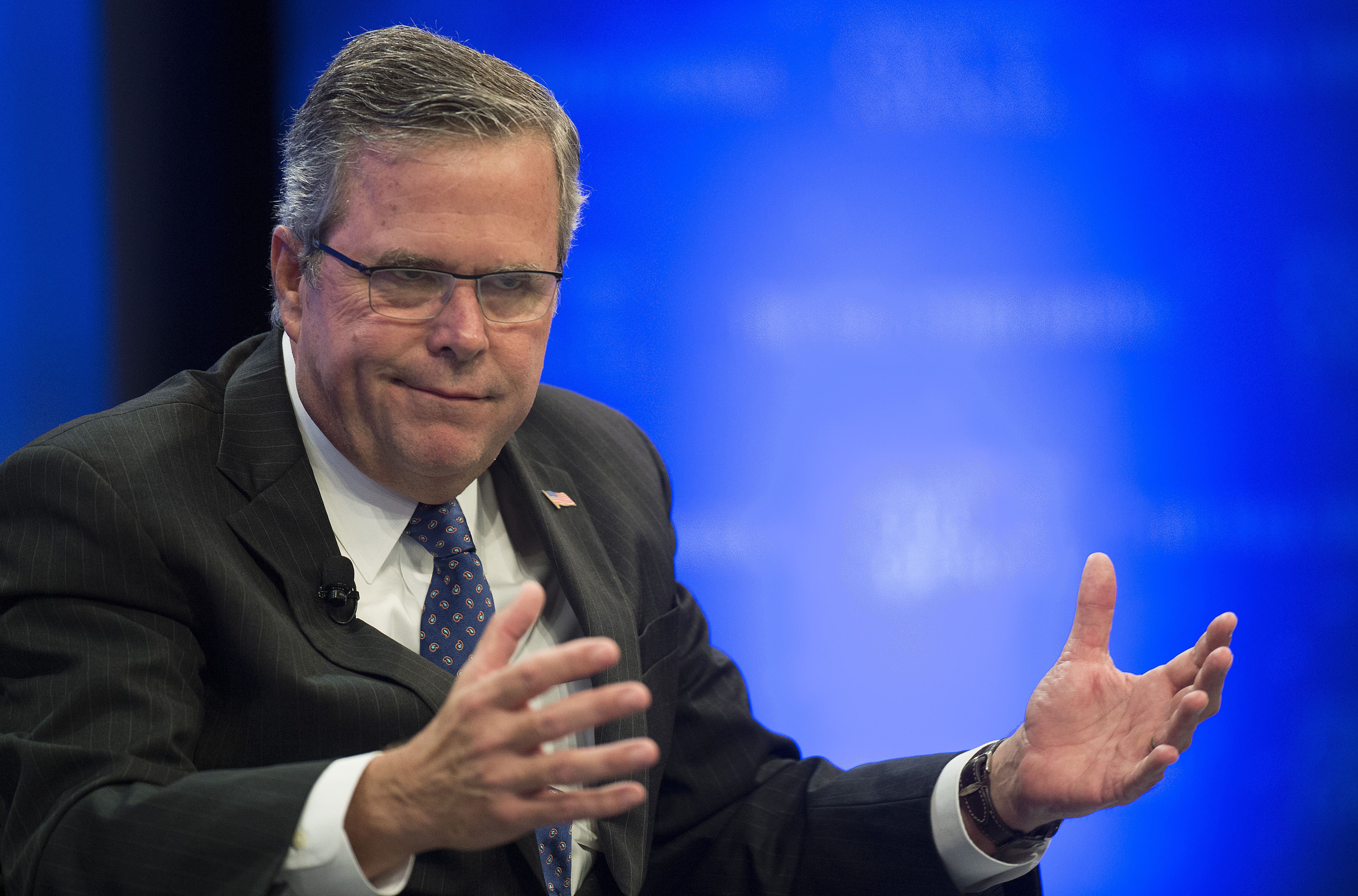
It sure sounds like Jeb Bush is going to throw his hat in the ring:

The big political news over the weekend is that it looks like Republican Jeb Bush is moving closer and closer to a presidential bid in 2016 — after announcing he would release 250,000 emails from his days as Florida governor, as well as release a new book. (You’re usually not taking these actions if you’ve decided AGAINST a presidential run, right?) Folks, this isn’t someone simply dipping his toes into the presidential waters; it’s someone who’s bouncing up and down on the diving board. More than anything else, Jeb’s moves are a signal to Republican donors and campaign staffers that he’s going to probably run.

Dougherty is against the idea:

Nominating Jeb Bush is an implied admission that the GOP cannot put together a post-Reagan presidential coalition without this one family.

It would mean advertising that the party that just put together an impressive, across-the-board electoral comeback in 2014, and that has performed unusually well in gubernatorial races several cycles running, is bereft of talent and must rely on an older brand — one that people tired of twice. Republicans should reject these assumptions about their party, no matter how desperate eight years out of the White House has made them.

The last few years have been ones of experimentation for the party. There is the libertarian-inflected Rand Paul; there are Chris Christies and Scott Walkers who promise dramatic confrontations with public bureaucracy. There is the family-friendly wonkery of Sen. Mike Lee of Utah. If people want to try Bushism again, they should at least have the decency to demand that Marco Rubio’s face be stretched over that political zombie’s head.

Larison reminds everyone that Jeb is as hawkish as his brother:

Everything Bush has said publicly on the subject confirms that he agrees with his party’s hard-liners on most issues, and he has never said anything that would suggest the opposite. As a domestic policy “centrist,” Bush’s ability to break with the party significantly on foreign policy is greatly reduced. Like many relative moderates, Bush overcompensates for his “centrism” on domestic policy by endorsing failed and confrontational policies abroad. For their part, quite a few movement conservatives are willing to forgive all kinds of heterodox views on many other issues so long as the “moderate” candidate fully embraces hawkish interventionism. That probably won’t be enough to win the nomination, but it will make the quality of the debate during the nomination contest that much worse.

Allahpundit doesn’t trust Jeb:

Is he running because he has a conservative vision, the odd Common Core or immigration heresy aside? Or is he running because the wingnuts are threatening to wrest the nomination from the donor class and someone with clout needs to step up and punch them in the face? Why would any tea partier turn out in the general election for a guy who took that approach with them, however successfully, in the primaries?

Jennifer Rubin disagrees with this framing:

The right wing, at least its loudest spokesman and crankiest bloggers, have decided Bush is going to snub them, run against the right and imitate Jon Huntsman, who seemed to delight in insulting conservatives. I have explained why I think this is mistaken. However, the challenge for Bush is to define what it means to be “conservative,” and not accept the notion that conservatism demands shutting down the government, rejecting a pathway to legalization (the MSM and right-wing often mischaracterize him as pushing a pathway to citizenship) and eschewing school standards. (Again, Bush contrary to the right-wing hecklers supports Common Core — or higher individualized standards).

And Husna Haq shows how much of a drawback Jeb’s last name could be:

While 73 percent of CEOs may favor a Bush candidacy, many Americans have indicated that they’re ready for fresh candidates and names – even Jeb’s own mother, Barbara Bush, who famously said last year that America “had enough Bushes.” An NBC/Wall Street Journal poll indicates that two out of three Americans (69 percent) say they agree with Barbara Bush.

(Photo: Former Florida Governor Jeb Bush speaks during the Wall Street Journal CEO Council in Washington, DC, on December 1, 2014. By Jim Watson/AFP/Getty Images)

Would You Report Your Rape? Ctd

by Dish Staff

The personal thread takes a new direction:

Thank you so much for continuing the discussion on rape. My rape story is a little different. I never felt a tremendous weight of shame, but rather anger that some jerk could think it was okay to do that to me. And anger at the ways our culture fosters that kind of thinking.

I was a college student living in an off-campus house with several people. My birthday party that night was the usual: a decent amount of drinking and a lot of fun with friends and friends of roommates. I eventually went to bed, alone. My roommate wasn’t in bed yet, so I left the bedroom door unlocked for her. A little while later I woke up from a heavy, drunken sleep to an acquaintance beginning to rape me. He was a college basketball star, and a very tall imposing one. He is black and I am white. I fought him and started screaming, which finally caused him to stop the rape and leave.

I did not report the rape to the police or to the university because who would believe an underage drunk girl against a college basketball star? They would undoubtedly claim I led him on, and if I argued I did not, I felt there was a very good chance they would pull the race card. After all, why wouldn’t I be interested in the attentions of the local sports hero, unless I’m actually a racist?

I will echo some of your other writers and simply say that in a case such as this, of he-said, she-said, I felt it was not worthwhile to fight to be taken seriously. We all have a lot of battles to fight in life, and this isn’t one that I necessarily wanted to spend my efforts on, only to be interrogated, dismissed and have my reputation tarnished.

In the aftermath of this incident, my friends barely took my story seriously and continued to be his friend. I eventually moved away and graduated college elsewhere.

I abhor the worship of university sports heroes and “frat culture,” with its repulsive, dangerous combination of male entitlement and female objectification. I believe it is that kind of misogynist thinking that led my perpetrator to justify what he did to me. But I don’t want you to get the impression that I hate all men. I have been married for more than 15 years to a really great guy, and we are raising two smart, strong girls. I simply feel our culture has for too long tolerated certain behaviors that are not respectful or healthy for women (or men, for that matter).

Polarization Is Here To Stay

by Dish Staff

Polarization

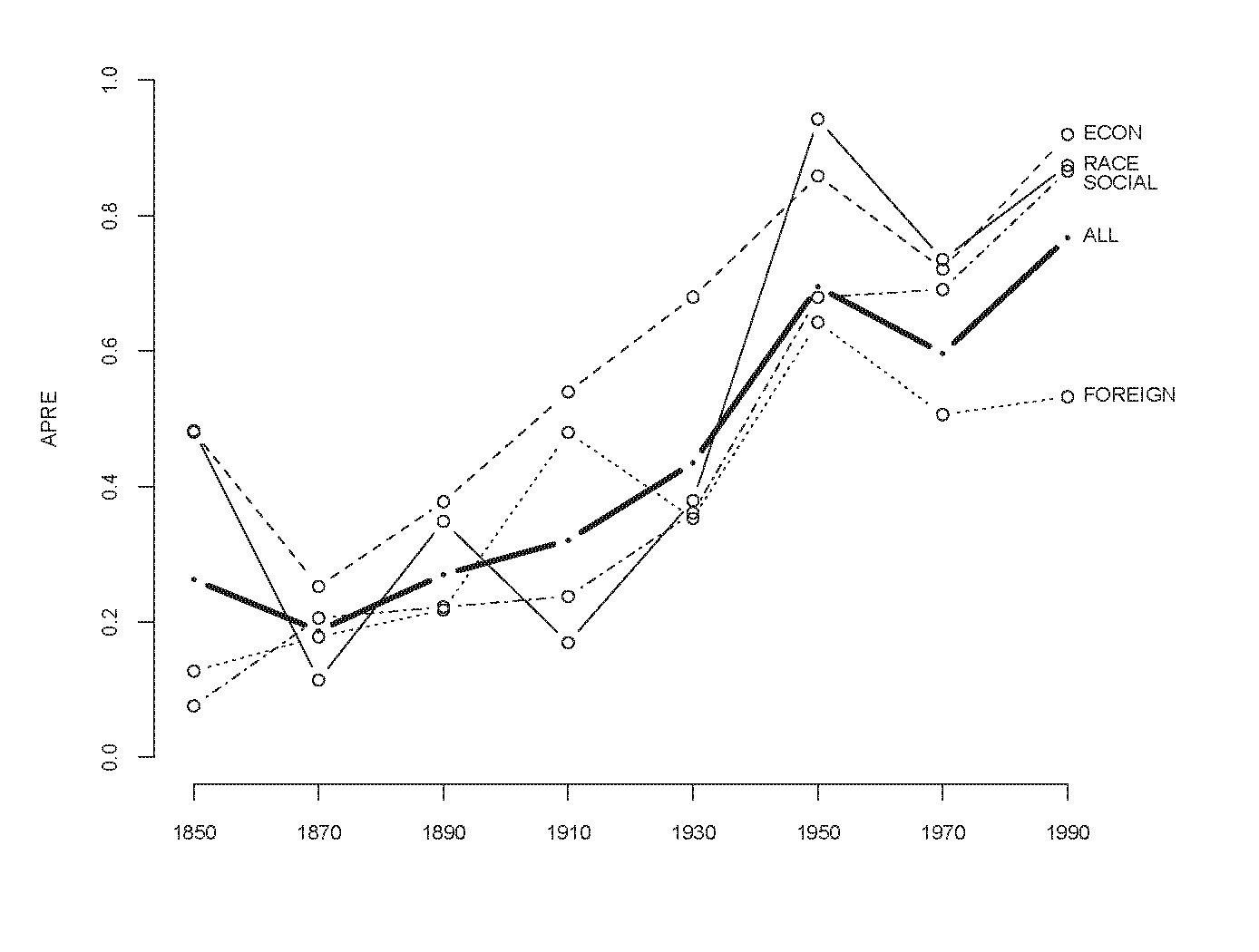
That’s the contention of Brendan Nyhan, who calls the bipartisanship of the mid-20th century “a historical anomaly.” Hans Noel compares our period of polarization to previous ones using the above chart:

The parties were definitely polarized 100 years ago, but not on the basis of such widely held ideologies. There were ideological conflicts, to be sure, but they were not organized around a liberal pole opposed to a conservative pole. Those poles emerged, largely coming into full force by about 1950. It is hard to compare ideological conflict in the era of ideological blogs, cable news and talk radio to an era of pamphleteering and partisan newspapers. But the analysis in Political Ideologies and Political Parties in America suggests that ideology was less one-dimensional in the 19th century. Over time, liberal and conservative ideology has been sharper on every issue area, including race but also economics, social issues and foreign policy. This figure shows how well a one-dimensional model fits the opinions of writers in major political journals over time. The ideological organization increases in all issue areas from 1850 to 1990.

Julia Azari chimes in:

 Why does this shift from party to ideology matter?

Parties – even ones that are ideologically sorted –  are collective enterprises. They’re organizations and coalitions. Leading a party involves brokering among interests and distinct groups. Articulating an ideology does not. To the extent that presidential rhetoric shapes public expectations about what leaders will be able to accomplish, laying out an ideological agenda makes compromise even more difficult to achieve. As Hans points out, “Speaker Boehner has to placate a Tea Party faction that mostly differs with mainstream Republicans over how much they should compromise with Democrats.” When the president tells the nation that the election was a contest between highly distinct governing visions, it’s even harder for members of Congress to defend compromise to their constituents.

When presidents cast themselves as the vessels of new political visions, they contribute to the idea that the right leader, with the right words and enough political will, can simply cut through the “mess in Washington” – i.e., the organized interests of the people of the United States, and the Constitutional checks and balances – in order to bring about wholesale change and costless problem-solving. (Nyhan has smartly labeled this the “green lantern theory of the presidency,” and president scholars like George Edwards and the late Richard Neustadt have long noted the gap between expectations and actual presidential capacity.)

Why Didn’t Amy Pascal Just Pick Up The Phone?

by Michelle Dean

Aaron Sorkin, burnishing his credentials as He Who Blows Hard While Knowing Little, has an op-ed in the New York Times today complaining about the journalistic feeding-frenzy on the hacked Sony emails. Naturally, his rhetoric spirals into the atmosphere. For example:

As a screenwriter in Hollywood who’s only two generations removed from probably being blacklisted, I’m not crazy about Americans calling other Americans un-American, so let’s just say that every news outlet that did the bidding of the Guardians of Peace is morally treasonous and spectacularly dishonorable.

You know, I haven’t looked at HUAC transcripts recently but I wouldn’t be surprised if accusations of “treason” and the like came up just as often as accusations of “un-Americanness.” Sorkin might want to cool it. Discomfort with the fact that these documents are stolen and worry about what this heralds for the protection of personal employee information is perfectly legitimate. Talking about journalism in terms that belong in some Lifetime remake of Braveheart, much less so.

But Sorkin’s not alone. Handwringing about the “ethics” of the Sony hack is at high tide right now. It puzzles me, mostly because I didn’t start out as a journalist, I started out as a lawyer. And as a lawyer, my sympathy lies with the poor in-house counsel shmuck who has undoubtedly been saying to Amy Pascal for years, “Please just pick up the phone next time.”

See, at the heart of Sorkin’s complaint is the idea that the studio’s business records are subject to an inviolable right of privacy. But even Sony’s lawyers know that’s never the case.

Crap emails, to borrow an old Jezebel phrase, have long gotten businesspeople in actual trouble. When I was a very bored first-and-second-year corporate litigator, a good portion of my job was devoted to trawling through other people’s inboxes. I worked on securities litigation and bankruptcy cases, so mostly it was investment bankers’ emails I’d end up with. But the principle extends everywhere. I’d always be looking for information about some dry financial transaction, but you’d be surprised what kind of asides would get tangled up with those business emails. Pictures, insults, “jokes.” And more than once, those “jokes” ended up bearing on the dispute at hand, getting cited in legal briefs, relied on by judges in their rulings.

Email, in other words, has long been something lawyers told rich businesspeople to be careful with. Even jokes that seem harmless at the time can come back to haunt you.

Take, for example, the colorful emails that flew back and forth about the production of the Jobs biopic. If anyone involved in that mess had decided to sue someone else, on virtually any theory, all of those emails would have been pulled into the case. Discovery standards in American courts are very wide; you can pull in virtually anything that’s relevant. Scott Rudin’s off-the-cuff assessment of Angelina Jolie’s talents could very well have been the lynchpin of someone’s argument about a contract. Even if the whole thing never went to trial, the size and nature of any settlement might well have hinged on his “candid” emails. And all that would happen whether or not Rudin liked it; in the context of a lawsuit his consent would be as irrelevant to the court as it is to the hackers.

Have all the qualms about hackers that you like, of course. But it’s odd to pretend that these big fancy business people had no idea of the risk. They chose to ignore it in favor of the expediency of negotiating over email, fine. But these men doth protest too much, I’m saying.

What The Hell Just Happened In Sydney?

by Dish Staff

Monday morning (Sunday night in the US), a man wielding a gun and a black flag similar to that used by ISIS walked into the Lindt Chocolat Café in the Australian city’s central business district and proceeded to hold the customers and staff hostage for 16 hours before police stormed the shop around 2 am Tuesday, ending the standoff. According to the Sydney Morning Herald’s ongoing live coverage, the gunman and at least one other person are dead, with several others injured.

The gunman, an Iranian immigrant and self-styled “cleric” by the name of Man Haron Monis, tried to portray himself as an agent of ISIS but came off as more of a delusional, attention-seeking psychopath (though to be fair, those often go hand in hand):

Monis, also known as Sheik Haron, was convicted of sending offensive letters to the families of Australian soldiers who died serving in Afghanistan. He is out on bail as an alleged accessory to the murder of his ex-wife, as well as a string of 40 indecent and sexual-assault charges in connection to his time as a self-proclaimed spiritual leader. Monis used a YouTube account to post a series of three videos of hostages reciting his demands, which included the delivery of the black flag of ISIS. He asked “to please broadcast on all media that this is an attack on Australia by the Islamic State,” and to speak to Prime Minister Tony Abbott. The demands would be met with the release of more hostages, according to the videos. YouTube has since removed the videos from the account.

Juan Cole wishes the press would stop playing into the hands of such criminals by hyping them as terrorists, implicitly tarring innocent Muslims in the process:

Sydney had another hostage crisis, in 1984, in a bank. A formerly wealthy (secular) Turkish-Australian became unhinged at losing his fortune. Today’s incident is not more important than that one, which few now remember. Both of these hostage-takers were common criminals. Neither is a “terrorist.” Today’s Sydney hostage-taker is not representative of a new activity. He isn’t important, and ordering a black flag won’t make him so. The only one who can bestow recognition on this criminal is the mass media and the press. They shouldn’t do it. … Criminals and gangsters should not be fetishized as “terrorists.” It is just a way for them to inflate their egos.

Peter Hartcher excoriates the Australian media for doing just that, by rushing “to cheerlead the hype and to provide a ready platform to any politician who wanted to insert himself into the event”:

Terrorism is a tool of the weak against the strong. It is designed to turn the enemy’s strength against itself. One man showed how to get extraordinary attention and inflict serious disruption using only a gun and a Muslim prayer banner. Successful terrorism is so rare in Australia that the overreaction is perhaps understandable. The police response seemed exactly right. But our political and media systems need to get better at measured reaction.

Abbott said on Monday evening that the incident had been “profoundly shocking”. He added: “I think I can also commend the people of Sydney for the calmness with which they have reacted”. With no help from the politicians.

By comparison, this response from Sydney residents was spot-on:

A young Sydney woman, Rachael Jacobs, appears to have inspired the campaign after posting a moving Facebook status about her encounter with a Muslim woman earlier in the day. “…and the (presumably) Muslim woman sitting next to me on the train silently removes her hijab,” Ms Jacobs wrote. “I ran after her at the train station. I said ‘put it back on. I’ll walk with u’. She started to cry and hugged me for about a minute – then walked off alone.” The inspiring status quickly circulated on social media before inspiring the #illridewithyou hashtag.

Uber, meanwhile, came under fire yet again for turning on surge pricing during the crisis, charging users in downtown Sydney a minimum of $100 for a ride (they later backtracked, offering refunds to customers who had paid the extortionate rates and making all rides in the area free). That sounds pretty despicable, but Danny Vinik offers a qualified defense of the rideshare company:

I’m one of the few people here who doesn’t think Uber is actually doing anything wrong. A terrorist attack will understandably cause many people to try to get home at the same time and make many drivers fearful to go on the road. Raising rates will deter some people from using the service while incentivizing more drivers to get on the road. That’s simple supply and demand. Uber almost certainly earns higher profits as well.

Critics are right that this isn’t a fair systemthe rich will be able to get home easily in the case of a terrorist attack and the poor won’t. But you also have to look at the alternative. If rates stayed the same, fewer drivers would go on the road and wait times would increase. It would be harder for everyone to get home. People will differ on which they value more: economic efficiency or fairness. But there is an economic rationale behind Uber’s moves.

Update from a reader:

That’s some unqualified horseshit; Uber isn’t up front about it’s price-gouging. Unsurprisingly, it’s pretty hard to get an accurate estimate of just how much you’re getting screwed by them until after the fact. Passengers generally don’t realize they’ve had their pockets picked until well after they’ve arrived at their destination or checked their credit-card statements. The driver doesn’t tell you beforehand that you’ll be charged 3x, 4x, or 50x the standard rate. Most people treat hailing an Uber as one would hail a cab. Except, unlike with a normal cab, there’s a hidden danger of spending triple-digits on a short ride and not even knowing it, since no physical currency is handed over.

Another counters that reader:

That’s simply not true. Uber tells you when surge pricing is in effect. If you don’t believe me, here’s a photo of the type of message Uber provides its customers when surge pricing is in effect.

Another backs him up:

On two counts your “reader” is grossly misinformed. I suspect willfully so – for people of a certain politics its pretty fun to hate on Uber. But Uber actually does notify users when price surging is in effect. The app uses a surge confirmation screen. The user has to physically type in the surge pricing in effect. (This policy is on Uber’s page.) Pretty hard for people to claim afterwards “they didn’t know”.

And Uber also makes it easy to get an estimate of the fare you’re getting. You see when you get ready to order a car, there is a screen with a button called “Fare Estimate.” And yes, this is also clearly stated on Uber’s page.) After using Uber for several years, I’ve never had a fare be unreasonably outside the fare estimate. It’s probably about as reliable as a yellow cab driver estimating what my fare will be.

I’d give your reader a pass on surge pricing if he’s never used Uber in a New York snowstorm. But when he/she claims Uber doesnt make it easy to get a fare estimate? I’m thinking they’ve never used Uber in their life.

A Global Response To Global Warming

by Dish Staff

PERU-COP20-CMP10-KYOTO-PROTOCOL

Brad Plumer unpacks the UN climate deal stuck in Lima, Peru:

Over the next six months, each nation will be required to submit a plan for how it will address future emissions. These plans will form the basis of a major new climate agreement to be negotiated in Paris at the end of 2015 and take effect by 2020.

The actual content of each country’s plan, however, is entirely voluntary. In principle, countries are supposed to pledge to do more on climate than they’ve already been doing. But there are no rules about how emissions actually get restrained or what the timetable should be.

Rebecca Leber looks at how the agreement was watered-down:

To ensure more than 190 countries were on-board, particularly the developing world, negotiators weakened much of the requirements for individual countries in the final 30 hours.

Lima set out to establish a minimum guidelines for what information countries must disclose about cutting carbon pollution. The seemingly small detail is important because it lets countries compare apples to apples, and potentially push for more cuts. Except now the review process won’t be as vigorous as it could be, thanks to a single word change. Now, most of the information for these plans will be voluntary, rather than mandatory, because the text says countries “may” include detailed information, rather than “shall.”

In the end, some of the toughest decisions were simply postponed until Paris.

Eric Holthaus declares that the “U.N. process isn’t where the action is on climate anymore”:

Progressive cities, transformative industries, and mass protests have the best chance of providing the tipping point that’s needed. These talks are a distraction from the kind of urgent, on-the-ground work that needs to happen in order to steer the world’s economy toward a carbon-free path and prepare for the impacts of increasingly extreme weather.

But Erik Voeten sees the accord as significant:

While new numerical commitments may work for smaller, more cohesive groupings of countries, such as the European Union, the global approach has since shifted to a different strategy, which is based on the realization that the main push for climate-friendly policies must come from within countries. The purpose of international agreements and institutions is to help those domestic groups that favor emission curbs, not to set central standards that the international community can’t enforce. This fits the insights from political scientists that the effect of many treaties depends on domestic politics.

So how does the Lima agreement help domestic groups that favor carbon reductions? A first, and very important, feature is that it brings the issue on the agenda in every U.N. member state. Every country has agreed to develop a national action plan, although the language on what exactly needs to be in that plan was watered down during the negotiations. Still, anyone who has ever participated in or studied an activist movement knows that getting an issue on the agenda is a major hallmark.

Some environmental groups are unhappy:

The target of the United Nations-hosted climate process is to limit the rise in global temperatures to under 2 degrees Celsius above pre-industrial levels. But the architecture of the emerging plan rests on a series of nationally decided commitments that are unlikely to ensure the steep emissions cuts that experts say are needed to meet that target. Environmental watchdogs said the Lima deal would not achieve the stated aim. “The outcome here does little to break the world from a path to 3 degrees warming or higher,” Oxfam said in a statement.

Robert Stavins responds to such criticisms. He argues that “these well-intentioned advocates mistakenly focus on the short-term change in emissions among participating countries  … when it is the long-term change in global emissions that matters”:

They ignore the geographic scope of participation, and do not recognize that — given the stock nature of the problem — what is most important is long-term action.  Each agreement is no more than one step to be followed by others.  And most important now for ultimate success later is a sound foundation, which is what the Lima decision can provide.

(Photo: Environmental well wishes are seen written on a wall on December 13, 2014 in Lima, as work continued on the final draft of a UN climate agreement. By Cris Bouroncle/AFP/Getty Images)