
Debating Woody Allen On Super Bowl Sunday

188110379ST037_Celebrity_Si

The only thing I can infer with absolute certainty from the anguished letter Dylan Farrow has written to the New York Times is that she is expressing incandescent rage. I cannot know from a distance what exactly is the reason for that rage, but she hates her former step-father adoptive father, Woody Allen, with an intensity completely compatible with child abuse, and hard to explain away entirely without it. You can see how truly she hates him from her opening and closing lines. These are sentences designed to do as much harm to Allen as he allegedly did to her – to pin the crime of child-rape onto every movie he has ever made, to obliterate his legacy as an artist by insisting that his entire oeuvre be viewed through the prism of his monstrousness. I can fully understand the impulse. Can’t you?

At first you think this is melodrama, but then you realize she is simply wielding the most lethal weapon she has:

What’s your favorite Woody Allen movie? Before you answer, you should know: when I was seven years old, Woody Allen took me by the hand and led me into a dim, closet-like attic on the second floor of our house. He told me to lay on my stomach and play with my brother’s electric train set. Then he sexually assaulted me. He talked to me while he did it, whispering that I was a good girl, that this was our secret, promising that we’d go to Paris and I’d be a star in his movies. I remember staring at that toy train, focusing on it as it traveled in its circle around the attic. To this day, I find it difficult to look at toy trains.

I’m not sure how, especially after reviewing the evidence Maureen Orth collected over twenty years ago, you manage not to believe Dylan Farrow – even though in every hugely dysfunctional family, there is more than one side. But the fact that Mia Farrow may be a few sandwiches short of a picnic doesn’t prove that Woody Allen isn’t a monster. And Farrow’s anguished yet vicious letter makes a lot of emotional sense coming after the Golden Globes’ celebration of Allen’s lifetime of achievement. Then there’s what we already know of Farrow’s behavior as a child:

Several times …  while Woody was visiting in Connecticut, Dylan locked herself in the bathroom, refusing to come out for hours. Once, one of the baby-sitters had to use a coat hanger to pick the lock. Dylan often complained of stomachaches and headaches when Woody visited: she would have to lie down. When he left, the symptoms would disappear. At times Dylan became so withdrawn when her father was around that she would not speak normally, but would pretend to be an animal.

These are classic indicators of abuse – along with plenty of other eye-witnesses to Allen’s creepy behavior around the girl.

And yet Dylan Farrow will, I’m afraid, fail in this case.

Not entirely. Re-reading that Orth piece and absorbing that letter definitely impacts my view of Allen as a whole. It reminds me again of who this man is. Like when we’re watching a Polanski or a Gibson movie, there will always be, for most of us, a tinge of guilt, even distant complicity, in admiring the craft of a man whose predilection for relationships was with women utterly under his totalitarian control. But the brutal truth is: we will move on. His art and his craft is so extraordinary in its range and scope and creative integrity that it escapes the twisted psyche that gave birth to it. It does things for us as viewers and as human beings that can eclipse the reality Dylan Farrow wants smack-dab in front of our eyes.

In some ways, I wish this weren’t so. It would be a less fallen and compromised world. But the human mind can, alas, live quite fully in places where the practical moral conscience seems irrelevant. And so it is essential to understand Heidegger’s foul complicity in the Third Reich but impossible to reduce his world-historical genius to it. That T.S Eliot was a rancid anti-Semite does not, frustratingly, dilute the perfection of the Four Quartets, nor does Philip Larkin’s racism alter the triumph of Aubade. Jefferson’s thought and career, for that matter, will always elude the facts of his ownership of human beings and intercourse with some of them. Perhaps with less essential talents, the sins may more adequately define the artist. But that, in many ways, only makes the injustice worse. Those with the greatest gifts can get away with the greatest crimes.

We can and should rail against this, while surely also be realistically resigned to it. It struck me, for example, rather apposite that as the blogosphere is debating whether to boycott Woody Allen’s films in the future because of this horrifying story, exponentially more people are tuning into the Super Bowl to watch a game we now know will render many of its players mentally incapacitated in their middle ages and beyond. We know that this spectacle is based on the premise of brain damage for many of its participants, but we watch anyway. Reforms in the game that might change the number of concussions are resisted by the fans as ferociously as by the owners. And in the excitement of the game, such things are so easy to obliterate from our minds. We forget that this massive industry knew full well what they were doing and yet subjected human beings to this fate for years. They abused people’s bodies and minds for money – and now we are required to celebrate their entire cult en masse for one night.

I imagine the family of a former football player whose brain was turned into swiss cheese by this organization might find it as painful to watch the Super Bowl as Dylan Farrow did to witness the Golden Globes. But we will watch anyway.

Humankind cannot bear very much reality. Or only so much. And only so often.

(Photo: Director Woody Allen is seen on February 1, 2014 in New York City. By NCP/Star Max/GC Images via Getty.)
Faith On The Football Field

dish_supernaturalsports

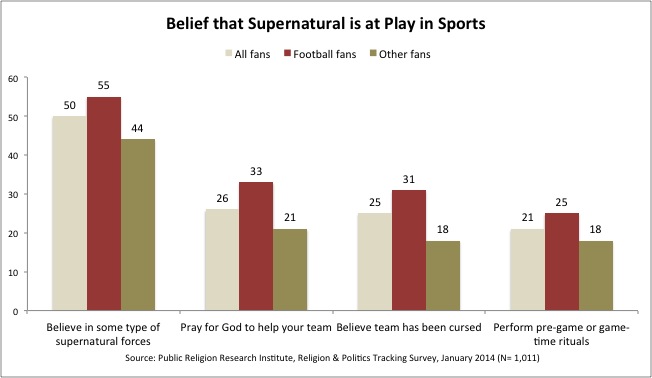
Jerry A. Coyne passes along the above chart:

This graph summarizes the data, with “average Americans” in tan, football fans in maroon, and other fans in olive. Now since the survey methodology reports a survey of 1,011 adults—not just sports fans—I assume that the data below represent a subset of those Americans who follow sports. But, according to the data, that is 89% of all Americans (I’m one of the other 11%). Yes, exactly half of the fans (and 55% of football fans) see supernatural influences in sports.

In an interview, Gregg Easterbrook is asked, “Does God participate in the National Football League?” Part of his answer:

To the extent that people believe that God controls outcomes—and I am a churchgoing Christian who does not believe that—then football games present you with a fast-moving morality play. The good guys should beat the bad guys; the virtuous athletes should succeed over the cheating athletes. If you believe that God controls outcomes, daily life is full of little morality plays—but most of them are hard to discern, whereas a football game is right on TV. You know what’s happening, you know who wins, you know which players you like and which players you don’t like. Athletics gives you a type of morality play for the presence of God’s active control in life.

Easterbrook also recently cautioned that it’s mostly not pro players who suffer the effects of game-related concussions:

What about high school concussions? Steven Broglio of the University of Illinois estimates prep football players sustain 43,200 to 67,200 concussions annually. That’s versus 80 to 100 concussions annually in the NFL, where the attention focuses. In high school there is usually no certified athletic trainer on scene (fitness trainers are nice but often unskilled in medical matters), nor ready access to neurologists. The only health insurance many high school players have is Medicaid, which is stingy about specialists; their parents or guardians may avoid doctors, fearing co-pays. The result is a head-injury double whammy: High-school concussions are far more frequent than NFL concussions, plus more likely to be mistreated (if treated at all).

Which Beer Is The Coldest?

The one in the fridge:

How cold a beer is has nothing to do with how it’s brewed and packaged and everything to do with whether and how long the consumer refrigerates it before drinking it. No thinking person would ever claim to like Beer Brand A more than Beer Brand B because Beer Brand A is colder. But beer advertisements aren’t geared toward thinking people—they’re geared toward thirsty people. Commercials that brag about beer’s coldness are a wildly unsubtle attempt to circumvent viewers’ rationality by appealing to their baser instincts. Whatever your level of media literacy, a bottle of beer that sheds fragments of ice as it’s slammed down on a countertop in slow motion looks pretty darn refreshing.

When Faithlessness Leaves Family Behind, Ctd

A reader can relate to atheist guilt:

I spent my teens reading Camus and saying that God doesn’t exist. Then, in my late teens, I joined a youth group and tried to believe – partly because of my family, my friends, and the social stigma of not being a believer in the 1980s South (Atlanta).

Fast forward to age 35, when after years of hiding my non-belief, I came out. Mind you, I went to church, wound up teaching Sunday school, went on some mission trips, and was asked to be an elder or deacon. At that point, I figured I needed to come clean. So I came out. My wife and I divorced – partly because of my non-belief (she was on the road to becoming a Christian writer) – and partly because of the lack of intimacy we had between us. I felt guilty just watching The Sopranos because it wasn’t ‘uplifting.’ How can you have an intimate relationship when there is that type of judgment on the simple stuff?

Of course, my ex thinks I’m going to hell, literally. My family does too. My sister told me she didn’t know who I was, and we really don’t have a relationship anymore – after 13 years. But I’m happy. I’m open and honest about my beliefs and my wife and kids that I have now share my beliefs.

Meanwhile, an atheist since childhood offers some advice to new “converts”:

It’s important to remember that atheism is an altogether unremarkable thing. Sure, many come to the idea, or the acceptance, with a great degree of awe, and they convince themselves that they must now be true to themselves as atheists and never set foot in that awful place of worship again.

But your parents aren’t going to be around forever. Breathing and heartbeats are a finite resource. Go to fucking church with them. If your atheism is hanging by such a thread that you can’t sing a song from some old book with your parents, you probably aren’t really an atheist.

Update from a reader:

Your reader’s experience of attending church with parents might be “singing a song from some old book,” but attending church with my mom (before I affirmed every cliche of the de-converted and left the South for California) was a very different prospect, and much more of an assault on my identity.

It would have involved, at minimum, 30-45 minutes of energetic singing, clapping, and hand waving, during which at any moment a member might break out into several laps around the sanctuary before falling out in religious ecstasy. (If this member happened to be a woman, another female member would quickly cover her splaying, spasming legs with a coat, since women were forbidden to wear pants or shorts.)

Following this warm-up, my willingness to make this sacrifice for my mom would have been tested by a sermon averaging 90 minutes, during which the very idea that someone could doubt God’s existence, question the sacrifice of Christ on the cross, choose a “worldly” lifestyle based around money and hedonism (the only pursuits that could be conceivably imputed to those outside the fold), or heaven literally forbid, go the whole hog into sin and TURN GAY, would be relentlessly mocked, scorned, or just regarded with a sad, knowing pity. (Anyone in attendance would also be encouraged to subsidize this worldview during the offering, with a strong reminder that failing to reach into your pocket could be the difference between someone’s salvation and damnation.)

Finally, this would all wrap up with an altar call, which was very likely to culminate in people kneeling and weeping for their sins, while groups of “prayer warriors” surrounded other individuals who needed a little extra help to “pray through” for the first time (or maybe just recommit themselves to the cause, e.g. “pray BACK through”). Anyone who attempted to tactfully sit back and disengage during this ritual ran the risk of being approached by a concerned member asking if they could lay hands on them. A firm no was sure to be met with suspicion, while any hesitation would invite said laying on of hands, which, if administered by a particularly vocal church member, would serve as a beacon for others to latch on to the hapless subject and add their hands and voices to the prayer.

Finally (I know I said the altar call was the end, but really it wasn’t), with tears being wiped and beatific smiles being exchanged, someone would extend an invitation to re-convene at Denny’s or Cracker Barrel, where in smaller groups of a dozen or less, members would go over some of the strongest points of the night’s sermon or talk about how wonderful it was to see Bro. Smith or Sis. Jones “pray back through.” If a political issue was in the news, a more respected member of the group might point out how clearly silly the “worldly” view (oddly enough, almost always the one opposed to the Republican view) was. (For those who say “Just go home” at this point…my mom was always one of the more social members of the church, so accompanying her would have inevitably ended up here.)

Despite my deep love for my mom and my genuine guilt at the pain that I know my falling away from the fold has caused her, I refused to run this gamut for her. Maybe I should have sucked it up, but I know that by even walking in the door, I would have been marked as a target for re-conversion. I really wish I had been raised Episcopalian, so that I could have gone to church with her after I stopped believing and just “sang a song from some old book” to make her feel better.

The Spirit Of Springsteen

Bruce Springsteen recently talked about the “religious impulse” that shapes his music:

Without overusing the word, you know, there’s a Christian element that runs through it because I grew up Catholic and so I was indoctrinated in religious language between eight o’clock and nine o’clock every single morning for the first eight years of my schooling. Five days a week, every single morning, the first thing you did was religion. And so you grew up with that language and it was, of course, distorted, and screwed me up terribly, but at the same time, it made for good writing. And it was a wonderful source of metaphor when you went to write about the world and about your inner life and it served me. I suppose looking back on it, I would like to change some things but I wouldn’t have had that any other way in that it’s served me very, very well and continues to do so. I have a very deep connection to gospel music. I understand the language — I feel I understand the essence of the music itself.

Citing the above, Tim Hoiland makes a connection:

This reminds me a bit of the time the “militant atheist” Richard Dawkins told a reporter for the Spectator that he has a certain love for the Anglican tradition in his native land, and specifically its aesthetics, even if he doesn’t for one moment believe any of its theology. Would he feel deprived if church buildings were to disappear from the English landscape? “Yes, I would feel a loss there,” Dawkins said. “I would feel an aesthetic loss. I would miss church bells, that kind of thing.”

These comments from Springsteen and Dawkins beg the question: What should Christians make of such (unexpected?) appreciation for the aesthetics, sensibilities, and cultural contributions of our faith, while the substance behind those contributions is largely or wholly dismissed? Is this good, to an extent?

For those interested, one of the classic essays on the topic remains Andrew Greeley’s 1988 piece in America,  “The Catholic Imagination of Bruce Springsteen.” Previous Dish on Springsteen herehere, and here.

(Video: title track from Springsteen’s new album, High Hopes)

Religion’s Degree Of Difficulty, Ctd

Earlier this month Tom Ehrich argued that religion ”shouldn’t be this hard,” leading Rod Dreher to warn against “the siren song of easy religion.” Readers join the debate:

Responding to Tom Ehrich, Dreher neatly sidesteps the point by changing the subject, and politicizing the argument. As I understood it, Ehrich was commenting on how faith’s original role – to ease the suffering of guilt so we might have a closer relationship with God – has been flipped to a kind of Big Brother approach to guilt, where, instead of having Jesus help you carry the weight (“my yoke is easy and my burden is light”), a supposedly loving community pushes down harder. It’s a “hospital for sinners” where the sick are made to feel worse.

A few readers think Dreher made a category error:

Rod Dreher either misses the point of Tom Ehrich’s article or is deliberately obfuscating things to project his own biases onto the debate. ”Church,” “faith,” and “religion” don’t all mean the same thing, yet Dreher equates them. In the original article, Ehrich specifically makes this distinction:

Faith should be difficult, yes, because it inevitably entails self-sacrifice and renewal. Life, too, is difficult. Dealing with Mammon is difficult. Speaking truth to power is difficult. Confronting our own weakness and capacity for sin is difficult. But the institution whose sole justifiable purpose is to help us deal with those difficulties shouldn’t be making matters worse.

Another tries to reconcile Ehrich’s and Dreher’s views:

When you quote Ehrich saying religion should not be so hard and Dreher saying religion should challenge the believer, the opposition of ideas is interesting but omits a discussion of the bridge between the two. Dreher is right that Christian believers should question their behavior and confront sin, but when they do that they should do so with the glad news of the gospel – that grace will offer them forgiveness and acceptance.

Grace is something we can be sure of receiving because it is promised and is the assurance Ehrich wants to provide to the uncertain, but grace is something we cannot know we have in hand and the desire to seek grace is what can compel Christians to do the hard work Dreher favors. Grace is a practice that should infuse our behavior, and Pope Francis has demonstrated the basics of grace when he talked about being a sinner and downplayed rules of the church to emphasize the value of every person. Grace is a gift of God, and believers cannot decide how and when and where God will grant it.

A serious, thoughtful reading of What’s So Amazing About Grace? by Philip Yancey was a revelation to me.

Literature That’s Left Faith Behind

Last Sunday, we pointed to an interview with the Catholic poet Dana Gioia, in which he mused that there “is a great essay waiting to be written on the differences between observant and cultural Catholic writers.” Dreher picks up the question:

From the outside, my guess is that culturally Catholic writers are more likely to be reacting against something. Their imaginations were formed by the culture and rituals of Catholicism, even if they’ve rejected the religion. I am skeptical, though, about whether there is anything identifiably or meaningfully Catholic about any culturally Catholic writer whose imagination was formed after the postconciliar dissolution of that strong and distinct American Catholic culture. I could be wrong about that; there is certainly something distinctly Jewish about culturally (but not religiously) Jewish writers. Then again, Jews are a minority in America, whereas Catholics are members of the largest church in the country — though an increasingly assimilated one.

Noah Millman offers an explanation for the distinctiveness of such Jewish writing:

Judaism is simply less theology-centric than Catholicism, and as a consequence you can be a religiously observant Jew who writes books about religiously observant Jews and your fiction may still be Jewish primarily in the sociological sense. Take, as an example, Kaaterskill Falls, by Allegra Goodman. This is a very good novel to read if you want to get a feel for the dynamics of an ultra-Orthodox Jewish community. It’s also a good novel qua novel. But it isn’t god-haunted in the way that, say, Graham Greene’s or Flannery O’Connor’s work is. Or, for that matter, Isaac Bashevis Singer’s – even though Singer was less observant than Goodman is. I’d say similar things about Nathan Englander: that he’s interested in Jews and Judaism, but if he’s haunted by anything, it isn’t by God. History, maybe.

An interesting phenomenon to end on is Jewish writers who, in search of a spiritual inspiration, wandering into foreign fields precisely because that’s the best way to find their way home. Tony Kushner’s play, Angels in America, for example, is fascinated by Mormonism precisely because of its link to archaic Judaism, which (though politically very problematic) appears more spiritually nourishing than the Judaism that actually exists in the contemporary world.

Previous Dish on faith and literature here, here, and here.

Barely Legal Highs

Mike Power investigates the world of designer drugs, or “controlled substance analogs,” described as “version[s] of a banned compound that [have] been created with the aim of making it legal”:

[H]ow easy is it to design and commission a new legal drug based on a banned one?

For the most part you cannot simply tweak cocaine, add a molecule and dodge the law—most countries are wise to this, and their rules are tightly-written, expert affairs focused on well-known narcotics. But outside of headline drugs … it is simple enough to scan medical literature and look for new compounds that could intoxicate. The resulting drug will, most likely, be legal—though whether the result will be pleasant or not will only be discovered by a process of human trial and error.

I passed my drug along to [clinical toxicologist] John Ramsey at St. George’s [Hospital in London] to be logged into TICTAC, a database that is used by law enforcement and healthcare professionals. We do not know precisely what my legal drug will do: It may be incredibly unpleasant—but it will be active and, with the right marketing, could potentially sell by the truckload.

And here lies the problem. We can ban drugs. But we can’t ban chemistry, and we can’t ban medical research. There are an almost infinite number of different drugs and substitutions that are possible, and a combination of circumstances have radically increased the public’s ability to access and alter them. The openness of the Web, China’s prominence as both a manufacturer and exporter, the ability of laypeople to study organic chemistry, the availability of research, improved technology and falling prices—these have all come together to create an unusual, explosive, effect.

Our Need For Speed

Since the early days of Hollywood, movie editing has picked up the pace considerably:

In the 2007 thriller The Bourne Ultimatum, as the critic Michael Phillips has noted, the set piece in which Bourne must dispatch a rival sent to kill him lasts approximately 109 seconds. From the time he crashes through the window to when he finally subdues the assassin, there are roughly 122 cuts—less than a second per cut.

Still well above the threshold of visual perception, but in filmic terms, it is the kind of pacing we once associated with, at its extreme, the visually and psychically jarring “montage” film-within-a-film in Alan Pakula’s 1974 conspiracy film The Parallax View. “The miracle,” writes Phillips of Bourne, “is that it’s not simply sickening to watch.”

As James Cutting, a professor of psychology at Cornell University, has noted, where average shot lengths during the “classical Hollywood age” timed in around the languorous 10-second mark, today’s films are lucky to hit the five-second mark. The average shot length for the entire running time of Quantum of Solace was 1.7 seconds. … While there are pragmatic reasons Hollywood likes shorter cuts—they are easier to edit, for one—Cutting says they also seem perfectly engineered to capture human attention. “Every time there’s a cut in a film,” he says, “it forces you to reallocate your attention.” With each new scene, the eyes typically move toward the center of the screen: What have we here? It is a virtually involuntary process.