A Good Death, Ctd

More stories fill the thread:

In the 1980s, I taught conversational English in Japan. One of my favorite classes had just three students – three middle-aged women who weren’t afraid to say what they felt. Once, one of the ladies missed two weeks. When she returned, she apologized for missing class – her father had died. I hurriedly said how sad I was to hear it, but before I could go on, she stopped me. She told me that I shouldn’t be sad – his death was beautiful. That’s certainly an adjective I had never heard applied to death before.

She explained that her father had caught a cold while he was riding his bike. He was in his late 70s. After a few hours in bed, as the cold turned into pneumonia, he told everyone that he was dying. His children and their families came from where they lived and congregated at his bedside. He was alert and not in pain. He spent a day saying goodbye to everyone. Once he had a chance to talk to his children and grandchildren, he went into a coma. He died an hour later.

By the time the student finished the story, we were all crying and smiling.

Another joins this reader in some gallows humor:

The thread has reminded me of the old joke: I want to die like me grandfather did – peacefully in his sleep – and NOT like the screaming, terrified passengers in that bus he was driving.

In truth, I actually would like to die as my grandmother did. At age 90 she was in marvelous health, needed no medications, and was quite active in her community and church.  On the eve of one of her many trips to Norway to visit relatives, she visited her doctor for a checkup. After the nurse had checked her vitals my grandmother remained seated on the exam table.  The nurse exited saying the doctor would be in to see her momentarily. My grandmother joked that if it took too long she might just take a nap.

When the nurse and the doctor came back in my grandmother was down on the table, a smile on her face.  She had passed, simply, and one assumes painlessly. Would that we all slipped this mortal coil with such ease.

Another reader:

My mom was diagnosed with Stage IV ovarian cancer in November 2009.

She refused any radiation or chemotherapy (she was 84), but in the five months of her final illness, she claimed never to have a minute of pain. (Personally, I think this was due to a benign tumor she had for years above her ear – I think it must have blocked pain receptors in some way.)

At any rate, Easter was April 4 in 2010. Our family celebrated on Saturday so various college students could get back to school on Sunday, and my sisters and all our kids (and their multiple significant others) were there. We had a splendid time, although by then Mom was very frail and occasionally on oxygen. She wasn’t strong enough to sit at the dinner table, but she did spend that time in a chair in the living room, close enough to hear and enjoy the fun. Later that evening we helped her up the stairs to her bedroom. This was the first time she needed help – she was pretty indomitable. We helped her into bed and told her we loved her, and she died in her sleep sometime during the night.

When we went up to see her in the morning, she looked so peaceful. If she had scripted her last 24 hours, I don’t think it would have been any different.

Another:

We lost my brother last year. He was 25, perfectly healthy, almost done with the Navy’s cryptology network technician training, when he started having trouble breathing. After a month or two of struggling with what the base doctor thought might be asthma, he almost blacked out walking to his truck, and checked himself into a hospital. He had rhabdomyosarcoma, a heart tumor. He passed away less than eight months after his original diagnosis.

What was good about that? Nothing – but so many things. He was tired of fighting about three months in, and I worried for him then; so many cancers take years and years to reach a conclusion. The speed of it all was hard – but also merciful, in a way.

His greatest hope was that he wouldn’t lose mental and physical faculties, and for the most part, he didn’t. The stroke and subsequent brain tumor impeded his language faculties, but he could still speak and interact with us, and take care of himself – albeit slowly – almost to the very end.

His treatments were conducted about two hours away from our hometown, which allowed him a strong support system of family and friends. Our mom was able to stay with him at the cancer care center, so from the diagnosis to the end, he was never on his own. In the end, he died in his childhood room, with my mom singing to him and his siblings around him holding his hands and sufficient meds to keep the pain and anxiety at bay, and enough counseling from hospice and the funeral home staff that we knew kind of what to expect.

We all knew this was a traumatic thing, but it didn’t feel traumatic – more like a clock winding down and then just not ticking anymore. There wasn’t a visible wrenching from life to death, just smaller and smaller steps until you pass some invisible line and then … then he looked just like before, only motionless. Whether as the person leaving or as the person being left – I really don’t know what I would change about that. I can’t come up with a much better way to go.

Ukraine Reignites, Ctd

In a desperate effort to appease opposition protesters, Ukraine’s Prime Minister Mykola Azarov and his government resigned today, while parliament repealed a draconian anti-demonstration law passed two weeks ago. But it may be too little, too late:

“It’s more like a smoke break,” said Sergei Kononenko, who was helping to man the makeshift barricades a short walk from the Presidential residence. “We’re not going anywhere.”

Neither, it seems, is President Viktor Yanukovych. In the past two weeks, as riot police have tried and failed repeatedly to clear the streets, he has shown that he will grant practically any of the protestors’ demands – except his own resignation. “That is non-negotiable,” says Nestor Shufrich, a senior lawmaker from the President’s political party. … As for the party’s options now, he would not say whether force was the only one. “That is up to the President,” he says. But if the protesters still refuse to leave the center of Kiev, and if the President still refuses to leave his post, the stalemate will continue until someone flinches. “That’s when things could get bloody,” says Kononenko, the protester.

Half-measures are unlikely to succeed:

[E]xperts warn that historically, once a government starts making concessions, it is more likely to inflame revolution than placate its opposition. “I do not see any signs that the situation can be improved or that compromise can be reached,” says Sergei Gaiday, a political scientist who runs the Kiev-based “social engineering” agency Gaiday.com. “What is happening in parliament no longer has any influence on what is going on out in the streets. The protesters have too many demands, and these are not being met.”

Writing before the latest news broke, Gavin Weise noted how the opposition’s goals had escalated since the protests first broke out in November:

Talk of lesser aims, such as an amnesty for prisoners or opposition representation in Yanukovych’s cabinet, sounds hollow and has probably come too late. After this week’s spreading violence and last week’s Russian-style legislation limiting freedom of assembly and speech, growing numbers of Ukrainians just want to see Yanukovych and his cronies punished and exiled from the political world.

Recent Dish on the Ukraine crisis here and here.

The Pig Production Line

Slaughterhouse

Alastair Philip Wiper visited Denmark’s Danish Crown Slaughterhouse:

Danish Crown is the world’s largest exporter of pork, supplying pork to customers all over the world – 90% of the pork slaughtered in Denmark is exported, with the UK being the biggest market. Completed in 2004, the slaughterhouse at Horsens kills approximately 100,000 pigs per week, making it one of the largest in the world. 1,420 people are employed there, and the slaughterhouse receives around 150 visitors per day. The slaughterhouse has been designed with openness in mind – a viewing gallery follows every step of the production, from the pigs arriving, to the slaughter itself, to the butchering and packaging.

Other photos from the series here. Shepard at Metafilter is put off by the images:

From the very first word on through to the author enjoying delicious sausages in the plant cafeteria, this is 10,000% a puff piece. It has nothing to do with journalism and everything to do with PR.

Another Metafilter commenter pushes back:

So here’s a slaughterhouse that TRIES to do the right thing by being clean and open about what they do, and it’s still no good to some people? I understand that some people feel very strongly about (not) eating meat, but it’s a fact that to most people, eating meat is just as much a staple as eating veggies. That’s not going to go away. To me, a slaughterhouse like this, that tries to be open and ethical about the process, is to be commended, not vilified — in fact, I wish we had abattoirs like that here in the US.

More of the Wiper’s work, which focuses on industrial and architectural spaces, can be viewed at his website and on his Facebook page.

The Rumbled Grift Of “Sponsored Content”?

Here’s an “ad/post/article/sponsored content/whatever, it pays the rent” that leaps out:

Newcastle Ale ‘bought’ me — an in-house copywriter — because actual Gawker writers can’t accept money from advertisers (not that I’m personally cashing Newcastle’s checks but you know, whatever). As someone being paid to write this, I have to say that it’s the greatest ad ever, mostly because Newcastle asked me to use those exact words. Is it the greatest ad I’ve ever been paid to call the greatest ad ever? Yes.

It’s by Stephanie Georgopulos, Senior Content Producer at Gawker Media, or more technically, a “sponsored collaboration” between Newcastle and Studio@Gawker. Yes, the newspeak deepens every time you check in.

It’s an interesting twist on sponsored content, and perhaps – or am I over-reaching? – a harbinger of its eventual collapse.

The “article” is titled: “We’ve Disguised This Newcastle Ad as an Article to Get You to Click It.” Clever, meta – meta-meta even. Even the ad/article/post is meta: “Welcome to the mega huge website we could afford for the mega huge football game ad we couldn’t afford.” But all of this pirouetting suggests to me that Gawker’s “content producers” are beginning to realize that their audience is catching on to the fact that, along with so many other sites, they routinely “disguise an ad as an article to get you to click it.” Now, it seems, to retain any sense of hipness with their increasingly clued-in readership, they have to own the lie, take off their disguise and reveal the fact that large swathes of online content is deliberately deceptive and written by people who know they’ve been “bought” by corporate interests to create propaganda.

At some point, doesn’t the whole house of cards start to tumble? When a grift is rumbled, doesn’t another grift need to be created to fill the gap?

Update here.

A Silver Age? Ctd

Pierre Omidyar’s and Glenn Greenwald’s vision:

Salmon is struck by Omidyar’s ambition:

[H]e wants to build a global news organization with multiple brands, deep pockets, fearless journalists, top-notch support services, and even its own technology company. You can see how he could get to $250 million pretty quickly, at that rate. That’s a lot of cash — but it’s still less than a single year’s journalism budget for Bloomberg, Reuters, or the BBC. Omidyar needs to make his money go a long way: he’s building not only an international virtual newsroom (with real physical newsrooms in more than one city) but also an elaborate technology, sales, and even legal infrastructure.

Meanwhile, George Packer is confused by Ezra’s new project:

What does it mean to explain the world on the Web? One thing Internet journalists are never short of is commentary—many of them, such as Klein and Matthew Yglesias, who will leave Slate to join the new project, have been specializing in it since they were fledgling bloggers. (Klein has also written for The New Yorker.) What the Web has never figured out is how to pay for reporting, which, with the collapse of print newspapers, is in desperately short supply, and without which even the most prolific commenters will someday run out of things to say. Klein says that the new site is going to be in the “informing-our-audience business,” which describes everything from the Times to Fox Sports to blogging (which is what Klein and his colleagues have made their names doing). Perhaps Klein isn’t ready to say clearly; perhaps he doesn’t yet know exactly what he and his colleagues will be doing at Vox.

Vox CEO Jim Bankoff provides some details. On the eight-figure investment request:

[Q] Ezra reportedly sought $10 million plus from The Post for a new venture; is Vox committing that amount to this?

[A] We are not disclosing our investment, but suffice it to say these rumored amounts are way off and way high. Moreover, Vox already has many of the core pieces in place, including a leading proprietary modern media platform, Chorus, as well as a full set of creative brand advertising products, killer sales, technology, design, business teams, etc. So Ezra and team will be already starting with a very strong infrastructure.

[Q] Is the built-in infrastructure, etc the main reason why the “eight figure investment” figure is way high?

[A] Well, as I said, I never heard of an eight figure investment being contemplated to begin with (beyond unsourced rumors that are way off), but our existing infrastructure does contribute to making this initiative stronger and more cost efficient …

Mercifully, Vox’s “creative brand advertising” doesn’t include sponsored content:

Bankoff told Ad Age that he has no intention of “tricking anyone” with alternative forms of advertising such as sponsored content or “native” ads — which other new-media growth stories such as BuzzFeed have said they believe are a key part of the future of content. Instead, the Vox CEO said he is counting on Vox’s ability to produce better-quality display ads that will bring in more revenue than the standard banner or site takeover. As he described it:

“We really are in the process of reinventing what brand advertising can be on the web… we believe it can be engaging and beautiful and well integrated [and] fully transparent — we’re not trying to trick anyone like some native ads do… we can create high quality media products at large scale, and we can create high value brand advertising at scale as well.”

Last but not least, Nate Silver updates us on his progress and describes the website he’s building:

In contrast to the previous version of the site, which mainly focused on electoral politics, the new FiveThirtyEight will provide coverage of five major subjects: politics, economics, sports, science, and lifestyle. By design, almost any topic in the news can potentially fit into one or more of these categories. Our idea is that the site’s mission will be defined by how we cover the news rather than what we cover.

How will we cover the news? The new version of FiveThirtyEight will seek to apply the concept of data journalism on a wider scale.

What is data journalism? In one sense, data journalism can refer to the application of statistics and other quantitative methods toward issues in the news. Plenty of us are “stat geeks” at FiveThirtyEight. However, our methods will also include data visualization; the development of interactive graphics and features; and investigative and explanatory reporting, especially as applied to publicly-available data sets.

We’re aware that our strengths as a journalistic organization provide more value in some fields than others. For instance, statistical analysis is more likely to be useful when applied to a gubernatorial election in South Carolina than to a civil war in Syria. We have immense respect for news-gathering journalists and for original reporting.

Earlier Dish on the rise of the blogazines here and here.

Why Do Men Have Weaker Immune Systems?

T:

This month, a team of scientists at Stanford University has reported some of the best evidence yet that testosterone directly influences immune system function in men. … This finding that testosterone may dial down the immune system in humans is consistent with the results of studies of other animals, ranging from fish to chimps. But why would an essential male hormone deliberately handicap the immune system?

The answer might be that this is one of those odd outcomes that follow from the perverse incentives of evolutionary logic. In 1992, a pair of biologists at the University of Tromsø in Norway proposed the “immunocompetence handicap hypothesis,” which essentially says that males will perform dumb, dangerous stunts to impress females. The idea behind the immunocompetence handicap hypothesis is that, in order to prove their genetic fitness to potential mates, males make a trade-off between a robust immune system and a set of elaborate, testosterone-driven secondary sex characteristics, like brightly colored plumage in tropical birds.

Assortative Mating Takes Off

As Charles Murray noted and predicted years ago, marrying someone with the same level of education has gotten more popular:

The paper’s authors, led by Jeremy Greenwood at the University of Pennsylvania, mined census data from 1960 to 2005 and found that people’s tendency to marry someone of the same education level as their own increased steeply. After taking into account the increases in the education levels for men and women that have occurred between 1960 and 2005, the odds of a college-educated male marrying a college-educated female rose by 12 percentage points.

One more factor behind radical economic and social inequality is asserting itself. I wonder sometimes if this is not also behind some of the cultural and political polarization that plagues us. The more the educated group marry and hang out with each other, the less contact they are likely to have with people outside their purview. How many real friendships, for example, does a college graduate have with someone who didn’t finish high school? If you don’t marry across these gulfs, and your social circle naturally has few people in it who can speak to their own experiences in the truly struggling middle class, how can we begin to cross the red-blue divide?

It’s not that this divide isn’t crossed daily, nor that assortative mating makes it impossible, nor that milder versions of this didn’t always happen. It’s just that so many trends, now exacerbated by this one, are making “one nation” increasingly difficult to sustain. What potent social and economic trends are bringing these two nations together? Reality TV? Millman finds that the shift is largely due to women’s preferences changing:

[W]omen’s preferences have come to match men’s preferences over the 45 years in question. In 2005, the percentage of highly-educated women willing to marry men with a low education was essentially identical to the percentage of highly-educated men willing to marry women with a low education. In 1960, women were much more willing than men to “marry down” educationally-speaking.

Drum qualifies the study by noting that “that assortative mating has actually increased only modestly since 1960.” And he doesn’t blame rising inequality on matrimonial trends:

[R]ising income inequality isn’t really due to a rise in assortative mating per se. It’s mostly due to the simple fact that more women work outside the home today. After all, who a man marries doesn’t affect his household income much if his wife doesn’t have an outside job. But when women with college degrees all start working, it causes a big increase in upper class household incomes regardless of whether assortative mating has increased.

The View From Your Window Contest: Winner #189

vfyw

A reader makes a snap judgment:

Definitely Las Cruces, New Mexico. I recognized the Organ Mountains instantly from my many trips to New Mexico State University for work. Don’t know where in town exactly, but given the new state of what looks like an apartment complex I’d say it’s on the north side of town just west of Interstate 25 where most of the new construction seems to be taking place. Best I could do in the three minutes before heading out the door …

Another also goes with his gut:

I haven’t done the research, but my first reaction to that flatness was somewhere in California’s San Joaquin Valley. I’m sticking with it. John McPhee wrote that the San Joaquin “outplains the Great Plains,” and Hitchcock transplanted a corn field to the San Joaquin, because no location in the Midwest was flat enough for the crop duster scene in North by Northwest.

The housing market has been brutal in the San Joaquin the past several years, and that apartment/condo complex looks new-ish, so I’m going with Merced, which is home to the University of California’s newest campus and maybe a little more resilient.

Another:

The place looks like the San Francisco Bay area, somewhere on the Peninsula.  And the “lease” sign looks like it has area code 415 as its first 3 digits.  Clearly it’s a US motel (you can see the building 2 sign), along with US stop signs. You’ll get at least 2000 replies saying SFO area.

Most of this week’s contestants did answer the same area, but not San Francisco. Another gets close:

Clearly American Southwest (American because of the double-yellow line in the lower right hand corner, and Southwest because that’s the only place in America that looks like that). At first I was thinking someplace like Henderson, NV, but I think there are more mountains near Las Vegas. Tucson, AZ is the closest of any place I’ve been to resembling the location.

Arizona it is. Another recognizes the city:

After the renewal countdown started appearing on the Dish, I should have expected an obvious ploy to woo my re-up with an easy VYFW contest shot of a neighborhood in my metro. I have neither the skill, time nor patience to search Google images and maps for the exact spot but it looks like southeastern Phoenix to me. Pretty sure that’s Piestewa Peak in the mountain range in the background which is not far from my house.

Alright already! Rest assured my renewal will be forthcoming.

Another notices the main hidden clue for this week’s contest:

Go Tigers!

Another elaborates:

This is totally exciting for me to send this. I love the VFYW contest but they’re always so difficult.

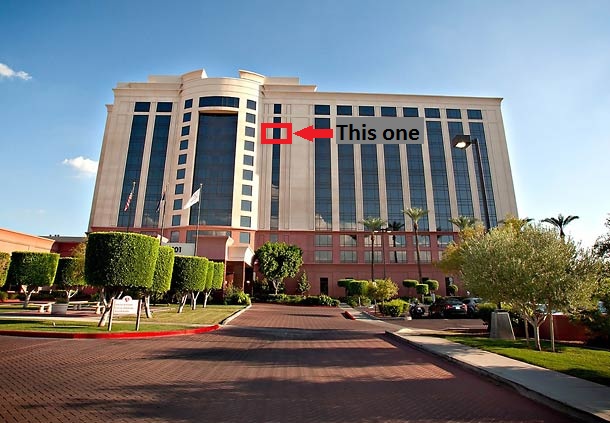
The picture immediately reminded me of how it looks in Arizona. I live in Sierra Vista (not far from the Mexican-American border) which is several hours from Phoenix, but it’s looks pretty similar. The view is from the Phoenix Airport Marriott hotel in Phoenix, Arizona. The sign by the road is “Balsz Tigers” next to the Balsz Elementary school located at 4309 East Belleview, Phoenix, AZ 85008. The hotel is at the corner of E Moreland Street and N 44th street.

VFYW-PhoenixAirportMarriott

I know I won’t win. I know people will send exact floor and window of the hotel, but I don’t care. It’s quite awesome just to send this in for the first time.

And an awesome visual. Another is also just thrilled to be a contender:

One of my FAVORITE parts about the Dish is the VFYW contest, and one of the reasons I renewed my subscription last week was so I could keep seeing the fascinating entries – but I am so excited to send in my FIRST guess! I am sure you are going to get a million entries for this one, since the “Balsz Tigers” is Google-able to Phoenix, Arizona, and the airport Marriott is right there. I’ll guess the sixth floor of the Marriott at 1101 North 44th Street, Phoenix, AZ, and leave your insanely skilled readership to beat me by choosing the room

How fun, thanks for throwing us an easy one! (Now I really hope I’m right and not in the dreaded section above Read On …)

The very first guess we received this week:

Omigod! Okay, I’m not going for the win by figuring out where the hell is the tall building near the Papago Gardens condo complex in Phoenix because I just want to get this in before anyone else does. The elementary school across the street is called Balsz. Yes. And their slogan is “Believe in Balsz … Balsz believes in you!”

Other readers question our motives:

Pretty balszy (or lazy) of you.

Another:

Did you want to see how many people actually play?

461 this week. But the Green Line in Brookline is still our most popular contest ever, as far as entries. Another reader:

Is it some renewal marketing effort or have the pictures from Equatorial Guinea or some sparsely populated Swiss Canton stopped coming in?

Challenging-but-not-too-challenging views have become really scarce in the in-tray, but once in a while it’s good to throw a really easy one in the mix so most people can participate. Another reader:

I see from GoogleMaps that this shot is taken from an upper floor window of the Phoenix Airport Marriott hotel, but I haven’t a clue how to do the trajectory calculation to find the exact window. Kudos to the techies who are masters at this sort of thing.  Thanks for throwing a piece of low-hanging fruit to those of us who otherwise despair week after week.  Know hope indeed!

And fun for the whole family:

My nine-year-old son has taken an interest in the VFYW contest and this one was easy enough that I could coach him through the steps.  While I recognized it as Phoenix right away, I walked him through the steps (plants suggest desert, looks like American city, etc.).  He found the “Balsz Tigers” sign and was able to locate the school in PHX using Google.  Little bit harder to get the “taken from” concept but the whole experience was fun for him.  Later in the morning I heard him quizzing his younger sister about the puzzle and explaining the clues.

Another channels her inner grand-champion:

This photo is taken from the Phoenix Airport Marriott, 1101 North 44th Street, looking northwest. I’m guessing the 12th (i.e., top) floor. Alanza Place Luxury Apartments in the middle of the photo; Balsz Elementary School off to the left – how nice of them to put up a sign for their team!

Given the HUGE clue right in the middle of the photo (maybe it was chosen after a very long day of working on renewals?), I’m sure you’ll have hundreds of correct answers. Maybe that should reduce my excitement level about identifying a View, but I’m still utterly thrilled. You once ran one of my photos (Contest #144) and one of my (incorrect) guesses, but my VFYW footprint is otherwise non-existent. I toil in obscurity. Sometimes I get close; (I guessed Germany last week); more often I’m on the wrong continent.

Until today. This is as close to a Doug Chini moment as I’m going to get, and I’m savoring it!

Speaking of Chini-like triangulation:

Tricky. Google Maps doesn’t have the Balsz Tigers art in the fence, but there aren’t many Balsz Tigers in the world to Google. I’d say it’s from one of the top floors (9th?) from how steeply it can look down on the neighboring buildings and from near the convex part of the building from what was included in the photo.

image

Another reader knows the area well:

Having lived in Phoenix during my teens I instantly recognized the sharp profile of Piestewa Peak on the horizon, a popular scramble for local climbers and hikers. (We knew it then as Squaw Peak before it was renamed in honor of Lori Ann Piestewa, the Hopi woman who was the first female casualty of the Iraq War and the first Native American woman to die in a US military combat operation)

Another notes:

Piestewa Peak was named after Lori Piestewa, the first woman to be killed in action in the war in Iraq. She was taken as a POW along with her best friend Jessica Lynch but unfortunately died from the injuries she sustained in battle before she could be rescued. It’s good to remember those who served.

Another sends the best visual entry this week:

I’m terrible at guessing heights and room numbers, but I’m going to go with room 1105 – possibly a business suite, a photo of which is attached as BusinessSuite – since those are the only rooms I can find on the Marriott website that show plants in the rooms. (Well, those, and the concierge suite which seems to be on a lower floor and features a balcony.)

PLANTS

Another reader has stayed at the hotel often:

This week’s VFYW is taken from the Phoenix Airport Marriott, located at 1101 N 44th St in Phoenix. I’ll guess its taken from the seventh floor. I’m not sure of an exact room number this week, as I can’t find any posted floor plans of the Phoenix Airport Marriott, most likely due to the fact that it’s an airport hotel and security precautions preclude them from posting photos that might give potential wrongdoers a leg up. I’ve actually stayed there several times in the past, as this was a hotel my former employer used for conferences when I was still working. If only I’d known that eight years later I’d be playing an addictive detective-type game that required a detailed floor plan in order to MAYBE win, I’d have held onto the map that they gave us through my cross-country moves. (If only I was joking …)

Another gets painfully close to the right window:

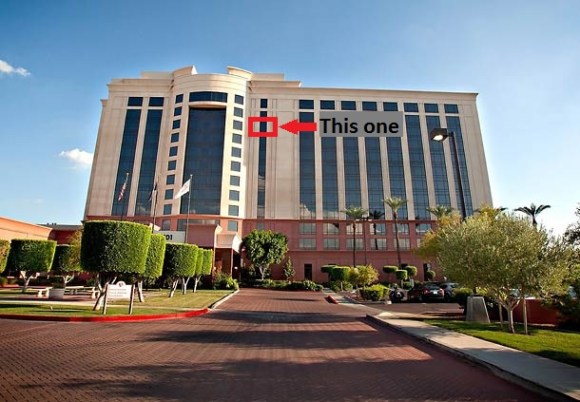
The window looks skinnier than most of those on the front of the hotel. Based on the angle of the hotel compared to the street, it doesn’t appear to be one of the smaller ones on the half-moon extending out of the left side. Therefore, I’m guessing it has to be one of the very skinny windows just to the right of the half-moon. Since those windows are, in turn, right next to a section of the facade without any windows, I’m guessing these windows are for guests waiting for the elevator. Some eyeballing the distance from the top of the building across the street to the horizon, I’m guessing the 10th floor, but I’m not too confident about that. See the attached image in case my description is not sufficient:
hotel

A Phoenix native was tempted to head down to the scene:

I recognized Piestewa Peak right away (formerly known as Squaw Peak), then used the antenna in the distance to figure out that it had to be taken from the airport Marriott on 44th St and Belleview in Phoenix, AZ. As that’s only about a mile from my house, I considered getting in the car and going there to figure out the room. Then I realized it’s the weekend, so I opened a bottle of wine instead. Totally bookworthy.

One more:

There’s no way on Earth I can win this one, since the “BALSZ TIGERS” sign is going to completely give away the location and people are going to spend hours triangulating the exact position of the window in the Phoenix Airport Marriot. Of the 1000+ entries that guess that much correctly, I’m assuming that 300+ will get the correct room. Of those, 100+ will guess how far the photographer was standing from the window, 50+ will know the species of house plant blocking the view, and 5 will somehow deduce the photographer’s blood type. The winner will be the one who did all this successfully 83 times without winning.

Indeed, this week’s winner has correctly guessed numerous previous contest without ever clinching the prize. His detailed entry:

189-winner-images

This one was too easy. The Balsz Tigers banner is easily visible along the major thoroughfare, so a Google search for that turned up Balsz Elementary in Phoenix. When you look at that in Google Maps, it’s clear that Balsz Elementary is the building in the left of the VFYW, and the picture is taken from the Marriott. (See image #1 for the range of the view shown in the VFYW.) So this is going to be an issue of getting the right picture.

A view from the other end of the side street visible on the right in the VFYW makes it clear that the center of the Marriot looks slightly different.  (See image #2.)  A view from N 44th Street, basically a reverse of the window view, confirms that the near windows of the center part would fit the picture.  (See image #3) Although the hotel is positioned at an angle to the street, the VFYW seems to be even more angled, indicating that the windows facing more toward N 44th Street would fit.

Then it’s an issue of which floor. I honestly have no idea, so I’m just guessing the window I’ve indicated in image #4, attached.

The submitter of the contest photo verified the exact window for us and added:

I was there for a science fiction convention called Dark Con that featured Adrian Paul of “Highlander” and world-famous science fiction author Gini Koch. After I noticed this week’s contest was based on my photo, it took great restraint on the part of my best friend to keep him from entering. We play every week. I even bought him a Dish subscription to make it easier!

Many thanks to the hundreds of contestants this week, most of whom were playing for the first time. And don’t worry, next week will be much more challenging!

(Archive)

Can You Repair A Shattered Glass?

Stephen Glass, the fabulist who wrote dozens of false and libelous stories for TNR and other magazines in the ’90s, is still having trouble getting his new career as a lawyer going; the California Supreme Court just denied him admission to the state bar. David Plotz, who strongly dislikes Glass, calls the decision “misguided and cruel”:

The Supreme Court also worries that Glass would fabricate documents and deceive clients, a bizarre and backward conclusion. The very first thing anyone knows about Glass is that he was a liar and a fraud. Any judge he appears before will know: This is that lying journalist. Any opposing counsel will be aware: This is Shattered Glass. He’s not trying to sneak into courtrooms under a new name: He’s Stephen Glass. He is a flashing red highway sign. This is what happens when you Google him. Glass is far less likely than most lawyers to try to sneak something past a judge, because he’ll know that every single word he speaks and document he signs is suspect.

Bmaz agrees:

[W]hile what Glass did as a journalist is appalling, the unyielding and scathing tone of the California Supreme Court seems to be somewhat shocking in the face of the common story of America being a land of redemption and second chances. Especially when the lower tribunals, that heard the real evidence, found otherwise. I guess second chances and redemption are only for banksters and war criminals, but not for a guy who made up some lousy digital media stories. You don’t have to like Stephen Glass to see the disconnect here as to who in American life really gets the shots at second chances.

I hired Glass as a personal assistant way back when.

In that job, he was terrific, as well as meticulous and charming and, in retrospect, sociopathic and manipulative. Mercifully, I had gone from TNR when he was wreaking his terrible damage to the place. I still feel a lot of anger about him and what he did, but I cannot but agree with David. The man at some point deserves to be able to start over. He’s been working as a paralegal in a law firm for ten years; he has passed the bar; there have been no allegations of unethical conduct in his current job. Maybe this says something about the pecking order, as this quote from the NYT suggests:

The question is, Are we prepared to say as lawyers that a man who is no longer considered moral enough to be a journalist is moral enough to be a lawyer? If people flame out in journalism because of dishonesty, is the law open to them? I think the answer is no.

Would journalists say that of an ethically challenged lawyer seeking to write about the news? I doubt it.

The Republican Alternative To Obamacare

Avik Roy summarizes key parts of the Senate plan unveiled yesterday:

While the plan would repeal Obamacare, it would preserve some of the law’s most popular features, such as its ban on lifetime limits on insurer payouts, and its requirement that insurers cover adult children younger than 27. It would replace Obamacare’s premium hike on young people, known as age-based community rating, with a more traditional 5:1 rating band.

It wouldn’t maintain Obamacare’s individual mandate, nor its requirement that insurers offer coverage to everyone regardless of pre-existing health conditions. Instead, the plan would require insurers to make offers to everyone who has maintained “continuous coverage,” while aiding states in restoring the high-risk pools that served those who insurers won’t otherwise cover. Subsidy-eligible individuals who failed to sign up for a plan would be auto-enrolled in one priced at the same level as the subsidy for which they qualified.

Carpenter notes one major drawback:

[T]hose with pre-existing conditions that fail to maintain continuous coverage at any time could be denied coverage. Nearly 90 million Americans have a pre-existing condition. That’s quite the crack to fall through.

Beutler calls the proposal a “mess”:

If Republicans had offered this plan as an opening bid in 2009, they might have found Democrats willing to make a counteroffer and negotiate toward some kind of compromise — or they might have knocked the whole legislative process off the rails. But in 2014, a plan that devolves crucial aspects of Obamacare without any inducement for Democrats is a joke.

Yglesias thinks “key thing about this is that it doesn’t envision radically remaking the health care system along free market lines”:

Relatively to the status quo that existed in 2009, it would constitute modestly remaking the health care system along liberal lines. Most of all, as a political document it reflects an appreciation of the overwhelming political power of the status quo. You can’t kick those 25-year-olds off their parents’ insurance plan. You can’t deny the currently insured the peace-of-mind that comes from knowing that getting sick won’t make them uninsurable. You can’t change tax policy in a way that’s too disruptive. And this plan isn’t going to pass in 2014. It’s not going to pass in 2015. And it’s not going to pass in 2016. By 2017, Medicaid expansion and subsidized exchange plans will be the new status quo. Are the Coburns, Burrs, and Hatches of 2017 really going to be willing to blow that up?

Sarah Kliff’s related thoughts:

Obamacare has become the starting point for negotiations. This wasn’t really true a few years ago, or even a few months ago, before the health-care law’s insurance expansion started. It’s interesting that this proposal takes some of the contours of Obamacare and works around them, such as ending pre-existing conditions and continuing dependent coverage up to age 26. The health-care law’s $700 million in Medicare cuts stick around, too. Even though it’s a replacement plan, it also acknowledges that Obamacare isn’t totally going to disappear.

Yuval Levin talks up the plan:

It can … be called a very encouraging sign that congressional Republicans know that they will need a serious Obamacare replacement if they are to persuade the public that Obamacare must be repealed. It’s especially encouraging that Orrin Hatch – who is the ranking Republican on the Senate Finance Committee (the key committee with oversight for federal health-financing policy) and would likely become chairman of that committee if Republicans took over the Senate next year – is among the sponsors of this proposal. The ideas here are also very much in line with those laid out over the years by Paul Ryan, who is likely to become chairman next year of the equivalent House committee, the Ways and Means Committee.

This proposal is just a step, of course – an imperfect and an incomplete step, like any legislative proposal. But it is a major and important step, and a very encouraging one.

Philip Klein’s bottom line:

Ultimately, the new Coburn-Burr-Hatch plan would not usher in a free market for health insurance in the United States, which would require fully ending the distortion of the tax code and removing far more regulations. What it does do is offer individuals more freedom than now exists under Obamacare.