A Symphony From The Heart Of The City

Stephen Walsh praises Brian Moynahan’s Leningrad, a book on how the siege of the city influenced the work of composer Dmitri Shostakovich:

Shostakovich, a native of Leningrad/St Petersburg, was in the city for the first few weeks of the siege, and by the time he was flown out in early October 1941 he had composed the bulk of three movements of his Seventh Symphony. He already saw it as a symbol of the city’s defiance, and in Moscow he told an interviewer: ‘In the finale, I want to describe a beautiful future time when the enemy will have been defeated.’

It had become a Leningrad Symphony in all but name. Its composer had been photographed on the roof of the Conservatoire in a fireman’s outfit hosing down a (non-existent) conflagration. Now, in his absence, Leningraders struggled to concerts played by emaciated, half-dead musicians in freezing halls. Music had become an emblem of that peculiar Russian ability, honed through centuries of repression and hardship and in the end disastrously underestimated by Hitler, to slow down their mental metabolism almost to a standstill and survive like aesthetically tuned cattle in conditions that would drive others to breakdown and insanity.

How else to explain the successful performance of the Seventh Symphony that following August? It was a full-blooded 70-minute work for an orchestra of more than 100, performed by a radio band reduced by death and infirmity to a mere handful of sickly regulars, augmented by military-band players from the battlefront and by whatever extra wind and string players could be drafted in from the city’s dilapidated musical substrata, and directed by a conductor — Karl Eliasberg — who could himself barely hold a baton or stand upright.

Gavin Plumley discusses the piece with Semyon Bychkov, a conductor born in Leningrad shortly after the siege who is now conducting the symphony:

The first image that comes to Bychkov’s mind while preparing is that of his mother, as a giddy school leaver on 22 June 1941, 11 years before he was born. “Throughout the country, graduation balls are taking place for those finishing high school. It’s a big celebration. In Leningrad, it’s the White Nights,” he says, referring to northern Russia’s famed twilit season, “so the city is bursting with young people, by the river, partying, celebrating. Some are dreaming of university or going to the conservatoire. The future is very beautiful and very mysterious.” It’s a scene described, in effect, in the lusty opening bars of the symphony. “That first stride has a real sense of energy and optimism,” Bychkov notes, “and when the second theme comes, it’s a dream put into sound.”

Update from a reader:

The documentary Russia’s War: Blood Upon the Snow features the story of the Leningrad symphony (available thanks to Youtube, from 19:49 to about 22:14).  It also contains absolutely staggering and heartbreaking footage (at 20:48) of a repeat performance held 25 years after the premiere, held in the same concert hall, with the same musicians and the same original audience members, each sitting in their original spot. The hall is almost empty, as nearly all the original attendees have since died – many of them, undoubtedly, among the million or two Leningraders who died during the siege.

(Video: Shostakovich plays a fragment of his Seventh Symphony in 1941)

A Well-Adjusted Psycho

James Fallon, a neuroscientist diagnosed as a psychopath, discusses his idiosyncrasies:

I treat strangers pretty well—really well, and people tend to like me when they meet me—but I treat my family the same way, like they’re just somebody at a bar. I treat them well, but I don’t treat them in a special way. That’s the big problem.

I asked them this—it’s not something a person will tell you spontaneously—but they said, “I give you everything. I give you all this love and you really don’t give it back.” They all said it, and that sure bothered me. So I wanted to see if I could change. I don’t believe it, but I’m going to try.

In order to do that, every time I started to do something, I had to think about it, look at it, and go: No. Don’t do the selfish thing or the self-serving thing. Step-by-step, that’s what I’ve been doing for about a year and a half and they all like it. Their basic response is: We know you don’t really mean it, but we still like it.

I told them, “You’ve got to be kidding me. You accept this? It’s phony!” And they said, “No, it’s okay. If you treat people better it means you care enough to try.” It blew me away then and still blows me away now.

Previous Dish on non-violent psychopathy hereherehere, and here.

Is Facebook Dying?

FB-death

A study suggests so:

By drawing similarities between Facebook’s rapid adoption and the proliferation of an infectious disease, researchers at Princeton have devised a model that predicts Facebook will lose 80% of its users by 2017.

“Ideas, like diseases, have been shown to spread infectiously between people before eventually dying out, and have been successfully described with epidemiological models,” write authors John Cannarella and Joshua A. Spechler in an article recently posted to the preprint database arXiv. The basic premise is simple: epidemiological models, the researchers argue, can be used to explain user adoption and abandonment of online social networks, “where adoption is analogous to infection and abandonment is analogous to recovery.”

Mashable thinks this logic is fundamentally flawed:

It all starts with ideas — or rather, the notion that ideas are like diseases. Ideas “have been shown to spread infectiously between people before eventually dying out, and have been successfully described with epidemiological models,” the study says. That sounds rational until you consider all the ideas that have spread and stuck — such as democracy, electricity and the theory of evolution.

John Aziz criticizes the study for comparing Facebook to MySpace:

MySpace died as it became clogged up with spam, was neglected and misunderstood by its new corporate owner, and after its users migrated to other social networks, particularly Facebook.

Facebook doesn’t necessarily face any of these problems. While Facebook has introduced advertising and while spam is a problem, Facebook has done a reasonable job at fighting spam. It has thus been far less intrusive than the huge quantities of spam that infested MySpace in its dying years. Another big difference: At Facebook, founder Mark Zuckerberg remains in charge, and the company is making profits.

The Jury Is Out On Heightened Scrutiny

This week the 9th Circuit ruled that jurors cannot be excluded for being gay. Mark Joseph Stern analyzes the meaning:

In one sense, the court’s ruling was inevitable. In 1986, the Supreme Court found that attorneys couldn’t dismiss jurors based exclusively on race, holding that both defendants and jurors themselves have a right to a racism-free voir dire. Ten years later, the court extended that principle to female jurors, adding a new justification to the mix: Justice Harry Blackmun proclaimed that gender stereotypes are “rooted in and reflective of historical prejudice” and thus serve no valid purpose in jury selection. Anti-gay stereotypes are, of course, rooted in similar “historical prejudice”—a “deplorable tradition of treating gays and lesbians as undeserving of participation in our nation’s most cherished rites and rituals,” in the words of the 9th Circuit. The court, then, had no choice but to shield the jury box from these irrational prejudices.

Yet in another sense, Tuesday’s decision is a critical and novel development in the legal battle for gay rights. The Supreme Court protected blacks and women from prejudiced peremptory challenges because they’re both constitutionally protected classes; in other words, any law that discriminates against them is subject to heightened judicial scrutiny. But the court has never actually declared gays a protected class.

Why heightened scrutiny matters:

Judge Reinhardt called for “heightened scrutiny” in such discrimination cases – a move that shifts the burden of proof off of the plaintiffs, and potentially makes challenges to employment protection policies or state bans on same-sex marriage, for example, easier to win.

“The difference is night and day,” said James Esseks, director of the American Civil Liberties Union Lesbian Gay Bisexual Transgender & AIDS Project. Under heightened scrutiny, “any law that treats gay people differently is presumed unconstitutional; it no longer gets the benefit of the doubt.”

Noah Feldman thinks the court probably went too far:

Equality for gay people is a pressing imperative of civil liberties. But progress has been achieved so far without relying on a forced legal analogy to discrimination against blacks and women. Those forms of discrimination have structural economic roots that make them particularly persistent and pernicious. Homophobia, by contrast, is a nasty social attitude that can be eventually reduced to the point of this disappearance — and when it is gone, gay people will be truly equal. That day is coming, with the help of the courts and common sense. Heightened scrutiny can be reserved for those people who really need it.

The Robots Took Er Jerbs!

Automation

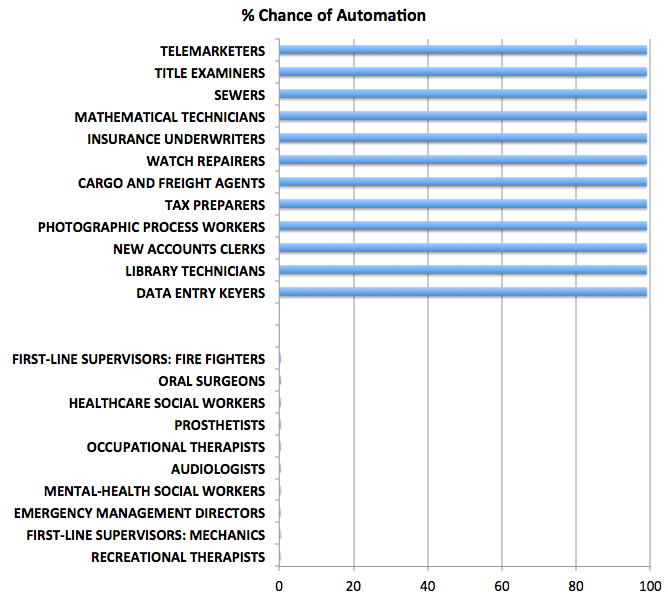
Prompted by a new study predicting that as many as half of all American jobs might be lost to computers and robots in the next few decades, Derek Thompson stops to consider how our view of automation is changing:

We might be on the edge of a breakthrough moment in robotics and artificial intelligence. Although the past 30 years have hollowed out the middle, high- and low-skill jobs have actually increased, as if protected from the invading armies of robots by their own moats. Higher-skill workers have been protected by a kind of social-intelligence moat. Computers are historically good at executing routines, but they’re bad at finding patterns, communicating with people, and making decisions, which is what managers are paid to do. This is why some people think managers are, for the moment, one of the largest categories immune to the rushing wave of AI.

Meanwhile, lower-skill workers have been protected by the Moravec moat. Hans Moravec was a futurist who pointed out that machine technology mimicked a savant infant: Machines could do long math equations instantly and beat anybody in chess, but they can’t answer a simple question or walk up a flight of stairs. As a result, menial work done by people without much education (like home health care workers, or fast-food attendants) have been spared, too.

But perhaps we’ve hit an inflection point.

As Erik Brynjolfsson and Andrew McAfee pointed out in their book Race Against the Machine (and in their new book The Second Machine Age), robots are finally crossing these moats by moving and thinking like people. Amazon has bought robots to work its warehouses. Narrative Science can write earnings summaries that are indistinguishable from wire reports. We can say to our phones I’m lost, help and our phones can tell us how to get home.

Kenneth Anderson is skeptical that the coming advances in AI will destroy human jobs without creating new ones:

The “this time is different” view seems to me overstated – as so often the case with AI, as Gary Marcus has noted. One should never rule out paradigm shifting advances, but so far as I can tell, the conceptual pathways as laid down for AI today are not going to lead – even over the long-run – to what sci-fi has already given us in imagination.  Siri is not “Her” – as even Siri herself noted in a recent Tweet.  For the future we can foresee, in the short-to-medium term, we’ll be more likely to have machines that (as ever) extend, but do not replace, human capabilities; in other cases, human capabilities will extend the machines.  The foreseeable future, I suspect, remains the process (long underway) of tag-teaming humans and machines.  Which is to say (mostly), same as it ever was.

The significant new job categories (I speculate) run toward skilled manual labor of a new kind. The “maker movement”; new US manufacturing trends toward highly automated, but still human-run and staffed factories; new high technology, but still human-controlled, energy exploitation such as fracking; complex and crucial robotic machines under the supervision of nurses whose whole new skill sets put them in a new job category we might call nursing technologist – these are the areas of work that point the way forward.

Drum zeroes in on why people would rather not think about the potential AI future:

Conservatives don’t like the idea that it almost inevitably will require a much more redistributive society. Liberals don’t like the idea that it might make a lot of standard lefty social programs obsolete. As a liberal believer, I’ll put myself in the latter camp. I’m not willing to give up on the standard liberal social program because (a) I might be wrong about AI, (b) if I’m not, we’re still going to need variations on these programs, and (c) we still have to deal with the transition period anyway. I assume conservative believers might feel roughly the same way.

A Fiscal Hawk With Expensive Taste

In an 14-count indictment, prosecutors tell the tale of the bizarre, years-long relationship that former Virginia governor Bob McDonnell and his wife Maureen had with Jonnie Williams, the CEO of a pharmaceutical company peddling an anti-inflammatory diet supplement. The first couple accepted gifts from “JW”, as he’s referred to in the indictment, of everything from $15,000 for their daughter’s wedding to golf trips, vacations, and loans to prop up the couple’s rental properties. Perhaps one of the weirdest highlights of the indictment (and there’s plenty of weird there) is a proposal to test Williams’s cure-all supplement on Virginia civil servants:

In August 2011, following an email from Bob McDonnell to Virginia’s secretary of health, Maureen McDonnell met at the Executive Mansion with Williams and one of the secretary’s senior policy advisors. At that meeting, according to the indictment, Williams discussed the idea of having Virginia government employees use Anatabloc, Star Scientific’s anti-inflammatory dietary supplement, “as a control group for research studies.” This wasn’t the only time this kind of idea came up. In October 2011, according to the indictment, Maureen McDonnell accompanied Williams and a research scientist who consulted for Star Scientific to a company event in Grand Blanc, Mich. … The scientist later emailed Maureen McDonnell a summary of their discussions. In it, he suggested it might be useful “to perform a study of Virginia government employees… to determine the prevalences [sic] of autoimmune and inflammatory conditions.”

Byron York wonders why the hell McDonnell didn’t have the patience to wait for the perfectly legitimate corruption that awaited him after he left office:

A former governor can make a lot of money. He can cash in on the influence he still has after leaving the statehouse. But if the indictment is correct, the McDonnells, in debt and wanting to drive Ferraris and wear Rolexes and play golf at swanky courses, couldn’t wait, even four years, for the payoff. And that is the story of United States v. Robert F. McDonnell and Maureen G. McDonnell.

The petty sleaze is what does it for Amy Davidson:

Like the maddest sort of sex scandal, the greed is both unbounded and imaginatively constrained. A catering bill? Two golf bags? It’s like hearing about a politician sexting or seeing a prostitute and asking oneself, He gave it all up for that? … It’s the sort of scandal that, in all its tackiness, can be an indicator of a deeper mess—a gold Oscar de la Renta canary in the political coal mines.

The McDonnells’ reputations may be ruined, but making the charges stick will be much harder:

It’s all very distasteful. But Bob McDonnell has a strong argument when he says he didn’t do anything illegal. It’s acceptable under Virginia law for politicians to accept gifts, if they are properly reported. And while the McDonnells both did things aimed at helping Williams’ business (such as having a launch party at the mansion and endorsing the supplement), it’s very, very hard to prove there was a quid pro quo. McDonnell did not push legislation to help Williams or, according to the indictment, participate in some direct and obvious payback.

Needless to say, the Republican’s misdeeds contrast pretty strongly with his political positions:

Perhaps another lesson is that fiscal conservatism is a myth for many who spout it most vociferously. The man who campaigned on fiscal-minded sobriety, largely charmed the commonwealth with his soft-spoken political style, and achieved hugely popular reforms on kitchen-table issues—including mass-transit reform, pension reform, and education—was fundamentally incapable of walking the walk when it came to his own life: He successfully governed like a sober fiscal conservative while he opted to live like he was Lord Grantham.

Which Alec MacGillis thinks hurt the Republican brand:

[I]t’s precisely McDonnell’s remaking of himself into a pro-business conservative that makes his indictment on federal corruption charges so potentially damaging to the Republican Party. The party’s establishment leaders, and their associated boosters in the conservative press and think tankery, have tried hard to differentiate responsible, business-minded Republicans who care only about cutting taxes and blocking the expansion of Medicaid from Paleolithic social-issues conservatives like Todd Akin and Richard Mourdock who prattle on about “legitimate rape” and pregnancies from rape being “something that God intended to happen.”

Mark Kleiman believes the lesson here is about the American obsession with wealth and status:

One of the many problems that flows from increasing inequality of income and wealth is that the standards of the rich become the ruling standards. Mrs. McDonnell obviously felt that she would be disgraced if she appeared at her husband’s inaugural ball in the sort of dress an honest public servant’s wife could afford, when all the fundraisers’ wives – to say nothing of the female fundraisers – would be wearing a large fraction of the median annual household income. Does that excuse her committing extortion to get an Oscar de la Renta dress? Of course not. But it testifies to a corruption of manners that goes far deeper than corruption in office.

Update from a reader:

I am as appalled at the greed of former Gov. McDonnell and his wife as anyone, but Kleiman’s article about the couple has a real historical clunker in it: “But there’s one deeply, deeply twisted element to the story that ought to worry all of us. McDonnell was the Governor of Virginia, the successor of Jefferson. And he wanted a Rolex watch.” Thomas Jefferson was perpetually in debt, thanks in large part to his habit of living well beyond his means. This is even acknowledged on the official Monticello website.

“We Will End The Failed War On Drugs”

On Tuesday, Chris Christie spoke out against the drug war:

We will end the failed war on drugs that believes that incarceration is the cure of every ill caused by drug abuse. We will make drug treatment available to as many of our non-violent offenders as we can and we will partner with our citizens to create a society that understands this simple truth:  every life has value and no life is disposable.

Erik Altieri wants the Jersey governor to back up his words with deeds:

While critiques of the War on Drugs are always welcomed (Governor Christie had previously made similar statements), it is hard to take his comments seriously when you consider his record regarding sensible reforms to New Jersey’s marijuana laws.

The same day he was calling for an end to this failed policy, two pieces of legislation that would have made pragmatic changes to New Jersey’s marijuana laws were sitting on his desk awaiting signature. The first would have allowed state farmers to receive licenses for industrial hemp cultivation as soon as the federal government changed the national policy on the issue. The other, Senate Bill 1220, would have ensured patients enrolled in New Jersey’s medical marijuana program would be able to receive organ transplants and not be disqualified because of their medicinal use of cannabis. You would think that a governor who just stood at a podium and lambasted our prohibition as a failed policy, would immediately leave the stage and eagerly sign these pieces of legislation.

He didn’t. These two important measures sat on his desk, unsigned and were ultimately doomed to failure by Governor Christie’s pocket veto.

Balko calls Christie’s declaration “pretty significant” but adds caveats:

Though Christie admirably wants to end the cycle of incarceration, he also supports mandatory treatment for recreational drug users, even first-time offenders. That doesn’t exactly scream freedom. (The overwhelming majority of recreational drug users aren’t addicts, and aren’t in need of treatment.) And while New Jersey technically legalized medical marijuana nearly four years ago, Christie has done everything in his power to prevent it from actually happening. Finally, in 2012, Christie vetoed a “good Samaritan” bill that would have protected from criminal prosecution someone who calls 911 to report a drug overdose.

Sullum joins the conversation:

Although Christie’s version of the drug war may prove to be less bad than the ones waged by Bill Clinton and Barack Obama (whose drug czars made similar noises), it should not be confused with drug peace, which requires renouncing the use of force against people whose only crime consists of consuming politically disfavored intoxicants or helping others do so.

Upward Mobility Is … The Same As Ever?

Economic Mobility

Leonhardt summarizes a new study:

The odds of moving up — or down — the income ladder in the United States have not changed appreciably in the last 20 years, according to a large new academic study that contradicts politicians in both parties who have claimed that income mobility is falling. …

Raj Chetty, a professor of economics at Harvard and one of the authors, said in an interview that he and his colleagues still believed that a lack of mobility was a significant problem in the United States. Despite less discrimination of various kinds and a larger safety net than in previous decades, the odds of escaping the station of one’s birth are no higher today than they were decades ago.

Jared Bernstein yawns:

The conventional wisdom, as I’ve stressed in many places for many years, is that is has neither decreased nor increased.

In that regard, it’s surprising for this stability to be labeled a surprise, or, as the WSJ puts it, a finding that “muddles the debate” on mobility or inequality.  To be fair, researchers and politicians do sometimes lapse into claiming that the rate of mobility has decreased, and I know of one quality paper that finds a slight, though statistically significant, decline in the rate (here), but one paper doesn’t change the CW.  Most economists in this debate recognize that the rate of mobility has been relatively stable—nothing at all wrong, and a lot right, with a high quality new paper confirming this stable trend.  But it’s not new so I’m not sure why it’s news.

Heather Boushey’s analysis:

In terms of specific questions I’m left with after reading the paper, I’ll start with the tantalizing cliffhanger. The authors don’t yet have much income data for children born after 1986. As an interim measure, they look at college attendance rates. College attendance is correlated with later earnings, so this makes sense. But, of course, we don’t know yet what that relationship will look like for students who just graduated, especially for those starting their careers in the Great Recession.

Second, if Chetty and his co-authors are correct, the variation in intergenerational mobility is much greater within the United States than across time. In the United States, it matters more where you were born than when you were born. So, what are some places doing right (and what are others doing wrong)? What’s so special about Northern California or Salt Lake City?

Ezra passes along the map above (interactive version here), which shows that “geography is a massive predictor of future mobility.” J.D. Vance takes the debate in a different direction:

There’s a risk here of exaggerating the authors’ conclusions.  They didn’t find that opportunity for the poor is stable and robust, but that it’s stable and endangered.  For those who care about the American Dream, there’s much work to do.  There just isn’t more work to do now than there was a few decades ago.  That’s hardly consolation.

Still, if it doesn’t change the fact that upward mobility is something we need more of, it should change the conversation about why we don’t have it.  The story of many on the left is that America was humming along nicely until Reagan rigged the system for the rich.  Carter’s loss ended the hopes of the working class.  It was a convenient story, but now we know it’s basically false.

The Genius Of AIPAC’s Strategy

Iran Opinion

From this new poll, it appears Americans support both the agreement with Iran and exactly the sort of provisions that would derail it:

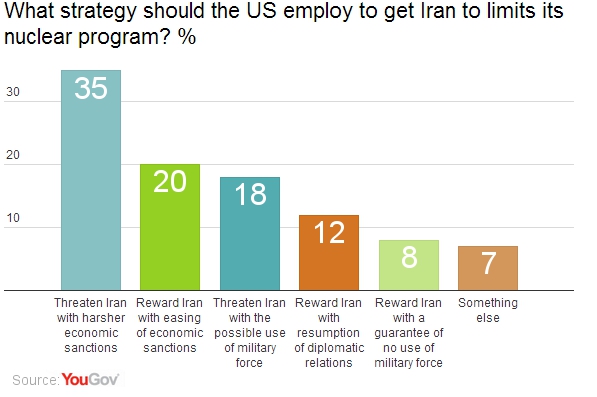
By 58% to 25%, Americans approve of the current international agreement that would freeze Iranian nuclear development in return for the easing of sanctions.  But more than half think the best way to get Iran to limit its nuclear program is to threaten it with consequences – either military or economic – if Iran does not limit its nuclear program.

This is the genius behind AIPAC’s bill to kill in advance any deal with Iran. For those who do not read the actual bill, or have a sketchy memory of the last five years, it seems perfectly rational to increase sanctions until Iran cries uncle. The polling question that got the result above was a non-time-related: “What strategy should the US employ to get Iran to limit its nuclear program?”

But that has been the policy and it brought Iran to the negotiating table. Americans are right about that principle. But there comes a point at which the sanctions have worked and we have the result we said we were looking for: a frozen program and a negotiation. The question now is: would moving the goalposts after we have gotten them to the negotiating table and have already frozen their nuclear program’s advance, help get a solid deal? If you unpack it that way – and it is the only honest way to unpack it – you see how shrewdly duplicitous AIPAC’s strategy is.

And, of course, AIPAC’s bill would not just threaten new sanctions; it has several provisions that open up past actions of Iran to new sanctions; and it raises many broader questions about Iran’s regional power apart from the nuclear issue. In every case, as Edward Levine has definitively shown, moving the goalposts in such a way now would easily wreck the possibility of any deal at all.

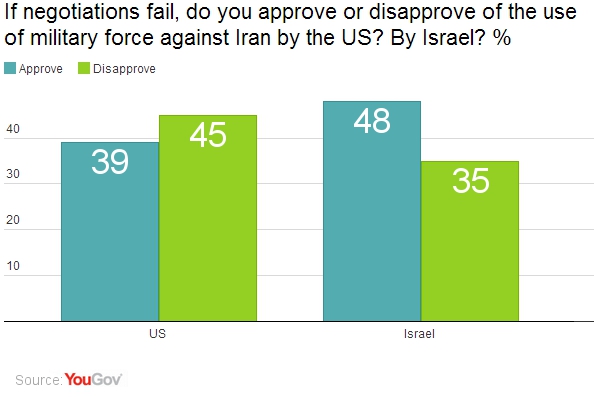
Mercifully, the AIPAC bill seems to be on hold for now. But AIPAC’s fanaticism on this should not be under-estimated. They are determined to get a new war against Iran, however they can, and you can see that when you read the actual bill. For example, take the poll’s finding on what should happen if the talks were to fail, as AIPAC wants:

iran2

You’ll see that a majority is against the US starting a new war in the Middle East (although it’s disturbingly small), although they would not disapprove of Israel’s taking unilateral action. But the new sanctions bill would solder Israel’s war with America’s in advance, and commit the United States to a pre-emptive war if Israel were to decide to launch one. Here’s the key paragraph 2 (b) (5):

It is the sense of Congress that — if the Government of Israel is compelled to take military action in legitimate self-defense against Iran’s nuclear weapon program, the United States Government should stand with Israel and provide, in accordance with the law of the United States and the constitutional responsibility of Congress to authorize the use of military force, diplomatic, military, and economic support to the Government of Israel in its defense of its territory, people, and existence;

Notice the key word “military support” in that instance. AIPAC, it seems to me, is trying to get the US Senate on record now not only to derail any chance of a negotiated settlement but to back any future pre-emptive war by Israel to damage Iran’s nuclear infrastructure. The phrase “legitimate self-defense” is difficult to parse, I’ll grant you. But when one country (Israel) already has a huge nuclear arsenal outside the Non-Proliferation Treaty, and one (Iran) has none, and the country with the nukes attacks the country without them, “legitimate self-defense” is an absurd construction. What the AIPAC bill does is therefore effectively delegate the American president’s and Senate’s deliberation on war and peace to a foreign government. In advance. It effectively makes Israel the arbiter of America’s fate in the world.

I believe that the American people care (rightly) about Israel’s security and survival. But I do not believe that they want the US to contract out its foreign policy – especially in a crucial area of war and peace – to any country other than their own.

Christie’s Nosedive

Christie Favorables

Benen flags a new poll:

The above chart is from the poll’s internals (pdf), showing Christie’s support over the course of four years. Note, the governor enjoyed steady-but-not-overwhelming popularity for a long while, only to see his support soar with the Sandy crisis.

According to the new data, that bump has now evaporated. Also note, the latest Quinnipiac poll offers some additional bad news – independents seem to be moving away from Christie rather quickly, which offered results roughly in line with the Pew Research poll we discussed yesterday.

Ezra compares Christie to LBJ:

President Barack Obama so often seems powerless before an intransigent Congress that it’s become common to hear people yearn for an LBJ-like executive — one who knows how to get things done. “LBJ-nostalgia is a reaction to Barack Obama’s presidency,” wrote the Economist. That nostalgia, however, is focused more on LBJ’s victories than on his methods. If the president tried to wield power in a similar fashion today, he would be driven from office.

Christie has been a beneficiary of LBJ nostalgia.

He’s a tough Republican governor in a blue state facing a Democratic legislature. He yells at people who oppose him. He swaggers across the national stage. He gets things done — including big things, such as pension reform — which encourages people to believe that maybe, just maybe, he’s a political leader who could make Washington work again.

Jon Chait instead compares Christie to Nixon, who “happily cut deals with Democrats in Congress.” Chait sees “no reason why a politician can’t abuse power and cooperate with the other party”:

Working with a legislature controlled by the opposite party is a shrewd way for an executive to maximize his power and influence. Genuine ideological opposition may prevent such deals, but if your only goal is power and influence, then you’re less likely to let that stop you. Indeed, the sort of threats and rewards Christie characteristically deploys would have little force if he were reliably partisan. It is only his willingness to cross party lines to help pliant Democrats — or punish disagreeable Republicans, like Tom Kean Jr. — that gives him the flexibility to be an effective bully. A reliable partisan would be locked into alliances with his fellow partisans, and locked into rivalries with the opposing party.

Barro feels that, on plenty of occasions, Christie was just doing his job:

I’ve seen a lot of “shocked, shocked” interviews with New Jersey politicians over the last few weeks, in which they are stunned to discover that political support for the governor might influence where a DMV office gets located or whose calls get returned. But those rewards and punishments are tools a smart executive uses to build legislative coalitions, pass budgets and policy reforms, and keep the state running smoothly. They are how Republicans and Democrats can work together effectively.

New Jersey residents shouldn’t want a governor whose staff causes traffic jams on purpose. But they shouldn’t want a governor who doesn’t try to instill favor in his allies and fear in his opponents — unless they want an end to bipartisanship.