Young Catholics Revolt, Ctd

The protests at Eastside Catholic High School, sparked by a gay vice principal being fired for getting married, have caused the school’s president to resign. Dreher reflects on the news:

This is big, it seems to me. Notice that the school is private, not archdiocesan; it’s interesting to think of how the archdiocese would have handled the situation. Still, the school identifies itself as Catholic, and it’s a big deal that protests by students, parents, and alumni drove the principal to resign. She probably did the right thing, inasmuch as she had apparently lost the ability to lead. This is an unambiguous victory for gay-rights supporters among Catholics. Catholic schools nationwide are going to be seeing a lot more of this. There has been a lot of “don’t ask, don’t tell” related to gay teachers and administrators in Catholic schools (hypocrisy is the necessary lubricant for much social life), but the legalization of same-sex marriage forces the issue.

So we now have two resignations – the chair of the board and the president. Mary Elizabeth Williams chimes in:

Sister Mary Tracy’s decision to leave may yet indicate the stirrings of true change in the church. And her choice to leave the school may have stemmed from more than just bad publicity. There may have been an element of conscience. Earlier this month, she told the school’s openly gay freelance drama instructor Stephanie Merrow that Merrow’s work status wasn’t an issue, and that’s she was “welcome” to stay on at the school. And most tellingly, she let her own students share a statement she gave to them, in which she told them, “I look forward to the day where no individual loses their job because they married a person of the same sex.”

Things are coming to a head sooner than anyone expected. I suspect Pope Francis understands this. Which makes this year’s Synod on the family and marriage a potential watershed of sorts.

$420K!

We made it! With two hours to spare. Who said stoners are sluggish?

Renew now! Renew here!

Update from a reader:

I just wanted to share a story from a stoner who made a non-sluggish subscription purchase many hours before the 4:20 deadline.

About 8 months ago, I had a small personal garden and I’d sell my excess meds on Craigslist. I was selling such small quantities that I really didn’t worry about the DEA ramming down my door, but I didn’t feel comfortable associating my actual phone number with the Craigslist ads. So I found a company that basically charged $5/month to set up dummy telephone number and forwards any calls/texts to your actual number (Protip: they also have a free version that will store all your passwords across all your various devices). Long story short, my landlord informed us she intended to put the house up for sale, and I felt it was best to remove the garden to avoid any awkward moments during walkthroughs with potential new landlords. But I kinda just forgot to cancel my $5/month subscription until the company prompted me to use the phone masking function when I was booking a plane tickets earlier. Over the same time span, I was one of the people who rationalized that I couldn’t possibly afford 20 whole dollars to read the full version of The Dish. But upon seeing your plea this morning, I decided to cancel the subscription and transfer that $5/month, which I didn’t even know I was paying, to you guys instead.

So I guess the moral of this story is that I bet a lot of your readers don’t have to give up a single thing to enjoy the full Dish experience; they just have to find money they’re spending unknowingly and put it to better use.

Finding, Ctd

Some other reactions to the new HBO series, Looking, which I reviewed yesterday. We’ll be airing your views soon as well. Eric Sasson calls it “the first truly post-DOMA show, luxuriating in the mundaneness of gay men’s lives without needing to dress them up in mainstream television’s usual tropes of same-sex marriage, gay parenting and ‘acceptance.” Emily Nussbaum reaches a similar conclusion. But many are not so impressed.  J. Bryan Lowder:

[Looking] is an almost unbearably boring television show. Alessandra Stanley of the New York Times and Rich Juzwiak of Gawker have said so directly, and more positive reviewers have still intimated as much. But the adjective, one I would normally consider critically lazy, is so apt in this case that repetition is warranted. Looking is so boring, so utterly flat in terms of narrative or characterization, so in need of occasional pauses in which to perform a few jumping jacks to bring one’s heart rate up to resting, that I would opt out entirely if we gay men—or at least gay male culture critics—weren’t contractually obliged to watch.

Mick Stingley was also bored:

Gays have largely been depicted in television and movies as either extremely fun and funny (Will and Grace; The Birdcage) or starkly sad and depressing (Philadelphia; Angels in America) so perhaps it’s time for a Hollywood portrayal of gay life as normal, tedious, and bland. Makes straight guys seem together and interesting by comparison, though. And if this show really takes off, prepare yourselves for a world of boring gay men who blend in and will probably talk to you about last night’s game and drink bourbon.

And that would be wrong because … ? Stingley’s throwback piece was updated with this note:

We apologize to anyone offended by our attempt at humor in this piece. It reflects one man’s viewing experience. He does not think all gay people are boring. Just this show, a little.

I have to say that I think, in this regard, the show is way ahead of this particular critic. In the first place, it doesn’t attempt to explain a gay show to straight readers.

It assumes we are all in the mix and that straight guys will understand – and even be diverted – by a simple dramedy about life, sex and love in a big city. Esquire is still obsessing over the gay-straight divide, while this show is past that. Equally, there’s Stingley’s dated attempt to insist that gay men really should be more fun, more super-thanks-for-asking, more witty and interesting than straight men. There’s this sentence that leaps out:

If this show really takes off, prepare yourselves for a world of boring gay men who blend in and will probably talk to you about last night’s game and drink bourbon.

For me, that is not a bug of this show, or of the gay rights movement. I have longed for the day when gay guys and straight guys can both talk about last night’s game over a bourbon, if they want to. Stingley sees the dawn of a new equality and yearns for the past. Looking looks directly into the face of the present and begins to imagine a future.

The Other Israel Lobby

J Street is fighting against the new Iran sanctions bill:

By decoupling support for Israel with support for new sanctions against Iran, the group is making it easier for lawmakers inclined to support the White House. “We’ve been working diligently on Capitol Hill and in the Jewish-American community to raise support for the president’s diplomatic efforts vis-a-vis Iran, and oppose any legislation which would threaten it,” said Dylan Williams, director of government affairs at J Street. “We feel very strongly that the current bill in the Senate would threaten diplomacy.”

J Street’s influence is also clear in the money it spends. Among pro-Israel groups, JStreetPAC was the largest single political donor during the 2008 and 2012 cycles, contributing nearly $2.7 million to federal candidates, parties, and outside groups. And some lawmakers supported by J Street have been vocal in support of the group’s position. Senate Intelligence Committee Chairwoman Dianne Feinstein, for instance, has spoken out strongly against the new Iran sanctions. As one congressional aide put it, “Those are the political calculations that are made easier when a group like J Street gives you cover.”

Sargent notes that Patty Murray and Elizabeth Warren now oppose a vote on the sanctions bill:

Those who favored a vote were far more vocal at first — as of now, 16 Dem Senators have signed on. But the continued silence of many Dem Senators signaled a broad unwillingness to join the bill, even as many were unwilling to publicly declare this to be the case, since Dems apparently see allowing negotiations to proceed, without getting a chance to vote in favor of getting tougher on Iran, as a politically difficult position to take.

If current conditions remain, a vote is starting to look less and less likely. Right now, the bill has 58 co-sponsors. On the other side, 10 Dem Senate committee chairs have signed a letter opposing a vote. Around half a dozen Dem Senators subsequently came out against it. With Murray and Warren, the number of Dems against a vote has comfortably surpassed the number who want one.

Which means the US will not be the actor in this that sabotages negotiations. Which is good for the US, Israel and Iran.

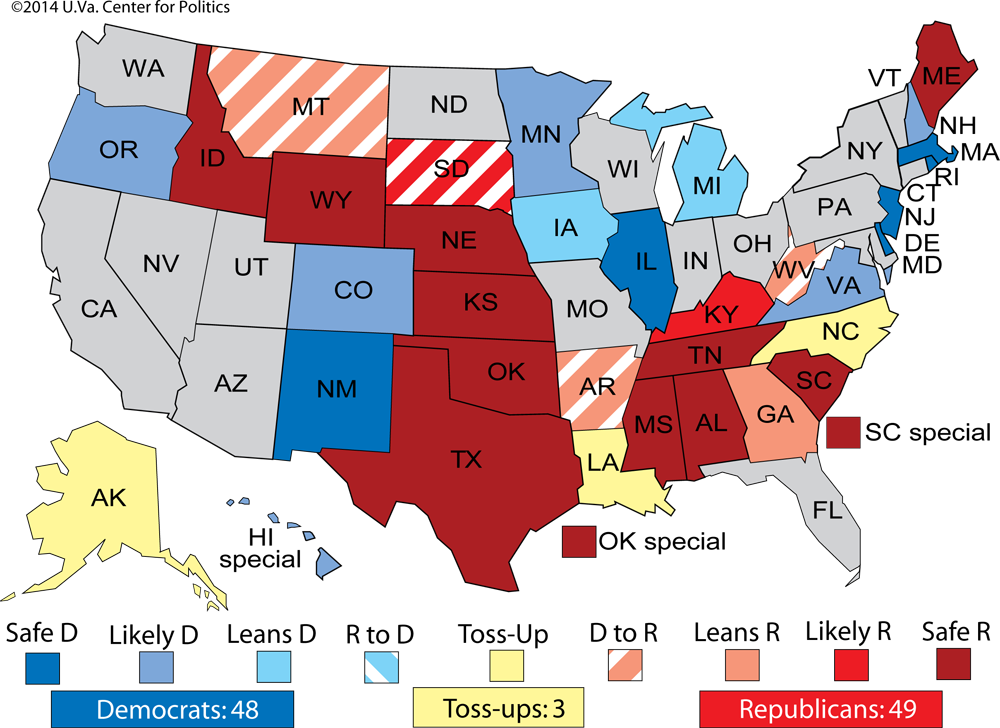
The Senate Is A Toss-Up

Senate Rankings

Sabato sizes up the Senate races:

We now favor Republicans in four Democratic-held seats: Montana, South Dakota and West Virginia, as well as — in a ratings change — Arkansas, where Sen. Mark Pryor (D) appears to be at least a slight underdog to Rep. Tom Cotton (R) in a reddening state. Assuming Republicans can win those, they have roughly even odds to win in three other states where there are Democratic incumbents: Alaska, which we’ve long classified as a Toss-up, and Louisiana and North Carolina, which we’re switching back to Toss-ups after having them in that category  for much of last year. It’s possible that the race for the Senate will come down to these three Toss-ups, with the party that wins at least two of the three controlling the Senate.

Sean Trende expects Obama’s approval numbers to have a major impact on the result:

If the president’s job approval is still around 43 percent in November — lower than it was on Election Day in 2010 — the question would probably not be whether the Democrats will hold the Senate, but whether Republicans can win 54 or 55 seats. Given the numbers right now, that should not be unthinkable.

But there’s a flip side to this. If Obama’s job approval does bounce back — which is exactly what happened in 2012 — there’s a reasonable chance that Republicans could walk away from this cycle with just a handful of pickups.

In a later post, Trende explains why the number of seats the GOP wins matters so much:

[I]f the GOP wins a bare majority in 2014, the odds are very, very good that the Senate will revert back to Democratic hands in 2016. In fact, if GOP gains are confined to the “traditional seven” Democratic races (the three open seats and the four incumbents in states Mitt Romney carried), they’re still favored to lose the chamber two years later. On the other hand, if Republicans get to 54 seats, their chances of retaining control are very good, and given the horrific playing field for Democrats in 2018, they would be extremely unlikely to lose it that year.

Burma’s Religious Civil War

Graeme Wood reports from Burma, whose glasnost has done little to ease the plight of its Rohingya Muslims:

[O]n the streets of Rangoon, Burma’s Great Unclenching is a beautiful thing. The Burma I first visited in 1998 was a snakepit of secret police and muzzled dissent. But last fall, I heard people openly express love for the leader of Burma’s democratic opposition, Burma Muslims face Buddhist FuryNobel Peace laureate Aung San Suu Kyi. On every street corner, kiosks sold dozens of vibrant tabloids free from routine censorship. Burma’s economic isolation once forced foreign visitors to pack in bundles of crisp hundred-dollar bills. Now brand-new ATMs disgorge money just like in Paris or Buenos Aires.

But Arakan state looked a lot better when things were still clenched.

Muslims and Buddhists who recently lived with each other peacefully now squat on opposite sides of barbed-wire fences and plot each other’s elimination. Old women and children too infirm to run from raiding parties have been speared or beaten to death in their homes. The fortunate ones are fleeing to other countries on overladen, leaky boats. In Sittway, the state capital, Buddhists have surrounded the old Muslim quarter, starving its residents into submission. “It’s a concentration camp,” a diplomat in Rangoon told me.

The U.S. government has sent diplomats to monitor Arakan, and at key junctures in the blossoming of bilateral relations, Obama has brought up the Rohingya issue. But the Rohingya are, so far, unlucky casualties of progress, and their ongoing ethnic-cleansing hasn’t been enough to sour Obama’s rapport with the Burmese president, Thein Sein. Nor, it seems, has it managed to stir the outrage of Aung San Suu Kyi, whose lack of comment has made activists, once piously reverent, now treat her as something between demoness and fool.

(Photo: In March 2013 in the he city of Meiktila, Muslims were attacked by Buddhist extremists. Khaing Thinzar Oos, aged 23, holds a photograph of her younger brother, who was murdered in the violence. The waves of anti-Muslim violence has paralyzed Burma and threatens the democratization of the country. By Jonas Gratzer/LightRocket via Getty Images)

Getting Johns And Prostitutes Off The Hook

Aziza Ahmed argues against zero-tolerance prostitution laws:

Abolitionists typically insist that criminalization is imperative. Some have pushed for making the sale of sex illegal. Others, however, including feminists who oppose prostitution, support a different model: outlawing only the purchase of sex. They argue that criminalizing clients will force the sex industry out of business, liberating sex workers but not treating them as criminals. …

In reality, there is no convincing evidence that punishing “johns” decreases the incidence of commercial sex. Troublingly, Sweden’s sex workers report that criminalization has simply driven the sex industry underground, with dangerous consequences: Clients have more power to say when and where they want to have sex, inhibiting workers’ ability to protect themselves if need be.

She proposes treating sex work like other forms of legitimate labor:

Today, a camp of legal experts contends that the many problems sex workers face can be addressed with labor laws. If sex work were considered a legitimate economic sector, the argument goes, where work conditions, fair wages, injury compensation, and other basic employment issues were matters of law, the sex industry and those within it would be less exposed to violence and other harms.  Under a labor model, U.S. sex workers could report health risks at brothels to the Occupational Safety and Health Administration. They could unionize and lobby for stronger protections against police harassment. In the long run, they would be viewed as citizens like any other, and their industry as a safe and acceptable one.

Recent Dish on prostitution herehere, and here.

When Pot Is A Problem, Ctd

Readers push back on Leah Allen’s piece:

It really aggravates me when people who are obviously psychologically disabled become “pot-heads” instead of what they are: psychologically disabled and also doing that thing you don’t like and you must now blame. My father has smoked weed for as long as I can remember, and he’s your typical pot-head in my experience: president of a small business (25 employees); former president of our youth sports park; coach of every sons’ (four of us) baseball and football team; named our community’s ‘citizen of the year’; an avid swimmer and runner; and his mind is sharp and quick. I struggle everyday to be as good a father and citizen and businessman as he is. He is always there emotionally or financially for anybody and everybody.

We never smoked together until I was well into my 30s, and even then, he had to be coerced. But I am also a typical pothead: a successful attorney, father of three, community volunteer, and pretty good at all of it. (Wish I could come out of the cannabis closet.)

In conclusion, to Leah Allen: I am truly sorry that your dad is so obviously mentally disabled (abandoning your children is not something I have ever known anyone do, much less a paranoid pothead) but you’re looking in the wrong place for the answers.

Another:

Part of why I love the Dish is that as you argue or advocate for something, you are not afraid of conceding certain counterpoints where they exist.  In the case of marijuana legalization (which I am 100% for and which I enjoy a few times a month myself), I greatly appreciate your airing of Ms. Allen’s account of her father’s problem with marijuana. Her father reminds me of another “sad” and chronic marijuana user I used to know – the guy who I used to buy pot from many years ago.

Like Ms. Allen’s father, on the rare occasion he was not stoned, he also had a “sharp temper,” or was anxious, irritable and just plain miserable to be around.  While stoned he was a dreamy, sort of flaky, retro-hippie type.  Yet, I am sure marijuana was a godsend to him, that he was in essence medicating himself away from his default personality with pot.

Twelve years ago I worked at the largest (at the time) academic drug abuse research program in the world, Integrated Substance Abuse Programs at UCLA.  This was where the “marijuana as gateway drug” myth was summarily put to bed.  The myth is that a perfectly average person not prone to substance abuse could smoke a joint, and then become a helplessly addicted fiend who, before you knew it, was breaking into people’s homes for heroin money.  That is simple nonsense.  What was discovered is that for addictive personalities, yes, marijuana (and alcohol) are indeed the likely, obvious first step on the road to serious drug problems.  But it was also discovered that marijuana could be enough for the addictive personality, a destination in and of itself (such as Ms Allen’s father, and my ex-pot dealer), and was ultimately far, far easier to treat than other addictions, including alcohol.

The Need To See

An NYT Op-Doc based on the audio diary writer and theologian John Hull kept after going blind:

New research offers a glimpse at how we might someday cure blindness. Printed eye cells might be the answer:

Researchers at the University of Cambridge used a standard ink-jet printer to form layers of two types of cells taken from the retinas of rats, and showed that the process did not compromise the cells’ health or ability to survive and grow in culture. Ink-jet printing has been used to deposit cells before, but this is the first time cells from an adult animal’s central nervous system have been printed. The group hopes to develop the technology into a tool for generating new tissues that can be grown outside the eye and implanted in patients with retinal damage. Alternatively, the technique could potentially be used to insert cells directly into damaged retinas during ocular surgery, says Keith Martin, a professor of ophthalmology at the University of Cambridge, who led the research.

Gene therapy also shows potential:

A team of surgeons in Oxford have used a pioneering new form of gene therapy to stop six of their patients going blind--and it’s hoped the technique could be used to treat blindness more generally. The patients all suffer from a genetic condition known as choroideremia, which causes the light-detecting cells at the back of the eye to slowly die. Patients with the condition initially struggle to see in low-light conditions, but their sight gradually declines until most sufferers lose their eyesight completely by the time they reach middle age. Worst of all, there’s no treatment. Prof Robert MacLaren and his team, however, have been experimenting with a new technique which sees them inject functioning copies of the CHM gene—known to be faulty in these patients—directly into the retina.

A Good Death, Ctd

Spurred by Julie Myerson’s story, readers share their own:

My mother had a good death. She died in 2006, two days after gall bladder surgery. The surgery was “successful” and she was at home (she lived in a retirement community). I was not there but my sister was. Mother was sitting in her living room chair working a crossword and died very suddenly. Why this was a good death: 1) she wasn’t alone; 2) it was very quick; 3) it was (apparently) painless; 4) her greatest fear – losing her faculties – did not come to pass. Everything about her death was “auspicious”, and this has made my grieving process very easy. She always said, “If I ever get to where I can’t take care of myself, just shoot me.” I wouldn’t have done this but I can certainly understand the sentiment.

America’s handling of death is horribly backward. Everyone from their late 20s on (or even earlier) should have an advanced medical directive made. If you ask doctors what end-of-life treatment regime they want, invariably they select the least intrusive and aggressive option possible – because they have seen the hideous pain wrought by aggressive treatment.

Another reader:

My Dad died of heart disease. As his heart was failing, he considered surgery (even though he was already in his 80s) and the docs would have done it but for the fact he also had COPD and they knew they would never get him off a respirator if they did bypass on his heart. So I watched him come to terms with his own death (the day before he passed, he asked his doc if there wasn’t something to be done, only to be told no). He died in the Intensive Care unit after first refusing to use a bed pan and insisting he could still walk to the bathroom, and he had his last heart attack in that way. So he went out on his own terms, and I’m proud of him for not giving in, even when he had nothing left to give.

My Mom died a couple years later of complications from Alzheimer’s. Her decline was agonizing.

There came a time when my brother and I confronted her doctor about all the various prescriptions she was still taking in the nursing home, and he agreed that some of what she was getting was no longer necessary. To some degree, that might have hastened her departure, but at the same time, she was already so far gone that it made no sense to keep pumping various medicines into her, including the drug she was taking to slow the progression of her underlying disease. She actually passed away from pneumonia, and the doctor and nursing home honored our request not to take extraordinary measures even though they had never signed a medical directive.

I was present when they both passed, and though that didn’t make it any easier (no amount of forewarning can change the pain of losing a loved one), I never regretted anything we did to make their last few months easier. I have friends who think we should have done otherwise with regard to my Mom, but they are wrong.

Another:

My father died last year at this time.  My sisters and I spent his last 3 months taking turns being at his home, taking care of him and just saying good-bye.  We always knew that he wanted a natural death, did not trust doctors and wanted zero intervention. In the last months, he was genuinely frightened that someone would intervene.  It was to the point that we could not even say the word “Hospice” as it sounded too much like the word hospital and it would send him into a panic.

Every person that was allowed to enter the house had to first promise that if he had any type of event or, frankly, looked like he was about to die they would NOT, under any circumstances, call an ambulance.  He had a brain tumor and we were essentially just waiting for the end.  I think it was the greatest show of love that we could spend those last months protecting him from the medical establishment and made sure that the end of his life was as he always believed it should be.

Many people tell me they are sorry for my father’s death.  I am not sorry at all.  He had a wonderful life.  He raised three daughters, got to see all of them married, with children and in fulfilling lives and died with his beloved wife at his side.  Nothing to be sorry about at all.  He had a good death to go with his good life.

One more:

My mother’s death also was as good as I can imagine one to be. When she was diagnosed with lung cancer at age 76, her response was something like “It’s about time.” She’d been a smoker since her college days, and had tried to give it up in her 40s but then decided to stay a smoker. I think she was relieved that she would go quickly from cancer rather than have it take years with something like emphysema – but we never discussed it.

She refused chemotherapy – it might have given her a few more months to live, but she’d have started feeling awful right away. All of her family and all but one of her friends supported that decision.

When discussing what she wanted as a service, she personally shopped around for the cheapest cremation she could find. She didn’t have any directives what to do with her ashes – she said that was our problem. She read about a memorial where people sat around telling stories and eating and drinking. So she and her best friend (who also smoked since they were in college together but had given it up 20 years earlier) went to one of NYC’s swankiest funeral homes to check it out. When they asked who the deceased was, she said “Me!” Turns out New York law forbids food at a funeral home, so her friend agreed to have the memorial at her apartment.

She was given hospice care. A nurse came to visit her in her apartment weekly. She told the nurse that she didn’t believe in god or an afterlife so they discussed books every visit. The nurse gave her a comfort kit that included a low dose of some morphine. She didn’t take any till very close to the end, and was amazed at how good it made her feel. DUH. Not for the pain, but it slowed her body’s need for oxygen and she was short of breath.

She did have her doctor prescribe a presumably lethal dose – it was such a high dose that the pharmacy didn’t stock it. She made arrangement for me to pick it up, but it didn’t arrive till a day after she died.

She was in very little pain (or so she said) till the last few days. The hospice nurse had her admitted to the facility – they thought some radiation might relieve the pain for a little while. I went to see her that day and she was in good spirits. While I was there she actually made calls to her mutual fund company transferring money to an account where it would be easier for me as her executor to retrieve. She smiled and told me what fun it was making those calls. My sister who lived farther away made it up the next day and my mom passed that night. She had been given pain medication – that was her wish – so I’m sure she wasn’t very lucid at the last. I think she got the radiation treatment but I really don’t recall. It obviously didn’t matter, she wasn’t in pain at the end. It was about 4 or 5 months after her diagnosis.

The hospice was a Jewish one, and the next day I got a condolence call from the rabbi who said he’d been able to see her and pray with her the evening before she died. I thanked him and didn’t have the presence of mind to tell him that was probably what pushed her over the edge.

I have no regrets not being there as she breathed her last. We had said all we’d needed to in the weeks and months before she died.