The Struggle For Syrian Peace, Ctd

The “Geneva II” Syrian peace talks got off to a rocky start today:

In his opening remarks, opposition leader Ahmed Jarba accused Syrian President Bashar al-Assad of war crimes, bringing up new evidence of torture investigated by three war crimes prosecutors, and demanded the government delegation agree to the “Geneva I” transition of power. Syrian Foreign Minister Walid Moallem accused the West of “pouring arms” into Syria and backing terrorism. He addressed U.S. Secretary of State John Kerry, who said Assad had lost legitimacy and that there could be no place for him in a transitional government, asserting, “No one, Mr. Kerry, has the right to withdraw legitimacy of the [Syrian] president other than the Syrians themselves.” U.N. Secretary General Ban Ki-Moon appealed to the warring parties to seize the opportunity to resolve their conflict.

The conference began with more than 30 international governments, but is expected to be followed by mediated talks between government and opposition representatives at the end of the week. Iranian President Hassan Rouhani, whose invite to the conference was withdrawn on Monday, said the peace talks were unlikely to succeed due to the lack of influential players at the meeting.

Given the fragmentation of the opposition, William Mccants and Jomana Qaddour are not optimistic:

After almost three years of brutal warfare, the Syrian ‘opposition’ is an alphabet soup of internally warring and ideologically polarized political and military forces: the National Coalition of Syrian Revolutionary and Opposition Forces (SOC), the al Qaeda-affiliated Islamic State of Iraq and Syria (ISIS), the Islamic Front, and numerous other independent battalions. The Syria-based Islamic Front has dismissed the talks (ISIS rejects power-sharing even for a transitional period, and thus rejects the conference in its entirety), and only the Turkey-based SOC has agreed to participate after a contentious vote that a third of its 119 members boycotted.

Even in the unlikely event that a political settlement emerges from the Geneva conference, there is no guarantee that the SOC can effectively negotiate and implement the agreement on behalf of the Syrian opposition in Syria due to the dwindling power of the Free Syrian Army (FSA).

Joshua Landis points out that Assad is negotiating from a position of strength:

The regime’s resilience is based, first and foremost, on the Syrian Army. Without its loyalty, Assad would likely have fallen as quickly as did Tunisia’s President Zine El Abidine Ben Ali and Egypt’s President Hosni Mubarak in 2011. But while many soldiers and officers did join the rebellion, most did so as individuals; few entire units defected and no entire divisions did. Structurally, the military held together, and it was able to replenish its ranks through intensive recruitment among the Alawite minority, where many are loyal to the regime and still more live in mortal fear of sectarian retribution at the hands of the Sunni-led armed rebellion. The same factors allowed the military to expand its capabilities through the paramilitary Popular Committees, often called shabiha. And it has also been able to enlist the support in critical battles of units of the Shia Hezbollah militia from neighboring Lebanon, whose leaders recognize that their own military fortunes depend on maintaining the re-supply lines that the Assad regime has long provided.

Stewart M. Patrick also doubts that the talks will succeed:

[T]he most likely diplomatic outcomes of this long awaited “peace conference” are likely to be pretty thin gruel. Even with the Iranian spoilers relegated to the sidelines, “Geneva II” is unlikely to see any major breakthroughs. At best, the summit will mark another phase in a protracted negotiating process that may continue for years, unless circumstances on the battlefield result in a clear victory for one side.

The Dish previewed the talks yesterday.
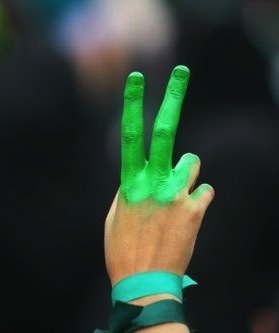
History Can Still Be Made

Earlier this week, Iran suspended its activities on its nuclear program, in accordance with an agreement reached with six great powers – the US, Russia, China, Britain, Germany, and France. And you could have heard a pin drop in the American public discourse in the face of this remarkable turn of events. And that is a bizarre thing.  For the constellation that came together these past twelve months is unlikely to happen ever again. All the major world powers – including Russia and China and the US – are in agreement. The Iranian regime and – most significantly – the Iranian people want a deal that would both restrain Iran’s nuclear capacities to civilian purposes green-peaceand slowly pry open its economy after brutal sanctions have close to extinguished it. A huge amount still needs to be figured out and it will be a formidable task of negotiation to move forward. It may all come to nothing. But surely, surely, it’s worth giving diplomacy a chance.

Why? For my part, it’s for the Iranian people, and global security. Neoconservatives portray their position against any agreement as one of solidarity with the Iranian people against their regime. And I’m sure that’s a genuine as well as admirable motive. But aren’t they engaging in a classic bit of ideological projection? In so far as we can tell anything about the views of the actual Iranian people – especially its younger and more educated generation – it is that they overwhelmingly want both a peaceful civilian nuclear program (in part as a matter of national pride) and re-engagement with the wider world, including the West. So the neocons are in fact either acting against the interests of the Iranian people, or accusing them of false consciousness. Neither seems to me the right response to this moment.

It’s also an ineluctable fact that Iran has acquired the intellectual and material infrastructure to become a nuclear military power if it wants to at any point in the foreseeable future. Let me repeat that: Iran’s potential as a nuclear military power is a fact. The time to prevent that would have been the Bush-Cheney years; but we tragically chose to pursue the control of imaginary weapons of mass destruction in Iraq instead. So the proximate actual choice we have with a regime with a disgusting record of internal repression and a nuclear potential is a) negotiating an internationally-monitored civilian nuclear program with strong inspections, b) a pre-emptive war with unknowable consequences to delay (but not end) the regime’s potential for a viable nuclear weapons program, or c) resume the Cold War stand-off, increase sanctions some more, destroy their economy and contain their military power.

For a long time, I thought c) was probably the least worst, realistic option. That view was entrenched during the Green Revolution. To see such hope and positive energy crushed by merciless regime thugs was a sober reminder of the forces we are dealing with. But here’s the thing: the Iranian people did not despair. Hemmed in by rigged, approved political candidates, they nonetheless voted in 2009 for a clear shift back toward the West and then in 2012 for the most pro-Western candidates there were. The Iranian people told us that engagement – and not continued polarization – was the answer they wanted. This movement – combined with the effect of, yes, “crippling” sanctions – brought the Iranian leadership to the backrooms of diplomacy. It was a perfect constructive storm.

This is where we are. It is not an ideal situation – but after the catastrophe of the Bush-Cheney years in foreign policy, we have no ideal situations. But it is also not the worst situation.

It’s an extraordinary victory, in many ways, for pro-Western forces in the Middle East. A hugely important country – America’s natural ally in the region – is a hotbed of democratic activism and pro-American sentiment among many of its people. That country has declared that it will never use nuclear weapons and, unlike nuclear-armed Israel, is a member of the Non-Proliferation Treaty. Its newly elected government, backed by the theocratic Supreme Leader, openly says it wants to entrench a nuclear-weapon-free Iran in an international agreement. In return, it’s asking for relaxation of sanctions that would allow its economy to grow. And that growth would redound to the credit of the reformers, and perhaps begin a slow thawing of the regime itself.

These moments do not come often in human history. I remain of the view that the greatest single threat to our civilization is the combination of religious extremism with weapons of mass destruction. If we can reliably ensure that the biggest Shiite power does not seek to build or use nuclear weapons and retain that commitment over time, we have made a huge stride toward reducing the greatest danger we face, in the wake of 9/11. The Obama administration has already – by design or accident – managed to secure and begun to dismantle another major global WMD danger in Syria. To get an inspections regime in place to do the same for Iran would be a historic gain for global security in the most volatile region on the planet.

A deal would help Iran’s moderates; it would be a real achievement in a new global partnership between the major world powers; it is our only hope to keep Iran’s actual nuclear capacities restrained to civilian use without a full-scale war; its economic benefits would accrue to the regime – but also, critically, to the moderate path the Iranian people have chosen – in the face of bullets and torture and terror – for the last several years.

Let’s re-appraise the value of this moment, and not let it pass into the ether, because of fear or paranoia or habit, or fail to grasp the full extent of the advance that is now possible. And those Senators actively backing the American sabotage of the process should take a deep breath, put AIPAC on hold, and let diplomacy take its course. This is history. It deserves more than the politics of a domestic lobby. It deserves statesmanship. And prudence. And patience. And time.

What’s Next For The Religious Right?

According to Damon Linker, the religious right is “finished” and its remaining followers “have been reduced to playing defense.” He asks, “What will come next for these voters, now that the original religious right is fading out?”:

The first and most likely development is one that’s already underway: A stepping back from national ambitions across a range of issues to a narrower emphasis on state-level initiatives that restrict access to abortion. This is a shrewd move, politically speaking. Thanks to advances in ultrasound technology, public opinion on abortion is likely to remain deeply conflicted, with strong support for reproductive freedom coupled with a strong moral aversion to both late-term abortions and the termination of pregnancies for what many judge to be frivolous reasons.

The focus on passing legislation in conservative-leaning states, meanwhile, allows the remnants of the religious right to maximize the impact of their limited resources. The end result, at least in the short-to-medium term, is likely to be greater ideological polarization across the country, with abortion harder than ever to procure in some states and others proudly trumpeting their absolute commitment to reproductive freedom.

Another possibility he entertains is that “the next generation of religious conservatives will take a different path, withdrawing from politics altogether”:

There is already some evidence that younger religious conservatives are more inclined than their parents to look with suspicion on politicized faith. If this inclination persists, perhaps further encouraged by increasing disappointment with the available political alternatives in the United States, it could drive religiously devout conservatives away from activist engagement entirely.

African-Americans And Prohibition Of Weed, Ctd

A Medical Marijuana Operation In Colorado Run By Kristi Kelly, Co-Founder Of Good Meds Network

A reader quotes me:

So one of the most powerful arguments for legalization of marijuana – that Prohibition grotesquely singles out African-Americans for criminal enforcement and spares whites – carries no more weight among African-Americans than it does among whites. Of those African-Americans who feel strongly about the subject, 40 percent oppose legalization and only 32 percent support it. Overall, there’s no statistically significant difference between whites and blacks on this. I’d be fascinated to hear from readers why they think this might be so. It seems on the surface that social conservatism is outweighing civil rights. But I’m genuinely baffled.

The answer to your question is that African-American marijuana users aren’t being arrested at higher levels. African-Americans in general are being arrested at higher level for everything then their white counterparts. The weed is just along for the ride. We understand this, so that argument doesn’t hold as much sway as it could.

That reader is echoed by another with a “perspective as a public defender”:

I think that people in the African American community see the different treatment of blacks and whites vis a vis marijuana enforcement as a symptom, and not a cause, of deep-seated racism in the criminal justice system.

That’s the kind of thing my confirmation biases can blind me to. Which is why I love my job. Another reader with expertise on the subject:

I co-founded the grassroots nonprofit now leading legalization in Rhode Island. You’ve addressed the most unasked question in the legalization debate, but it only demonstrates the complete tone deafness of white people like you who have their heart in the right place but don’t fully appreciate the wider racial dynamics of prohibition. As my colleagues said after observing the sea of white at a major drug policy reform conference: “If these guys are trying to save black people, why can’t they bring any of them to their conferences?” The partial answer is the indefatigable pride and resilience in communities of color we’ve worked with. I encourage you to approach an elderly, church-going woman of color who’s seen her neighborhood destroyed by drugs. Try shooting the shit about legalizing weed and see how far you get.

But the second answer reveals one of the paradoxes of legalization.

In this country, the archetypal divide for social change is between activists who feel an acute, moral zeal, and the rest of us whose allegiance lies with pragmatism and decide from the sidelines. But legalization completely inverts this rule: because there is such an enormous long-term price tag attached to reform, the open secret in legalization circles is that the types of activists it attracts tend to think of themselves as pragmatic, forward thinking businesspeople getting in on the ground floor of a major industry – not really as moral crusaders. Meanwhile, the moral case for marijuana comes less from its activists than observers and commentators, often in journalism, like you.

Thus your “bafflement,” like most sympathetic white people, is pretty common. The irony will be that that the people unharmed by prohibition were the only ones privileged enough to lobby against it. It raises the Faustian question: given the eventual multi-billion dollar windfall, how much lower would black support actually need to be before white invocation of their plight was exploitative? As has so often been the case in this country, the outcome of finally rectifying long overdo injustice will be black people moving out of prison, and white people (in this case, overwhelmingly men) moving out of their tax bracket. I guess that’s the price of change.

Another reader:

I will keep shouting this from the rooftops until somebody listens but “Black people are conservative!”. This applies not just to African-Americans but all of our diaspora. I’m Nigerian and we are some of the most homophobic, biblical literalist, anti-drug people on the planet.

As it relates to drugs and the Af-Am experience, one has to remember the deleterious affect that drugs had on the community (see the crack epidemic). Many older AA (over 55) would never fathom drug use since it’s a highway, in their minds, to brokenness, incarceration and a slew of other ills. Also, many older Black people see drugs as something white people do that’s been introduced to us to keep us down.

Most AA are live-and-let-live libertarian types on some matters, but by and large the older set really don’t get this new liberalism amongst the younger set.  I’m sure if you tease out the younger AA cohort on the data you will see a fairly prominent divide. My Gen-X AA contemporaries fall into two camps weed legalization: “meh, not for me but let’s tax it” and “more fiya!”

Another:

For lower-income families, an addiction to drugs or alcohol, an illness, a pregnancy, etc. can have far more devastating effects than for wealthier people. So it would make sense if there was a stronger sense of social conservatism there. Leave aside that not going to jail is better for the families than going to jail. It might be a more general ethic of “don’t screw up, be safe, etc.”  The consequences are more severe. If on the whole, the African-American population has more lower-income families, you might have a greater number of those who oppose.

(Photo: Matthew Staver for the Washington Post via Getty Images)

Outsourcing Injustice

Jon Fasman calls private probation an extortion racket:

It works like this: say you get a $200 speeding ticket, and you don’t have the money to pay it. You are placed on probation, and for a monthly supervisory fee you can pay the fine off in instalments over the course of your probation term. The devil, as ever, is in the details, as a great Sunday story from the Atlanta Journal Constitution makes clear. Those supervisory fees vary markedly: in Cobb County, for instance, just north of Atlanta, the government charges a $22 monthly fee. Private companies charge $39, and often add extra costs on top of that to cover drug testing, electronic monitoring and even classes they decide offenders need. Fees often rise and even multiply when probationers cannot pay—and remember, these are people, for the most part, who could not come up with a hundred bucks and change to pay the initial fee; you have to expect they’ll have some trouble paying.

Even worse, people who fail to pay the fines imposed by these private companies can find warrants for their arrests sworn out and the period of their probation extended. I spoke with an attorney for a couple in Alabama who say they were threatened with Tasers and the removal of their children if they did not pay the company what they owed. In 2012 a court found that the fees levied by private-probation companies in Harpersville, Alabama, could turn a $200 fine and a year’s probation into $2,100 in fees and fines stretched over 41 months. A judge in Richmond and Columbia counties ruled such probation extensions illegal last autumn.

Drum adds:

Isn’t that great? It’s the free market at work, all right. It reminds me of last year’s piece in the Washington Post about the privatization of the debt collection in Washington DC[.] … You may remember this as the story of the 76-year-old man struggling with dementia who was thrown out on the street and had his house seized because of a mix-up over a $134 property tax bill.

Toward A Smaller, Smarter Army

A short history of US military spending:

Gordon Lubold looks at the consequences of downsizing:

The Army has long been criticized for being too big and lumbering – qualities that perhaps suited it all right for the conventional land wars of the past decade. Calls for a lighter, nimbler one haven’t made huge impacts yet on the institution. But aside from the conventional threats in the Asia Pacific like China, most people argue that in this budgetary environment, there are few reasons to have a large, sitting Army that topped about 570,000 just a few years ago. And an Army sized at 420,000 soldiers is not exactly skeletal. In fact, it’s roughly the size of the pre-war Army in 2000. And cutting it back isn’t anything like the hundreds of thousands of forces cut in the early 1990s.

A smaller force may have an impact on one of the Army’s cherished new concepts:

regionalized brigades. The idea is to give soldiers assigned to a brigade basic language and cultural skills for a certain region. Although the brigades are not assigned to a specific part of the world, they are theoretically “on the step” to deploy there — most typically in smaller, platoon- and company-sized units — for training and advising or potentially more “kinetic” missions. It’s an ambitious approach and one not without its critics. But for example, the Army has begun using the Army’s 2-1 brigade combat team as one of the first ones trained and ready to deploy to Africa. “I think what we want to make sure is that they’re much more culturally attuned to the area they’re going to,” an Army official working on the initiative, told Foreign Policy’s Situation Report last year. “I think that is an important part, and it’s certainly something that 12 years of operations in Iraq and Afghanistan has highlighted to us, that you’ve got to understand the culture within which you operate. If you don’t, it does come with potentially cataclysmic problems.”

Checking In On PreCheck

Amar Toor examines the TSA program that expedites the security screening process for travelers who either have applied for the program or who have been invited by “behavior-detection officers”:

There are … doubts over whether the TSA’s behavior-detection methods are even effective at identifying potential threats. A November report from the nonpartisan Government Accountability Office (GAO) found that behavior-detection techniques work only “slightly better than chance”, and that they may be applied on inconsistent or subjective bases. The report was especially discouraging considering that the TSA has spent an estimated $1 billion on implementing behavior-detection protocols since launching the program in 2007. The TSA later contested the report’s findings, saying they were based on a survey of academic studies focused on identifying liars, rather than the suspicious behaviors that its agents are looking for. …

Yet [the Cato Institute’s Director of Information Policy Studies Jim] Harper and security experts see value in PreCheck’s unpredictability. TSA agents select passengers to pass through PreCheck at irregular times and locations, usually depending on queue length, and some eligible travelers are randomly selected prior to going through security. That makes it harder for would-be terrorists to exploit the system, but Harper still has reservations about a two-tiered approach to airport security. As the program expands, he argues, it’s not hard to imagine a situation where affluent passengers whisk through PreCheck, while poorer or less experienced travelers remain trapped in longer lines.

Update from a reader:

Your note and link about TSA PreCheck is a little off base – and I should know as I designed and implemented PreCheck for United! There are currently five methods of obtaining access to the TSA PreCheck lane:

1) qualify for PreCheck based on flight criteria, 2) qualify based on membership in the DHS Global Entry program (which requires a background check and in-person interview), 3) qualify based on membership in the new TSA PreCheck application program (which again requires a background check and in-person interview but is cheaper than Global Entry), 4) have your itinerary selected at random by the TSA’s black box, and 5) be admitted to the lane by a Behavioral Detection Officer.

Of all of these, selection by BDO is a tiny, tiny percentage of the total.  I’m not in a place to speak about how well the BDO’s do their jobs, but I know for a fact that the first four methods I mentioned (and a sixth that may or may not occur this year) are designed thoughtfully and do provide a less stringent security posture for people who concretely pose less risk.

The TSA’s stated goal is to get an ever larger share of the traveling public into the more trusted security screening lanes over this year and the next, and I expect we can return to pre-9/11 screening for a large majority of passengers within the next five years.  This will all be done without any BDOs.

Will The Internet Swallow TV? Ctd

For a small monthly fee, Aereo makes broadcast TV available online (previous Dish coverage here). The Supreme Court has agreed to hear the appeal of major broadcast networks that object to Aereo’s services.  Michael Phillips explains why the case “may determine the future of television”:

To carry network programming, cable and satellite companies normally pay what are known as “retransmission consent fees,” which have come to make up an ever-greater portion of the networks’ revenue. CBS, for instance, pulled its channels from Time Warner Cable last fall while negotiating higher fees. However, Aereo, using a novel interpretation of copyright law, argues that the complex mechanics of its service mean that it doesn’t have to pay.

Under the Copyright Act, you need permission—typically an expensive license—from a copyright holder to show, say, a television program to a large number of people. But the act doesn‘t prohibit showing it “privately” to “a normal circle of family” or “social acquaintances.” This is why you can host a Super Bowl party in your living room without paying an additional fee to whichever network is broadcasting it, or worrying that a lawyer in a power suit will bust down your front door. Because each antenna is assigned to a single subscriber, Aereo claims that it is merely facilitating the sort of individual, private viewership that is allowed by the Copyright Act. …

The putative question before the Supreme Court is whether Aereo is violating the Copyright Act by putting on “public performances” without appropriate licensing. But the Court’s decision to hear the case may signal some sympathy for the networks’ argument that Aereo poses an existential threat to their industry. Out of some ten thousand petitions that the Court receives each year, it chooses seventy-five or so cases to review. Many of these cases earn the Court’s attention because of contradictory rulings between lower courts. As Aereo’s lawyers have emphasized, however, the broadcast industry has pursued its claims against the company in five cases and in three states, and every court that has reached a decision so far has sided with Aereo. This suggests that the Supreme Court has some other rationale for taking the Aereo case. It seems possible that the Court is willing to consider the networks’ argument that Aereo is so dangerous to the broadcasting industry that a review of the matter is of “national importance.”

Egypt Votes On A New Constitution… Again, Ctd

Peter Hessler reflects on last week’s constitutional referendum:

Perhaps the most disturbing thing about the 97.7-per-cent approval rate is that there is no overt evidence of widespread fraud. But this is why voting is only a small part of what constitutes a democracy; since the revolution, Egypt has held seven fraud-free national votes, and yet the country still doesn’t have a single government official who was elected to his position democratically. (Everybody voted into national office has been subsequently removed by coup or court decision, and local governments have yet to hold elections.) …

The most heartening thing about the referendum, though, was the relative lack of violence. Egypt won’t go the way of Syria—there’s too much power in the Army and the police, and too little support for the Brotherhood. And Egyptians have a social cohesiveness that allows them to survive despite a deeply dysfunctional government. Throughout the chaos of the past three years, even a big city like Cairo has remained remarkably safe and functional. There are signs that terrorist activity is expanding, but, thus far, the attacks have been focussed on the police, the Army, and other government institutions, rather than on the public. At five o’clock in the morning of the first day of the referendum, a bomb exploded in front of a Cairo court; the façade was damaged, but there were no injuries. The attack was clearly a statement—but a very different statement than would have been made by a midday bomb at a crowded polling station.

Marc Lynch considers what a constitution means for a country in Egypt’s situation:

The primary value of a constitution in an unsettled political arena like that of Egypt is to provide predictability through stable, legitimate rules. Democratic politics rest upon the guarantee that all sides understand and agree upon these rules of the game: Without such predictability, politics is no more than an endless game of Calvinball, with powerful players changing the rules at a moment’s notice to suit their interests. Nobody knows from one day to the next whether their political activity, journalistic investigations, protest against injustice, or organizational membership will be a demonstration of democratic commitment or evidence of terrorism. This debilitating uncertainty helps to fuel polarization and dangerously raises the stakes of political conflict. …

The July military coup magnifies the intensity of this problem, however, and may have made it almost impossible to overcome. The precedent has now been firmly established that the military will step in if it does not approve of the direction in which politics is heading. No promises to avoid future such interventions can possibly be made credible, regardless of what the constitution says. This effect will take decades to wear off, which means that the pathologies of uncertainty, unaccountability and unpredictability will continue to afflict Egyptian politics. Political actors will constantly have to be looking over their shoulders in fear of a military overthrow, which will be a defining context of their strategies and actions.

Michael Albertus and Victor Menaldo imagine the glass half full:

A new democracy can … jettison or overhaul a constitution inherited from the military or outgoing autocratic elites. Since 1950, 31 percent (a total of 19) of the countries that democratized with autocratic constitutions went on to shed their inherited constitutions and replace them with new social contracts. … This means that if the Egyptian government is to represent all of its people, there must be another future phase of reform. To become a more perfect democracy, Egypt’s next political vanguard will have to wage a different type of revolution, one dedicated to institutional reform. While some of these battles may still be waged in Tahrir Square, many of them will take place behind the scenes and involve lawyers, academics, and other members of civil society – including Islamic clerics – persuading Egypt’s politicians to themselves become the advocates of a fuller version of democracy.

Recent Dish on Egypt’s constitution here.

The Sad Story Of Dr. V

Caleb Hannan’s Grantland profile of inventor Essay Anne Vanderbilt took an ugly turn when Vanderbilit committed suicide, causing many to blame the suicide on Hannan, who disclosed that Dr. V was transgender. My take on editor-in-chief Bill Simmons’ apology here. Christina Kahrl addresses the cavalier way in which Hannan dealt with the outing:

We’re here because Essay Anne Vanderbilt is dead. And she’s dead because — however loath she was to admit it — she was a member of a community for whom tragedy and loss are as regular as the sunrise, a minority for whom suicide attempts outpace the national average almost 26 times over, perhaps as high as 41 percent of all trans people. And because one of her responses to the fear of being outed as a transsexual woman to some of the people in her life — when it wasn’t even clear the story was ever going to run — was to immediately start talking and thinking about attempting suicide. Again.

It was not Grantland’s job to out Essay Anne Vanderbilt, but it was done, carelessly.

Not simply with the story’s posthumous publication; that kind of casual cruelty is weekly fare visited upon transgender murder victims in newspapers across the country. No, what Hannan apparently did was worse: Upon making the unavoidable discovery that Vanderbilt’s background didn’t stand up to scrutiny, he didn’t reassure her that her gender identity wasn’t germane to the broader problems he’d uncovered with her story. Rather, he provided this tidbit to one of the investors in her company in a gratuitous “gotcha” moment that reflects how little thought he’d given the matter. Maybe it was relevant for him to inform the investor that she wasn’t a physicist and probably didn’t work on the stealth bomber and probably also wasn’t a Vanderbilt cut from the same cloth as the original Commodore. But revealing her gender identity was ultimately as dangerous as it was thoughtless.

Dreher pushes back on the rush to blame Hannan:

Is Caleb Hannan morally responsible for Dr. V’s suicide? There’s no doubt that she would be alive today if he hadn’t begun writing the piece about her. But there’s also no doubt that Dr. V was happy to cooperate with the piece as long as she could control what was going to be written. She knew that the author was a golf nut and a fanboy of her invention. She also loved passing herself off as a mysterious genius. Trouble was, she couldn’t control the story, and once the reporter started digging, he found that the mysterious Dr. V was not at all who she said she was — and that her deceptions had victims. I think Hannan can’t be blamed for this mentally ill person’s suicide. He didn’t set out to take her down. He set out to write an admiring story about a reclusive genius who invented a new golf tool that stood to greatly improve the game. He had no idea, could not possibly have had any idea, where this story was going. When he found out her ultimate secret, how could he have kept it? She was happy to lie constantly when it suited her, and to steal, and to threaten, but when the journalist unraveled all her lies, she killed herself. And this is the journalist’s fault?

Josh Levin thinks the tragedy illustrates “the dangers of privileging fact-finding and the quest for a great story over compassion and humanity”:

I believe that “Dr. V’s Magical Putter” was a story worth telling, but this was not the right way to tell it. “What began as a story about a brilliant woman with a new invention had turned into the tale of a troubled man who had invented a new life for himself,” Hannan writes after describing Dr. V’s 2008 suicide attempt, at once revealing his ignorance about trans issues and his protagonist’s utility as a fascinating narrative arc. When you reread the story knowing that Essay Anne Vanderbilt is dead, the whole thing feels cold-hearted. … I don’t believe that Caleb Hannan and his editors were willfully callous. This is the kind of story, though, that breeds cynicism about journalists. It is a piece of writing that treats its subject as a series of plot points rather than a person, and that seems concerned with little else aside from propelling itself toward a dramatic conclusion.

A reader sounds off:

I found this tragic story and the coverage it has received compelling from day one. I have read all three articles on Grantland and other takes on the article and have been waiting for The Dish to weigh in. As someone who has an undergrad degree in journalism – I am actually a corporate writer now – and is almost half-way to a Master’s Degree in Marriage and Family Therapy, suicide is something I have reflected upon a lot as are journalistic ethics.

First, I find it extremely unfair to try and blame Hannan for Dr. V’s suicide. This was not her first attempt at suicide and more than likely would not have been her last if she never spoke to Hannan. It’s very likely that it was only a matter of time before she was approached by someone else. She told many lies for financial gain. She was deceiving her investors. She accepted the interview because – and I am assuming here – it would further promote her product and that would make her more money. Lies have a way of being discovered, especially lies told to many people.

Was the story insensitive to Dr. V? Absolutely. The story came off as more salacious than it needed to be and her gender changing should have never been included because it is irrelevant. That being said, suicide is a personal decision that an individual makes for his or herself. One person cannot compel another person to commit suicide. Hannan is no more responsible for her suicide than is her partner who is probably kicking herself for missing the warning signs. The only person responsible for Dr. V’s suicide is Dr. V.