California’s Endless Summer

CA Snow

Last week California declared a drought emergency. Amelia Urry catches us up:

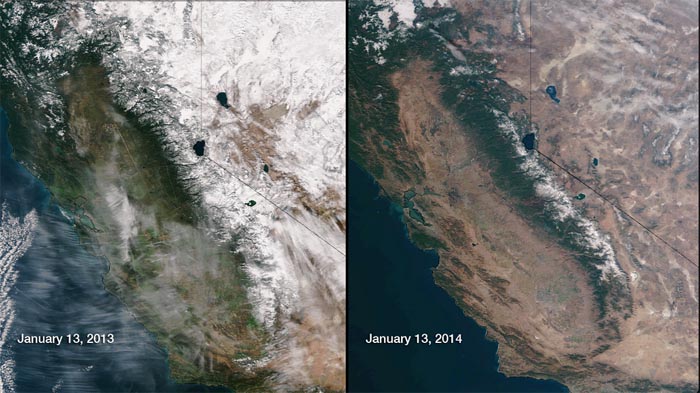
In the past two weeks, the percentage of the state experiencing extreme drought conditions shot from 28 percent up to a vertigo-inducing 63 percent, according to the U.S. Drought Monitor. Snowpack in the Sierra Nevada Mountains is at a perilously low 17 percent of its usual level this time of year [as seen above]. Since as much as 65 percent of Cali’s water comes from this virtual water cooler, and much of that goes toward the state’s multibillion-dollar agricultural industry, the effects of a catastrophic water shortage may be widely felt in the year to come.

Though droughts are not uncommon in the region’s Mediterranean climate, the pattern of the past few years points to a slow-mo climate crisis crashing into the West Coast. 2013 was California’s driest year on record, with about two thirds of the state experiencing severe water shortage and fire danger.

Christopher C. Burt details the agricultural impacts:

A major drought in California would have nation-wide implications.

California is the number one state in cash farm receipts with 11.3 percent of the U.S. total. The state accounts for 15 percent of national receipts for crops and 7.1 percent of the U.S. revenue for livestock and livestock products. California’s agricultural abundance includes more than 400 commodities. The state produces nearly half of U.S.-grown fruits, nuts and vegetables. Across the nation, U.S. consumers regularly purchase several crops produced solely in California. The state is also the nation’s largest agricultural exporter.

Chris Mooney examines the region’s fire potential:

Hotter, drier conditions favor wildfires. Indeed, California has already seen several significant fires since the October 31 end of the traditional fire season, including December’s Big Sur fire and the ongoing Colby Fire in the Los Angeles area. That’s a bad sign. So is the fact that in just the first 11 days of January, the state saw 154 fires that burned 598 acres. That’s way above the five-year average for this time of year.

For California, seven of the 10 largest fires in state history have occurred since the year 2000. And if these dry conditions persist throughout 2014, another new fire may be added to that list.

And the future looks drier and drier:

Over the longer term, climate projections suggest that this [drought] risk will continue or increase. According to the draft National Climate Assessment, the US Southwest—which includes California and five other states—can expect less precipitation, hotter temperatures, and drier soils in the future, meaning that by 2060, there could be as much as a 35-percent increase in water demand. Along with that comes a 25- to 50-percent increased risk of water shortages.

(Image: NOAA/NASA)

A Good Death

Julie Myerson calls her mother-in-law’s passing “as good as I can imagine a 21st-century death to be.” She urges others to share their positive experiences:

Helen’s death felt oddly like the labor of birth: exhausting and devastating, yes, but natural too and, in some strange way, productive. More crucially, and reassuringly, the nurses understood this far better than we did. As the moment drew near and, inevitably distressed on Helen’s behalf, we requested pain relief, these nurses explained, with real gentleness and compassion, that it would be far better for her if they did not intervene. And they were right. Her final moments were peaceful. And to be allowed to be there with her as they ticked on past – it’s not something I can put into words. …

I’ve thought often about whether or not to write about this, especially when I read yet another newspaper account of how the medicalization of death, the obsession with intervention and saving at all costs, is robbing us all of our right to die in peace. But I’ve always hesitated. Partly because death, any death, is such an intensely intimate experience and seeking to describe it may be, for lots of reasons, a step too far. And partly, of course, because this particular death belongs at least as much to the others who were present as it does to me. All you have here is a purely subjective description from someone who loved her children’s grandmother very much.

And yet. It seems to me that what we all experienced on the 11th floor of St Thomas’ Hospital on that April evening was something that ought to be known about, appreciated, celebrated even. We surely can’t be the only family who’ve had such an experience? So I hope that Helen – whose love and friendship I feel moved to have known – would forgive me. Because how can we possibly debate these issues with any honesty if we don’t seek to share our most positive experiences of intensely private moments?

Ukraine Reignites

Protests have popped up again in Kiev after the Ukrainian parliament passed a new law that essentially bans demonstrations:

The relatively quiet spell was broken last Thursday, when the Ukrainian parliament passed a series of new laws that seriously limit the scope for protests. The laws were rushed through by President Yanukovych’s supporters, with a show of hands and no time for discussion. Not for the first time, a brawl broke out in parliament. But the voting procedure was clearly fine with Yanukovych, and the next day he signed the laws.

The laws, summarized in English on this infographic, clearly limit Ukrainians’ freedom of assembly. They introduce penalties for wearing helmets at demos, setting up tents and public stages and distributing “extremist” materials, among other activities. People driving cars in columns of more than five could have their licenses and vehicles confiscated (presumably a response to the increasingly popular “automaidan” initiatives). Foreign observers are particularly dismayed at the law—which could have been copy and pasted from Vladimir Putin’s Russia—that labels NGOs receiving money from abroad “foreign agents.”

Timothy Snyder declares that, “On paper, Ukraine is now a dictatorship”:

In practice, will Ukraine become a dictatorship? Ukrainians have powerful reasons to resist. These laws, now signed by the president, end the Ukrainian republic as they have known it. They also much reduce the possibility of future European integration, something which is yearned for throughout the country, and for that matter among elites and the political class. No one in Brussels or European capitals is going to lobby for a trade deal with a leadership that has explicitly chosen authoritarianism. If these laws are allowed to stand, the future of Ukraine will thus be with Belarus and Russia, for lack of another option. This makes no economic sense, since Europe’s market is bigger and more important. The only kind of sense it makes is political, for a president who knows he is too weak in his own society to win another democratic election.

Hannah Thoburn looks at the fractures within the country:

A large percentage of Ukrainians hold [Ukrainian president Viktor] Yanukovych personally responsible for solving the current political crisis,but his choosing one side over the other will polarize this already divided country more than it has been before. Yanukovych’s political base is in eastern Ukraine, where the majority speak Russian and identify strongly with Russia. Only 17 percent of eastern Ukrainians approve of the protest movement and would be only too happy to see their president quash it in whatever manner he deems necessary. Meanwhile, 80 percent of citizens in the western and more European-leaning part of the country approve of the protest movement and disapprove of the president’s recent decisions. They did not vote for him and will not support him.

While rounding-up videos of the protests, Fisher flags the clip above:

This is important: Most protesters are not violent, and what’s happening in Kiev is not, despite some government assertions to the contrary, a “mass riot.” Still, there’s been violence, with some protesters throwing flares at the vast rows of security forces. This video shows what it looks like from the police’s perspective …

The Lonely Listener

8940839074_1487a6fd8c_o

Stan Alcorn investigates why Internet users almost never share audio the way they share, say, pet videos:

“Audio never goes viral,” writes radio and podcast producer Nate DiMeo. “If you posted the most incredible story – literally, the most incredible story that has ever been told since people have had the ability to tell stories, it will never, ever get as many hits as a video of a cat with a moustache.” It’s hardly a fair fight, audio vs. cat video, but it’s the one that’s fought on Facebook every day. DiMeo’s glum conclusion is an exaggeration of what [viral video-maker Bianca] Giaever reads as the moral of her own story: “People will watch a bad video more than [they will listen to] good audio,” she says.

Those in the Internet audio business tend to give two explanations for this disparity.

“The greatest reason is structural,” says Jesse Thorn, who hosts a public radio show called “Bullseye” and runs a podcast network called Maximum Fun. “Audio usage takes place while you’re doing something else.” You can listen while you drive or do the dishes, an insuperable competitive advantage over text or video, which transforms into a disadvantage when it comes to sharing the listening experience with anyone out of earshot. “When you’re driving a car, you’re not going to share anything,” says Thorn.

The second explanation is that you can’t skim sound. An instant of video is a still, a window into the action that you can drag through time at will. An instant of audio, on the other hand, is nothing. “If I send someone an article, if they see the headline and read a few things, they know what I want them to know,” a sound artist and radio producer told me. “If I send someone audio, they have to, like… listen to it.” It’s a lot to ask of an Internet audience.

For some radio makers, social media incompatibility is a sign of countercultural vitality. Thorn has called his own work “anti-viral,” and believes that entertaining his niche audience is “still so much better than making things that convince aunts to forward them to each other.”

(Image by Flickr user JB912)

The Christie Scandal Metastasizes

First Read analyzes the latest:

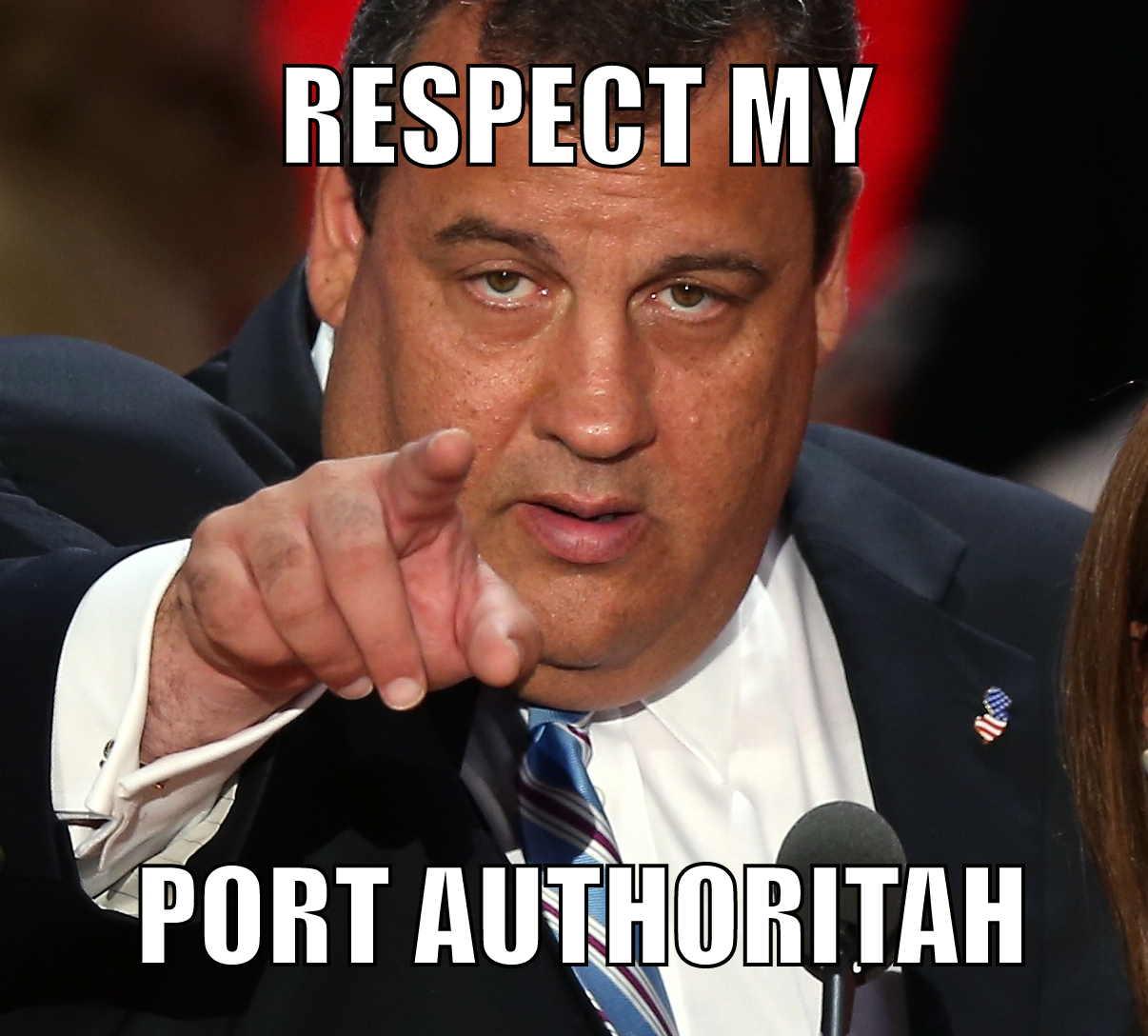
Christie’s biggest political problem right now is that he’s fighting wars on two different fronts, both of which increasingly look like wars of attrition. The first war is the two-week-old George port-authoritahWashington Bridge scandal, and 18 new Christie aides and associates have been subpoenaed by New Jersey Democrats now investigating the matter. And, at the very least, it promises months of new email revelations, testimony, and storylines. (Since this is being led by the state Assembly, it also means it will likely grind Christie’s second-term agenda to a halt before it even begins.)

The second war is Hoboken Mayor Dawn Zimmer’s allegation, first made on MSNBC over the weekend, that the Christie administration threatened to hold up the city’s Hurricane Sandy relief aid unless she supported a private development project. That matter is now being investigated by a federal prosecutor, and it also promises weeks and months of potential headaches for Team Christie. “What we’ve got now is a federal criminal investigation into the Christie administration’s administration of Sandy funds,” NBC’s Michael Isikoff reported yesterday. As history teaches us, a two-front war is never an enviable position for the person fighting it.

Ezra puts the scandal in context:

It would be easier to dismiss Zimmer if not for the bridge closure. And it would be easier to explain away the bridge closure if not for Zimmer. That’s the problem for Christie: These stories are beginning to build. Each new revelation makes the past scandals more believable — and more damaging. And each new story intensifies the media’s efforts to find more.

Benen notes that Team Christie is trying to shift the focus to the media:

There is a pretty standard tactic in Political Crisis Management 101: discredit those asking the questions. The strategy, however, is not without flaw. For example, Team Christie has not yet uncovered any factual errors in MSNBC reporting, which would presumably be the prerequisite to any complaints. When allegations of wrongdoing surface, this is not a sound defense: “The allegations are wrong because they’ve been reported by journalists we don’t like.” A better defense would be, “The allegations are wrong and here’s why.”

Jeff Smith, speaking from personal experience, discusses the possible federal prosecution of the Christie administration:

What these pundits forget—and, as Christie, a former U.S. attorney, knows as well as anyone—is the old saw that federal prosecutors can get a grand jury to indict a ham sandwich. They don’t need a bulletproof case. And once they have a target, they aren’t limited to investigating the matter that caught their attention; public corruption probes often widen as new information emerges. Federal prosecutors rarely have just one attack route. Remember, they brought down Al Capone for income tax evasion, not bribery, bootlegging, or murder. The Fort Lee incident may be merely a bridge, if you will, to other Christie administration misconduct.

The Struggle For Syrian Peace

Screen Shot 2014-01-21 at 12.33.38 PM

The second round of Syria peace talks (“Geneva II”) kicks off this week. Colum Lynch and John Hudson explain how the talks were almost scuttled when the UN tried to invite Iran:

Ban [Ki Moon] said that he had granted Iran the invitation after Iran’s Foreign Minister Javad Zarif had assured him that his government supported the key goals of the conference, including its call for a transitional government. “Foreign Minister Zarif and I agree that the goal of the negotiations is to establish, by mutual consent, a transitional governing body with full executive powers,” he said. “Therefore, as convenor and host of the conference, I have decided to issue an invitation to Iran to participate.” A misunderstanding between Ban and Zarif appears to be the source of the problem. Shortly after Iran received its invitation to Geneva, Iran’s Foreign Ministry said it would attend the talks without preconditions — a statement that infuriated the Syrian opposition. Ban’s spokesman, Martin Nesirky, is now telling reporters that Zarif and Ban did in fact agree on preconditions.

The invitation was quickly withdrawn and the talks are back on track. To be honest, I don’t see why Iran cannot play a role here. They are Assad’s critical ally and have leverage over him no one else has. Assad is not going anywhere any time soon – even as the horrifying atrocities mount in a brutal war that could play out for years without resolution either way. And one of the points of the opening toward Iran is precisely that it can play a part in dealing with this kind of regional problem (even though it has played such a major role in fomenting the war and foiling the opposition forces). At some point, we have to get real and ask ourselves if we care enough about the war’s toll to try new avenues of diplomacy. Paul Pillar thinks the Iranians are being treated with unfair suspicion:

The episode has exhibited the general tendency, which appears on other issues as well, to worst-case what Iran might be up to.

Why would the Iranians be more likely to get in the way of negotiating the Syrian regime out of existence than the Syrian regime itself would be? A useful bit of background to remember is that the odd-couple alliance between Iran and Syria began as a response to both being rivals of Saddam Hussein’s regime in Iraq, which is no longer a factor. Yes, there are some other commonalities, such as economic ties and the relationships of each with Lebanese Hezbollah, but if Assad were on shaky enough ground to make an Assad-less transitional government a reality, his regime would be as much of a liability as an asset to Tehran.

It is hardly surprising that Iran would balk at the sort of conditions being imposed on it to participate in Geneva II. The Iranians are being called on to declare full allegiance to the outcome of an earlier conference from which they were pointedly excluded. Who else would be willing to do that? And if Iran’s assistance to one side in the Syrian civil war is some kind of disqualifier, it is hard to explain why similar conditions are not applied to those who have stoked the war by supplying lethal assistance to the other side.

Meanwhile, Steven Heydemann advises against expanding the scope of the talks beyond negotiating an end to the conflict:

To shift the focus of Geneva talks away from core political issues would be a significant mistake. It would continue a process of re-legitimating the Assad regime, further delay accountability to its tens of thousands of victims, and render even less likely the prospects for a political transition in the future. To broaden the agenda will be a vindication of the Assad regime’s strategy of diverting attention from Geneva I. It would send a clear signal that the Geneva I framework — already on life support — will be all but dead and buried. If the U.S. and other international actors wish to prepare for failure in Montreux, their best bet is not to change the subject, but to figure out how to change conditions on the ground and create the conditions for the next round of negotiations to succeed.

Morton Abramowitz takes a closer look at the humanitarian problem:

International aid goes to the needy in Assad controlled areas where the population is greater and apparently lesser amounts to the non-Assad controlled areas where the need is probably greater but more difficult to deliver. Assad forces and some rebel groups often prevent aid deliveries. The US is leaning now on Russia and through others on Iran to find ways of persuading mostly the Assad regime to allow more goods into encircled areas. There is the belief that the Sochi games and efforts to embarrass the Russians may help prod Moscow to persuade Assad to allow more goods into beleaguered areas. Assad has recently offered Moscow to allow goods into some encircled areas including Aleppo but only if there is a ceasefire. The rebels have looked with justifiable suspicion at the government’s behavior on this score. Even if Geneva produces increased internal deliveries, it is doubtful they will be permanent or proportionate to the need.

(Photo: from the Syrian opposition groups, detailing evidence of torture of those in Assad’s custody in the civil war. Via CNN. See the full slideshow here.)

The View From Your Window Contest: Winner #188

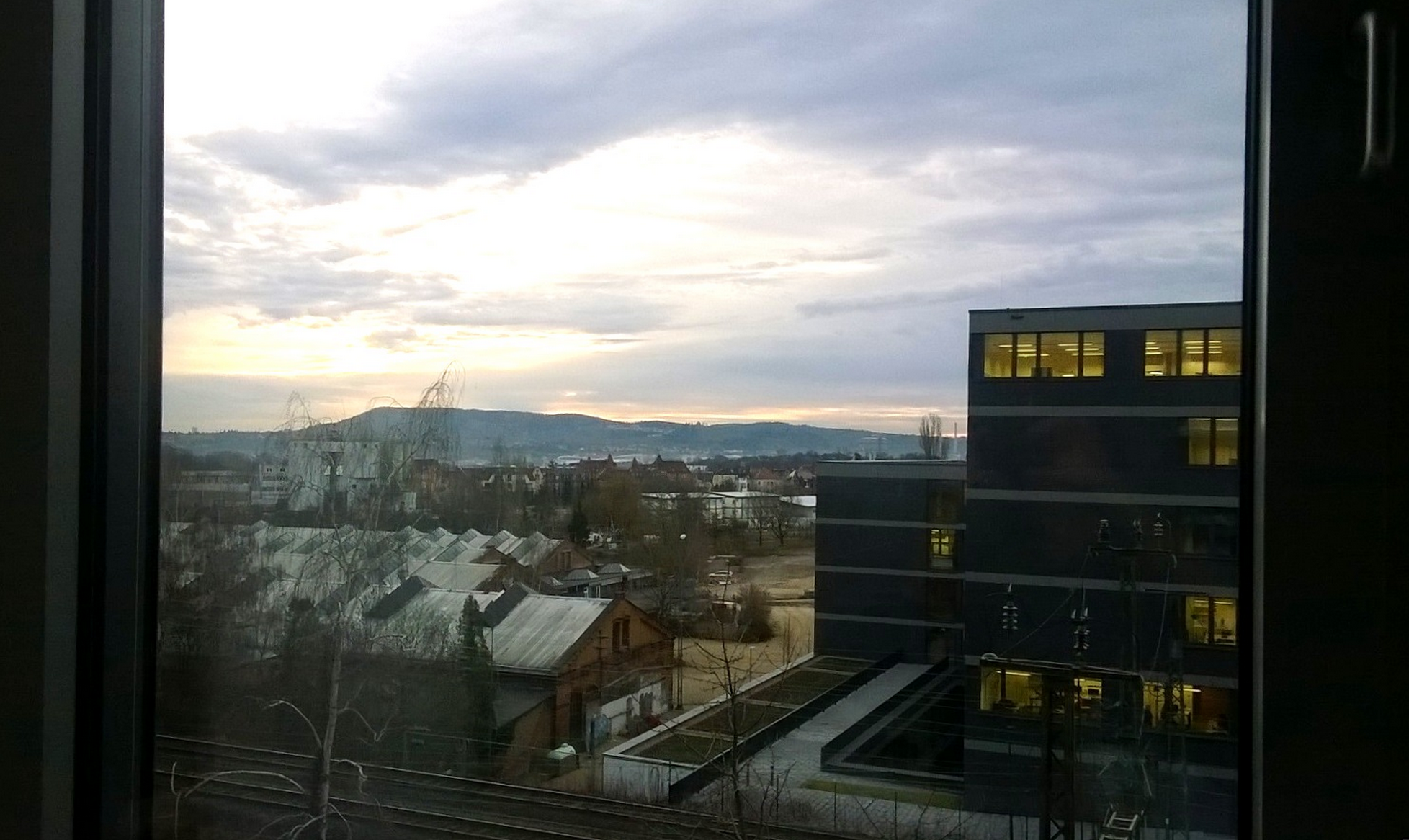
vfyw_1-18

A reader writes:

Really?  I re-upped my subscription only to be mocked with this utterly ridiculous contest photo? It all looks vaguely Scandinavian, but that is not the point.  So all the stuff you write about on Sunday is obviously BS, since it is increasingly clear to me that you are beginning to taunt your readership.

I like that. I wish I had renewed for more that $25.00.

Another describes the scene:

Snow, low mountains, old industrial buildings in the foreground, turn of the 20th century-style housing in the background. This is a hardscrabble industrial town of the kind that you find throughout the northern reaches of Appalachia (just drive any part of I-81 for that experience). Pennsylvania alone has dozens of towns/cities that look like this, and I don’t have the patience to scour every single one on Google Earth. I’m going with my gut based on that mountain in the background: It reminds me of many a drive up to college past Binghamton, NY.

Another:

Early on in this contest I often spent an hour or more trying to determine the place. Then all the experts began their triangulation and GPS, etc. I could never keep up. I always try for the right continent and usually get that right. Starting this year, I thought I’d try for Hemisphere. That shouldn’t be too hard. This photo follows a pattern, hills in the background, a river, perhaps a lake, leafless trees and tin roofs. Another feature is the railroad track. A modern building – office-like looking. I was in Quebec last fall, so it’s as good a guess as any.

Right hemisphere. Another:

This looks like central Pennsylvania to me – but I don’t have Doug Chini‘s resolve, so I won’t be following every train track in the state looking for those bumpy roofs. Instead, I’ll just guess Wilkes-Barre, Pennsylvania – and I’ll look for my entry to appear well above the jump!

Another:
moca

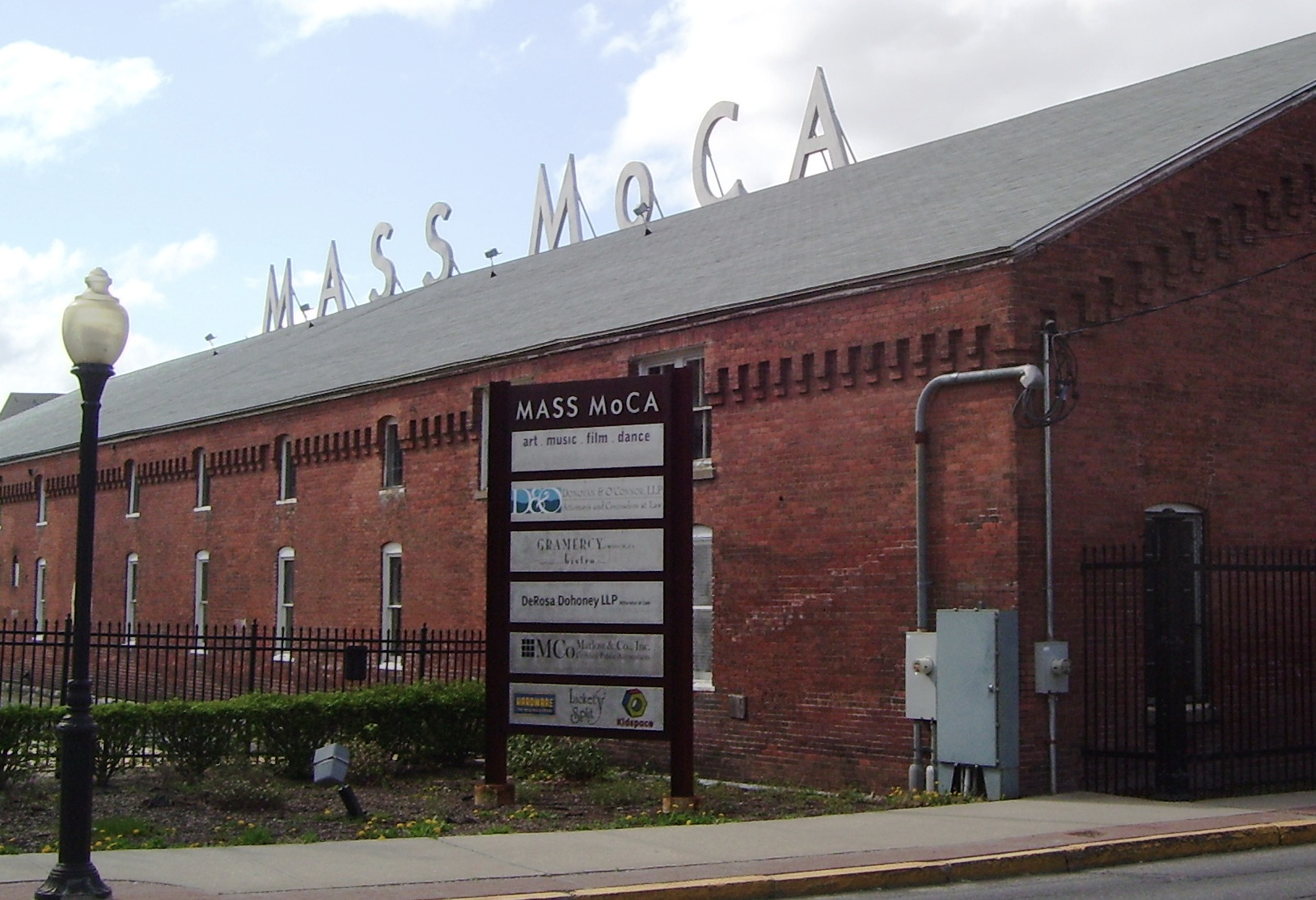
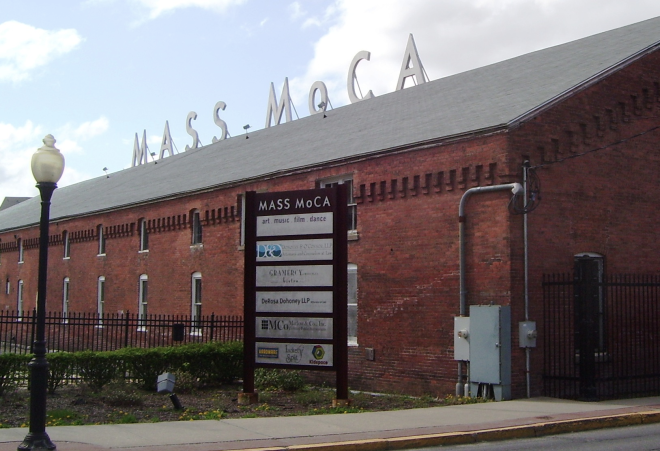
Well, I thought this was going to be two easy ones in a row.  It looks like a glamorous new lobby has been added to an old New-Englandish warehouse. Some kind of art/cultural destination near a railroad. Dia Beacon? No. MassMOCA? The warehouse has the same kind of scalloped edge! Has to be! Only I can’t for the life of me find this view on the map.  But I’ll submit North Adams, Mass, in case the same warehouse builder had other business in the area.

Another:

My initial reaction was that with visible dirt on the ground and less-than-impressive mountains in the background, we are looking through a window somewhere near Borat’s native Kazakhstan. And with the dimness and angle of the sunlight, I think we are somewhere near 49.0278° N latitude (give or take). Looking at cities around this latitude, I have choices of Lviv, Ukraine or Erdenet, Mongolia (which no one in the US has ever heard of). I’ll choose Erdenet. If this is right, I’d love to hear why anybody would ever be in Erdenet, Mongolia …

Another lands on the right continent:

This week’s picture lends new meaning to the word “grim.” You have never before used a photograph that portrays cheerlessness to this extent. It looks like a place which the world has left behind. My mind took itself immediately to Russia and the old Soviet Union, with the birch tree and unique narrow-gauge railway tracks (which helped lead to Hitler’s defeat) supporting my mental travel. Those several church steeples could be atop sanctuaries of the Russian Orthodox faith. With a higher resolution screen, it might be possible to determine what the parabolic shape in the middle background of the picture represents. It may be part of a stadium. The abundance of green, non-deciduous trees and the profile of old, worn down mountains have helped me convince myself that this is in the southern part of the Caucusus. Traveling to this place, sitting with a cup of coffee, and watching the place come to life on a sunny day in May, is an intriguing notion.

Another:

Gothenburg, Sweden? Because of the swooping-sided stadium barely visible in the background. I think that’s Ullevi stadium, but I can’t figure out the perspective and can’t spend any more time on it. I’d guess the photo is taken looking S-SE toward Ullevi stadium from around the port somewhere. Or not.

Another gets the right country:

The middle-distance houses look very German, especially the ones with pointy roofs. A run-down look, so probably east Germany. The hills look something like the tail-end of the Harz, so I’d go for Thale.

Another:

This is a hard one. The birch tree in the front and some vaguely German-looking houses far in the back. Also, Germany is kind of keen on the solar power these days, so the solar batteries on the roof of a warehouse are consistent, and their angle fits the general latitude of northern Germany. Beyond that – no clue. So I am going on a limb here and guess Bremen.

Another nails the right city:

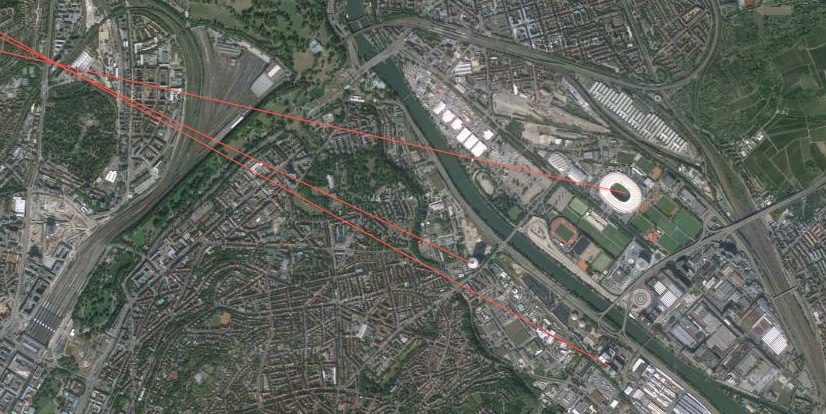
This week’s contest was done in a rush on Tuesday morning because I was out of town for the MLK holiday in a surprisingly cold Miami.  At first I was lost on this one, but the green roof, the hills in the distance, and the buildings made me think somewhere in Germany.  Then I noticed the stadium in the middle and started looking for stadiums in Germany with that profile.  Thanks to some Wikipedia and Google image searching, I settled on the Mercedes-Benz Arena in Stuttgart. From there it was about 20 mins of Google maps searching to find the right building, the BülowBogen Business Center located at Heilbronner Strasse 150. The picture was taken from an office on the back side of the building overlooking the train tracks.  Based on the height of the power lines for the train, it was probably taken from the sixth floor in the building’s southern half:
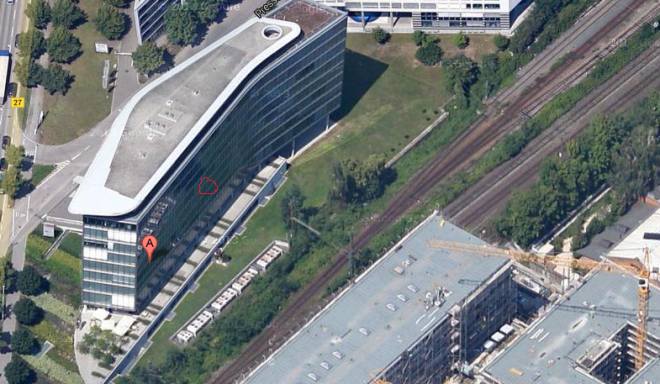
Stuttgart 2

A few other readers also correctly answered the BülowBogen building:

The electrified railway in the foreground looked like Germany to me, as did the yellow-brick stone buildings with (partially) skylighted roofs that look like the typical industrial architecture in so many railroad adjacent industrial areas from the late 19th / early 20th century. However, these indicators were only good for a first guess. What gave it away was the quite distinguishable top of a stadium in the medium background. That and the hills in the far background limited the choice of possible cities. The stadium in the medium background is Mercedes-Benz-Arena, home of German Bundesliga soccer club VfB Stuttgart. The BülowBogen Business Center is the only higher building in the vicinity of the point from where the photo could have been taken (3rd or 4th floor maybe). On Google maps’ satellite view, the black office building on the right is still under construction.

I wanted to attach a screenshot from Google Maps with arrows and circles and stuff as so many do at these contests, but the distance between point of photography and stadium was too big to be informative. Also FYI: I was given a one-year membership as a present last Christmas. Now, this is my first TVFYW contest I participate in. Good luck to you guys in your efforts!

Thank you! As far as the winner this week, the following reader guessed the closest floor of the BülowBogen building, has participated in the highest number of previous contests among this week’s finalists, and produced the most detailed entry:
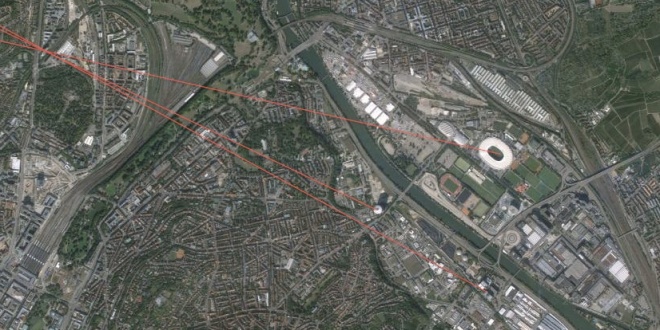
stuttgart

The view is of Stuttgart, Germany. You can see the stadium vaguely in the background. It’s near the Mercedes-Benz factory (which the stadium is named after). I thought it was weird to see a professional sports stadium without any large buildings or skyscrapers around, and that was a tip that this isn’t a view of an American city. So what sort of small towns have professional sports stadiums? Numerous cities in Europe. The shed like structures are actually some sort of music venue and restaurant space called the Wagenhallen – photos of it here.

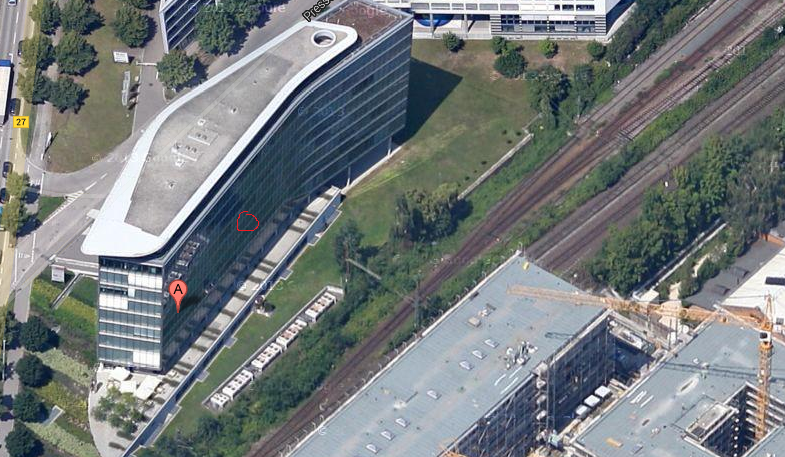
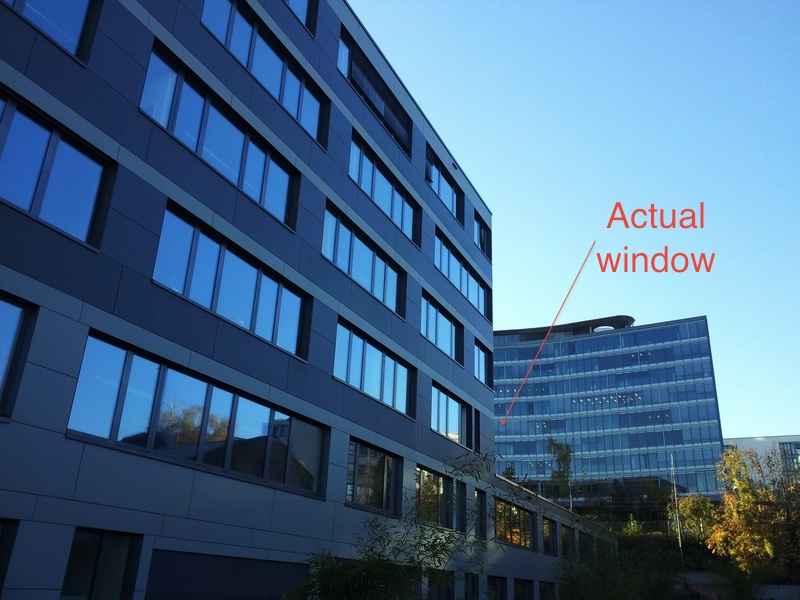
The picture itself was taken from the BulowBogen Business Center at 150 Heilbronner Strasse. I believe the room that the photo was taken from is on the fourth floor. I’ve attached a photo of the building with an arrow pointing to my best guess at the actual window your picture was taken from:
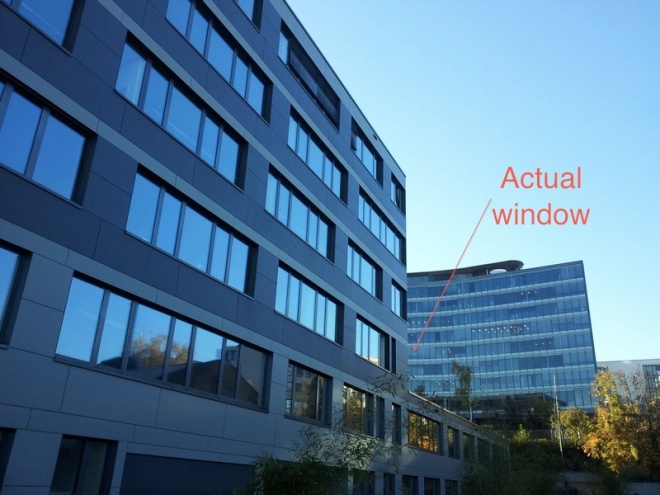
Actual window

From the submitter:

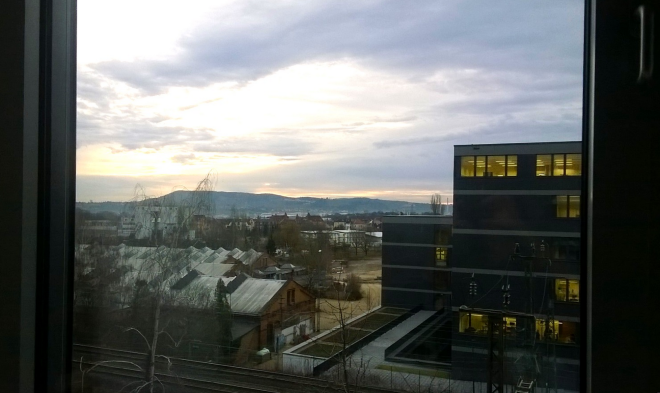
I’ve sent similar shots from my workplace before, but I particularly like this one, with the early-morning sky and the lighted interior of the nearby vocational school. Location: Stuttgart, Germany, taken from the second floor of the Bülowbogen office building at Heilbronner Strasse 150. Time: 8:45 am, Jan. 9, 2014. Description: Directly adjacent to the railroad tracks on the right is a recently built vocational school. To the left is a late-nineteenth century railroad car depot which is now being used for artist ateliers and various cultural events. In the far distance along the Neckar River (not visible) is the Mercedes-Benz Arena, where the local Bundesliga team plays. The area in the middle distance will be undergoing a radical transformation in the next several years because this belongs to the development site of Stuttgart 21, a controversial and very expensive project in which the current above-ground railway station will be transformed into an underground station, freeing up the immense area taken up now by tracks for new development close to the city center.

(Archive)
The President’s Position On Pot

In his new profile of Obama, Remnick asked the president about the dangers of marijuana:

“As has been well documented, I smoked pot as a kid, and I view it as a bad habit and a vice, not very different from the cigarettes that I smoked as a young person up through a big chunk of my adult life. I don’t think it is more dangerous than alcohol.”

Kush_closeIs it less dangerous? I asked. …

Less dangerous, he said, “in terms of its impact on the individual consumer. It’s not something I encourage, and I’ve told my daughters I think it’s a bad idea, a waste of time, not very healthy.” What clearly does trouble him is the radically disproportionate arrests and incarcerations for marijuana among minorities. “Middle-class kids don’t get locked up for smoking pot, and poor kids do,” he said. “And African-American kids and Latino kids are more likely to be poor and less likely to have the resources and the support to avoid unduly harsh penalties.” But, he said, “we should not be locking up kids or individual users for long stretches of jail time when some of the folks who are writing those laws have probably done the same thing.”

Accordingly, he said of the legalization of marijuana in Colorado and Washington that “it’s important for it to go forward because it’s important for society not to have a situation in which a large portion of people have at one time or another broken the law and only a select few get punished.”

I want to congratulate Remnick on asking the question which I have inexcusably failed to ask on the few occasions I’ve had the chance to grill the president. One key thing matters about this quote: the president of the US thinks a drug currently viewed by his own administration as the most dangerous kind of drug in existence is less harmful to the individual than alcohol. And that is one thing the federal government really can do: change the DEA’s classification of marijuana so that it complies with basic science and reality. When the government is loudly proclaiming something that a huge majority of reasonable people know is untrue, it is making an ass out of itself. The follow-up question is therefore: why, Mr president, does your own administration hold to a view about pot, with huge legal consequences for millions, that you do not share and for which there is no rational justification whatsoever?

But then, as is his wont, the president wandered around a bit in his own thoughts:

“Having said all that, those who argue that legalizing marijuana is a panacea and it solves all these social problems I think are probably overstating the case. There is a lot of hair on that policy. And the experiment that’s going to be taking place in Colorado and Washington is going to be, I think, a challenge.” He noted the slippery-slope arguments that might arise. “I also think that, when it comes to harder drugs, the harm done to the user is profound and the social costs are profound. And you do start getting into some difficult line-drawing issues. If marijuana is fully legalized and at some point folks say, Well, we can come up with a negotiated dose of cocaine that we can show is not any more harmful than vodka, are we open to that? If somebody says, We’ve got a finely calibrated dose of meth, it isn’t going to kill you or rot your teeth, are we O.K. with that?”

Please name someone who favors legalization who thinks it’s a “panacea” for “all these social problems”. Even I don’t believe that. I think legalizing it would be a net social good, with very few negative consequences, but of course there will be some who suffer from legalization, as well as complexities we don’t yet understand. So while I’m at it, here’s the most honest and persuasive essay on the cost-benefit analysis of legalizing weed I have yet read. It’s by Scott Alexander and its conclusion is that “there is not a sufficiently obvious order-of-magnitude difference between the costs and benefits of marijuana legalization for a evidence-based utilitarian analysis of costs and benefits to inform the debate.” And that’s why, in a nutshell, I’m fine with federalism on this, as I am with marriage equality.

Sullum parses Obama’s comments:

Obama is not really going out on a limb by acknowledging that alcohol, measured by acute toxicity, accident risk, and the long-term effects of heavy consumption, is more hazardous than marijuana. On the face of it, he would be taking a bigger risk by endorsing the theory of evolution. … To say that “it’s important for [legalization] to go forward” is a bigger step than the signals of prosecutorial forbearance the administration has offered so far. Obama seems to be saying he wants these experiments to succeed. In short, Obama is conceding that marijuana prohibition is unscientific and unjust. That is indeed a pretty big deal, assuming he does not find a way to wriggle out of it.

Sargent’s view:

Obama circled back around and noted the new laws in both states could be “a challenge” because of the potential for legalization of other, harder types of drugs. He also noted he has advised his daughters not to smoke marijuana. So it wasn’t an outright endorsement. But the moment was still significant in several ways. In context of the United States’ long-running and highly problematic war on drugs, it is quite notable to have a president come out and say that marijuana isn’t nearly as harmful as it is often made out to be and to back serious changes in the legal regime governing the drug.

Ed Krayewski doubts Obama will act on this:

Given that Obama says he’s quit smoking cigarettes (which are kinda like weed to him) but still drinks socially (which he says could be more dangerous than pot) and has previously laughed off the suggestion that marijuana legalization would be beneficial (and continues to head a federal government waging a war on marijuana), his comments shouldn’t be interpreted as much more than off-the-cuff punditry.

Isaac Chotiner was put off by how Obama answered the question, and others:

It’s not just that the answer is now maddeningly long. Nor is it merely that Obama exhibits his annoying tic of stating his opponent’s case in the most extreme, over-the top way (who exactly thinks marijuana legalization is a “panacea” for solving “all these social problems?”) It’s also, again, the condescension. We know there are other sides to the issue. We know the issue is complex. We know there are slippery slope arguments about drug legalization. But either he doesn’t think that we know these things or, more damningly, he must remind us that he knows them, too.

The reason he does this, I would argue, is that he is more interested in telling us how he thinks than what he thinks.

When Partisan Politics Began

It looked a lot like today. Reviewing Jeffrey L. Pasley’s The First Presidential Contest, James M. Banner, Jr. takes us back to when John Adams and Thomas Jefferson vied to replace George Washington:

[I]n Pasley’s telling, it was in 1796 that many of the metaphors and symbols we still recognize as integral to our politics first took root. Thomas Jefferson was taken to task for his lack of “manly” virtues—being often thought of as (in Pasley’s words) “an effete dilettante and annoying smarty-pants”—and for his sympathy for revolutionary France. John Adams and even George Washington himself took brickbats for their monarchical bearing and British-like formality. Symbolic language about a “man of the people” and the “father of the state” vied with each other for the first time. And for the first time, too, foreign policy penetrated deeply into the presidential campaign.

While including the requisite caveats, Banner notes that “this first partisan presidential election seems to be the Big Bang from which American national politics has since drawn its energy”:

In 1795 and 1796, people argued about Jefferson’s and Adams’s characters. In bravura displays of negative campaigning, they tore down the candidates’ motivations, dredged up their previous writings, and had at their earlier careers. It was in every way what today we call a cultural war—Pasley calls it precisely that—as they battled over religion and other values and beliefs. In Pennsylvania, the state that even then was a battleground and a sure thing for neither Democrat-Republicans nor Federalists, local politicians engaged in “voter suppression” as partisan and purposeful as any we see today. … For we can now see that the election portended much that was to follow: its boisterousness; the engagement of state legislators, local voters, newspaper editors, and opinion makers; the permeation of questions about the candidates’ characters and their previously written convictions—by such developments the election contributed to what would prove to be the emergence, however slow, of American political democracy.

Exit Ezra, Smiling

The New Yorker's David Remnick Hosts White House Correspondents' Dinner Weekend Pre-Party

The last few years have been fascinating to watch as new media stars have both benefited from and then fallen out with big media companies. Nate Silver is the obvious example. He went from being an independent blogger – heavily linked by the Dish among other new media sites – to becoming the true star of the NYT’s 2012 election coverage. Then he and the NYT could not figure out a mutually beneficial deal, and he quit to run a new 538-style site at ESPN.com. It won’t launch for a bit (maybe March, I hear). But ESPN, as they showed with Bill Simmons’s original blog and now Grantland, is one of the very few big media outlets to find a way to a win-win proposition with Internet stars.

Or think of Glenn Greenwald. First an immediate blogging sensation; then Salon, then the Guardian and now … working on his own news-and-opinion website, with a massive global brand, funded by the founder of eBay. The WSJ’s Kara Swisher and Walt Mossberg are also now exiting the WSJ’s employ to start their own site. The Dish’s story – until last year – was also a story of trying – and failing – to get a win-win arrangement with media companies interested in allying with us.

The truly frustrating thing about all this is that it was surely in everyone’s interests to stick together – legacy media with new media stars is a win-win proposition. And yet almost every time – the one exception I can think of may be Andrew Ross Sorkin’s Dealbook – the deals have unraveled. The egos of legacy media honchos and the energy of new media stars could not quite get along. Mutual resentment, the thorny question of compensation, and the power of personal brands all played a part.

For some, the entire model of individually branded content is a dismaying idea.

Michael Wolff cannot understand it.  His best shot at a description is that we are “less interested in the publishing business per se than in a kind of channel purity and deepness.” But then, Wolff is a big believer in old-school massive media conglomerates, is one of Rupert Murdoch’s primary hagiographers, and with respect to Roger Ailes, makes Mike Allen look like a footnote in the annals of brown-nosing. Today, he’s celebrating the end of net neutrality, so that big media companies – owned by the super-rich – can begin monopolizing again. He finds it mysterious that some writers might actually be in new media not just for the money but also for the freedom to say what they want whenever they want in ways not constrained by highers-up. I’m not so mystified.

Which leads me simply to wish Ezra the best of luck. There are many models going forward, and Ezra may not be content with the Dish’s slow, organic, reader-funded evolution. But we do not exactly have a surplus of trying to find new profitable models for non-listicle, non-sponsored-content journalism. If Ezra can help with that, he can help all of us, but especially readers. Not all of them want to read the stuff that only very, very wealthy corporations think is fit to publish. They might even forgive a few niche interests and quirkiness in the process.

Update from a reader:

You wrote:

The egos of legacy media honchos and the energy of new media stars could not quite get along. Mutual resentment, the thorny question of compensation, and the power of personal brands all played a part.

I think this phenomenon is more general. I have known numerous tech companies that were acquired by behemoths, or spun off as subsidiaries rather than independent companies. I worked for one of them. In every case, the management of the parent swore on a stack of Bibles that they wouldn’t interfere with the entrepreneurial culture of the new venture (as if they knew what the word “entrepreneurial” meant). In each case they couldn’t resist meddling, with serious and sometimes fatal consequences for the spinoff.

There were many reasons, of course: financial straits, changes in corporate strategy, new competitors. But I think the common denominator is the irrevocable human tendency to prefer control over success.

Brilliantly put.

(Photo: Journalist Ezra Klein attends The New Yorker’s David Remnick Hosts White House Correspondents’ Dinner Weekend Pre-Party at W Hotel Rooftop on April 26, 2013 in Washington, DC. By Dimitrios Kambouris/Getty Images for The New Yorker.)