Where Are All The Black Atheists? Ctd

A reader writes:

Thanks for having the thread on black atheists. I feel like atheism is the third rail of black identity. I have spent most of my life not fitting in neatly with any particular group while getting along well with almost everyone. I’m a black Jamaican immigrant raised by parents who were intellectual and black power-y enough to give both their children African middle names and eschew organized religion. My parents were both raised in religious households but when it came to raising their own children they said they’d “let us decide for ourselves when we grew up.” Suffice it to say, that meant the default context was atheism and, no offense, but religious origin stories are a tough pill to swallow if they haven’t been ingrained long before one develops the capacity for reason.

I almost feel like being an atheist is something I have to hide so people don’t look at me funny.

Being black and atheist has really resulted in feeling fairly alienated from “mainstream” black American culture. I just flat out don’t get, don’t want to get and can’t relate to the level of Christian religiosity that is part and parcel of African-American culture.

That said, I’m not ignorant. I’ve been to black church services and appreciate the role the black church has played in sustaining African-Americans culturally, spiritually, and political throughout a brutal history steeped in white supremacy and black oppression. Still, I am not about that life.

Pretty much none of my close friends slides much past “spiritual” on the religious scale, and I don’t think it’s an accident that of my very closest friends, not one is African-American. I almost feel like a bad black person typing that, even though I know my expression of blackness is just as valid as the “praise Jesus, God is good” version of it. But there’s just so little room for expressing it, it feels taboo.

Long story long, what I’m trying to say is thank you for providing a venue for me to express myself and for showing me enough other people like me to normalize my experience. Like the attorney in the piece said, we need more images in popular culture – like a black atheist version of Will & Grace – to expand the perception of what blackness includes.

Coding Toys For Girls And Boys

dish_toys

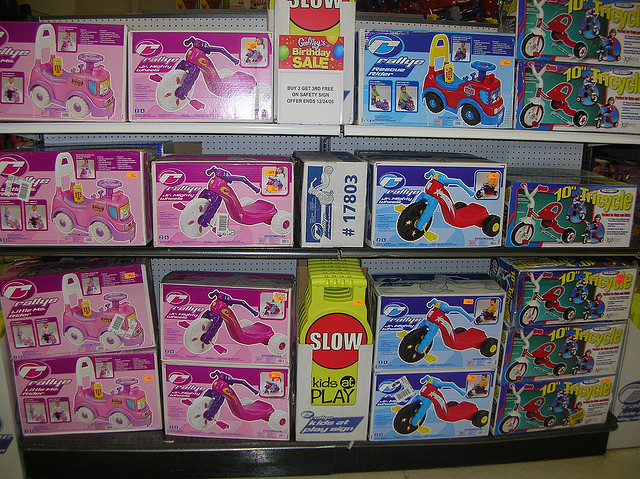
“It seems that the more progress we make toward less rigid gender roles,” observes Susan Bailey after visiting a kids’ toy store, “the more extreme the gender coding of toys becomes”:

The toys were far more color coded than four decades ago. Back then bikes, trucks, airplanes and even dolls sported a wide range of bright colors—red, green, yellow as well as shades of blue and rose.  The pink/lavender vs. black/dark navy dichotomy is a division that, among other things, probably helps sales. Teach children and parents the color-code and you double your market.  What little brother will want to settle for his big sister’s pink tricycle?

Earlier this month, C.J. Pascoe and Tristan Bridges argued that “the denunciation of all things pink should not really be our primary focus if we want to move toward a more gender equal world for girls and boys”:

The focus on the push back against pink and, by extension, princess culture is especially surprising when one looks at what is for sale in the boys’ aisle.

Take the first category of offerings for boys at the Toys R Us website for example – action figures laden with a variety of weapons who are designed to defeat the bad guys.  The closest offering for girls is a dolls category – featuring Barbies, the Little Mermaid, and Strawberry Shortcake. None of them are warriors.  None of them have weapons. We see a similar difference even when looking at the exact same categoryGirl’s Building Sets vs. Boy’s Building Sets. Girls apparently build houses, salons… and the occasional bridge. Boys? They build Super Star Destroyers and Monster Fighter Vampyre Castle… and the occasional bridge.  To be clear, the “pink aisle” of toy stores is deeply problematic. It encourages a narrow range of passive, primarily family-oriented and appearance-obsessed femininities.  But, as the toys on the (digital and physical) shelves indicate, we are encouraging equally restrictive and arguably more dangerous masculinities –  warriors, space fighters, and ninjas.

Rebecca Hains joins the discussion, saying she’d “like to see a movement that … challenges marketers to put an end to the incessant pink-washing”:

By “pink-washing,” I’m specifically referring to the instances where marketers or toy makers create a product that is pink for no reason other than to make it as girly as possible. After all, there’s nothing wrong with pink–it’s a perfectly nice color–but there IS something wrong when it’s a) promoting sex role stereotypes and b) basically the only color found in little girls’ worlds. They deserve a full rainbow of colors. …

The Let Toys Be Toys movement is doing terrific work challenging the status quo in the UK. By calling for toys to be desegregated–grouped by theme or interest type, rather than by gender—they’re empowering parents and children to think outside of the pink and blue boxes that marketers have been placing children into. I’d really love to see a comparable movement here in the U.S. and Canada.

(Photo of gender toy divide in Toys “R” Us by Brian Sawyer)

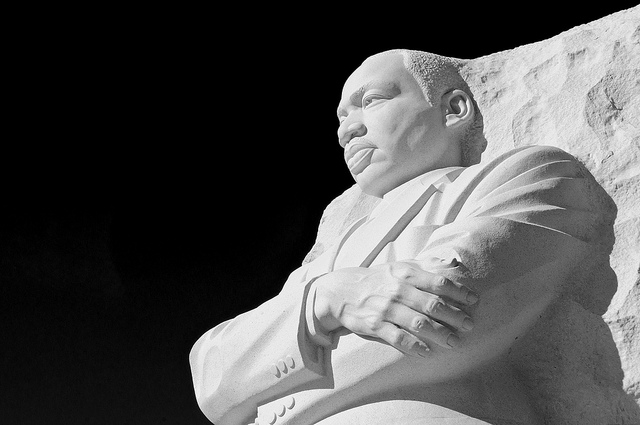
Commemorating King

dish_mlk2

Gary May pays tribute:

Looking back on King’s life and career, some would say that he had died at the right moment, that martyrdom rescued him from an equally serious blow: irrelevancy. The Voting Rights campaign had clearly been his greatest achievement and, as it turned out, his last. But the 1964 Civil Rights Act and the 1965 Voting Rights Act are a testament to his leadership and commitment to achieving change through nonviolent protest. Nearly 50 years after his death it is King’s words and deeds that live on in the American memory — not that of the racists who hated him or the Black Power advocates who scorned him.

King left us a rich legacy. Nonviolence became an effective tool in the hands of reformers throughout the world as well as the United States, which experienced the end of segregation in a relatively bloodless revolution. Despite his self-doubts and the attacks of critics in his own camp, he persevered, committed always to nonviolence and to the fulfillment of American democracy however long it would take. That is what we should be celebrating on this day.

Jenee Desmond-Harris urges us to refrain from asking “What would MLK think?” when it comes to today’s politics, emphasizing that his views could be difficult to pin down during his own lifetime:

“He was constantly evolving in his thoughts, and that evolution would have continued to impact his politics,” says Hasan Jeffries, professor of history at Ohio State University.

Jeffries points to the way King “trailed his wife, who’d already participated in anti-war protests years earlier” before finally making the Riverside Church declaration against the Vietnam War, getting himself cut off from more-conservative civil rights activists. It’s evidence that neither King’s positions nor his alliances were static. … Naturally, as his reality and his adversaries changed, so did his positions and his goals.

And even when it comes to people who are living today, it’s not as if everyone on the left, everyone who was active in the civil rights movement or all black politicians or activists are of the same mind when it comes to contemporary issues. Where would he stand on education reform? The Affordable Care Act? What about President Obama’s responsibility to African Americans in an environment that could be seen as the embodiment of King’s dreams but that goes hand in hand with racialized political potholes he couldn’t have imagined? Scandal? Your guess is as good as mine.

Meanwhile, Aura Bogado casts a critical eye at The GAP’s “MLK Event” sale, adding that she never “lets the day go by without reading King’s ‘Letter from a Birmingham Jail.'” Drawing on Taylor Branch’s Parting the Waters, Paul Elie details the “strange circumstances” of how the “Letter” was written:

What strange circumstances?  That King, prompted to set out his views after reading a newspaper article in which white liberal clergymen denounced nonviolence as an incitement to “violence and hatred,” started to write the letter in the margins of the newspaper. That he developed his argument (Branch reports) among “pest control ads and garden club news,” drawing arrows and loops to connect one insight to another — such as the point that “time is neutral” and so “we must use time creatively.” That once he got some note paper from his SCLC associate Clarence Jones, he crafted a three-hundred-word sentence explaining “why we find it so difficult to wait” for justice. … That a New York publisher suggested that an expression from the letter, simplified, should be the title of a book, King’s third: Why We Can’t Wait.

Ellen Blum Barish recommends listening to a 1958 speech given at her synagogue in Evanston, Illinois.  MLK’s Nobel Prize acceptance speech can be viewed here. Update from a reader:

Your post missed what I thought would have resonated with you today: how much Pope Francis sounds like MLK.  From the 1956 sermon “Letter From St. Paul to American Christians“:

They tell me that one tenth of one percent of the population controls more than forty percent of the wealth. Oh America, how often have you taken necessities from the masses to give luxuries to the classes. If you are to be a truly Christian nation you must solve this problem. You cannot solve the problem by turning to communism, for communism is based on an ethical relativism and a metaphysical materialism that no Christian can accept. You can work within the framework of democracy to bring about a better distribution of wealth. You can use your powerful economic resources to wipe poverty from the face of the earth. God never intended for one group of people to live in superfluous inordinate wealth, while others live in abject deadening poverty. God intends for all of his children to have the basic necessities of life, and he has left in this universe “enough and to spare” for that purpose. So I call upon you to bridge the gulf between abject poverty and superfluous wealth.

Previous Dish on MLK here, here, and here.

(Photo of Martin Luther King, Jr. memorial in Washington DC via Flickr user InSapphoWeTrust)
The Case For Small-Scale Science

This year’s Edge question is “What scientific idea is ready for retirement?”  From mathematician Samuel Arbesman’s response:

While the trends clearly point to the advent of team science, small and clever science—the realm of the tiny budget or the elegant experiment, or sometimes even the hobbyist—is by no means over.

To be clear, small science is not necessarily the lone underdog working against the establishment. More often it is simply one or two underfunded scientists doing their best. But it seems that they can still survive even in this modern era of big science. For example, several years ago, a paleontology graduate student made a discovery that cleared a dinosaur of cannibalism charges that began with a very simple observation: by looking at one of the fossil casts on the wall of the American Museum of Natural History’s subway station. Or take the scientists who examined the space of possible ways to tie a necktie, and whose research was published in Nature. Little science is still possible. …

You can even still do science on the cheap. Several decades ago, Stanley Milgram measured the well-known Six Degrees of Separation using little more than postcards. While science has become bigger since then, in some ways it has become even easier to conduct large-scale science by the scientist who operates at a small scale: due to massive computational advances and widespread data freely available (not to mention easier data collection online), now any scientist can do big science cheaply and in a small and easy way. Technology has allowed research scientists to leverage a tiny budget in astonishing ways. And each of us can now even easily contribute to science as an amateur, through the growing prevalence of citizen science, where the general public can help—often in a small incremental way—to collect data or otherwise help with science. From categorizing galaxies and plankton to figuring out how proteins fold, everyone can now be a part of the scientific process.

The Bilingual Brain, Ctd

Arturo E. Hernandez explores how age affects the ability to learn multiple languages:

Particularly sensitive to age is a person’s ability to speak without an accent and to detect speech sounds that are not present in their native language. For example, infants can detect sounds from a language not in their environment at six months of age. By 10 months of age they lose this ability. This suggests that the ability to detect speech sounds from around the globe is available to all infants but slowly fades away. Another arena where age plays a role is in the processing of grammar. Those who learn a second language later in life do not perform as well on tests of grammar as early learners. Hence, the ability to learn grammar and speech sounds appears to be very dependent on the age that one first learns a language.

Despite this general rule, there are some very interesting exceptions.

For example, Christophe Pallier and his colleagues tested a group of adults who had been born in Korea and adopted as children in France between the ages of 4-8. This group of adults were asked to listen to sentences in Korean, French, or an unknown language. The results revealed no difference in their brain activity when compared to native French speakers. That is, both groups showed similar activity for French, Korean, and a foreign language. Furthermore, the Korean adoptees had no discernible accent. They sounded French. The results are intriguing because they suggest that a language can be lost even relatively late in childhood. This suggests that the age at which a language is learned is not the only predictor of how well a language is spoken as an adult.

Previous Dish on the subject here.

The Deadliness Of Doing, Ctd

Antonia Macaro considers how “doing nothing” may work to our benefit:

[A] lot depends on what we mean by “nothing”. In our achievement-orientated culture there is a danger of construing this as any activity without a clear end-product. In fact, there are different ways of doing nothing, some positive and some negative. There is a passive watching-TV-all-day kind of doing nothing, which is indeed often a sign of malaise. But there is also a “doing nothing” that includes reading, walking, reflecting, attending to the small things in life. An active doing nothing, if you know what I mean.

I’m not advocating doing nothing as a general policy in life. But it’s important not to confuse all unproductive activity with wasteful idleness. Allowing and cherishing a “doing nothing” of the active variety could enrich life as much as a passive doing nothing is likely to impoverish it.

Baggini looks to “The Dude” of The Big Lebowski, whose philosophy advocates “abiding” over “doing”:

I’m not sure many of us would really like to live like The Dude and the real world is more complicated than the often surreal universe of The Big Lebowski. But we can learn something from him even if we don’t become card-carrying dudeists. It’s that many battles are not worth fighting, even though our cause is just and our enemies in the wrong. The world is unfair and, if we cannot accept that fact, we will often end up further disturbing the peace of ourselves and others. We should not let people get away with everything, of course. But against the perennial temptation to believe something must be done, doing nothing is often the more courageous and fruitful path.

Oakeshott’s views on the matter here.

Not Jewish Enough For Marriage?

Israelis disagree about what makes a person Jewish, with the state using one identity test and rabbis, who oversee marriage and divorce, using another. The result? Some immigrants are in limbo:

In a concession designed to widen support for the new state, when Israel was founded its secular rulers left matters of marriage, divorce and burial in the rabbinate’s hands. It decides who is eligible for these rites, as well as carrying them out—so would-be brides and grooms must demonstrate their Jewish credentials. Supplying the necessary documents and witnesses can be inconvenient and galling: people resent having to prove what they know to be true. Immigration has made the system seem not just irksome but unsustainable.

For example, the Ethiopian Jews who migrated to Israel in the 1980s-90s, risking their lives and losing relatives along the way, have faced persistent doubts as to whether they are properly Jewish in doctrine and descent.

“I feel that I’m the Jew I want to be,” protests Fentahun Assefa-Dawit of Tebeka, an advocacy group for the 130,000-strong community. “I don’t want anyone to tell me how to be Jewish.” Western migrants, too, are sometimes doubted. The rabbinate considers some American rabbis too lax to vouch for their congregants and rejects their testimonies; it deems many overseas conversions inadequate. Many Israelis worry about the impact of such disdain on the diaspora’s political and financial backing for their state.

The biggest problem comes from the clashing consequences of two great ruptures in 20th-century history: the Holocaust and the collapse of the Soviet Union. Under Israel’s Law of Return, anyone who has, or whose spouse has, at least one Jewish grandparent can claim citizenship—a standard expressly modelled on the criteria for persecution under the Nazis’ Nuremberg laws of 1935. The Law of Return also recognises conversions that the rabbinate rejects. The wave of immigration from Russia in the past two decades means the discrepancy between these two standards has become glaring. There are now several hundred thousand ex-Soviet Israelis who were Jewish enough to get in, but are not Jewish enough for the rabbis

An Unsettling Bestseller

Mein Kampf is rising to the top of e-book bestseller lists:

Mein Kampf hasn’t made The New York Times nonfiction chart since its U.S. release in 1939, the same year Germany invaded Poland, and its print sales have fallen steadily ever since. But with a flood of new e-book editions, Hitler’s notorious memoir just clocked a banner digital year. One 2012 English-language version is currently the number one Propaganda & Political Psychology book on Amazon. Another digital selection is a player in the Globalization category. …

The first Kindle edition of Mein Kampf surfaced in late 2008, selling for $1.60. Shortly after that, another version popped up for $1.58 and rocketed up Amazon’s Legal Thrillers chart, then suddenly vanished in March 2009, along with a slightly pricier rival version, after a blogger at CNET acknowledged its burgeoning success. At the time, Amazon did not respond to CNET, which found it “unclear who uploaded the Kindle Edition of Mein Kampf.” Nevertheless, the e-book behemoth removed the virtual versions while continuing to offer a range of cloth and paperback printings, the overwhelming majority of which sold poorly if at all.

Stephanie Butnick wonders about the sudden rise:

For one thing, it’s a lot easier to click open the Kindle version instead of whipping out a print copy of Mein Kampf on the subway.

The book is so notorious, even the most curious readers probably wouldn’t bring it to the checkout counter at Barnes and Noble. As Vocativ points out, the book’s popularity falls in line with the 50 Shades of Grey model: readers are much more likely to stealthily download the online version, just to see what’s inside.

And maybe it’s time they did. The book itself, published a decade before World War II, is frighteningly frank about Hitler’s plans. In it, Hitler details his intentions to eliminate the Jews, also suggesting the German Reich expand by taking some of Russia’s land. As Marc Tracy noted back in 2010, while the book outsold the Bible in Germany as Hitler rose to power, no one seems to have actually taken a look inside.

Jason Heller links the book’s resurgence to a new study that suggests there’s a formula for successful books:

Thankfully, literature is not a science. Yet the writing and selling of literature increasingly is. Thanks to a proliferation of analytics, it’s easier than ever for publishers to track, graph, and therefore do their desperate best to predict market trends. Judged on that cold scale of downloaded units, Mein Kampf—which has come roaring back recently thanks to a high volume of e-book sales—might now be considered a good book.

I won’t go so far as to say that reducing the richness of books to ones and zeroes, and then judging them on such a scale, is tantamount to literary eugenics. But it does raise a question about what it means for a book to be formulaic, and whether that’s a good or bad thing. Or whether those kinds of questions even mean anything anymore.

Update from a reader:

You should know that the Mein Kampf “bestseller” story is blown way out of proportion. At most it was selling 10 books a day before the media got ahold of it. Thorough debunking from a self-published author here. (I am one as well, and let me tell you, we pay attention to what rankings actually mean!) It’s an overblown story that provides fodder for a lot of think-pieces.

Stimulating Your Memory

A new study indicates that caffeine “may enhance consolidation of memories only if it is consumed after a learning or memory challenge.” Cathy Newman talked to one of the study’s researchers, Michael Yassa:

So you gave people who didn’t regularly use caffeine either a placebo or a 200-milligram caffeine tablet five minutes after they studied a group of images. Both groups returned 24 hours later to be tested. The caffeine users remembered the images better.

Caffeine was first isolated from the coffee bean in the 19th century by a German chemist. Do we know exactly how it works? There are several mechanisms. It acts on the adenosine receptors and increases heart rate, vigilance, blood pressure—the fight-or-flight response when you see a bear. It’s what happens when someone says, “I get an adrenaline rush.” It also acts on a small region of the hippocampus, which plays an important role in long- and short-term memory.

How much coffee do you have to drink to get 200 milligrams of caffeine?

It’s about two shots of espresso.

Should we all rush out and order triple-shot grande lattes as a result of these findings?

Keep in mind that those drinks also involve lots and lots of sugar. I’ve been a coffee drinker for years, and I’m not going to double my dose.

Victoria Turk feels that the study is being misreported:

Sure enough, the people who were given caffeine rather than a placebo (it was a double-blind study) completed the task a bit better. “We conclude that caffeine enhanced consolidation of long-term memories in humans,” wrote the researchers.

That’s all very interesting. But it doesn’t follow that downing an espresso after a revision session will make you perform better in an exam the next day, as some reports would have you believe.

What actually happened in the study is that those who had caffeine were better at spotting which images were similar but not exactly the same to the previous day’s. They weren’t significantly better at spotting which images were brand new and which were the same. That’s quite a specific effect observed, then, and one that doesn’t immediately transfer into real-life applications.

Previous Dish on how to time your caffeine consumption here.

Why Mindfulness Matters

Dan Hurley traces the dramatic rise of mindfulness meditation in Western psychology:

Although pioneers like Jon Kabat-Zinn, now emeritus professor at the University of Massachusetts Medical Center, began teaching mindfulness meditation as a means of reducing stress as far back as the 1970s, all but a dozen or so of the nearly 100 randomized clinical trials have been published since 2005. And the most recent studies of mindfulness – the simple, nonjudgmental observation of a person’s breath, body or just about anything else – are taking the practice in directions that might have shocked the Buddha. In addition to military fitness, scientists are now testing brief stints of mindfulness training as a means to improve scores on standardized tests and lay down new connections between brain cells.

Michael Posner, of the University of Oregon, and Yi-Yuan Tang, of Texas Tech University, used functional MRIs before and after participants spent a combined 11 hours over two weeks practicing a form of mindfulness meditation developed by Tang. They found that it enhanced the integrity and efficiency of the brain’s white matter, the tissue that connects and protects neurons emanating from the anterior cingulate cortex, a region of particular importance for rational decision-making and effortful problem-solving.

Perhaps that is why mindfulness has proved beneficial to prospective graduate students. In May, the journal Psychological Science published the results of a randomized trial showing that undergraduates instructed to spend a mere 10 minutes a day for two weeks practicing mindfulness made significant improvement on the verbal portion of the Graduate Record Exam – a gain of 16 percentile points. They also significantly increased their working memory capacity, the ability to maintain and manipulate multiple items of attention. That a practice once synonymous with Eastern mysticism could be put to the service of Western rationalism may sound surprising, but consider: By emphasizing a focus on the here and now, it trains the mind to stay on task and avoid distraction.