Kids Can’t Handle The Fiction?

Natasha Vargas-Cooper suggests that “maybe the novel is not the best device for transmitting ideas, grand themes, to hormonal, boisterous, easily distracted, immature teenagers”:

[M]ost high-school-age kids … go to overcrowded, underfunded schools, staffed by largely well-intentioned adults who don’t have the resources, or sometimes even the intellectual vigor, to make emotional landscapes of the western front, nineteenth-century London, or Pamplona very real to sixteen-year-olds. … Maybe there is a better format and genre to spark a love of reading, engage a young mind, and maybe even teach them how to write a coherent manner. Thankfully this genre exists: It’s called non-fiction.

Journalism, essay, memoir, creative nonfiction: These are only things I started reading as an adult because of how little I enjoyed reading novels in high school. Surely, the un-made-up stuff would be more of bore, I thought. Yet when I finally read In Cold Blood, Into Thin Air, the works of Hunter S. Thompson and Joan Didion, I continually pleaded aloud my friends in their twenties, “Why didn’t anyone make me read this in high school?!”

Margaret Eby agrees with Vargas-Cooper that most high schools may be unequipped to make novels appealing to teenagers, but “that’s not the point of teaching novels”:

At its loftiest, the idea of a high school curriculum—really, the idea of education in general— is to get students to think about, react to, absorb, and otherwise navigate situations that they wouldn’t have to outside of school. Solve a calculus problem. Dissect a frog. Memorize the preamble to the Constitution. These aren’t just party tricks for later, the point is the introduction. Just because teenagers might not totally grasp the implications and nuances of a subject doesn’t mean we shouldn’t expose them to it. Realizing that you don’t understand something is how you begin to understand it.

She adds:

What’s striking about the hypothetical syllabus Vargas-Cooper caps her essay with—one that’s brimful of literary journalism gems—is that the authors on it all owe a tremendous debt to fiction writing.  Truman Capote’s “In Cold Blood” and Adrian Nicole LeBlanc’s “Random Family,” to name two selections from Vargas-Cooper’s list, are engrossing reads not just because of the extensive research their authors conducted, but because they deftly employ the storytelling conventions of novels in their writing. I’m willing to bet that none, or very few, of the writers on her list got to where they are without reading novels.

The Diets That Died Off

Meg Favreau compares past and present:

Really, there are just two main differences I found between turn-of-the-[20th]century diet fads and modern diet fads. First of all, the goal of the old-timey diets was always the prevention and cure of disease. Sure, you can argue that’s also a goal of today’s diets, but come on — everybody really wants to be sliding into their skinny jeans. Turn-of-the-century diets were more life and death — remember, this was a time before antibiotics, when gout was a common ailment instead of an amusing old-timey reference, and an outbreak of cholera could kill over 10% of a local population. Hell, there were still literal cesspools attached to houses.

The second difference between the old diets and modern diets?

The recipes from the 1800s and early 1900s diet cookbooks I researched taste like hot cardboard (or, in the case of the “unfired” recipes, cold cardboard). Yes, on the surface, a text like 1854’s New Hydropathic Cook-book has similar principles to Michael Pollan – eat mostly plants; don’t bury your food in fat and sugar. But the book also preaches a complete abstinence from salt, vinegar, and lemon, aka “flavor.” [John Harvey] Kellogg had a similar philosophy — but John Harvey, my man, when you’re making a cracker whose two ingredients are grain and water, you need to put some damn salt in it.

Meanwhile, David Katz offers a stern warning that “we are missing the big picture when it comes to nutrition”:

Embracing the notion that we actually have to eat well, overall, and be active, to optimize our health suppresses magical thinking in ways we seem unwilling to sanction. So, instead, we continue to focus — as we have now for calamitous decades — on one food, nutrient, nutrient grouping, or ingredient at a time, all the while missing the big picture.

have written beforemore than once, about how egregiously misguided this is. It does nothing but play into the designs of Big Food, which is delighted to reshuffle their very short list of favorite cheap ingredients into new versions of junk and profit from our preoccupation du jour. If we fixate on cutting fat, we can have low-fat cookies. If we fixate on carbs, we can have low-carb brownies. If we fixate on fructose, we are privileged to trade not up but sideways to equally sugary but now “high-fructose corn syrup free” versions of the same rubbish. … If we fixate on gluten, we can have gluten-free junk. If grains are bad, there are innumerable ways to eat badly without them, just as there are with them. If meat is the enemy, there is a whole universe of variations on the theme of vegan junk food to explore.

This is not theoretical. We have been inventing new ways to eat badly for literal decades, with the profound ills of modern epidemiology to show for it. The suspended animation of common sense and an apparent unwillingness to learn from the follies of nutritional history consign us to repeat them again and again.

(Hat tip: 3QD)

The Sexist Ads Of Yesteryear

article-2295267-18C2186D000005DC-308_634x825

Cynthia Petrovic blogs about vintage ads geared toward female consumers.  In an interview, she talks about how her interest developed:

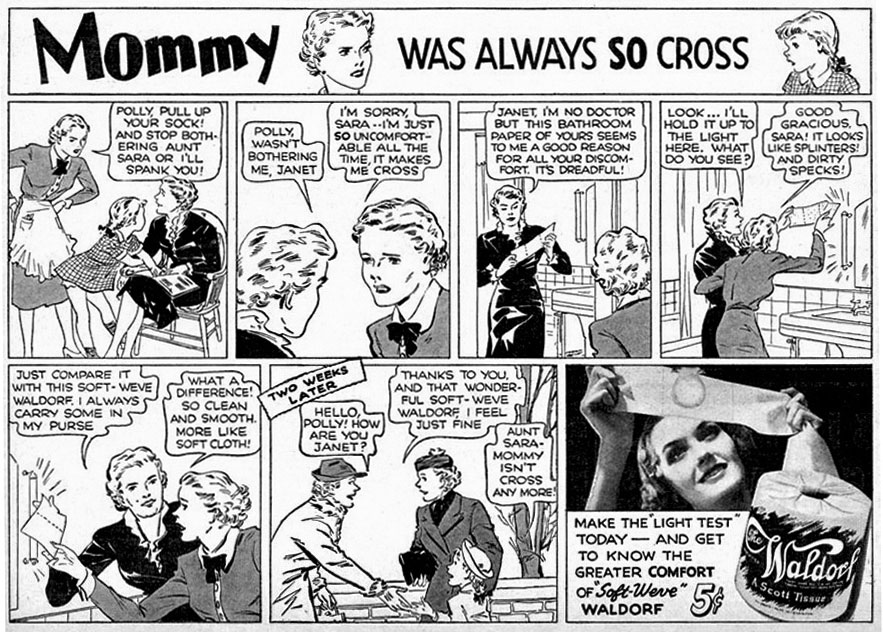
When I was in college, I came across a 1930s romance magazine called “True Story” in an antiques store in Orange, California. Flipping through the pages, I found an ad for Waldorf toilet paper, which was a little comic strip. A man has become so cranky toward his wife that their marriage is on the rocks. As it turns out, cheap toilet paper is the thing that’s driving him crazy because it has bits of splinters in it. The couple holds the tissue up to the light, and they see little pieces of wood in it. Waldorf advertised repeatedly in these magazines. In some of the ads, the wife was cranky, and then it was their little girl. Eventually, the whole family was affected by this scourge. I found it so funny.

After that, I got addicted to finding these old romance magazines from the ’30s and ’40s—“True Romance,” “True Story,” and “True Secrets”—as well as the homemaking magazines like “Woman’s Home Companion” and “Ladies’ Home Journal.” But the romance magazines were where I found the ads that really take the cake. They’re the most entertaining, and just shameless. The most common premise is that a woman does not want to offend a man. These ads speculate about whether your husband is going to walk out on you because you’re not using a feminine hygiene product or your scalp smells when you’re dancing or you have undie odor.

What she’s observed about advertising trends:

In the late 19th century, magazines took over the advice and care of your family. As magazines were available to more and more people, you could read about what to buy, how to take care of your kids, what you should look like, and what you should be thinking and doing. People turned to the magazines to get information and form opinions about themselves. Suddenly strangers were telling people what they should look like, buy, and think. Today, that’s exploded with the Internet.

I noticed a fever pitch building up during the 1930s. By the late ’30s, the advertisers were on a roll. You open up any of these magazines now, and you burst out laughing. But during World War II, I would say about 80 percent of those ads that manipulate you, the ones that say you stink or you’re not socially acceptable on some level, vanished.

By the way, here’s that comic-strip ad for Waldorf toilet paper:

dish_vintageads

Browse through countless others at Petrovic’s site.

Overrun With Indies?

Contemplating this year’s Sundance festival, Manohla Dargis makes a request of movie producers (NYT):

[T]ake a moment and consider whether flooding theaters with titles is good for movies and moviegoers alike. Because no matter how exciting Sundance will be this year, no matter how aesthetically electrifying, innovative and entertaining the selections, it’s hard to see how American independent cinema can sustain itself if it continues to focus on consumption rather than curation. There are, bluntly, too many lackluster, forgettable and just plain bad movies pouring into theaters, distracting the entertainment media and, more important, overwhelming the audience. Dumping “product” into theaters week after week damages an already fragile cinematic ecosystem.

Tim Wu has a great counterargument, writing that “making lots of films to yield a few hits is not dangerous to independent film but exactly how independent film sustains itself—and ultimately how it improves Hollywood”:

Who exactly gets hurt if too many movies are made?

If making films weren’t challenging and fun for the people involved, they wouldn’t do it. As John Kenneth Galbraith wrote decades ago, we live in an affluent society, with plenty of surplus cash, much of which ends up in the arts. More art means more bad art, too, but so what? … It may sound strange, but visible failures are the sign of a fertile cultural industry.

Ultimately, the only real victims are film reviewers like Dargis, whose job is complicated and made tiresome by the duty of watching so many films. … This leads to a suggestion for the Times’ critics: namely, that the paper’s ambition of reviewing every film that is “released” in New York City theatres is folly and entirely too twentieth-century. (The Times reviewed nearly nine hundred films in 2013.) The significance of a release is eroding in every media market—film is just the latest. Just as book-review sections long ago gave up on trying to keep track of every book published, it is pointless to review every film released, especially when the real life of most films happens on the small screen anyhow.

(Video: Trailer for Computer Chess, winner of the Alfred P. Sloan Prize at the 2013 Sundance Film Festival)

Why Is Lightning Getting Less Fatal?

dish_lightning

Rebecca J. Rosen investigates the question:

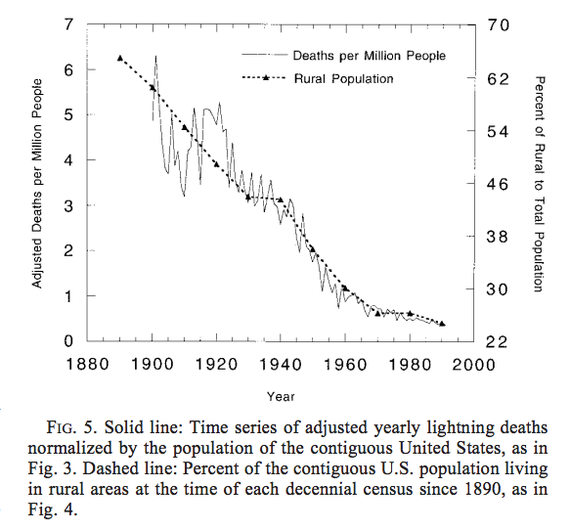
In the lightning-death literature, one explanation has gained prominence: urbanization. Lightning death rates have declined in step with the rural population, and rural lightning deaths make up a far smaller percent of all lightning deaths (see figure at right). Urban areas afford more protection from lightning. Ergo, urbanization has helped make people safer from lightning. …

But is the move from farms to cities what is driving the decline? Sure, lightning deaths and the rural population both declined during the 20th century, but so did a lot of other things, for instance, the percent of people living without electricity and plumbing, two infrastructural improvements that also help make your home less vulnerable to lightning. Of course, the development of better infrastructure—what I’ll refer to as modernization—is related to urbanization, but it is not limited to urban areas. Over the 20th century, rural infrastructure modernized as well. How can we know how much each is driving the decline in lightning deaths?

There’s one number we’d really need, and that’s the death rate for the rural population over time. If the rural rate held steady, than urbanization is responsible. If it too dropped, we’d be able to get a glimpse of the relative merits of the urbanization and modernization theories.

The Science Of Literary Escape

Nick Carr investigates what’s going on in our brains when we read deeply:

What is it about literary reading that gives it such sway over how we think and feel and maybe even who we are? Norman Holland, a scholar at the McKnight Brain Institute at the University of Florida, has been studying literature’s psychological effects for many years, and he offers a provocative answer to that question. Although our emotional and intellectual responses to events in literature mirror, at a neuronal level, the responses we would feel if we actually experienced those events, the mind we read with, Holland argues in his book Literature and the Brain, is a very different mind from the one we use to navigate the real world.

In our day-to-day routines, we are always trying to manipulate or otherwise act on our surroundings, whether it’s by turning a car’s steering wheel or frying an egg or tapping a button on a smartphone. But when we open a book, our expectations and our attitudes change. Because we understand that “we cannot or will not change the work of art by our actions,” we are relieved of our desire to exert an influence over objects and people and hence can “disengage our [cognitive] systems for initiating actions.” That frees us to become absorbed in the imaginary world of the literary work. We read the author’s words with “poetic faith,” to borrow a phrase that the psychologically astute Samuel Coleridge used two centuries ago.

“We gain a special trance-like state of mind in which we become unaware of our bodies and our environment,” explains Holland. “We are ‘transported.’” It is only when we leave behind the incessant busyness of our lives in society that we open ourselves to literature’s regenerative power.

That doesn’t mean that reading is anti-social. The central subject of literature is society, and when we lose ourselves in a book we often receive an education in the subtleties and vagaries of human relations. Several studies have shown that reading tends to make us at least a little more empathetic, a little more alert to the inner lives of others. A series of experiments by researchers at the New School for Social Research, reported in Science in 2013, showed that reading literary fiction, in particular, can strengthen a person’s “theory of mind,” which is what psychologists call the ability to understand what other people are thinking and feeling. “Fiction is not just a simulator of a social experience,” one of the researchers, David Comer Kidd, told The Guardian newspaper; “it is a social experience.” The reader withdraws in order to connect more deeply.

Well, There’s One Name Off The No-Fly List

This week, after a nine-year court battle, former Stanford student Rahinah Ibrahim became the first person to successfully challenge her placement on a US government’s watch list:

Ibrahim’s saga began in 2005 when she was a visiting doctoral student in architecture and design from Malaysia. On her way to Kona, Hawaii to present a paper on affordable housing, Ibrahim was told she was on a watch list, detained, handcuffed and questioned for two hours at San Francisco International Airport. The month before, the FBI had visited the woman at her Stanford apartment, inquiring whether she had any connections to the Malaysian terror group Jemaah Islamiyah, according to the woman’s videotaped deposition played in open court.

U.S. District Judge William Alsup ordered the government to either purge her name from the list, or certify that it has already been removed. Federal watch lists contain some 875,000 names.

Jeffrey Kahn comments:

Judge Alsup’s ruling is a game-changer for the Government, the latest in a series of reversals resulting directly from this litigation.

The Government’s previous positions, that the district court lacked subject matter jurisdiction over the No Fly List and that a foreign national such as the plaintiff was not entitled to make claims of constitutional injuries, were both rejected by the Ninth Circuit Court of Appeals in 2008 and 2012.  The Government has now also lost its core position that internal agency oversight, whether by the FBI (whose Terrorist Screening Center creates these lists) or by the Department of Homeland Security’s “TRIP” redress program, provides sufficient protection against erroneous deprivation of a variety of liberty interests.  According to Judge Alsup, “The government’s administrative remedies fall short of such relief and do not supply sufficient due process.”  A judicially enforced remedy is therefore required.

Scott Shackford examines the twisted logic behind the government’s position in this case:

The administration’s efforts to “vigorously” contest the case went so far as to ordering an airline to not let Ibrahim’s daughter board a flight to San Francisco in December to testify at the trial. Given the petty tactics used by the feds in this case, one wonders if they even have any reason other than “OMG! Terrorists!” to keep the order sealed. If, for example, you were an actual terrorist, wouldn’t you already know why you’re on the no-fly list and once you found out, wouldn’t you be able to figure out what information the feds would likely have on you to keep you from flying? Are the feds trying the argue that the average terrorist has so many balls in the air − like the evil mastermind in some television spy serial − that he or she needs to sue the government to find out which ones they’ve figured out? The existence of the no-fly list itself and the discovery that one is on it provides enough information to create concerns for any actual terrorist that the feds know something is going on.

Our Water Security System Is Leaky

Reflecting on the WV chemical spill, covered by the Dish here and here, James Salzman warns that “water systems present an impossibly big target to protect from intentional acts or accidents”:

The good news is that poisoning a water system is hard to do. Putting a few drops of cyanide in someone’s glass will lead to a gruesome death. Putting a few drops, or even a few barrels, in a reservoir is pointless. Reservoirs generally hold anywhere from 3 million to 30 million gallons of water. Even assuming one could back several trucks up to the reservoir and dump their loads without being detected, one would still need to get huge quantities of the poison in the first place. The Department of Homeland Security keeps track of biological and chemical agents that might be used by terrorists, and these substances are not easy to come by in large quantities.

But, in his estimation, accidents “give special cause for concern” and argues “it would be foolhardy to ignore [West Virginia] as a one-off event”:

First, we need to pay closer attention to the structural integrity of chemical storage near water bodies. At a time of reduced agency budgets and pressure for deregulation, we need to acknowledge that officials ensuring compliance with health and safety regulations, such as tank safety requirements, keep us safe. Second, water authorities need the resources to ensure effective detection and rapid communication. These are critical in minimizing harm when threats do arise.

A Threat To Free Speech In Israel

Marc Tracy considers a Knesset bill that would ban the use of the word “Nazi”:

Nazi analogies are always fraught, their deployment frequently a sign of flailing desperation or ulterior motive on the part of the deployer; there’s a reason we have phrases like Godwin’s law (which states that Internet arguments, no matter the topic, are virtually certain to include Nazi analogies if they go on long enough) and reductio ad Hitlerum (coined, I learn from Wikipedia, by Leo Strauss!). In Israel, the comparison is problematic twice more: Because the Jews were in many ways the Nazis’ most important victims, and because the contingent circumstances of Israel’s founding cannot be understood without reference to the Holocaust.

But it seems to me that the Holocaust’s uniqueness should actually make it an extremely useful heuristic for understanding the world, even and especially in an Israeli context. We can use its special awfulness to wake up to events in our own time that might be less but still plenty awful. Reasonable adults, after all, understand that to compare someone to a Nazi—even, off-the-cuff, to call someone a Nazi—need not be an argument that the person in question is the equivalent of a Nazi. (As for unreasonable adults who do mean to argue such equivalence, they can be dismissed and disgraced. Again, see: free speech.) Similarly, reasonable Israelis might shun anti-Semites who are eager to paint the comparison while simultaneously appointing to themselves the burden not to resemble the Jews’ greatest persecutors. A healthy Israeli society would assimilate legitimate critiques and better itself.

Tom Wilson also opposes the bill on free speech grounds:

It may well be the case that Israel’s high-pitched political discourse has a problem with the flippancy with which unthinking accusations of Nazism are made, but the idea that the solution to the low quality of public debate is more laws to limit free speech is wrongheaded. The ease with which Haredi and far-left activists have the tendency to charge Nazism at centrist politicians who clearly have no such sympathies with any aspect of Nazi ideology is silly if not unforgivably offensive, but making it illegal is hardly a proportionate or well considered way of dealing with this practice. Irving Kristol was quite right when he explained that Israel’s young political culture lacked a certain intellectual depth and required the infusion of the greats of Western thought. Solving the problem of Israel’s troubled political discourse will be a long process, requiring a lot more than clumsy top-down legislation. Although, if this bill does pass Israelis will at least have to get far more inventive in the future. Perhaps Israel’s politicians can look forward to being compared to Pol Pot and Ceausescu from now on.

Abby Ohlheiser links the proposed ban to other Israeli laws governing speech:

As striking as the “Nazi” ban is, the measure would join a number of existing restrictions on free speech in the country. Israel already bans anyone who demeans Israel’s democratic character or its status as the “state of the Jewish people” from running for office, as the Forward points out, and a number of similar laws have been used to keep many Arab parties and politicians out of elected offices. In 2011, Israel banned all boycotts against the state or its settlements in the West Bank, a popular protest tool used by those who oppose Israel’s settlement building on land that Palestinians would like to use to build their own state in the future.

Eylon Aslan-Levy points out that the law would “jail half the cabinet”:

1. It would be illegal to refer to the Green Line as “Auschwitz borders”. Deputy Foreign Minister Ze’ev Elkin, Housing Minister Uri Ariel, Tourism Minister Uzi Landau and even Prime Minister Benjamin Netanyahu himself could all find themselves behind bars for using Abba Eban’s provocative phrase to describe Israel’s borders before 1967.

2. It would be illegal to compare anyone to Goebbels. Foreign Minister Avigdor Lieberman was acquitted on corruption charges, but another prosecution beckons if he calls Turkey’s Prime Minister Erdogan “the successor to [Nazi propagandist] Joseph Goebbels” again; his comparison of a Palestinian Authority letter to the contents of Der Stürmer would also land him in hot water. [Update: Transportation Minister Yisrael Katz would also be guilty of accusing Channel 2 of broadcasting Goebbels-like “Nazi propaganda”.]

3. It would be illegal to compare Mahmoud Ahmedinejad to Hitler. Prime Minister Netanyahu (again!) could find himself in prison for repeating comments comparing the former Iranian president to the Nazi dictator. President Shimon Peres has made similar remarks, but at least he has presidential immunity to fall back on to avoid prosecution.

I don’t know. Maybe the ban wouldn’t be so bad after all.

Political Animals

Damon Linker argues against granting animals human rights:

I’m all in favor of treating animals decently, with special sensitivity to their pain and suffering. By all means, let’s pass stricter regulation of factory farming and laboratory experimentation. But the basis of these reforms should not be any quality we presume the animals themselves to possess. It should grow out of an expansion of the sphere of human concern and sympathy, along the lines of the old aristocratic ideal of noblesse oblige — the notion that one’s superiority obliges one to act nobly toward commoners. In other words, we should treat animals decently not because they’re just like human beings, but rather because they’re not.

The animal rights movement, by contrast, invariably takes the opposite tack — either reducing us to the level of animals or attempting to raise them up to ours. Both should be resisted. … [T]o demonstrate that it possesses inviolable rights, a chimp or bonobo would need to do nothing less than “stand up and, led by a love of justice and a sense of self-worth, insist that the world recognize and respect its dignity.” That’s what it would take to prove that the members of an animal species possess the same intrinsic moral worth as human beings. Anything short of that is an expression of human self-deception. And blindness about all that we are. Losing sight of that reality and truth in an act of advocacy-driven conceptual obfuscation is simply too high a price to pay, even for the promise of alleviating the suffering of our closest cousins in the animal kingdom.

Earlier Dish on giving human rights to chimps here and here.