The Masochism Of Theater Lovers

Emma Brockes argues that Broadway is “the last bastion of a certain kind of thinking, which is: if it hurts, it must be working”:

For many of us, going to the theater is still bound by notions leftover from school that art is occurring and we’d better knuckle down and enjoy it, or else. If it’s uncomfortable, all the better, and everything is set up to encourage this mindset: making you wait outside the theatre, no matter the weather, until the last possible moment.

Even in the West End, where the seats are as small but the tickets at least cheaper [than in New York], you’re allowed to mill in the foyer long before showtime – and then marshaling you brusquely across the threshold, past the bar where you can drop $20 for a gin and tonic and on to your seat, where, getting up to let others pass, you threaten to pitch forward into oblivion, never to return. (Unless you’re in the expensive seats, where all you suffer is the indignity of a chest or knee bump with the person you’ll be listening to breath for the next two hours.) At the end of the performance, you are chucked out a side-door into an alley by the dumpster. …

The odd thing is that these conditions persist in an age when all forms of entertainment are subject to such fierce competition. As the tech expo, CES, has been demonstrating this week, the sophistication of home entertainment is such that it is a wonder any of us ever leaves the house. Even going to the movies, at $20 a shot, looks increasingly unappealing in the face of new 4S screen technology: “four times sharper than HD,” say the releases, which Netflix among others will be filming in this year and will presumably make reality look like a shabby also-ran. In such a climate, you would think theaters would make an effort to coddle their patrons, but perhaps they know something we don’t.

How Will The Recession Change Us?

McArdle wonders about the long-term psychological affects of the financial crisis:

The economy does seem to be easing back into a slightly more normal pattern of jobs and growth (at least, as long as we think that the dismal December jobs report was a fluke, rather than a harbinger of worse to come). But it still faces a big test: Can people who survived the Great Recession shed the fear they acquired during those wretched years? The people who survived the Great Depression, particularly its early years, bore permanent scars. There were labor market scars – then, as now, being out of work for a long time was not good for your long-term earnings prospects. And there were psychological scars. My grandfather used to hide money in the house in case the banks closed, to the point where my grandmother found $10,000 stashed in a teapot she was about to donate to the church jumble sale. (Thank heavens she decided to clean it first!) U.S. household savings rates began to decline just as the last children of the Great Depression began to retire and let the baby boomers take over, and while a lot of factors contributed to that, struggling through the Great Depression may have made those generations more conservative in their financial habits.

A recent study suggests that growing up in a recession has a lasting effect on young people’s belief in a just world:

It turns out that a severe regional recession strikingly alters the attitudes and beliefs of individuals growing up there. Recessions do alter perceptions, especially of people between the ages of 18 and 25. Recession-influenced respondents expressed a stronger preference for government redistribution and tended to believe that success in life was more a matter of luck than hard work; as a result they are also more likely to vote for a Democratic president. Four points are worth noting:

  • First, the effects of a severe recession experienced are large when the individual is between the ages of 18 and 25 – the so-called formative age – during which social psychologists think most of social beliefs are formed; the effects are not so strong when the recession is experienced later in life.
  • Second, these effects are permanent because attitudes of recession-stricken individuals remain significantly altered many years after the severe recession ends.
  • Third, we control for individuals’ endowments such as income, level of education, and ownership of a house that could also have an impact on beliefs. We thus measure the direct effect of a recession on beliefs; this effect could be even bigger if we added also the indirect effect through the personal endowments, which are also affected by a recession.
  • Fourth, our estimation represents a lower bound of the effect of a recession on beliefs because our identification strategy relies only on regional shocks implicitly ignoring the effects of nationwide recessions.

That same pattern is found in an analysis of the World Value Survey, which includes data from 37 countries. When we worked with this larger sample of countries, we also found that coming of age in a lousy economic environment breeds the belief that success in life depends more on luck than effort, which in turn leads to more support for social welfare policies.

A Whale Of A Documentary

Noah Davis notes how Blackfish, the documentary about killer whales at SeaWorld that was just snubbed for an Oscar nomination, took almost a year after its premiere at last year’s Sundance festival to go from obscurity to enormous popularity:

On one hand, it’s amazing it took Blackfish this long to explode given that it’s a well-done film about animal cruelty, a subject Americans jump all over. On the other, it makes you realize how many steps it takes to break through the noise. Consider the path:

Sundance to theaters to cable to Netflix, a chain 12 months in the making. And it’s not as though the film was ignored at each step. Blackfish garnered positive press everywhere it played, landing write-ups in major newspapers and on websites. There was an easy, relatable narrative, one that people would feel good (or self-righteous) about telling their friends. Blackfish is sharable, not in a LOL Cats way but in a “look at how caring/socially conscious I am” and “in a people really like animals” way. It’s the type of thing people put on their Facebook pages or share on their Twitter feeds. And still, it took a year to spread.

I think the bigger point here is that the thing “everybody’s talking about” isn’t really being talked about by everybody. It’s being talked about by people you know. I’m guilty of this, too. I only watched it because a close friend recommended it to me. Before I started researching this piece, I assumed it came out of nowhere. I had no idea it was shown on CNN, much less played at Sundance. It wasn’t on my radar, and then it was, and then it was everywhere. The Blackfish phenomenon continues to grow, and it’s having at least some tangential effect. SeaWorld’s stock has dropped almost nine percent since July 19 and more than six percent in the last month.

Update from a reader:

It was with great disappointment that I saw that Blackfish lost out on a well-deserved nomination. I work in the wildlife tour industry (the film ends with a trip on a boat similar to ours!) located in the Salish Sea. What Sea World does to the orcas is a crime against nature. The film accurately exposes this and needs to be seen. Whether it should win or not is another question. (The film on the Indonesian mass killers, The Act of Killing, is the most compelling and original piece of filmmaking I have ever watched.)

Another notes that “Seaworld stock soared with the news of Oscar snub”:

Shares of SeaWorld Entertainment surged 8.39 percent on Thursday to close at $33.59 a share, the stock’s highest level since August. On a day with little news about SeaWorld, based in Orlando, Fla., it’s not a stretch to suggest that the Oscar snub was fueling the stock’s rise.

How Profitable Is Legal Pot?

Legal Sale Of Recreational Marijuana Begins In Colorado

It’s less lucrative that you might expect:

Generally speaking, investors are interested in checking out a company’s gross profit margin, which is the ratio of its revenue minus cost of goods to its overall revenue. A high gross profit margin suggests the company could be highly profitable as it scales up its production. Over a six-month period, Brandon’s dispensary had an average gross profit margin of 32 percent. That’s not terrible—most grocery stores have gross profit margins around 20 percent—but it’s not great either, and not at all the financial bonanza many people make the legal marijuana business out to be. Starbucks, another company that deals in mind-altering, plant-based substances, regularly has gross profit margins of 57 percent, nearly twice that of Brandon’s dispensary.

When we shared a redacted version of Brandon’s financials with Alexander Ooms, managing partner at ClearCreek Partners, a Denver financial advisory firm, he was circumspect, to say the least. “Since I help companies raise capital, my thought here is, ‘Wow, it’s going to be really hard for any marijuana business to raise institutional equity,’ ” he says. “Can retail marijuana be a solid business? Clearly, yes. Can it be highly profitable? Not sure.”

Meanwhile, Harrison Jacobs looks at how legal weed threatens Washington’s medical marijuana system:

Medical marijuana’s lack of oversight was a prime reason so many voters with no stake in the marijuana debate voted to legalize recreational weed. Under I-502, the Washington Liquor Control Board authorizes licenses for businesses, enforces regulations and collects 25% excise taxes at three separate points: when the producer sells to the processor, when the processor sells to the retailer, and when the retailer sells to the customer.

Tack on state sales taxes and you are looking at nearly a 40% tax rate for recreational marijuana. A regulated, heavily taxed system had voters, politicians, and even potential marijuana investors with dollar signs in their eyes. Medical marijuana, on the other hand, is subject to only the state’s regular sales tax rate, which is just 6.5%.

It’s now clear that it doesn’t make sense to maintain Washington’s loosely medical marijuana business alongside the new, highly taxed recreational system. If people can obtain legal high-quality marijuana at a far cheaper price, users will likely attempt to go to the medical marijuana stores. That could be a lot of lost revenue for Washington state and provide ammunition for legalization’s opponents to call the experiment a bust.

Sullum also covers the issue:

Last summer Mark Kleiman, the UCLA drug policy expert who has advised Washington state’s marijuana regulators, told me “the legal market is going to have a hard time competing with the illegal market, but a particularly hard time competing with the untaxed, unregulated sort-of-legal market.” He was referring to the hundreds of medical marijuana suppliers in Washington, which are not licensed by the state but operate under creative interpretations of a provision allowing patients to create “collective gardens.” Yesterday the state House of Representatives took up the question of how to deal with these competitors. The leading proposal, reflected in a bill considered by the House Health and Wellness Committee, is to ban them. …

What works for patients … does not necessarily work for the state, which wants to maximize tax revenue and head off federal intervention by creating a tightly regulated system aimed at preventing diversion to minors and other states. Although the backers of I-502, Washington’s legalization initiative, assured skeptics that the measure would not change the rules for medical marijuana, it was pretty much inevitable that legislators would once they absorbed the fiscal and political realities created by the new distribution system.

(Photo: Tyler Williams of Blanchester, Ohio selects marijuana strains to purchase at the 3-D Denver Discrete Dispensary in Denver, Colorado. By Theo Stroomer/Getty Images)

Taking An Interest In National Interest

Beinart liked Rand Paul’s foreign policy speech:

Paul approvingly quoted the diplomat and scholar George Kennan as distinguishing “between vital and peripheral interests.” That may not seem significant, but it is. For most of American history, U.S. foreign policymakers had a rough idea of which chunks of the globe really mattered to American security. They started with the Monroe Doctrine, the belief that no foreign power should make the Americas a base for operations against the United States. In the 20th century that expanded to include the belief that no single power should be allowed to dominate Western Europe or East Asia, since that power might then threaten American access to key overseas markets. That principle was finally extended to the Middle East on the theory that no adversary should be allowed to threaten America’s access to oil. …

When the Cold War ended, however, the idea of a foreign power dominating Western Europe or East Asia, or creating a beachhead in the Western Hemisphere, suddenly seemed fanciful.

As a result, the language of national interest largely disappeared. It has been replaced by a discussion of foreign “threats” and American “values.” But without a definition of interests, it’s impossible to define what constitutes a threat. And without a definition of interests, supporting American “values” is a limitless pursuit. Americans will never reach a consensus on where exactly our interests lie, but just reintroducing the concept suggests an overdue recognition that because America’s power is finite, its interests must be too. Which is what Paul did on Tuesday night.

Larison responds:

[T]he problem of the last twenty years isn’t that American politicians and policymakers have ceased referring to national interest, but that many of them tend to treat even relatively minor foreign disputes and conflicts as things that threaten “our vital interests” and some go beyond that to pretend that “our vital interests” are at stake wherever our “values” are coming under attack. It isn’t enough to “reintroduce” the phrase national interest to the debate. It is essential that it be defined in a much less expansive, bloated way than it has been for the last twenty years, or else it will continue to be used to justify endless meddling all around the world.

Chart Of The Day

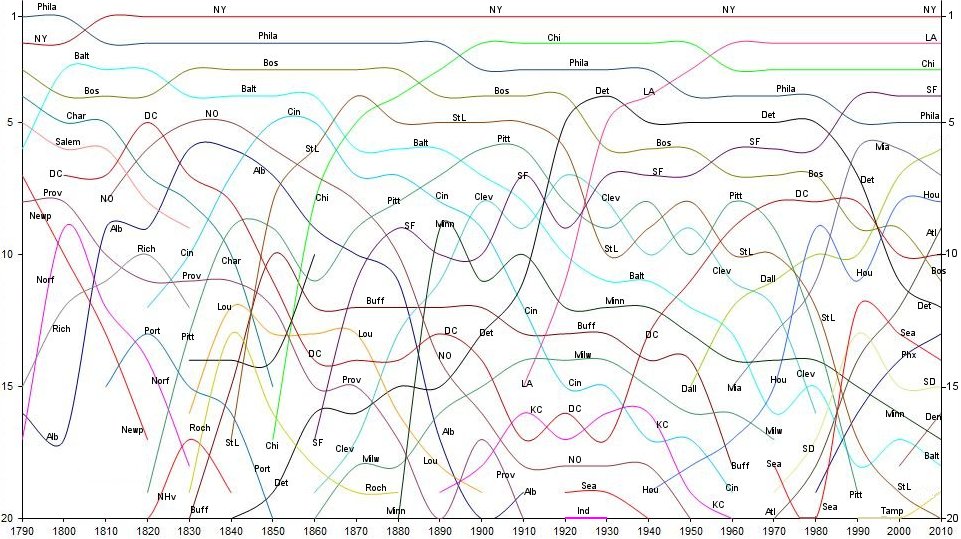
The rankings of the top 20 metro areas in the US over the past 200 years (click to enlarge):

Top Metro 2010

Cillizza comments:

Starting in the early 19th century, New York City has been number one and never given up that pole position. (It’s the Kentucky hoops recruiting class of big city populations.) Philadelphia, too, has been relatively consistent population-wise over the centuries — starting at number one in 1790 and standing at number five in 2010. Los Angeles, which only entered the top 20 metros in 1910, is now the second largest. Chicago — President Obama’s hometown — has risen from the mid-teens in late 1800s all the way to number three in 2010. …

Even more intriguing are the metros that have tumbled significantly over the decades.

Follow Detroit’s rise and fall and you follow the rise and fall of the manufacturing industry in America. The Motor City broke into the top 20 in 1840 and within 100 years was one of the five largest metro areas in the country. The last three decades have seen a population free fall in Detroit, however, all the way to the number 12 in 2010. St. Louis is now barely on the list after peaking at the fourth most populous metro area in the late 1800s. Baltimore has fallen from top five to barely top twenty.

He also looks at how current trends could change the electoral map:

In short, the demographic changes that began in the 1980s — population losses in the Northeast and Midwest, population gains in the South, Southwest and Plains — will only accelerate over the next few decades. … Republicans are right then to note that the states that will grow population-wise over the next five decades are in places where they have traditionally done well at the presidential level. But, the areas of growth within those states tend to be in places and groups where Republicans have struggled in recent elections. And, even if the 2060 map were in place in 2012, Romney still loses the election by a wide margin.

Reforming The Voting Rights Act

Last June SCOTUS ruled against the VRA’s preclearance provisions. Maya Rhodan reports on a bipartisan effort to amend the law:

The bill would offer new criteria under which states need to seek permission from the Justice Department before enacting changes to voting laws, known as preclearance. Reps. Jim Sensenbrenner (R-Wisc.) and John Conyers (D-Mich.), along with Sen. Patrick Leahy (D-Vt.), presented the new bill, which they called a direct response to the Supreme Court ruling. … The bill offers a new coverage formula requiring any state that has committed five voting violations over the most recent 15-year period be subjected to the Voting Rights Act’s preclearance provision. In the Shelby County v. Holder decision last year, the court ruled that the standards for determining the states and jurisdictions that needed preclearance were based too heavily on their history of discrimination, rather than current discriminatory practices. Under the new bill, individual jurisdictions could be subjected to preclearance after three voting violations, or only one if the jurisdiction has had “persistent and extremely low minority voter turnout.”

Justice Department rulings against voter ID laws, which have been pushed by Republicans and condemned by Democrats, would not count toward the number of violations that could lead to preclearance.

Zachary Roth and Adam Serwer explain the voter ID exemption:

The bill wouldn’t stop the Justice Department from challenging voter ID laws as racially discriminatory. But it would treat such laws differently from other types of racial discrimination in voting in two ways. First, the expanded Section 3 “bail-in” provision doesn’t apply to voter ID. So a state can’t be placed under federal oversight merely because it enacted a discriminatory voter ID law. That could have a big impact in Texas: The Justice Department’s ongoing lawsuit against the state’s voter ID law asks to have Texas brought back under federal oversight. Second, an objection by the Justice Department to a voter ID law can’t count as one of the five violations that puts a state under federal oversight—though a court ruling against a voter ID law does count.

Republicans in numerous states have pushed voter ID laws recently. Voter ID laws in Wisconsin, Texas, and North Carolina are currently being challenged by the Justice Department or civil rights groups. A wealth of evidence shows the laws have a disproportionate impact on minorities, who are more likely than whites to lack ID. But Spencer Overton, an expert on voting rights at George Washington University Law School, suggested the carve-out might be worth it if it helps gain GOP support. “These concessions,” Overton said, “may be necessary to satisfy the states’ rights concerns of the Roberts Supreme Court, and the political concerns of Republican members of Congress.[“]

Jenée Desmond-Harris looks at which states would lose preclearance requirements under the new rules:

According to the Advancement Project, the bill’s restoration of the federal preclearance requirement for states that have had at least five voting-rights violations within the past 15 years would appear to require Georgia, Texas, Mississippi and Louisiana to obtain preclearance before implementing voting changes. However, the civil rights organization also predicts that states such as Alabama, Alaska, Arizona, North Carolina, South Carolina, Virginia and Florida would not be automatically covered.

“The exclusion of North Carolina is especially egregious, considering the flood of harmful voting policies from the state,” said Advancement Project Co-Director Penda D. Hair in a statement released on Thursday. “These measures include a 2012 redistricting plan that diluted the power of African-American voters; the passage of a voter-suppression law that cut early voting by a week, eliminated same-day registration and requires strict voter ID, among many other restrictions; and last week’s decision that residents of the 12th Congressional District will be forced to go 300 days without representation.”

Supporters of the VRA are divided on the amendments:

While members of the Congressional Black Caucus signaled their support for the legislation, according to National Journal, the Hispanic Caucus and civil rights organizations have expressed misgivings. Voter ID laws are exempted from the violations list, meaning restrictive changes passed in North Carolina, Texas, and elsewhere won’t be held against those states. “These [voter ID] laws make it harder for people of color to  have a say in our democracy,” said Katherine Culliton-González, director of voter protection for the civil rights advocacy organization Advancement Project. “There’s no reason for this distinction. It’s arbitrary.” (Voter ID laws can still be blocked if the Department of Justice or federal courts deem them unfair; they just won’t count toward a state’s five-violation total.) Culliton-González also took issue with a provision that only court rulings, not consent decrees or settlements, will count in a state’s violation total. Organizations like Advancement Project often settle voting rights lawsuits to get changes implemented faster, she said, whereas the proposed bill would incentivize drawing out court proceedings.

Rick Hasen weighs the constitutionality of the new provisions:

There is lots of good and constitutional stuff in this bill. The idea of requiring jurisdictions making election changes to publicize them on the Internet is a terrific idea, and allows for timely lawsuits if necessary to combat draconian voting changes throughout the country. Disclosure is an unmitigated good here, and it is hard to see any constitutional objection. Similarly, making it easier to get preliminary injunctions in section 2 cases makes a lot of sense, and clears procedural hurdles without infringing on state sovereignty. … The new coverage formula pegged to relatively recent voting rights violation is likely, but not certain, to be held constitutional if enacted. The benefit of this new formula is that it is tied to current conditions—looking at recent voting rights violations, and in the case of subdivisions, recent minority voter turnout statistics. This tends to defeat the Shelby County holding that requires under principles of “equal sovereignty” of states that any preclearance regime be tied to current conditions.

Where the bill goes from here:

The effort does not yet have full buy-in from Republican leadership, said a senior GOP aide. Leaders are wary of pushback from conservative members and are skeptical that the bill could attract the support of a majority of the Republican Conference. They are also concerned that Democrats would politicize the issue to make gains in the 2014 midterm elections. Furthermore, Sensenbrenner, a former chairman of the Judiciary Committee and an author of the last extension of the Voting Rights Act in 2006, has occasionally voted against leaders’ priorities, most recently casting a “no” vote on the omnibus appropriations bill. That has damaged his clout with leaders, the aide said. Conyers suggested the fate of the new VRA legislation is in the hands of the House Judiciary panel’s current chairman, Robert W. Goodlatte, R-Va. “I haven’t raised it directly with him yet so I can’t say” whether he would support the effort, Conyers conceded, “but the question may come down to whether we want to do it in parts. … I’m not sure how this is going to play out.”

Beutler expects the GOP to muck it up:

[T]he full menu of objections suggests that Republicans are considerably more focused on the internal and external political ramifications of fixing the VRA than on the substantive and moral questions the Supreme Court thrust upon them. Not a hopeful sign. There are one or two countervailing dynamics at work, though. The bill is designed to attract some non-trivial amount of GOP support, including from Southern Republicans. Rep. Jim Sensenbrenner, R-Wis., who co-authored the bill, told reporters on Thursday that Reps. Trey Gowdy, R-S.C., and Spencer Bachus, R-Ala., have both signed on to the bill, and Sen. Patrick Leahy, D-Vt., expressed unusual confidence that the bill will pass the Senate.

And at the risk of veering into amateur psychology, I’m pretty convinced that some Republican leaders — particularly Majority Leader Eric Cantor, R-Va. — sincerely believe it would be wrong to let the Supreme Court’s decision be the final word on voting rights in states and districts with histories of minority disenfranchisement. But with $2 and a bundle of Eric Cantor’s best intentions, you can buy a slice of pizza after getting turned away at your polling place in November. And at this point it doesn’t look like GOP leaders are interested in putting more than their intentions on the line.

African-Americans And Prohibition Of Weed

A Medical Marijuana Operation In Colorado Run By Kristi Kelly, Co-Founder Of Good Meds Network

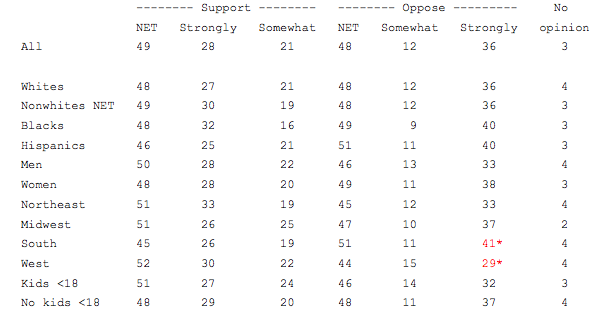
The latest poll on legalization of marijuana from ABC News shows an even split – 49 to 48 percent – by Americans on the subject – not a clear majority as some other recent polls have found (Gallup’s in particular). That’s still a record high for the ABC poll, which has the benefit of identical wording over time: “Overall, do you support or oppose legalizing the possession of small amounts of marijuana for personal use?” Support has doubled since the mid-1980s.

But what’s interesting to me about the poll is its internals. They’re really surprising to me. I asked ABC News for the full data and here it is:

Screen Shot 2014-01-17 at 12.18.19 AM

So one of the most powerful arguments for legalization of marijuana – that Prohibition grotesquely singles out African-Americans for criminal enforcement and spares whites – carries no more weight among African-Americans than it does among whites. Of those African-Americans who feel strongly about the subject, 40 percent oppose legalization and only 32 percent support it. Overall, there’s no statistically significant difference between whites and blacks on this. I’d be fascinated to hear from readers why they think this might be so. It seems on the surface that social conservatism is outweighing civil rights. But I’m genuinely baffled.

The second most striking thing is that having kids in the home doesn’t seem to change views much.

So that’s another perhaps lazy assumption debunked in this poll – that “protecting kids” works either for or against legalization. Even what you’d imagine would be a big regional split – between the West and the South – is pretty much a damp squib. The West favors legalization 52 – 44; the South opposes it by a similar margin. The only statistically significant variation in the regional polling is between the South and the West among those strongly opposing legalization. It’s 41 percent in the South and only 29 percent in the West. That makes more intuitive sense. But the South is far closer to the rest of the country on pot than on gays.

So what factor is statistically significant? It’s age:

Americans 65 or older are half as likely to approve of legalization as are those age 18 to 64 – 27 vs. 54 percent. And 59 percent of the elderly disapprove strongly. Support peaks among 18 – to 39 – year-olds, at 59 percent , including 37 percent who strongly support the idea.

This, in other words, is an issue like marriage equality or president Obama’s base of support. It’s generational. The young cannot see the logic behind criminal prohibition of a pleasurable plant much less dangerous than alcohol or tobacco. The old retain the attitudes and the fears of the past. Perhaps, over time, the young will become more like the old. But the huge shift in favor of this over the last two decades, like the huge shift in favor of marriage equality, suggests precisely otherwise. They all suggest a new, saner, more tolerant America is out there, waiting for one recalcitrant faction of one particular generation to die.

(Photo: Matthew Staver for the Washington Post via Getty Images)

Playing A TV Cop In Real Life

Terrence McCoy exposes the sloppy police work encouraged by the reality cop show The First 48:

In Detroit, city police shot a 7-year-old girl in the head in a bungled attempt to catch a suspect on The First 48. In Houston, another man was locked up for three years after cops wrongfully accused him of murder within the first 48 hours. And in Miami, according to a New Times examination of court records, at least 15 men have walked free of murder charges spawned under the program’s glare. Despite it all — sloppy crime scenes, rushed arrests, ruined lives — The First 48, which has now reached its 13th season, is as popular as ever. Millions of Americans tune in to every new episode, and with ratings as seductive as these, who cares about a few botched investigations?

Balko worries about the effect these shows are having on public perceptions:

The premise of “The First 48″ presents its own unique set of problems, mostly the implied pressure on the departments to meet the 48-hour deadline. But more broadly, reality cop shows tend to emphasize all the ass-kicking, name-taking aspects of police work, with little emphasis on community service. (“Cops,” the longest running police reality show, was actually one of the more accurate portrayals of the job.) Over the long term, that raises some interesting and troubling questions about what a generation raised on these shows thinks about police work, and about what sorts of personalities will be attracted to a career in law enforcement based on the way the job has been portrayed on TV. Most police departments also retain the right to veto what footage gets on the air, so viewers often see a revised, cleaned-up sort of “reality.”

When Does A Thought Become A Crime?

In a report on “Cannibal Cop” Gilberto Valle, who was convicted of conspiring to kidnap, rape, and kill half a dozen women, Robert Kolker considers the tangled relationship between thought, action, and the law:

While thoughts haven’t always been protected from prosecution (as the witch hunts and red scares and political detentions of many eras demonstrate), there was a time, more than a century ago, when even attempted crimes like theft and murder and kidnapping weren’t considered criminal activity: If you tried to pick someone’s pocket and there was no money in the pocket, then you couldn’t be prosecuted. When attempted crimes first became criminalized in the early 1900s, Supreme Court Justice Oliver Wendell Holmes urged caution, asserting that for the defendant to be convicted, “[t]here must be dangerous proximity to success.”

That standard weakened in the sixties, when a new set of guidelines called the Model Penal Code – a successful effort by the legal community to standardize the criminal code across the nation after a century of inconsistent case law –replaced the idea of proximity with that of a “substantial step.” For law enforcement, this was a happy coincidence: As violent crime became a more common reality, the police could use a suspect’s state of mind to justify an arrest, as long as that suspect also took at least some real action.

What’s changed in recent years are the tools used to detect intent—namely, a person’s online activity.

“We’ve always said you can’t punish for thoughts alone, but now we really know what the thoughts are,” says Audrey Rogers, a law professor at Pace University who has taught the Valle case in class. Since 9/11, the government has used the monitoring of ­electronic communication to bring more than 200 prosecutions against people suspected of providing material support to terrorist organizations. “You expand the definition of a crime by extending it to this sense of what might happen in the ­future,” says Georgetown law professor David Cole.

What’s also changed, perhaps, is the scale of certain crimes – not just 9/11 but Columbine, Aurora, and Sandy Hook—and the way technology has emboldened many to think that anyone with ill intent might be stopped before snapping into action. In 2009, the FBI was reading Najibullah Zazi’s e-mails to Al Qaeda and picked him up before he ever built a fully workable bomb. Just last month, in Arizona, police traced threatening e-mails to a 15-year-old who turned out to own 100 rounds of ammunition; he didn’t own a gun, but after his arrest, police said they’d learned he had researched how to make an explosive device but was unable to procure the parts. And then there are the scores of To Catch a Predator-style stings.

But as far as the Cannibal Cop, it should be noted that he left behind plenty of real-world evidence of his intentions; he “looked up potential targets on a restricted law enforcement database, searched the Internet for how to knock someone out with chloroform, and showed up on the block of one woman after agreeing to kidnap her for $5,000 for a New Jersey man.”