The Physics Of The Flying V

Scientists have figured out how and why birds stay in formation:

[F]lying in a V isn’t just about staying in the right place. It’s also about flapping at the right time. As each bird flaps its wings, the trail of upwash left by its wingtips also moves up and down. The birds behind can somehow sense this and adjust their own flapping to keep their own wings within this moving zone of free lift. “They trace the same path that the bird in front traced through the air,” explains Portugal. Imagine that a flying ibis leaves a red trail with its left wingtip as it moves through the air. The right wingtip of the bird behind would travel through almost exactly the same path. “It’s like walking through the snow with your parents when you’re a kid,” says [Steven] Portugal. “If you follow their footprints, they make your job easier because they’ve crunched the snow down.”

This is a far more active process than what Portugal had assumed. “We thought they’d be roughly in the right area and hit the good air maybe 20 percent of the time,” he says. “Actually they’re tracking the good air throughout their flap cycle. We didn’t think they could do that. It’s quite a feat.”

The Football Settlement Gets Blocked

On Tuesday, a federal judge tentatively rejected the NFL’s traumatic brain injury settlement.

She says that even with the NFL promising up to $914 million for compensation, research, and other purposes, the pact could run out of money over the six decades it’s supposed to cover. At a minimum, she wants more economic analysis proving that it’s sufficient.

Lester Munson explains what this means:

[U.S. District Court Judge Anita] Brody’s ruling is significant in two ways. First, it is an embarrassing setback for the players’ attorneys who have submitted the proposal.

These lawyers included in their proposal a request for $112 million in fees for themselves. It is difficult to imagine how the lawyers could have done $112 million in legal work and not submitted the expert reports to the judge. After spending more than four months preparing these legal papers, the player-clients now learn that the lawyers omitted critical materials from the paperwork.

Second, the rejection, even if temporary, will add to the growing skepticism among players and their personal attorneys about the settlement terms. In addition to the demand for enormous fees and delays in preparing paperwork, the judge’s concerns about the adequacy of the settlement funds will fuel player concerns that their representatives have settled for too little. It could add to the number of players who will opt out of the settlement and take their chances in the litigation process.

Marc Tracy thinks the judge made the right decision but for the wrong reason:

One leaps to agree: Yes! It’s far too small! It should be billions and billions! But while Brody indeed left herself room, in her decision, to decide that it should eventually be billions, she would not be sharing the reasoning of an observer who believes the players are not getting a fair shake. Her objection is to whether the settlement amount is consistent with the internal logic of the settlement itself. Specifically, she is concerned that the $675 million that is actually set aside to pay players—according to a complicated, tiered scheme agreed to by both sides—simply will not be enough. “It is difficult to see how the Monetary Award Fund would have the funds available over its lifespan to pay all claimants at these significant award levels,” she wrote.

Is the problem that the players deserve more? No. That the NFL need not admit a scintilla of guilt, culpability, or wrongdoing? Nope. That there won’t be discovery as a result of the settlement? Nunh-unh. Even sniping among various plaintiff factions—ESPN’s Fainauru brothers have a good rundown—has been centered around the question of whether the allotted funds are enough to fulfill the settlement’s own parameters, not whether the settlement’s parameters are all wrong.

Read the whole Dish thread on this case here.

The Right’s New Attack On Obamacare

National Review decries Obamacare’s “bailouts” for insurance companies:

The bailout provisions of Obamacare are found in Sections 1341 and 1342 of the Affordable Care Act, both of which should be repealed. Doing so will be difficult, but it is not impossible. The first provision bails out insurance companies for costs associated with individual patients when they exceed $45,000. Under this so-called reinsurance program, insurers will be able to push off 80 percent of costs between $45,000 and $250,000 onto a fund financed by a fee of $63 per head on customers of insurance companies and workers covered by self-insuring companies. Given that most of the associated costs will almost certainly be passed on to consumers by insurers, that fee is in effect a tax. And in the event that the fund does not generate revenue sufficient to cover its costs — far from an unlikely scenario — then taxpayers will be explicitly on the hook.

This preemptive bailout was included in the law as a deal-sweetener to induce more insurance companies to participate in the program. It is a good deal for insurers, for whom any opportunity to reassign risk to somebody else is a welcome profit opportunity, but it is a terrible deal for consumers and taxpayers.

The second and potentially even more troubling bailout provision is the one for so-called risk corridors, which asks the insurance company to project their total costs and then picks up most of the difference if losses should exceed those targets. The potential for gaming the system here is obvious and dire, and the potential costs are enormous. Senator Marco Rubio already has introduced a bill to repeal this provision, though it is unlikely to pass. At the very least, Republicans should ensure that the provision, scheduled for sunsetting in 2016, dies on schedule.

Cohn pushes back:

Bailouts typically start with companies taking egregiously irresponsible actions and end with the government forking over mind-boggling sums of money to save them. Think of the savings and loans institutions misleading the public about the state of their finances in the 1980s—or the financial industry making those bad home loans and risky investments a decade ago. Each of those involved grievous management errors, frequently skirting the limits of legality. The federal outlays to save those banks were in the hundreds of billions of dollars.

With Obamacare, the situation is different. Projecting future insurance costs inevitably involves a little guesswork. With a brand new program like Obamacare, it inevitably involves a lot of guesswork. Even the smartest, most responsible actuaries might not get the numbers right … Truth is, no insurer will be sure about its beneficiaries for many months, until the open enrollment period ends and the newly insured have a few months in which to file claims. That makes it impossible to know what kinds of losses, if any, insurers will take. But even if the losses are significant, the taxpayers won’t be in for another Wall Street-style bailout.

Ditch The Rock, Ctd

You can catch up on the entire thread on engagement rings here. Readers offer more alternatives to the traditional diamond:

A few years back, I heard a stand-up routine about how women get an expensive ring but men get ryansword 2nothing. The comic (I can’t remember who) suggested a sword as a perfect gift from a wife to her husband. On our wedding day, while I was slapping on my warpaint and my husband-to-be was on the other side of the venue with his retinue, I sent my maid of honor’s husband over with a package. As soon as he saw the long, narrow box he knew exactly what it was.

Let’s just say I won major wife points with the “wedding sword.” It’s currently hanging over our front door, in case of zombie attack.

Another unconventional pick:

My husband and I met in graduate school for forestry. We’re both passionate about our work and have devoted much of our lives to the conservation of forest resources and the responsible use of forest products, so when it came time to get married, I wanted this important part of our lives reflected in our union.

Our engagement was relatively casual, but my husband did give me his mother’s engagement ring. I had the diamond reset in a ring that I happily wore until our wedding. However, since I’m frequently in the woods for work and often working in tropical forests in developing countries, a big diamond ring didn’t fit my everyday life. So for our wedding, I bought us wooden wedding bands. I worked with a carpenter in the US and was able to choose the species of tree for each ring, and ensure the forest of origin was managed to my standards. The rings are gorgeous, reflective of our lives and relationship, and a great conversation piece.

Another reader:

My boyfriend was the marrying type.  I wasn’t.  He went to Japan for a week.  I changed my mind. I realized that because I was the one with the cold feet, I was the one who had to propose. But do you have any idea how hard it is to find a MALE engagement ring?  (Oh wait, I guess you do.)  I finally settled on a silver AIDS bracelet as a “promissory note” and then we could go shopping for a ring later.  Well, he loved being proposed to and loved the bracelet.  He wore the bracelet every single day for years until he lost it when a paragliding line snapped it off of his wrist.

Meanwhile, I have a simple gold wedding band on my finger.  When I see it or play with it, it reminds me of him. I don’t need a big rock to feel sentimental.

Another:

If you really do want a physical symbol of undying affection and joint devotion, how about getting your own rock, and doing it together?

Before getting married, you should take a vacation trip together to western Montana. Near Philipsburg, in beautiful mountain scenery, there is a place called Gem Mountain Sapphire where you can pan for sapphires without much physical effort and with a very high chance of success. They dig up the stream sediments for you, run them through a sluice box to get rid of the muddy stuff, and present you with a big box of fine gravel. You pick through the gravel with a pair of tweezers and pick out the good ones, which are really obvious. It’s a very pleasant activity, and the surroundings are just gorgeous. My wife and I have several stones from our two visits, ranging from pale green to ruby red, all of them far larger than anything we could have afforded at a jewelry store.

Not to go all geological on you here, but contrary to the De Beers slogan, diamonds really aren’t forever. They’re combustible. Sapphires really are forever – they’re made of aluminum oxide, one of the most insoluble and heat-resistant materials known, and only a little bit softer than diamond. Even if the flame of passion fades, and even if real flames claim your house, these stones will survive.

Another did the same thing at “one of those tourist-trap mines that are all over the Georgia/North Carolina border.” Another reader:

Four years ago, I gave my then-partner a ring I had purchased in Provincetown in 1975. I had never removed it from my finger until then. But it was a few months later that I proposed. We sort of thought of that ring as an “engagement” ring.

photo 2We were going to get married in Connecticut – he lived in Oklahoma, I in Florida – several months later, but I got a job offer that meant a move to Las Vegas, thwarting that plan (although it did mean he could join me). Work and busyness meant postponing again – to this past August in San Francisco – but then, again, “stuff” got in the way and we had to cancel, losing our money for the license and ceremony we paid up front.

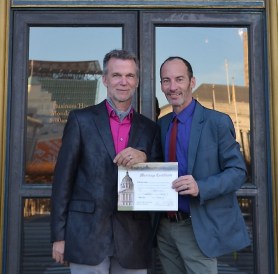
In October, I made new license and ceremony appointments and paid the fees again. We had once found rings online that we both quite liked, but finances didn’t allow their purchase. As this was turning out to be a rather low-budget affair (a good friend was giving us a hotel room for three nights and we were driving to the city from Vegas), I found discount online jeweler and selected only rings on their clearance page. We chose $12 titanium rings which you can see in the picture below, taken in front of San Francisco’s City Hall moments after we were married on December 24, just three weeks ago.

I don’t care one whit about the value of the ring. As a 55-year-old man who grew up never thinking of marriage as ever being a possibility, our $12 rings are priceless.

It will be interesting, however, to see how this evolves, whether younger gay men and women who can imagine marriage for themselves try to fit into the “established” norms of engagement and wedding rings (and other marriage traditions), or if new paths will be forged.

Don’t Count Christie Out?

Ponnuru isn’t:

I’m amazed by how many people are writing off Christie’s chances in 2016. The party establishment still thinks he’s a winner, his defects from the point of view of the conservative base of the party are a lot smaller than those of the last two nominees, and the latest poll numbers suggest this scandal isn’t obsessing voters as much as it is the press. I still think he’s got a better shot than anyone else for the Republican presidential nomination.

The Fix crew agrees:

Our case for Christie as front-runner — or, maybe, more accurately first among almost-equals — is built around the idea that there is no perfect/electable conservative in the race and that Christie has a decent chance of beating out Jindal, Rubio and Walker in the battle to be the establishment candidate. (There is a whole other primary — where Rand Paul is the front-runner — that will pick the outsider candidate to battle the establishment pick.) Of that quartet of credible establishment conservatives, Christie is the one who, at first glance, could most easily put together the tens (and probably hundreds) of millions of dollars needed to run real operations in a series of states in short order.

Yglesias throws cold water:

The relevant things about the 2016 primary are that it’s happening right now and that it’s really hard to win. It’s happening right now in the sense that in order to win, any candidate needs to first gain the allegiance (or at least nonhostility) of a wide range of elites outside his immediate political circle. House members from South Carolina. State senators from Iowa. Anti-abortion activists in New Hampshire. Talk radio hosts. Fox News executives. Donors. Lobbyists. State-level Chamber of Commerce chiefs. These people are paying attention right now, and they’re thinking about who they want to back and who they want to bandwagon against. And there’s just no way this bridge thing is making any of those people more likely to support Christie than they were six months ago. Republican elites are mostly looking to find a candidate who is both conservative, effective, and electable and this makes him look less electable and less effective without making him look more conservative. It’s bad news.

Weigel highlights a new Christie poll, which contradicts the ones we flagged yesterday:

Christie’s strength among Republicans has waned. His overall approval is down, sure, from 68 percent last summer to 55 percent now. Much of the leakage is coming from Democrats (down 5 points) and independents (down 22 points). But he’s lost 15 points among Republicans—down from 96 percent approval to 81 percent approval. Not great.

Who’s To Blame For Benghazi?

Serwer summarizes the Benghazi report released Wednesday:

The report, which the committee approved by a voice vote, concluded that the attacks could have been prevented and makes several recommendations for improving security of U.S. diplomatic facilities in areas where U.S. personnel are likely to face threats. It also faults the State Department for not responding to repeated requests for increased security at the facility, and for ignoring incidents prior to the Sept. 11, 2012 attack that indicated Americans there were at risk. The report also states that Stevens himself rejected two offers from General Carter Ham, the head of the U.S. military’s Africa command, for military protection the month before the attacks. The report concludes that the attacks were “likely preventable” had warnings about the “deteriorating security situation” been heeded.

He points out a few notable debunks. Such as:

Various versions of the talking points do not suggest the White House edited them to cover up references to Al Qaeda or to manufacture evidence of a protest.

Amy Davidson notes that the Benghazi tragedy “was more than a single misjudgment”:

The talking-points controversy was always strangely misdirected—in part because, as this report makes clear, there is a lot that was substantively wrong with the way things were managed in Benghazi.

That is true particularly if the subject of discussion is Hillary Clinton. She does not come out well in this report, in any part, although the Republican minority is more florid in its criticisms. The State Department made mistakes when she was its leader. One of the findings is that nothing changed even when “tripwires” meant to prompt an increase in security or suspension in operations had been crossed, and people in the Department knew it.

Aaron Blake interprets what the report means for Hillary:

The p-word — “preventable” — is what stings most for Clinton. The report says, conclusively, that State’s failures contributed to the deaths of four Americans on Sept. 11, 2012. And Republicans can and will say that people died because of those failures.

At the same time, the report doesn’t detail whether any of these warnings or requests actually reached Clinton’s desk. Had it done so, then she really would have been in trouble. While Clinton was, ultimately, the buck-stopper at State, she is more able to distance herself from the problems identified by the Senate report if it doesn’t specify that she was directly aware of them.

First Read doubts Benghazi will hurt Clinton as much as Bridgegate hurts Christie:

Hillary Clinton has 20 years on the national stage (including a thoroughly litigated presidential bid in ’08) to balance out a bad story, while Christie is still making his first impression on the national stage. And of course, a third difference is that no Democrats believe the worst about Hillary (and might try to take advantage of it) when it comes to Benghazi, while the same isn’t true for Christie. Plenty of Republicans, particularly conservatives who were never enamored with Christie in the first place, do believe the worst about Christie and the bridge.

Eli Lake focuses on the report’s criticisms of Gen. Dempsey, chairman of the Joint Chiefs of Staff, :

An addendum to a scathing report from the Senate Select Committee on Intelligence on Benghazi signed by six of seven Republicans on the committee singles out Dempsey for “failures in leadership.” Specifically, the six Republicans fault Dempsey for failing to have a plan to respond to an attack on Benghazi given the ample intelligence showing the desire of terrorists to attack Americans there, and for allowing General Carter Ham, who was the combatant commander for Africa Command, to not know the CIA maintained an annex in Benghazi near the U.S. temporary mission.

The Republicans slam Dempsey for failing to send more military support from the region as the attack was unfolding. “General Dempsey’s attempts to excuse inaction by claiming that forces were not deployed because they would not have gotten there in time does not pass the common sense test,” the senators write. “No one knew when the attacks against our facilities in Benghazi would end, or how aggressive the attacks would be.”

And Benen finds that the GOP hasn’t changed its tune:

Given the latest report, which reinforces the previous reports, are Republicans finally prepared to move on to some other alleged conspiracy? Of course not.

Rep. Steve King (R-Iowa) saw the findings of the Senate Intelligence Committee and said, “It should be clear, even to my critics by now, that Benghazi is bigger than Watergate.”

Sen. James Inhofe (R-Okla.) added, “I’m familiar with cover-ups throughout history, the Pentagon Papers, Iran-Contra, all of them. This is gonna go down as the greatest cover-up in history because the president and Susan Rice both knew it was an organized terrorist attack and deliberately sent Susan Rice to tell the American people it was not.”

It doesn’t matter that they’re wrong; they don’t care. They start with the conclusion and try to work backwards to find evidence that satisfies their goal.

The Dems’ Montana Maverick

Benjy Sarlin profiles Brian Schweitzer, the former governor preparing to run against Obama’s record in the next presidential primary:

Schweitzer’s scorn for Obama has led him to hatch a surprising plan. After turning down a run for Senate this year and settling into a new job as a mining executive, the ex-governor surprised observers by announcing his interest in a possible run for president in 2016. He’s since visited Iowa, the kickoff caucus state, to rail against Obama’s “corporatist” health care law and to criticize Hillary Clinton, the presumed Democratic frontrunner in 2016, for voting to authorize the Iraq war when she was a New York senator.

A Schweitzer presidential candidacy would be a long shot by any measure. He has no national profile and a heterodox political persona that’s served him well in rural, libertarian, and energy rich Montana but doesn’t necessarily sync with the average Democratic primary voter. Clinton, while still undeclared, is such an overwhelming favorite that donors-in-waiting are already competing for territory. But what Schweitzer does have is a message that’s unique in the likely Democratic field. The former governor is gambling that Democrats won’t just want an alternative to Clinton in 2016–they’ll want a complete and total rejection of the Obama presidency.

Ezra questions Schweitzer’s strategy:

More interesting than Schweitzer’s lack of praise for Obama are his extremely specific criticisms.

He loathes Obamacare and believes it should be replaced by a single-payer health-care system. He calls the NSA revelations “un-effing-believable.” He says the Obama administration “just haven’t been very good at running things.” It’s an outline of where one extremely savvy politician thinks the left might be unhappy with Obama — and, by extension, Hillary Clinton.

But Schweitzer didn’t become governor of right-leaning Montana by accident. He’s skeptical of gun control and likes to shoot at things in campaign ads. He’s a big believer in coal production and expanded oil drilling. He’s the sort of red-state Democrat that the party thought was key to its future in 2005 but whose political appeal has been diminished by the rise of Obama’s younger, more multicultural majority.

Bouie adds:

If Schweitzer is an unlikely choice for the Democratic nomination, it has less to do with his low national profile, and everything to do with his pronounced Obama-skepticism. Black voters have their concerns with the Obama administration, but the president is held in high esteem. Which is to say that, if you’re going to distance yourself from the administration, you have to do so without without attacking Obama as a figure. Otherwise, you’ve alienated African Americans and crippled your bid for the nomination.

Kilgore sees Schweitzer alienating the entire party:

At a time when Democrats are frantically trying to hold onto control of the Senate, Schweitzer talked about running for Max Baucus’ seat and then bailed. Next thing you knew, he was talking about running for president. Most Democratic activists think they need a viable Senate candidate in Montana more than they need an openly anti-Obama presidential candidate. From that perspective, Schweitzer looks narcissistic, and that’s not a personality trait likely to ignite a crusade.

Maybe I’m just wrong. I met Schweitzer back when he was running for the Senate in 2000—before he had any national ideological profile at all—and thought he was an odd but intense man afire with self-regard. Some fans out West have long thought he had some personal magic along with the right positioning to win red states. If he keeps going to Iowa, we’ll soon know if that activist-rich state gives him traction—or a strong heave-ho.

Recent Dish on Schweitzer here

A Right Not To Hear Someone Else’s Free Speech?

Emily Bazelon expects the Supreme Court to rule in favor of the plaintiffs in McCullen v. Coakley, a case pitting anti-abortion activists against a Massachusetts law that prevents them from approaching abortion clinics:

In Massachusetts, abortion critics who are trying to talk women out of going through with the procedure—you can call them “protesters” or “counselors,” depending on your point of view—have to stand 35 feet from a clinic entrance or driveway. The Supreme Court heard a challenge to that law today in which the picture-perfect lead plaintiff is a regular Boston protester, Eleanor McCullen, a friendly grandmother type who stresses how “gentle” her persuasion tactics are, and odds are more than good that the buffer zone in Massachusetts is on its way out. If that happens, free-speech as well as anti-abortion advocates will claim it as a victory for the First Amendment. The clinics and the women they serve will have to deal with more hassle and heartache, and maybe more danger, abortion-rights advocates worry.

Dahlia Lithwick also doubts the law will survive:

Coakley is a tough case for free speech purists, as it certainly appears to suppress only one viewpoint on public sidewalks. The ACLU nevertheless came out in support of the Massachusetts speech bubble, arguing that it’s needed to protect another, competing right: the right to terminate a pregnancy. But the Roberts Court has proven itself far more speech-protective and significantly less choice-protective than the Rehnquist Court that decided Hill. The majority in Hill believed that the right to be left alone and free from unwelcome messages trumped the rights of the protestors to say what they wished. The Roberts Court is more solicitous of the right to be heard, regardless of the preference of the listener to be left alone.

Noah Feldman argues that the law should be upheld:

[T]wo reasons suggest that the court should uphold the law. First, there is the reality that pro-choice activists do often have a presence at clinics. Admittedly, they are generally there to escort patients who might otherwise be intimidated passing the pro-life gantlet. But the fact that the pro-choicers aren’t acting as counter-protesters doesn’t detract from the free-speech component of their actions. If the pro-lifers are moved out to 35 feet, the pro-choicers will be, too — and a fair application of the law would not let them accompany clinic patients into the buffer zone. Because both sides are speaking, the law really can plausibly be described as neutral between them.

Second, under current constitutional norms, protesters at a wide range of public events are often moved to different locations in order to allow for the free flow of traffic.

Marcotte says the law is important for the safety of these clinics’ workers and patients:

Michelle Kinsey Bruns, a Virginia-based activist who has volunteered in clinic defense in eight states, told me that she’s seen plenty of patients who come to clinics “in fight mode,” worried about being bullied by protesters. “That’s what clinic harassment and violence have done for the experience of going to a gynecologist’s office: Patients know it’s going to be a gauntlet, and they approach it like a combat zone.” And Lori Gregory-Garrott, an escort at the last abortion clinic in Mississippi, wrote on Slate about the daily battle that is just trying to get patients past a wall of hostile protesters, even if the patients are just picking up their birth control prescriptions.

Charles Cook calls this a spurious argument:

The court did not consider itself to be judging the constitutionality of an anti-intimidation or anti-protest law. Instead, it believed that it was determining the question of how far wholly non-violent speech — including silent prayer and the holding of signs — may be restricted. This is a reasonable question. What is not reasonable is the claim that blanket limits on free speech are necessary in order to prevent intimidation, murder, violence, and the physical blocking of entrances. Why? Because all of those activities are already illegal, both under Massachusetts law and, in some cases, under federal law. Because there are no areas in which intimidation, murder, violence, or physical restraint are permissible, there is no need for “zones” in which they are not.

Trevor Burrus also focuses on the free speech issue:

Despite the controversial subject matter, this case is not about abortion. It’s about the First Amendment. Both pro-lifers and pro-choicers must see past the polarizing issue of abortion and focus instead on the freedom of speech and freedom of peaceful public presence issues underneath. Pro-choicers should stand against this law in the spirit of the maxim, usually attributed to Voltaire: “I may disagree with what you say, but I will defend to the death your right to say it.” After all, the law is so broad that if a pro-choicer wanted to stand within 35 feet of a Massachusetts abortion clinic and repeat that maxim, they would be breaking the law.

Scott Lemieux points out that the law as written is content-neutral:

The challengers to the buffer zone have a superficially persuasive argument that the Massachusetts law lacks the content neutrality the First Amendment requires. Presumably, the law is most likely to affect opponents of reproductive rights—supporters of abortion rights are unlikely to try to interfere with women heading into an appointment—and in this way can be seen as targeting anti-abortion speech. This argument, however, is not terribly convincing on further inspection. Certainly, the law does not target solely anti-abortion speech on its face; as Justice Ginsburg put it, the law is “not content [based]—it’s not based on speech about abortion. It’s that you can’t speak about anything.” And, as Massachusetts assistant attorney general Jennifer Grace Miller noted, the law would not only apply to anti-abortion speakers even in practice: in one case in the record, “[y]ou had the Pink Group, which is a pro-choice organization, pushing and shoving and jockeying for position.” As debate takes place near health clinics, there may be circumstances in which groups of abortion rights supporters might impede access, and the law would apply to them.

Wendy Kaminer appreciates the emotional resonance of the case to pro-choice activists but comes down firmly against the law:

Legal arguments against the law came easily; from my perspective, its unconstitutionality was clear. But putting aside emotional support for it was hard. Violence against abortion clinics was becoming a very scary fact of life back then. Opposing a buffer zone asked too much of women, especially young women and teenagers seeking abortions in a climate of fear, supporters of the buffer zone argued. In fact, we were asking a lot of them, but no more than what civil liberty demands of us all – a certain stoicism. Besides, absent an expansive buffer zone, women would not be deprived of all legal protection. Federal and state laws prohibit protesters from impeding access to clinics, and, as Harvey Silverglate points out, Massachusetts has longstanding penal law prohibiting harassment and disturbance of the peace.

And So It Begins … ?

mary-knots

One of the great question marks still hanging over Pope Francis’ tenure as Bishop of Rome is whether any actual doctrinal changes will occur. Damon Linker has a provocative and honest piece out wondering if “liberal” Catholics even care about doctrine any more – because so many have been content simply to celebrate the sharp transformation of tone in the Francis era and the new emphasis on Christianity as an urgent and empowering and demanding way of life. Money quote:

I had assumed all along that liberal Catholics wanted to liberalize Catholic doctrine — that they wanted to bring the church, as I wrote in TNR, “into conformity with the egalitarian ethos of modern liberalism, including its embrace of gay rights, sexual freedom, and gender equality.” But here was a liberal Catholic telling me I’d gotten it all wrong. The pope’s warm, welcoming words are “everything,” Trish said, because doctrine, including that covering contraception and divorce, is “useless.”

As someone who, to be honest, has been exhilarated this past year by the re-emergence of a genuine, living, breathing Christianity in the Vatican, I’m not in the same camp as “Trish”. But it also depends on what you mean exactly by doctrine.

If by doctrine, you mean the core tenets of the Creed I recite at Mass by heart (or at least used to until Benedict added all sorts of anal-retentive clutter), then I do not favor any changes in doctrine. I believe in what I say. Sometimes, of course, it is hard to believe something that is beyond my real understanding. I’ve thought about, meditated on, puzzled over and marveled at the doctrine of the US-JUSTICE-GAY-MARRIAGEIncarnation, for example – for me, the most radical of all Christianity’s improbable claims. I believe in it until I can’t, at which point, I embrace a mystery – what Pascal called “the use and submission of reason.” But I am utterly unworthy – morally and intellectually – to offer any real critique of these mysteries; and because I feel and know the living presence of Jesus in my own life, because that presence seems to me both human and divine, and because Jesus has rescued me so many times from myself and from the world, I accept what I cannot understand.

Then there are questions of morals. And readers know I find the natural law arguments that I have been told to believe in about human sexuality and the family to be both incoherent and unpersuasive precisely as “natural” law. (See the relevant chapters in Virtually Normal and The Conservative Soul.) I see Aquinas through the prism of our modern, and far deeper, knowledge of human biology and evolution and my own human experience as a homosexual in modernity. But over the decades I have written on this, I haven’t done more than ask the Church hierarchy to confront and grapple with what I see as incoherence, or cruelty, or anachronism in its sexual teachings. I have, for example, been passionate in backing equal civil marriage rights; but I have never made a case for including gay couples in the sacrament of matrimony, because I think we need a much deeper and slower and conscientious discussion before we think about that kind of change in a Supreme Court Hears Arguments On California's Prop 8 And Defense Of Marriage Acttwo-millennia-old faith. But, alas, both John Paul II and Benedict XVI not only forbade such a discussion but also enforced some of the most insulting and condescending views about who we homosexuals are, spoke about us as inherently drawn to evil by our very nature, and refused even to address us as fellow-Catholics or as fellow human beings.

But Francis has changed that. He famously sent out a questionnaire to all Catholics asking for our views on questions of the family, of sexuality, and of our actual lives in the modern world. It’s in preparation for a Synod later this year in Rome to air those very subjects – the kind of honest, real dialogue Benedict spent a lifetime squelching, stigmatizing and censoring. No one knows where it will lead. But the dialogue is as important as any result. It’s a start. Glasnost is returning to the church again.

And so when the leading Catholic theologians in Germany produce a response to the questionnaire that deeply challenges the rigid doctrines the hierarchy has deployed to understand and enforce sexual morality, it’s a sign of a real paradigm shift. Catholics are part of a faith that cherishes the life of the mind, that asserts that Christianity is fully compatible with reason until mystery intervenes, that in the beginning, as John has it, was logos. And logos was with God. And logos was God. With a Jesuit at the helm, that is arguably truer than ever.

So what do these theologians say? It turns out – quite something. The full document is embedded below. Some highlights:

In response to a question regarding the church’s teachings on the value of the family, for example, the theologians respond that the church’s teachings are “practically not accepted” and “often lacks in [their] relation to experience.” Continuing on that subject, the theologians also state that people “are not satisfied when the Church proposes only celibacy and marriage as legitimate forms of life … In the light of the Gospel, the question should be examined whether other forms of life could be relieved of the verdict of sin,” they state … Responding to questions on the church’s prohibition of artificial contraception, the theologians state that “even the most committed Catholics don’t perceive their practice of artificial contraception as a conflict with their involvement in the Church which might lead to changes in their sacramental practice.”

But what is the positive vision the theologians offer instead? I recommend reading the full document, but NCR has a great summary:

Moving to their proposal for a new paradigm of evaluating sexual acts, the theologians say the church needs to appreciate the nakedness and vulnerability people experience in their sex lives.

They state that such a paradigm would have at least three dimensions:

A caring dimension to “protect that which is fragile.” Marriage, the theologians state, “could then be understood as an institution that protects this fragility, not as an institution of obligation.”

An emancipatory dimension that “opens new perspectives when vulnerability has become violation … As an emancipatory ethics, Christian sexual ethics has to take the side of those who lose in relationships, the ones who are left and hurt to the core,” they state. “It rejects all forms of sexual violence.”

A reflexive dimension that “accepts vulnerability and counters the banalization and routinization of sexuality.” … “As a reflexive ethics of vulnerability, Christian sexual ethics know the ontological value of vulnerability,” they state. “The joy of intimacy can be experienced only when it is possible to be vulnerable without being violated.”

That last line is quite beautiful to me. Why? Because it sees just how fraught a sexual encounter must be for two human beings, and therefore how radical a form of mutual respect is required to allow it to be joyful. Yes: joyful. Instead of seeing sex as intricately bound up in sin, policed by doctrine, subject to rules first seriously devised in the thirteenth century, Catholics can see the intimacy and vulnerability of sex as requiring a kind of grace to remove from it all forms of power, exploitation, and disrespect. This is not the language of rights-based liberalism. It is the language of reason, experience and respect for the profound and great gift of sexuality and its capacity to emancipate us, to show us a way to truly care for one another, and to protect the vulnerable in an avenue of joyfulness.

It removes at once the instrumental view of sex-as-solely-procreation and replaces it with something – dare I say it? – more Christian.

I want to re-read and reflect on this document some more. I hope you do too.

German theologians respond to Vatican’s synod questionnaire

This embed is invalid

(Photos: Getty Images)

A Death Blow To Net Neutrality? Ctd

John Blevins argues that the FCC ruling hasn’t killed the open net:

The FCC’s open Internet rules quite sensibly prevented Internet access providers from engaging in blocking and other unreasonable discrimination. The D.C. Circuit, however, struck down these rules, which has led to criticisms that network neutrality is dead. Fortunately, it’s not.  The court vacated only these particular rules, not the FCC’s ability to act in the future. Specifically, it concluded that the FCC could regulate Internet providers under a statute known as Section 706, which authorizes the FCC to take various steps to promote broadband deployment. The court correctly recognized that prohibiting blocking and discrimination can lead to greater broadband deployment by increasing consumer demand. For instance, the introduction of the World Wide Web (which required no permission or toll payments) fueled the network investments of the 1990s. The growth of online video is driving modern investment today. …

In sum, the FCC still has sufficient authority to protect the open Internet. The million-dollar question is whether it will choose to use it — and whether the public will pressure it to do so. Following the opinion, Chairman Tom Wheeler stated his preference to proceed in a “common law fashion,” which is legalese for individualized decision-making. I am therefore tentatively hopeful that the FCC is heading in this precise direction.

Matthew C. Klein highlights the costs net neutrality impose on ISPs:

The reality is that these companies must spend vast sums on capital expenditures to keep pace with soaring demand for high-speed Internet service. For all the talk about stifling competition and hurting startups, the existing system means that text-based websites end up paying the same rates to Internet access providers as video-streaming services that consume far more bandwidth. Why is one-size pricing — an effective subsidy — fair?

How is that in the interest of consumers? Why shouldn’t companies pay for the data needs they create? If the government can prove that broadband providers should be classified as common carriers in the same manner as telephone companies, then it should regulate these companies as utilities. If not, it should let Verizon Communications Inc., Comcast Corp. and Time Warner Cable Inc. set Web access prices as they see fit. They could use the extra revenue to invest in new capacity and make U.S. consumers better off.

Berin Szoka and Geoffrey Manne assert that the ruling actually gives the FCC “carte blanche to regulate the entire internet”:

[C]ounterintuitively, there’s every reason to think new entrants — the little guys — would benefit most from non-neutrality: Payola (paying radio stations directly for extra airplay), for example, is frequently derided by those who misunderstand it, but it actually helps new artists break through. Sponsored data and other prioritization arrangements on the internet are just a further extension of this. The FCC’s earlier approach would have foreclosed innovative, upstart edge providers from buying the preferential treatment or “premium carriage” they might need to gain recognition and draw users away from well-established incumbents.

Bottom line: The FCC should stop trying to ban prioritization outright and focus only on actual abuses of market power. But instead of adopting antitrust principles, Wheeler’s case-by-case approach will probably be guided by little more than the outer boundary of avoiding common carriage regulation (if even that). And that’s the real issue here. It’s not about what the FCC wins or loses, but that net neutrality “common law” could be haphazard and devoid of economic rigor — and, worse, that the FCC could use the same Section 706 power to regulate internet services beyond broadband. That’s where we should be focusing this discussion: the FCC’s new, sweeping discretion.

Reihan understands net neutrality proponents’ concerns, even if he doesn’t share them:

The broadband market is defined by high barriers to entry, and one suspects that at least some ISPs will be willing to test the bounds of their customers’ patience before competitors spring up to challenge entrenched incumbents. Or perhaps ISPs will find ways to differentiate their offerings in ultimately consumer-friendly ways. I would feel more comfortable if the U.S. were more open to alternative arrangements, like municipal broadband networks, and if more spectrum were available for innovative wireless technologies deployed by new entrants.

Kevin Werbach thinks competition will allow for more innovation than net neutrality has:

It’s important to keep in mind that the point of network neutrality isn’t to ensure that no company ever has a competitive advantage; it’s to allow innovators to thrive and win in the marketplace. And the best way to do that is through a competitive market. Network neutrality was devised in the early 2000s as a “second-best” response after the FCC refused to require physical open access to dominant broadband networks, the approach adopted in most of the world. Even now, the best hope for a dynamic, affordable, and innovative Internet is real broadband competition.

Most of the greatest barriers to broadband competition are at the local level: State prohibitions adopted at the behest of the incumbent carriers, difficulties with zoning and access to rights of way, and limited willingness to invest in the kinds of municipal open access fiber optic utilities that are wildly successful in cities like Stockholm. The FCC has been hesitant to confront these impediments, perhaps because it was so focused on net neutrality. Yet even Judge Silberman, who dissented in part in the Verizon case because he thought it gave the FCC too much authority, expressly stated the Commission could take such actions.

Paul Waldman fleshes out the competition argument:

Is net neutrality the reason that here in America we have some of the most expensive Internet service in the world, at speeds that have consistently lagged other highly developed nations? No. The reason our broadband is so expensive and yet so mediocre is simple: ISPs operate as virtual monopolies, with most Americans having only a couple of choices for broadband service, but we don’t regulate them like monopolies, meaning they can keep raising prices all they want. It’s the deadly combination of low competition and low regulation.

Susan Crawford doubts that competition will keep ISPs in line:

The court’s opinion is about much more than net neutrality. In finding that the FCC must be held to its decision to exempt Comcast Corp. (CMCSA)Time Warner Cable Inc. (TWC), AT&T Inc. and Verizon Communications Inc. from common carriage obligations, the court says the commission can’t require these giants to connect to any other networks, treat new businesses the same as old ones, carry the speech of Americans without altering it, or otherwise refrain from imposing their profit-driven interests. In the Internet access business, competition cannot replace regulation, because real competition doesn’t exist. At the moment the court’s ruling came down, I was in my living room in Cambridge, Massachusetts, talking to my friendly Comcast installer. He told me that our mayor had signed an exclusive agreement with Comcast so that no competitors would be allowed in town. The man may have been a little confused about the legal niceties of what’s happened here, but he was dead on about the reality: My only choice for high-speed Internet access in Cambridge is Comcast. And the same is true for more than 77 percent of Americans: The local cable monopoly is the only seller of wired high-speed, high-capacity Internet access. I asked whether Comcast would soon be installing fiber-optic service — the fastest kind. Nope, he said. Too expensive. Yet in Stockholm, a city I had just visited, 100 percent of the businesses and 90 percent of the homes have fiber optics. In New York, where I also live, I pay four times as much as someone in Stockholm does for service that is an 18th as fast.

Tim Fernholz bets that this ruling blowing up in the winners’ faces:

The basic question—one at the heart of a lot of internet issues—is to what extent the internet’s pipes should be considered public infrastructure, like roads, water lines or telephone lines. Such “common carriers” may not unreasonably discriminate against their customers. The FCC doesn’t consider ISPs common carriers but “information services,” exempt from regulation as new, developing technologies. The federal appeals court said, in essence, that the FCC can only impose net neutrality on the broadband providers if it first declares them common carriers. It could now take that step. The carriers’ allies in Congress have long opposed such a move, but they probably couldn’t force the Obama administration to block it. Congress itself could also put in place—or prohibit—net neutrality rules, although it’s unlikely to do either. Even failing a common-carriers declaration, net neutrality isn’t buried. Both its opponents and proponents believe the court decision has unintended consequences that will empower the FCC to enforce the essentials of net neutrality without re-classifying ISPs. Even if they aren’t considered common carriers, the FCC is empowered to regulate them under a different statute.