Treating Criminality

Vince Beiser reports on how Obamacare’s Medicaid expansion and subsidy system could help reduce recidivism rates in our prisons:

An astonishing two-thirds of the 730,000 men and women released from America’s lockups each year have either substance abuse problems, mental health problems, or both. Very often, those problems were largely responsible for getting them locked up in the first place. Most addicted and mentally ill prisoners receive little or no effective treatment while they’re incarcerated or after they’re turned loose, so it’s little surprise that, like Sanders, they soon wind up back in jail. But for some, that revolving door may stop spinning this year, thanks to a little-noticed side-effect of President Obama’s Affordable Care Act. Obamacare, it turns out, might be a crime-fighting tool.

Numerous studies support the common-sense notion that treating offenders’ drug addictions and mental illnesses helps keep at least some of them from going back to jail. Get that junkie off heroin, and maybe he won’t steal your car stereo for fix money; get that mentally ill homeless person on proper medications, and maybe she can find a job instead of turning tricks in alleys. “It’s not the drug itself, it’s the stealing and robbing they do to get the drug,” says Abbie Zimmerman, a therapist at Transitions Clinic, a program based in San Francisco’s hard-bitten Hunter’s Point area that treats former prisoners (including Sanders, who is now an outreach worker there). “If I can keep them sober, I can keep them out of jail.”

But no one has been willing to pay for such treatment for hundreds of thousands of ex-cons. And they certainly can’t afford it themselves: According to a recent report by the Council of State Governments, the vast majority of released prisoners re-enter society with little money and no health insurance. But now many of those former prisoners are eligible for insurance, courtesy of the federal government.

Publish Or Perish

Alan Jacobs worries that the fast pace of the blogosphere is discouraging writers from doing their homework and really understanding the issues they’re writing about:

[O]ne of the most reliable ways to sharpen your own thinking is to find out what other smart people have thought and said about the things you’re interested in — that is, to take the time to read. But the content-hungry world of online publishing creates strong disincentives for writers to take that time. Almost every entity that has an online presence wants to publish as frequently as possible — as long as the quality of the writing is adequate. And often “adequacy” is determined by purely stylistic criteria: a basic level of clarity and, when possible, some vividness of style. That the writer may be saying something indistinguishable from what a dozen or a hundred writers have said before is rarely a matter of editorial concern. Get the content out there!

Tim Parks observes the same obsession with publishing among fiction writers:

Every year, I teach creative writing to just a couple of students. These are people in their mid-twenties in a British post-graduate course who come to me in Italy as part of an exchange program. The prospect of publication, the urgent need, as they see it, to publish as soon as possible, colors everything they do. Often they will drop an interesting line of exploration, something they have been working on, because they feel compelled to produce something that looks more “publishable,” which is to say, commercial. It will be hard for those who have never suffered this obsession to appreciate how all-conditioning and all-consuming it can be. These ambitious young people set deadlines for themselves. When the deadlines aren’t met their self-esteem plummets; a growing bitterness with the crassness of modern culture and the mercenary nature, as they perceive it, of publishers and editors barely disguises a crushing sense of personal failure.

Marijuana’s Next Electoral Battles

Adam O’Neal stares at the political horizon:

With even more states considering full legalization, 2014 could end up as a banner year for pot. In Alaska — where possession of less than four ounces and personal cultivation has been already been decriminalized — residents will likely have the chance to vote on an getty-potinitiative that would regulate and tax marijuana and allow for the opening of recreational cannabis shops. A poll from last year showed 60 percent of the state’s residents support full legalization. In Oregon, voters are also expected to consider legalizing the substance, just two years after a similar initiative failed in a statewide vote. As with the 49th state, a poll taken last year in Oregon showed strong support for legalization. Advocates and opponents of legalization both point to Oregon and Alaska as the likely battlegrounds for the issue this year. Though that excites activists, the two states have a combined population of less than 5 million.

To really send a message to federal lawmakers in 2014 — who activists hope will become increasingly deferential to states as more enact legalization — and create momentum going forward, advocates are looking for a major victory. And the already pot-friendly state of California (where medicinal usage has been permitted since Proposition 215 passed in 1996), with its population of nearly 40 million, might provide it. After all, if California legalized marijuana, then roughly one in five Americans would live in a recreational-use state.

He goes on to detail the various legalization ballot initiatives fighting to make it on the California ballot. Meanwhile, Reid Cherlin wonders whether a Republican winning back the White House would reverse the progress being made:

It’s probably safe to assume that if Democrats retain control of the White House, the new president will, at minimum, keep in place the Justice Department’s laissez-faire stance. (There has been little talk of actually amending the Controlled Subtances Act.) Less predictable is what would happen under a Republican—or how the issue might play out in a volatile Republican primary. No one expects marijuana to be the deciding issue, but then again, it might well be a helpful way for the contenders to highlight their differences.

Richard Skinner expects marijuana to be a bigger issue for the Dems:

There’s no organized group backing legalization that has the clout of the gay lobby. (No, NORML doesn’t count). But liberal Democratic voters tend to be more supportive of legalizing pot. With her maternal image, Hillary Rodham Clinton doesn’t seem likely to back legalization. This provides an obvious opportunity for a liberal challenger. But it wouldn’t be hard for her to drift towards a federalist approach. Which is what I suspect she’ll do.

How he suspects it will play out in the general election:

It’s an easy issue to pass off to the states. I suspect both nominees will back a federalist approach, with the Democrat probably expressing more sympathy for those who support legalization. The experiences of Colorado and Washington State will probably have significant impact.

(Photo: Getty Images)

How Not To Write About Parenting

Gobry hates the slew of internet stories about parenting:

Apparently parenting stories are the new cat photo slideshows for high(middle)brow websites (thank you Amy Chua) because I see more and more of them (the most popular story on Quartz right now is this cruel, insufferable one about how to brag on the internet about mistreating your kids). And each time it is like an ice cream headache. The parenting stories that are all the rage have all the hallmarks of why our current bourgeoisie is insane.

He singles out articles with a “ridiculous pseudo-empiricism” as “perhaps the most infuriating”:

Here’s the thing: there’s almost nothing that proves less than a parenting study because it is one of the fields where the causal density is the highest and where it is nigh impossible to isolate one potential cause from the others. The vast majority of parenting studies are just throwing darts on the wall, and the few that have some credibility merely corroborate common sense. As bad as it is that journalists seem to interpret “Study Says” as “SCIENCE PROVES” it seems to be the worst in parenting stories, both because of their overreliance on it and the intrinsic faultiness of the evidence at hand. In this sense, almost everything you read about parenting on the internet is wrong.

Of course, these trends reinforce each other. If all you accept for parenting information is “studies” then all your metrics are going to be things like income level which means that’s how you will be measuring what successful education is. But what lies at bottom of all of this is a dramatic poverty of moral imagination. It is not allowed, it is not done, it is not even considered to ask what education, what raising a child, is for and how one should raise their higher faculties. Instead, the summum bonum is tips and tricks that can get your kid into Harvard.

Kalashnikov’s Regret

AK47

The designer of the AK-47, who died last month, had serious misgivings about his invention:

In 2010 Kalashnikov wrote the Russian Orthodox Church to ask if all the blood shed by the wildly popular weapon over the years was on his hands. It’s quite poignant. “My spiritual pain is unbearable,” he wrote. “I keep having the same unsolved question: if my rifle claimed people’s lives, then can it be that I… a Christian and an Orthodox believer, was to blame for their deaths?”

He’s not the first weapon inventor to feel pangs of regret. Alfred Nobel—yep, the guy the Nobel Peace Prize is named after—created dynamite hoping it would help achieve peace, but instead it wreaked havoc throughout WWI. The inventor of pepper spray was horrified when police used it violently against protesters. The group of nuclear scientists that developed the first atomic bomb then pleaded with the president not to drop it.

The church told him not to worry:

The press secretary for the Russian Patriarch, Cyril Alexander Volkov, told the paper the religious leader had received Kalashnikov’s letter and had written a reply.

“The Church has a very definite position: when weapons serve to protect the Fatherland, the Church supports both its creators and the soldiers who use it,” Mr Volkov was quoted as saying. “He designed this rifle to defend his country, not so terrorists could use it in Saudi Arabia.”

Dreher agrees with this position:

The Russian Church’s judgment is wise, I think; it responded that Kalashnikov created his weapon to defend his country against the Nazi invaders. It is hard to see where he bears real fault for the subsequent misuse of it.

John Michael McGrath considers the millions the gun has killed:

Because history is sometimes funny, Kalashnikov didn’t get his design approved for manufacture until two years after the Red Army took Berlin—it started rolling off the lines in 1947, hence the world’s most ubiquitous weapon, the AK-47. It was put to use killing people in large numbers beginning in the 1950s, and even in comparatively quiet times is now estimated to be killing a quarter of a million people a year.

But he doesn’t blame Kalashnikov:

If we take it out of the world of morality and put it in the world of economics, you could say the AK-47 permanently increased the cost of war—it’s like a peculiar form of inflation. But war was already, almost everywhere and always, a terrible idea before 1947. (Look at the countries that started World War II. It didn’t end well for any of them.) Despite the examples of the 20th, and now the 21st century, it still seems only the dead have seen the end of war. But it’s not Kalashnikov’s fault he lived on a planet of slow learners.

Lastly, The Economist looks at why the AK-47 remains so popular:

The gun is nothing special. Its controls are unsophisticated; it is not even particularly accurate. But this simplicity is a reason for its success. Compared with other assault rifles, the AK-47 has generous clearance between its moving parts. That is bad for accuracy, but it means that the mechanism is unlikely to jam, no matter how clogged it gets with Sudanese sand or Nicaraguan mud. Designed to be operated by Soviet soldiers wearing thick winter gloves, it is simple enough for untrained recruits (including children) to use. These features explain why the gun has remained in demand. But its success is also down to supply. The Soviet Union wanted to standardise military equipment among its allies, and so shipped giant caches of the weapons to friendly states, where it also established factories to churn out the rifles by the hundreds of thousand. (The USSR was unconcerned with copyright, too, meaning that knock-offs proliferated.) The gun has spread all over the world. But where the Soviet Union had less influence, the AK-47 was less popular. To this day, bandits in the Philippines are more likely to use variants on the M16, an American-made assault rifle supplied to the Philippine army by the United States.

(Photo by Flickr user zomgitsbrian)

The Death Row Science Experiment

Now that states are having a harder time getting the drugs they need for lethal injections, Ian Steadman reports that they are trying out new drug combinations, some of which are completely untested:

On October 15, for the 1986 rape and murder of 21-year-old Angela Crowley, Florida executed 51-year-old William Happ using the sedative midazolam hydrochloride. Allen Nicklasson, 41, was executed for murder on December 11 in Missouri using pentobarbital, after a temporary stay of execution in October after controversy over the alternative drug that the state wanted to use—the general anaesthetic propofol, which is similar to valium, and which has never been used to execute anyone before. The state refused to comment on who manufactured the pentobarbital used, or where it was bought. … Several states, led by Ohio, have since 2009 been moving away from the three-drug cocktail towards simply using pentobarbital on its own—it can cause the body’s lungs to stop working when given in high enough doses. However, the difficulty in procurring even that single drug means that not only are alternative drugs being used without much knowledge of their efficacy, prisons are turning to unregulated “compound pharmacies”. These are where two or more other drugs are mixed to approximate the effects of another drug—a process that is unreliable at best, and which has led to outbreaks of diseases like meningitis in areas where the method has been tried with prescription drugs.

(There’s further irony here that the nation most responsible for the international War on Drugs is now forced to seek out an alternative dealer—one which peddles an inferior-quality product, with unknown risks attached—now that its preferred brand is unavailable.)

Recent Dish on lethal injection here, here, and here.

Carting Out Confucius

Evan Osnos reports that the Chinese government – which just a few decades ago blamed Confucianism for fostering “monsters and freaks” – has found a new use for the ancient scholar:

In the eighties, the Party studied how Confucian values had helped to stabilize other countries in East Asia. Generations of Chinese thinkers had dreamed of finding the optimal recipe for “national studies” – the mixture of philosophy and history that might insulate China from the pressures of Westernization. After the democracy demonstrations at Tiananmen Square in 1989 ended in a violent crackdown, leaders needed an indigenous ideology that might restore the Party’s moral credibility. The Communists gave speeches at meetings devoted to Confucianism, and state television launched a series about traditional culture intended, it said, “to boost the people’s self-confidence, self-respect, and patriotic thought.” In 2002, the Party officially stopped calling itself a “revolutionary party” and adopted the term “Party in Power.” The Prime Minister, Wen Jiabao, declared, “Unity and stability are really more important than anything else.”

The view from Qufu, Confucius’ home town:

In 2007, the city’s International Confucius Festival was cosponsored by the Confucius Wine Company. Thousands of people filled a local stadium, giant balloons bearing the names of ancient scholars bobbed overhead, and a Korean pop star performed in an abbreviated outfit. Near the cave where Confucius is said to have been born, a five-hundred-million-dollar museum and park complex is under construction; it includes a status of Confucius that is nearly as tall as the Statue of Liberty. In its marketing, Qufu has adopted comparisons to Jerusalem and Mecca and calls itself “The Holy City of the Orient.” Last year it received 4.4 million visitors, surpassing the number of people who visited Israel.

Clean Coal, Dirty Water, Ctd

Jedediah Purdy blames the contamination of West Virginia’s Elk River on a lack of oversight:

On the federal level, before the spill, the Occupational Safety and Health Administration hadn’t inspected Freedom Industries, and the E.P.A. seems to have left matters entirely to state officials. Attacking federal environmental regulation is regarded as a safe bet in West Virginia state politics, where the coal industry’s war on the Obama Administration has become a local insurrection. Democratic Governor Earl Ray Tomblin promised, in his last State of the State address, that he would “never back down from the E.P.A.” The state’s junior senator, Joe Manchin, a Democrat, was elected after he ran an ad in which he pumped a bullet into a copy of the (failed) 2010 cap-and-trade bill, to show his contempt for the regulation of coal. His comments on the spill have avoided talk of regulation or responsibility.

The entire crisis is a tableau of abdication: years of privatization and non-regulation followed by panic. It is an emergency, not least because inaction has insured that no one knows enough to say that it is not an emergency. The response thus far—issuing no-use orders for the water supply and mobilizing the national guard to distribute household water—is one of minimal government.

Meanwhile, Republicans have been busy gutting the Clean Water Act:

In a week when the contamination of a major West Virginia river has served as a painful reminder of how little clean water is left in the strip-mined state, Republicans pushed policies that would further endanger water quality. It’s a timely issue right now: The Environmental Protection Agency is in the midst of trying to clarify how much jurisdiction it has over small streams and wetlands, many of which are used for drinking water in rural communities. (In West Virginia, such streams have often been dirtied past the point of use thanks to mountain top removal and mining waste.) The think thank the Natural Resources Defense Council (NRDC) assembled a list of environmental riders proposed by the GOP this summer. Many concern water. One, NRDC warns, “would permanently prohibit EPA from clarifying which streams and wetlands are protected by the Clean Water Act”; another would “block the Department of Interior (DOI) from enforcing safeguards designed to protect streams from pollution from surface coal mining.”

Poverty Is Bad For Your Health

Hypoglycemia

No shit:

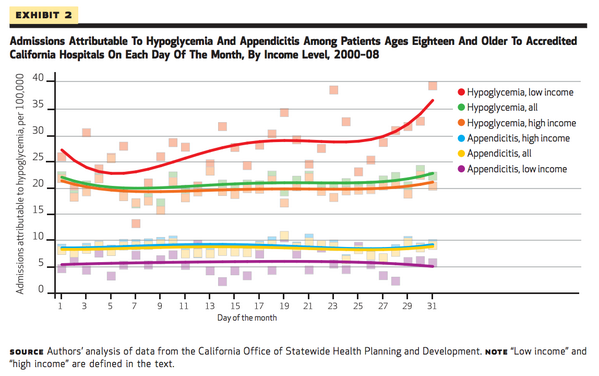
The basic idea is that people struggling to make it paycheck-to-paycheck (or benefits-to-benefits) might run out of money at the end of the month—and have to cut back on food. If they have diabetes, this hunger could turn into an even more severe health problem: low blood sugar. So we should expect a surge of hypoglycemia cases at the end of each month for low-income people, but not for anybody else.

That’s what researchers found when they looked at the numbers for California between 2000 and 2008. As you can see in their chart [seen above], low-income people (red line) were <27 percent more likely to be hospitalized for hypoglycemia in the last week of the month than in the first. There was no week-to-week difference for high-income people (orange line). …

Okay, but isn’t it possible that poorer people just tend to be less healthy in general?

Sure. That’s why the researchers also looked at when people go the hospital for appendicitis, which doesn’t depend on diet. So there shouldn’t be any end-of-the-month increase for low-income people if tight budgets are the problem. There wasn’t. As you can see above, appendicitis cases were flat across the month for both high (blue) and low (purple) income people. In other words, poorer people don’t need more care at the end of the month for every kind of condition. Just the ones that get worse when you don’t have enough to eat.

Adrianna McIntyre sees this study as an example of what gets ignored in our health policy debate:

Policy wonks have a terrible habit of focusing on insurance and health system design (and here I count myself, because health care financing is the research I find most interesting, so it’s what I write about). This gives short shrift to the “social determinants” of health—upstream factors related to lifestyle, environment, and socioeconomic status—that cannot be corrected by medical interventions. We’re fond of highlighting how much more the United States spends on health services, but an idiosyncrasy that receives less attention is how much less we spend on other social services.

Egypt Votes On A New Constitution… Again

EGYPT-POLITICS-UNREST-VOTE

Juan Cole takes a look at the contents of the charter that Egyptians have been voting on yesterday and today:

The constitution itself forbids torture and allows citizens to sue the police. If the provision is actually implementing, it seems to me Egyptians would have more rights in these regards than Americans. It gets rid of the clause that makes the al-Azhar Seminary the arbiter of Islamic law incorporated into state practices, which had been a step toward an Iran-style theocracy. It guarantees freedom of belief (the Coptic church is backing it). It is good on the rights of children. While it gives the army 8 years in which the civilian government can’t interfere much with it, that provision was in the Morsi constitution, too.

But constitutions are only as good as their implementation. Some Egyptians have argued that the interim government has overstepped its authority with its anti-protest law and ban on the Muslim Brotherhood, and that the anti-protest law, at least, is unconstitutional by the text of the new constitution. About that, we’ll see.

Manal Omar gauges the mood of voters in Cairo:

The two-day referendum, which began Tuesday, Jan. 14, is widely seen as an opportunity to end — or at least mitigate — the political debates that have been threatening to rip Egypt apart. The country has been deeply polarized since July 3, 2013, when the military deposed President Mohamed Morsi. The previous constitution was suspended, and a new road map for a political transition, led by a military-appointed government, was established. This government, which has banned the previously ruling Muslim Brotherhood and cracked down on street protesters, wrote the newly proposed constitution. The document incorporates more rights and freedoms than the last constitution, but it also guarantees greater autonomy for the military, still affirms principles of Islamic law as the main sources of legislation, limits the establishment of trade unions to one per profession, and leaves room for civilians to be tried in military courts — all causes of popular discontent.

Yet in voting, many people I spoke to said their primary interest is not in enacting a particular government charter; rather, it is in finding a way to move the country forward and to bring attention back to the much-needed social and economic reforms that inspired the 2011 revolution. Which is to say, they just want to get past it. Everyone also seemed to silently acknowledge the elephant sitting in the polling rooms: A no vote is not even an option.

Maher Hamoud doesn’t see any good coming of the referendum:

That this constitution will pass is a foregone conclusion. It is a fact that will not necessarily bring the much-mentioned stability, but it will provide the military, Mubarak loyalists and the business elite with what they wanted: power, protection and a “democratic” mask to show to international players. We have to remember that no ruler in Egypt since the mid-1970s has been able to afford being an enemy of the US or the west in general (and vice-versa).

But stability? The Muslim Brotherhood is not a small faction, and radical Islamist groups will not let bringing down the only Islamist model, which they did not necessarily like, go unpunished. The political roadmap will continue, the military will retain power (constitutionally this time) either directly or behind a civilian façade. But before we know it stability will be advocated again in another campaign, once people have realised for the third time that the revolution’s goal of freedom and social justice is not yet on anyone’s political agenda.

Steven A. Cook, meanwhile, begs Sisi not to run for president:

[L]arge numbers of Egyptians—with the encouragement of elites associated with the old order and important parts of the media—seem inclined toward an al-Sisi presidency. People are convincing themselves that Egypt needs a strong personality, if only temporarily, to put the country back on track.  They are comforted by the fact that the new constitution, which is up for referendum today and Wednesday, sets term-limits for the president to two, four-year terms.  This is an improvement in a country that has had problems with the overwhelming power of the executive, but observers should know that  1) presidential political systems are prone to the accumulation of power in the office of the presidency, and 2) there are reasons to doubt the durability of the term limits   After all, Anwar Sadat did away with them in 1980 when they became inconvenient.  The July 3 coup set a precedent that the political institutions of the state could be ignored, if powerful people and their allies agree that it is convenient to do so. One can easily imagine a scenario in which authorities override term limits in some way—security conditions, for example—to allow al-Sisi to remain in office. Another president for life is clearly not what Egypt needs.

(Photo: An Egyptian man has on his chest a portrait of Egypt’s Defense Minister General Abdel Fattah al-Sisi with a slogan in Arabic reading ‘I vote for the loin of Egypt for the presidency’ outside a polling station during the vote on a new constitution on January 14, 2014 in Cairo. By Khaled Desouki/AFP/Getty Images)