Internment In Israel

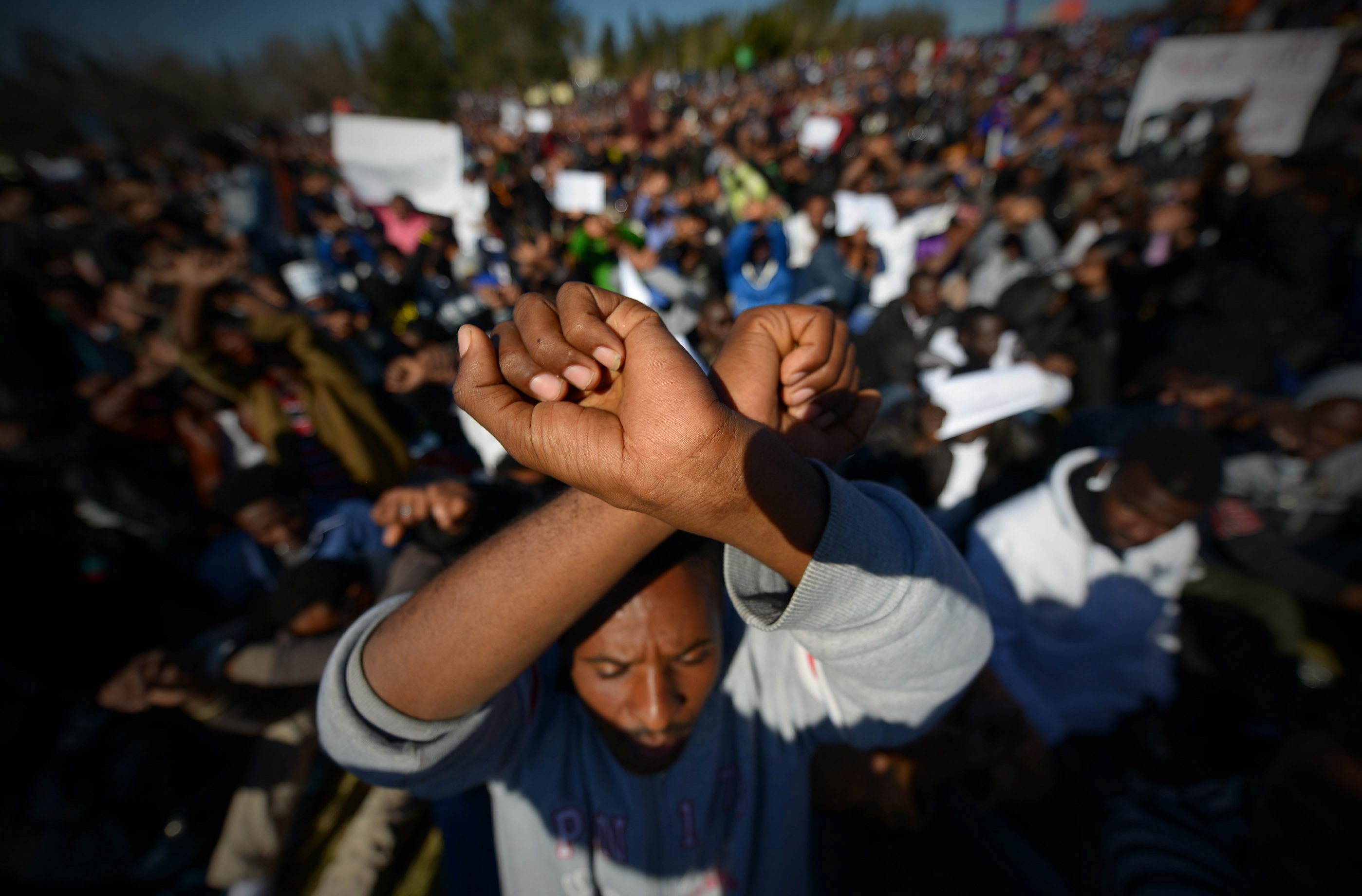
African migrants rally outside the Knesset

Batya Ungar-Sargon explains why 10,000 African migrants have taken to the streets in Israel this week:

The protestors, representing Israel’s estimated 55,000 African migrants, are protesting their treatment by Israel’s Ministry of the Interior, whose policies don’t recognize migrants from Eritrea and Sudan as refugees – instead designating them “infiltrators” – which has led to the detention of nearly 2,500 refugees in the Saharonim and Ketziot internment camps. That number is about to increase, the result of a new detention policy and the establishment of an “open” internment facility at which African migrants will have to check in three times a day. The protests also coincide with increased arrests among this population, who are required to renew their visas every one to three months. …

After a Supreme Court ruling in September deemed the three-year mandatory incarceration of Sudanese and Eritrean refugees in these camps to be in violation of Israeli human rights law, the Ministry of the Interior delayed releasing the incarcerated migrants, while passing new legislation which swapped three-year internment in closed internment facilities to indefinite internment in open internment facilities, says Tally Amir, professor of law at the College of Law and Business in B’nei Brak. “The focus of the protest is the violation of the refugee convention with the mass detention in Saharonim and in the open facility.”

Over at Ha’aretz, Bradley Burston implores Israelis to “let my people stay.” Meanwhile, Ruth Margalit is impressed by the scale of the protests:

For people who have lived for years on the margins of Israeli society, this week’s protests and strike mark an unusually public move. Since 2006, 53,000 asylum seekers have arrived in Israel, according to official figures; the vast majority of them – from Eritrea and Sudan, including from Darfur – trekked by foot for days across the Sinai desert. In 2012, some ten thousand African refugees crossed the once-permeable border from Egypt, before Israel erected a four-hundred-million-dollar fence, replete with cameras and sensors. The fence did the job: in 2013, only thirty-six refugees managed to find their way into the country. (That other refugees are now largely left to the mercy of the Egyptian border police, who have a history of gunning down asylum seekers, went largely unremarked.)

Fifty thousand out of a country of 8 million seems like a negligible number. But the problem, the government argues, is that the migrants, many of whom have been given a “conditional release” that does not include the right to work while their cases are pending, have taken over large swaths of working-class neighborhoods in Tel Aviv and seized jobs that could have otherwise gone to Israelis. That these jobs often pay less than the minimum wage, and that they used to be held primarily by Palestinians, is, apparently, beside the point.

Previous Dish on Israeli backlash against African immigrants here.

(Photo: Thousands of African asylum seekers demanding to be recognized as refugees rally outside the Israel’s parliament Knesset on January 8, 2014. By Salih Zeki Fazlioglu/Anadolu Agency/Getty Images)

Rubio’s Anti-Poverty Plan

Alex Rogers summarizes it:

He outlined two major changes. One would move most of America’s existing federal anti-poverty funding into one single agency, which would administer a “revenue neutral flex fund” and dole out grants to states. The other major change would be to replace the earned income tax credit with a federal wage enhancement that would be “highly  targeted” to avoid fraud or abuse. Rubio also mentioned “bolstering” the nation’s existing job-training system and addressing the shortage in skilled labor through encouraging alternatives to the traditionally accredited college degree. Alex Conant, Rubio’s press secretary, said to expect legislation “sometime in the coming weeks,” but with a Senate Democratic majority, it’s highly unlikely that anything will come of it.

Drum has low expectations:

It’s a shame that Rubio is almost certainly not serious about genuinely fighting poverty. Because these aren’t impossible ideas.

The first one is basically the usual conservative dream of block granting everything and then dumping the whole load onto the states, something that liberals are quite reasonably skeptical about. After all, virtually every state controlled by Republicans is currently refusing to expand Medicaid coverage even though it’s nearly 100 percent paid for by the federal government. This gives everyone a pretty good idea of just how eager red states are to help the poor.

And that’s a shame, because Rubio is right when he says that state experimentation, a la welfare reform in the early 90s, could be pretty valuable. If states were truly serious about finding answers, and if each of the various state policies were rigorously studied, it could provide some genuine insights into how best to fight poverty. But what are the odds of that?

Yuval Levin likes the policies Rubio touted. A caveat:

We shouldn’t overestimate the potential of state experimentation. States are laboratories of corruption and waste as much as they are laboratories of innovation and creative policymaking. But the substantive argument for federalism or subsidiarity is particularly strong in the case of helping the poor.

Allahpundit wonders whether the Rubio should focus instead on the middle class:

In a sense, this is the perfect topic for him. His message since day one has been full-throated celebration of the American dream, using himself as Exhibit A in what a man from a humble background can achieve here. An obvious corollary to that is how to extend the dream to those whose background is way south of humble, and the corollary becomes even more obvious on the 50th anniversary of LBJ declaring a war on poverty. In another sense, though, this is an odd subject for the GOP generally and Rubio specifically to be tackling. Like Byron York says, the party’s big headache, and big opportunity, is with the middle class. All the anti-poverty speeches in the world aren’t going to convince impoverished voters that the GOP will be better for them than welfare-state Democrats will.

Douthat sees that as a false choice:

If you were to build a rhetorical frame around some of the better policy ideas floating around on the right-of-center these days — from Mike Lee’s family-friendly tax plan to the James Capretta Obamacare alternative to the kind of unemployment-fighting agenda A.E.I.’s Michael Strain outlines in the latest issue of National Affairs — it probably wouldn’t be neatly divided into a “message on poverty” and a “message for the middle class.” Instead, it would talk about how this new right-of-center agenda would offer the same kind of thing to Americans below the poverty line as it does to Americans anxiously holding on to their place in the middle class: Not a conservatism of “compassion” (that Bush-era frame was always a mistake, even when the substance was decent), but a conservatism of respect, in which benefits and tax credits are tied to effort, responsibility, family, work, in ways that apply up and down the income ladder.

Cohn’s bottom line:

There are plenty of reasons to be cynical about Rubio’s motives. And who knows what his actual legislation will include when, and if, he ever introduces it. But on Wednesday, Rubio engaged in a conversation Republicans have shunned for too long. That’s progress.

Pursuing Professorship

AAUP_Trends_In_Professor_Employment-thumb-570x421-118600

Amid a lively debate about exploitation in academia, McArdle suggests a simple solution: “If we want the job market to get better for academics, then graduate programs have to admit fewer students”:

The “tournament model” of employment, in which a lucky few win the lottery while most people scrape by on very little, is a cruel and unattractive way to run a business. But it is cruelest in glamour industries such as the arts. Growing up on the Upper West Side, before it became the exclusive province of the wealthy, I inevitably met a lot of the people this model destroyed. The worst off were the folks who’d kept getting just a taste of success – a minor part in a Broadway show, a critically acclaimed performance at a second-tier festival. Those folks kept waiting until their late 30s or early 40s for success and security that never arrived. By the time it was clear it never would, they were broke, and trying to start another career at a time when most people are heading into their peak earnings years. And the slow crushing of hope over a process of decades often did something tragic to their souls.

Professional sports also runs on the tournament model, but with one key difference: athletes find out pretty early that they’re not going to make it – early enough to still have a basically normal life doing something else. As the time it takes to get a PhD has stretched out, academia is looking less and less like athletics, and more and more like the theater. The students would be much better off if they were weeded out earlier, in the application process for PhD programs. A substantial fraction – maybe the majority – of PhD programs really shouldn’t exist.

Caplan is supportive. Freddie, not so much:

If there’s one group that shouldn’t throw stones about job prospects, I’d say journalists applies. I still marvel at the way people throw shade at grad students while their career To Do List reads “become big-time successful writer!”

McArdle waxes sympathetic for all of us saps in the academic game, pointing out that the academy is a tournament-style employment field where many take risky gambles but few succeed. She does this from her position in political punditry. I can only assume she’s aware that there’s several thousand desperate youngsters trying to be journalists and bloggers and pundits for every one spot among the elect, so I’m not sure why she doesn’t similarly indict her own profession. I mean, if I was going to decry winner-take-all lottery style employment, I likely wouldn’t do it from the vantage of writing for Bloomberg, you know what I mean?

Megan responds:

[M]ost people don’t spend five or six or eight years just preparing to be eligible to get a job in journalism, and an additional four years or so cycling through post-docs before it becomes clear that that journalism job isn’t going to happen. Nor, when they are six years into their first permanent job, do they have a committee that meets to decide whether to fire them and put them back on the job market, quite possibly with very poor prospects. They don’t have to move to towns in the middle of nowhere or give up relationships because their partners will never be able to find work in the Ozarks. Female journalists do not have to put off starting a family until they’re pushing 40 because it would be insane to reproduce before the tenure committee approves them. The opportunity costs of trying to become a journalist are quite a bit lower than the opportunity costs of trying to become an academic.

(Graph via Jordan Weissmann)

Who Will Run Against Hillary?

Obama Accepts Nomination On Final Day Of Democratic National Convention

Weigel suspects former Montana Governor Brian Schweitzer:

He’s been visiting Iowa and promising to visit all 99 counties. (It’s on his “bucket list.”) The Venn diagram of people who visit all 99 Iowa counties and people who run for president is basically a solid circle. Schweitzer’s only just been added to presidential polls, where he comes in between zero and 2 percent. He talks about these numbers the way a presidential candidate always does. “The Republicans tend to choose the candidate who came in second place in the last election, and Democrats tend to move on,” he says. “Ask President Ed Muskie how it worked out to be the front-runner. Ask President Howard Dean how it worked out.”

Sam Kleiner looks at where Schweitzer deviates from your average Democrat:

Becoming famous as a “blue man in a red state,” Schweitzer compromised on core liberal commitments to gun control and allied himself with the NRA. In his 2008 run, Schweitzer was endorsed by the NRA with an “A” rating and a personal visit by Wayne LaPierre for a campaign rally. Schweitzer signed an array of NRA-backed bills into law, including a 2009 “stand your ground” bill that the NRA called a “victory.” …

While it’s tempting to write off Schweitzer’s relationship with the NRA as a kind of compromise that Western Democrats must make in order to stay in office, it’s worth recalling that [Montana] Senator Jon Tester was a supporter of the Manchin-Toomey gun control bill. Schweitzer is either a genuine conservative on gun control or, more troublingly, a candidate willing to “tack hard right” in order to get elected, as he would put it.

On the environment, Schweitzer has similarly been far to the right of the Democratic Party, and he isn’t sorry about it. He blamed “jackasses” in Washington for the delays on the building of the Keystone Pipeline. While Western Democrats have a tradition of producing some of the party’s greatest conservationists, including Secretaries of the Interior Stewart Udall and Bruce Babbitt, Schweitzer has gone the other direction. He has been one of the strongest advocates for expanding coal production, with extensive plans to ship coal to China. That plan has been met with fierce resistance from groups such as the Sierra Club. Western Democrats have a rich tradition of being the vanguards of the party’s environmentalist wing, but Schweitzer does not fit there.

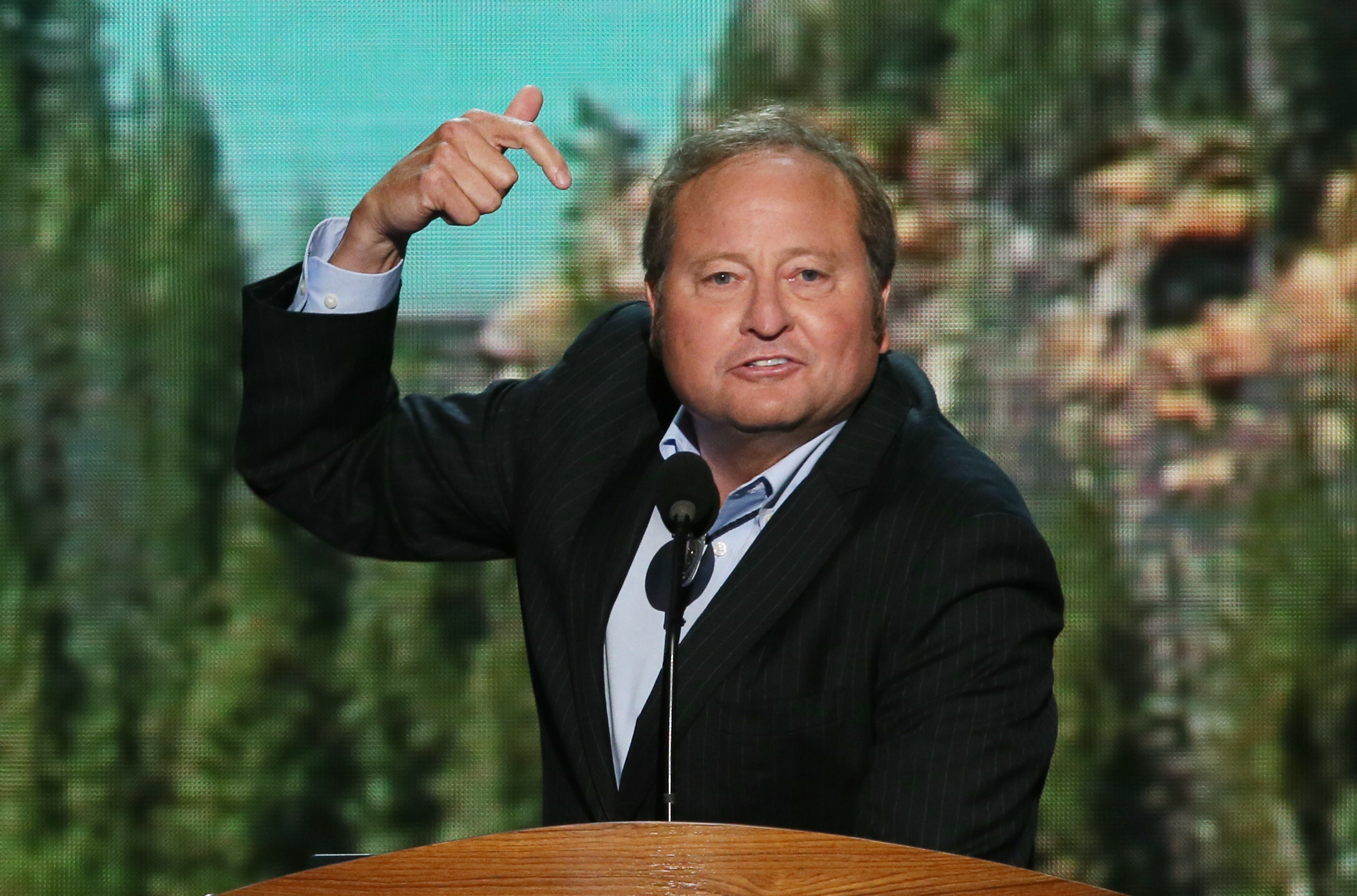
(Photo: Montana Governor Brian Schweitzer speaks on stage during the final day of the Democratic National Convention at Time Warner Cable Arena on September 6, 2012 in Charlotte, North Carolina. By Alex Wong/Getty Images)

The In-Tray Swarms the Christie Presser

This lunchtime, Governor Christie insists he couldn’t pick Mayor Sokolich out of a police line-up. A reader writes:

Hm. Plausible, just barely: he meets a lot of people, after all. But “until [he] saw [Sokolich’s] picture last night on television,” he wouldn’t have been able to pick him out of a lineup? Last night? How many months has this bridge scandal been going on? Color me unconvinced.

Another:

Governor Christie was once the US Attorney.  His Chief of Staff, Chief Counsel and Deputy Chief Counsel were all former Assistant US Attorneys.  All of them know how to investigate misconduct.  It is absolutely inconceivable that Christie or these senior staff members did not recognize that the answers to the swirling allegations would be found in the emails.  Either they learned  the damning facts right away and sat on them or they said to each other “we better not go there because we will only find trouble”.   There is no good explanation for the Governor here.

Another:

It seems to me that two simple questions should pry the lid off this: “Governor Christie, your staff told you the lane closures were part of a traffic study. Did you ever ask your staff or the DOT to produce the results of the traffic study, or even a contract ordering the study? If not, why not?”

Another:

Here’s something to add to the “obvious pattern” you talked about.

We know that Christie was focused on running up the score by the fact that he scheduled a special election for Senate (at great expense for the State) a few weeks before the general election in November to make it less likely that Cory Booker supporters (Democrats) would show up at the polls and reduce his margin. For a man that intent on maximizing his margin, it is easy to believe that he would be vindictive against those who refused to go along.

Another:

I’m surprised no one seems to be talking about the fact that this traffic sabotage occurred on 9-11. Isn’t the GWB a high value target? And wouldn’t the people of NJ be more sensitive to, and stressed out by, something so out of the ordinary? Not to mention the need of first responders to be on high alert. Is it just a coincidence that they planned this for the week of 9-11 or was that part of the effort to inflict as much pain as possible on Fort Lee residents?

Another:

The emails that were turned over were heavily redacted. Who redacted them? They were obviously reviewed by someone. Why didn’t alarm bells go off? I don’t get it. And the person who reviewed them did not hear the bells going off. I’m not buying Christie’s explanation that he had no idea until 9AM yesterday.

That would have made his statement that he’d lost sleep the last couple of nights a little off, don’t you think? Unless he knew this was coming.

The Rise Of The Independents

Independents

The latest numbers:

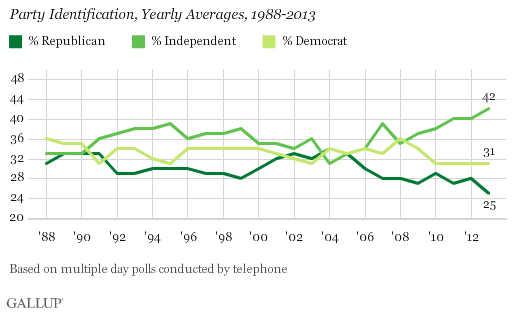
A record 42% of people consider themselves Independent, compared to Democrat (31%) or Republican (25%). That’s a huge shift from just a decade ago, when affiliations were divided around a third for each. The chart below shows how Americans’ dissatisfaction with the parties is nothing new. (Note the surge in independents around the time of Ross Perot’s 1992 presidential campaign.) The spike in Independents is eating more into the GOP, which has seen party moderates sidelined by extremists. The data suggest that there may be a place for a Bloomberg presidential bid after all.

Alan Abramowitz disagrees with that final sentence:

Despite Gallup’s findings, you won’t see a large number of successful independent candidates next November, nor will many Democratic or Republican candidates distance themselves from their own party on major issues. That’s because, despite the apparent rise in independent identification, Americans are actually becoming more rather than less partisan in their behavior. Yes, even “independents.”

What I see is a bunch of formerly Republican voters/leaners being too embarrassed to admit it any more. Sides digs into the data:

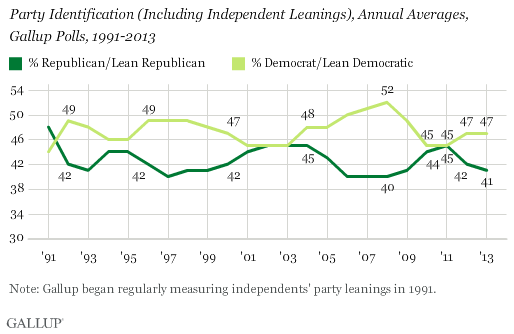
Most self-described “independents” do lean toward a party. This other graph by Gallup is really the more important one:

Independents Party

Why is it more important? Because independents who lean toward a party — or “independent leaners” —  behave like partisans, on average. They tend to be loyal to their party’s candidate in elections.  They tend to have favorable views of many political figures in their party. They are not much more likely to identify as ideologically moderate. To be sure, independent leaners are not as partisan as the strongest partisans. But they resemble weaker partisans much more than they do real independents. In actuality, real independents make up just over 10 percent of Americans, and a small fraction of Americans who actually vote.

Matt Welch has a different perspective:

[A]s Nick Gillespie and I argue in The Declaration of Independents: How Libertarian Politics Can Fix What’s Wrong With America (a distillation of which you can read in the August 2011 issue of Reason), the economy/society-wide loss of brand loyalty and gain of individualized, tech-fueled disruption will hit politics and especially governance last, because of government’s guaranteed revenue streams and party-rigged insulation from competition. But just because it will happen last, doesn’t mean it isn’t already beginning to happen.

Finally, Drum thinks the poll “goes a long way toward explaining that Pew survey last week, which found that belief in evolution had plummeted from 54 percent to 43 percent among Republicans over the past four years”:

If you dig into the details of that poll, the decline is actually a little more moderate than it seems, and it’s probably explained mostly by the fact that so many moderate Republicans have left the party. When you remove a big chunk of people who believe in evolution, the group that’s left will have a higher percentage of deniers even though no one’s beliefs have actually changed.

When Did Christie Know?

Barro has a hard time believing that Christie was completely in the dark until yesterday:

Here’s what I don’t buy. Let’s stipulate that this hare-brained scheme was hatched by Christie’s staff and appointees without his knowledge. Therefore, he didn’t know about the lane closures or their motivations before Sept. 13, when Port Authority Executive Director Patrick Foye (a New York appointee) started complaining about them. There have been 117 intervening days, during which Christie accepted the resignations of two of his Port Authority appointees who are caught up in this scandal. I assume he and his top staff have had a lot of conversations during that time, trying to figure out exactly what happened in Fort Lee. Did his people really manage to keep him in the dark for that entire time such that he’s shocked today? If so, what does that say about his skills as a personnel manager?

After watching Christie’s presser, Barro asks four questions. Among them:

The governor says Kelly lied to him and said she had no involvement in the bridge lane closures. But Kelly wasn’t the only person who knew Kelly was involved. In August, she emailed David Wildstein, Port Authority Director of Interstate Capital Projects: “Time for some traffic problems in Fort Lee.” Wouldn’t Wildstein have told the governor, in the process of tendering his resignation, that Kelly had told him to do it? Bill Baroni, Christie’s top appointee at the Port Authority, was also checking in with Wildstein about whether “Trenton” was happy with the handling of the closures. Why didn’t Baroni tell the governor his staff had known?

Josh Marshall points out that many Christie loyalists must have been involved:

Clearly, a lot of different people in Christieland were in on this, at least in the sense of knowing it was going on, if not taking a direct role themselves. And the tone is pretty much universally one of joking about it or enjoying it rather than in any sense seeing it as a major inconvenience they were trying to rectify. … The emails do not suggest a bad apple each at Port Authority and the Governor’s office up to no good. This is a range of Christie staffers and appointees sitting back observing and chuckling as a big multi-day traffic snarl unfolds.

If Christie didn’t know about this there must have been a concerted effort on the top of his top people to keep him in the dark.

Tomasky sees three possibilities:

1. He’s telling the whole and complete truth in yesterday’s statement, that this was the first he’d known that the lane closings were political;

2. He was in on it from the start and helped mastermind it or at least winkingly approved it;

3. The middle position, which is that he didn’t have prior knowledge but he learned it was political some time ago—not long after it happened, say—and is now lying about having just learned.

If it’s two or three, I’d say you can forget not only his presidential ambitions. He’ll have to resign the governorship. Right? Hard to see any way around it. To have lied to your people for months about something like this, if that’s what he did, is a pretty good definition of being unfit for office.

Allahpundit is on the same page:

[A]t this point, given his emphatic denials that he had anything to do with the lane closings, what’s the alternative to resigning if a smoking gun emerges proving that he did? He’s not going to stand at the podium, cop to having lied baldfaced to the world about his role in punishing the public in order to retaliate against a political enemy, and then say, “Oh well, see you tomorrow.” His whole shtick is that he’s a straight talker who tells the truths that more polished politicians are too afraid to tell. He can’t admit to having lied to protect himself and then go back to business as usual. So what’s the alternative to resignation if he gets caught red-handed? Which, I guess, is another way of saying that the odds of him getting caught red-handed are verrry low or else his denials wouldn’t be so emphatic.

He Hasn’t Gotten Around To Anger Yet

original

A few thoughts about Christie’s presser (which continues to go on). He’s a pro. He stood there and took the heat, kept on message, revealed an impressive grasp of detail, explained what he’s been doing these last few days, and declared himself “betrayed.” The general assertion is that he could have had no direct responsibility for creating a culture in Trenton that gave us “callous indifference” to the welfare of the citizens of New Jersey and what he called a rogue political operation run by his own deputy chief of staff. He was poised; he did not seem too rattled; he took responsibility for the blow to New Jerseyans’ confidence in the integrity of their government. He claims, moreover, that he had no idea who the mayor of Fort Lee was. He had no idea he refused to endorse him. So he had no motive to do anything nefarious. So it remains a “mystery” to him.

As long as he’s telling the truth, the whole truth and nothing but the truth, I think he did about as well as anyone in that pickle could. But … one thing truly stuck out to me. Christie fired Bridget Kelly without talking to her since the emails emerged. That does not seem to me a chief executive entirely interested in how this actually came about. If I were in his position and believed I was betrayed to the point of going out there and telling untruths, I would want a face-to-face with my deputy chief of staff to understand the full context, and get to the bottom of it. Firing her summarily without even talking to her seems a weird act of abrupt distancing. I’m not sure it’s even wise. Sure he was right to fire her. But why do so in such a way as to alienate a close staffer without giving her a chance to explain herself? What happens if she returns the distancing herself? She will likely be subpoenaed and we’ll find out.

I was also struck by Christie’s insistence that Kelly was fired because she lied to him. Not because she engaged in petty vindictive politics. But because she deceived him. He claimed that she had never deceived him previously in any way. Again, his core issue is what was done to him, not what was done to the inhabitants of Fort Lee. What he cannot explain away, it seems to me, is the tone of the emails which suggest that this kind of thing was so routine it could be talked about almost in code and another official would instantly respond “got it” to a mere suggestion of “traffic problems.” That’s not a rogue moment, it seems to me. It’s part of an obvious pattern. The vindictiveness is not a leap; it’s a premise. The idea that Christie had no responsibility for creating a culture in which that premise was unremarkable is, to my mind, deeply implausible.

But he sure has put himself out there on a very long limb.

His administration, he tells us, as he told us for months, has “nothing to hide.” He wants to be judged now for expeditiously firing the responsible people, not letting this kind of petty, vindictive abuse of power spread in the first place. He is, he insists, a total victim in all this, blindsided, shocked, surprised. And he nailed that performance.

But if I were Christie, I’d be a little worried about Bridget Kelly. He threw her under the bus without even seeing her face to face. He’d better be damn sure she has no way to implicate him as well. And, after being blindsided by one bunch of leaked emails, what happens if he’s blindsided by more?

I give him a high grade for this performance. If it contains even an ounce of inaccuracy, he’s toast. And this thing will doubtless go on. And subpoenaed emails and texts are unpredictable things.

What Happens To Utah’s Marriages? Ctd

Yesterday Utah declared that it will not recognize same-sex marriages that were already performed. Serwer parses:

The circumstances facing Utah are sufficiently rare that there are few prior precedents for how to handle same-sex couples who are married after a same-sex marriage ban is overturned but before the issue is settled in the courts or at the ballot box. In New Mexico and California, courts ultimately ruled that those marriages had to be recognized by the state. The fact that the law is unclear however, doesn’t mean that Utah’s decision was necessary.

“I don’t think it’s a foregone conclusion that they had to do this, they could have said while the litigation was pending, anyone who got married before the stay was issued is still considered married,” said Samuel Bagenstos, a professor at the University of Michigan Law School. “The fact that they didn’t is as much about their choice about how to interpret state law and the stay from the Supreme Court as what was required.”

Timothy Kincaid’s analysis:

In addition to being awkward and placing same-sex couples in extreme legal confusion, this may have been a strategic misstep on the part of the state.

It places Utah in the position of treating people in exactly the same situation (same-sex couples married under Federal authority) in disparate ways. The second problem with the Attorney General’s decision is that in many ways this closely mirrors the Proposition 8 scenario. In Hollingsworth v Perry, the Ninth Circuit found that you cannot grant rights to a group of people and then take those rights away. Here the state granted specific rights to married same-sex couples and then swooped in and took those specific rights away. And while the Ninth Circuit decision does not create precedent in the Tenth Circuit, it nevertheless will be given consideration. Had Utah simply said, “if you got married, you are married; if you didn’t, you are not”, that would have been a clean and simple ruling. But by taking a “we will not give you one iota of protection that we haven’t already processed” stance, the state demonstrates a significant degree of hostility. And by doing so, they have strengthened both our argument that the banning of same-sex marriage is rooted in animus and our call for heightened scrutiny in legal decisions.

Ari Ezra Waldman weighs in:

The state may not want to recognize the marriages performed in Judge Shelby’s equality window, but the federal government should. The federal government, according to instructions from agencies like the IRS and the Office of Personnel Management, will recognize marriages performed in the states as long as those marriages were performed in a state that recognized those marriages. That is the “state of celebration” rule. Utah recognized the validity of same-sex marriages when the 1300 marriages were performed. And nothing has changed. The stay granted by the Supreme Court did not invalidate those marriages. Nor did it undo Judge Shelby’s decision, despite what some commentators have suggested. Governor Herbert’s decision to put the marriages “on hold” does not deny their validity, either. Everything is just on hold. And that doesn’t change the fact that the marriages were valid in Utah when they were performed. That’s the end of the story.

Earlier Dish on Utah’s marriages here.

The American Plutocracy

Nicholas Carnes’s new book, White-Collar Government, examines the prevalence of the wealthy in our government. If American millionaires had their own political party, he notes, it would have “a majority in the House of Representatives, a filibuster-proof super-majority in the Senate, a 5 to 4 majority on the Supreme Court and a man in the White House”:

Political observers in the United States have always worried about the effects of government by the rich. During the Founding, Anti-Federalists warned that the Constitution would create a government of wealthy merchants that would “consist . . . of men who will have no congenial feelings with the people, but a perfect indifference for, and contempt of them.” Federalists such as Alexander Hamilton countered that although the Constitution might produce a white-collar government, the effects would be small because different classes of Americans would have the same basic views about economic policy. We all want growth, so what’s the harm in letting the upper class call the shots?

White-Collar Government is the first book to bring hard evidence to bear on this long-standing debate. In it, I’ve compiled every available source of data on how legislators from different occupational or social-class backgrounds think and behave in office. What I found is squarely at odds with the rosy notion that class doesn’t matter in our political institutions. Pollsters have known for decades that Americans from different classes have different views about economic issues, that working-class Americans tend to be more progressive and that the wealthy tend to want government to play a smaller role in economic affairs. White-Collar Government shows that politicians are no exception.

In an interview last November, Carnes explained his current research project:

Right now I’m working on a big set of research projects designed to shed light on why there are so few working-class people in office. I just finished surveying all 10,000 of the people who ran for state legislature nation-wide in 2012, and in a month or so, I’ll survey all 6,000 of the people who lead the state and county chapters of the Republican and Democratic parties.  I’m also mining existing data on the social class makeup of state legislatures to see whether there are times and places where working-class people have made progress in our political institutions. My approach is essentially the same one that I used when I wrote White-Collar Government: I’m going to pull together every available source of data on this problem (including some that I have to collect from scratch) to try to get the most complete picture possible. In a few years, I hope to be able to definitively say, “These are the factors that are keeping working-class people out of public office, and this is what you can do about it.”