Another War We Can’t Win?

Poverty

Derek Thompson marks the 50th anniversary of Lyndon Johnson’s war on poverty, partly blaming the problem’s stickiness on the rise of the single-parent household:

The poverty rate among married couples is quite low: 6 percent. The poverty rate among single-dads/moms is quite high: 25/31 percent. Since the share of single-parent households doubled since 1950, we should expect it to stress the poverty rate, especially since low-income people closer to the poverty line are less likely to marry, in the first place. Things get really interesting when you zoom into the marriage picture. Among what you might consider “modern families” (e.g. the 61 million people married and living together, both working), there is practically no poverty. None. Among marriages where one person works and the other doesn’t (another 36 million Americans) the poverty rate is just under 10 percent.

But take away one parent, and the picture changes rather dramatically. There are 62 million single-parent families in America. Forty-one percent of them (26 million households) don’t have any full-time workers. This is something beyond a wage crisis. It’s a jobs crisis, a participation crisis—and it’s a major driver of our elevated poverty rate.

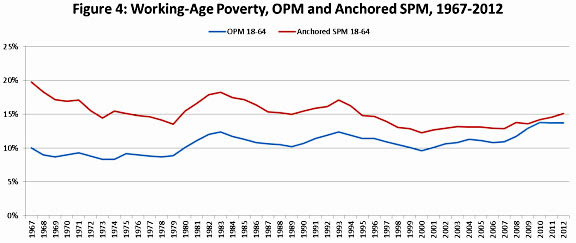
Drum touches on the anniversary as well, passing along the above chart and noting that he sees the war as more of a stalemate:

The Great Society programs of the 60s got the working-age poverty rate down from 20 percent to 15 percent, but then we gave up. Since the mid-70s, the poverty rate has stayed stubbornly stuck at about 15 percent[.] This is a chart to really keep in mind as you read the inevitable retrospectives. The overall poverty rate has gone down substantially in the past half century, but that’s largely because of the huge effect of Social Security on elderly poverty. But as much as this is a great achievement, it’s not what most people think of when you talk about “poverty.” Rather, they’re mostly thinking of working-age people who are either unemployed or earning tiny wages. And among those people, we simply haven’t done much for the past 40 years.

Jared Bernstein points out that poor families are up against a worse economic climate than they faced a few decades ago:

The data clearly show that anti-poverty policies have been effective, but they’ve had to work harder in the face of increasing economic challenges facing low-income families.  We could try to push the safety net further, but the politics aren’t there, to say the least.  Moreover, unless we do more to deal with the underlying structural problems in the economy that are increasing poverty — especially the lack of decently paying jobs, which I link closely to the absence of full employment — we’ll have to increasingly ratchet up government support year after year.

The American safety net is actively helping millions of economically disadvantaged families, and we should protect and improve it.  But the best way to help it — and more importantly, the poor themselves — is to strengthen the underlying economy in ways that will take some of the pressure off of what has, over the last 50 years, become an effective set of anti-poverty social policies.

Flavelle argues that the Republicans have a point in criticizing the anti-poverty project:

[T]he OECD data suggest that for every dollar of social spending, the U.S. gets less poverty reduction than other developed countries. There are plenty of possible explanations for that, including poorly run programs; spending that is disproportionately focused on certain groups (such as the elderly); and noneconomic barriers facing some minorities. Another explanation could be the share of social spending that comes in the form of cash, rather than services. U.S. social spending is evenly split between cash benefits and services; in France, cash makes up almost two-thirds of the balance, according to the OECD.

Whatever the reasons, the combination of relatively high social spending and relatively low poverty reduction gives credence to a main plank of Republicans’ argument: When it comes to the war on poverty, the current approach isn’t working that well, in terms of getting the most value for what the U.S. is already spending. What should be done differently is another question.

But Zeke J Miller, Maya Rhodan, and Alex Rogers don’t see the parties coming together on this issue anytime soon:

Both sides largely reject the others’ proposals as misguided. “The goal ought to be, is to get people out of entry-level jobs, into better jobs, better-paying jobs. That’s better education. That’s a growing economy,” Ryan said in response to President Obama’s State of the Union last year. “I don’t think raising the minimum wage, and history is very clear about this, doesn’t actually accomplish those goals.” Democrats object that Republicans are trying to gut welfare programs and public education with their so-called reforms. At the root of the dueling rhetoric around the The War on Poverty is a political question: Does the government enable, or is it an enabler? “There is a lot more clarity on the current trends in inequality than there is on what to do about it, much less any agreement,” said Isabel Sawhill, Senior Fellow in Economic Studies at the Brookings Institution. “Amongst experts there is much more clarity. We need a bipartisan agreement about what to do about inequality because if we don’t nothing will happen.”


Why So Few Black Women On SNL?

[youtube:http://www.youtube.com/watch?v=5377GA_4_HM#t=83%5D

Sasheer Zamata, the 27-year-old comedian seen above, has been tapped to join the cast of Saturday Night Live, becoming the first black woman on the show since Maya Rudolph’s departure in 2007. Drew Grant comments:

It’s an uneasy victory: While it’s definitely a good thing to have more diversity in the cast, the fact is that Ms. Zamata was hired in direct result to the backlash caused by Kenan Thompson’s comments to TV Guide last October, when he claimed the show had a hard time staffing black women because many of them were not qualified. The show’s producers were under considerable pressure to address the problem, and held several auditions to find someone who could reprieve Mr. Thompson of having to put on a dress every time the show needed an Oprah character. (SNL, which does have a sense of humor about itself, did a brilliant send-up of the issue in its cold opening with Kerry Washington last year.)

This is not to say Ms. Zamata is not qualified. A graduate of the University of Virginia, the acting major has been taking classes UCB, a popular feeding pool for late night, since 2009. Her YouTube videos show that she has a wide array of characters and impressions up her sleeve, including Beyonce and Michelle Obama. She’ll make a great addition to the show, and hopefully going forward, SNL will not have to hold seperate auditions for black women.

Erik Voss explored the controversy back in October:

The lack of diversity on SNL has always been a thorn in the paw for the show’s progressive fan base.

Since SNL premiered in 1975, only 15 black performers have been in the cast (and only two Latinos and zero Asian-Americans), and only four of those black performers have been women: Yvonne Hudson (1980-81), Danitra Vance (1985-86), Ellen Cleghorne (1991-95) and Maya Rudolph (2000-2007). Since Rudolph left, viewers have complained that SNL has no one to play zeitgeist celebrities like Michelle Obama, Oprah Winfrey, or Beyonce — not to mention a wealth of original black female characters. In the past, Thompson donned drag to play Whoopi Goldberg and Star Jones, but he now refuses to play such roles. SNL‘s casting process is notoriously secretive, leaving outsiders wondering why the show hasn’t diversified its cast. Is it, as Thompson suggested, simply a matter of the SNL‘s producers being unable to find black women who are “ready”? How is that possible when those of us in the alternative comedy scene know hilarious black women who have auditioned, only to be mysteriously rejected? Is anyone ever “ready” for SNL?

Poniewozik says SNL’s writers have work to do as well:

The next step will be making sure Zamata has someone to play besides Beyoncé, Michelle Obama, and Oprah Winfrey. Impressions, for better or worse, have been SNL’s bread and butter for decades; pretty much everyone in the cast needs to do them (Rudolph had a famous Oprah) and presumably so will Zamata. It’s one reason that diversity on SNL matters for practical reasons and not just social ones: you need people who can play everyone in the wide world of public figures.

But what will make Zamata’s hire worthwhile, for her and for the show, is making sure that she gets written great, memorable characters who aren’t black female celebrities as well. It’s the difference between being an African American woman SNL star (a funny performer who is black and female) and being the African American woman SNL star (a performer who’s specifically there to be black and female). That may seem like semantics, but it’s also about what real diversity on a cast means–giving a performer like Zamata the kind of range that the show’s most successful white men have had (and white women, and black men like Eddie Murphy).

Watch five impressions by Zamata here and many more videos of her work here.

The Math On The Medicaid Expansion

Ezra unpacks the ACA enrollment numbers:

The exchange numbers are solid. You can trust those. … But the Medicaid numbers are more complex. Each state runs its own count, and the data includes people who enrolled in Obamacare’s Medicaid expansion as well as people who were eligible under prior law. To the Obama administration’s annoyance, some states are also counting people who’re simply renewing existing Medicaid policies.

A lot of the 4.4 million people who got coverage under Medicaid in the last few months got it from Obamacare’s Medicaid expansion. Even more would’ve gotten it if all the states were participating in Obamacare’s Medicaid expansion. But some simply got coverage under the preexisting Medicaid program.

By Sean Trende’s rough estimates which, he admits, “may be off by a fair amount (in either direction),” only 190,000 of those 4.4 million were newly eligible:

[S]everal states that expanded Medicaid advertised this fact heavily and probably attracted a disproportionate number of people who were already eligible for Medicaid but didn’t know it. While it’s probably fair to attribute these enrollees to Obamacare, they would keep their coverage in the event of a repeal, and might not figure heavily in November. Regardless, even if you double the estimate — which seems awfully generous — that’s only 380,000 new Medicaid enrollees due to Obamacare, a far cry from 4 million.

This makes intuitive sense. The states that expanded Medicaid were blue states, many of which already had more generous Medicaid programs. In other words, their baselines were higher, so we’d expect the number of newly qualified recipients to be lower than if, say, Texas had participated.

The View From Your Frozen Window

KONICA MINOLTA DIGITAL CAMERA

St. Paul, Minnesota, January 6th, 10.05 am, -19°. Many more scenes from the historic week after the jump:

Chiberia 013

“The view from Chi-beria”, Illinois, January 6th, 9.47 am.

unnamed (1)

Schaumburg, Illinois, January 6th, 10.15 am. “About 25″ of snow, -14 degrees outside, and a wind chill of ‘I don’t even want to know’ below zero.”

0103141053a

Rochester, New York, January 3rd, 11.18 am, 3°

IMG_1486

Minneapolis, Minnesota, January 6th, 9.03 am, -20°, -41° with wind chill

chicago-window-ice

Chicago, Illinois, January 7th, 10.23 am. “Oh, that ice is on the inside.”

philly

Philadelphia, Pennsylvania, January 4th, 10.18 am

DSC_0602

Minneapolis, Minnesota, January 6th, 6.45 am

webster-groves-mo

Webster Groves, Missouri, January 7th, 8.30 am

brooklyn

Brooklyn, New York, January 3rd, 8.30 am

SAMSUNG

St. Louis, Missouri, January 5th, 2.38 pm

IMG_2346

Oak Park, Illinois, Janurary 5th, 7.42 am

P1100856

Decatur, Indiana, January 5th, 2.55 pm. “The snow is getting heavier in front of the arctic temperatures set to arrive tonight and tomorrow (-25° to -35° ). I put extra bird feed out for our feathered friends.”

view from front window 1.5.14

Cedar Bluff, Iowa, January 5th, 6.28 pm.  “Wind chill is at -21° and heading down.”

Exit Cheney, Far, Far Right, Ctd

Now that Liz has dropped her primary challenge against Wyoming senator Mike Enzi, citing a family member with health problems, Margaret Carlson hopes she’ll spend her free time mending fences with her sister:

Cheney’s ill-timed race hurt more than her career. Unless she’s made of stone, she has a deeper loss — her relationship with her sister, Mary, a lesbian, who took umbrage at her older sister’s opposition to gay marriage. Every election has one winner and at least one loser, but this one has a family that lost its privacy and comity. When her father, Dick Cheney, weighed in, he took sides, supporting the sister who was running and dissing the other one. Dad clarified that Liz felt sorry for Mary. Although Liz had “compassion” for Mary, he said, that shouldn’t be mistaken for approval. … If Liz has a sick family member, she has everyone’s compassion. This must have been a tough holiday season for the Cheneys; the sisters didn’t spend them together. Now the Cheneys have a year to get it right before the next one.

Suderman paints her as a failed foreign policy hawk:

Cheney dropped out because she had no chance. And she had no chance in part because of the declining influence of the Republican Party’s most hawkish members.

Her run was, as much as anything, intended as a way to make some noise about the foreign policy issues that party hawks thought were getting lost in the shuffle, and to serve as an opposing voice to what is easiest to describe as the Rand Paul wing of the GOP, which is more worried about civil liberties and less interested in overseas adventurism or maximizing defense-sector spending. That Cheney’s campaign gives a sense of the electoral landscape within the GOP. It’s hard out there for a hawk.

Or perhaps, per Mark Joseph Stern, a failed anti-gay candidate:

The takeaway here is not necessarily that the era of anti-gay politicking is entirely over; as Windsor reaches into the states, conservative legislators will undoubtedly continue to score support by stoking homophobic animus. Instead, the undignified collapse of Cheney’s campaign suggests that, in 2014, a candidate cannot simply demonstrate hatred of gay people to pull in conservative votes. Aside from illustrating the depths of her bigotry by betraying her own sister, Cheney presented few coherent policies on the campaign trail. By dint of publicity—publicity she practically demanded—she became known as a hardline anti-gay candidate. And that did absolutely nothing to narrow her humiliatingly low popularity, to boost her fundraising, or to garner conservative support.

Larison thinks the answer is simpler:

Even if she had tried to attack Enzi on foreign policy grounds, there are so few differences between them on these issues that there would be nothing for her to say. The main and fatal weakness of her campaign was that it had no reason to exist: the incumbent she was challenging was popular, he had a reliably conservative voting record, he wasn’t tainted by any scandal, and her only qualification for public office was that she had held a position in the Bush administration with responsibility for the region that saw its greatest errors and failures. If Cheney’s failed campaign has any significance beyond its implications for her own career, it demonstrates that Republican primaries can’t be won on a platform of nothing more than increased combativeness for its own sake.

Alex Altman says there are few tea leaves to read here:

What does her failed campaign tell us about the political landscape in 2014? Not much. Nearly all of the Republican primary scuffles this cycle feature a Establishment-type incumbent trying to fend off a Tea-infused upstart. Cheney’s challenge to Republican Mike Enzi didn’t fit that format. The Tea Party was not a factor. Both are Establishment figures. Neither are squishy moderates by any means. The race drew national attention (and national money) because of Cheney’s name and network, but on the ground it was very much a local affair, flavored by issues like coal.

If there is a lesson to draw from the race, it may be that the Republican grandees with targets painted on their backs this year may be tougher to take out than people think. Pundits will snark about the colossal failure of Cheney’s campaign, but up close she was a strong candidate: smart, polished, and informed. But Enzi had few vulnerabilities. During three terms in the Senate, he’s compiled a deeply conservative voting record. He’s widely praised for constituent service back home. And his low-key, avuncular style plays well with the sparse and spacious frontier state he represents.

What Happens To Utah’s Marriages?

Toobin wonders:

During this long journey through the judicial system, the same-sex couples who married while it was legal to do so in Utah will find their unions in a kind of netherworld. They are not suddenly divorced, but it’s not clear what will happen if they now try to obtain the kind of government benefits that married people normally receive. Can they file joint state tax returns? Can they obtain health-insurance benefits as spouses? Can they be treated as spouses when they seek to visit one another in the hospital? Further litigation on this question is possible. (After Proposition 8 ended California’s first, brief experiment with marriage equality, in 2008, that state’s Supreme Court upheld the legality of the same-sex weddings that took place while they were legal.)

Noah Feldman asks similar questions:

Right now in Utah, some people are in a marriage limbo. They have married since the district court ruling, and now their unions are recognized by the federal government, too (one presumes) under Windsor. If the state ban is reinstated, what then? They will be unmarried (maybe) under Utah law. Will they be federally unmarried, too? It’s not an abstract question, since they might not be able to get married in other states that recognize gay marriage since they aren’t residents of those states. In short, we may be facing citizens who are married in no state but are married federally.

Mike Dorf notes that “the Supreme Court could have–and should have–resolved this question with its order”:

It could have added a couple of lines specifying that these marriages either are or are not to be treated as valid in the interim.  My own view is that, even if the Court was right to stay the judgment with respect to Utah same-sex couples who haven’t married yet, it should have said that the already-married 900+ couples should be treated as legally married pendente lite.  After all, part of the rationale for staying the judgment is to avoid having couples marry but then be told that their marriages are invalid.  That rationale doesn’t apply to the 900+ because declaring their marriages void pendente lite inflicts the very harm that a stay is meant to avoid.  But even if the Court disagreed with me about that point, it could have said so expressly, rather than leaving Utah citizens and the state uncertain about the legal status of their marriages.

I don’t know why the Court didn’t expressly resolve this issue but I have a pretty good guess: I suspect that the Justices could not achieve unanimity on this point and so they compromised on an ambiguous ruling.

Fired For Taking His Medicine

Following a company drug test, Brandon Coats lost his job because he tested positive for marijuana:

“I’m not going to get better any time soon,” paraplegic plaintiff Brandon Coats told reporters after his 2010 firing by Dish Network was upheld in a precedent-setting Colorado Court of Appeals case last April. “I need the marijuana, and I don’t want to go the rest of my life without holding a job.” As the Denver Post reported, Coats alleged he was illegally fired by the cable company Dish Network for using medical marijuana to mitigate muscle spasms. (Coats was fired three years before Colorado voters legalized recreational marijuana use; his case rested on the state’s Medical Marijuana Amendment, which went into effect in 2009.) Dish did not respond to Salon’s Thursday morning inquiry.

“If Mr. Coats can’t win this case, then nobody can,” Coats’ attorney Michael Evans told Salon. “He’s about as bad as you can get in terms of physical disability … He was a great employee, and they admit that he was never impaired [at work] … He was following all of the laws.”

Now that regreational marijuana is legal in Colorado, Andrew Cohen anticipates more stories like Coats:

Coats has a legal right to ingest cannabis for medicinal purposes but no legal right to have his employer recognize that right in a way that provides him with a reasonable remedy.

In this way his case and his cause have forced state and local officials to confront another one of the truths that surrounds this story. It is not just another court fight over the rights and responsibilities of employers and employees, although it surely is that, as well. It’s also about figuring out a way for the law to account fairly for the different rates at which alcohol and marijuana leave the human body. Alcohol comes and goes in a matter of hours or days. THC can stay for weeks.

And that means, for now anyway, a Colorado employee can get drunk as a skunk on a Saturday night and have no fear on Monday of losing her job to a drug test so long as she shows up sober and ready to work. And it means that the employee’s coworker cannot have even a puff of pot on that same Saturday night without fearing that a subsequent drug test will cost her a job, even if she also shows up sober and ready to work on the following Monday. That’s a patent inequality that is as easy to explain as it is difficult to justify: a “zero-tolerance” drug policy that employers conveniently apply to some lawful drugs but not to others.

What Should The GOP Do About Jobs?

Michael Strain outlines a jobs agenda for the right. Among his many heterodox ideas:

Conservatives should … consider some creative reforms of the unemployment-insurance system. Giving unemployed workers a modest cash bonus when they secure employment has been shown to be effective in shortening the length of unemployment spells, and, if targeted at workers who have a high probability of exhausting benefits, it can actually save the taxpayers money in the long run. It seems implausible that a re-employment bonus would have a large effect on long-term unemployment, but evidence suggests that it would help in addressing shorter unemployment spells.

There is also some evidence that giving out lump-sum unemployment benefits may be preferable to the current system of weekly checks. Under traditional unemployment insurance, a worker forgoes his unemployment benefit by taking a job. Lump-sum unemployment insurance may be beneficial because it would mitigate the weekly-check system’s incentive to delay starting a job. With lump-sum unemployment benefits paid, say, every month rather than every week, a worker who got a job at the beginning of a pay period could take in both unemployment compensation and a paycheck for that month. If this gets workers off unemployment faster, then the program could save money over traditional unemployment insurance.

There’s a hell of a lot there worth pondering and thinking through. What’s thrilling about it is its final break with the 1970s and 1980s – and a creative response to the actual problems of today combined with the lessons of the last five years. Tomasky’s response:

I liked the essay and even agreed with a respectable percentage of what Strain had to say. But reading it was far more infuriating than reading something by a conservative and disagreeing with every syllable, because articles like Strain’s refuse to acknowledge, let alone try to grapple with, the central and indisputable fact that the contemporary Republican Party—his presumed vehicle for all this pro-jobs reform—has opposed many of these initiatives tooth and nail.

Yes, of course. But you have to start somewhere. These things take time and instead of pissing on writers thinking outside certain orthodoxies, why not encourage them? Pierce also dismisses the article, along with my recent post on the Pope and the GOP:

The problem, of course, is that not a single policy proposal in the piece has a snowball’s chance in hell of passing the House Of Representatives as that body is currently constituted.

That is because the House Republican caucus remains thoroughly wedded to the economic snake-oil introduced into the national bloodstream by the sainted Ronald Reagan in 1980. Until the Republicans abandon supply-side economics as the phantasmagoria it always has been, there is no hope for the kind of reform Strain seems to be advocating.

We can see the same self-annihilation in Andrew Sullivan’s little cock-a-doodle-doo regarding how the pope’s recent pronouncements on economic justice have discomfited the economic royalists for whom Reagan’s policies opened the door. … Who was it that nailed the Laffer Curve to the doors of the cathedral? It was Ronald Reagan — and, elsewhere, Maggie Thatcher — and I don’t recall any great howls of Papist outrage from Sullivan back then, when everything the pope condemns today was just winding into its political strength.

In 1979 and 1980, I was sixteen and seventeen. The top rate of tax in my country was close to 98 percent. The government owned almost every major industry. The economy was crippled by abuse of union power. A once-great country was reduced to something nearing Eastern Europe. I believed then and believe now that reforming that socialist over-reach (yes, in Britain it sure was socialist), reigniting entrepreneurialism, cutting taxes, and facing down the Soviet empire were all important advances in my home country and, to a lesser extent, in the US. But even in my early 20s, I opposed deficits and deficit spending – I was much more a Thatcherite than Reaganite. Indeed, Thatcher never bought the Laffer curve. But my broader point is that times and circumstances change. I don’t believe that FDR’s policies would have been appropriate in the 1950s, for example; I don’t think that the economic problems in 1980 are in any way comparable to the economic and social problems we face today.

Pierce, of course, needs no understanding of any particular set of circumstances, no grip on the contingent issues that emerge over time, no need to judge any specific situation to judge what might be the best set of options. For him, doctrinaire liberalism is the only option now, then and for ever (just as his foes on the ideological right see Reaganomics as some kind of eternal truth). I find that far more disturbing intellectually than the ability to absorb new data, new facts, and adjust to new policies. That’s what Levin and Ponnuru and Strain and Wehner and Gerson are doing. I wish them all the very best, and the Dish will do what we can to air the debate and encourage fresh thinking. We need a viable conservative party in America. Right now, we only have a sub-moronic populist rabble.

Young Catholics Revolt, Ctd

Something quite contagious is happening at Eastside Catholic School in Sammamish, Washington. A well-liked vice-principal was fired recently (Dish coverage here) not because he was gay but because he married his partner. In a spectacular and revealing twist, the vice-principal, Mark Zmuda, claims that in his discussions with the school’s president, he was told he could be re-hired if he divorced his husband:

“Apparently the fact that I have a same-sex partner and (am) having a same-sex marriage . . . they are against that,” Zmuda said during the 16-minute interview conducted by Catrina Crittenden, one of his former students. “But I also thought another teaching they were against was divorce. I’m a little shocked that was even on the table to have me keep my job. They also offered for me to have a commitment ceremony if I were willing to get a divorce.”

What does it say about the twisted, absurd view of homosexual persons that the Catholic Church should demand that they divorce their spouses as a condition of working for a Catholic organization? It tells you so much. What the church is saying by this is that homosexuals should be punished for constructing stable, committed relationships of mutual care and support. If they stay single or have some kind of down-low commitment ceremony, all will be ignored.

No wonder then that another staffer at the school has now come out:

Stephanie Merrow is a theater and dance teacher who runs workshops with local companies like Cornish College of the Arts and Village Theater. She is currently choreographing her second musical for Eastside Catholic School in Sammamish. As she told The Ron and Don Show on Monday, Merrow is also gay, and planning a wedding with her partner of five years.

“I will be showing up for work tomorrow (Tuesday) with a big rock on my hand that I got from my fiancé, Jenny,” she announced during a call-in segment on KIRO Radio.

Go read the story and see if a school is insane for firing such dedicated professionals simply for committing to another human being for life. The Pope recently warned against treating a diverse society, and a diverse catholic community, with such hostility or misunderstanding that the church delivers a “vaccine against faith.” Here’s what I know. Eastside Catholic should be proud of itself for attracting such gifted teachers and for producing a young student body able to stand up for the marginalized and persecuted. It should be ashamed for the way it is treating all of them.

John Rizzo’s Decision To Commit A War Crime

The former CIA lawyer claims he could have prevented the agency from torturing people. Why he didn’t:

I couldn’t shake the ultimate nightmare scenario: another attack happens, and Zubaydah gleefully tells his CIA handlers he knew all about it and boasts that we never got him to tell us about it in time. All because at the moment of reckoning, the Agency had shied away from doing what it knew was unavoidable, what was essential, to extract that information from him. And with hundreds and perhaps thousands of Americans again lying dead on the streets or in rubble somewhere, I would know deep down that I was at least in part responsible. In the final analysis, I could not countenance the thought of having to live with that.

Psychologically, you can understand this dynamic. I think it explains a lot about how men like Rumsfeld and Cheney adopted the methods of the Communist Chinese in torturing prisoners under American control. But Rizzo knows better. The very premise is wrong. Both one internal CIA review and the Senate Intelligence report found that the resort to torture helped our intelligence gathering not one bit – which is why, of course, both reports remain unavailable for public perusal and study and, if they do come out, will probably have John Brennan’s massive Sharpie blocking out the actual totalitarian-style horrors the US succumbed to.

Besides, torture in all the gruesome varieties deployed by George W Bush across every single theater of the war is relevant to the top lawyer at the CIA for one reason: to judge if they are legal or not. That’s all Rizzo should have concerned himself with. And they were of course illegal – outlawed most categorically in every single form by Ronald Reagan in the UN Convention Against Torture. The language of that legally binding treaty allows for no nuance, no wiggle room, and certainly no EITs. Some choice quotes:

Torture means any act by which severe pain or suffering, whether physical or mental, is intentionally inflicted on a person for such purposes as obtaining from him or a third person information or a confession … No exceptional circumstances whatsoever, whether a state of war or a threat or war, internal political instability or any other public emergency, may be invoked as a justification of torture.

How does a lawyer defend openly breaking such a law? Why hasn’t he been disbarred? And this “lawyer” was knee deep in overseeing and authorizing the torture of the most brutal kind:

Rizzo traveled with David Addington, the Vice President’s chief of staff; William Haynes, General Counsel of the Department of Defense; and Michael Chertoff, then the head of the Criminal Division of the Department of Justice, to consult with officers at the Guantanamo Bay detention camp in late September 2002. One week later, a CIA lawyer told personnel with the military intelligence interrogation team at Guantanamo that, “if the detainee dies, you’re doing it wrong.”

Again, I do not know why a war criminal like this – a man who destroyed the rule of law when his job was to uphold it – is still treated with anything but horror in this country’s elite.

And, of course, you see his own defense of the indefensible with the usual diversion (one used by David Gergen in a recent debate on AC360 Later): Rizzo says he finds it “ironic” that it “is far less legally risky, and in many quarters considered far more morally justifiable, to stalk and kill a dangerous terrorist than it is to capture and aggressively interrogate one.” When you put it like that, of course he’s right. But if you change “aggressively interrogate” a prisoner with “torture”  prisoner, as Orwell would note, it reads differently.

As a brief reminder, here’s what such “aggressive interrogation” meant, under the authority of General Stanley McChrystal in the US torture Camp Nama:

[The prisoner] was stripped naked, put in the mud and sprayed with the hose, with very cold hoses, in February. At night it was very cold. They sprayed the cold hose and he was completely naked in the mud, you know, and everything. [Then] he was taken out of the mud and put next to an air conditioner. It was extremely cold, freezing, and he was put back in the mud and sprayed. This happened all night. Everybody knew about it. People walked in, the sergeant major and so forth, everybody knew what was going on, and I was just one of them, kind of walking back and forth seeing [that] this is how they do things.

But Rizzo, having given the green light to these moral outrages, doesn’t expect torture to return:

I can’t imagine the Agency ever again coming close to running detention facilities or engaging in any sort of even mildly coercive interrogation practices. Given the enduring controversy over the legacy of “waterboarding” and “black sites”—the widespread vitriol generated by the popular 2012 film Zero DarkThirty is but one example of this phenomenon—I can’t see any president ever reopening that can of worms. What’s more, no CIA director in his or her right mind would ever let the organization go down that path again. To do so would be beyond folly. I don’t think even another catastrophic 9/11-like attack will change that.

I would respectfully predict that future presidents will not only continue to be in the business of killing, but will double down on it. And that the CIA will salute the commander in chief and be in the middle of it, without hesitation or resistance.

One small point. In just war theory, it is permissible to kill an enemy combatant in self-defense in wartime. There is no justification in just war theory for capturing a human being and torturing him. It is always and everywhere evil.

Previous Dish on Rizzo’s new book is here and here.

(Thumbnail image: Project on Government Oversight)