
The View From Your Window Contest: Winner #186

vfyw_1-4

What a reader sees:

Flat roofs, no visible vegetation, laundry hung to dry, crenellations, a hint of fortifications, a glimpse of the sea and harbor, and what appear to be bronze shields displayed here and there, and a general Mediterranean feel?  Easy. Acre, in the 13th century, either looking north from the Genoese Quarter, or west from the Venetian Quarter. Either that, or 1st century CE Roman Ostia.

Another gets with the times:

I have no idea where exactly this is but it looks like what I remember from my room in Athens, Greece when I was there 13 years ago staying at the Hotel Stanley over New Years with my giant college marching band, the James Madison University Marching Royal Dukes.  The band has continued to be both enormous in size and successful most recently leading the Macy’s Thanksgiving Day Parade.  So my official entry is that is was taken from the 4th floor of the Hotel Stanley, looking toward the Aegean Sea to the south west early one winter morning.

Another:

Qawra, Malta. Surely that’s it.

Another:

This is an especially fun one because of contradictory clues. Satellite dishes facing us mean we’re facing away from the Equator, out to a beach that appears to be open sea. Not a minaret in sight: instead, the style of church towers signal a Catholic country of lower to middle income, and the light and architecture feel unsuited to snow.

But practically no cities this dense meet those two clues. North coast of Spain? Montevideo? When I ran out of time I was poking around Lima, Peru, so that will have to be my guess. Please publish at least one response from a satellite-dish geek explaining whether the vertical inclination of satellite dishes is some signal of latitude. Thanks!

Another satellite-dish geek:

I had a very tough time with this one, but feel I’ve got a reasonable guess.

First impression is of a coastal town in the developing world. The disparity in general crappiness quotient between the buildings on the left vs. right half of the photo is striking, and suggests an area that has seen a recent-ish influx of money (probably as a result of being coastal and thus of interest to tourists). The general appearance reminded me of coastal towns in Arab countries, but the absence of visible minarets threw me off the scent for a while.

A couple of additional clues looked promising: a stylized “N” is barely visible on one of the satellite dishes and there appears to be some writing on one of the walls. I searched in vain (for a long time) for some satellite service provider whose name starts with N and whose logo looks similar to the one I saw on the dish in our picture. No luck, which sucks because a clue like that could have really helped pin the location down.

Instead, the best I could do was to play with the filters and contrast and tease out what appears to be Arabic numbers (2487) on a wall, which at least would seem to confirm we’re in the Middle East. So after lots of searching satellite company web sites and playing with the photo, I came back to my first impression: Arab coastal town. In the course of searching satellite dishes, I’d come across other photos from Tunisia that looked quite similar, including lots of the square chimneys you see in our photo. So I chose a Tunisian coastal city, more or less at random: Sousse.

Another Tunisia guesser:

It looks like this picture was taken before sunset on a dry northern coast.  Africa seemed to be the best bet.  There are an abnormal number of blue doors and window shutters in the picture, and (according to the intertubes) Tunis is known for its blue windows and doors.  So, Tunis it is!

Another:

I really want this VFYW to be in Oman.  Several people have wrongly guessed Oman the past few months.  I lived in Oman and really like Oman.  I honestly don’t recall whether hanging laundry to dry in publicly visible areas was socially acceptable or common so that tempers my hope.  I am virtually certain this isn’t Muscat where I lived and I doubt it’s Sur so that kinda leaves Salalah as the only city big enough to have such a neighborhood.  So that’s what I’m going with.

Another moves in the right direction:

My best guess is that this is just outside Beruit, in an area called Jnah.  Jnah is in the state/region of Mont-Liban, Lebanon.  It is near Beirut Rafic Hariri International Airport, and I’m hoping some of those specs in the sky are commercial planes, which would be the correct flight path out of that airport.

Another gets on the right continent:

I can’t place this, and don’t have the time today to dig for it, so I’ll guess the first thing that comes to mind: Algiers, Algeria.  Rocky coast, chaotic looking neighborhood with run-down buildings. Reminded me of the great movie Battle of Algiers.

The view reminded another reader of a different film:

The photo reminds me a lot of Matt Damon running across the rooftops in Tangiers in The Bourne Ultimatum, so that’s what I’m going with.

Tangiers was a popular guess:

The large building in the photo looks to me like he Hotel Continental in Tangiers, right next to the Ancient Medina. The architecture looks like the architecture throughout Morocco, and the building placement works with the sea in the background of the image! In fact, this photo appears to have been taken from the Grand Mosque of Tangiers, which is located very near to the the Hotel Continental. Gosh I hope I am right …

Right about the country, but too far north. Many readers correctly guessed Morocco:

It definitely looks Arabesque, while being somehow Western. And while others would go for the obvious and say Casablanca. I know you’re trickster, so this is Rabat, Morocco.

Another gets closer:

The white houses, the rusty satellite dish, the clothesline, the density, the ocean view and the lack of church steeples all remind me of Casablanca, Morocco. I lived there for about a year and would do all of my internet browsing (including reading the Dish) up on the roof where the internet connection was strong. Is this Avenue Lalla Yacout from the rooftop terrace of the Majestic Hotel?

Another closer still:

The low buildings, flat roofs and coastal sprawl all suggest the eastern Mediterranean – and there is an arabic feel – but I don’t see anything built up like in Israel or Lebanon – maybe it’s Morocco? I’ll go with Asilah though I suspect that tower (is that what it is?) in the background will be a dead giveaway for someone.

Several readers nailed the correct city:

Essaouira, Morocco. Spent four days there last March. Water is pretty cold but didn’t stop us from swimming in the ocean at 4am after drinking with Canadians from Manitoba (they basically were traveling with a mobile bar).

Another:

I’m virtually certain it is Essaouira.  I have a very similar photo I took while there a couple of years ago.  I pretty sure I know more or less where it is in town.  Unfortunately, I don’t have the Google Earth skills to pinpoint the exact location.

Another gets the right street in Essaouira:

I believe this week’s VFYW Contest picture was taken from one of the Dar 91 guesthouses on Rue Chbanat in Essaouira, Morocco. I’ve never been to Essaouira (only visited Rabat, Marrakesh, and Casablanca briefly in college), but the coastline looked familiar enough that Essaouira was the second city I looked at (after Agadir was a bust). By chance I recognized details of the large, long white building near the waterfront in Bing Maps’ imagery of the city (which is interestingly better than Google’s here), and then it was just a matter of getting the look angles right to find the site of the photo. In the image, the blue doors look like the Ancien Cinéma Rif, which led me to believe the image was taken from somewhere on Rue Chbanat nearby. Dar 91 seemed the more realistic place for one of your readers to stay in the area!

A former winner nails the correct building and suite:

This week’s view is taken from the Riad Chbanate, located at 179 Rue Chbanate Essaouira 44000 Morocco, looking northwest toward the Atlantic. Blue shutters and white buildings – that was enough for me to get lucky, again!  After Mykonos, Essaouira (formerly Mogador) was the second place I took a serious look at after an image search turned up some promising hits.

The large newer-looking rectangular building on the right of the frame and rocks off the shore served as helpful aerial landmarks.  The rose-petaled Riad Chbanate looks to be the right riad!  From what I gather the view photo came from either a roof terrace common area or possibly the Chbanate Superior Suite. Confirmed by guest photos posted on TripAdvisor:

vfywcontest-essaouira-ta

Thanks again for a fun trip overseas!

Chini leaves no doubt:

When I was eight years old we went to Epcot Center and had dinner at the Marrakesh restaurant in “Morocco.” That’s about the closest I’ve ever gotten to the country in this week’s view and shockingly it didn’t help my search one bit. Nevertheless, this was a nice contest to start the new year with; not too easy, not too hard.

This week’s view comes from the old medina of Essaouira, Morocco. The picture was likely taken from the Chbanate Suite on the top floor of the Hotel Riad Chbanate, and looks almost due north along a heading of 352.08 degrees. Attached are an overhead view, a picture from inside the room, and a shot of the same view taken when the suite was just a roof terrace:

VFYW-Essaouira-Chini

Another star player also nailed it:

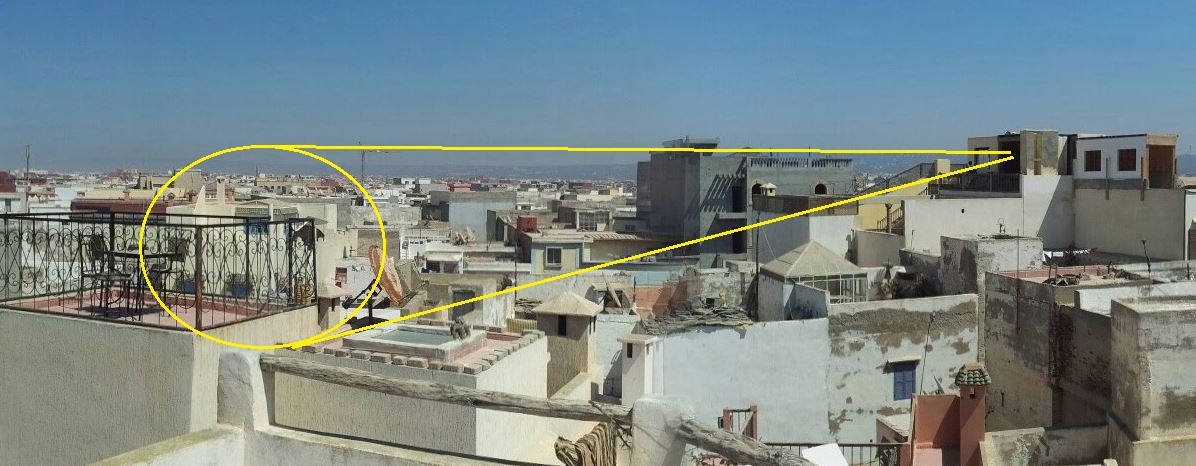
I was pretty confident that it was Morocco as soon as I saw the picture, but were it not for the long building close to the shore, I doubt I would have been able to pinpoint the town. This one is from Essaouira, Morocco, looking NNW toward the ocean. A rooftop panorama shows the unique building in the picture and where I think it was taken, which looks like it was under construction at the time:

ess_rooftop

I think it was taken from the Riad Chbanate hotel, from the Chbanate Superior Suite on the 4th floor – the website confirms that this suite was recently opened. The hotel is at 179 Rue Chbanate, 44000 Essaouira, Morocco. In the website’s photos of the suite and some traveler photos you can find the same view.
The tie-breaker goes to the reader who has participated in the most contests by far:

The photograph was taken from the Chbanate Suite at the Riad Chbanate, likely from the doors leading on to the porch. I was given a hint by a previous contest winner as to the city. His guess was off, but I found the rectangular building and worked back from there. Google Maps didn’t show much other than the Cinema Rif, which has a photograph online. And guess what? It’s visible in the window view, curved roof and all. (Finding old cinemas in the States on Google Maps by looking for curved roofs is an old pastime of mine; that site is very informative and shockingly poorly-designed.) Anyway, the nearest hotel to there is the Riad Chbanate (corner of Rue Chbanat and Rue Moulay Ismael), and the view from the Chbanate Suite (or perhaps the rooftop terrace, although it seems to lack windows) shows the same view as the VFYW submission, so going on the “these are usually taken from hotels” corollary, that’s where it is. (Also, this photo. And people seem to speak highly of the hotel on TripAdvisor.) Looks like a nice place to stay!

From the submitter:

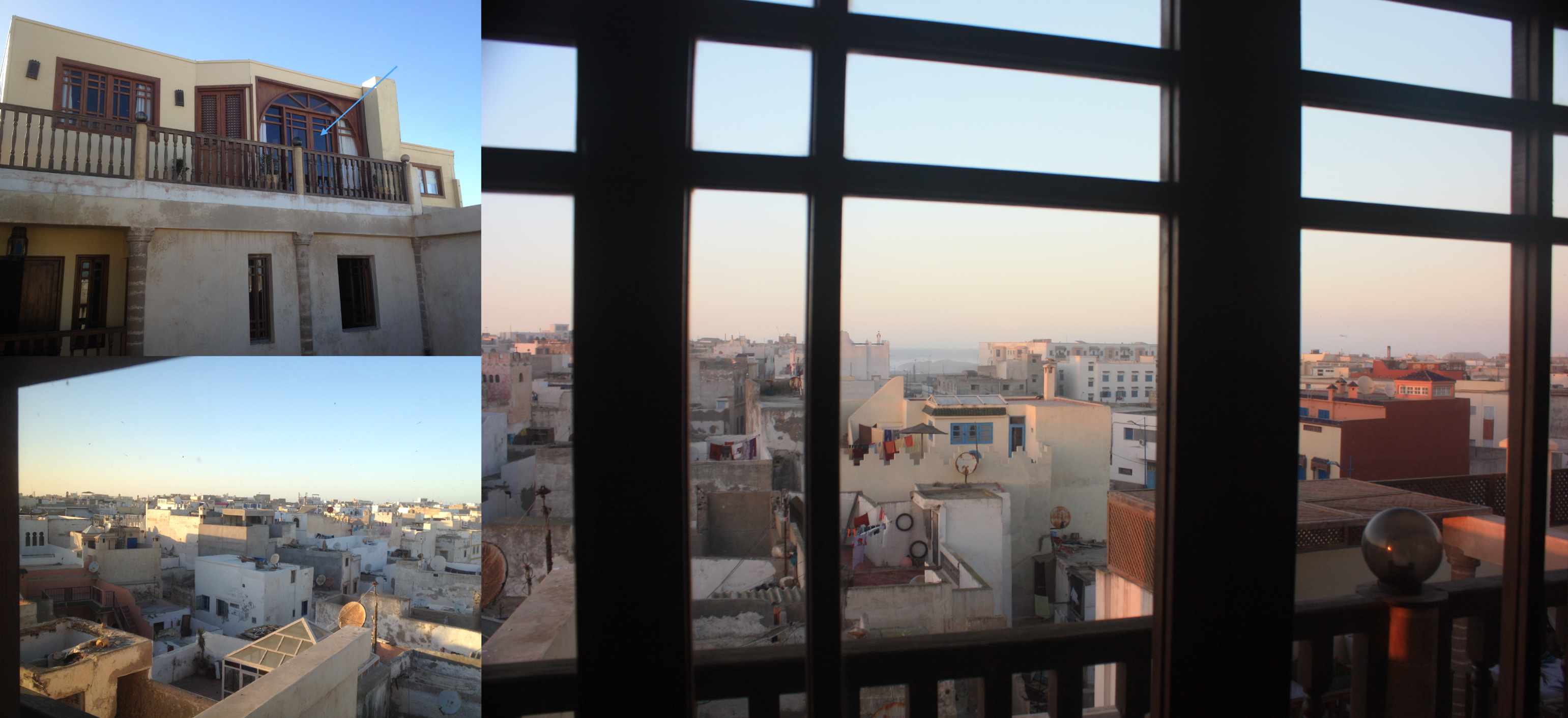
Essaouira-window

Morocco is a tough country for VFYW since most of the traditional buildings have windows looking out into internal courtyards and not into the streets, so there won’t be so many images of the right window. These photos were all taken a week ago from the same window in a room at the top of a small riad hotel in the coastal city of Essaouira. The hotel is called Riad Chbanate, has only 8 suites and is located just inside the fortified walls of the medina. The suite we had was a recent addition built on the roof and so very light with great views over the city skyline. The correct window: Chbanate Suite, 4th floor (5th US) of Riad Chbanate, 179 Rue Chbanate, Essaouira, Morocco.

Essaouira is only a couple of hours west of Marrakech and is a more laid back, welcoming place. Good for seafood, windsurfing and a mild climate.
(Archive)
Reality Check

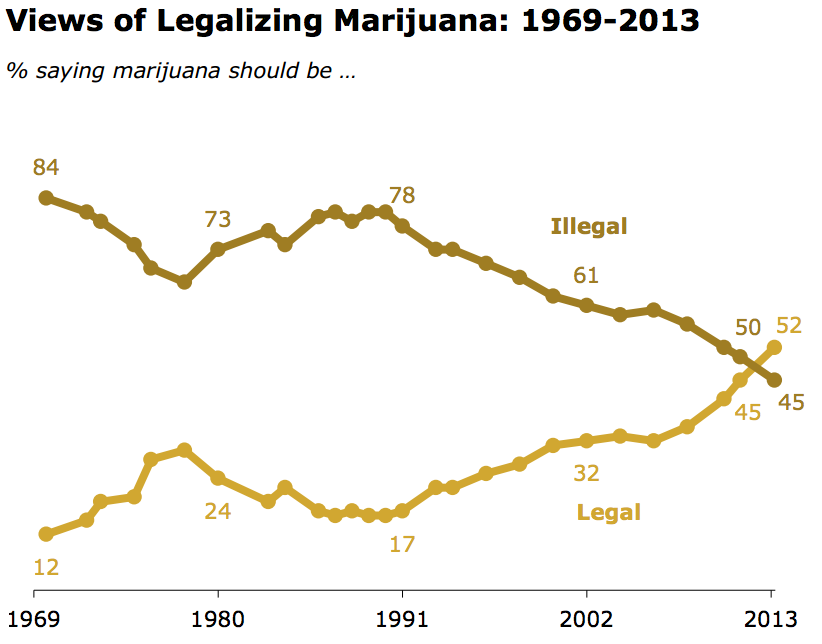
Pew Marijuana

Who says we live in a polity in which empiricism and common sense are always outweighed by ideology and culture war? Here’s CNN’s latest polling on pot, which closely shadows Gallup’s and Pew’s (see above):

Fifty-five percent of those surveyed thought using pot should be legal, according to a CNN/ORC International poll released Monday night, compared with 44 percent who said it should not be. Among those aged 18 to 34, support was 67 percent to 32 percent, and for those 35 to 49 years old, it was 64 percent to 34 percent.

More details:

The biggest change indicated by the poll reflected the number of people who said smoking pot is morally wrong. In 1987, 70% said it was, making it a sin in the minds of more Americans than abortion or pornography. Now, that number has been halved – just 35% today said smoking marijuana is morally wrong.

My own view is that this is because more people have had experience with pot-smoking, have looked at the actual data and science behind it, know the enormous medical possibilities of the plant, and can’t quite muster up the (racially tinged) hysteria that kept it illegal in the first place. Plus: loads of people have at least tried it, and they haven’t become raving lunatics, as some of the more zealous Prohibitionists would have you believe. Allahpundit ponders the massive age gap:

It boils down, I think, to experimentation.

Fifty-two percent overall told CNN that they’d tried marijuana in the past. Even among the 50-64 age group, 56 percent copped to having tried it. Among seniors, just 21 percent did. That’s not surprising but it is revealing. The taboo against weed was much stronger before the 1960s, when seniors came of age. They didn’t try it, they accepted that it was banned for a good reason, and those opinions stuck. For just that reason, I’d be curious to see an even deeper subsample showing the split on this issue between younger and older Republicans specifically. GOP voters remain opposed to weed on balance but I suspect that’s more a function of the party skewing older than some firm ideological principle that Republicans of every age adhere to. In fact, when asked whether smoking weed is morally wrong, Republicans now split at a razor-thin 50/49. Given that seniors tilt heavily towards the “immoral” view, it can only mean that younger Republicans disagree.

If I were advising Republicans professionally (currently I do it out of the goodness of my heart), I’d tell them to embrace marriage equality and the end of marijuana prohibition. There are respectable conservative arguments for both (hey, Buckley was for the latter long before it was cool) – and they’d be the first conservative positions the Millennial generation might actually hear and agree with.

A Sign Of The Times

https://twitter.com/jetpack/status/420135305820131328
We are all perfectly aware of the terrible pressures on the media industry right now. We’ve all but lost the physical thing we used to sell entirely. Advertizers have so many other options. Readers are used to reading for free online (however economically nuts that is for media); and newspapers are in free-fall. Any sane person would expect some radical experiments in getting the whole thing to work again. What I didn’t fully expect was the sheer speed and totality of the editorial surrender to the business side; and the almost rapacious move toward handing over the very fonts and headlines and by-lines to advertizers and p.r. merchants as if there were no real difference between writing to sell something and writing because it’s true and your opinion or product of independent reporting. After all those speeches and papers and conferences and J-School lectures, the media jumped immediately into an area once deemed verboten, and rolled around like Cartman in Kyle’s money.

In a rare exploration of this in mainstream media (which is busy become mainstream p.r.), the Guardian’s Emily Bell takes stock:

This week the New York Times unveils a new website design. Part of it will be a new native advertising push, with posts clearly labelled “paid post” and bearing a blue line of demarcation. In a detailed memo timed perfectly to coincide with the holiday break, its publisher, Arthur Sulzberger Jr, told staff that the new native advertising platform for the organisation would be digital and very clearly marked. It followed an announcement a month earlier by Time Inc., that the magazine publisher would dramatically increase the amount of native advertising it carries. The question that the FTC is concerned with is that of transparency in the mind of the consumer. Is it clear where funding for programmes and articles is coming from?

Separating the church of editorial from the state of advertising is more difficult in digital media; everything is necessarily melded together more closely, and the context or “furniture”, which is hard to miss in a newspaper or during a broadcast, is stripped away as files zip round the web. The anxiety over transparency is understandable, particularly when it comes to vulnerable markets and toxic products, like loan companies, insurance schemes, lobbying and gambling products.

Two question marks hang over native advertising, which will become more significant this year.

For the producers it is the longevity of the trend. At the moment the curve of enthusiasm for the approach, and ignorance about its benefits or impact, are both at a high, which is the point at which companies make money. This is unlikely to last.

For the consumer it is the issue of transparency. It is easy to become very exercised by the potential of native advertising for good and ill. It is arguably a relatively benign part of a much more embedded trend.

Every person and institution can now make their own messages and potentially have as much impact as the largest corporation. The occlusion of motive is becoming more problematic in many areas of communication, but at least in native advertising there is an identifiable commercial transaction. When CBS’s primetime current affairs show 60 Minutes recently ran an exclusive interview with Amazon boss and new newspaper owner Jeff Bezos, it pitched him no hard questions and allowed him to demonstrate his potty scheme for deliveries by drone. This was not advertising, but nor was it really journalism; the access the programme gained reduced its appetite for inquiry and analysis. Advertising is everywhere, as fluid and malleable as the streams it inhabits. And increasingly there will be no lines, blurred, blue or otherwise.

The NYT public editor is already sensing the blurred lines. From her assessment of a NYT advertizer using a manipulated A.O. Scott tweet without his permission:

This is not native advertising. However, on the very week that native advertising is scheduled to begin in The Times, this episode does give one pause about keeping the lines between editorial content and advertising perfectly clear and well-defined.

A reader chimes in:

Perhaps this would be of interest in light of the Dish’s recent interest in “native advertising”: In David Foster Wallace’s famous 1994 essay in Harper’s, “Shipping Out” (later re-titled A Supposedly Fun Thing I’ll Never Do Again in the book of the same name), the author wrote about the pernicious effect of advertising posing as art – not for its threat to journalistic ethics, but for the psychological effect it has on those exposed to it. In the brochure for the luxury cruise on which he is about to embark, Wallace found an experiential essay written by the late author and former director of the Iowa Writer’s Workshop, Frank Conroy:

Conroy’s “essay” appears as an inset, on skinnier pages and with different margins than the rest of the brochure, creating the impression that it has been excerpted from some large and objective thing Conroy wrote.  But it hasn’t been. The truth is that Celebrity Cruises paid Frank Conroy up-front to write it, even though nowhere in or around the essay is there anything acknowledging that it’s a paid endorsement, not even one of the little “So-and-so has been compensated for his services” that flashes at your TV screen’s lower right during celebrity-hosted infomercials.

And below Wallace expounds the real dangers of this “essaymercial”:

In the case of Frank Conroy’s “essay,” Celebrity Cruises is trying to position an ad in such a way that we come to it with the lowered guard and leading chin we reserve for coming to an essay, for something that is art (or that is at least trying to be art). An ad that pretends to be art is—at absolute best—like somebody who smiles at you only because he wants something from you. This is dishonest, but what’s insidious is the cumulative effect that such dishonesty has on us: since it offers a perfect simulacrum of goodwill without goodwill’s real substance, it messes with our heads and eventually starts upping our defenses even in cases of genuine smiles and real art and true goodwill. It makes us feel confused and lonely and impotent and angry and scared. It causes despair.

No Flying Cars Yet, Ctd

Isaac Asimov’s predictions from 50 years ago have gone viral. Brian Merchant pushes back on them:

Taken as a whole, Asimov’s vision for 2014 is wildly off. It’s just that ’Genius predicted the future 50 years ago’ makes for a great article hook. Asimov does hit a couple of his predictions pretty close to home: He ballparked the world population (6.5 billion); he anticipated automated cars (“vehicles with ‘robot brains’”); and he seems to have described the current smartphone/tablet craze (“sight-sound” telephones that “can be used not only to see the people you call but also for studying documents and photographs and reading passages from books.”)

But he also thought we’d have a colony on the moon, be living under a global population control regime, eating at multi-flavored algae bars, and letting machines prepare us personalized meals. Most divergent of all, he believed that increasing automatization of labor would spawn not inequality or joblessness, but spiritual malaise.  … Asimov imagined that humanity would decide to distribute the wealth accrued by the automatons, and the problem wouldn’t be lost capital for workers, but lost meaning. Of course, in reality, it’s both—and therefore a much, much bleaker scenario.

Jerry Coyne points to the Internet as something Asimov didn’t see coming either:

[T]he world is becoming plugged in in a way Asimov simply couldn’t predict. When you walk down the street in an industrialized country, or ride in a plane or train, notice how many people are using their cellphones, iPads, iPods, or computers. Google Glass, the wearable computer, is next. This is the way the whole world will go. (My theory is that eventually the entire Earth will resemble New York City.) Connectivity has brought tremendous advantages: think of the ability to access information at your desk instead of a making a laborious trip to the library. And electronic journals and instant publication have markedly sped up the progress of science. Well, perhaps we won’t be as bored, but we may lose the skills of interpersonal communication.

Asimov made many other predictions. In general I think he did pretty well—certainly better than I would have—but it’s remarkable how many other people got stuff wrong, usually predicting a more technologically advanced or ideologically repressive society than we have now. Remember Nineteen Eighty Four (written in 1949), or The Jetsons cartoon series, which supposedly took place in 2062?

Better Wages Can Trickle Up

Adam Davidson argues (NYT) that better paid, better treated employees reap more benefits for their employers:

The success of Costco, Trader Joe’s, QuikTrip and Mercadona, Spain’s biggest supermarket chain, indicate, [business professor Zeynep Ton] argues, that well-paid, knowledgeable workers are not an indulgence often found in luxury boutiques with their high markups. At each of the aforementioned companies, workers are paid more than at their competitors; they are also amply staffed per shift. More employees can ask customers questions about what they want to see more of and what they don’t like, and then they are empowered to change displays or order different stock to appeal to local tastes. (In big chains, these sorts of decisions are typically made in headquarters with little or no line-staff input.) Costco pays its workers about $21 an hour; Walmart is just about $13. Yet Costco’s stock performance has thoroughly walloped Walmart’s for a decade.

Along the same lines, Daniel Gross explains why Henry Ford doubled his employees wages in 1914:

Ford was playing a deeper, longer game. The Ford Motor Company was in the business of building an expensive durable good. The first cars he had built in number, the 1903 Model N, cost about $3,000, and so were accessible only to that era’s one percent. Henry Ford recognized that the automobile would be more successful as a volume business than as a niche product. “I would build a motorcar for the great multitudes,” he proclaimed. Through relentless innovation, vertical integration, and the obsessive development of an assembly line, Ford had already managed to bring the cost of the Model T, the first democratic car, down to about $500. And the company was moving about 250,000 cars a year. But per capita income was only $354 in 1913. The U.S. didn’t have a developed consumer credit industry. People paid for things with the wages they earned and their savings.

So this was Ford’s theory: Companies had an interest in ensuring that their employees could afford the products they produced. Put another way, employers had a role to play in boosting consumption. While paying higher wages than you absolutely needed to might lower profits temporarily, it would lead to a more sustainable business and economy over time. If the motorcar was going to be a mass-produced product for typical Americans, not a plaything for the rich, Ford would strive to pay his workers enough so they could afford the products they worked on all day.

Previous Dish coverage of Walmart’s labor practices here, here, and here.

The Psychos Of Cinema

Vaughan Bell quotes from a recent study that identified the “most accurately depicted psychopaths” in Hollywood films:

Among the most interesting recent and most realistic idiopathic psychopathic characters is Anton Chigurh in the 2007 Coen brothers’ film, No Country for Old Men.

Anton Chigurh is a well-designed prototypical idiopathic / primary psychopath. We lack information concerning his childhood, but there are sufficient arguments and detailed information about his behavior in the film to obtain a diagnosis of active, primary, idiopathic psychopathy, incapacity for love, absence of shame or remorse, lack of psychological insight, inability to learn from past experience, cold-blooded attitude, ruthlessness, total determination, and lack of empathy. …

In terms of a ‘successful psychopath’, Gordon Gekko from Wall Street (1987) is probably one of the most interesting, manipulative, psychopathic fictional characters to date. Manipulative psychopathic characters are increasingly appearing in films and series. … For the past few years, with the world economic crises and some high-profile trials (such as the Bernard Madoff trial), the attention of the clinicians is more focused on ‘successful psychopaths’, also called corporate psychopaths…. Films and series presenting characters such as brokers, dishonest traders, vicious lawyers, and those engaged in corporate espionage are emerging (e.g., Mad Men, The Wire) and are generally related to the global economy and international business. Again, we see a strong parallelism between what happens in our society and what happens in film.

Divorcing Your Family, Ctd

Many readers discuss the wrenching decision to cut off a family member for good:

My mother is a borderline personality. She sees people as either wholly evil or wholly saintly, and her views can switch like lightning. Her rage is terrifying, unpredictable, and targeted, à la Mommie Dearest. After yet another very difficult Thanksgiving, I decided I was going to “divorce” her, since all the years and all the other techniques I had tried hadn’t eliminated the abuse.

The only complication has been her relationship with my siblings; she is the only topic my sisters and I cannot speak frankly about. They not only tolerate but refuse to acknowledge behavior that they would label domestic abuse if our significant others did it. Our mother married a manic-depressive man who also refuses to acknowledge his own disorder and take prescribed treatment. At what point does one decide that the mentally ill do not deserve the position of power they’ve taken for themselves?

Another reader:

Just today I had a conversation with a coworker about this very same issue. We both have sisters who are (or have been) in desperate need of help. In my case, one of my sisters developed some mental health issues that prevented her from being able to maintain a job.

She was never out of control or completely dysfunctional; she just found it impossible to keep a job. As a result, she struggled financially for years. Our parents helped her out for some time, largely because my mother needed to know that her grandchild – my sister’s daughter – always had a roof over her head. When that grandchild turned 18 and moved out, our mother no longer needed to help. We made one last-ditch effort to reach out to my sister as a family and she bit our mother’s head off, blaming all of her troubles on our her.

After our last effort failed, my sister moved out-of-state. The family has had almost nothing to do with her since. I think every once in a while about reaching out to her, to make sure she’s okay, but then I think of what the last 30 years have been like – again, nothing that’s really, really bad, but just bad enough – and I don’t reach out. Why should I open up myself and maybe the rest of the family to all of that again?

Another:

I won’t get too detailed because I doubt you want to read a ridiculously long email, but in short, she forged a document or two, manipulated the family court system – with which she was very familiar, having worked as a sort of social worker in the county courts – and wove a web of lies in an effort to gain primary custody of my 10-year-old sister and to extract maximum financial pain from my disabled father. This was an extremely difficult time, as I was 17, applying for college (as the first in the family to go), and not mature enough to deal with the almost sociopathic way that my own mother just invented memories – both recent and not-so-recent – out of thin air to justify her actions.

Bottom line: you just can’t get over some stuff people do. Especially when they not only do really bad things but never admit to having done anything wrong – and then insist that you are the bad person for not agreeing. In the end, I couldn’t have that sort of poison in my life, so I had to make a choice if I was to ever have healthy relationships and a healthy psyche.

Another:

I was adopted as an infant. The emphasis on blood kin is perplexing to me even now that I have a biological child, because for most of my life family has been other than biological in nature. Perhaps the blood fixation is simply a human prejudice.

That said: Who cares? If someone is dangerous, indifferent or simply too big of a pain in the ass to engage with regularly, why does it make a difference if they are family? You wouldn’t, I would hope, put up with such nonsense from people who weren’t related to you, right?

An Eye On Crime

A new study shows that the “pupil of the eye in a photograph of a face can be mined for hidden information, such as reflected faces of the photographer and bystanders.” What this could mean for law enforcement:

The researchers say that in crimes in which the victims are photographed, such as hostage taking or child sex abuse, reflections in the eyes of the photographic subject could help to identify perpetrators. Images of people retrieved from cameras seized as evidence during criminal investigations could be used to piece together networks of associates or to link individuals to particular locations. By zooming in on high-resolution passport-style photographs, Jenkins and co-researcher Christie Kerr of the School of Psychology, University of Glasgow were able to recover bystander images that could be identified accurately by observers, despite their low resolution.

Megan Garber explains how it’s done:

First, you have to zoom in (really, really zoom in) on images of eyes—since, as Jenkins notes, “a face image that is recovered from a reflection in the subject’s eye is about 30,000 times smaller than the subject’s face.” Then you have to enhance those zoom-ins to isolate the faces—the “bystander images“—that the human subjects’ pupils contain. But even if you do that, the question remains: Are the pupil-mirrored images, given their small size and curvature, even discernible as faces? If the reflection in the eyes is someone other than yourself, can you make out who it is?

To test that, the researchers presented a series of pixellated faces—an average of only 322 pixels each—as part of a face-matching task they administered to subjects. The subjects who were unfamiliar with the bystanders’ faces were able to match the pixellated faces to the standard images of them with 71 percent accuracy; when they were familiar with the faces (if the pixellated face belonged to, say, Barack Obama), they performed with 84 percent accuracy.

(Hat tip: Kottke)

The Racial Injustice Of The Drug War

Marijuana Arrests

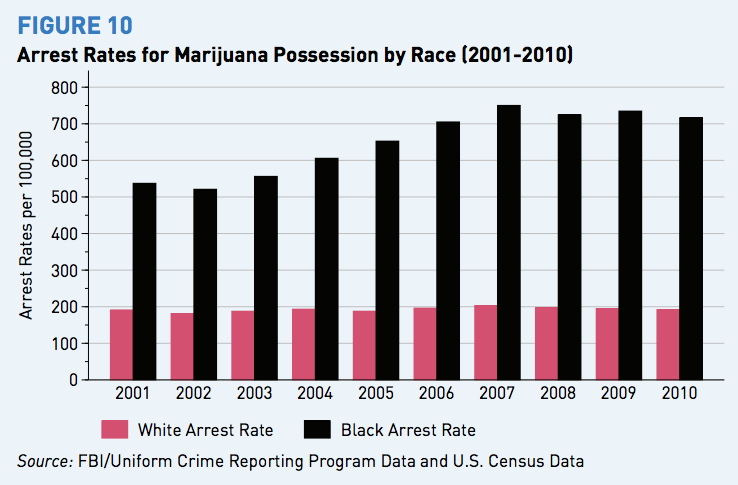
Serwer passes along the above chart on marijuana arrests:

Although marijuana use among blacks and whites is about the same, according to a 2013 report by the ACLU, blacks are almost four times more likely than whites to be arrested for marijuana possession. This startling graph from the report tells the story … As Michelle Alexander notes in her book, The New Jim Crow, the consequences of being convicted of felony marijuana possession can be far more dire than the sentence itself. Former offenders can find themselves deprived of professional or driver’s licenses, educational aid, food stamps, public housing, their right to vote, and they may find themselves fired and unable to find new employment, having been marked by society as little more than a criminal. For blacks caught up in the system it can compound the already considerable effects of ongoing racial discrimination.

Goldblog, in a hilarious and humane column, gets this core issue:

The disparity in arrest rates between white and black pot-users is the most interesting aspect of this debate.

Federal statistics show that in 2010, blacks were almost four times as likely as whites to be arrested on possession charges. For most whites, pot was long ago de facto decriminalized. This double standard is one of the most obvious reasons I know for moving toward comprehensive decriminalization. One might argue that the double standard could be dealt with by enforcing possession laws more stringently in white communities. But good luck with that. In reality, here on Earth, that isn’t going to happen, mainly because whites in power would never allow their children to be exposed to the criminal justice system in that way.

Conor reframes the debate:

There are times when locking human beings in cages is morally defensible. If, for example, a person commits murder, rape, or assault, transgressing against the rights of others, forcibly removing him from society is the most just course of action. In contrast, it is immoral to lock people in cages for possessing or ingesting a plant that is smoked by millions every year with no significant harm done, especially when the vast majority of any harm actually done is born by the smoker.

That there are racial disparities in who is sent to prison on marijuana charges is an added injustice that deserves attention. But if blacks and whites were sent to prison on marijuana charges in equal proportion, jail for marijuana would still be immoral.

I couldn’t agree more. So far, now that the debate has finally crept away from the blogosphere and into the boomer pundit organs, the debate has not been exactly even, has it? The Prohibitionists have got close to nothing in their defense.

The UI Battle

David Freddoso opposes extending unemployment insurance (UI), claiming that North Carolina proves it doesn’t help:

In July, North Carolina became the first state to end extended unemployment benefits altogether. As John Hood notes in the Carolina Journal, the number of employed in the state jumped by 39,000 between July 1 and Nov. 30, after standing still for the entire first half of the year. The state’s unemployment rate had taken more than two years to come down by 1.5 points to where it was in June (8.8 percent). Between July 1 and Nov. 30, it declined by roughly that amount (to 7.4 percent). During that same period, about 26 percent fewer workers were dropping out of the workforce each month than had been previously.

That’s at least enough to conclude that the world didn’t end. It may even suggest an upside to returning benefits to their normal duration. In a market with few good jobs available and long-term unemployment benefits, it was rational for earnest job-seekers to hold out for something better than what was there. But when the issue is forced, some job is better than no job at all. The supposed “new normal” is a permanently less dynamic economy. In that context, extended benefits are just adding months before people have to accept the disappointing, lower-paying jobs that eventually await them anyway. Nobody wants it to be that way — it just is.

Pethokoukis looks at the national numbers and argues for more relief efforts, not fewer:

The Long Emergency that is the US labor market continues, meriting both an extension on emergency benefits and UI reform that would be pro-work such as (a) giving unemployed workers a modest cash bonus when they secure employment; (b) paying jobless benefits monthly so workers who get a job at the beginning of a pay period could take in both unemployment compensation and a paycheck for that month; (c) temporarily reducing or eliminating the capital-gains tax on new business investment; (d) relocation subsidies to the long-term unemployed to finance a good chunk of the costs of moving to a different part of the country with a better labor market; and (e) significantly lowering the minimum wage for the long-term unemployed for at least the first six months after the date they begin work at their new job, and coupling that lower minimum with an expanded Earned Income Tax Credit or with wage subsidies exclusively available to the long-term unemployed.

Ryan Cooper contends that even the best conservative ideas on unemployment aren’t dealing with the real problem:

The basic analytical error here is ignoring the idea of aggregate demand. “Reforms” on labor supply might help some individual people get a job somewhat faster, but they won’t increase the total number of jobs.

If the problem is unemployed people who won’t get off their hind ends to hustle for work (“structural” unemployment), then you would expect to see persistent vacancies and rising wages in some industries due to a skills mismatch between job openings and the unemployed. This is what you find in countries like South Africa which really do have massive structural unemployment. But in the US, we don’t see anything like this.

Employment is down across the board (with a few tiny exceptions, like North Dakota) and job seekers outnumber job openings 3-1There just aren’t enough jobs. This realization: that otherwise well-qualified people who are trying their level best to find work and can’t do it, leads you inexorably to a basically Keynesian view of depressions. The problem is not enough spending, and the solution is more spending. Private, public, doesn’t matter, “You just fling resources in the general vicinity of the problem.” The vast majority of conservatives, needless to say, refuse to believe this, and their supply-side tinkering is just not even close to big enough to make a dent in unemployment even if all their ideas are right.

Sargent wonders whether Republican Senators from high-unemployment states will vote for a new UI extension bill:

The unemployment rate in Illinois (Senator Mark Kirk’s state) is 8.7 percent; in Tennessee (Bob Corker and Lamar Alexander) it’s 8.1 percent; in Arizona (John McCain and Jeff Flake) it’s 7.9 percent; in Georgia (Saxby Chambliss and Johnny Isakson) it’s 7.7 percent; in Ohio (Rob Portman) it’s 7.4 percent; and in Pennsylvania (Pat Toomey) it’s 7.3 percent. In many of those states, tens of thousands of people have already been cut off, according to stats compiled by Ways and Means Dems. [Rhode Island Senator Jack] Reed said many of who have lost benefits are “desperate,” and said he thought other Senators understood this. “Many of them are middle aged, have worked for a long time, and have found that it’s difficult to find jobs,” Reed said. Fellow Senators, he added, “are sensing back home, through editorials and newspaper stories, that these aren’t people who are enjoying collecting $300 or $400 per week. These are people who worked for decades. The reality is not this hypothetical where everybody will get a job.” But there’s still no indication Republicans will vote accordingly.

George Zornick weighs in:

Alas, many of those very senators are already on the record against an extension. Many of those states are deep, deep red—so even though polls show substantial, bipartisan support for extending the emergency unemployment program, and though many local media outlets are aggressively covering the issue, the senators in question have little to fear. There are certainly enough senators remaining who might deliver the needed ‘yes’ votes—say, someone like Republican Mark Kirk in Illinois, which is a blue state with a high level of long-term unemployment. And maybe that will work. But if it doesn’t, there are larger perils for the Republican party—Democrats are reportedly ready to once again embrace economic populism as a campaign message this year, and if Republicans block a meager benefit extension for those hardest hit by the recession, they play into Democratic hands. That should worry all GOP Senators regardless of where they’re from. Voting against a benefit extension may not hurt Senator Jeff Sessions too badly in Alabama, but it may do real damage to his chances of being in the majority at this time next year.

GOP rhetoric on the issue seems to be evolving:

“I’ve always said that I’m not opposed to unemployment insurance, I am opposed to having it without paying for it,” Sen. Rand Paul (R-Ky.) said Sunday on ABC. Rep. Peter King (R-N.Y.) likewise said Sunday on CBS that he could back an extension if Democrats agreed to vague compromises like easing “burdensome regulations.” And Boehner, too, has said he would be open to an extension with some conditions.

Democrats, meanwhile, are going on the offensive to keep the issue in the spotlight and put pressure on Republicans. Framing the debate as being between one party favoring benefits for the needy, and the other party opposing those same benefits, they think, is a winning campaign argument. Decrying a do-nothing GOP caucus at the same time would only be an added bonus. Then again, Republican calls for compromise could be little more than pre-election posturing. Blocking unemployment benefits out of hand probably won’t sit well with voters. But by blocking those benefits while claiming to back said benefits if paired with compromises, Republicans could deflect some of the blame from themselves, passing it along instead to everyone’s favorite scapegoat: Dysfunctional Washington.