Meanwhile, In Iraq…

Al-Qaeda militants have taken over the Anbar province cities of Fallujah and Ramadi, prompting a campaign by the military to win them back. Ariel Zirulnick explains how the group’s resurgence is linked to the Syrian civil war:

Anbar is overwhelmingly Sunni Arab and the toppling of Saddam Hussein began a process in which their community has felt more and more politically and economically marginalized relative to the country’s majority Shiite Arab community. While that process of disenfranchisement paused briefly towards the end of the US occupation of the country, when a US military strategy of outreach to Sunni Arab tribes with promises of jobs and a seat at the political table paid huge dividends, Shiite Prime Minister Nouri al-Maliki has persistently antagonized Sunni Arab politicians and citizens alike since the US military’s departure at the end of 2011.

Many of the Sunni Arabs of Anbar now view Maliki much as they did Iraq’s interim American rulers and with a civil war in Syria raging next door, the local Al Qaeda franchise is finding the wind at its back once more. The Islamic State in Iraq, which incorporated many Syrian jihadi fighters during the battle against US forces, formally merged with Al Qaeda supporters in Syria last year to form the Islamic State of Iraq and the Levant (ISIL, also commonly referred to as ISIS) which has become one of the most powerful groups fighting against the Syrian regime. The cross-border movement is far from supported by all in Anbar – its heavy-handed treatment of citizens of towns it controls and contempt for the local culture, tradition and tribal notables saw to that – but the number of people willing to join up, and almost as importantly willing to turn a blind eye rather than informing the authorities about militant movements, has swelled.

Frud Bezhan looks at how the crisis unfolded and what it might portend:

According to Kamran Karadaghi, a London-based Iraqi political commentator and former chief of staff to Iraqi President Jalal Talabani, much of the current fighting is a result of the longstanding political crisis in Iraq. ‘The political establishment has failed to reconcile with the Sunnis,’ he says. ‘The Sunnis are almost completely sidelined. The Sunni provinces of Iraq, especially Anbar, were once staunch opponents of federalism but now they want federalism for themselves. That shows you to what extent they’re dissatisfied.’ Tensions spiked in Anbar after Sunni lawmaker Ahmed al-Alwani was arrested in Ramadi on December 28, reportedly on terrorism charges. Days later, on December 30, Iraqi security forces broke up a yearlong sit-in being staged by Sunni protesters who complained of being marginalized by the Shi’ite-led authorities and unfairly targeted by security forces. The crackdown triggered clashes between the military and local tribesmen. The dismantling of the Sunni protest camp also prompted 44 lawmakers, many of them Sunnis, to submit their resignations. Protests against the government first broke out in Sunni areas of western and central Iraq in late 2012 and have continued for more than a year.

The ongoing fighting could have significant implications. Domestically, the violence will deepen tensions between the government and minority Sunnis. Karadaghi believes this could bring Iraq to the brink of civil war and lead to the country’s disintegration along sectarian lines. ‘The violence will only deepen the crisis in Iraq,’ he says. ‘Without a real and genuine reconciliation and political solution, the situation will escalate and become worse and worse. It might turn into a real Sunni-Shi’ite confrontation.’

Looking at these and other recent events, Daniel Byman pronounces 2013 “the year we lost Iraq”:

Al Qaeda in Iraq (AQI) has seemingly returned from the dead. On the verge of strategic defeat as U.S. forces departed Iraq, AQI has since regrouped into a large and growing force, contributing to the surge in violence in Iraq and the broader region. Although the neighboring conflict in Syria partially drives AQI’s resurgence, the causes of the group’s comeback are much deeper. Domestically, the weakness of the Iraqi state – and thus the ability of small, violent groups to operate with considerable freedom – has been a persistent problem since the fall of Saddam’s regime. Politically, the government of Iraqi Prime Minister Nuri al-Maliki made progress in restoring faith in Iraq’s institutions and establishing order in 2008-2009. However, in recent years he has focused on consolidating power and, in so doing, has alienated Iraq’s Sunni Muslim community. Iraqi security services are now more brutal, more political, and less skilled than they were when U.S. forces departed Iraq in 2011. As the Sunnis became marginalized, AQI’s popularity again grew.  Iraq’s neighbors contribute to the problem, sending money and volunteers directly to AQI or indirectly to the organization to support its role in the Syrian conflict. As the violence spreads, it has taken on its own dynamic. Iraqis trust the security services less, and more Sunnis support AQI for revenge or because of a perceived need for self-defense from the Shi’a-dominated security services or associated militias. This in turn leads the regime and the Shi’a community to view the Sunnis with even more suspicion and in their eyes justifies greater regime repression. Unfortunately, none of these problems are abating, and several are getting worse. So AQI’s power is likely to grow.

(Video: Raw footage of fighting in Anbar province from the Associated Press.)
Conservatives For Government

In the new issue of National Affairs, Michael Gerson and Peter Wehner re-establish government as a conservative value:

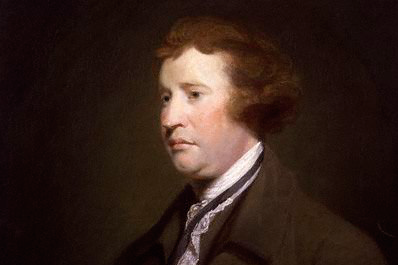
It speaks well of conservatives that they want to be thought of as the defenders of the Constitution. But at a minimum, “constitutional conservatives” should recognize what both the federalist founders and Lincoln actually envisioned for the republic edmundburke1771-sdthey created and preserved. They were, on the whole, rigorous, empirical, modern thinkers, as well as sober and skeptical heirs of the Enlightenment, who believed they were fortunate to inhabit an age of progress. Far from being constrained by the prevailing physical, political, or economic arrangements of America in 1787, the founders fully expected America to spread across a continent, undergo economic and social change, and emerge as a global actor. And they purposely designed a constitutional system that could accommodate such ambitions.

Of course, this does not answer the question of how big the federal government should be, or what precisely it should and should not do. But it does warn against short-circuiting that discussion with overly simplistic and legalistic appeals to the Constitution as a purely limiting document. Our debates about what government ought to do must be debates about what we take our constitutional order to be and what we think are appropriate national goals. Such questions should be addressed through the political process established by the Constitution; we cannot expect them all to be settled in detail simply through direct interpretation of the Constitution’s text.

What I disliked about the essay was its caricature of Obama’s moderate centrism as over-reaching statist liberalism – but I can see nonetheless why this is a potent rhetorical point to entice some of the more doctrinaire libertarians to take notice. What I liked was its understanding that a conservative movement that sees government – all government – as the enemy is nether conservative nor viable as a vehicle for governance. Coming from a British Tory tradition, of course, my libertarian instincts have always been complemented by a deep belief that government is good, as long as it is not over-stretched, over-spent and devoted to utopian schemes as opposed to pragmatic responses to contingent social, political and economic problems. And these problems will necessarily change from decade to decade, century to century. The trouble with current rigid Republican ideology is that is cannot adjust to this reality. It is an avoidance of thought with respect to grappling with social change in order to sustain a coherent society and polity.

I also requires balance and moderation – two dirty words on the American right. This was a great, Burkean passage:

The proper measure of action is prudence. If Prohibition was a disaster in one direction, so, in the other direction, would be the licensing of methamphetamines and heroin for sale at every convenience store. Responsible, self-governing citizens do not grow wild like blackberries, which is why a conservative political philosophy cannot be reduced to untrammeled libertarianism. Citizens are cultivated by institutions: families, religious communities, neighborhoods, and nations.

And those nations also have histories which affect our current way of life. To deny the legacy of slavery and segregation, for example, simply because they no longer exist, is a terribly unconservative thing to believe. It treats a country’s development as an Etch-A-Sketch.

Conservative government, in other words, should be as strong as it is limited, as pragmatic as it is cautious, as empirical as it is open to a broader conversation with liberals and everyone else. It’s great to see this fundamental truth reasserted by Pete Wehner and Michael Gerson. I just hope someone within the conservative movement will listen. My hopes, sadly, are not very high.

Is Emotional Intelligence A Business Asset?

Not always:

Recently, psychologists Dana Joseph of the University of Central Florida and Daniel Newman of the University of Illinois comprehensively analyzed every study that has ever examined the link between emotional intelligence and job performance. Across hundreds of studies of thousands of employees in 191 different jobs, emotional intelligence wasn’t consistently linked with better performance. In jobs that required extensive attention to emotions, higher emotional intelligence translated into better performance. Salespeople, real-estate agents, call-center representatives, and counselors all excelled at their jobs when they knew how to read and regulate emotions—they were able to deal more effectively with stressful situations and provide service with a smile.

However, in jobs that involved fewer emotional demands, the results reversed.

The more emotionally intelligent employees were, the lower their job performance. For mechanics, scientists, and accountants, emotional intelligence was a liability rather than an asset. Although more research is needed to unpack these results, one promising explanation is that these employees were paying attention to emotions when they should have been focusing on their tasks. If your job is to analyze data or repair cars, it can be quite distracting to read the facial expressions, vocal tones, and body languages of the people around you. In suggesting that emotional intelligence is critical in the workplace, perhaps we’ve put the cart before the horse.

Mapping Our Emotions

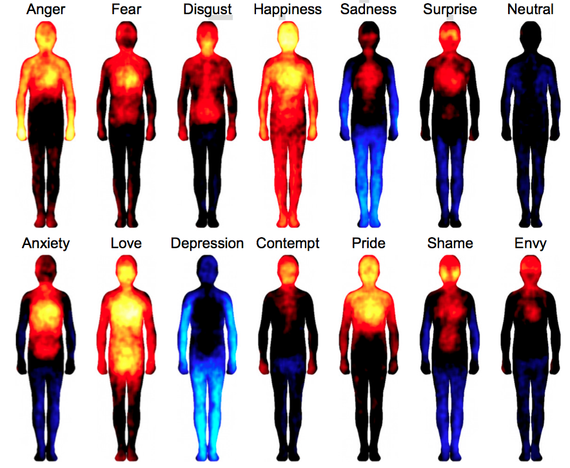
dish_emotionmap

A new set of experiments asked participants to read short stories or watch movies and then “color in the areas of their body where sensations became stronger (the red and yellow) or weaker (blue and black) when they felt a certain way”:

The mapping exercise produced what you might expect: an angry hot-head, a happy person lighting up all the way through their fingers and toes, a depressed figurine that was literally blue (meaning they felt little sensation in their limbs). Almost all of the emotions generated changes in the head area, suggesting smiling, frowning, or skin temperature changes, while feelings like joy and anger saw upticks in the limbs—perhaps because you’re ready to hug, or punch, your interlocutor. Meanwhile, “sensations in the digestive system and around the throat region were mainly found in disgust,” the authors wrote. It’s worth noting that the bodily sensations weren’t blood flow, heat, or anything else that could be measured objectively—they were based solely on physical twinges subjects said they experienced. The correlations between the subjects’ different body maps were strong—above .71 for each of the different stimuli (words, stories, and movies). Speakers of Taiwanese, Finnish, and Swedish drew similar body maps, suggesting that the sensations are not limited to a given language.

So what are we seeing in these illustrations? The authors note that, measured physiologically, most feelings only cause a minor change in heart rate or skin temperature—our torsos don’t literally get hot with surprise. Instead, the results likely reveal subjective perceptions about the impact of our mental states on the body, a combination of muscle and visceral reactions and nervous system responses that we can’t easily differentiate. Feeling jealous may not truly make us red in the face, for example, but we certainly might feel like it does.

“The First Great Account Of The Digital Age”

That’s how James Santel describes Saul Bellow’s Humboldt’s Gift, a novel published in 1975:

[Narrator Charlie Citrine’s] insights into 1970s America feel especially calibrated to our hyperconnected world: he understands both the wages of overstimulation (“I knew that it took too much to gratify me. The gratification-threshold of my soul had risen too high”) and the paradox of endless information (“I knew everything I was supposed to know and nothing I really needed to know”). Moreover, he recognizes, and is preoccupied by, the difference between activity and meaningful work: “Sloth is really a busy condition, hyperactive,” he meditates. “This activity drives off the wonderful rest or balance without which there can be no poetry or art or thought—none of the highest human functions. These slothful sinners are not able to acquiesce in their own being, as some philosophers say. They labor because rest terrifies them.”

And from what does all this distract us?

Humboldt’s Gift makes it clear that it’s the ultimate question of mortality: the novel ends with Humboldt’s reinterment in a proper cemetery after a long exile in a potter’s field, and Bellow renders Charlie’s graveside thoughts with muted poignancy. Humboldt, he reflects, “had opened his mouth and uttered some delightful verses. But then his heart failed him. Ah, Humboldt, how sorry I am. Humboldt, Humboldt—and this is what becomes of us.”

Looking Back At A Self-Help Legacy

Ann Friedman reviews Stephen Watts’s Self-Help Messiah: Dale Carnegie and Success in Modern America, which investigates the man who gave us How to Win Friends and Influence People, the perennial bestseller first published in 1936. Carnegie’s main strategy for getting ahead? He argued that once you realized “people are mainly self-interested … by playing to those interests with unwavering enthusiasm, success [is] a given”:

Instead of judging people for what they want, Carnegie suggested, we should try to understand their cravings and cater to them. This line of thought, perhaps, explains such modern capitalist horrors as the Doritos Locos Tacos at Taco Bell—but it was clearly in harmony with the emergence of a mass consumer economy. In the early twentieth century, “a new ethos emerged that was preoccupied with personality development, personal happiness, interpersonal relations, and self-fulfillment,” Watts writes, describing it as “a form of individualism less concerned with religious salvation or overt economic profit than with emotional well-being.” Whereas Carnegie’s bootstrappy, individualist sensibility could be seen as libertarian, he was in fact decidedly apolitical—almost in the manner of a “Hey, I’m just doing me” Silicon Valley bro who can’t see the larger implications of his worldview.

Reviewing Watts’s book in November, Maureen Corrigan elaborated on the cultural shifts Carnegie’s work heralded:

Carnegie’s emphasis on projecting a sunny personality was part of a larger shift away from a Victorian concern with character and self-denial to a modern fascination with advertising, consumerism and self-promotion. Carnegie’s teaching promised to pay off in self-fulfillment and fat wallets. … Watts shows how particularly attuned Carnegie was to the psychological needs of Americans beaten down by the Great Depression, who needed to hear that positive thinking would garner positive results. It’s easy, of course, for we contemporary readers to dismiss Carnegie’s teaching as mere boosterism and Babbittry, but his self-help legacy has endured well beyond his own death in 1955, and flourishes in our own age.

The Economist released a new video interview with Watts here.

Time For A TED Take-Down?

In the above TED talk, Benjamin Bratton questions the utility of the format itself. “TED of course stands for Technology, Entertainment, Design,” he says, adding, “I think TED actually stands for: middlebrow megachurch infotainment.” He calls for “more Copernicus, less Tony Robbins”:

Let me tell you a story. I was at a presentation that a friend, an astrophysicist, gave to a potential donor. I thought the presentation was lucid and compelling…. After the talk the sponsor said to him, “you know what, I’m gonna pass because I just don’t feel inspired … you should be more like Malcolm Gladwell.”

At this point I kind of lost it. Can you imagine? Think about it: an actual scientist who produces actual knowledge should be more like a journalist who recycles fake insights! This is beyond popularisation. This is taking something with value and substance and coring it out so that it can be swallowed without chewing. This is not the solution to our most frightening problems – rather this is one of our most frightening problems.

Heebie-Jeebie is unsympathetic, exclaiming, “TED talks are entertainment! The end.” Paul Fidalgo strikes a middle ground:

I suppose … there is a kind of “churchiness” about [TED talks], a gee-whiz awe-inducement about the Great Beyond which may or may not actually exist or come to pass. … In a way, it’s not entirely fair to TED-talkers. For one, they host plenty of talks grounded fully in reality and hard science. Other times, they host talks that genuinely spark new ways of looking at complex problems, or draw connections that deserve attention. But I suppose the point is that it’s hard to know which is which, and especially to the secular layperson, to decide requires a little too much faith.

Chad Orzel remains skeptical of TED naysayers, writing, “Sometimes, stuff that looks like speculative inspirational piffle in the moment turns out to be foundational for a whole new field.” He cites Richard Feynman’s 1959 speech “There’s Plenty of Room at the Bottom” to illustrate his point:

What’s amusing about this is that Feynman’s famous speech is, essentially, a TED talk. Okay, he does a few more order-of-magnitude calculations than you would expect from a typical TED speaker, and it’s way too long for TED, but in spirit, it’s pretty much exactly the sort of thing TED promotes and Bratton is inveighing against. It’s pure gee-whiz techno-optimism– Feynman himself says “What would be the utility of such machines? Who knows?”– with only hazy ideas about what this would accomplish, or how you would do it. The few suggestions he makes about concrete ways to proceed are mostly wrong, or at least bear very little resemblance to what people actually doing nanotechnology research do these days.

And for a very long time, none of the stuff Feynman talks about went anywhere. You could easily argue that we still haven’t done most of it. If you’d pointed to this talk in, say, 1979 and said it would be one of Feynman’s most enduring legacies, most physicists would’ve said you were crazy. It had basically zero practical impact for decades, but now is trotted out as an example of the prescience of genius, and an inspiration for all sorts of amazing new science.

Meanwhile, Keith Humphreys points to this Onion parody as “the ultimate takedown of the format.”

Bigotry In Britain

Dan Shewan finds the 2006 film This Is England, which depicts young skinheads in the early ’80s, an especially resonant portrayal of racism in his home country:

The bleak, fractured Britain depicted in Shane Meadows’ 2006 film This Is England is not unlike the one in which I grew up. We moved around a lot when I was young, but eventually settled in a depressing coastal town not entirely dissimilar to the one in which Shaun, the movie’s protagonist, lives. Meadows’ semi-autobiographical film reveals to us a glimpse of a Britain divided by racism — a nation where intolerance masquerades as pride, and one in which young minds are molded by fear. Growing up in a working class town, racial slurs such as “Paki” and “wog” were inextricably interwoven into the vernacular of the public schoolyards in which I played. Some children used them cruelly. Others simply didn’t know any better.

Although racism in Britain can be traced back to the slave trade, the legacy of hatred portrayed in This Is England is enduring.

A recent survey by market research firm OnePoll revealed that one in three Britons admitted to making racist remarks on a regular basis, or engaging in conversations that could be considered racist. More than one in ten people confessed to having been called a racist by someone close to them. Lastly, around forty percent of Britons polled had prefaced a comment with the classic refrain of “I’m not racist, but…” at some point or another. Perhaps most disconcerting is the fact that many of the two thousand adults surveyed by OnePoll claimed their feelings of racial prejudice had been passed down to them by older members of their family. In terms of demographics, individuals over the age of fifty-five were found to be the least racially tolerant, but young people aged between eighteen and twenty-four were close behind.

There’s a huge amount of tolerance in Britain, but it shouldn’t be mistaken for an absence of intolerance. And in this, as in many other things, London is not the same as England. Still, I’m shocked by the data on the youngest generation. It suggests a deep lack of real integration beyond the prosperous metropolis.

What If Christians “Won” The Culture War?

James Chastek, a Catholic writer, fears what it might look like:

Christians occasionally daydream about winning the culture over for Christ. But this would mean that belief in Christ would be policed and encouraged in the same way that our current cultural beliefs are: by manipulation of the levers of power to control spoils, intimidate dissent, and coin new taboo words and thoughtcrimes that can immediately condemn without argument and persuade without reason. Any teacher is impressed by the degree to which cultural doctrines are thoroughly and universally believed and flawlessly applied in all particular situations; and they are not merely mouthed by children who, though really skeptical of what they are saying, mouth the words anyway. They really believe all that stuff – they even see it as self-evident.  Is that how I want someone to believe in Christ? Would I feel better if I could just silence dissent with a taboo word or the confidence that the thoughtcriminal would lose his job?

Dreher extends the thought experiment to more than just Christians, adding that “you don’t have to be any sort of religious believer to be a self-righteous prick”:

A useful thing for all of us to think about, no matter where we are in the culture war: What would victory look like? How would we treat the defeated? Would we impose a Versailles-style peace, thus setting the stage for a terrible backlash and resumption of the war? And, what would victory — the achievement of cultural hegemony and commanding power over the defeated — do to us? Would we become that which we hate?

As I write this, I’m thinking about a secular liberal I used to know. We weren’t friends, but we moved in the same circles. He was a smart guy and a paragon of crusading righteousness. You couldn’t joke with him about anything; he was always looking for signs of deviation. He was the sort of person who, if ever he gained power, would be ruthless with his enemies. This sort of person recurs through history, in all guises…

[H]e really was, and is, someone to be feared. People like that always are. They tend to be effective culture warriors, because they are tireless and uncompromising. Their moral ardor is not compromised by a sense of tragedy, of their own fallibility, of basic humanity, or even something as trivial as a sense of humor. I’ve been around people on the conservative side of the culture war who are like that; in those instances, I would rather be having a drink at a gay bar. I’m serious about that.

The Dharma Of Proust?

Pico Iyer argues that Proust was an “accidental Buddhist,” quoting from Within a Budding Grove to illustrate his point:

“We do not receive wisdom,” [the painter] Elstir tells the narrator (who has just realized that “this man of genius, this sage” is a “foolish, corrupt little painter” in another context), “we must discover it for ourselves, after a journey through the wilderness which no one else can make for us, which no one can spare us.” Could the Buddha, enjoining his disciples to “Be a lamp unto yourselves,” have phrased it any better? Or: “If there were no such thing as habit, life might appear delightful to those of us who are constantly under the threat of death—that is to say, to all mankind.” I can’t think of a clearer formulation of the Western Buddhist’s teachings that habit is how we keep ourselves away from truth, imprisoned in our heads and not the world.

Iyer continues:

Proust’s genius, like that of his compatriot [Henri] Cartier-Bresson (who called himself “an accidental Buddhist”), is to register every detail of the surface and yet never get caught up in the superficial.

Here is the rare master who saw that surface was merely the way depth often expressed itself, the trifle in which truth was hidden thanks to mischievous circumstance (or, others would say, the logic of the universe). It takes stamina, bloody-mindedness, concentration, and a fanatic’s devotion to stare the mind down and see how rarely it sees the present, for all the alternative realities it can conjure out of memory or hope. Proust had the sense to belabor us with little theology, academic philosophy or overt epistemology; yet nearly every sentence in his epic work takes us into the complications, the false fronts, the self-betrayals of the heart and mind and so becomes what could almost be called an anatomy of the soul. I’m not sure sitting under a tree in Asia 2,500 years ago would have produced anything different.