Eric Schwitzgebel, a philosopher, offers a “semi-technical definition”:
[S]omeone who fails to appropriately respect the individual perspectives of the people around him, treating them as tools or objects to be manipulated, or idiots to be dealt with, rather than as moral and epistemic peers with a variety of potentially valuable perspectives.
Perhaps the jerk’s greatest moral failing? A lack of mercy:
Mercy is, I think, near the heart of practical, lived morality. Virtually everything everyone does falls short of perfection. Her turn of phrase is less than perfect, she arrives a bit late, her clothes are tacky, her gesture irritable, her choice somewhat selfish, her coffee less than frugal, her melody trite — one can create quite a list! Practical mercy involves letting these quibbles pass forgiven or even better entirely unnoticed, even if a complaint, were it made, would be just. The jerk appreciates neither the other’s difficulties in attaining all the perfections he himself (imagines he) has nor the possibility that some portion of what he regards as flawed is in fact blameless. Hard moralizing principle comes naturally to the jerk, while it is alien to the jerk’s opposite, the sweetheart. The jerk will sometimes give mercy, but if he does, he does so unequally — the flaws and foibles that are forgiven are exactly the ones the jerk recognizes in himself or has other special reasons to be willing to forgive.
Walter Russell Mead describes why he believes in a personal God:
For theists, the universe isn’t just a place with scattered bits of meaning in it. Meaning isn’t decoration or illusion, a subjective human response to hardwired stimuli in our brains or grace notes that accompany us on our meaningless way through the dark void. Existentialists and others who believe that the universe is ultimately meaningless but who still choose to act as if meaning was real are among the moral heroes of the world, but theists think there is more to life than the brave but doomed affirmation of meaningless ideals in the face of an idiot, uncaring universe.
Theists think meaning really means something, that it all adds up. The transcendence that comes to us in life doesn’t just happen in our heads; it points to the nature of ultimate reality. That ultimate reality transcends our ability to comprehend, and we only get scattered glimpses of it here and there, but whatever it is, it is greater than we are.
When theists think about that meaningfulness we experience in peak moments, we find ourselves thinking about its source. Theists believe that the source of meaning and existence hangs together and points to something greater than itself. “Meaning” for theists is like “justice” and “truth”; it is something we don’t completely see or grasp but it is real. And because meaning is the source of such meaningful ideas as justice and beauty, its existence is even more important and more consequential than the existence of these other ideals for which people are willing to die. Theists are people for whom this concept of the meaning of life is so powerful, so present, so active that they find that it can’t be talked about except as a supreme force of transcendence and world shaping power, the truth behind all truths. Something this beautiful, this lively, this intelligent, this powerful, this transcendent, theists believe, cannot be less than alive and self aware. It is not a Thing, but a Person.
As part of a Commonweal symposium on Terrence Malick’s2011 film, The Tree of Life, Karen Kilby argues that “theological issues around loss and death in particular are right at the heart of the film”:
How can the suffering of the innocent, the sudden, pointless loss of life, be reconciled with the love of God? The question surfaces early in the film in connection with the death of the middle son in the family, but its centrality is signaled still earlier, in a quote that stands at the very opening of the film: “Where were you when I laid the foundations of the earth?… When the morning stars sang together and all the sons of God shouted for joy?”
To see how these lines can be taken as a kind of key to much of The Tree of Life, one needs to recall their place in the Book of Job. They come near its end. Most of the book has been taken up with an extended debate between the afflicted Job and his three friends. Repeatedly Job defends his integrity, rejecting the view of his “comforters” that some transgression must be at the root of his sufferings, and repeatedly he demands that God should appear. He wants to stage a trial: he wants God to show up and justify himself, to provide an answer to the question of why the innocent suffer. And then suddenly, shockingly, God does appear, speaking from a whirlwind. But the great oddity of the book of Job is that what follows is a massive non sequitur.
God pays no attention to questions of the injustice of the world, shows no interest in the suffering of the innocent in general, or in why Job in particular has been stricken. In fact, he seems to show no interest in humanity whatsoever. Instead he dwells boastfully, almost bombastically, on the sheer magnitude of creation, the terror and splendor of it.
What if one assumes, though, that it is not a non sequitur: what if God’s speech is not a rebuke of Job, or a rejection of his question, or a change of subject? What if one assumes that it is, in fact, somehow, a genuine answer? This, it seems to me, is part of what Malick is trying to imagine in The Tree of Life. “I want to see as you see,” prays the young Jack, and perhaps the film itself is trying to see as God sees: What does the world look like if God’s speech is not a rejection of Job’s question, but truly an answer to it?
A man with two penises has uploaded some NSFW pictures on Reddit, where he also answered reader questions. Despite doubts, it appears to be real:
Diphallia, also known as penile duplication, may seem like it belongs in a science fiction novel, but health care professionals are well aware of this condition. Affecting one out of every five and a half million boys in the United States, diphallia is a rare medical condition with around 100 confirmed reports since Johannes Jacob Wecker discovered it back in 1609.
Experts are unsure of what causes diphallia, but speculate it occurs after the 23rd day of gestation following an injury, chemical stress, or a gene malfunction. Unfortunately, men born with this condition tend to die at an earlier age due to infections and renal failure. Although both penises are able to function on their own, men with diphallia are usually sterile due to congenital defects. These men are also at a higher risk of developing spina bifida, a condition that results in malformation of the vertebrae designed to protect the spinal cord.
Caroline Bankoff rounds up “universal lessons” from the anonymous poster’s Ask Me Anything thread:
People are slightly more accepting of differences than you’d expect: In response to a question about how women react to seeing two penises on one guy, DoubleDickDude wrote, “It varies from girl to girl. Some have been like WOW. some have been like THATS FAKE! some have freaked out like, called me names. Most are pretty curious, but i dont have casual sex anymore, i stopped a few years back. Didnt like the empty feeling inside after a 1 night stand. did a lot of those in my late teens. A LOT of them. but for the most part, girls were nervous and some changed their mind at the last minute. dudes NEVER change their mind, they always want it even if they’re freaked out a little. lol”
Inspired by the near-extinction of classic peep shows that once dominated Times Square, and which were featured in an old episode of Real Sex, [director Chris] Moukarbel kicks off the pilot with a long segment focalizing their modern counterparts — cam girls and boys, who monetize their sex, and sometimes their interpersonal relationships, armed with little more than a webcam. Moukarbel manages to illuminate how “camming” has created one of the safest and self-empowered forms of sex work.
“The cam models are essentially crowdsourcing sex work so they only need a small amount of money from a lot of people,” Moukarbel says. “In an industry that traditionally favored men or the paying client, camming has shifted power in the direction of the sex worker. In the past you would have to share physical space with a client, and that brings a lot of potential hazards. If someone is disrespecting you while camming, they can be blocked forever.”
Christopher Glazek talked to Moukarbel about what viewers can expect in upcoming episodes:
One thing I’m very interested in is Grindr and dating apps like Tinder, which are creating this unified language for hooking up. Apps are super-convenient, of course, and also give you an opportunity to be more discerning or more specific about what you’re looking for. They can be great for people in rural areas who have a harder time meeting people. At the same time, they’re arguably killing street cruising culture. Even attendance at gay bars is affected. Part of the second episode would focus on hook-up apps. Its seems like something that people are really curious to learn about.
I’m also starting a segment on Ceara Lynch. Shes a Humiliatrix. Basically she’s an entrepreneur Cam model that provides online psychological humiliation. She doesn’t even really get naked. One service she provides is called “ignore.” For a couple dollars a minute, she’ll ignore you. She might turn on the cam so you can watch her ignore you, or maybe she won’t.
Recent indications that dolphins may get high off puffer fish nerve toxins have not swayed Christie Wilcox, though she does admit that recreational “use of tetrodotoxin [TTX] by dolphins would be really, really cool.” She insists that TTX “simply doesn’t make sense as a drug (and let’s be honest—if it did, humans would be snorting it off bathroom counters already)”:
In very, very, very low doses, tetrodotoxin causes numbness, tingling, and the slight lightheadedness that fugu, the Japanese preparation of raw pufferfish flesh, is known for. … I find it tough to believe that dolphins are so careful that they can walk the fine line between tingly lips and maddening paralysis, especially when different individuals of the same species of pufferfish can carry vastly different amounts of toxin in their tissues.
Instead, what I hear in the BBC’s description [of the behavior] is naive animals learning a hard lesson: soon after ‘puffing’ on puffer, young male dolphins were filmed behaving strangely, even near-motionless at the surface. It doesn’t sound like a happy high; it sounds like the first stages of tetrodotoxin-induced paralysis, with the dolphins instinctively (and perhaps luckily) hovering in shallow water to retain the ability to breathe. It seems unlikely that they interact with puffers like this routinely. Even if the dolphins were pleasurably intoxicated, the inability to react quickly would leave them dangerously exposed to predators like large sharks, not to mention the inherent risks to their lives associated with the toxin involved.
Late last month, a federal judge ruled (pdf) that Sherlock Holmes and Dr. Watson are now public domain characters. The plaintiff, publisher Leslie S. Klinger, celebrated the ruling:
Sherlock Holmes belongs to the world. This ruling clearly establishes that. Whether it’s a reimagining in modern dress (like the BBC’s Sherlock or CBS-TV’s Elementary), vigorous interpretations like the Warner Bros. fine Sherlock Holmes films, or new stories by countless authors inspired by the characters, people want to celebrate Holmes and Watson. Now they can do so without fear of suppression by [Arthur] Conan Doyle’s heirs.
Jesse Walker calls the decision “mostly good news”:
I call this mostly good news because the judge sided with the Doyle estate when it came to elements of the Holmes mythos introduced after 1923. Those are still under copyright protection in the U.S., so if you want to publish a story that mentions, say, Dr. Watson’s career as a rugby player, you still need to pay a fee to Doyle’s heirs.
Gavia Baker-Whitelaw considers the implications for “countless fan writers” over the last 125 years:
In the world of fanfic, Sherlock Holmes is the oldest and greatest source of what we think of as modern fandom, a culture that primarily subsists on the discussion and exchange of fanfiction and other transformative works. When Conan Doyle was still alive, readers often sent him samples of their own Holmes fanfiction, many of which he personally acknowledged. This even includes a Holmes parody by Peter Pan author J.M. Barrie, The Adventure of the Two Collaborators, which was originally thought by many readers to be the work of Doyle himself.
Zooming out, Michelle Dean takes a moderate view on the ruling:
I certainly agree that people’s great-grandchildren, and frankly corporations, are not entitled to unending streams of license revenue. But there is a significant constituency of people in between, say the recently widowed partners of artists, who I think have a case that they deserve some money. And the easiest way to achieve that is to extend a finite amount of protection after someone’s death. If that puts people, like the complainants in this case, at a disadvantage when they put together anthologies of Sherlock Homes stories knowing full well that such stories wouldn’t sell if they were called Herlock Sholmes stories, so be it. At least, for a while.
Meanwhile, M.H. Forsyth assesses the Victorian sleuth as “the Messiah who can save us all from Modernism”:
To Sherlock Holmes, there are no fragments. To Sherlock Holmes, there are no strangers. The signature action of Sherlock Holmes is his ability to tell a visitor his whole biography after mere glance, as he does at the opening of almost every tale. All stories are completed for him. There are no more fragments. This is why we remember Sherlock Holmes much more than we remember any particular crime that he solves. Sherlock Holmes is a vision of how modern man can cope with the modern city. He is an idea and an ideal. Through Sherlock Holmes, the Modern Condition of fragments and incomplete stories is vanquished. He is another way of looking at the city.
(Video: The BBC’s newest “mini-episode” of Sherlock, “Many Happy Returns”)
A series of articles by Steve Johnson about “tools and strategies” for the writing life prompted Alan Jacobs to notice a deeper problem would-be writers tend to ignore:
[L]et me encourage you to look again at Johnson’s posts. He tells you how to “keep your hunches alive,” how to use e-book annotations, how to keep researching as you write, and so on. All very good in its way. But: What if your ideas are crap? What good does it do — for you or the world — if you are clever and efficient in communicating thoughts that are carelessly arrived at, or ill-formed and incompletely worked through, or utterly unimaginative repetitions of what people in your would-be peer group have already said? … [I]f you want to do really good work, intellectually and/or artistically substantive work, then your first question can never be “How do I express my ideas?” but rather “How can I acquire ideas that are worthy of being expressed?”
In a follow-up post, Jacobs takes a stab at the latter question, imploring writers, “get out of your comfort zone, your echo chamber”:
But don’t do so by seeking out the crowd-pleasers and rabble-rousers from outside your typical group (unless you’re trying to understand sociological phenomena). If you’re a conservative who wants to understand liberalism, don’t bother with Michael Moore; if you’re a liberal who wants to understand conservatism, don’t bother with Sarah Palin; if you’re an unbeliever who’s curious about Christianity, ignore Joel Osteen; if you’re an orthodox Christian trying to get a fix on atheism, steer clear of Bill Maher.
If you seek out what’s strange to you in its better expressions, several things will happen. First of all, you’ll court being changed by the encounter, having your views altered, perhaps in significant ways. You’ll learn that the people who disagree with you are almost certainly, taken as a whole, morally and intellectually the equal of the people you agree with. … You’ll probably come to realize that any question that is fiercely debated is fiercely debated because there aren’t simple and obvious answers to it. … [I]f you want to have thoughts worth expressing, you’re going to have to take the risk of being slowed down and even seriously altered.
Pearl Sydenstricker reports on the rising number of Han Chinese tourists in Tibet and the politics behind it:
It’s government policy: tourism is an officially designated “pillar of the economy” in Tibet. The goal is to attract fifteen million tourists a year by 2015 in the so-called “Tibetan Autonomous Region,” which has a population of only three million. In the first half of 2013, tourist visits to Lhasa surged by 36 percent, according to state media. Rather than threatening Tibetan monks with army troops, the government is smothering them with throngs of pushy tourists, who show their sympathies with their fashion statements: green camouflage is in. On recent summer and autumn days, they wore camo hats, camo hoodies, and even camo leggings, as if each were playing a part in the paramilitary.
In the Chinese media, Tibetans are always portrayed as the poor beneficiaries of Chinese aid.
Their costumes are funny, their cultural beliefs hopelessly “backward,” tourists tell me. One villager I speak with in Hebei, thousands of miles away, complains that his taxes are going for charity for this distant group. The government seems to have drawn up a caricature—somewhat like Ronald Reagan’s “welfare queens”—depicting Tibetans as lazy. No surprise, then, that Han Chinese carry on loud cell phone conversations in prayer halls and walk counterclockwise against the flow of pilgrims, deliberately interrupting these “superstitious” rituals. As I walk through the Barkhor, the newly reconstructed “Old Quarter” of Lhasa—one of the holiest sites and top tourist destinations in all of Tibet—armored vehicles rumble past souvenir stands. I count forty-seven police stations in half a square mile, all of them clearly marked on the tourist maps set up in the streets, like at Disneyland. Tourists may fulfill their role in the soft-power paramilitary, but it’s no secret that the real paramilitary is here too.
A related Dish thread, “Why Do Chinese Tourists Have Such A Bad Rap?,” is here, with a post specifically addressing Tibet here.
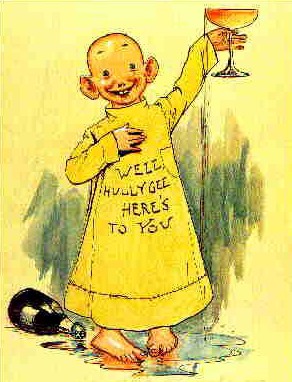
The comics were the high-tech weapon of the great newspaper circulation war and tumult, if not violence, was the new medium’s stock-in-trade. The term “yellow journalism” itself derived from the first comic-strip star, a denizen of the teeming, single-image slum tableaux Hogan’s Alley, who became known as the Yellow Kid. This jug-eared, barefoot urchin, draped in a canary-colored nightshirt, was created by thirty-three-year-old magazine artist Richard Felton Outcault at Pulitzer’s New York World….
Although replete with racial and ethnic stereotypes, the first newspaper comic strips were not so much an extension of vaudeville as precursors of the equally déclassé and temperamentally anti-authoritarian motion picture. The early strips thrived on choreographed violence, including runaway horse carts, baroque streetcar collisions, and a panoply of what [newspaper magnate William Randolph] Hearst might have termed polychromous explosions.
In an October review of Maresca’s book, Steven Heller summed up how the genre got its start:
The genesis of Sunday funnies began with technology providing a way to cheaply produce color newsprint pages, and out of a desire for an outlet to lampoon new social developments in transportation, communication, power. This was also a period of huge immigration, particularly from the poorer countries in Europe where English was limited and accents were the fuel of comic and stereotypical ridicule. A growing working class from different backgrounds shared a thirst for entertainment.
“With the masses specifically in mind, newspaper comics became the first popular culture as we know it today: synchronous, predictable, ephemeral, and with a near-universal appeal, well before cinema, radio, and TV,” Maresca says.
(Image of The Yellow Kid by Richard Felton Outcault, 1897, via Wikimedia Commons)