In an excerpt from their new book, Larry Downes and Paul Nunes explain how disruptions in the tech market work:
[T]oday, new products and services enter the market better and cheaper right from the start. So producers can’t rely on a class of early adopters and high margins to build up a war chest to spend on marketing to larger and later markets. For better and for worse, thanks to near-perfect market information, consumers are too savvy for that. Everyone knows right away when some new offering gets it right — or, conversely, gets it wrong. The bell curve, once useful as a model of product adoption, has lost its value as a planning tool. This kind of disruption has its own unique life cycle, and with it its own best practices for marketing and sales, product enhancement, and eventual product replacement. Markets take off suddenly, or they don’t take off at all. Since adoption is increasingly all-at-once or never, saturation is reached much sooner in the life of a successful new product. So even those who launch these “Big Bang Disruptors” — new products and services that enter the market better and cheaper than established products seemingly overnight — need to prepare to scale down just as quickly as they scaled up, ready with their next disruptor (or to exit the market and take their assets to another industry).
They give the example of Kinect, an add-on to Microsoft’s Xbox 360:
Kinect was an enormous hit, selling eight million units in just the first sixty days. According to Guinness World Records, that made Kinect the fastest-selling consumer electronic device in history. A little over a year after launch, twenty-four million Kinects had been sold, pushing sales of Xbox 360 consoles and games along with it. In 2010, Microsoft took the top spot in the fiercely competitive console market for the first time since Xbox 360’s launch in 2001. For Big Bang Disruptors, however, catastrophic success invariably leads to rapid market saturation — and with it decline and sunset. Within six months, the pace of Kinect sales dropped precipitously. Though stragglers continued to buy the product in peaks and valleys over the next year, the product had largely fulfilled its mission in its first ten months. For Microsoft — and other game developers — it was time for another innovation.
You quoted Nelson Jones: “The problem with surgical intervention isn’t just the theoretical one that it violates the integrity of the body but the practical one that the doctors might well make a mistake.” The possibility that the child grows up to express a gender different than the one assigned is real. However, it’s important to understand that the sexual surgeries usually performed on intersex infants are mutilating, even when the gender assignment is not “wrong.”
The most common surgeries are intended to make the child’s clitoris smaller. That is done by removing clitoral tissue. Lots of clitoral tissue. Psychologist Suzanne Kessler asked female college students to imagine having been born with the kind of clitoris that causes children to be targeted with these surgeries (any clitoris over 3/8 inch):
Students were then given the physician’s standards for genital lengths, and women were asked to imagine having been born with a clitoris between 1.0 and 2.5 centimeters. Under what conditions would they have wanted it surgically reduced? Ninety-three percent would not have wanted their parents to agree to clitoral reduction if the condition were not life threatening and if it resulted in the loss of orgasm or pleasurable sensitivity. Over half of the women would not have wanted surgery even if the condition were unattractive and made them feel uncomfortable. This was particularly true of the lesbian and bisexual women in the sample. Twelve percent of the women would not have wanted a clitoral reduction under any circumstance
— Kessler, S., 1998. Lessons from the intersexed. New Brunswick, New Jersey: Rutgers University Press. (page 100-101).
Other sexual surgeries performed on intersex children include:
* vaginoplasty (a part of the colon is transferred to the perineum to form or to lengthen a vagina)
* gonadectomy (the child’s gonads are removed, both sterilizing the individual and rendering her dependent upon exogenous hormones for life)
* hypospadias surgery (skin flaps are used to try to extend the penile urethra so that the penis urinates from the very tip instead of somewhere further back along the underside)
Intersexed people all over the world who have been subjected to these surgeries (including myself) are calling for them to be stopped because we have experienced them as mutilating rather than normalizing. The vast majority of us remain in the gender that we were assigned, so the harm is by no means limited to wrong gender assignment. Surgeons claim that most of their patients are happy with their surgical outcomes, but you will search in vain for such silent, happy graduates of the intersex normalization process.
Shame is even more crippling than mutilating sexual surgeries. These surgeries are a response to shame. Ironically, by delivering a message that intersexuality renders the individual unloveable without mutilating sexual surgeries, they actually serve to reinforce shame. Those of us who are speaking out are the ones who have managed to transcend shame.
Your post was right on the money. I drive an 18-wheeler and haul cars in the US and Canada. When entering Canada, I’m treated with professionalism, asked specific questions, and granted access. But when I return from Canada, I am treated as if I’m, at minimum, smuggling something illegal and asked numerous questions, sometimes the same question more than once. I can only imagine the way foreign nationals are treated if I am treated this way as an American citizen. And I’m a white guy in my 60s who doesn’t fit any kind of a profile that would warrant this level of scrutiny.
Several other readers share their experiences:
Nice timing of your post, as I was just mailing my wife’s I-751 form to lift her conditional status on her green card. Being born here myself, I had no idea on how badly we treat people trying to immigrate here until I went through it with my wife.
She’s from Germany, and before we got married we had to worry each time she entered the country, even though we were following the rules and doing nothing wrong. She was grilled each time she entered and it was always the same; they presumed she was up to no good and she had to convince them otherwise. All it takes is for one immigration agent to have doubts and you can be sent back and ruin your chances to complete the immigration process. I, on the other hand, never had any problems going to Germany and was never treated there like she was treated here.
Then we had to go to the immigration agency to be interviewed to ensure our marriage was legitimate. I wasn’t worried, because from my perspective we had nothing to hide, but once the interview started it became apparent that the guy who was handling our case wasn’t simply interested in confirming that we were genuine about getting married. He proceeded to tell me that I was a bad father because I was getting remarried soon after getting divorced and at one point looked at me and said, “You know your kids will be messed up for life.” It was all I could do to not jump over the table and strangle the guy. My kids wellbeing have ZERO to do with the legitimacy of my marriage, but he wanted to get me mad, say something to give him a reason to deny her a green card.
I’m educated and have a good income, plus my wife’s from Germany, so I can only imagine we had it much easier than those without money coming from Third World countries.
A virtuoso performer is devastated after he claims customs officials at John F. Kennedy International Airport destroyed 13 handmade flutes. Boujemaa Razgui says he was passing though the airport when he was questioned about the unique instruments the was carrying. He was then given a number call, only to discover that that his valuable nay and kawala flutes had already been deemed agricultural products and crushed. Razgui said: “They told me they were destroyed. Nobody talked to me. They said I have to write a letter to the Department of Agriculture in Washington, D.C. This is horrible. I don’t know what to do.”
It’s also consistent with what I hear from travelers generally, even those who are US citizens but who also may be of a darker hue or whose name is something suggests an ethnicity other than white, non-Hispanic.
Another:
I’m a US citizen who has lived outside of the US since 1998. My least favourite country to travel to is the US. While I’m sure that my experience is not as brutal as yours or as others who apply for visas, it can also be brutal for US citizens going home.
A year ago at Christmas my family (my wife and daughter are also American) was traveling home to be with our extended family. The border agent – I think this was at LAX – after asking us many questions about where we worked and what we did then asked us why we were coming to America. I wanted to tell him to fuck off as it was none of his business why I wanted to come home to my own country. Of course all I could do was smile and answer or else suffer the pain of being pulled into an interrogation room for hours. Previously to this he’d subtly changed our answers and repeated the same question back to us to try and catch us out as he appeared to assume we were lying. Mind you, I probably shouldn’t have told him that my wife worked in UXO removal eliminating the ongoing legacy of secret US bombing in Laos.
I’ve been pulled aside, carefully searched, and had my checked bag marked with a big red “Security Risk – Load Last” tag in Heathrow (I was working in Afghanistan at the time) and thoroughly questioned at many other borders. But they are almost always polite and in the case of the Heathrow agents apologetic for my treatment. But US border agents are almost unfailingly rude and brusque even if you’re an American flying home.
Another US citizen:
On your tourism post, I’m not exactly a world traveler, but I’ve traveled to Europe a good bit. Last year my wife and I went to England and Turkey. We flew into Heathrow and it took us about 10 minutes to be on the way to the Heathrow Express. We filled out a little form and told a very nice man that the reason for our visit was pleasure and, after a stamp in my passport we were off. We flew from London into Attaturk Airport in Istanbul and the wait was a bit longer because we had to go through two lines (one for the visa and one for customs) but it might have taken 30 minutes total as the lines were long. Again, we filled out a little form and told the men at the two booths that we were in Turkey for pleasure, got stamps and we were off.
It was quick, easy as about as painless as checking out of the grocery store. Given that I’m an American, I had no idea getting into here was so hard, but I’m certainly not surprised.
Keli Goff wonders when it’s acceptable to cut a close relative out of your life:
January has long been considered the most popular month for divorces with many unhappy spouses ready to make a fresh start after faking it through the holidays for the sake of the kids or other family members. But what if the dysfunctional relationship in your life isn’t with your spouse, but with another family member? Is January a good time to consider divorcing a sibling, parent or other family member who makes you miserable?
While divorce is widely accepted today there remains a stigma around ending a relationship with other family members, often no matter how egregious their behavior. I was reminded of this just before the holidays when on a recent episode of Oprah Winfrey’s Lifeclass, megachurch pastor T.D. Jakes chastised two sisters who had not spoken in years. The reason for the estrangement:
one sister tried to engage in an affair with the other’s boyfriend but was caught before the relationship was consummated. The sister in question had never apologized to her sibling for this transgression. Yet for some reason Jakes seemed under the impression that having this woman out of her life was a major loss for the sister whose boyfriend the other one had tried to shag and insisted they reconcile. But the question I kept asking is: why?
Why should this woman want a person she cannot trust and has shown her no remorse or empathy to remain in her life? What benefit is there in such a relationship? Jakes insisted on the importance of blood, which seems an odd reasoning to focus on when it comes to defining what constitutes a worthwhile relationship, particularly since we live in a society in which there are plenty of strong, healthy adoptive families who do not define family along bloodlines.
Sargent thinks “there are scenarios under which [Republicans] might negotiate for certain types of changes to the law, in exchange for changes Dems or liberals want.” He rattles off reforms Republicans might propose:
Larry Levitt of the Kaiser Family Foundation laid out the types of incremental changes Republicans might pursue. He suggested Republicans might propose various ways of relaxing Obamacare’s regulations, in keeping with conservative policy ideas, that wouldn’t destroy the law. For instance, they could propose allowing insurance sales across state lines so competition drives down prices, something liberals might be willing to accept under certain circumstances if the law’s uniform federal minimum coverage standards are kept (which could theoretically prevent the “race to the bottom” liberals fear).
Or Republicans could propose to make tax deductions available to those over 400 percent of the poverty line who do not qualify for Obamacare subsidies, helping those who see premiums go up (which Republicans have turned into a major issue) and mitigating Obamacare’s redistributive elements a bit. Or Republicans could propose relaxing the limitations on age ratings, allowing insurance companies to charge more than the current three-to-one ratio the law mandates between older and younger people.
Joshua Green agrees that Republicans should face reality:
The fact is that even if Republicans win the White House and both chambers of Congress in 2016, they won’t dare strip benefits from what, by that point, will probably be upward of 10 million people. The best they can hope for is to be able to change the law in a way that’s more amenable to conservative ideals, as Frum was counseling them to do four years ago. What changed on Jan. 1 is that the “repeal” crowd became obsolete. The new coin of the realm for conservatives is coming up with a viable-seeming alternative to Obamacare that allows for the reality that Republicans are never going to strip millions of people of their health insurance. That’s what matters now.
Sargent acknowledges that none of this will happen in 2014, and possibly not until after 2016 too. That’s my guess as well. And even then, there will probably be only minimal Republican appetite for dealmaking. … I’d guess that 2017 is about the earliest likely date for Republicans to give up their dream of total repeal.
On New Year’s Eve, Supreme Court Justice Sonia Sotomayor issued a temporary injunction (NYT) preventing the government from enforcing the ACA’s contraception requirement on a Denver nursing facility run by an order of nuns, as well as several other non-profits covered by the same Catholic insurer. The nuns argue that even signing-up for an exemption from the mandate violates their religious freedom. Jennifer Haberkorn explains the complexity of the case:
The case brought by the Little Sisters of the Poor Home for the Aged falls into an unexpected loophole in the ACA’s contraception coverage. Earlier this year, the Obama administration tried through regulations to accommodate religious-affiliated nonprofits that took issue with the requirement that employers cover contraception. It allowed groups like the Little Sisters to tell their insurance company or third-party administrator that they objected on religious grounds. The insurer or administrator would then have to provide contraceptives to the employees at no charge. The premise was that an insurer or administrator would not have the same objection to providing such products. But the catch here is that the Little Sisters’ administrator — the Christian Brothers Employee Benefits Trust — is also run by a religious order. The Christian Brothers, who joined the Little Sisters on the lawsuit, qualify as a church under employment law. And under that law, if they don’t want to provide contraception, the federal government has no recourse to force them to do so.
The government is expected to tell the Supreme Court on Friday that if the Brothers have religious objections to the mandate, they can refuse to send contraceptives to the employees with no repercussions — and therefore, the Little Sisters have no reason to bring this lawsuit. That was the government’s argument to the 10th Circuit Court of Appeals in the case. “No one will ever get contraception coverage in that context, so it’s hard to imagine they have standing, that there is a substantial burden on their religious beliefs or that there is sufficient harm to [block the policy],” said Brigitte Amiri, a senior staff attorney at the American Civil Liberties Union, which has filed briefs in support of the government’s position in similar cases. The Little Sisters say they object to even notifying their administrator to provide contraceptives, regardless of the fact that the Brothers would not comply on religious grounds. “What the Little Sisters say is we can’t sign a permission slip to give our employees something that we believe is wrong,” said Daniel Blomberg of the Becket Fund for Religious Liberty, which represents the nuns.
I’m sympathetic to the nuns’ religious liberty. But I honestly think that signing a permission slip for employees to make their own decision about contraception coverage – and not having to pay for it at all – is a perfectly sane compromise. Marcotte fumes:
These Catholic nonprofits that wanted an exemption from covering their employees’ contraception needs—and got an exemption from covering their employees’ contraception needs—are now fighting the provision (that exempts them from covering their employees’ contraception needs) simply because they don’t want to have to fill out a form that states that they are exempt. Why? Because their employees need that form in order to get birth control directly from their insurers (which they need to do because their employers—these Catholic non-profits—are exempt, as they want to be). That’s right: These groups are arguing that filling out a form is a violation of their religious freedom and that “religious freedom” means that you should have control over your employee’s health care decisions even when they happen outside of the insurance coverage you directly provide for them.
Amy Davidson also sees no grounds for the objection other than to restrict access to reproductive healthcare:
The suggestion here is that birth control has such a dirtiness to it that even the formal and financial separation of religious employers from the coverage—they don’t manage it, they don’t pay for it, even though their employees get it—is inadequate. (Purely religious institutions, like churches, have an even broader exemption.) They know about it—know, that is, that the women who work for them have choices that they would prefer they did not have. But they do have them; a Catholic charity can’t insist that the nurses or cleaning women who work for it don’t use contraceptives. (The home has sixty-seven employees.) What the religious-affiliated groups are insisting is that the women bear a heavier economic cost for the sake of their employers’ beliefs—even though the Church groups wouldn’t pay more either way. In that sense, the suit embodies the irrationally passionate objections to not only Obamacare but also women’s access to contraceptives and, more broadly, reproductive rights.
[R]eligious liberty should end at your own nose, and not entitle you to demand that anyone within your reach adhere to your same principles. It certainly should not give any religiously affiliated organization carte blanche to argue that filling out a form is a substantial burden, and the form requirement itself is tantamount to religious discrimination. The American legal system privileges religious belief over many other kinds of deeply-held moral values, so while this line of argument wouldn’t hold up in court, it’s still worth asking: how is filling out a form a more substantial burden than, say, having to pay hundreds of dollars out of pocket for birth control, or having to travel a substantial distance and spend thousands on an abortion, or raising a child?
Scarborough repeats tired, intellectually lazy arguments against the legalization of marijuana:
You’ll notice a few things about this inane discussion. There is close to zero informed understanding of marijuana, its physical and psychological effects. You don’t find discussions about how marijuana hurts the adult mind or how it’s as addictive and socially disruptive as alcohol (because those arguments disintegrate as soon as you try to substantiate them). There is a completely anecdotal premise that a drug used by the last three presidents – and countless truly creative and accomplished people – simply makes everyone “dumb.” You’ll notice above that the entire smug boomer crew on Scarborough’s show has no real response to the point that alcohol can also make you dumb (and violent and out-of-control). They dismiss that scenario if you drink alcohol in moderation. So why not pot in moderation? But my point is this: they haven’t even gotten past that basic stage of the debate because they haven’t spent more than a few seconds mulling it over. To wit:
…legal weed contributes to us being a fatter, dumber, sleepier nation even less able to compete with the Chinese
That should be “our being a fatter, dumber, sleepier …” But I guess a little weed is what’s going to kill off grammar.
Almost all the anecdotes, moreover, are from the distant past and are about white, teenage or college use (something legalizers are keen to discourage). Little data are presented; no specific social harms are identified. In other words: cable news. The other thing I notice is something I saw very early on when a whole bunch of pundits realized they had to say something to oppose gay marriage. These people simply don’t know a lot about the subject, do not regard it as serious enough to be better informed, and offer arguments that are so weak or irrelevant to the central question that they are setting themselves up for total failure in this debate. I give you Ruth Marcus:
Please do not argue that Colorado’s law, like those proposed elsewhere, bans sales to those under 21. Ha! I have teenage children. The laws against underage drinking represent more challenge to overcome than barrier to access. And although alcohol seems to be the teen drug of choice among the adolescents I know, the more widely available marijuana becomes, the more minors will use it. If seniors in fraternities can legally buy pot, more freshmen and sophomores will be smoking more of it.
This would make sense if not for one fact: teens have said for years that marijuana is currently easier to get than alcohol. Prohibition has made it so. All of which is a warm-up for David Brooks’ column today, reminiscing about his former pot-smoking and adding a moral disapproval to pot he would never assign to alcohol:
Laws profoundly mold culture, so what sort of community do we want our laws to nurture? What sort of individuals and behaviors do our governments want to encourage? I’d say that in healthy societies government wants to subtly tip the scale to favor temperate, prudent, self-governing citizenship. In those societies, government subtly encourages the highest pleasures, like enjoying the arts or being in nature, and discourages lesser pleasures, like being stoned.
In legalizing weed, citizens of Colorado are, indeed, enhancing individual freedom. But they are also nurturing a moral ecology in which it is a bit harder to be the sort of person most of us want to be.
But what if pot enhances the higher pleasures – like listening to or making music, or appreciating fine wine or great food? And why doesn’t alcohol fit squarely into the same category? Millions of grown adults (not giggly teens) use the drug the way others use alcohol – with far less socially damaging or physically dangerous effect. What David doesn’t do either is address the real issue at hand: the social costs of prohibition versus the social costs of legalization. On that note, Matt Welch fires back at Brooks:
“Healthy societies” don’t throw millions of people into human meat lockers to satisfy the moral urges of social engineers. It is “a bit harder to be the sort of person most of us want to be” after you go to jail for engaging in the same recreational activity as a teenage David Brooks. The “moral ecology” got a whole better on Jan. 1, and will get better still when people stop using the criminal code as a laboratory experiment on their fellow human beings.
Gary Greenberg, who’s the full-on stoner whose life was apparently ruined in Brooks’ column, joins the conversation [Update: Greenberg clarifies: “What follows here is satire of the Juvenalian variety. I thought I embedded enough tipoffs, but then again I forgot how much stranger than fiction truth can be. So to those who thought it was real and suffered pain as a result, I apologize.] Tom Chivers calls Brooks’ column“startlingly smug, patronising and complacent”:
[W]hat I will say is this: notice that, in David Brooks’s youthful experimentation, his “been there, done that” memoirs, in which no real harm is done to him by this relatively safe drug, there is not a section in which he is arrested, imprisoned for possession, given a criminal record and barred from several professions later in life. And in fact most of these “I took drugs in my youth, but it was a youthful indiscretion, and I regret it, so we shouldn’t legalise them” memoirs are all similar in a noticeable way: they’re written by successful people whose lives weren’t ruined by a criminal prosecution. That’s the “subtle tip of the scale”, that’s the way the government apparently “encourages the highest pleasures”: by locking up people and destroying their future lives.
Brooks’ column only serves to prove that many kids will quit on their own, and — in any event — the experience won’t stop them from going on to be highly successful pundits. In fact, the only way his marijuana use might have hurt Brooks (and possibly ruined his life) would have been if he had been arrested. And that danger is now almost completely out the window in Colorado. And so, we are left with a very well-written and thought-provoking column that ultimately fails to make a coherent argument.
If you’re black in America, you’re four times more likely to be arrested for marijuana, even though all races use marijuana at the same rate. In some states, the disparity is as high as 8 to 1. The overwhelming majority of these arrests are for possession. If you’re poor and black, or if you live in a particular inner city neighborhood, your arrest is a near certainty.
Lastly, a lone Brooks defender: Dreher wishes legalization supporters would treat Brooks, and those like him, more civilly:
I hate the way many liberals and libertarians are so zealous about the issue, in a way that shuts down deliberation. Somebody on my Twitter feed today said that pot legalization is for the left what guns are for the right: the issue on which there can be no legitimate dissenting position.
I sure hope I’ve treated David’s arguments, such as they are, civilly. Ditto my friend David Frum’s. I know they are well-intentioned, and the idea that there can be no cost to ending prohibition is silly. The real argument is that the benefits of legalization far outweigh the costs – an argument David simply doesn’t address. I wish he would. I also wish that every pundit who writes about their youthful folly would do us a favor and research the current state of marijuana use and production, examine the far more sophisticated mixtures of CBD and THC, of sativa and indica, that this amazing plant is now grown to produce, and would acknowledge the medical uses of pot, which research is beginning to show are bewilderingly manifold. I wish they would not insult so many of their fellow adults and fellow citizens by arguing that their pleasure of choice is simply a way to be “dumb.” Calling those who disagree with you dumb is not that civil.
Cohn lists five rules for talking about Obamacare. Number four:
The Affordable Care Act’s critics say premiums for people buying coverage on their own will actually increase. That’s true. The law’s defenders say tax credits offset the cost for many and probably most of those people. That’s also true. The law’s critics say some people will lose coverage from employers and won’t be happy about it. That’s true. The law’s defenders say most of those people will be better off, because they’ll be low-wage earners getting subsidies on the exchanges or they’ll be older workers who had stayed working because, previously, it was their only way to get benefits. That’s also true.
You may notice a theme here.
Obamacare sets in motion all kinds of changes. They will typically affect different people in different ways—creating winners, losers, and all sorts of people in between. Are there more winners than losers? How much worse off are the losers? Those are the kinds of questions we need to answer if we want to make a judgment about the law. And the answers are rarely simple.
Although many have made bold claims about how this law will impact coverage by private and public insurance, we simply won’t know until we see the data from our major household surveys of insurance coverage, available in the fall of 2014. Ultimately, the projections of the Congressional Budget Office suggest that the ACA will not be fully implemented for three years, the amount of time it took to ramp up to full implementation in Massachusetts. So we won’t be able to draw final and firm conclusions until late in 2016.
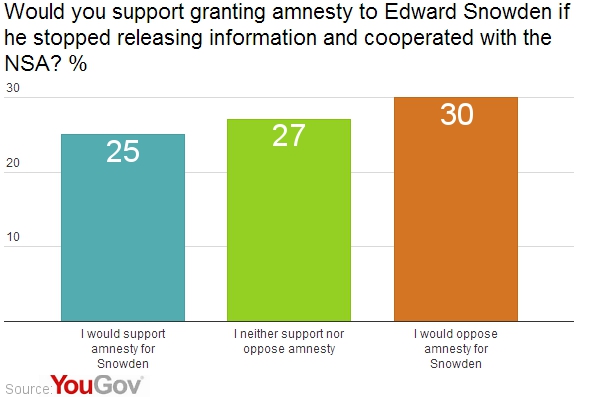
A NYT editorial proposing leniency, if not clemency, for Edward Snowden has set off a chorus of support and condemnation throughout the blogosphere. Shafer points out that the Grey Lady’s editors are not the first to float this balloon:
You could ridicule the Times editorial for wild, wishful thinking had Rick Ledgett, a top NSA official in charge of the Snowden damage-assessment task force, not also entertained the idea of amnesty on 60 Minutes three weeks ago. “It’s worth having a conversation about,” said Ledgett, who is expected to be the agency’s next No. 2 official. “I would need assurances that the remainder of the data could be secured and my bar for those assurances would be very high.” Ledgett insisted his statement represented a “personal view” — as if top NSA officials expecting promotions are allowed to share their “personal views” about national security on national TV. Was he expressing the agency’s powerlessness to contain future leaks of the 1.7 million documents Snowden’s now believed to have stolen, and trial ballooning the possibility of a deal, or was he gaming Snowden, as I conjectured at the time?
Ed Morrissey argues that the editorial presents “a false binary choice” and that Snowden had other options for exposing the NSA, such as presenting evidence to members of Congress:
Senators Ron Wyden and Rand Paul were well-known opponents of domestic surveillance; why not go to them, or anyone else first before taking the cache elsewhere, especially to China and then Russia? The fact that the Times’ editors never even address that channel shows how weak their argument is — which is why they don’t really try to make the amnesty argument in the end.
There is one argument for offering amnesty, which is to secure what’s left unexposed of the cache.
If it can be established that the cache is secure and no one else has the data, it might be worth a trade in purely practical terms. It’s difficult to see how that could be established, though, especially with Snowden’s travels taking him through two of the less-friendly states to American security concerns. Otherwise, a deal would suggest to people still within secured-data environments that stealing a little data is dangerous, but stealing massive amounts of it might be their ticket to fame and fortune. It’s a bad precedent to set, and we’d be better off spending our time improving our legitimate whistleblowing channels and hardening security.
Max Boot calls Snowden a traitor, not a whistleblower, saying, “the only kind of plea bargain I would like to see offered to Snowden is one that allows him to serve life in a maximum-security prison rather than face the death penalty for his treason”:
Even if you think that the NSA’s collection programs are excessive, it is hard to make the case that sharing the most vital secrets of the U.S. government with the news media–and probably hostile foreign governments in Beijing and Moscow, although the Times doesn’t mention this inconvenient probability–is the way to address the problem. Snowden now claims that he tried to notify a couple of superiors about his concerns; the NSA denies it. Whatever the case, there is no evidence he tried to notify the NSA’s inspector general, the Foreign Intelligence Surveillance Court, or the intelligence committees of Congress. No doubt this is precisely because he knew that all of the activities he disliked were fully authorized by all three branches of government. What we have here is not a case of “whistle-blowing,” as the Times disingenuously claims, but a case of a young, arrogant, headstrong techie with a libertarian bent and a taste for fame who has taken upon himself the responsibility of deciding which intelligence programs the U.S. government may carry out and which it may not. A true whistleblower, like Daniel Ellsberg, stays to face the consequences of his actions–he does not flee to hostile foreign capitals.
There are at least a few flaws in Boot’s argument. First of all, as the Times notes, there still isn’t any evidence that the surveillance programs that Snowden revealed have een at all helpful in stopping any terrorist cast, or that they could have stopped past terrorism like the 9/11 attacks. Second, while Boot quite apparently does not agree. there are serious questions about whether or not the actions that the N.S.A is engaging in are Constitutional, as Judge Richard Leon has indicated, and without Snowden’s public revelations there would be no Court in nation engaging in a public review of what the agency is doing. Third, as the Times notes, there is at least a plausible argument for why Snowden would not feel safe staying in the United States after the information he had obtained was made public. Finally, while there remain several reasons to distrust Snowden’s judgment, such as his decisions to flea to places like Hong Kong and Russia, there are even more reasons to distrust the government acting in secret in our name and mining vast arrays of data for information whenever they feel justified in doing so. The fact that the American people had no idea that any of this was happening is something that should bother any American, and the response that we can trust the government not to misuse all this data ignores decades of history showing misconduct by the Executive Branch, law enforcement, and Intelligence Agencies.
Conor dismisses the idea that clemency for Snowden would set a precedent for future leakers:
The concepts of pardon and clemency are part our system precisely because there are instances when applying rules we’ve generally decided upon would be unjust and counterproductive. They are meant to be used judiciously, on an ad hoc basis, in what are clearly exceptional circumstances. Snowden’s leak meets those tests. Urging clemency for Snowden is not a radical case against our existing system of rules—it is an acknowledgment that, like all rules, ours are imperfect. One of the finest presidents, George Washington, pardoned farmers who took up arms against the federal government (!) to protest a tax on whiskey. He wouldn’t have granted those pardons had he thought that he was making a radical case against the legitimacy of the U.S. government or setting a precedent for anti-tax insurrections. And it is difficult to argue that any such precedent was set, even at the dawn of the federal republic when norms were still being established. Today, it is even more difficult to imagine that a pardon for Snowden, or one of the lesser forms of forgiveness the Times advocates, would cause other federal employees to imagine that they’d avoid punishment if, say, they made public the identities of American spies abroad or secret codes from the U.S. nuclear program.
A study released yesterday found that, for those newly insured through Medicaid, access to health insurance doesn’t reduce ER visits:
Advocates for health care expansion reason that the newly insured will seek out health care more often, but will choose a primary-care physician over the ER. One reason the uninsured tend to go to the ER when they do finally seek treatment is that it’s their only option. You need to present an insurance card to get service at most physicians’ offices, whereas the ER is legally bound to attend to any case that comes through the door. Once insured, a patient does have every reason to see a primary-care physician and skip the ER: As every American knows, you don’t go to the ER for a good time. You go there expecting to sit under a glaring fluorescent light on a hard-backed plastic seat for four hours (if you’re lucky), surrounded by a combination of crying babies and hacking coughs. If you’ve got the option of making an appointment at your doctor’s office instead, you take it. But according to the Oregon study, the newly insured still choose the ER over the doctor’s office. What’s more, the increase in ER use documented by the study comes in large part from patients with ailments like cuts and sprains—problems that could have been managed through a primary-care physician or by an urgent care clinic (both of which are covered by Medicaid). Patients aren’t, in fact, substituting primary care for the ER to the extent that many insurance advocates have hoped they would.
Brandy Zadrozny worries that our emergency rooms can’t handle the extra workload:
The Medicaid population is expanding at a time when the general strain on the nation’s emergency care facilities is both growing and used disproportionally by Medicaid patients (They made up a third of emergency room visitors (PDF) in 2010 but make up just 16 percent of the population). And while 38 percent of adult Medicaid patients had at least one emergency department visit in the past year, only 16 percent of the privately insured and 21 percent of the uninsured made similar visits. The visits of Medicaid patients are also more likely to be classified as non-emergencies.
The increase in ER use comes as no surprise to Avik Roy:
[O]ne of the big holes in the myth of uninsured “free riders” is that the uninsured only account for 15 percent of the population, 14 percent of total ER visits, and 12 percent of aggregate ER expenditures, according to a study by the Kaiser Family Foundation. Medicaid beneficiaries, by contrast, accounted for 9 percent of the population, 15 percent of visits, and 9 percent of expenses. Given all of this data and experience, it was obvious that expanding coverage through Obamacare would increase taxpayer costs, not reduce them. But predictably, the pro-Obamacare “fact-checkers,” like those at PolitiFact, have been nowhere to be found.
Suderman thinks this calls into question the efficacy of Medicaid:
These findings ought to spark a rethinking of Medicaid’s value and effectiveness. It’s not enough to provide some positive benefit. It’s also important to ask whether there are other, better, less expensive and resource-intensive ways of achieving the same goal. If Medicaid is to be a financial smoothing program rather than a health-improvement program, then we ought to treat it like one, and make reforms accordingly.
Kliff speaks to a health economist who defends the Medicaid expansion:
[Jonathan] Gruber, the MIT economist, doesn’t see the Harvard study as a compelling case against expanding Medicaid. There are still other benefits to insurance coverage, he says, that aren’t about saving public funding. Separate research on the Oregon expansion, published last spring in the New England Journal of Medicine, found Medicaid enrollees to have significantly lower rates of depression and were more able to pay their medical bills. “The overall notion is we’re getting people more health care,” Gruber says. “There are huge improvements in mental health. For those who want to argue that expanding Medicaid is a free lunch, this is bad. But that was never the right argument.”
Imagine if the debate over the Affordable Care Act had unfolded as follows — the president stated that in the interests of improving the mental health of low-income uninsured Americans, but not necessarily improving their health along other dimensions, he hoped to pass a large and expensive Medicaid expansion; to address the needs of the medically uninsurable population, he intended to implement a series of new insurance regulations that would, among other things, prompt the cancelation of large numbers of insurance policies serving the individual and small group insurance markets, with the net result being a reduction in the number of Americans with private insurance coverage, despite new subsidies aimed at low- to moderate-income households; and to finance these new initiatives, he’d restrict the growth of Medicare expenditures and he would raise various new taxes. It’s not obvious to me that this bundle would have struck many voters, including Democratic voters, as attractive.
The effect size was pretty small—about one extra ED visit per recipient, every 3.5 years or so. In dollar terms, this amounts to an estimated annual expenditure increase of something like $120 per recipient. We can’t say from this paper whether the extra ED visits were valuable or cost-effective. We can say that these results will embarrass some liberal advocates who argued that expanded coverage would reduce overall rates of ED use.
It should. This talking point was never properly evidence-based or even particularly plausible given prior research. It’s not obvious that reducing the rate of ED use is even a sensible policy goal. Advocates across the political spectrum should stop using the ED for cheap talking points about the mythical savings associated with universal coverage or about the misbehavior of Medicaid recipients who supposedly waste huge amounts of money through overuse.
Aaron Carroll argues that more ER visits don’t necessarily constitute a problem:
[U]ntil someone proves to me that the increased ED use was unnecessary, I don’t know why anyone would assume it’s a bad thing. If our goal is to increase people’s access to the health care system, getting more people insurance (like Medicaid) is a good tool for that. If our goal is to help people make more effective use of the healthcare system, increasing coverage isn’t necessarily going to be as good a tool. I’m sure there will be a ton of partisan hay made out of this being another “broken promise”, but I’m not participating in that.
Individuals of different socioeconomic statuses have heterogeneous needs, priorities, beliefs, and limitations when it comes to accessing health care—so rational behavior is going to be similarly varied. With expanded coverage, a central challenge on the health policy scene is making the delivery system adapt to meet the needs of a more diverse patient population. That’s something insurance alone can’t do.
Ultimately, my view is that “overuse” of the ED reflects the broader problem that the health system is not very responsive to consumer demand or sensitive to all types of consumers. (The disparities literature is relevant here.) In other words, it’s not consumers making “bad” choices, but the system offering poor ones.

 The Dish