To Resolve Or Not To Resolve

Jessica Lamb-Shapiro points out that it may be wise to skip New Year’s resolutions this year:

The statistics are bleak: only 8% of people who make New Year’s resolutions stick to them, and those who don’t usually abandon them after just one week. Unrealistic resolutions are fated to fail. And it is unrealistic to think that you can immediately overcome a habit you have spent years establishing. But is this necessarily harmful? There’s a good chance that it is. If your New Year’s resolution is to eat less, but you have no plan in place — or even if you do have a plan and you fail — you will do damage to your sense of self-worth. If you already have a complicated relationship with food, your likely coping mechanism for failure is eating more food. Thus the New Year’s resolution to eat less can actually result in your eating more. Ditto drinking, drug use, smoking, finding a mate, exercising, etc.

But all hope is not lost:

Naturally, if you set more realistic goals, you are more likely to succeed.

In a study that looked at the role of expectations in exercise, the psychologist Fiona Jones and her colleagues found that people with more modest expectations were far likelier to complete a twelve-week-long exercise course. And once we’ve set goals, we’re most likely to reach them by creating a firm plan. The theory of implementation intentions, a term coined by the psychologist Peter Gollwitzer, maintains that we have a better chance of sticking to a goal if we think about contingencies in advance and devise a direct, automatic response to each of them. (If feel too tired to go to the gym, I’ll have some coffee or eat an apple before heading out.) “It’s harder to break a specific commitment then a nonspecific one,” [psychologist Katherine] Milkman said.

Sunstein gives more advice:

It’s easy to resolve to be more altruistic, to exercise greater self-control, to be more patient, or to enhance one’s life, but it’s costly to do these things. Suppose that you aren’t always as generous and kind as you would like to be, or that you have trouble resisting temptation, or that you don’t give yourself enough time off. If so, it’s probably because it’s costly to do those things, and it’s hard to anticipate those costs and burdens in advance.

The best remedy is to find ways to reduce such costs and burdens. If you want to be more altruistic, you might set up automatic monthly gifts to your favorite charity. If you want to increase your self-control, you might alter your environment so that you run into temptations less often — for example, by keeping less food in your refrigerator. If you want to have an adventure or two, you might accompany your New Year’s resolution with a purchase, today or tomorrow, of a plane ticket.

A New Year’s Moment

dish_Friedrich

The start of a new year prompts Stefany Anne Golberg to meditate on Caspar David Friedrich’s painting “Woman before the Rising Sun,” which she says she would like to retitle “New Year’s Moment”:

A woman in a long dark dress stands facing a sunrise that bursts up from behind a mountain. The rays of sun blaze and illuminate the rocky landscape, turning the sky a fiery orange. The woman is quite far from the sunrise but Friedrich positioned her in such a way that the rays seem to be shooting out of her whole body. And even so, she is not contorted in ecstasy before the new day. She’s not grasping at the sunrise either, trying to gather the sun into herself. She simply stands there, waiting, her arms turned slightly open.

Interestingly, this painting is sometimes called “Woman before the Setting Sun.” Caspar David Friedrich … often mixed up time in his paintings. Now something is rising, now something is passing, now something is dying, now something reborn — nature and time always infinite, and mysterious, happenings to stand before in mute awe. Friedrich once said of his paintings (in other words, his life), “I shall leave it to time to show what will come of it: a brilliant butterfly or maggot.” This is exactly what the woman in “Woman before the Rising Sun (Woman before the Setting Sun)” is doing. She opens her hands a little bit toward to the coming sun and invites the new day to arrive. She welcomes her spring as the winter passes, leaving time to show what will come of it.

For Adam Gopnik the new year brings to mind the stories of the Titanic and its more successful twin ship, the Olympic:

You have certainly heard of the Titanic; you have probably never heard of the Olympic. We have a fatal attraction to fatality. We don’t have one movie called “Titanic,” starring Leo DiCaprio and Kate Winslet, about a tragic love and a doomed adventure, and another called “Olympic,” a musical comedy starring Hugh Jackman and Anne Hathaway, about a happy voyage over. We have only one movie, and remember only one sad tale. …

Two boats set sail in those prewar years a century ago: the boat that sailed on and the boat that sank. Olympic or Titanic? Which is ours? It is, perhaps, essential to life to think that we know where we’re going when we set out—our politics and plans alike depend on the illusion that someone knows where we’re going. The cold-water truth that the past provides, though, may be that we can’t. To be a passenger in history is to be unsure until we get to port—or the lifeboats—and, looking back at the prow of our ship, discover the name, invisible to our deck-bound eyes, that it possessed all along.

(Image of Woman before the Rising Sun (Woman before the Setting Sun) by Caspar David Friedrich, c. 1820, via Wikimedia Commons)

Legalization Eve

Tomorrow, legal marijuana goes on sale in Colorado:

At 12:00 a.m. MST this Wednesday, the first legal sales of marijuana will occur in Colorado. Other sales will follow shortly in Washington state. How will this actually work? Colorado has been scrambling to come up with a legal architecture for this new industry, and the results look more modest than many expected (e.g.: There will be a very limited number of distributors, it can only be used at home rather than in cafes or large parties, etc.), but there are some creative entrepreneurs at work already. But what will this look like in a few months? Will marijuana lose some of its stigma? Will it lose some of its caché? Will usage actually increase substantially, or are the people who would use it already finding ways of getting it? And, perhaps most importantly, will Colorado’s and Washington’s experiences end up serving as an example or a warning to other states?

John Hudak states the obvious:

If the movement will continue to succeed, it must be actively committed to making implementation work and work well.

If the experience of the Affordable Care Act in 2013 has shown us anything, it is that implementation matters. Botched rollouts, unforeseen bumps in the road and other challenges hurt advocates and embolden opponents.

Sullum expects demand to outstrip supply:

Denver Relief, one of Colorado’s best-known dispensaries, plans to focus on serving current customers, allocating only about a fifth of its plants, producing 10 pounds or so a month, to the recreational side. Co-owner Kayvan Khalatbari says new customers probably will be limited to “family and friends, referrals from people who already come in.” Khalatbari predicts that outlets open to the general public will have a hard time meeting demand. “People who come here on January 1 are going to be sorely disappointed by the lack of marijuana,” he says. “I think there’s going to be a huge drought. People are going to be able to sell eighths for 60, 70, 80 bucks for the first few months.”

If the price gets too steep, there is another option for those who planned ahead or have friends who did. Since last December, Coloradans have been allowed to grow up to six plants at home and share the produce, up to an ounce at a time, “without remuneration.” Those provisions could give rise to an alternative distribution system, although how far cannabis cooperatives can go without breaking the law is a matter of dispute. At what point does compensation for expenses become remuneration? “This is a difficult area of law that I anticipate will receive a lot more attention from state and local elected officials,” Elliott says.

Incandescent Lights Out

Lightbulbs

The US will stop making and importing 40- and 60-watt incandescent lightbulbs starting tomorrow:

This follows the recently completed transitions from the old 100- and 75-watt incandescent bulbs over the past two years, a process that unfolded very smoothly because there are so many better-performing options available. Consumers now have three major types of bulbs to choose from: new and improved incandescents that use 28% less energy, and CFLs (compact fluorescent lamps) and LEDs (light-emitting diodes) that provide energy savings of at least 75% and last a lot longer. …

To be clear, incandescents are not disappearing at the first of the year — they’re just getting more efficient. And technological advances — like the GE 43W bulb below that replaces the 60-watt incandescent — have already saved homeowners and businesses billions of dollars on their energy bills. The new standards eventually will save as much electricity as is generated by 30 large coal-burning power plants – and the associated pollution that harms our health and contributes to climate change – every single year.

Benen discusses the politics of the phaseout:

In 2007, Congress tackled a pretty important energy bill, which included light-bulb provisions that weren’t considered controversial in the slightest. At the time, Rep. Fred Upton (R-Mich.) and congressional Democrats worked together on the larger legislative package, which included advanced light-bulb standards intended to spur innovation, lower costs, and improve energy efficiency. The provision was approved with bipartisan support – the radicalization of the Republican Party has intensified quickly in recent years – and the larger bill was easily passed and signed by President George W. Bush.

What’s more, the policy has been quite successful, working exactly as intended, and producing the kind of energy innovation proponents hoped to see. It was, by any fair measure, a bipartisan success story. We’ll still occasionally hear Republicans describe the Bush/Cheney-backed energy bill as an authoritarian scourge intended to literally keep Americans in the dark, but the transition to a smarter energy policy has actually progressed nicely and efficiently.

If you absolutely must have your incandescent light, Larry Birnbaum found a loophole in the law that lets him manufacture “rough service” bulbs and sell them to the general public:

The law has a variety of exceptions, though, for “for specialty lighting, including bulbs with unusual bases, others meant for special display purposes, and rough service bulbs.” Birnbaum described a “rough service” bulb as one that “can take a beating, one meant for industrial purposes — imagine a lightbulb on a subway car, built to survive the jostling and vibrations of  the daily commute.” He said that they work like normal bulbs and, as Fox News noted, “consumers can buy them and screw them into any ordinary lamp socket.” Birnbaum applied for a permit to build the bulbs in 2010 and, after a tedious and bureaucratic process, he finally got approval to make his “Newcandescents” bulbs, which “began shipping in 2010 — made in America, at a plant outside of Indianapolis by around two dozen employees.” Birnbaum said that he received over $100,000 worth of orders after an appearance on the Rush Limbaugh show in 2012.

On The Ball

Tonight, over a billion people will tune in to watch the ball drop in Times Square. Latif Nasser traces the history of the New York tradition:

In 1877, Western Union installed a time ball on its Manhattan headquarters, at Broadway and Dey Street. … After Adolph Ochs became the publisher of the Times, in 1896, he decided to move it to 2014 New Year's Eve Philips Ball Testthe former site of the Pabst Hotel, at the intersection of Forty-second Street, Broadway, and Seventh Avenue. The Times’ new terra cotta and pink granite building was the second tallest in Manhattan. By 1904, Ochs had convinced Mayor George McClellan to rename the square after the paper. That same year, Ochs planned a New Year’s Eve party, promising fireworks at midnight, to lure New Yorkers away from the city’s traditional gathering, on Wall Street, where people listened to the bells of Trinity Church. It worked. Three years later, though, Ochs couldn’t get a permit for the fireworks. Instead, he installed a seven-hundred-pound sphere of iron and wood, covered it in a hundred twenty-five-watt light bulbs, and had it lowered from the flagpole at midnight.

The Times moved in 1913, but the Times Square ball drop continued, interrupted only by wartime blackouts in 1942 and 1943. Until 1995, the ball was lowered much as older time balls once were: by “six guys with ropes and a stopwatch.” Today, the drop is initiated by a laser-cooled atomic clock in Colorado, the primary time standard for the United States. It continues to be our most spectacular display of public time-keeping.

Two years ago, Jen Glantz joined a crowd of a million to watch the ball drop in person:

By 8:30 pm, I wanted to call it quits.

I could no longer feel my itty-bitty toes and my bladder was starting to hit that 3/4 full mark. I was sandwiched between the pushy elbows of someone from Turkey and the unnecessary baggage of someone from Idaho. I was fully immersed in it all. Smells of food, people peeing in their pants, babies in a state of misery I desperately wish I could get away with at this age, rowdy crowds of hungry and antsy human beings.

But instead of giving up, I gave in. Dancing beside a family of 5 to keep busy, to keep sane, and most importantly to keep warm. Exchanging life stories, told to me in broken English juxtaposed with beautiful accents. Learning about people, their places and their things has the ability to make 9pm flirtatiously flow into 10pm…. If I wanted to get through spending New Years Eve in Times Square, an occasion half of the people I know batted their eyelashes at me and told me I was crazy for attempting, I had to let myself go. And if you, my friends, want to make it through a New Year, a new list of resolutions, changes, discoveries you want to make, I suggest you do the same.

(Photo: The 2014 New Year’s Eve Waterford Crystal ball during a test at One Times Square on December 30, 2013. By Astrid Stawiarz/Getty Images)

The Deadliest Assignment

Twenty-nine reporters were killed in Syria this year, making it the most dangerous country for journalists in 2013. That’s nearly three times as many reporters who died in the world’s second-most-dangerous country, Egypt. Catherine Traywick explains why Syria is exceptionally dangerous:

First, from a baseline of relative safety, the security situation for journalists deteriorated rapidly once the conflict began. (In the two decades before the 2011 uprising against Syrian President Bashar al-Assad, CPJ [the Committee to Protect Journalists] had not documented a single journalist death in the country; the following year, it ranked No. 1 in journalist deaths).

Second, both sides of the conflict have specifically singled journalists out for violence. Assad’s regime – already notorious for suppressing media freedom – was the first to target journalists reporting on the civil war. In the early days of the uprising, Syrian authorities began arresting local reporters covering the anti-government protests. Then, in 2012, when Sunday Times correspondent Marie Colvin and French photographer Remi Ochlik were killed in a rocket attack carried out by the Syrian army, the Telegraph reported that the Syrian Army may have specifically targeted the journalists after tracking their satellite phone signals to a particular building. Soon after, CPJ confirmed that satellite phone tracking was being widely used by military and security forces …

Journalist abductions are also increasingly a problem in Syria. According to CPJ, 60 journalists have been kidnapped since the start of war – most likely taken by opposition groups – with 30 still missing. In most cases, the kidnappers don’t ask for ransom, but are looking to mete out their version of “justice.”

The View From Your Window Contest: Winner #185

vfyw_12-28

A reader writes:

The tall buildings side by side, vegetation and proximity to the water all suggest a hotel on the east coast of Florida. And if it weren’t for that island in the distance, I’d be pretty confident it is Miami Beach somewhere, maybe the Fontainebleu Hotel, 8th floor or so. My only hope is that most players are taking the Christmas week off and that this guess is in the right zip code.

Another:

Weathered concrete facades look like East Asia, probably South Korea. My guess is that it’s somewhere close to the southwest side of Haeundae Beach in Busan.

Another:

Seems obvious to me that it’s Vancouver, BC – the architecture, the fog, the water and the islands in the background.

Another:

I feel like I only write into this contest when it’s an Italian window. Call it laziness or a sureness in my convictions, but that’s what I recognize. Anyhow, this view looks awfully much like the view across the Bay of Naples toward Misenum from Pozzuoli, Italy. The vehicles in the look European in origin and I could have sworn (maybe my memory is playing tricks on me) that those apartment towers are in that city.

Another:

An Nahdah, Saudi Arabia? Another needle in a haystack picture. But I would probably do better if I didn’t get distracted by user pictures on Google Earth. This week I learned about Red Sea slugs and the country of Oman.

Another

Nha Trang, Vietnam? I’m probably wrong but I figured I would give it a try based on memories of being in the place. It looks like it’s outside of the main part of town, but the lack of motorbikes is what has me thinking I’m on the wrong track.

Another:

Long-time reader (and subscriber!), first-time VFYW guesser. Happy to see a familiar view. That’s the Aterro de Flamengo waterfront in Rio de Janeiro, Brazil, I think around Rua Machado de Assis. If memory serves, all that area past the buildings is landfill that moved the shoreline out (water used to lap up to where the buildings now stand). If you haven’t read it, Machado de Assis’ Dom Casmurro is a classic. The love interest is described as having captivating “eyes like the undertow” (olhos de ressaca), a phrase that always stuck with me.

Another:

From the Malecon Center building on George Washington Ave., Santo Domingo, Dominican Republic. I want to win that book.

Better luck next year! A family entry:

By now, my wife and daughter have both taken an active interest in this weekly VFYW contest. Generally, we’ll collaborate and come up with a consensus guess. Not this week. None of us spent a great deal of time researching our ideas (it’s busy holiday time after all), so our entry contains all three of our “gut” guesses. There are some bragging rights regarding who gets closest. The three guesses are Qingdao, China; Myeik, Myanmar; Canton, Equador.  As a previous contest winner, I’ll be getting some heat if my guess (the China one) isn’t closest.

Ecuador is the closest among those guesses, but the correct country is actually a little farther north:

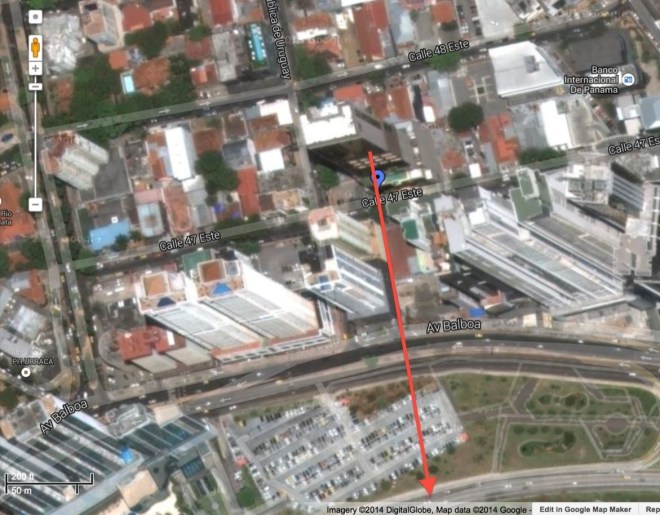
My best guess is that this is taken from Calle Uruguay in Panama City, Panama looking out onto Av Balboa/Cinta Costera, the building on the right is the Hotel de Meridien, on the right just past this is the Club de Yates and in the distance is the Causeway. Taken in rainy season (although that makes up 9 months of the year!). Whoever took this will be enjoying the non-rainy, less humid, and slightly breezy time of year now. Other than the crazy taxi drivers, I wish they would have captured a Diablo Rojos for you!

Many readers correctly guessed Panama City, and several knew the exact building:

The view photo looks south from the Waldorf Astoria Panama located on Calle 47 Este in Panama City, Panama.  Lining up sight lines to the neighboring buildings from TripAdvisor traveler photos taken at the 7th-floor pool level and one from the 15th floor, I’m guessing that the view photo comes from the 12th or 13th floor. Let’s go with room 1320 just for kicks. From the 15th floor:

correct-guesser-panama-city

I admit to getting a bit lucky on this one; it could easily have taken up hours, but I found it, amazingly, in about 20 minutes.  The palm trees said tropics.  The shore showing a lower tide level along with the calm waters and heavy boat traffic said port/bay.  My first thoughts were maybe somewhere in the Caribbean, or Africa … so not too much to narrow it down.

I actually started with a Google search on “port city bay Africa” which returned a number of links for Port Elizabeth and Nelson Mandela Bay.  So that’s where the search began, halfway around the world from the actual view location.  I knew the distant islands/land mass with large buildings shown in the view would be a pretty good tell-tale.  Quickly I was zooming out my satellite map search beyond Africa and spinning the globe to check out the Caribbean … first Cuba, then Jamaica, then I moved over to Central America.  Panama came into view first, zooming into Panama City it all came together.

The twin islands, Perico and Flamenco, part of what I now know is the Amador Causeway, looked promising and I moved on to scanning the shoreline for the buildings shown in the view.  Soon I was plotting hotels, and the Waldorf Astoria proved to be the one.

Thanks for giving me a good diversion and a weekly nudge toward a self-imposed lesson in geography!  My wife has started ribbing me with Carmen Sandiego jokes for my contest efforts. I’m thinking next week I’ll have to get our three-year-old daughter in on the fun!

An aerial view:

unnamed

Another reader:

After years of reading the site, I finally got one. I recognized this immediately – and it probably didn’t hurt that I’m stuck in frigid Boston waiting for my Panamanian girlfriend to return from Christmas with her family. Their apartment’s view isn’t too far off from this one.

Another reader with ties to the country:

I have lived on and off in Panama since 1976, first for two years straight and then for month-long visits. I was last there from September to December, 2007. The changes to the urban fabric have been mindboggling. When I left, none of the waterfront highway extension – ciclovía, costera throughway, and parking lots – existed, nor indeed had their construction begun. Neoliberalism unbound produces a whole new cityscape of highrises that keeps expanding up and out. Happily the former US Fort Amador complex, once off limits for many years to all but a few US servicemen – and then to strongman Noriega and a few of the Panama Defence forces – is now open to all; and people throng there, especially on weekends. From it you have a view of a forest of high-rise towers across the bay that bids to eclipse Miami.

Another view from above:
panama city, bella vista

Of all the people who guessed the Waldorf, six have guessed correctly in previous contests without winning. Our winner this week just missed the right room number:

waldorfviewI think the picture was taken from the new Waldorf Astoria, at 47th and Uruguay St. The building seen to the right is the Villa del Mar apartment complex. Here’s a picture from Trip Advisor with almost the same view. Trying to guess a room/floor which would be easier with more ground-level images but I’m not finding any Google Street View available. I found another very close view a little to the right that was from 1211, so I’ll guess room 1209.

Have a happy New Year!

And a Happy New Year to all of our contest followers.  As a year-end bonus, we made a map of all contest entries from 2013:

Screen Shot 2013-12-31 at 1.15.19 PM

Zoomable version here. From the submitter of this week’s photo:

I’m a former winner (contest #73, Benghazi) and wanted to contribute for either the contest or just the regular daily view from your window. The picture was taken from Room 1207 at the Waldorf Astoria in Panama City, at the corner of Calle 47 and Calle Uruguay (there is no street number).

As for the story behind the photos, I’m nearing the end of an almost-around-the-world trip – I start a new job in January and quit the old one at Thanksgiving in order to give me some vacation time. I’m blogging about the trip here (my blogroll link to the Dish has hopefully resulted in at least a few new visitors to your site). I spent two minutes in North Korea at the DMZ, ran across some undercurrents of dissent in Shanghai (as well as a lot of non-religious Christmas displays), had a nasty ferry ride out of Macau, caught a piranha in the Amazon rainforest (where I came upon some remote oil installations), and had a few other adventures.

Even the VFYW grand champion, Doug Chini, missed the hotel room number; he went with 1212. But he was playing with a handicap this week:

I only had an hour or two of free time to search and I was fighting a toothache so strong that it had me squinting with my right eye closed. Pro tip: one-eyed-view hunting, not a good idea.

(Archive)

The Internet Hath No Vengeance Like Google Scorned

screen shot 2013-12-31 at 8.54.50 am

Last week, the search giant punished rapgenius.com for trying to game its algorithm by scrubbing the site from its search results. Jay Yarow ponders the news:

It’s pretty crazy that Google can just do this to a company. How is this legal? Google is so essential to so many companies, and yet it’s virtually unregulated and can do what it wants to decimate a company. Rap Genius had better have been committing some seriously shady SEO tricks to get this sort of a punishment. Otherwise, this seems unfair.

This has to scare the crap out of Andreessen Horowitz which invested $15 million in Rap Genius. It’s not just that Google has nuked Rap Genius. Its Google rank will come back in time if it’s on good behavior. It’s the fact that Google can flip a switch and destroy Rap Genius. As Danny Sullivan noted when the Rap Genius mess kicked up, “it’s probably an incredibly dumb business model to be doing a lyrics site that hopes for Google traffic in a time when Google, like Bing, is moving toward providing direct answers. Lyrics, to my understanding, often have to be licensed. That makes them a candidate for Google to license directly and provide as direct answers.”

Alec Liu speculates as to how Rap Genius pissed Google off:

Google likes to flaunt the notion of transparency when it suits the company, but is decidedly opaque when it comes to its proprietary search algorithm. It’s the secret sauce after all, so we’ll never know for sure what Rap Genius did to induce the wrath of the SEO gods. But there’s enough evidence to make an educated guess, including this Facebook update, since removed, posted two days before Christmas.

Enterprising bloggers that took the bait received a friendly email from Mahbod Moghadam, one of Rap Genius’s co-founders, promising “MASSIVE traffic” if they were willing to insert some code into their posts. Google’s search rankings are based partially on the number of sites linking into the site in question, based on the valid assumption that sites that get linked to often are of higher quality than those that don’t. It’s a basic tenet of search engines everywhere, and attempts to game that principle—for example, by asking other people to link to a spammy smattering of your posts, rather than linking because your posts are actually useful—largely died out years ago.

Yglesias sees value in Google punishing sites that try to game its algorithm. But:

Google isn’t just a lucrative company with some popular products. It’s a powerful company whose Web index and search algorithm are part of the critical infrastructure of 21st-century life. Antitrust law to an extent constrains Google from using its power over search to advance Google’s other business interests. But Google apparently feels comfortable zapping a company like Rap Genius. There’s a lot of wiggle room here. What if executives start pursuing personal vendettas via the search process? Back in the old days of the telephone book, I take it that Ma Bell wouldn’t have been allowed to just make some particular business “disappear” from the white and yellow pages.

“R.I.P. The Blog, 1997-2013”

Kottke argues that the once-relevant medium has evolved into something new and disparate:

Instead of blogging, people are posting to Tumblr, tweeting, pinning things to their board, posting to Reddit, Snapchatting, updating Facebook statuses, Instagramming, and publishing on Medium. In 1997, wired teens created online diaries, and in 2004 the blog was king. Today, teens are about as likely to start a blog (over Instagramming or Snapchatting) as they are to buy a music CD. Blogs are for 40-somethings with kids.

Instead of launching blogs, companies are building mobile apps, Newsstand magazines on iOS, and things like The Verge. The Verge or Gawker or Talking Points Memo or BuzzFeed or The Huffington Post are no more blogs than The New York Times or Fox News, and they are increasingly not referring to themselves as such. … Sites like BuzzFeed and Upworthy aren’t seeking traffic from blogs anymore. Even the publicists clogging my inbox with promotional material urge me to “share this on my social media channels” rather than post it to my blog.

He elaborates on his “deliberately provocative” argument:

[A]s someone who’s been doing it since 1998 and still does it every day, it’s difficult to ignore the blog’s diminished place in our informational diet.

Through various blogrolls (remember those?) and RSS readers, I used to keep up with hundreds of blogs every day and over a thousand every week. Now I read just two blogs daily: Daring Fireball and Waxy. I check my RSS reader only occasionally, and sometimes not for weeks. I rely mainly on Twitter, Facebook, Digg, Hacker News, and Stellar for keeping up with news and information … that’s where most of the people I know do their “blogging”.

How longtime blogger Om Malik sees it:

[W]hile I embrace every new social platform with gusto, I find it frustrating that my point of view is spliced across various networks. I think the blog is the one that ties it all together — a central location where you fit together all the Lego pieces. In many ways it is no different than what blogs used to be in the beginning. Instead of them being a starting point of the journey, they are now the final stop, a digital home in our social media meanderings. Marc Canter,came up with a concept called “digital life aggregators.” And he was right — blogs are just that, digital life aggregators.

My own take on “the death of blogs” is here.

Mangling A Myth, Ctd

Readers sound off on the latest installment of The Lord of the Rings, picked apart by critics here:

Allow me to summarize: Peter Jackson 2013 = George Lucas 1999 (the year The Phantom Menace debuted). The only thing missing from the Hobbit films is a clearer analogue to JarJar Binks.

Another:

I figured out why the adaptation of The Hobbit has left such a bad taste in my mouth from the moment I learned that it would be expanded to a three-part epic. Put simply, The Lord of the Rings was Peter Jackson’s masterful homage to J.R.R. Tolkien and his works. The Hobbit is Peter Jackson’s masterful homage to Peter Jackson.

Another:

This can all be boiled down to a single word: Greed. Jackson is taking a single, not particularly long book and turning it into three movies because he can make three times as much money that way.  He HAS to change stuff, a lot of stuff, to stretch it out that much.  There simply isn’t enough material in the book to make three movies.  Even the stuff he is pulling from the LOTR appendixes to try to cover his money-grubbing ass was in the appendixes and not in a revised edition of The Hobbit for a reason – Tolkien thought they detracted from the tightness of the story of the Hobbit and/or distracted from the message he was trying to convey.

Another is much less critical:

This past fall, my son and I read The Hobbit out loud over about a month as our bedtime story. This past weekend, I took him and three of his friends to see latest installment of The Hobbit for his birthday. None of the other three children had read it prior and now they are ALL reading it with their parents. That seems like a big win to me.

Several Tolkien fans scrutinize the film versions at length:

As someone who knows the entire story of LOTR about as well as any “layman”, I have always understood that any attempt to visualize the series is not going to be verbatim, and I can accept that because moviemaking is simply a different way of telling a story. I recognize that Warner Brothers is more in the business of making money than making movies, so I understand why Legolas has such a huge presence in a film based on a book he was never mentioned in, after three films where his status was raised from being one of the Fellowship to a super-soldier capable of singlehandedly slaying an oliphaunt.

Some variations of the story I didn’t mind: no one would ever dare to film the chapters that include Tom Bombadil, for example. And I thought giving Arwen a larger role in LOTR was a good thing, she’s barely mentioned in the trilogy and only says a few lines near the end. You need to go to the appendices to get more background on her. Mostly I disliked making Gimli little more than comic relief in terms of characters. And if they want to make a movie where young girls can masturbate to Legolas, just cast him as the lead in a romantic action film and be done with it.

But as a moviegoer looking at the films as films and disregarding the casual disregard for the actual story, I think all five of the films (and yes I’ve seen them all, but once only – like watching a car crash) have been just awful. Far too long with far too much reliance on effects for the sake of effects, particularly all that damn slo-mo fighting. In Desolation of Smaug, the long, drawn out battle as the dwarves ride down the river towards Esgaroth was extremely annoying, never mind that no such event took place in the book. I kept saying to myself “Christ, get to the town already!” Frankly, Rankin-Bass did a better version of the story.

A scene from that version is above. Another reader:

Jackson’s Fellowship of the Rings trilogy was spectacular as filmmaking and wholly missed Tolkien’s point from the books. Tolkien starts and ends his story with small unassuming hobbits – gardeners with woolly feet – who till the earth they live in and are quite afraid of anything non-Shire. They are not supposed to be heroes, unlike Gandalf, Aragorn, Boromir, Legolas, etc. But it is to the hobbits Tolkien assigns the hero’s quest – leaving their homes, facing obstacles seemingly beyond their measure, enduring hardships, and then returning. And it is the last part, the return, that Jackson misses entirely, and thus misses Tolkien’s point. When the hobbits arrive home, their home too has been ravaged. The outside world has reached in and destroyed their previously inviolable, safe and secluded part of the world. They must take what they have learned and fix their own homes, their own community, their own land. They have to drive out Sauroman and his henchmen. Jackson eschews (or simply misses) this and instead focuses on the parallel story line of Aragorn, essentially finishing up the movie with his coronation. Tolkien drives his point home by slowly peeling off the members of the fellowship as the hobbits return home, until they are alone, just the four. And then the razing of the shire ensues. Tolkien is reminding us that we need to “tend our own gardens” too.

As an aside, I was heartened, thinking that Jackson had understood this point, when during the Galadriel’s mirror scene Jackson depicts the Shire being burned down. I thought at the time he would then finish the trilogy both in keeping with Tolkien’s writing, and more importantly, with his meaning. He of course didn’t. The hobbits come home and all is well except Frodo has to look winsomely off a ship as a he sails away into a gossamer sunset and the other hobbits return home to the imperturbable Shire. Crapity crap crap. Jackson’s trilogy has no moral compass, only a series of arduous tasks demanding incredible endurance. (Did I mention I liked it as a movie though?)

Another:

Well of course Jackson’s approach to the Hobbit mangles it! All you need to do to understand why that’s so is read it with the eyes of an adult. Immediately it’s very apparent that The Hobbit was specifically written as a fairy tale, a myth specifically written for children. What Tolkien really wanted to publish was parts of what his son ultimately collected and published in his late father’s name as The Silmarillion, but no publishing house would consider the idea when he proposed it because no one had ever published such a work before and so there was no way to know if there was a market for such a book. One publisher was willing to publish a children’s story if he’d write one, so he reluctantly did so and named it “The Hobbit”. If I recall correctly, it had a sufficiently successful reception for the publisher to ask him to write a sequel. Tolkien began the sequel truly as a follow-up children’s story to The Hobbit, but as he went along the story that came out of his fingers became less and less a children’s story, and more and more a part of his beloved Silmarillion. That’s why the first third to a half of The Fellowship of the Ring clearly reads as “a children’s story”, but after that it reads more like a saga.

Where Jackson goes wrong in honoring Tolkien’s work is he’s taking that children’s story and treating it as though it was every bit as much of a saga as The Lord of the Rings. (If he has any sense he won’t ever try to make a movie of The Silmarillion! It’s just too much for a movie. You could easily make several different, unconnected movies from its material.)

One more:

I won’t wade into the debate directly, but anyone who thinks Tolkien’s original Hobbit required additions in order to become great drama really should listen to Nicol Williamson’s 1974 audio version (click on “VBR ZIP” to download all the MP3 files in one fell swoop – and be patient, it takes a few minutes.) The recording doesn’t want for excitement; it doesn’t add anything, and in fact takes a great deal away, necessary to limit the recording to four hours’ length; but it retains all the subtle shadings of the characters, and the story’s essential emotional heart, which is the feeling of being small and scared in a big, scary world – and facing those fears. That’s something Jackson never, ever gives a thought to.

Plus, take it from experience, this is the best road-trip story for kids: it guarantees four hours of rapt silence in the back seat … though parents will be surprised to find themselves hanging on every word, too.