“The Worst Of The Worst”

The last three of 22 Uighur detainees, held at Gitmo for over ten years despite the government’s knowledge of their innocence, have been freed after Slovakia agreed to repatriate them. Serwer explains how domestic politics enabled this miscarriage of justice:

“Let’s be clear: these terrorists would not be held in prisons but released into neighborhoods,” [Republican Congressman Frank] Wolf said. “They should not be released at all into the United States. Do members realize who these people are? There have been published reports that the Uighurs were members of the Eastern Turkistan Islamic Movement, a designated terrorist organization affiliated with Al Qaeda.” Former House Speaker Newt Gingrich said the Uighurs “instructed by the same terrorists responsible for killing 3,000 Americans on September 11, 2001.” He then urged Obama to send them back to China. One of the prisoners responded to Gingrich through their attorney: ”Why does he hate us so much?”

A U.S. federal court had ruled in 2008 that the detention of the Uighurs was baseless and that they were not terrorists or “enemy combatants” – something that, according to [Daniel] Klaidman, the government had already known for at least five years. The court also questioned the government’s designation of the East Turkistan Islamic Movement as an ally of the Taliban and Al Qaeda, which Mother Jones’ Stephanie Mencimer writes was motivated by the Bush administration’s desire to shore up Chinese support for the invasion of Iraq, itself based on a falsehood. Judge Ricardo Urbina, who ordered the Uighurs be resettled in the U.S. in 2008 after determining they posed no threat to America (a ruling later blocked at the request of the Obama administration) told the Miami Herald that “there was not a shred of evidence that they were disliked by anyone — anyone but the Chinese government.” Don’t forget Wolf and Gingrich.

Our allies weren’t very helpful either:

The Bush Administration contacted more than 100 countries, almost all of whom refused to help either because they did not want to help the Bush Administration for political reasons, or because of Chinese threats to cut off trade relations.  If other countries had been more willing to help close Guantanamo (rather than simply to criticize the United States), the Uighurs would have been released long ago.  The Obama Administration’s first Guantanamo Envoy Dan Fried worked extremely hard to resettle the remaining Uighurs and succeeded in transferring another 14 in the Obama Administration’s first term.  In 2009, I wrote that it would be helpful to resettle at least some of the Uighurs in the United States; I continue to think that they would not have posed any more of a threat to this country than to the six countries that have agreed to take them. The sad story of the Uighurs demonstrates why the issues surrounding both the opening and the closure of Guantanamo are more complex than many critics believe. Cliff Sloan and Paul Lewis should receive bipartisan support in Congress for their efforts to reduce the detainee population at Guantanamo, and Obama Administration officials should resist the temptation to politicize their work.

But Ryan Cooper places the blame primarily on the GOP:

When it was clear even to the Bush administration—Bush himself said the prison should be closed—that these people had been rounded up by mistake, and they were being deprived of their freedom for no reason, the response of the demagogues—and eventually the entire Republican establishment, and most of the Democratic one, was to deny the administration the funding to close Guantánamo. Make no mistake, the Democrats are no heroes here. But publicly denouncing out-groups known to be innocent of any crime is one of the most evil things it is possible for a politician to do.
Curses! Ctd

Some linguists assert that swearing aided the evolution of language:

To understand why, consider a certain type of grammatical construction called an exocentric compound. This involves cramming a noun and a verb together to create a new term, but without one necessarily modifying the other. As [linguist Ljiljana] Progovac puts it, “A scatter brain is neither a type of scatter, nor a type of brain.” Conjuring the idea of this person’s disorganized thoughts requires an extra leap in logic compared to a phrase like “navy blue” – in which “navy” more straightforwardly modifies the description of the color. Exocentric constructions are rare now, but were thought to be more common in the past, leading some to consider them linguistic fossils of our first stabs at grammar.

But when [linguists John] Locke and [Ljiljana] Progovac examined these fossils in English and Progovac’s native Serbian, they found that they were often teasing or downright insulting.

“Fuckwit” and “shithead” are two examples that survive in English, while they found insults like “shit-sword,” “fart-rabbit,” and “no-wash-underpants” in Serbian. As a result, the researchers wonder if the construction first evolved in verbal duels, as our ancestors competed to come up with more creative curses. “What we are saying is that the ability to build abstract words was enhanced by the creation of these types of insults,” Progovac says.

They point out that the practice of “flyting”  exchanging humorous insults in public – has been recorded throughout history in works such as the Iliad and Beowulf. In some ways, they say, it is simply an extension of the vocal duels shown by other primates, in which the males size each other up with their calls. If the most creatively vulgar men were viewed as more dominant, sexual selection might have pushed us through further linguistic evolution.

Previous Dish on obscenities here, here, and here.

An Unhappy New Year For The Unemployed

Last Saturday, unemployment benefits expired for 1.3 million Americans:

A record-low 25 percent of unemployed Americans will receive benefits now that Congress has allowed the federal program to expire, according to data from the Department of Labor compiled by House Democrats on the Ways and Means Committee. The number is the lowest since the Department of Labor began keeping records in 1946. Before Congress let the federal unemployment benefit-assistance plan expire on Dec. 28, 38 percent of unemployed Americans who paid unemployment taxes were receiving unemployment insurance either through their state or the federal government.

Unless Republicans agree to extend benefits, the number will continue to fall:

Nearly 72,000 people will lose unemployment benefits each week on average in the first half of 2014, according to new estimates released by House Democrats. Roughly 1.3 million Americans no longer receive those benefits as of Saturday. In total, an additional 1.9 million Americans could lose their benefits in the first six months of the new year, according to the estimates, if Congress doesn’t vote to extend the Emergency Unemployment Compensation program. Congress has voted to extend the program 11 times since its inception in 2008.

Chait expects the GOP to do nothing about this crisis:

Both parties have fairly well-defined ideas about the general role of taxes, spending, and regulation. The difference is that the Democratic Party also has a policy agenda that is specifically related to the special conditions of high unemployment and low interest rates.

The Republicans are still merely asserting that their normal agenda applies just as well now as ever. The unique, dire conditions of the Great Recession shouldn’t be expected to undo all the party’s program, or to alter its general long-term ideas. (Democrats have not, and should not, given up their preference for universal health insurance, reduced greenhouse gas emissions, and so on, nor should Republicans have to abandon their preference for the opposite.) What they lack is any legislative response to the economic crisis. They just want to get back to normal, and since normality has not arrived, they’d just as soon pretend it has.

Barro made related points in the middle of last month:

As with many economic issues, there is a gap between conservative wonks and conservative policymakers. Many conservative economic policy wonks break with the Republican party by favoring one or more recession-specific economic policies. Economists Luigi Zingales and Glenn Hubbard have called for aggressive programs to modify mortgages. Scott Sumner, David Beckworth, Josh Hendrickson and others have promoted monetary intervention to combat recessions. Michael Strain has promoted a suite of reforms, mostly aimed at the labor market, that would aim to cut unemployment in recessions.

But acceptance of these policies among actual Republican policymakers is near zero. The standard Republican answer for what to do about a bad economy is the same as their answer about what to do about a good economy. As with health care and bank regulation, economic recessions are a policy question to which conservatives have not the wrong answer, but no answer.

The GOP Stops Evolving

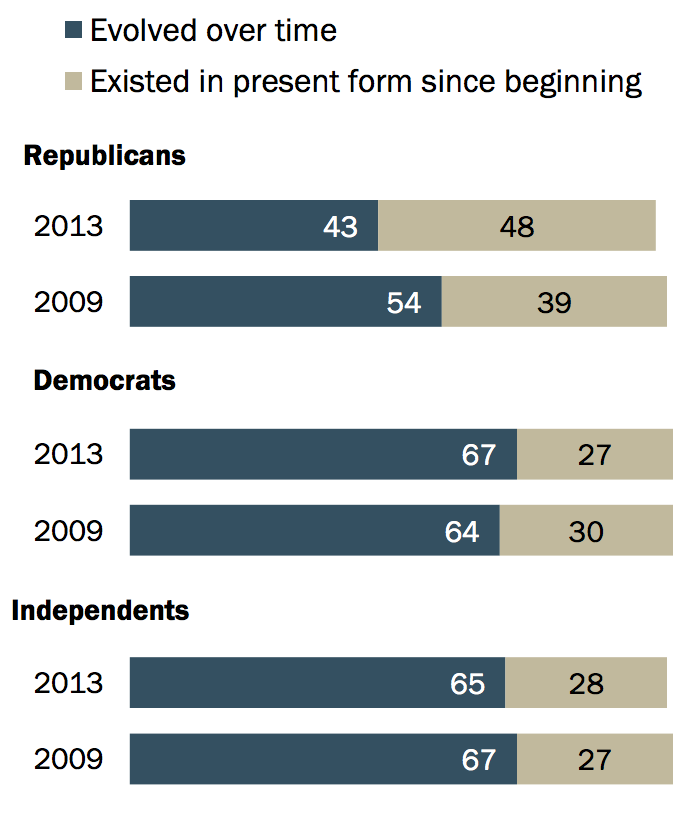
According to Pew, more Republicans deny evolution than they did five years ago:

Evolution By Party

David A. Graham ponders the cause of the problem:

One possibility is that respondents who identified as Republican and believed in evolution in 2009 are no longer identifying as Republicans. Fewer scientists, for example, are reportedly identifying with the GOP, and the overall trend is for fewer Americans to call themselves Republicans. But both Gallup and separate polling from Pew found approximately the same party ID in 2009 and 2013. Another is that the rise of “intelligent design” education has helped to swing younger Americans against evolution. Yet the age breakdown remains similar in 2009 and 2013, with respondents ages 18 to 29 most likely to believe in evolution.

What does that leave? Maybe the gap represents an emotional response by Republicans to being out of power. Among others, Chris Mooney has argued that beliefs on politically contentious topics are often more rooted in opposition to perceived attacks than anything else—an instance of “motivated reasoning.” Given that Democrats have controlled the White House and Senate since 2009, this could be backlash to the political climate, though it will be hard to tell until Republicans control Washington again.

Zack Beauchamp weighs in:

A wealth of research into political psychology shows that people’s partisan affiliations affect their beliefs on basic facts.

Republicans are overwhelmingly more likely to think the economy is doing well when Republicans hold the Presidency, and ditto with Democrats when their guy holds the White House. A recent experiment found that even basic math is contaminated by politics; people are much more likely to correctly solve basic math problems when, in context, solving them correctly helps rather than hurts their party.

In the evolution context, this suggests a feedback effect at work among Republicans. As the GOP becomes more associated with the creationist cause as a consequence of demographic shifts, Republicans start to feel more like being skeptical of evolution is their “team” position. So even Republicans who are demographically more likely to accept the basic science of evolution start to reject it, because that belief best harmonizes their beliefs with the perceived interest of their political party.

Allahpundit notes that “Gallup detected movement away from the creationist position among Republicans over roughly the same span that Pew was detecting movement towards it.” But he acknowledges that Pew’s numbers might be correct:

[M]aybe this is a simpler partisan impulse, where contempt for the political worldview as personified by the president bleeds over into some people’s judgments about perennial cultural disputes too. Wouldn’t surprise me to find support for evolution among Democrats rising a few points once the next Republican president takes office. It’s a defensive impulse against a political opponent who’s taken power, whether that impulse is really justified or not.

Black And White Cinema, Ctd

Shani Hilton rejects the idea that 2013 – which saw the release of 12 Years a Slave, The Butler, Fruitvale Station, and Best Man Holiday – marked a watershed moment for black films:

[H]onoring the achievements of black filmmakers by declaring it “their” year does them a disservice. Lumping together heavy dramas with lighthearted romcoms simply because of the skin color of the actors or director prevents these films from being measured against the whiter counterparts that actually share their genre — inadvertently ghettoizing the former and protecting the latter from scrutiny. It’s difficult to imagine pulling, say, Blue Is the Warmest ColourThe Great GatsbyThe Hangover Part III, and The Fifth Estate into a story declaring 2013 the year of the “white movie.”

Aisha Harris calls for more focus on films that show that “there is much more to life as a modern-day black individual in America than the legacy of slavery and the struggle for civil rights”:

Several fictional films about contemporary black life were released this year, although most of them got little attention compared to the likes of Fruitvale Station, et al. Mother of George, The Inevitable Defeat of Mister and Pete, and Big Words, for instance, all received critical praise. … These are not nostalgic movies. And they are not about slavery, civil rights, or police brutality. But that doesn’t make these films any less thought-provoking. Maybe if we champion them today, more movies like these will get made tomorrow. I hope so.

Harris recommends Terence Nance’s An Oversimplification of Her Beauty (trailer above). Previous Dish on the subject here.

Male, Female, Or Neither?

Emily Greenhouse discusses the changing landscape of intersex rights in Germany:

In early November, Germany—which, in part to combat the legacy of the Third Reich, has deliberately asserted the rights of marginalized groups—became the first country in Europe to allow a third gender designation: X, for indeterminate or intersex. (Australia introduced a similar measure in July.) If a baby is born with ambiguous sex characteristics, it won’t be forced to undergo a normalizing operation just so that nurses can tick “male” or “female” on its birth certificate. The legal acknowledgment of a third category should mean that fewer doctors urge parents to have sex-assignment surgery performed on their newborns. Fewer children should suffer the plight described by one person quoted in a report that helped lead to the new law, a German born with ambiguous genitalia in 1965, who spoke of being a “patchwork created by doctors, bruised and scarred.”  …

While certain religious groups argue that sexuality is a choice (and certain sexual lifestyles are therefore sinful), no one makes that argument about biology, which might suggest a certain logic to granting rights to genetic difference before sexual preference.

Jacinta Nandi approves of the new law:

[T]he new policy regarding intersex children is a necessary attempt to remedy a situation that, up until now, has been horribly difficult.

Previously, German parents had just a week’s time to decide whether their intersex children were male or female, and register them appropriately at the standesamt or registry office. The pressure on parents meant decisions would often be made in a state of panic and frequently lead to forced medical operations in the genital area. … Now, the German government and legal experts are keen to stress that this third blank box isn’t an official third gender, or the “other” box – so it doesn’t actually mean that there are now three recognized genders in Germany. It’s seen as a temporary solution for very specific intersex cases – the children aren’t expected to live their lives as X’s, but to make a decision to be male or female at a non-specified point in the future. However, many people view this decision, based on a review by the German Ethics Council, as a huge victory for intersex children. And it really is quite a momentous decision, especially when you consider that up to this point in time, intersex people haven’t had any legal recognition on European birth certificates whatsoever.

Hida Viloria argues that the law gives intersex Germans fewer rights, not more:

While it’s been widely reported that the law gives parents a new “choice” or “option,” it’s clear that the designation is mandatory. As OII Europe, the European affiliate of the Organization Intersex International (the world’s largest intersex advocacy organization), elaborates: “Who determines that a child ‘can be assigned to neither the female nor the male sex’? According to current practice: only medicine. The power to define what sex is and who is assigned to which gender remains intact with the new regulation.” Some claim this will help by giving parents more time to decide whether to label their baby male or female, but since the law states that babies with intersex bodies can not be labeled male or female, the only way for parents to attain those labels for their child will be through the use of “normalizing” genital surgeries. Surgeries deemed so harmful that the United Nations Special Rapporteur on Torture recently called for all member states to ban them. Intersex people in Germany and around the globe have been calling for this ban for decades. However, rather than banning intersex genital mutilation, the German government instead created a law that local intersex advocates believe puts intersex babies at greater risk of being subjected to it.

Nelson Jones points out that intersex people’s challenges extend well beyond the legal:

This is the core of the problem. On one level, humanity has become a great deal more enlightened since Roman times, when the birth of a “hermaphrodite” might be interpreted as an omen of war or natural disaster and the child was liable to be exposed, or since the Middle Ages when such an “unnatural” birth could be seen as evidence of the sin and perversion of the parents. Modern science recognises that biology in its infinite complexity doesn’t care about the neatness of human thinking with its love of binary categories. Being of indeterminate gender is not in itself a disability. …

The problem with surgical intervention isn’t just the theoretical one that it violates the integrity of the body but the practical one that the doctors might well make a mistake. The answer, say campaigners, is to hold off both legal gender assignment and surgery until the child is old enough to make up its own mind as to whether it’s a boy or a girl – or something in-between. Yet such a child, in our gender-obsessed culture, is likely to feel confusion and face prejudice. The stigma of “abnormality” can cause deep psychological scars: every child has a right to feel normal, and social expectations of gender can make it difficult to feel normal in a body that is not unambiguously male or female. Tackling that will be a much larger problem than a simple bureaucratic fix.

Howling About Wall Street, Ctd

A reader rolls his eyes at the film’s critics:

The Wolf of Wall Street mocks its Masters of the Universe mercilessly. They’re dumb, they’re vulgar; even Jonah Hill’s teeth are tacky as hell. The film is a comedy and its characters are the butt of the joke. If someone looks at this film and thinks those guys with their vintage Quaaludes are cool, that’s on the viewer, not Scorcese. In the end, when the FBI agent is riding on the train, Scorcese isn’t mocking him; the director is telling us, the rest of society, that we’ve got it wrong.

That’s the biggest joke of all, really. People are so wired to respond to money and luxury that they can’t comprehend a picture of wealth and success might not be flattering. We’re in it so deep the humor is lost on us.

Another singles out Yglesias:

I’m not sure where he got the idea that it’s a Hollywood director’s job to make movies that educate the public about Wall Street dealings, but I thought it was pretty obvious that Scorsese’s film makes little or no distinction between legal and illegal thievery. The early scenes with Matthew McConaughey establish that everything his firm was doing was legal, but it was the same practice DiCaprio uses later: same mentality, same coke-fueling, same tricking of clients. It’s all thievery!

Another compares The Wolf of Wall Street to other Scorsese films:

The movie is vastly entertaining, a tremendous comedy. But I can’t imagine anyone leaving it and not saying “These are some fucking horrible people.”

On some levels they’re worse than the gangsters in Goodfellas, even though there are no bullets in the head in this one. But like Goodfellas, Wolf glamorizes a certain lifestyle not because it is a preferable way of life, but because it is a tempting one. Scorsese – ever a Catholic filmmaker – has made a career exploring the various forms of temptation. That could be flouting the law in Wolf or Goodfellas, turning to vigilante justice in Taxi Driver, or – like Jesus faced in Last Temptation of Christ – simply being a normal person.

Another is close to the subject:

First of all, let me admit to being a (completely drug-free, commuter-train riding) Wall Street employee. I must say that I’m incredibly annoyed by this whole debate about the movie and the question of what’s wrong on Wall Street. The fact that this “wolf” sold penny stocks is really not relevant to the story. He could have been selling oil royalties or timeshares or Nigerian lottery winnings. He’s a talented salesperson without any morals preying on people’s desire to get rich quickly. And it takes three loooong hours to depict this.

The real Wall Street debate is a very complex one: if our financial system takes no risk, there will be no growth capital for the economy, and if there’s too much risk, there is systemic risk to the taxpayer. How do we find the balance? How do we foster “normal risk” while containing “catastrophic risk”? Those are difficult questions. Given that the “Wolf” stopped himself when explaining what an IPO is, we can’t expect a lot of help from Mr. Scorsese, I’m afraid.

Another reader:

Jordan Belfort of the film is a masterful salesman; I imagine the real Jordan Belfort is no different. His book, and subsequently the film, are simply the next steps in doing what he does best. He pulled the wool over the eyes of investors, his employees, and the attentive audiences at the seminars he held. I cannot help but think that the film audience is simply the next in line.

And then what? A reality show? Another reader suggests he’s getting some help from a familiar face:

Take a look at the appalling YouTube video of DiCaprio [seen above] in which he personally endorses Belfort. Was this the price paid for access to the guy? The words spoken by DiCaprio sound like copy for an informercial. Very creepy.

When Do The Obamacare Delays Stop?

Yuval Levin believes that “the individual mandate is probably done for”:

I would now assume that no one will pay the individual mandate fine for 2014. The administration may give up on the mandate in the course of the ongoing enrollment period if the political pressure is great enough, or they may keep up the pretense of it through the end of the enrollment period in March (when it will have finished its work, so to speak, since its purpose is to influence choices made during that period) but then exempt everyone from it as they did with the employer mandate for this year. Having now exempted from the fine people whose policies were canceled and who haven’t spent the money to get more expensive and less appealing new coverage, the politics of still applying the fine to everyone else who is uninsured this year will probably just not be sustainable, and the politics of exempting people from it (especially if they can hold out on doing so until after March 31) will be far too appealing for this White House to resist. They may claim the mandate will be back in 2015, but if they do exempt everyone from it in 2014 it will be hard to bring it back.

McArdle agrees:

If the administration had been resolute in the face of early complaints, and had stuck to the rules it wrote before October, then it would be in a stronger position to deny the next round of complainers. But it hasn’t.

And each round of special exceptions makes denying the next one harder: “The president was willing to help them, but not us! What’s wrong with us? Doesn’t the president care about people like me?” When you stick to the rules for everyone, you are not making any particular statement when you enforce them in an individual case. But when you start carving out exemptions on the fly, each individual case becomes a referendum on how much the Barack Obama administration cares about [the middle class/small-business owners/writers/early retirees/insert your group here]. And the president cannot afford to tell anyone that he doesn’t care about their problems. So I find it hard to believe that the mandate, or the clawback of overpayments, or any other rule that might upset people, will be enforced for 2014. And of course, that makes it more likely that none of them will be enforced, ever.

 Adrianna McIntyre weighs in:

The one thing that could still be a huge blow to the law is a full delay of the individual mandate, which HHS could maneuver by expanding the recent “hardship exemption” to include those who were uninsured. I’m not confident that’s off the table yet—especially considering that some state exchanges are still struggling—but if the administration does offer a blanket delay, I don’t think we’ll see it until the end of open enrollment. The reasons are both pragmatic and strategic: we can’t know the extent of “hardship” until enrollment wraps, but we also know that people tend to sign up just under the wire. Massachusetts illustrated this, and so did enrollments before the “soft deadline” this week, if the limited data we have so far is any indication.

A one-year mandate delay is also something the exchanges could probably recover from. I’m more bullish on this than others, but that possibility was the original context of my “risk corridors” post; the risk adjustment mechanisms are in place for three years. Moreover, the penalty is weak enough in the first year ($95 or 1% taxable income, whichever’s higher) that I’m not sure that enrollment will be meaningfully different with or without a mandate in the first year. This is doubly true if a mandate delay were to be announced late in the game, when most of the people who would have signed up will have signed up.

The View From Your Window

Rome-730 am

Rome, Italy, 7.30 am.

Update from our reader:

I saw that you posted my picture. I’m really quite floored – thank you! Today at Vatican City was amazing. A little background: I’m not Catholic, and were it not for Pope Francis, not only would I have not been interested in seeing the Pope, I would have made a point of avoiding any celebration of him. My opinion of the Catholic Church was, given its history of sexual and financial abuse, pretty much rock bottom, but Pope Francis has changed that. (BTW, I made a point of reading your Deep Dish on Francis before we left on this trip.)

Our accidental encounter today with the Pope:

We thought we had tickets for the Vatican Museum, but my husband had the day wrong. So we got into line for what we thought was a tour for St. Peter’s Basilica … turns out we were in line for the Papal Mass in the outside seating area, so we stayed and watched the mass from nearly front row seats on a big screen just outside the Basilica (my first Mass). Afterwards, we were in a great location to see Pope Francis give his New Year’s address live on his balcony (our binoculars helped). Needless to say, the crowd was huge and amazing. Wonderful experience, especially since none of it was planned.

My family is a funny group religion-wise: my husband is agnostic, my daughter evangelical, my son an atheist, and me … I come under that fuzzy heading of “spiritual and seeking” but turned-off by organized religion (actually, turned off by Christianism, to use your term). I had a lot of thoughts today about religion and its purpose in people’s lives which I hope to jot down when I return from vacation. Not sure it would be anything significantly new, but I may send it your way. Why? It was your Time article “When Not Seeing is Believing” that brought you into my life almost 8 years ago, and you have been an almost daily presence since.

Lighting Up In Latin America

As Roberto Ferdman informs us, “It’s barely been a month since Uruguay moved to legalize marijuana, and yet the effects of the decision are already being felt well outside of its borders”:

Neighboring Argentina, a long-time proponent of keeping marijuana illegal, gave its first indication that Uruguay’s pivot has tempted it to at least consider legalizing the drug. The recently appointed head of Argentina’s counter-narcotics agency, Juan Carlos Molina, admitted as much in a recent radio interview (link in Spanish). “Argentina deserves a good debate about this. We have the capacity to do it. We shouldn’t underestimate ourselves,” he said.

There are signs that Mexico is pondering legalization too. Earlier this fall, shortly after Uruguay’s lower house approved a bill to legalize marijuana, Mexico City’s council proposed legislation that would create a system of marijuana growing co-operatives, which would let people grow pot, but also allow the government to oversee its production and consumption.

Pot-friendly legislation still faces obstacles. Support for marijuana legislation across the region is still well below 40 percent, and a number of governments, including Peru’s, Mexico’s, Brazil’s and Colombia’s have been reasonably steady in their support for US-style wars on drugs. However, a growing proportion of young people in some of the region’s largest cities seem to be slowly changing their views. An overwhelming majority of Argentine, Chilean, and Mexican youth are in favor of legalization – 81 percent, 79 percent, and 73 percent, respectively (link in Spanish).

Previous Dish on the Uruguay experiment here and here.