The next Obamacare fight is going to be about access. After three months of enrollment, January will be the first month when shoppers can see what they purchased. We know that the plans for sale on the marketplace tend to have relatively limited networks, as insurers restricted doctor access to hold down premium prices. New subscribers could find that a doctor they want isn’t in network, and get frustrated. Co-payments may seem alarmingly high — a byproduct of keeping premiums low. While the health-care system probably has the capacity to absorb a few million new insurance subscribers … there is still room for issues about access to specific doctors and the price tag that comes along with trips to the doctor’s office.
A recent study suggests limited provider networks could become more common in the years ahead as the ACA takes hold. A Dec. 13 McKinsey study of 20 U.S. metropolitan areas found that two-thirds of ACA plans analyzed had “narrow” or “ultra narrow” networks, with at least 30 percent of top 20 hospitals excluded for coverage. The medium premium for plans with narrower networks, according to the study, was 26 percent lower than comparable benefit packages with broad networks.
Cohn asked various health care wonks to make predictions about how the ACA will fare this year. Here’s Sean Parnell, author of The Self-Pay Patient, who is among the more pessimistic:
The biggest hurdle will be enrollment, particularly among the young and healthy. Deductibles are high, premium subsidies generally aren’t available except to the poorest, the tax for being uninsured is low, and the young have always been overrepresented among the uninsured. This will continue to be the case in 2014 and beyond.
Late in 2014, insurers will announce premiums for 2015. They will be higher, inflicting a political price on Democrats. Expect more creative interpretations and regulatory flexibility out of the Obama administration in order to smooth over more unintended consequences of the ACA.
There will be more Americans who pay directly for more of their health care. The ACA is projected by the Congressional Budget Office to leave 30 million people uninsured, and tens of millions more will get high-deductible plans through exchanges or their employers. These self-pay patients will demand price transparency and discounts for paying in full at the time of treatment, and innovative entrepreneurs will step up to cater to them while ignoring the traditional third-party payment system.
At the end of 2014, I expect to see many advocates of the ACA look back and conclude that while it’s too early to call the law a failure, the meager results fall far short of what was hoped for.
Below is a much more striking wintry scene captured in the Windy City yesterday (but it’s not a true VFYW because the window frame isn’t visible):
Update from a reader:
The view of the ice breaking on the Chicago river also includes the abandoned foundation for the Calatrava Chicago Spire (the circular hole in the ground in the top right of the frame), a building that if it had been built, would have been indubitably the tallest in the Western Hemisphere. Thus, this photo could qualify for a view from your recession because it would have been built but for the financing drying up in the recession.
Thank you for continuing to cover the state of journalism today. I thoroughly enjoyed what you had to say about Time Inc’s remodeling – a development that I would not have known about were it not for the Dish – as well as your continued attention to the Mike Allen fiasco. It is disturbing that the media hasn’t covered the rise of revenue-based journalism more, and I’m glad that you keep drawing our attention to the issue.
To pile on, I just read the Playboy article by BuzzfeedBen about how social media – by which he really means Buzzfeed, with its tens of thousands of viral, share-worthy listicles – will “save journalism,” and I’m very much looking forward to your take on it. I say that not just because you’re mentioned briefly in that piece (as one of the pioneers of the political blogger revolution), but because he has some truly interesting defenses of Buzzfeed’s journalism/business model, including one section where he says that sponsored content is like the “beautiful, well-produced” advertizing one might see in Vogue and actually enhances the product rather than detracts from it. In another section, he seems to compare – bizarrely – the popularity of lists like “108 Reasons Corgis Really Are That Great” to the renewed interest in long-form journalism.
Of course, BuzzfeedBen doesn’t actually address any of the arguments against sponsored content (other than noting that it is “controversial” in some parts) or the virality-at-all-costs mindset of sites like Buzzfeed. The only criticism that he spends any time considering is the reader preference for sharing warm, fuzzy, inspirational news over more sobering items, but he also pooh-poohs that away as a “small-bore complaint” – because hey, in the end, Buzzfeed hires a lot of journalists and gets people to read a lot of “news,” and that’s what we all want for the industry, right?
To that end, I found Luke O’Neil’s Esquire essay, “The Year We Broke The Internet,” to be a great companion piece for the Playboy article. (O’Neil’s piece actually came out about a week before BuzzfeedBen’s, but I found it more informative to read Smith’s first, and then O’Neil’s.) Whereas BuzzfeedBen insists that Buzzfeed still values the same things old journalism valued – speed, hilarity, accuracy, originality – without ever acknowledging how that site’s business model has compromised the latter two values in favor of the first two, O’Neil skewers Buzzfeed’s hypocrisy (while admitting that he has also played a part in this race to the bottom). My favorite quote from his piece:
Among all the things I’ve written this year, the ones that took the least amount of time and effort usually did the most traffic. The more in-depth, reported pieces didn’t stand a chance against riffs on things predestined to go viral. That’s the secret that Upworthy, BuzzFeed, MailOnline, Viral Nova, and their dozens of knockoffs have figured out: You don’t need to write anymore – just write a good headline and point. If what you’re pointing at turns out to be a steaming turd, well, then repackage the steam and sell it back to us.
So much of the O’Neil essay encapsulates what bothers me about the accountability-free, pageviews-first mentality of Buzzfeed, even if the site does have some credible journalists who do good, original work (a point that O’Neil also addresses). I enjoy and am grateful for Chris Geidner’s tireless coverage of LGBT issues, for example, but I absolutely hate when he churns out some listicle whose sole effect is to pull eyeballs away from another journalist’s work, like his 13 highlights of Jennifer Senior’s New York interview with Justice Scalia – which was literally just a bunch of screenshots off the NYMag site, with no extra commentary.
Anyway, that’s the end of my rant. Happy New Year to you and the rest of the Dish Team! I’m really looking forward to another year of excellent coverage from you guys, and I’m definitely going to re-subscribe in February.
Meanwhile, another reader smells something fishy from another corner of the Internet:
Just in time for the new year, here’s another addition to the hall of shame of “sponsored content” posing as online journalism. The top spot on the new, confusingly re-designed website for the online magazine Slate features a story by one Jordan D. Metzl with the fast-breaking news that exercise is good for you. The story’s content usefully summarizes a new book on the subject by none other than … Jordan D. Metzl. In case the reader misses the mentions of the book in the article itself, or in the blurb about the author at the end (all with links to the book’s page on Amazon), the text is accompanied by a large photo of the book’s cover, which is also clickable to the Amazon page, and features a smiling photo of … Jordan D. Metzl.
Nowhere is this piece of blatant puffery tagged as “sponsored content,” yet it is impossible to believe that Slate paid money to its author. And so the insidious infiltration of online journalism by prepaid material continues. We should all resolve to exercise more in the new year. But I’d like to hope that Slate, which was such an early pioneer of online journalism, would make a new year’s resolution to back away from this pernicious practice before its credibility with faithful readers like me is lost forever.
Update from a reader:
The reader who considers the Jordan D. Metzl article in Slate to be a kind of “sponsored content” is all wet. Authors summarizing their arguments or excerpting from their new books in periodicals are taking part in a time-honored practice that benefits everyone. The author gets a chance to sell a book. The magazine gets some potentially valuable content. Readers get the chance to learn about a book they may want to read in its entirety, or to learn after a few paragraphs that it is a turkey to be avoided, or to absorb the essence for free and decide that’s enough. No one is pulling the wool over anyone’s eyes. Such stories are a feature of the magazine form, now extended to the web.
Another also doesn’t seem a problem:
Oh, come on, this kind of promotion is at least the second oldest profession. Remember when so many featured articles in Tina Brown’s New Yorker were outtakes from upcoming Random House books, a company run by her husband Harold Evans? It’s everywhere, all the time. I find it useful: it saves me buying, borrowing or even reading the book.
The new line, deployed against Pope Francis’ dismay at the materialism and ideological fixity of global market capitalism, is that the Pope was only referring to Argentina. Global capitalism in Argentina, according to the theocons and neocons, is so different than in the United States that Pope Francis’s critique is simply a regional one. In Argentina, he’s only referring to crony capitalism, entwined with government, combined with an entrenched lack of social mobility. If the Pope were to understand American capitalism better, he’d realize it was a truly free market, empowering social mobility, creating wealth and disseminating it on a massive scale. On CNN last week, that was essentially Newt Gingrich’s argument against the Pope’s Apostolic Exhortation (which I explore in considerable detail here).
A mega-rich donor to the American Catholic church is so offended by the Pope’s words on the importance of poverty that he is allegedly hesitant to pay for a large amount of the restoration of Saint Patrick’s Cathedral. Cardinal Dolan, the reactionary now left stranded by the new papacy, has struggled to rebut the implications of the Pope’s somewhat unequivocal words. Arthur Brooks, a Catholic running the American Enterprise Institute that favors torture, unfettered global capitalism, and pre-emptive war, makes the case as succinctly as he can:
Arthur Brooks … said he agrees that the pope’s beliefs are likely informed by his Argentine heritage. “In places like Argentina, what they call free enterprise is a combination of socialism and crony capitalism,” he said. Brooks, also a practicing Catholic who has read the pope’s exhortation in its original Spanish, said that “taken as a whole, the exhortation is good and right and beautiful. But it’s limited in its understanding of economics from the American context.” He noted that Francis “is not an economist and not an American.”
So America is so unlike Argentina that the Pope should not be taken seriously. The trouble with this assessment is that the Pope clearly was not restricting himself to Argentina in his Exhortation. His remit was much wider. Here’s a critical passage and it’s quite clear that the Pope is referring not to a single country but to the ideology of a global system, rooted in the economy of the United States and its unipolar power since the end of the Cold War:
The current financial crisis can make us overlook the fact that it originated in a profound human crisis: the denial of the primacy of the human person! We have created new idols. The worship of the ancient golden calf (cf. Ex 32:1-35) has returned in a new and ruthless guise in the idolatry of money and the dictatorship of an impersonal economy lacking a truly human purpose. The worldwide crisis affecting finance and the economy lays bare their imbalances and, above all, their lack of real concern for human beings; man is reduced to one of his needs alone: consumption. While the earnings of a minority are growing exponentially, so too is the gap separating the majority from the prosperity enjoyed by those happy few.
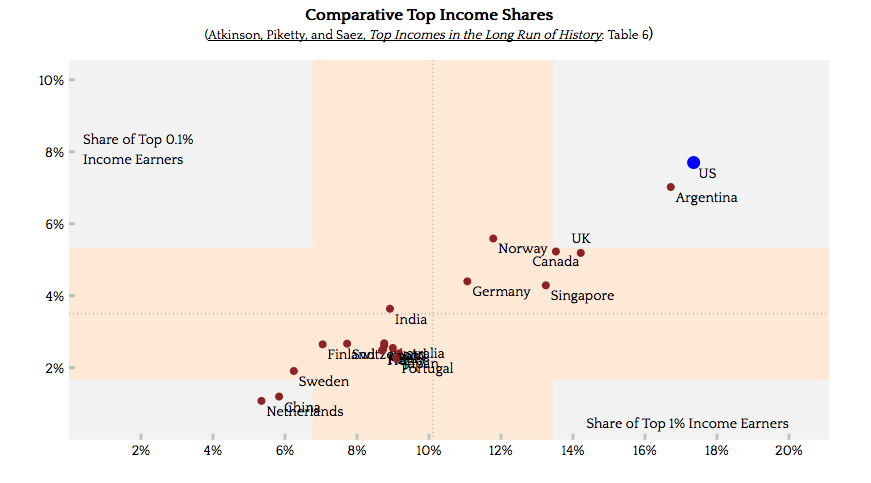
The question is: is this only true of Argentina and not of the US, as Arthur Brooks and Newt Gingrich claim? Let’s take a look at each countries’ one percent, and then the top 0.1 percent, and see how much of a country’s wealth they each represent. Here’s a graph from 2005 that shows where various countries fit on that scale:
Funny, isn’t it, how utterly similar the US and Argentina are in terms of inequality? Since that date, the US’s top one percent have moved from earning around 17 percent to more than 20 percent.
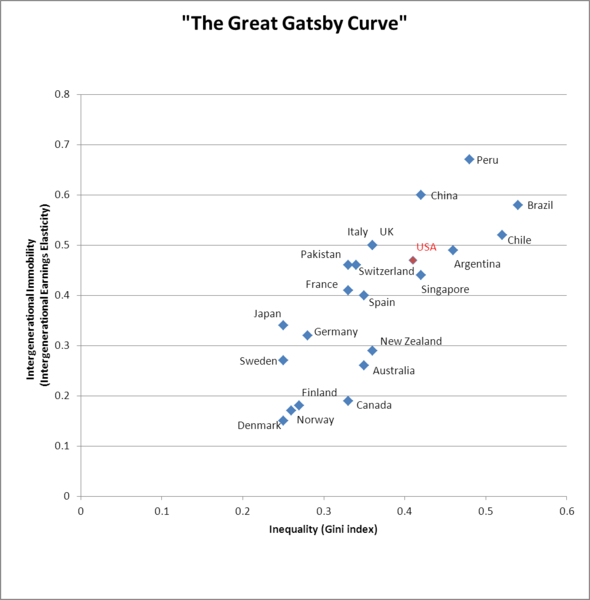
On the core question of social mobility, Argentina and the US are also very close together as the following chart shows:
So in terms of both income inequality and social mobility, the US and Argentina are basically the same country. So why does the Pope’s arguments apply only to Argentina and not to the US? I’m not an economist, so maybe there’s another dimension here that I’ve overlooked. As always, I’d be more than happy to post any correctives or clarifications to this basic reality. But right now, it seems to me that the Catholic right is simply wrong. Their American exceptionalism has morphed from a thoroughly admirable national pride at America’s achievements to a fixed and rigid idolization of a single country along with an idolization of wealth. Both, to put it mildly, are heresies. And perhaps the biggest impact of the new Pope on American politics will be more forthrightly denying the denialist, ideological right any Catholic crutch to peddle their snake-oil with.
German-Jewish painter Moritz Daniel Oppenheim’s TheKidnapping of Edgardo Mortara, thought to be lost for over a century, was recently rediscovered and then auctioned by Sotheby’s at their annual Judaica sale. Maya Benton details the controversial episode behind the art:
The painting, lost for more than a century, depicts the notorious case of Edgardo Mortara, a 6-year-old Italian Jewish boy seized by church authorities from his family’s home in Bologna in 1858, based on a rumor that he had been baptized by the family’s illiterate gentile servant girl.
If baptized, the boy would have to be considered a Catholic in the eyes of the church and would no longer be allowed to remain in the home of his Jewish family. Such unauthorized conversions of Jewish children were not uncommon in the papal states. Despite the family’s desperate pleas and protestations, little Edgardo was brought to a monastery in Rome, taken in by the pope, and raised as a Catholic. When he grew up, he became a priest.
The kidnapping of this boy, and his family’s tireless efforts to lobby the Vatican for his return, became a source of international outrage and controversy, galvanizing Jewish leaders, including Moses Montefiore, the Rothschilds, and rabbis throughout America and Europe, who lobbied the pope for Mortara’s return. The case became an international scandal with far-reaching political ramifications.
In an interview, David Kertzer, author of a book on the kidnapping, highlights the impact it had on church-state relations in Europe, especially Italy:
In Italy—well, I wouldn’t say that if not for the Mortara case there would still be papal states today—but the end of the papal states was a matter of convincing the various powers that be that this was an anachronism that could no longer be propped up. There was no more important figure in all of this than Napoleon III, because it was through his intervention, in 1859, that the Kingdom of Italy took shape. He had previously been the pope’s big protector. Indeed, he brought him back to power in 1849, even though personally he had his own anti-clerical past. But I think we have evidence that the Mortara case, which Napoleon III was well aware of, and in which he did indeed intervene, really made him feel that the papal states could no longer survive in the modern world and that he should not be propping them up. He had many other considerations, but the fact is that [the Mortara case] was one of them, and it’s remarkable that this totally unknown 6-year-old Jewish child in Bologna would play this role.
Update from a reader:
The kidnapping became an international incident because of a confluence of events. Jews were emancipated from European Ghettos during the 1840s and early 1850s at the time Europe was democratizing. Paul Reuter, a Jewish Englishman, invented the news wire in 1851. By the time of the kidnapping, 1858, newspapers, including Jewish papers – were being fed by a wire service offering international news. Denouncing the kidnapping of Edgardo Mortara became a way for world leaders to emphasize their commitment to democracy and human rights. Might also be the first example of worldwide Jewry exercising any kind of political influence.
And a noble cause that was.
(Image of TheKidnapping of the Mortara Child by Moritz Daniel Oppenheim, via Sotheby’s)
Your post on palliative care came at an especially appropriate time, as I witnessed my 80-year-old mother’s quick decline and death just last week. She spent almost three weeks in a local hospital, where it became clear to me and my sister that while she was dying of lung cancer that had metastasized to her liver – but no doctor really wanted to tell her that. Luckily, about three days before she died, she was transferred to Calvary Hospital in the Bronx where they specialize in end-of-life treatment.
What a difference between the two hospitals.
In the first one I had to take the reins in relaying the information to my mother. This was very difficult, since I am not a doctor and did not fully understand everything about her medical situation. But after having her primary care physician tell me on the phone that he wasn’t sure she was accepting of her situation because she became emotional when he brought up that there were no treatments she could tolerate, I knew I had to tell her. It seemed to me that it was the doctor’s discomfort with delivering this type of news and dealing with the patient’s reaction that was hindering us moving forward in a way that respected my mother. She was dying, but she was in no way cognitively impaired or incapable of understanding this.
I hung up the phone with her doctor and took my mother’s hand and laid out the situation as best I could. While it was difficult, she was relieved that someone was telling her what was going on. When I finally insisted that a palliative care person come to speak with her the next day, the woman commented on my mother’s straightforward manner and acceptance of her death. My mother was a no-nonsense woman and her understanding of her situation afforded us the opportunity to have meaningful conversations before her death. This has helped me enormously in my grief.
I imagine if she had been transferred to Calvary earlier in her ordeal we could have had more support in our journey. From the moment she got there, the staff was communicative and respectful of the dying process, unlike her community hospital. I suppose it is our culture that contributes to this inability to deal with death; Americans seem to see death as some type of failing or surrender. But like Peg Nelson describes in your post, it just doesn’t need to be that way. As difficult a time it was, I felt I was honoring my mother by being by her side and helping her face what she was going through. I think it helped us both let go.
Update from a reader:
When my mother was dying of lung cancer some years back, she elected to end her life before the cancer killed her. A doctor said afterwards that she would have lived another week to a month, with most of that time spent in a coma. I knew in advance what she planned, read the books, talked to doctors and sat with her while she took the pills that killed her. It was a very peaceful death and, while we all miss her passionately, neither I nor any other member of my family have any regrets about her choice. We had all been more than willing to care for her but knew her well enough to know that the spiraling loss of control would have made her last days a misery.
What has fascinated me about the aftermath is that having knowledge of this has made me a stop on a peculiar unofficial underground railway. Friends, friend’s parents, friends of friends of friends (strangers) have called me wanting to know what this experience is like. I have so little to offer them: compassion, where to look for information, my story. Not enough. We are all going to die. It would help many if we could talk about it.
Getting connected could be a big problem in North America in the 1890s, especially in the vast open spaces of the rural west. You could buy a telephone set from a mail-order catalogue, but what about the phone line itself? The Bell Telephone system was putting all its effort into connecting urban areas and had little interest in stringing wires to remote communities.
It didn’t take long for a few enterprising ranchers to notice, though, that the west was already covered with wire – the barbed-wire fences that divided the range to keep each rancher’s stock separate. At its peak, more than a million kilometers of the stuff was being laid each year. Why not just let it do double duty as a phone line? After all, they figured, wire is wire, and the ranchers were eager to communicate with their cowpokes working at outlying camps.
Ze Frank’s commentary on the natural world wins silver for Mental Health Break:
Paul Krugman was close second for the Dick Morris Award. He was nominated for his remarkably incorrect 1998 prediction about the Internet:
The growth of the Internet will slow drastically [as it] becomes apparent [that] most people have nothing to say to each other…. By 2005 or so, it will become clear that the Internet’s impact on the economy has been no greater than the fax machine’s.
The Chart Of The Year runner up shows the damage global warming is doing:
Joe Romm looks ahead to the future implied by Andy Haveland-Robinson’s “death spiral” chart of Arctic Ocean ice coverage over time:
Ian Bogost’s thoughts on McRib nearly won the Dish’s award for bad writing:
The McRib is like Holbein’s skull: we experience it as (quasi-)foodstuff, as marketing campaign, as cult object, as Internet meme, but those experiences don’t sufficiently explain it. To understand McRib fully, we have to look at the sandwich askew. … The McRib’s stochastic return mcdonalds-mcribmakes visible the relationship between the eater and the McDonald’s menu. It produces a stain, a tear in the order of things that reveals the object-cause of desire for McDonald’s, but only briefly before it evaporates like faux-cartilage. The fragile conditions that make the McRib possible also insure that desire for McDonald’s food more generally speaking is maintained.
Desire is a delicate system. For Lacan, the lover “gives what he does not possess,” namely the objet a that incites desire rather than sustaining it. Likewise, McDonald’s sells what it does not sell: the conditions of predictability, affordability, and chemico-machinic automated cookery that make its very business viable. … Industrialism is also a kind of magic, the magic of the perfect facsimile. Eating at McDonald’s—eating anything whatsoever at McDonald’s—connects us to that magic, allows us to marinate inside it and take on its power.
This comment by Richard Cohen almost earned him the Malkin Award:
People with conventional views must repress a gag reflex when considering the mayor-elect of New York — a white man married to a black woman and with two biracial children. (Should I mention that Bill de Blasio’s wife, Chirlane McCray, used to be a lesbian?)
Earlier this year, Copyranter wondered the Cool Ad Of The Year runner-up was “the best gun control commercial ever produced”:
This ugly comment made North Carolina State Representative Larry Pittman runner-up for the Hewitt Award:
Someone had posted something with a picture of Barack Obama and across it said ‘traitor.’ And, you know, I don’t always agree with the guy, I certainly didn’t vote for him but I gotta defend him on this one. I just don’t think it’s right at all to call Barack Obama a traitor. There’s a lot of things he’s done wrong but he is not a traitor. Not as far as I can tell. I haven’t come across any evidence yet that he has done one thing to harm Kenya.
Ramesh Ponnuru was the Yglesias Award runner-up for this admission:
[Republicans] have no real health-care agenda. Voters don’t trust them to look out for middle-class economic interests. Republicans are confused and divided about how to solve the party’s problems. What they can do is unite in opposition to the Obama administration’s scandals and mistakes. So that’s what they’re doing. They’re trying to win news cycles when they need votes.
And second place for the Moore Award goes to Mike Malloy for this rant against Limbaugh:
This guy, this Limbaugh, this is one of the most vile human beings ever to live! If Limbaugh had the power, he would open gas chambers! If Limbaugh had the power, he would line people up against the wall and execute them! If Limbaugh had the power, he would destroy children because he can’t have any! The only thing he sees in children is sex partners! This is a sick, degenerate, evil man!
Long-time New York restaurant critic finally reveals to readers his identity: Adam Platt. He calls the pretense of anonymity a “dated charade” since restaurants typically know who the “anonymous” food critics are:
Why do I (with the prodding and endorsement of my editors) choose this particular moment to come lumbering into public view? A better question might be “What took you so goddamned long?” Dining critics in London began running their photos above their columns some time ago, and several of New York City’s most reputable critics have been out of the proverbial closet for years. Craig Claiborne, who helped invent the myth of the discreetly “anonymous” critic at the Times, used to have promising chefs, like Daniel Boulud, come and cook for him outside of their restaurants. During my lunch with [former New York magazine critic] Gael [Greene], Alain Ducasse emerged from his kitchen to give her a warm greeting, a dramatic gesture that did not prevent her from gleefully slamming his restaurant in a blistering cover-story review.
Over the years, this myth of anonymity has served many useful purposes. It’s worked, in practice, for the mysterious Michelin inspectors, who return to dining establishments year after year to take away or bestow their stars. It can work, also, for local critics whose publications attempt to cultivate a similar illusion of omniscience, although it’s been my experience that the handful of grand restaurants that actually have stars to lose will make it their business to spot you. Mostly, though, anonymity has been a powerful marketing tool. It’s lent a sense of impartiality and Oz-like mystery to the dark art of restaurant criticism, and if members of the clubby fine-dining world didn’t always believe it, then at least the public sometimes did.
Even though Platt has gone public, he will “continue to book restaurant tables at odd hours, under a string of ridiculously random made-up names, because more than a wig or a set of false whiskers, the art of surprise has always been the critic’s most useful tool.”
Edith Windsor, 83, acknowledges her supporters as she leaves the Supreme Court on March 27, 2013. The Supreme Court heard oral arguments in the case ‘Edith Schlain Windsor, in Her Capacity as Executor of the Estate of Thea Clara Spyer, Petitioner v. United States,’ which challenges the constitutionality of the Defense of Marriage Act (DOMA), the second case about same-sex marriage this week. By Chip Somodevilla/Getty Images.
Rep. Steve Stockman (R-TX) is the winner of this year’s Malkin Award, which is given for intemperate right-wing rhetoric. The winning rant:
Democrats do not want abortion to be safe or rare. Democrats oppose even the most basic of health and safety standards for abortion mills. Democrats don’t care how many women are maimed, infected with diseases or die on the routinely-filthy abortion mills. Democrats worship abortion with same fervor the Canaanites worshipped Molech.
The Moore Award, for divisive left-wing rhetoric, goes to Health And Wellness Publisher Maria Rodale for this remark:
Yes, Syria has undoubtedly used chemical weapons on its own people. Maybe it was the government; maybe it was the opposition; maybe you [President Obama] know for sure. But here’s what I know for sure: We are no better. We have been using chemical weapons on our own children – and ourselves – for decades, the chemical weapons we use in agriculture to win the war on pests, weeds, and the false need for ever greater yields. While the effects of these “legal” chemical weapons might not be immediate and direct, they are no less deadly. … We’ve been trying to tell you for years that chemical companies like Monsanto, Syngenta, Dow, DuPont, Bayer Crops Sciences, and others are poisoning our children and our environment with your support and even, it seems, your encouragement. Just because their bodies aren’t lined up wrapped in sheets on the front pages of the newspapers around the world doesn’t mean it’s not true.
Hathos is the attraction to something you really can’t stand; it’s the compulsion of revulsion. Below is this year’s Hathos Alert winner – by a mile:
So this is apparently a real thing from the Wall Street Journal. The Onion couldn’t top this. Whether it’s the sad faces of all these put-upon dejected rich people, or the elderly minority couple who is depressed despite not paying extra taxes (or was that the point?), or the distressed single Asian lady making $230,000 who might not be able to buy that extra designer pantsuit this year, or the “single mother” making $260,000 whose kids presumably have a deadbeat, indigent dad just like any other poor family, or that struggling family of six making $650,000 including $180,000 of pure passive income and wondering how to make ends meet, mockery is almost superfluous. The thing mocks itself.
Paul Ryan earns the Dick Morris Award for his stunningly wrong underestimation of the president:
Oh, nobody believes [Obama’s vows to not negotiate on raising the debt ceiling]. Nobody believes that. He himself negotiated Bowles Simpson on the debt limit with Democrats. That was Kent Conrad’s requirement. He himself negotiated the Budget Control Act with the debt limit. Graham Rudman. Bush Andrews Airforce Base. Clinton Gore ‘97. All of those major budget agreements were debt limit agreements. I see this time as no different and I believe he does too. I think most people believe he’s just posturing for now.
Colin McGin, a philosophy professor who resigned this year from the University of Miami following allegations that he sent sexually explicit emails to a female graduate student, won this year’s Poseur Alert, awarded for really bad writing intended to appear profound. The passage he was nominated for:
What kind of hand job leaves you cleaner than before? A manicure, of course. Why does this joke work? Because of the tension between the conventional idiomatic sense of ‘hand job’ (a certain type of sex act) and its semantic or compositional meaning (in which it is synonymous with ‘job done by or to the hand’). When you think about it, virtually all jobs are ‘hand jobs’ in the second semantic sense: for all human work is manual work—not just carpentry and brick laying but also cookery and calligraphy. Indeed, without the hand human culture and human economies would not exist. So really ‘hand jobs’ are very respectable and vital to human flourishing. We are a ‘hand job’ species. (Are you now becoming desensitized to the specifically sexual meaning of ‘hand job’? Remember that heart surgeons are giving you a ‘hand job’ when they operate on you; similarly for masseurs and even tax accountants.)
I have in fact written a whole book about the hand, Prehension, in which its ubiquity is noted and celebrated.
I even have a cult centering on the hand, described in this blog. I have given a semester-long seminar discussing the hand and locutions related to it. I now tend to use ‘hand job’ in the capacious sense just outlined, sometimes with humorous intent.
Suppose now a professor P, well conversant in the above points, slyly remarks to his graduate student, who is also thus conversant: ‘I had a hand job yesterday’. The astute student, suitably linguistically primed, responds after a moment by saying: ‘Ah, you had a manicure’. Professor P replies: ‘You are clearly a clever student—I can’t trick you. That is exactly the response I was looking for!’ They then chuckle together in a self-congratulatory academic manner. Academics like riddles and word games.
The Chart Of The Year goes to the simple bar graph below. It illustrates that most Americans have no idea that the deficit is falling:
The point isn’t that Americans are stupid. They have busy lives and concerns that have nothing to do with the annual gap between taxes and outlays. Instead, the point is that public-opinion polls don’t belong on the same plane as facts and informed analysis, because they qualify as neither. … Public polls are a fine gauge of public opinion, but they’re not to be treated as a barometer of reality. Pretending otherwise mixes up the regurgitated misinformation of readers with the careful analysis of people who are in the business of busting misinformation.
Jon Huntsman won The Yglesias Award, given for risking something for the sake of saying what you believe, for this statement supporting marriage equality:
While serving as governor of Utah, I pushed for civil unions and expanded reciprocal benefits for gay citizens. I did so not because of political pressure—indeed, at the time 70 percent of Utahns were opposed—but because as governor my role was to work for everybody, even those who didn’t have access to a powerful lobby. Civil unions, I believed, were a practical step that would bring all citizens more fully into the fabric of a state they already were—and always had been—a part of.
That was four years ago. Today we have an opportunity to do more: conservatives should start to lead again and push their states to join the nine others that allow all their citizens to marry. I’ve been married for 29 years. My marriage has been the greatest joy of my life. There is nothing conservative about denying other Americans the ability to forge that same relationship with the person they love.
The Hewitt Award is for egregious attempts to label Barack Obama as un-American, alien, and treasonous. Orson Scott Card was the top vote-getter for this “experiment in fictional thinking” that “sure sounds plausible”:
Where will [Obama] get his ‘national police’? The NaPo will be recruited from “young out-of-work urban men” and it will be hailed as a cure for the economic malaise of the inner cities. In other words, Obama will put a thin veneer of training and military structure on urban gangs, and send them out to channel their violence against Obama’s enemies. Instead of doing drive-by shootings in their own neighborhoods, these young thugs will do beatings and murders of people “trying to escape” — people who all seem to be leaders and members of groups that oppose Obama.