Is The World’s Newest Country Falling Apart?

SSUDAN-UNREST-BOR

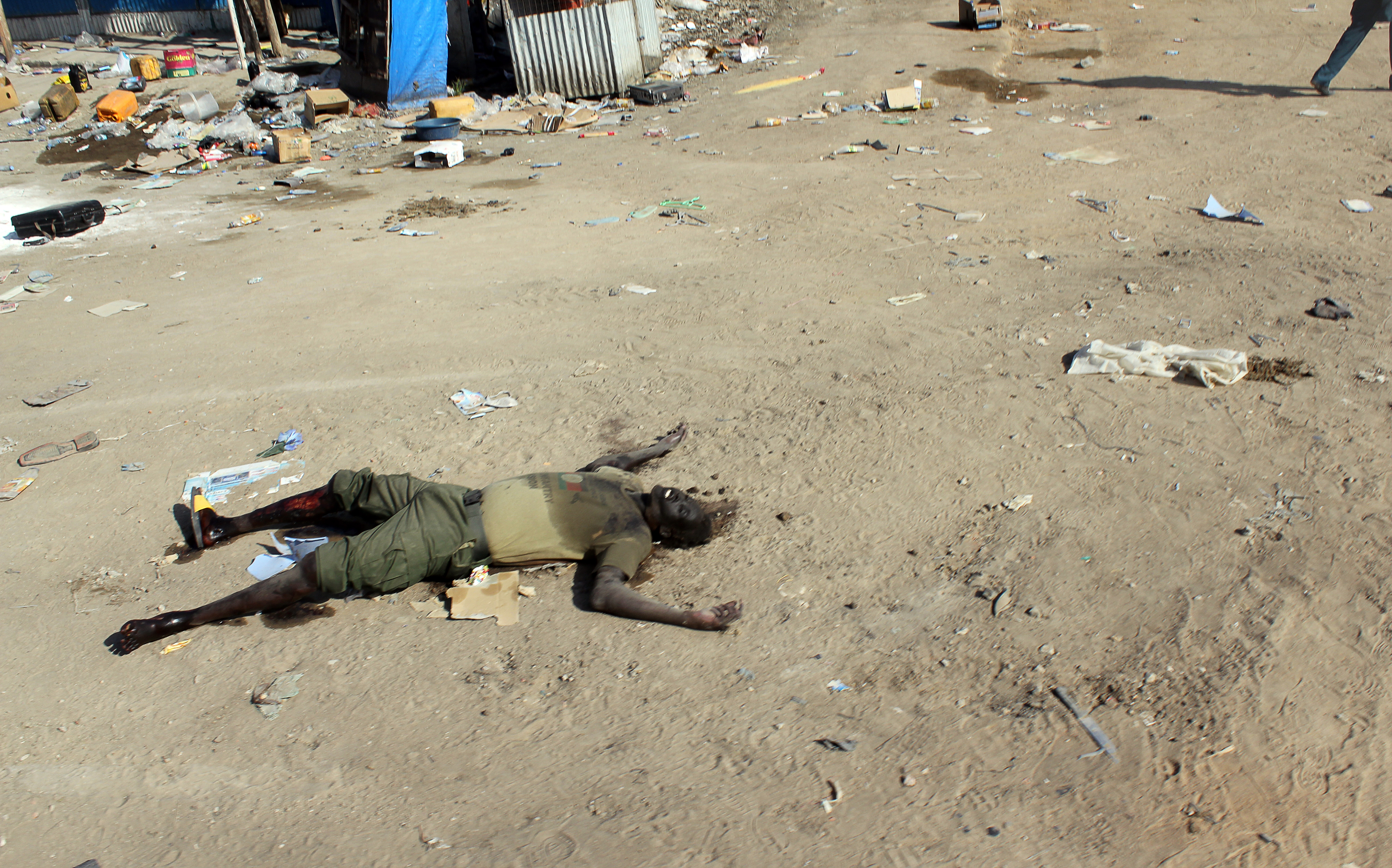
Over the past two weeks, South Sudan has come to the brink of civil war, with as many as 1,000 dead in fighting between forces loyal to President Salva Kiir and rebels led by former vice president Riek Machar. John Prendergast and Akshaya Kumar set the scene:

Tensions within the ruling Sudan People’s Liberation Movement have been simmering for years. That political power struggle among Juba’s elites has now shifted into open violence across the country. It is clear that there can be no purely military solution to this conflict. Neither forces aligned to sitting President Salva Kiir nor those aligned to former Vice President Riek Machar can seize control of the entire country. More importantly, continued violence undermines both men’s credibility. As a consequence, the initiation of an open and inclusive dialogue focused on negotiating a political settlement is essential.  South Sudan’s President Kiir has already evidenced a willingness to talk by sitting down with leading critic Rebecca Nyandeng de Mabior. Unfortunately, Riek Machar has been much more elusive, indicating that nothing short of President Kiir’s dismissal was acceptable.

Max Fisher explains how South Sudan got to this point just two and a half years after its creation:

The country’s path to independence was also a path to internal conflict. The decades before South Sudan’s independence are complicated but, in the simplest terms, it was defined by a half-century of fighting between the politically dominant, ethnically Arab north and the politically weaker, ethnically sub-Saharan south. Rebel groups in the south wanted more autonomy from the north. They had to fight very hard to get it (although they owe a lot to the north, which behaved so terribly that it galvanized world opinion in favor of the south).

The thing, though, is that South Sudan is actually pretty ethnically diverse. South Sudan, like a number of other countries in sub-Saharan Africa and particularly this region of it, is articulated by borders that have very little to do with the actual people there. The earlier, unified version of Sudan had been carved out, in part, by European and especially British colonialism. The long-running conflict between the country’s north and its south was, like many wars in post-colonial Africa, partly a consequence of European cartographers having forced disparate groups into artificial borders. Splitting Sudan in two helped to ease the tension created by these borders but didn’t solve it. The southern ethnic groups had been united by a common enemy — the north — but that’s no longer bringing them together.

Colum Lynch looks at the role of the US:

The stakes are high for the United States, as fighting threatens to upend one of the most important foreign policy initiatives of the last two decades in sub-Saharan Africa — one that unified Republicans, Democrats, African Americans, human rights advocates, and Christians. On Saturday, four U.S. troops were wounded when their V-22 Osprey came under fire during an aborted operation to evacuate U.S. nationals from the town of Bor. An additional 150 Marines have been sent to the region to prep for possible future evacuations. It’s an extraordinary and painful development, given America’s major role in securing independence for South Sudan. But the toughest part for Americans to swallow may be that it’s the U.S.-backed leaders of South Sudan — the supposed good guys — that are responsible for plunging the country into chaos and threatening to wreck America’s signature achievement in the region.

Larison is not surprised:

The “supposed good guys” happened to be the people in charge of the armed insurgency that the U.S. chose to support. Like many other insurgent groups over the years, their “goodness” was defined by their opposition to the government they were rebelling against. Like other cases of separatism gone awry, the new state that the U.S. helped to bring into being was plagued by so many political ills that its turn to authoritarianism, corruption, and internal conflict was practically guaranteed from the start. Given our recent experiences with ill-advised foreign interventions and the constant pleas to support “good” rebels in one conflict after another, Americans will have no trouble believing that the people that Washington anointed as “good guys” proved to be much less than that. They may begin wondering why our government thinks that it knows what it’s doing when it supports the creation of new states that always seemed almost doomed to fail.

Philip Roessler calls this an example of the “coup-civil war trap,” a common cause of state failure in post-colonial Africa:

The coup-civil war trap arises when political institutions are weak and ethnic groups are strong. Violence is dispersed among powerful Big Men who are embedded in and supported by different ethnic groups. And economic benefits are primarily derived from controlling the central government. Under such conditions, peace is often contingent upon power-sharing, in which the ruler strikes alliances with rival Big Men. These alliances allow the ruler to mobilize support and collect information from outside his own ethnic group, which in turn helps to secure peace and prevent civil war. But the potential danger is that in sharing real power with ethnic rivals, the ruler leaves himself vulnerable to a coup d’état. And there’s the rub: the policy solution to civil war in these weak states increases a rival group’s capabilities to win power in a coup. In more technical terms, ethnic power-sharing in the shadow of the coup d’état gives rise to a commitment problem, in which the ruler fears that rivals are supporting him only to better position themselves to take power in the future.

This commitment problem is a key source of bargaining failure and conflict in weak states because it prevents rulers from fully committing to peaceful power-sharing. Reluctant to strengthen their rivals, rulers don’t share enough power.  Fundamentally mistrustful, they pursue defensive safeguards, such as stacking the military and security organs with members of their ethnic group and other loyalists, in a bid to neutralize their rivals’ coup-making capabilities. But this only undermines confidence in the ruler. Regime partners question the ruler’s commitment to power-sharing and, even worse, fear that, having used his comrades to get to power, he is ready to dispose of them by purge or execution.

(Photo: The body of a man claimed to be a rebel lies on the ground in the market in the centre of Bor, on December 25, 2013. By Waakhe Simon Wudu/AFP/Getty Images.)
The Identity Crimewave

Mike Riggs wonders why most people don’t report identity theft to the police:

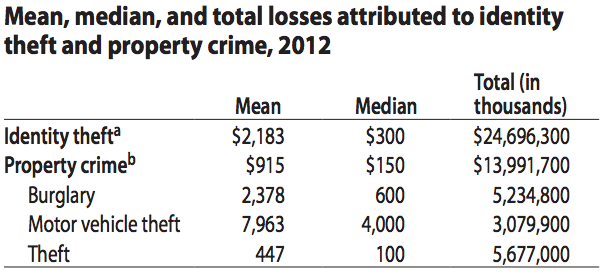
Property and violent crime affect us where we live and work, and we expect local government to do something about them. But even though these categories seem comprehensive, neither one includes identity theft. Considering identity theft now costs Americans nearly twice as Identity Theftmuch as property crime, that’s an odd omission. In a recent report, the U.S. Bureau of Justice Statistics found that total losses attributed to identity theft in 2012 were $24.6 billion, compared to $13.9 billion for property crimes. Not only is the total loss amount higher for identity theft, the mean and median loss per incident is roughly double (see the chart at right).

This isn’t to say we don’t talk enough about identity crime, because we actually talk about it a lot (mostly as it relates to personal finance and online security). But the BJS report suggests even identity theft victims don’t actually think about identity theft when they think about crime where they live. The biggest indicator? Only 9 percent of identity theft victims even contact the police.

A commenter provides a sensible explanation:

Reasons people report property crime include insurance and an overall perception that the police might catch the burglar/thieve who was physically present on the property.

Identity theft is often committed by people operating from overseas or using elaborate IT resources to conceal their own identity and location, making it very difficult to trace, let alone apprehend, especially if no major money trail was left. Even a dedicated local police office, well staffed and set on the right priorities, couldn’t do much to go after, say, a Russia-based online gang group that used the credit car info to attempt a purchase on a website from Singapore…

Sick Too Young

Three years ago, Leah Sottile’s husband was diagnosed Ankylosing Spondylitis, an autoimmune disease. She reflects on how this changed their lives:

I thought this would be the time when we’d be preparing for the rest of our lives: earning money, going on fun vacations, having families, building our careers. And we are, but at the same time, we’re doing it while we’re trying to manage pain symptoms, chase down prescriptions, and secure stable health insurance. When I was in college, I remember being prepared to survive in the workforce, but I don’t remember a class that told me how to do that if half of your household is in so much pain on some days that they can’t get to work. I’m barely over 30. I thought I had so much more time before I had to think about this stuff.

She also discovered that her husband isn’t alone:

It might be that our lifestyle is why Americans are so sick. Another theory, according to Dr. Frederick Miller of the National Institute of Environmental Health Sciences, might be that humans are being weeded out in different ways than in the past, as more communicable diseases have been eliminated.

“If you do away with the infectious disease risks that perhaps killed off a number of individuals early in life [in the past], people who may have altered immune systems, who perhaps couldn’t have handled [those infections, then] go on in adulthood to develop these diseases,” he says.

He points to the “hygiene hypothesis”: As humans have eliminated infections and led cleaner early lives, allergies and autoimmune disease incidences have increased because of our underdeveloped immune systems. “It’s not completely proven, it’s a hypothesis,” Miller says, “But it is consistent with some of the data out there.”

“There may not be too many free rides in this world,” he says. “As we move away from one disease, we may be moving toward other diseases.”

Fans Of The Flat-Rate

Catherine Tucker reviews research on the “flat-rate bias,” which describes the behavior of “consumers [who] will often choose a flat rate over a metered one, even when it’s not in their best interest”:

[In 2006, then-doctoral student Anja] Lambrecht found that the flat-rate bias could not be explained only by the fact that customers prefer the certainty or convenience of flat-rate pricing, or that they are overestimating their usage. Instead, it seemed that consumers actively avoid schemes where there is the possibility of feeling discomfort by mentally linking every extra unit of consumption to an increase in price. In other words, it’s not just a fear that you might underestimate your phone use or the congestion on your morning commute— it’s that consumers hate knowing that each extra minute or mile is costing them money. Lambrecht christened the discomfort that customers feel when the meter is running the “taxi-meter effect.” It appears that in general consumers want to enjoy a journey—or a phone call with a friend—without worrying about their wallets.

Surprisingly, however, the “taxi-meter effect” also seems to apply to experiences we don’t enjoy.

In a study of retail banking that came out earlier this year, Itai Ater and Vardit Landsman of Tel-Aviv University found that when an Israeli bank stopped charging per transaction and changed to a flat rate, their revenues went up by 15 percent. The previous pricing scheme had charged customers for most interactions with the bank, including check fees and fees per phone-banking transaction. Customers were happy to pay more per month to avoid having to pay per transaction. This work showed that the taxi-meter effect is not limited to a particular industry (previous experiments had focused on telecom), but is more deeply rooted in consumer psychology.

What Drones Could Do

Save lives:

Christopher Vo, education director for the DC Area Drone User Group, told me recently at a drone fly-in in Northern Virginia that these robots are uniquely equipped to transport items in emergency situations and hard-to-reach locations. Projects are underway to use drones to deliver vaccines in remote regions that lack infrastructure, and drones have already been used for surveillance in disaster areas. They could also drop off emergency aid—food, water, medical supplies—to people stranded or trapped, when ground delivery isn’t an option (for example).

Vo also mentioned defibrillators for victims of sudden cardiac arrest. “Five minutes, that’s the maximum time I can wait for one of these things. If I have to call an ambulance they could take 20 minutes to get there, and that’s too late,” he said. “Whereas if I could call a drone, a drone doesn’t have to wait in traffic. A drone could just go straight to me. And I could get there in five minutes.”

So mock Amazon all you want, but not drone delivery itself.

Drones might also revolutionize farming:

[E]very farmer has to deal with problems such as pest control, fertilizer application, and crop management, things the EPA says the average farm spends about $109,359 per year. A cheap drone costs a tiny fraction of that, and can help farmers cut costs in lots of ways.

According to Leo Reed, a chemist who licenses crop dusters in Indiana, demand for them in the state has doubled since 2007. In Iowa, agricultural aviation is a $214 million business annually. Crop dusters are also notoriously dangerous. The planes fly just 10 feet above the ground at speeds of about 150 miles per hour. With drones, the pilot is taken out of the equation, and crashes are likely to be in wide-open fields, not heavily populated areas.

Let The Claus Con Go On

dish_santa

“If you are struggling over whether or not to tell Santa’s story,” offers Laura Lewis Brown, “you may take comfort in the notion that it doesn’t really harm children to imagine”:

“Kids up to four, five, six, seven live in what we call fantasy life magic years,” says Dr. Benjamin Siegel, Professor of Pediatrics and Psychiatry at the Boston University School of Medicine. “They are influenced by what they see and hear around them. They get very excited about characters in their life that have special meaning for them.” Those characters include superheroes, monsters, animals and even Santa. …

Parents worry that they will have to break the news to their children and shatter their whole vision of Christmas. However, many children come to this realization on their own around age seven or eight, Siegel says. And when they do, they are basically unscathed. Siegel cites a study that revealed that children who learned the truth may have been upset, but not nearly as upset as the parents.

Alice Robb elaborates on that last point:

For a 1994 paper in the journal Child Psychiatry and Human Development, Carl Anderson and Norman Prentice, psychologists at the University of Texas at Austin, recruited 52 families with elementary school-aged children and interviewed both parents and kids about the family’s experience of Santa Claus. What they found was surprising:

“Children reported predominantly positive reactions on learning the truth. Parents, however, described themselves as predominantly sad in reaction to their child’s discovery … While children experience distressful reactions such as sadness, disappointment and anger, the degree of such reactions are generally minimal and short-lived.” In fact, they were so unperturbed that 58 percent said they pretended to believe in Santa after realizing the truth—so as not to disappoint their parents.

Sarah Sloat sums up:

Letting children use their imaginations to conjure this image is healthy, psychologists argue, saying that the practice is what will later help them dream up inventions and other big ideas. Similarly, fairy tales have been shown to be an effective and more meaningful way to teach children morals; the naughty-or-nice list becomes a guide to growing up to be a decent person. Even if your goodness is derived from a fear of not receiving a Furby.

Dish readers recently weighed in on whether it’s ever okay to lie to children, including about whether Santa is real.

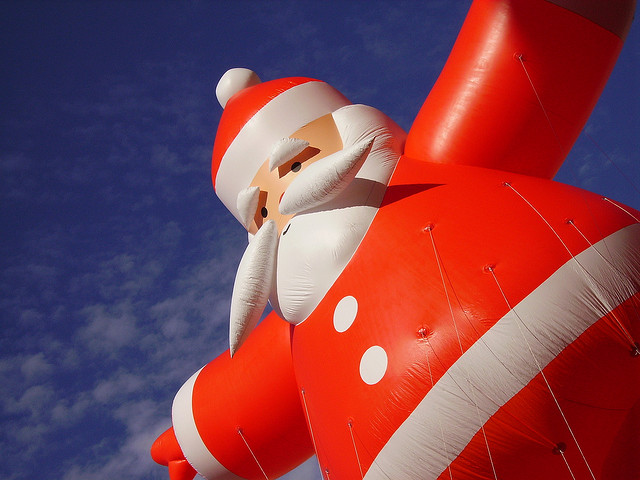
(Photo of a Santa float from a 2006 Christmas parade in Dallas, Texas by Bart Fields)

Bad Santa

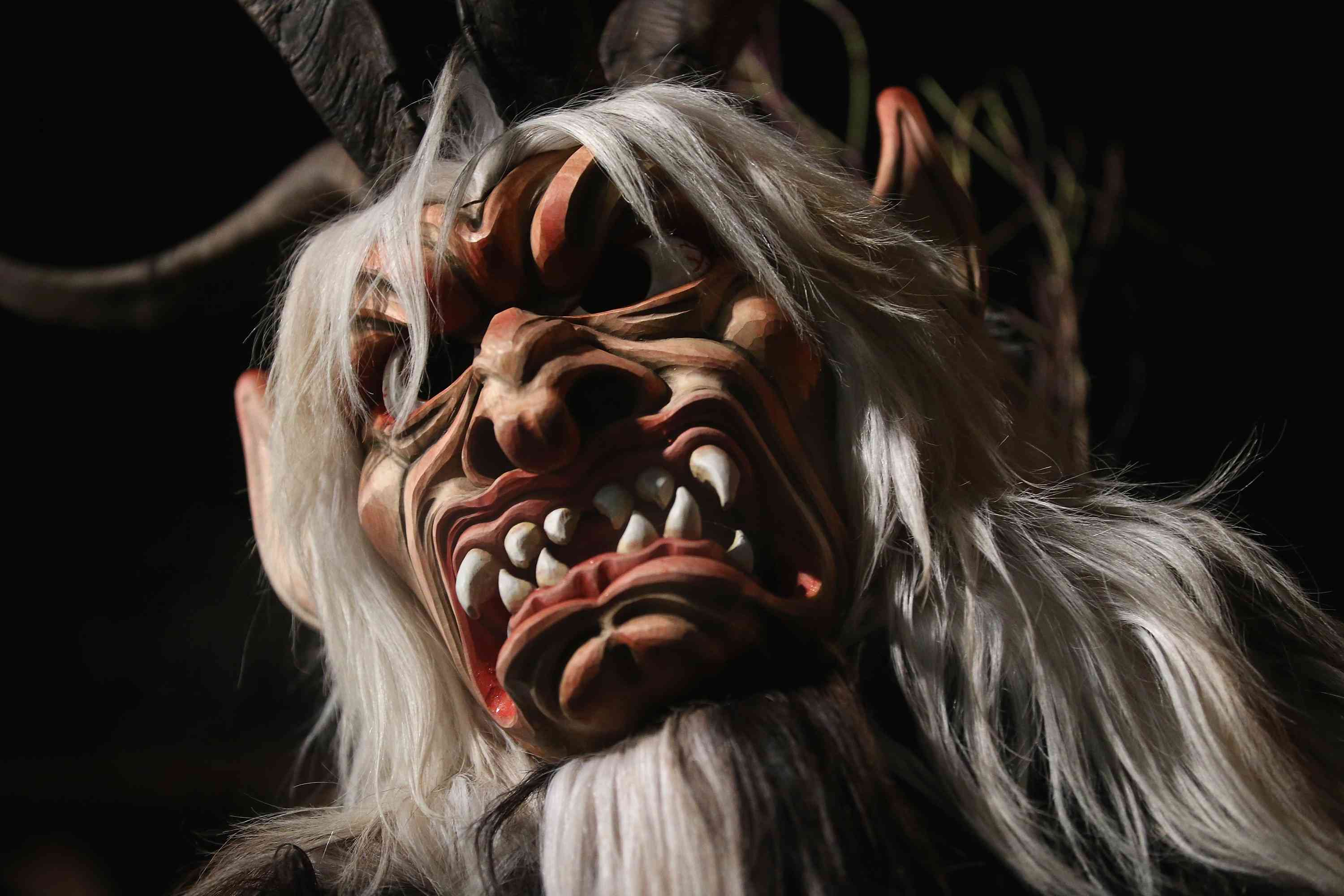
Krampus

Some background on Krampus:

Krampus, whose name is derived from the German word krampen, meaning claw, is said to be the son of Hel in Norse mythology. The legendary beast also shares characteristics with other scary, demonic creatures in Greek mythology, including satyrs and fauns. The legend is part of a centuries-old Christmas tradition in Germany, where Christmas celebrations begin in early December. Krampus was created as a counterpart to kindly St. Nicholas, who rewarded children with sweets. Krampus, in contrast, would swat “wicked” children and take them away to his lair.

Last December, Collectors Weekly talked to Monte Beauchamp, who published a book of early 1900s Krampus postcards, about the “Christmas devil”:

Collectors Weekly: Why was Krampus so scary?

Beauchamp: He’s like the bogeyman and was created by adults to scare the bejeezus out of wayward children. Every country seems to have their own bogeyman. On December 6, which is St. Nikolaus Day, obedient children would hop out of bed and rush to the empty shoe they’d placed outside the night before to retrieve the small gifts or treats that St. Nikolaus had left for them. In the shoes of disobedient children awaited switches, with which their parents would spank them. Those that had been especially bad were paid a visit by Krampus, who oftentimes would place them in the wooden basket strapped across his back and cart them off to the countryside and terrorize them until they promised to be good.

Collectors Weekly: Is Krampus the devil?

Beauchamp: Though Krampus is perceived as a devil and is referred to as one, he’s mainly a composite of man and beast; he has fur all over his body, and what devil has a tongue like that? He’s also a good-natured character; his only desire is to persuade unruly children to turn from their wicked ways. …

Collectors Weekly: What date does Krampusnacht take place? How do you celebrate?

Beauchamp: On the Eve of St. Nikolaus, which is December 5, in Salzburg, Austria there’s a winter festival known as Krampuslauf—“The Running of the Krampus,” in which young men clad in Krampus costumes are herded into town by a person attired as St. Nikolaus. He then greets the crowd and unleashes the herd of Krampuses, who rattle chains, clang cowbells, brandish birch switches, and terrify the children.

Previous Dish on Krampus here.

(Photo: Members of the Haiminger Krampusgruppe dressed as the Krampus creature parade in the town square during their annual Krampus night in Tyrol on December 1, 2013 in Haiming, Austria. Krampus is a demon-like creature represented by a fearsome, hand-carved wooden mask with animal horns, a suit made from sheep or goat skin, and large cow bells attached to the waist that the wearer rings by running or shaking his hips up and down. Krampus has been a part of Central European, alpine folklore going back at least a millennium and since the 17th-century Krampus traditionally accompanies St. Nicholas and angels on the evening of December 5th to visit households to reward children that have been good while reprimanding those who have not. However, in the last few decades, Tyrol in particular has seen the founding of numerous village Krampus associations with up to 100 members each who parade without St. Nicholas at Krampus events throughout November and early December. By Sean Gallup/Getty Images)

Lessons From Rudolph

Richard Beck finds wisdom in the Christmas TV specials he watched as a child:

Hermey, Rudolph, and Yukon Cornelius, after being chased by The Abominable Snowman, find the Island of Misfit Toys. This is an island where rejected, unwanted, and unloved toys find sanctuary. Rudolph, sympathetic to the plight of the Misfit Toys, because Rudolph knows what it’s like to be a misfit, promises to take their plight to Santa…. [T]he theology of Rudolph takes its most radical, surprising, and extreme turn when the personification of evil, The Abominable Snowman, comes back from death in a quirky resurrection event–Bumble’s Bounce!–as a peaceable creature who is also in need of loving community. Apparently, this “evil” creature is also a misfit. And the hint is that he’s “abominable” because he’s been marginalized and without community.

So, summarizing all this, I learned from Rudolph this important lesson about Christmas: Something about Christmas means misfits have a place, a community, a home. Or, rephrased, Christmas means that there are no more misfits.

Michael Schaffer is less taken with the story:

Let’s review. There’s this little reindeer with a deformity. We have no evidence that this deformity actually keeps him from his reindeer duties: He has a red, glowing nose. Big deal! It’s not like he has a torn ACL that might limit his flying-sleigh-pulling abilities. At any rate, because of this deformity, the other reindeer laugh, call him names, and bar him from their all-important games, effectively ostracizing him just because he looks funny.

Then, on December 24, the fog rolls in. Santa and the in-crowd are stranded. Without so much as an apology, Rudolph is asked to guide the sleigh. (Or perhaps he isn’t asked: The lyrics specify that Santa “came to say” that Rudolph could guide his sled—I’m guessing no one even inquired as to whether he had other holiday plans.) Despite the repeated snubs and the impolite request, Rudolph demonstrates his utility in brilliant form. At which point all the reindeer decide that they love him. Notice that they still don’t apologize.

Perhaps I am wrong, but this strikes me as a terrible, terrible lesson for kids.

How Do You Like Your Lights?

dish_xmaslights

Kelly Faircloth favors multicolored:

At the risk of sounding treacly, there’s just something a little magical about bringing a big, riotous burst of color to a random corner of your living room, or your front porch, or strung across your kitchen window. It changes the whole look of the place. You dim the overhead lights and suddenly it’s all red, green and blue. Doesn’t matter if you’ve got landlord beige walls and Ikea furniture—suddenly it’s like you’re inside that Chip and Dale cartoon where they wreak havoc inside Mickey’s Christmas tree, or that Indian restaurant downtown.

Plus, they’re retro as hell. You can trigger your parents’ nostalgia by lightly evoking your grandparents’ living room, or you can go with those big fat bulbs if you want to deck your tree out in full Mad Men cosplay. It’s fun. It’s festive. It says go ahead, have too many cups of spiked hot chocolate and wear that Santa hat, we’re all friends here.

Kate Dries prefers white:

Even without a tree, white lights are entirely superior beast to their bastard cousin, the multicolored light strand.

White lights give off a soft glow that demands the age-old mantra, “Everyone looks better in the dark,” be updated to “Everyone looks better when lit by white Christmas lights.” There is a reason college students, who are otherwise idiots about decor, use white light strands to decorate their barren dorm rooms: they set an automatic mood of peace and tranquility. Not to mention, white lights are classy as fuck. They work with everything. They let your decorations shine. They look like snow. They look like ice. They look like candles. They look like Christmas.

I grew up in a household where white Christmas lights – which, I like I said, are the only Christmas lights – were treated with a degree of reverence normally reserved for a beloved figurine of the Baby Jesus inherited from a long-dead relative. To watch my mother (and her father before her) put lights on a Christmas tree is akin to watching a great sculptor like Bernini lovingly craft some of his greatest works. It takes hours upon hours. … For this is the Most Holy Part of Christmas.

Update from a reader:

OK, at the risk of jumping into what seems a very minor skirmish in the non-War on Xmas, let me say that both colored lights and white lights are correct – colored lights indoors, white lights outdoors. The simple elegance of white lights adorning a house’s architectural lines, and perhaps in the shrubbery or smaller trees in front, do the original cultural work of our European mid-winter celebrations: they fight the darkness, remind us that the days might still be cold, but there’s more light every day. The multi-colored lights inside transform our vision the way the foods we feast on transform our palettes and our waistlines: more kinds of light, visual calories. Comfort food, comfort lights.

Happy Christmas to one and all at the Dish. See you the 26th: I’m taking a day off from the Web as a present!

(Photo by Flickr user Christmas w/a K)

Festive Foliage

Americans prefer real Christmas trees to artificial ones:

Rick Dungey, of the NCTA [National Christmas Tree Association], dismisses the artificial sort as “plastic tree-shaped decorations”. Americans tend to agree, buying more real trees than fake ones. Of 35m sold every year, 70% sprout from the ground. Despite a rise in sales a decade ago, fake trees have lost their sparkle since the financial crisis. But according to the American Christmas Tree Association, a trade group that claims to represent both types of tree, 83% of homes have a fake shrub.

Leslie Horn insists on authenticity:

[U]nless you’re a slight scrooge or suffer from severe seasonal allergies, you must go with the real thing. Douglas Fir, Blue Spruce, Scotch Pine—pick your pleasure. The smell is part of the fun, and car air fresheners or kitchen candles just don’t give the same seasonal effect.

Last year, Timothy Taylor reviewed research on how real and artificial trees affect the environment:

One artificial tree has greater environmental impact than one natural tree. However, an artificial tree can also be re-used over a number of years. Thus, there is some crossover point, if the artificial tree is used for long enough, that its environmental effect is less than an annual series of trees. For example, the [2009] ellipsos study [pdf] finds that an artificial tree would need to be used for 20 years before its greenhouse gas effects would be less than those of an annual series of natural trees.

Taylor considers other factors:

[T]he environment effect of the ornaments on the trees may be as large or greater than the effect of the tree itself. Data from the U.S. Census Bureau shows that America imported $1 billion in Christmas tree ornaments from China (the leading supplier) between January to September 2012, but only $140 million worth of artificial Christmas trees. Thus, spending on ornaments is something like six times as high as spending on [artificial] trees. The choice of what kind of lights on the tree, or whether to drape the house and front yard with lights, is a more momentous environmental decision than the tree itself.

Previous Dish on Christmas trees here and here.