According to the latest data and certifications of the Recording Industry of America, Elvis’ Christmas Album, recorded by Elvis Presley (who else?) has shipped at least 13 million copies since its original release in 1957. That makes it the biggest-selling Christmas album of all time. The album has been re-issued and repackaged several times, and continues to be a perennial holiday best-seller. It sold three million copies upon its original release in 1957 and has sold an additional ten million copies in the various forms it has been reissued in.
Titi Nguyen surveys the history of Christmas songs:
The songs that most of us recognize as carols date back thousands of years. They were originally pagan songs sung during celebrations of fruitful harvests and seasonal solstices in Europe. During the early seventeenth century, after Christians adapted these songs to celebrate the birth of Christ, carolers began singing door-to-door, in public spaces, and at home. Peasants roamed about singing for their suppers at the doors of the wealthy, and the celebration of the birth of Christ was an especially generous time when lords invited poor villagers to their manors to feast and drink. Groups of young men called wassailers would sing good tidings in exchange for food or money. Neighbors learned the same songs and sang them in unison with and for each other; caroling was a community event.
Meanwhile, Robert Bound considers contemporary offerings:
So what makes a good Christmas song? Well, not being too good is key. There’s a kitschness to Christmas that’s not the opposite of quality but a sister to silliness (see Slade’s “Merry Xmas Everybody”). Smells and bells in both musical and metaphorical form are also important at Christmas. This is when you can add the extras that would seem extraneous in other seasons. “All I Want For Christmas Is You”, belted out by Mariah Carey with the full compliment of trills and vocal tricks seems just about suitable when there are sleigh bells and choirs in (and on) the mix. Like wearing a reindeer-busy Christmas jumper for sitting around the house, this is a time when there’s almost no such thing as too much.
An extensive collection of Christmas songs from around the world is here.
A new survey suggests that American shoppers are warming to more secular holiday greetings:
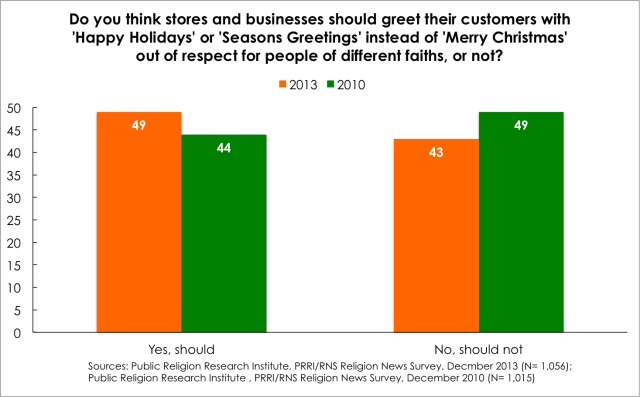
Nearly half (49%) of Americans agree stores and businesses should greet their customers with “happy holidays” or “season’s greetings” instead of “merry Christmas” out of respect for people of different faiths. However, a substantial minority (43%) disagree. Support for saying “happy holidays” or “season’s greetings” is up slightly since December 2010, when 44% preferred that businesses use less religious greetings. … The political divisions are stark. Roughly 6-in-10 (61%) Republicans favor using “merry Christmas” over “happy holidays,” while nearly as many (58%) Democrats say the opposite.
Matthew Schmitz reviews historical objections to “Merry Christmas”:
Queen Elizabeth, a woman of serious low-church piety, is said to prefer “happy” to “merry” because she dislikes “merry’s” connotation of boisterousness, even slight intoxication. (Similarly, in Holland some of the more strictly reformed Dutch prefer Zalig Kerstfeest—“Blessed Christmas”—to Vrolijk Kerstmis—“Merry Christmas.”) This moral suspicion of “Merry Christmas” dates back to the Methodist churchmen of the Victorian era who sought to promote sobriety among the English working class. Merrymaking of the ancient, alcoholic sort was frowned on year-round, perhaps never more so than during the celebration of the Savior’s birth. The phrase “Merry Christmas” would hang on, but the image of a family sharing a bottle of port or wine in the first commercial Christmas card was to give way to more temperate holiday depictions.
Yesterday we covered Schmitz’s defense of using “Merry Xmas!”
Daniel Luzer looks at how Hanukkah and Christmas in the US became co-opted by commercialization:
Ashton’s Hanukkah in America: A History explains that by the 19th century “the rising consumer economy and expansion of department stores embraced and promoted the new Christmas customs.” Prior to that time, Christmas celebrations, “where they occurred at all, tended toward ‘carnivalesque’ revelries often involving alcohol consumption and the firing of muskets in the streets, a general rowdiness usually decried by civic and religious elites,” Ashton writes. As the way we celebrate Christmas shifted over time, so too did our celebrations of Hanukkah. In short, they both became more commercial. … Many department store owners realized, correctly, that a gift-based Hanukkah could be very good for business. Only two percent of Americans are Jewish, but many of them settled in cities, where large department stores are easy to find. This meant that they could be a great addition to the market during the Christmas shopping season, so much so that for many gentiles this industry was really their only knowledge of Judaism, at least until relatively recently.
Love Actually is a considerable outlier among romantic comedies in its rigorous conviction not only that people fall in love without really knowing one another, but that they don’t even need to learn anything about each other to confirm their initial attraction. … The fundamental problem with Love Actually is that it presents romance as either absurdly easy—something that strikes you like a thunderclap and requires only a single grand gesture in order to be fulfilled—or all but impossible. Notably absent is the idea that love might ever be worth a little sustained effort: some mutual exploration and discovery, a bit of care and nurture, maybe even the overcoming of an obstacle or two. Indeed, it’s hard to shake the sense that what is “classic” about Love Actually is not that it shows us anything about how people fall in love, but that it so conspicuously declines even to try.
Emma Green issues a defense, saying she’s drawn to “the excitement and power of demonstrations of love”:
None of the movie’s characters manages to pull off a Hollywood-perfect version of this.
Hugh Grant, who plays Britain’s prime minister, gets caught kissing one of his staffers, played by Natalie McCutcheon, on stage at her nephew’s Christmas play. Colin Firth proposes to his former house cleaner, Lúcia Moniz, in grammatically sketchy Portuguese. Martin Freeman’s character meets Joanna Page’s character while they’re working as body doubles on the set of a soft-core porn movie, yet he fumbles their first kiss after he finally asks her out on a date. These scenarios are messy, awkward, and often hilarious, but they are also winning, because they make the universe seem ever-so-slightly more wondrous.
If the real world is not like this, then perhaps it’s the real world that needs to change—we’d be better off if there were more grand gestures. These are moments that remind of how special life really is: The gesturer gets the thrill of delighting someone they care about; the recipient feels as though they are uniquely worth of someone’s affections; and bystanders believe that, one day, they too might find the high heights of enthusiastic, whirlwind love.
Love Actuallyis the most pro-romantic film ever. It is a clarion call to share your pent up feelings for other people. That is good. That is decent. That is rare. People like to be told that they’re thought of as wonderful, that they matter to someone else. People should do it more often. And sure, they probably don’t feel the same way about you, but you should find out. Just in cases.
Alyssa Rosenberg, for her part, appreciates the movie “not because I think it’s a compelling celebration of love, or because it’s a good holiday movie, but because of how sad the film often is.” Lindy West joins the haters, and so does Julian Sanchez, who zooms out:
The ultimate wish-fulfillment is not imagining that you can become special through sustained effort, but to have it confirmed that you were special all along, as you always secretly suspected. A romcom in which two characters find love because they are both interesting, clever, funny, accomplished, kind, confident, attractive—insert your favorite adjective here—and play equal parts in winning of the affection of the other would not only fail to scratch this itch, it would be depressing. We don’t go to movies to watch people more interesting, clever, funny etc etc than ourselves achieve love and happiness in a context very much like that of our real lives—that’s what we are watching in our real lives. We go to movies to be reassured that we can have those things without being transformed ourselves. The viewer-identification characters here, then, need to seem basically good and genial—we’re not going to project ourselves onto someone actively unlikable—but also bland and passive enough that they don’t leave us feeling like true love is for people with desirable characteristics we conspicuously lack.
Orr stands by his claim that the film is “not merely unromantic, but actively anti-romantic”:
The problem … is the patterns that emerge when you consider the film as a whole. One subplot about an older man wooing a much-younger subordinate? Fine. But three? And on it goes: not one, but two gags (three, if you count the Colin subplot) about how the only possible way a man could overcome heartbreak is with the assistance of one or more supermodels; two storylines in which women (never men) see their romantic lives shattered by obstacles that ought to be surmountable; and, most important, upwards of half a dozen subplots in which characters go directly from initial physical infatuation to (presumed) happily-ever-afters, without remotely bothering to get to know one another in between. … Set aside the [Laura] Linney and [Alan] Rickman-[Emma] Thompson storylines (which I find problematic in other ways), and it’s almost two hours of rom-com porn, of grand gestures with little buildup and no follow through, of money shots.
Catherine Andrews calls for a truce, claiming that “almost all ‘rom coms’ are this bad”:
Look, in the end, I can forgive anybody, including myself, who likes Love Actually. Because BRITISH ACCENTS. And Colin Firth. And I guess it kinda WOULD be nice to fall in love without having to ever try or talk to a person or go on OKCupid. … And we could also just admit to ourselves, Love Actually is a movie with many sins, but sometimes, things are hard, and we just want to pop a beer and watch a stupid fantasy movie. Arrow-shooting elves don’t exist, but they’re fun to watch — and just because they’re depicted on screen doesn’t necessarily mean that most of us think it’s that way in real life. At least, I hope not.
Matthew Schmitz defends the abbreviation against its religious detractors:
One of the popular indicators of the supposed war on Christmas is the use of the abbreviation Xmas. The well motivated, if grating, “Don’t take Christ out of Christmas” alludes not so subtly to the abbreviation. The former Anglican bishop of Blackburn, Alan Chesters, advised his clergy against usingit. Jane Wyles, editor of the Anglican C Magazine, summed up much Christian sentiment when she criticized the “glib way people substitute Christ with this anonymous ‘X’. It’s all part of the PC picture—Christianity gets squashed into a smaller and smaller corner.” …
Xmas is, though, a much more venerable abbreviation than many suppose. The X signifies the Greek letter chi, which was traditionally combined with P, or rho, to signify the name of Christ. Constantine instructed his soldiers to scrawl the letters on their shields before the Battle of the Milvian Bridge, his victory in which led to the unlikely establishment of a Christian empire. Far from a symbol of secularization, then, Xmas carries echoes of the clash of battle that inaugurated political Christendom. The abbreviation’s use in English dates back to 1021, when an Anglo-Saxon scribe saved himself space by writing XPmas. The P was dropped but the term soldiered on: Coleridge used Xmas in his letter writing. The wags at Punch pressed it into service as a verb, Xmassing …
Carl Miller ponders a future when “normal people like you and me” commonly use digital currency like Bitcoin. “When bitcoin does indeed step over the threshold and into our world as a living currency,” he writes, “the possible challenges will make Silk Road trading seem like small fry”:
Peer-to-peer currencies reduce the ability of central banks to manipulate the money supply; have significant implications for how to track illegal transactions and may erode tax raising powers. Rubbing salt into the wound, it is now bitcoin miners, not Governments that receive ‘seigniorage‘, revenue earned by issuing the currency. Many bitcoiners are avid anarchists, who may wish and actively work to keep bitcoin separate.
In truth, no-one can be sure what will happen. Chinese authorities have in the last few days banned their banks from handling bitcoin and, anyway, it may not be bitcoin that eventually triumphs. Peercoin, Anoncoin, Zerocoin, Litecoin are all bring different strengths and benefits, from privacy and anonymity to the efficiency of the transaction. What bitcoin is however showing us is that Vires in Numeris [“Strength in Numbers”] is not ringing hollow. We will likely wake up to a world that uses currencies secured by cryptographical systems, and it is time that our social and political institutions seriously consider what this will mean for them and the people they protect and represent.
But, for Alec Liu, China cracking down proves that Bitcoin has a long way to go toward becoming a respectable currency:
[A]s much as the Bitcoin world loves to tout the latest store to accept Bitcoin, its utility in buying regular things still lags behind traditional currencies and platforms.
As we’ve already seen, Bitcoin’s ability to circumvent regulation is the sort of stuff governments won’t put up with for very long, and given Bitcoin’s reliance on centralized exchanges, it’s only a matter of time before those gateways are closed. China’s out, too. Hopeful Bitcoiners looking to India as the new hotbed of demand from a populous developing nation will likely be disappointed. The world’s second largest country by population will presumably follow the lead of its peers, while its relatively low per capita means that its citizens wouldn’t have the appetite or disposable income to make a real dent anyway. The only solution then is for Bitcoin to actually become useful.
Yglesias adds that Bitcoin has always relied on the laxity of regulators:
By using a bitcoin exchange as an intermediary, a Chinese person could sell yuan and a non-Chinese person could buy them. But this was going on more or less because the Chinese government was letting it go on. Like one of those “tax loopholes” that stays open because members of congress agitate in favor of keeping it open. Now the Chinese government has decided to close it—BTC China, the country’s main exchange won’t be taking any new deposits—and bitcoin prices are tumbling. Now if this does manage to play out that somehow the technology behind bitcoin is so sound that the PRC government can’t stop people from using it to implement exchange controls, that’ll be interesting (and probably unfortunate—judicious use of capital controls is good policy). But as of [last Wednesday] morning it looks like the party is over.
Reflecting on the first Christmas, Matt Emerson urges us to resist “sugary exhortations about love and goodwill” that usually accompany the holiday, adding that “so secure are our lives and fortunes, so long have we connected Christmas to parties and candy canes, we rarely wrestle with the reality of what happened”:
The news of Jesus’ arrival confused Mary; caused Joseph to consider divorce; and, in King Herod, commenced a genocidal fury. Once Jesus is born, Mary and Joseph have to flee Bethlehem to evade Herod’s assassins. The Holy Family wait there until an angel tells Joseph to return; but Joseph, fearful of Herod’s son, and warned by another angel, decides to head to Nazareth. That’s the first Christmas. It rattles a marriage. It exiles a family. It endangers lives. And it provokes a madman to murder. The brisk descriptions in the New Testament fail to capture what must have been, for Mary and Joseph and many others, a bewildering, terrifying ordeal.
Kenan Malik breaks down what monotheists inherited from their Greek forebears:
In redrawing the line between humanity and God, monotheism both adopted and discarded major themes in Greek philosophy. Greek philosophers had recognized human moral frailties, but had also believed that through reason and education some individuals at least could overcome the lure of the baser aspects of the soul. It was in the use of reason to accommodate life to the exigencies of fate that human dignity lay. At the same time, there was a strand within Greek philosophy that helped make more profound the distinction between Man and God. The distaste for the idea of capricious gods, and the desire for naturalistic explanations, evident from the Presocratics onwards, led some, like Democritus, to dismiss the very idea of gods and to insist on a purely materialist universe. Others redefined the nature of godliness. …
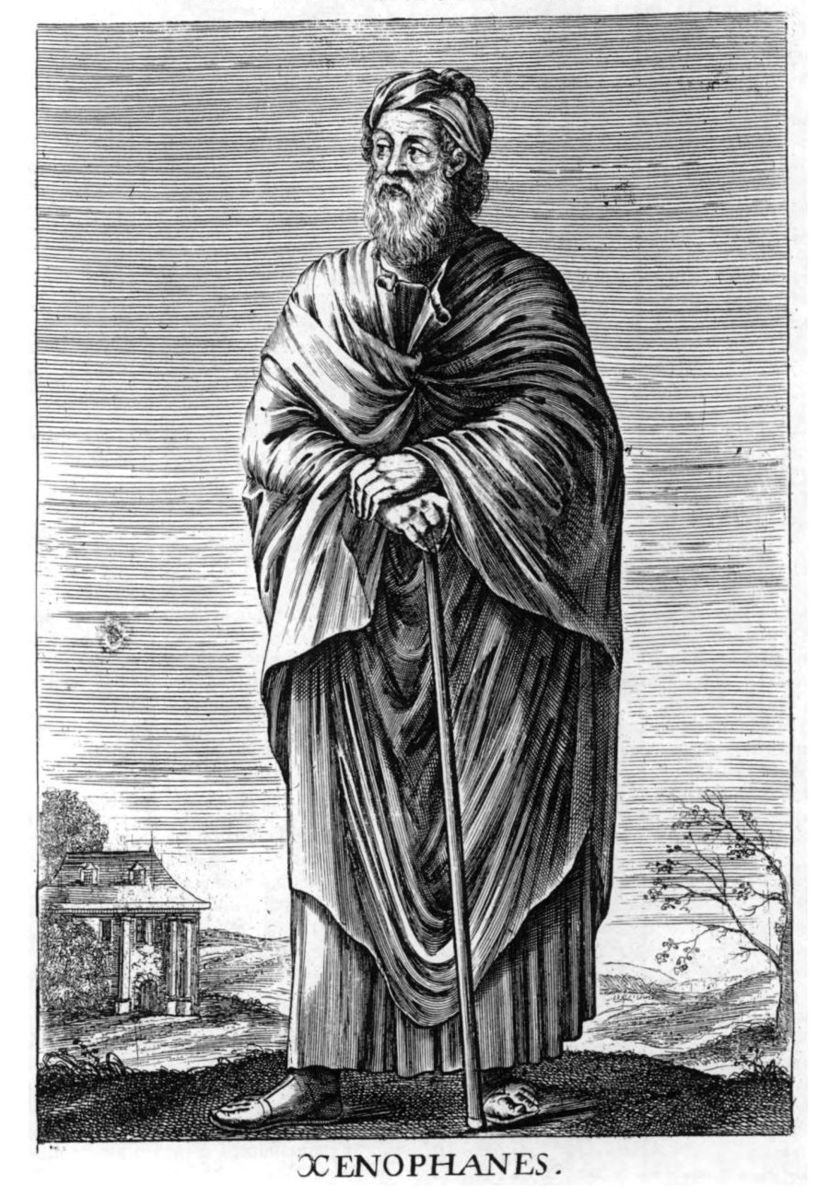
Xenophanes (c 570-476 BCE), one of the earliest of the Presocratics, savaged Homer and Hesiod for ‘attributing to the gods everything that men find shameful and reprehensible – stealing, adultery and deceiving one another.’
Humans possessed false ideas of gods because they fashioned them in their own image. So, ‘Ethiopians say their gods are flat-nosed and black, and Thracians that theirs have blue eyes and red hair.’ And if horses and cows possessed gods, they would undoubtedly be ‘horse-like gods, cow-like gods’.
There could only be one God, Xenophanes insisted, ‘since it is sacrilege for any of the gods to have a master’. This God could be ‘in no way similar to mortal men in body or in thought’. God must have always existed, for there is nothing superior that could have created Him, and He could not have been created by an inferior being. He is a living being but unlike like organic beings there are no parts in Him. He has no physical contact with anything in the world but ‘remains for ever in the same place, entirely motionless’ and ‘effortlessly, he shakes all things by thinking with his mind.’ This notion of a wholly simple God came to be important in both Islam and Christianity.
Allen Buchanan and Russell Powell look at it from an evolutionary standpoint:
Morality involves judgment, shame and exclusion as much as kindness. What is more, modelling work by the anthropologist Robert Boyd, the biologist Peter Richerson, the economist Samuel Bowles and their collaborators has shown that moralising punishment is likely to evolve only in the context of selection between groups. Which means that morality most likely evolved in an arena of intergroup conflict, in which violence and vigorous economic competition between groups was commonplace.
This conclusion is consistent with archaeological, ethnographic and ethological data, too. As the archeologist Lawrence Keeley, the psychologist Steven Pinker, the anthropologist Chris Boehm, the primatologist Richard Wrangham and others have observed, intergroup conflict is common in extant and prehistoric hunter-gatherer bands, and is well established in chimpanzees.
Given this picture, we should expect human beings to extend moral consideration to members of their own group, while at the same time ruthlessly exploiting people from other groups. In short, we should expect evolution to have produced a human moral psychology that is group-ish and strategic in nature — one that takes other individuals to be part of the moral community if they are part of one’s co-operative group, or otherwise capable of contributing to or disrupting co-operative goods. Extending moral consideration to outsiders — especially those who are not in a position to reciprocate or who could be exploited without fear of reprisal — is maladaptive in a moral system that arose from competition between groups. In other words, a conventional evolutionary view is that morality involved as a way of bolstering in-groups and excluding others – that we are ‘hard-wired’ for tribal loyalties and conflicts.
Aaron Cline Hanbury explores the enduring popularity of C.S. Lewis:
One of the few men who did attend Lewis’s funeral was the English theologian and philosopher Austin Farrer. In his eulogy that day, Farrer effectively described the combination of logic and emotion—of fact and imagination, of prose and poetry—that made Lewis’s writings resonate with many demographics of readers: Farrer said, “There lived in his writings a Christian universe that could be both thought and felt, in which he was at home and in which he made his reader at home.” In other words, readers found—and still find—that Lewis narratives both answer intellectual questions and satisfy spiritual longings; Lewis demonstrates the importance of images and stories for the life of faith, without forgetting the necessity of reasoned, coherent belief, as well.
But Lewis’s appeal clearly reaches further than his Christian audience and draws appreciation from adherents of other faiths and the non-religious. There’s a profound reason for that.
As the flamboyant, avant garde theater critic Kenneth Tynan, a proud proponent of amorality, wrote in his diary after reading Lewis’s novels, “How thrilling he makes goodness seem—how tangible and radiant!” And after reading a work of nonfiction, he wrote, “C.S.L. works as potently as ever on my imagination.”
In honor of his achievements as a writer, officials of Westminster Abbey announced last month that they will honor Lewis in the prestigious Poets’ Corner alongside literary figures such as Geoffrey Chaucer and Charles Dickens. The memorial stone displays Lewis’ famous summary of his faith: “I believe in Christianity as I believe the sun has risen. Not only because I can see it but because by it I can see everything else.” This vision for a Christian lens to the world permeates Lewis’s stories, because, for him, the best stories hinted at the deep structures of reality, helping humanity in the journey for truth and significance. Good stories point to an ultimate story. And as Farrer—but few else—might have predicted, Lewis appears more relevant today than ever.