Has The Novel Lost Its Faith? Ctd

Last year around this time, Paul Elie dropped a debate-spurring essay (NYT) on the decline of Christian novels in America, which the Dish covered here and here. In a new interview with the magazine Dappled Things, Elie furthers the discussion about faith in fiction:

DT: The [Catholic] faith is in decline in culture—at least on the face of it anyway. After all that’s one of the reasons Pope Benedict called for the Year of Faith. That same lack of faith, it seems fair to say, is reflected in at least three kinds of readers out there. You have a readership with a fragile faith, a readership antagonistic to the faith, and a readership that’s simply indifferent. So if you produce a fiction that seeks to challenge the reader—the first sort of reader will pull away from the work because he feels threatened; the second will reject it outright as either unbelievable or even inhuman; and the third will simply shrug their shoulders and remain unmoved. How does a work of fiction which proposes a fictional component then capture these sorts of readers?

PE: I don’t go along with that idea at all.

I’m not sure I got it from publishing or writers, but I see the book is something written by one person sitting alone in a room and read by one person sitting alone in a room. To ponder that is to realize the variety of readers. Not only is it hard to break readers down into three groups in terms of their religious disposition, and many readers don’t know where they stand on these issues. …

Flannery O’Connor says you can do whatever you can get away with, but nobody has ever gotten away with much. She also said about her novel Wise Blood, “That belief in Jesus Christ is to some a matter of life and death has been a stumbling block for readers who prefer to think of it as a matter of no great consequence.” She was writing from the situation you speak of but she figured out how to do it. She figured out how to shape everything in the novel to sympathize with Hazel Motes, who is indignant about the abuses of Christianity which then lead to his attention to doctrinal impurity in Christianity. In so doing, he gives us a grasp of what an authentic Christianity would be. It makes you identify with that in spite of yourself as the reader. That’s what O’Connor was trying to do anyway.

Growing A Legal Market

Obama Admin. Unveils New Policy Easing Medical Marijuana Prosecutions

Keeping tabs on Colorado’s newfangled marijuana industry isn’t an easy task:

Savvy business owners know that keeping an eye on the pot is about much more than merely complying with state law. Diligence discourages employee theft, pinpoints choke points in production procedures, and helps calibrate inventory to consumer demand. As [Pure Medical Dispensary owner Frank] Quattrone puts it, “You want to know where your assets are.”

Still, [Hank] Hasler [who enforces marijuana growing regulations] believes it’ll be a while before every Colorado marijuana business operates like Quattrone’s. “Right now, I am seeing less enforcement than I expected,” he says. He’s seen marijuana operations with no business records whatsoever other than a moldy stack of harvest sheets, a pot shop illicitly growing its product on the roof of a strip mall, and a grower who insisted all she had to list on her product labels for cultivation ingredients, as required by law, were “sunshine and love.”

Martin Lewis, who has a piece on the environmental problems with marijuana farming, wishes growers used more sunshine:

Growing sun-loving plants in buildings under artificial suns is the height of environmental and economic lunacy. Outdoors, the major inputs—light and air—are free. Why then do people pay vast amounts of money to grow cannabis indoors, regardless of the huge environmental toll and the major financial costs? The reasons are varied. Outdoor cultivation is climatically impossible or unfeasible over much of the country. Everywhere, the risk of detection is much reduced for indoor operations. Indoor crops can also be gathered year-round, whereas outdoor harvests are an annual event. But the bigger spur for artificially grown cannabis appears to be consumer demand. As noted in a Huffington Post article “indoor growers … produce the best-looking buds, which command the highest prices and win the top prizes in competitions.” In California’s legal (or quasi-legal) medical marijuana dispensaries, artificially grown cannabis enjoys a major price advantage, due largely to the more uniformly high quality of the product.

(Photo by David McNew/Getty Images)

‘Tis The Season For … Bigotry?

This month, Megyn Kelly tested American tempers by commenting on the supposed race of Santa. Looking abroad to Holland, Sophie McBain reflects on this year’s debate over “Zwarte Piet,” or “Black Pete,” a companion to Saint Nicholas (aka Sinterklaas) usually depicted in blackface:

This year, Sinterklaas has sparked a debate so fierce that even the UN has become involved. At the root of the controversy are Sinterklaas’s helpers, called theZwarte Pieten, or Black Petes. “And do you know why Zwarte Piet is black?” I remember my grandma asking me. “It’s because he comes down the chimney to bring you your presents.” This is the story told to most children in Holland, but Zwarte Piet isn’t smeared with soot like Dick Van Dyke after a longday on set. His whole face is painted black and he has thick, painted-on lips, a black curly wig and thick gold hoop earrings. …

dish_zwartepietNo one likes their festive traditions tampered with –imagine trying to implement a countrywide ban on Christmas trees in the UK – but emotions over Sinterklaas run deeper. Most Dutch people identify themselves as inherently liberal, yet attacks on Zwarte Piet have been construed as an attack on Dutch identity – which is political dynamite, given the rapid growth of the far-right in recent years. The deputy prime minister Lodewijk Asscher’s insistence that “You can’t say the whole of Holland is racist” has struck a chord with many who feel aggrieved that a beloved childhood tradition has attracted such condemnation.
The problem is that even if a practice isn’t intended to be racist, it can still be hurtful, discriminatory and, yes, racist. Underneath the popular insistence that Sinterklaas is just a cosy children’s event, some worrying and ugly sentiments have come to light. Organisers hoping to hold the first ever “Rainbow Piet” parade, featuring multicoloured Piets, had to cancel their event in October after receiving death threats.

Akim Reinhardt proposes a parallel between Zwarte Piet’s blackface and the “red face” encouraged by American pro sports teams with Native American mascots:

Americans such as myself can be quick to judge and condemn.

Living in a country that saw a protracted civil rights movement reach its apex half-a-century ago, the knee jerk reaction is to condescendingly nod our heads and mutter something about Europe’s backwards race relations.  We know our own state of race relations is far from perfect.  But black face in 21st America?  And directed at audiences of children no less?  Incomprehensible.

But what about red face? The Kansas City Chiefs football team. The Cleveland Indians baseball team. The Washington Redskins football team. The Atlanta Braves baseball team. The Chicago Blackhawks hockey team. And beyond professional sports teams garnering huge profits, there are also prestigious research universities like Florida State University and the University of Illinois that continue to field sports teams with Indian names and mascots, have many fans who dress up in red face, and even present sanctioned red face Indian performances for the crowd.

Black Pete is atrocious, and just about everyone outside of Holland gets that.  But America’s Indian mascotting is also disgusting.  Yet many Americans are as blind to their red face minstrelsy as the legion of Dutch supporters are to their beloved black face minstrel.

Recent Dish on race and Christmas conventions here, here, and here.

(Image of Sinterklaas and Zwarte Piet via Wikimedia Commons)

When’s It OK To Laugh At A Tragedy?

About 36 days later, according to psychologists at the University of Colorado who used an online survey to gauge people’s reactions to jokes about Hurricane Sandy:

The researchers divided the surveys into “during crisis” and “after crisis.” The day before the storm made landfall, people thought the tweets were pretty funny—they didn’t yet know it would be a tragedy. Over the next nine days, as people learned the extent of the damage, perceived humor declined. Participants found the tweets least funny 15 days after Sandy’s landfall. Then, it slowly started to be “okay” to find humor in the situation again, leading to a high point of humor 36 days after landfall. Humor fell again after that, and researchers saw another low point 99 days after the disaster. The study also showed that during the first dip in perceived humor, participants found the tweets more offensive.

How the study informs our understanding of humor: 

[A. Peter] McGraw and his colleagues argue these results provide evidence supporting the “benign violation theory” of humor. It states that “humor arises when something that threatens a person’s well-being, identity, or normative belief structure simultaneously seems OK, safe, or acceptable.” Or to put it more simply: “Humor requires threat, but not too much, or too little.”

So if you fear an approaching hurricane could actually hurt you, your interests, or someone you love, there’s nothing funny about it. If the threat has safely passed, its potential to generate humor rapidly retreats. But the moment when you feel you have dodged a bullet: That’s ripe for laughs. Humor, McGraw and his colleagues write, is a great example of “the human capacity for taking a source of pain and transforming it into a source of pleasure.” (In that way, it’s like the blues.) This ability, they add, “is a critical feature of the psychological immune system.”

Where Terrorism Happens

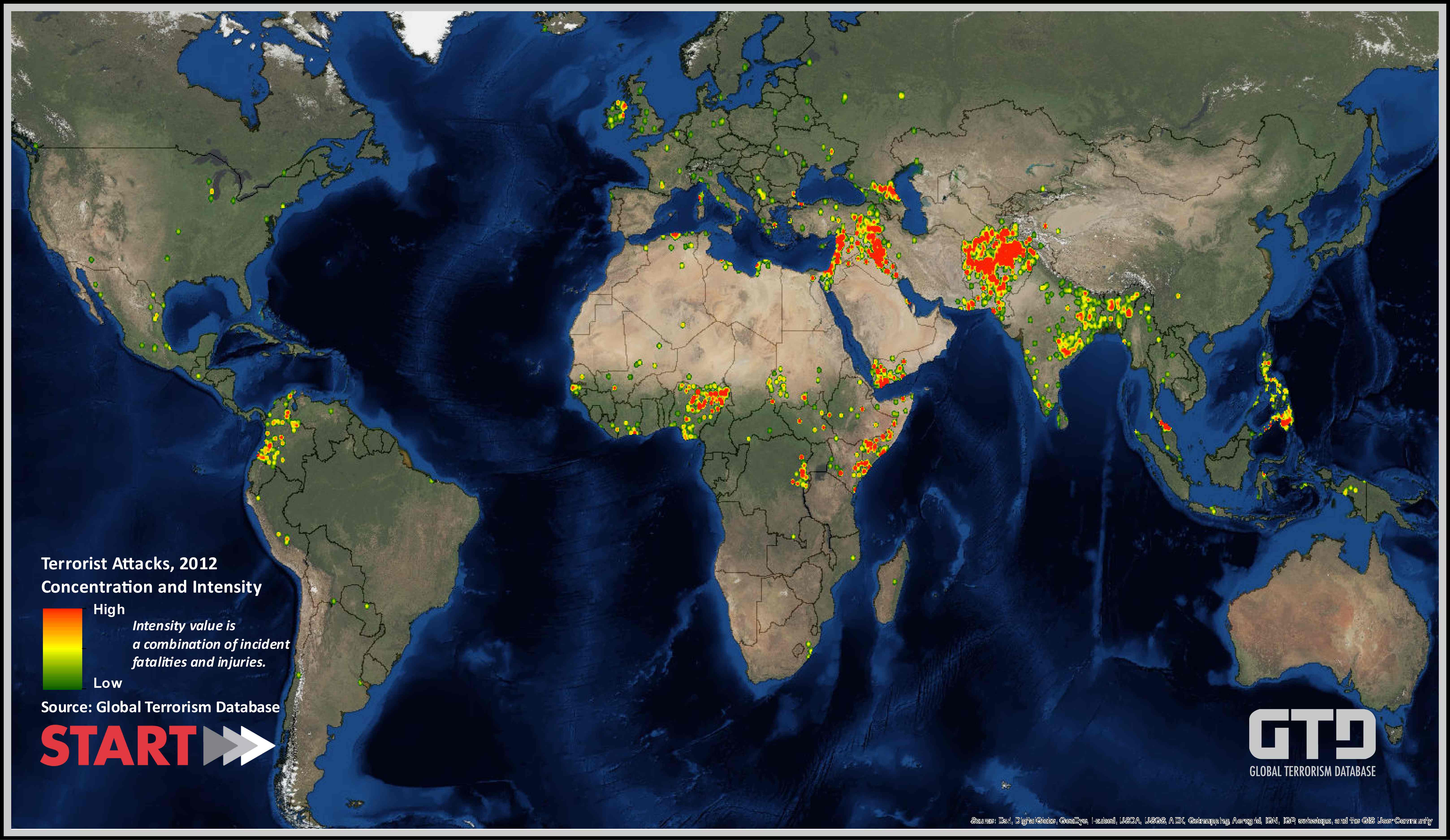
Terror-map

The National Consortium for the Study of Terrorism and Responses to Terrorism released new data on Thursday showing that the majority of the terrorist attacks and fatalities in 2012 happened in just three countries: Pakistan, Iraq, and Afghanistan:

The next five most frequently targeted countries were India, Nigeria, Somalia, Yemen and Thailand. “While terrorist attacks have in large part moved away from Western Europe and North America to Asia, the Middle East and Africa, worldwide terrorism is reaching new levels of destructiveness,” said Gary LaFree, START director and professor of criminology and criminal justice at the University of Maryland. In addition to illustrating a continued shift in location of attacks, the new data — with more than 8,400 terrorist attacks killing more than 15,400 people in 2012 — also show an increase in attacks and fatalities over the past decade. The previous record for attacks was set in 2011 with more than 5,000 incidents; for fatalities, the previous high was 2007 with more than 12,500 deaths.

These record numbers are partly due to a change in START’s data collection methodology, however, so the report cautions against a direct year-to-year comparison. Zach Rausnitz looks at who committed the deadliest attacks, and where:

Three of the five deadliest attacks from the year took place in Yemen. One perpetrated by al Qaeda in the Arabian Peninsula killed 210 people. Al Qaeda central did not itself carry out any attacks in 2012, but the six groups responsible for the most deaths worldwide had some affiliation with al Qaeda, START says. They include the Taliban, Boko Haram and AQAP. Along with Yemen, the Democratic Republic of Congo, Syria and Iraq each suffered individual attacks that killed more than 50 people. The only fatal attack listed in the database that took place in the United States in 2012 was the killing of six people at a Sikh temple in Oak Creek, Wisc., by a member of a white supremacist organization.

Benjamin H. Freidman points out that in the longer term, terrorism is really on the decline:

We should … be skeptical that the recent increase in terrorism means more danger for Americans. The cause of terrorism’s recent increase is civil wars and political unrest in Africa, the Middle-East and South Asia, where the vast majority of recent terrorist attacks have occurred. Meanwhile, terrorists killed fifteenseventeen, and ten private U.S. citizens (that is, non-military) in 2010, 2011, 2012, respectively. That means the danger to Americans either did not grow or that they mostly avoided it. The real problem then is not al Qaeda, but the fractured political order in Iraq, Syria, Afghanistan, Yemen, Pakistan, Somalia, Nigeria and the like.

Snark vs Smarm, Ctd

Richard Lea contributes to the debate spurred by Tom Scocca’s essay:

Not even Scocca is really arguing for snark. Instead he’s arguing for the licence to adopt a negative tone when you confront “smarm”, which he defines as a “kind of performance” that takes on “the forms of seriousness, of virtue, of constructiveness, without the substance”. Scocca assembles examples from literature and politics of smarmy doublespeak – and who could possibly be in favour of that? – where practitioners short-circuit dispute about real issues by claiming any criticism is merely personal attack and suggests that those who argue against snark are really concerned about preserving their own status.

But he’s not really arguing about snark at all, as becomes clear when he admits that “the complaints against snark are not entirely without merit”.

Some snark is harmful and rotten and stupid. Just as, to various degrees, some poems and page-one newspaper stories and sermons and football gambling advice columns are harmful and rotten and stupid. Like every other mode, snark can sometimes be done badly or to bad purposes. …

Instead we need to steer a course between snark and smarm, to remember that it is enormously hard to write a good book, and to engage with the book, which has eventually been written on its own terms. Those terms are, of course, subject to criticism themselves, but we have to remember that we’re not in Hollywood. In a world where US publishers produce more than 300,000 titles a year – not to mention the 390,000 US titles published directly by their authors – the duty to “review books negatively” that Dowd upholds is constrained by limits of time and space. Confronted with a bad book, we should say it’s bad, of course, and how and why, but unless it is important or dangerous, why bother to confront it at all? Why not find something better to review? If we renounce snark, then the negativity we permit ourselves must have a point, and must be balanced with generous explorations of those few books that aspire to something interesting and manage to match those aspirations with at least a little success. Otherwise we’re not really talking about literature at all.

Carbon Tax-Breaks

Why we should end them:

According to IMF calculations issued earlier this year, global fossil-fuel subsidies in 2011 cost $1.9 trillion — fully 2.5% of global gross domestic product — and the biggest single source of subsidies was the United States. Eliminating these subsidies globally, the IMF said, would cut energy-related carbon-dioxide emissions a whopping 13%.

Fuel subsidies are terrible primarily because, by “reducing the cost consumers pay for oil, natural gas and coal, subsidies promote the wasteful use of these polluting — and, at least in theory, finite — resources.” But they can also be harmful in a multitude of other ways. For example:

Earlier this year, Iran devalued its currency — the rial — against the US dollar. But when it did the devaluation, it failed to compensate by raising the rial-denominated price of fuel. As a result, the devaluation reduced the price in real terms that consumers in Iran pay for fuel. The market responded swiftly and sensibly: Massive amounts of diesel fuel are being smuggled out of Iran and into neighboring Pakistan, where the price of diesel at the pump now is 10 times what it is in Iran. According to the IEA, 60,000 barrels of diesel fuel are being smuggled out of Iran, mainly into Pakistan, every day.

A.I. Intimacy, Ctd

Christopher Orr considers Her the best film of the year:

Her is a remarkably ingenious film but, more important, it is a film that transcends its own ingenuity to achieve something akin to wisdom. By turns sad, funny, optimistic, and flat-out weird, it is a work of sincere and forceful humanism. Taken in conjunction with [Spike] Jonze’s prior oeuvre—and in particular his misunderstood 2009 masterpiece Where the Wild Things Are—it establishes him firmly in the very top tier of filmmakers working today. Like Eternal Sunshine of the Spotless Mind—of which Her is a clear descendant—Jonze’s film uses the tools of lightly scienced fiction to pose questions of genuine emotional and philosophical weight. What makes love real: the lover, the loved one, or the means by which love is conveyed? Need it be all three?

Dana Stevens’s take:

Her isn’t, in the end, a political or socio-cultural satire, much less a nostalgic tract about the need to throw away our devices and truly live. It’s a wistful portrait of our current love affair with technology in all its promise and disappointment, a post-human Annie Hall.

Brett McCracken compares the protagonist to the operating system:

Theodore earns a living communicating emotion for a populace presumably deficient in the art. In this world, communication itself has become a necessary nuisance. You need it to live, but it’s devoid of pleasure and avoided whenever possible. Other people write intimate letters for you; your OS writes your e-mails, makes your calls, chooses and buys presents for your goddaughter, and navigates dicey dynamics with divorce lawyers.

Theodore is paid to know people better than they know themselves, to dig into their quirks and nuances to best capture how and what they love. This is also, of course, what Samantha does for Theodore. In this and many other ways she is a mirror for him, a reflektor (to use a neologism from Arcade Fire, who provide the soundtrack for the film and whose latest album is in part about connection in the digital age).

A bit from Angela Watercutter’s review:

Jonze imagines a future where we trust our devices more than we do today — and we trust them a lot already. Think about how many secrets we tell them in the form of sexts and selfies, Snapchats and private e-mails. Increasingly, the love we get day to day comes in form of “hearts” on Instagram and Likes on Facebook. Would it really be so weird if the machines themselves got in on the conversation? They’ve been listening in all along; maybe it’s about time they piped up.

In Her – like our hyper-connected lives today – it’s possible to fall in love with someone you can’t touch, and to feel it every bit as much as you would with someone who’s there in flesh and blood.

Kurt Loder’s bottom line:

The movie has more on its mind than the old question of “What is love?” In a bracingly original way, Jonze suggests that whatever the future of digital evolution might hold in store for human romance, the danger of heartbreak will always remain, along with its attendant torments of desperate yearning and unfocused jealousy. “You helped me to discover my ability to want,” Samantha tells Theodore. Want what, he wonders.

Related Dish on the film here.

What If Fewer Young People Buy Insurance? Ctd

Obamacare won’t collapse if somewhat fewer young Americans sign up for coverage. Jonathan Cohn examines the big picture:

None of this means that unexpectedly low enrollment from healthy people would be a good thing—or without consequences. Premiums would rise, potentially increasing the cost of federal subsidies and/or premiums for people buying coverage without federal tax credits. But the increases would not be disastrous. And that’s a pretty good lesson to remember. People tend to talk about Obamacare as if it’s going to be a ringing success or a total catastrophe. In reality, it’s likely to be a mix of good and bad news, with lots of variation from state to state, and with lots of unanswered questions that linger for months and even years.

Philip Klein reframes the death spiral debate:

[W]hat’s been largely lost in the ongoing discussion about whether a death spiral can happen is that there isn’t one Obamacare “risk pool” and thus, there isn’t one potential “death spiral.”

In reality, there are 51 different risk pools (for each state plus the District of Columbia), which means 51 chances to get things right, as well as 51 possible death spirals.

It’s perfectly possible that come March 31 – the current end of the open enrollment period – evidence will show a bit of both. That is, some exchanges may be viable, and some may find themselves in deep trouble.

Larry Levitt of Kaiser looks ahead:

I expect a mixture of stories at the beginning of January. There will likely be reports of some remaining errors in the back-end transmissions to insurers, with some people thinking they’re enrolled when they’re not. And, as I said, some people will be surprised by which providers are or are not in their plans. Some people may also start to discover that they have enrolled in plans with modest premiums but high deductibles, which may not cover their more routine medical expenses. At the same time, we’ll start hearing many more stories than we have to date about people who have signed up and getting help that wasn’t available before. That will include people with pre-existing conditions who have been locked out of insurance before, or low- and middle-income people who are getting tax credits that make coverage much more affordable. What we’ll start to see in January are the real effects of the law, rather than the more hypothetical ones we’ve been talking about up until now.

An HIV Breakthrough?

Researchers may have figured out how HIV kills white blood cells and causes AIDS:

Scientists have long known that HIV sets up little biological factories inside the the body’s protective CD-4 T cells they infect, producing millions of copies that eventually lead to a massive destruction of the immune system. Until now, investigators have not understood why the virus becomes so aggressive. It turns out HIV, which infects only a small number of T cells at the start, destroys approximately 95 percent of immune cells through a process known as the bystander effect.

Warner Greene, head of virology and immunology at the Gladstone Institutes in California, says bystander cells that are in the neighborhood of HIV-infected cells succumb to a fiery death. “Most CD4-T cells during HIV infection die not because of the toxic effect of the virus, but because of an immune response against the virus.  So, CD4 cell depletion is more of a suicide than a murder,” said Greene.

This violent immune response seems to contribute to the progression of the disease:

The response is a self-destruct protocol called pyroptosis. In contrast to the better-known apoptosis, in which cells die quietly without triggering inflammation, pyroptosis is “not a bland, but a fiery death,” Greene says. These cells spew inflammation-causing chemicals as they die, attracting more T-cells that can then become infected themselves by the newly freed HIV. “In a bacterial infection, recruiting all these cells might be a good strategy for containing the infection,” Greene says, but with HIV a vicious cycle of infection results. Pyroptosis also explains why AIDS is associated with high levels of inflammation.

This finding may lead to new HIV therapies:

Greene thinks that pyroptosis (or the lack of it) could explain why HIV usually causes AIDS in humans but its relatives, the SIVs, barely sickens the apes and monkeys that they infect. SIVs can kill CD4 cells directly, but they can’t trigger the same pyroptosis response in other primates. They kill a few cells but the majority survive, and the immune system stays strong. “That’s the evolutionary solution—not to control the virus but to control the host response,” says Greene. “I think if we had another million years, we’d evolve in the same way.” Thankfully, his team is working to a tighter schedule. They’ve already found a molecule that can stop pyroptosis, at least in lab-grown cells.

The whole messy process depends on a protein called caspase-1. Without it, you don’t get any mature IL1β, and without that, you don’t trigger the vicious cycle of CD4 cell death. Caspase-1 plays many other roles in the body, and several pharmaceutical companies have tried to make drugs that block it, for the purposes of treating other diseases. One of these, VX-765, was developed to treat chronic epilepsy and autoimmune diseases. Greene’s team showed that it completely prevents HIV from killing the bystander CD4 cells. No caspase-1 activity. No IL1β signals. No inflammation. No mass cell death. No AIDS? That remains to be seen. These are only lab experiments, after all, and the drug still needs to be tested in actual HIV patients.