What Happened To Jesus’ Willy?

Before diving deep into self-parody here, some background:

By the eleventh century, several churches in Europe explained they had the Holy Foreskin – the story often went something like this – Jesus’ mother Mary kept the foreskin, along with the umbilical cord, and later gave it to Mary Magdalene. We then jump forward several centuries to the time of Charlemagne, when an angel gave the relic to the Emperor. From there it went to this place or that place, including to Rome. In 1421, it was even sent to Catherine of Valois in England, so that it would bring good fortune (and a pregnancy) to her marriage with Henry V.

The relic has provoked “a lot of theological commentary about whether or not [it] could be real, much of it negative”:

The whole matter was even brought before Pope Innocent III, who was asked to decide whether or not the foreskin and umbilical cord was a true relic. The Pope replied, “Rather than attempt rash answers to such questions, it is better that they be left entirely to God.” This seems to be the line that the Papacy has taken since, although as the idea became criticized and mocked by Protestants, the Holy Foreskin has been gradually hidden away and not talked about by the church.

The last place known to have publicly shown the Holy Foreskin was the Italian village of Calcata, which lies 30 miles north of Rome. The locals claimed that the relic had been there since 1527 and every year on January 1st, it would be taken out of the local church and paraded around. Then in 1983, it mysteriously disappeared, taken from a shoebox underneath the priest’s bed. Many locals believe that it was the Vatican that was responsible for taking away their precious relic. It has, however, brought an end to one of the strangest stories of medieval Christianity.

(Video: trailer for The Quest for the Holy Foreskin. Another video investigating the matter is here.)

(Hat tip: 3QD)

If It Exists, There Is Porn Of It

Ryan Schock

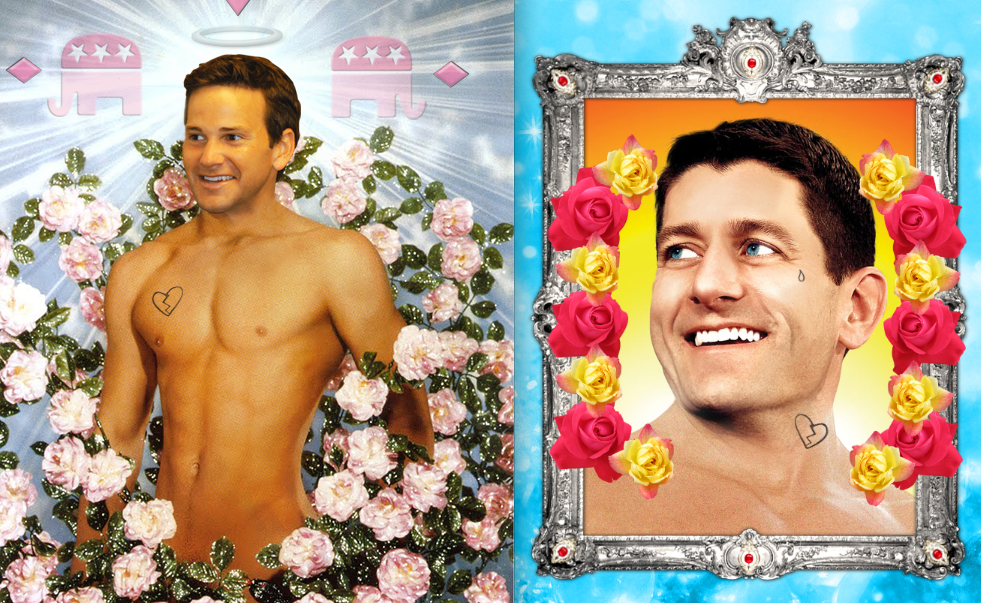
That’s Internet rule #34. Garance Franke-Ruta passes along more proof, in the form of some seriously NSFW fan-fiction:

Over the weekend, an anonymous writer launched a Tumblr imagining an X-rated tryst between congressional fitness buffs Aaron Schock and Paul Ryan. “Paul Ryan XXX“— subhed: “Things are getting steamy on Ways and Means …”—is not appropriate work reading, and it’s clearly intended as satire of a certain kind of fawning journalism both men have tended to attract (as well as, you know, as porn).

“He was obsessive about his personal fitness. He cared deeply about those close to him. He had an outstanding sense of humor, but he never resorted to jokes about others. His laugh could make any room come alive,” the author writes of Ryan, in one of the milder passages. “And there was his intellect. His vision. His ability to see how things were possible that no one else could.”

Here the writer gently mocks the conventions of the many thumb-sucking profile of Ryan—be sure to mention the vision thing—by using them for different narrative ends.

Queerty imagines how the story might develop:

While this is nothing compared to the Mitt Romney-Paul Ryan fanfiction from that glorious descent into pop culture irrelevancy known as their 2012 Presidential campaign, we can’t wait to see where the subsequent parts lead. Here’s a suggestion: things get complicated when Mitt returns, having left his wife and 12(?) kids to be with Paul, but only over Aaron Schock’s drop dead gorgeous body. This basically writes itself.

(Image via Joe Jervis)

Putin’s Pardon Party

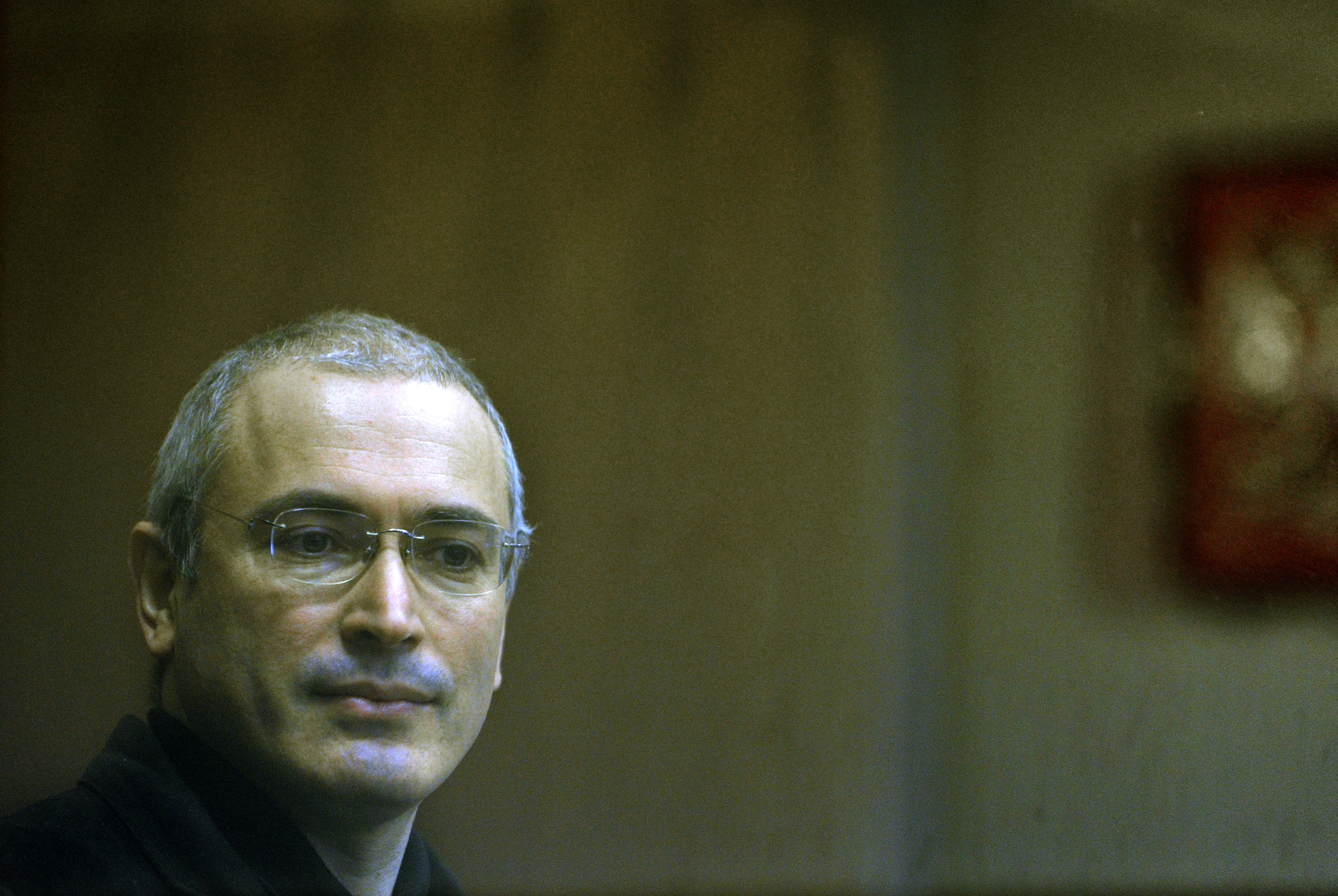
Former Yukos oil company chief executive

After granting amnesty to Pussy Riot and 30 jailed Greenpeace activists, Vladimir Putin ordered the release of former oligarch Mikhail Khodorkovsky, who has been imprisoned for a decade. Masha Gessen credits Obama’s decision to skip the Olympics and send a delegation of openly gay athletes:

The delegation he announced included no high-level politicians, something that has not happened in almost two decades. At the opening ceremony, the Americans will be led by University of California President Janet Napolitano, and at the closing, by Deputy Secretary of State William Burns. And in a clear reference to the Kremlin’s anti-gay campaign, Obama included openly gay athletes: Billie Jean King, Brian Boitano (who came out shortly after the delegation was annoucned), and Caitlin Cahow, an ice hockey Olympian. Obama issued no comments about his choice of delegates: When one snubs, one does not engage.

Putin panicked. On Wednesday he allowed his own version of an amnesty bill, which came before parliament that day, to be amended to cover the Greenpeace activists. The following day, he said he intended to pardon Khodorkovsky. There is every indication that this was unplanned. He made the annoucnement after the end of his annual press conference, during an informal chat with journalists. He made reference to a clemency request that Khodorkovsky had supposedly written but of which neither his family nor his lawyers were aware. Not even the clemency officials who would have processed such a request had ever heard of it.

She expects that “Putin’s ongoing crackdown on civil society will likely intensify significantly after the Olympic closing ceremony is over” but argues that “is no reason not to do the right thing, like refusing to stand next to a dictator as he puts on the show of his dreams.” Leonid Bershidsky comments:

The image Putin wants to project to the world is not that of a dictator who steals elections, stifles dissent and jails political opponents, but that of a mainstream conservative statesman who respects his country’s traditions and rules in the interest of the moral majority. That show may still get an audience of dignitaries in Sochi: There are still plenty of global leaders who have not pleaded schedule conflicts. The U.K. Prime Minister David Cameron, who famously rebuffed [Stephen] Fry by saying, “We could better challenge prejudice as we attend,” has not yet made his plans known. Neither has German Chancellor Angela Merkel.

Fisher mulls Putin’s political calculations:

So why is Putin doing it? Well, let’s look at what these pardoned prisoners have in common: they are all pretty famous and are well-known particularly in the West. This might sound obvious, but it’s worth noting that Putin may be pardoning Khodorkovsky et al. for the sake of appearances and not because he is actually interested in softening Russia’s treatment of political prisoners.

It’s not clear that Putin actually stands to lose very much with these pardons. After all, if the primary purpose of political arrests is to shape Russian politics, then the imprisonments of Khodorkovsky and the Pussy Riot members have likely served their purpose. Russia’s oligarchs got the warning loud and clear: don’t cross Putin, don’t go into politics. Russian civil society has a sense, from the Pussy Riot arrests, where the red lines lie. The political purpose of the Greenpeace arrests was never as obvious to me – a warning to foreign NGOs, perhaps – but it’s hard to imagine that the message was lost on its intended targets, if there were any.

The upside for Putin here is considerably clearer.

Eleanor Margolis applauds Obama’s Olympic snub:

In making one of the world’s most famous lesbians a US representative in legally homophobic country, Obama is breaking the relative silence of world leaders when it comes to condemning Russia’s new legislation. The “we’re here, we’re queer”-ness of the US Olympic delegation may not be groundbreaking, but it certainly draws attention to where it’s needed. Post-Cold War, some of America’s intercontinental ballistic missiles are lesbian-shaped.

Keating thinks releasing Khodorkovsky is a risk:

To put it bluntly, while the international community has been pushing for Khodorkovsky’s release for a long time, this looks a lot more like a czarist decree than anything resembling the rule of law. It seems like a high-stakes gamble for the Kremlin, however. His years in prison have transformed Khodorkovsky’s image from just another post-Soviet robber baron living off the ill-gotten gains of the 1990s into a prisoner of conscience and eloquent regime critic. He’s Russia’s best-known political prisoner by a long shot, only 13 percent of Russians believe the charges against him are real, and in the capital at least, the majority of people favor his release.

Putin has managed to consistently outfox and divide his opponents in the past, but this releases raises the stakes significantly. It seems like a risky move for some good pre-Olympic PR.

Simon Shuster, however, sees the move as a sign of strength:

Putin’s latest victories seem to have strengthened his stomach for risk. In the course of this year, he has beat out the West in a diplomatic duel over Syria, whose regime he has successfully defended against a U.S.-led military intervention. Just this week, he pulled Ukraine away from its integration deal with the E.U. and purchased the loyalty of Ukraine’s leadership with an economic bailout. His vision of rivaling the West with a new “Eurasian Union” of former Soviet states has turned from a political pipe dream into a reality, as Armenia, Kyrgyzstan and Ukraine drew closer this year to joining Russia’s budding trade bloc with Belarus and Kazakhstan. In February, Putin will see the greatest validation of his rule – the Winter Olympics in his beloved resort town of Sochi – and he has been getting prepared with a bit of political house cleaning. His aim was to avoid any Western boycott from soiling the mood of the Games, a risk that began to seem very real as U.S. President Barack Obama and several European statesmen announced this month that they would not be going to Sochi. So Russia has moved to preempt their criticism by cleansing its record on human rights.

The Guardian’s editors see through the publicity stunt:

The Russian government’s readiness to throw people into prison when they get in its way, bending the legal system to do so, has a long history, but has been a particular characteristic of Mr Putin’s rule since the detention of Mikhail Khodorkovsky and the confiscation of his Yukos empire in 2003 – the foundation act of the Putin era. The beauty of this strategy is that you are able to dispose of opponents and critics under cover of the law, but you can then get credit later for a measured clemency, as with Mr Putin’s indication yesterday that a pardon for Mr Khodorkovsky is on the way. Murmuring that Mr Khodorkovsky has served 10 years and that his mother is ill, makes Putin seem humane.But it was not humane to put him there in the first place. In lesser key, Mr Putin sought praise for the release of the Greenpeace and Pussy Riot detainees, but not without a final swipe at Greenpeace as an agent of foreign powers and at Pussy Riot as desecrators of Russian womanhood.

Christian Neef and Matthias Schepp link Khodorkovsky’s clemency to Russia’s other international image problem:

The timing of Putin’s announcement of the Khodorkovsky pardon is clever. For weeks now, he has been criticized for his handling of the situation with Ukraine. The United States and the European Union allege that the Russian leader exerted massive pressure on Kiev to reject an association agreement with the EU — all in a bid to pull the neighboring country back into Russia’s sphere of power. Critics say Putin’s actions disregard the nearly 50 percent of Ukrainians who favor closer relations with Europe. With his decision to release Khodorkovsky, Putin intends to show that he knows how to use not only the stick, but also the carrot — and that the West’s allegations that Russia is a profoundly undemocratic country do not line up with reality. Given this situation, it’s not surprising that Putin has explicitly pointed out that he was moved to issue the pardon by humanitarian concerns: In his speech, he cited the critical condition of Khodorkovsky’s 78-year-old mother.

Fred Weir stresses that Khodorkovsky requested and was granted clemency, not a pardon.

Mr. Putin told a scrum of reporters outside that Khodorkovsky had written an appeal for clemency – though not a request for pardon – and that the necessary arrangements for his release will soon be made. “In line with the law, Mikhail Borisovich [Khodorkovsky] should have written [a pardon request], which he didn’t do, but just recently he wrote this document and addressed me with an appeal for clemency,” Putin said. Khodorkovsky “has already spent more than 10 years in prison. That is a serious punishment. In his letter he makes reference to humanitarian circumstances. He has a sick mother. I believe that we can soon make the decision and sign a decree granting him amnesty,” he said. The difference between “pardon” and “clemency” is a crucial distinction for Khodorkovksky, since in legal terms the first would be tantamount to an admission of guilt, while the second is merely a plea for mercy.

Anna Kordunsky says the oligarch turned freedom fighter is still politically relevant:

How much does Khodorkovsky still matter? Short answer: a lot. Otherwise, the announcement of his release would not have happened so close to the Olympics, when Russia finds itself more battered in international opinion polls than it had hoped to be so close to the Games. The longer answer is more complex, depending in large part on what exactly Khodorkovsky told Putin in his appeal letter, and whether he submitted one at all. A straightforward request for pardon – as opposed to a more nuanced plea for clemency – would be tantamount to an admission of guilt, harming his credibility once he’s free.

That’s the outcome the Kremlin wants. “The fact that he [Khodorkovsky] is appealing for clemency means that he’s admitting his guilt,” spokesman Dmitry Peskov told Interfax earlier today. Yet the sheer force of Khodorkovsky’s story – of standing up to the Kremlin at such dire personal cost – could lend him a unifying power over Russia’s beleaguered and fractured opposition. And that’s the outcome the Kremlin will seek to avoid at all costs.

(Photo: Former Yukos oil company chief executive officer Mikhail Khodorkovsky, once Russia’s richest man, stands in the defendant’s glass cage in a Moscow courtroom on November 2, 2010. By Dmitry Kostyukov/AFP/Getty)

City Of Darkness

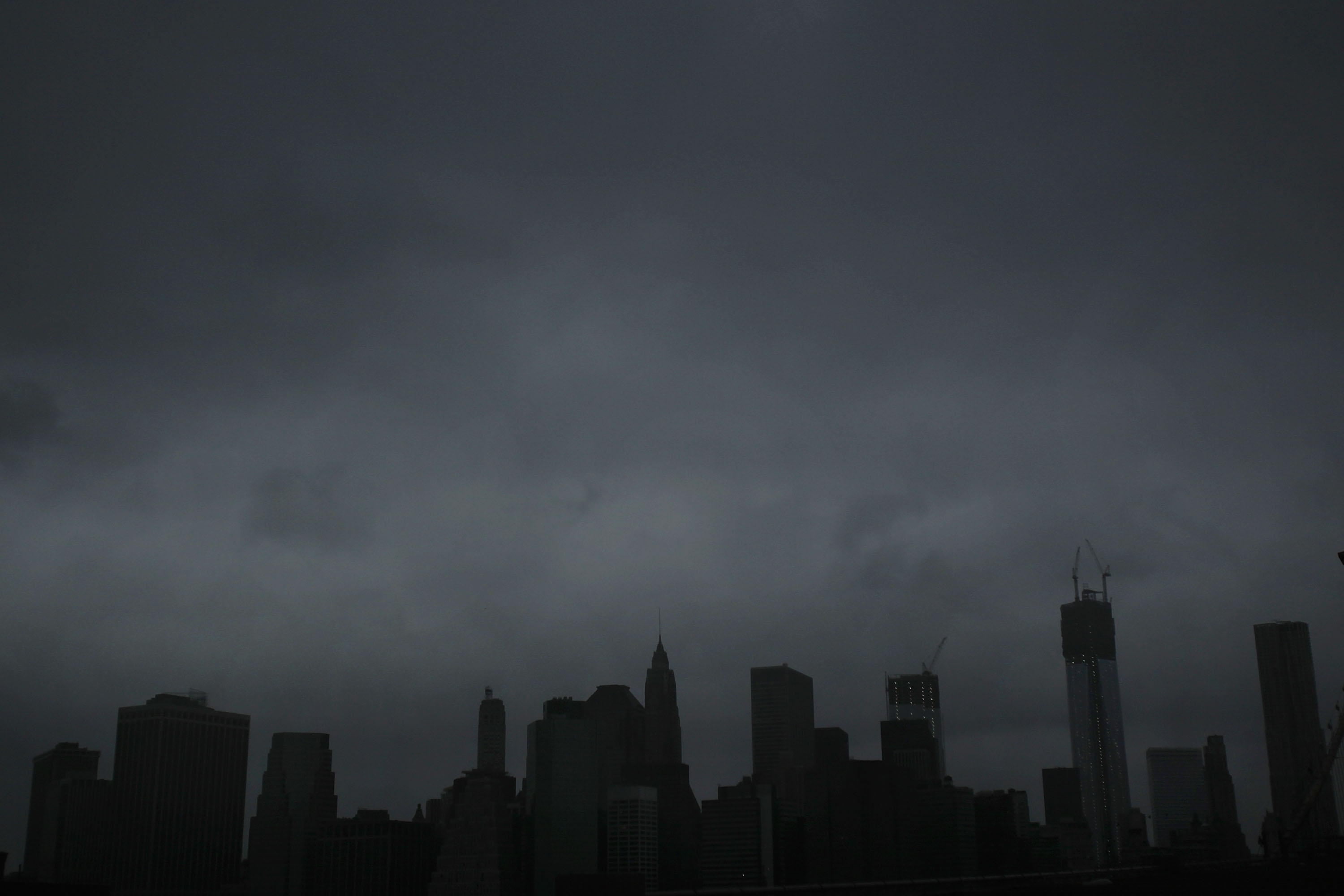
Mid Atlantic Coast Prepares For Hurricane Sandy

Well, we’re nearing the winter solstice, which means living in New York City becomes even more like living in a cave. We’re finally shipping ourselves and the dogs back to DC this weekend for a total crash-out Christmas. You know what I’m craving the most, after living in a second floor apartment in one of the less built-up neighborhoods in Manhattan? Light. Just light. Last year was the first in my life when my bloodwork came back with a Vitamin D deficiency. And I’m not alone, as this city of darkness grows ever more impenetrable:

On Ludlow Street in Lower Manhattan, Alice O’Malley, a photographer, now gazes dolefully across the street at the relentless rise of her neighbor due west — a 20-story hotel that has wiped out the last of her apartment’s gentle pink light.

On the Upper West Side, Ilonna Pederson greets a darkened apartment for the second winter after nearly 50 years there; her southern windows were bricked over a year ago to make way for a high-rise inches away. And in a once-sunny pocket of the far West Village, many are finding themselves in the large penumbra cast by the newly built 150 Charles, which rises 15 stories and houses 91 residences selling for an average of $8.6 million.

“Going higher and staying narrow would’ve allowed light and air,” said George Sanders, 58, who, with neighbors, waged a losing battle to get an alternate structure built. “Now we’re just plunged into darkness. It’s just too bad.”

I went to a party a couple of months back to mourn a friend’s loss of view and sunlight. I haven’t lost it, I’m glad to say. I never had it. Maybe a half hour of reflected sunlight a day is all I can get at almost any time of the year. What I didn’t understand about New York until I actually lived here is that all that amazing skyline is, for actual non-one-percent residents, a series of vast, light-blocking concrete blinds, shuttering out elemental things like the sun or even clouds. There isn’t even greenery anywhere unless you go to that massive over-kill, Central Park, which much of the city never stumbles across. How do you live without sunlight or green, without the sky and grass? I guess I grew up in a rural part of Sussex. To live without trees or green or birdsong or sunlight is just not part of my DNA.

What will I miss in New York City?

A great parish … hanging with a couple of great friends more regularly, while leaving many more friendships back in DC … and, er, that’s it. I should have moved to Brooklyn, I suppose. But then I already live in the equivalent in Adams Morgan in Washington. Everything else – the vast sucking sound of your wallet being emptied, the daily street warfare, the boundless self-love and provincialism, the mad cults of money and property and buzz – I can’t wait to leave behind.

I’ll be back, of course. And maybe when I don’t live here, I can learn to love New York the way I used to, with blinders on, enjoying the madness for brief periods of time, after which I can return to live in something most human beings would call civilization. I don’t regret coming here for a year and a half. It was vital to keep the Dish on the road. But at some point, the city of darkness overwhelms the human spirit. And you long to be where the sun sometimes shines.

Update from a reader, who gives me a kick on the way out:

You left. Good for you. Just as I left the shit-hole that is DC (and from where most of my friends cannot wait to escape). There have been more negative articles written about DC than NYC this year (including Sam Youngman’s recent ripper in Politico).  You enjoy it more. Go.  Stop blogging about New York.  It is tired, and honestly beneath you.  New York didn’t owe you anything.

Another New Yorker:

I live in a lovely (rental) apartment with great light, a living room with windows on three sides and the trees from the backyard next door reaching up to my third-floor window. And I live there because … it’s the apartment I chose to live in. Why take an apartment you don’t like and then blame the entire city for it?

Another:

Andrew, I love you. But if you ever state that Adams Morgan is the equivalent of Brooklyn again, I’m canceling my subscription. Adams Morgan is a single neighborhood in DC. Brooklyn is the most populous borough in New York City, with 60+ neighborhoods, depending on who is counting. Wikipedia tells me that Brooklyn has 2.6 million people while Adams Morgan has 0.016 Million. “They both have hipsters” is not the same thing as equivalence, thank you very much.

Another in Queens:

Brooklyn? Really, you should’ve moved to Queens. I mean, I saw a peregrine falcon on the opposite apartment’s roof the other day. And provincialism? Pretty hard to find in a borough that speaks 138 languages … but I ain’t here to defend my wounded New York pride. I’m here to praise your beloved England’s excellent common sense about the matter of sunlight in cities. Check this out: the law of “ancient lights,” passed in 1663 and still on the books – and very much in active use. We should’ve been so wise.

Another much farther north:

Here in Fairbanks, Alaska, this solstice weekend, we are enjoying a grand total of three hours and forty-two minutes of daylight. As I write this email at 10:35 AM, the sun is not yet risen. When the sun does finally crawl above the horizon at 10:58 AM, it will climb a total of 1.7 degrees above the horizon before sinking back at 2:41 PM. Think of the amount of light you get in the last ten minutes before sunset and you have an idea of high noon in Fairbanks. A hundred miles north of here the sun never clears the horizon at all.

So you don’t get much love from us for complaining about New York being dark.

(Photo: Spencer Platt/Getty)
So You’re Saying There’s A Chance

Sides calculates that Democrats have a 1% chance of retaking the House:

This is a testament to the fact that current conditions in the country, and the presence of so many Republican incumbents, make it hard for the Democrats to pick up many seats. In order for that forecast to change measurably in the Democrats’ favor, the economy needs to grow more rapidly or President Obama needs to become more popular, or both. A few more Republican retirements and strong Democratic challengers wouldn’t hurt, either. …

[A]s far as the House is concerned, 2014 is shaping up to be a status quo election.  National conditions just aren’t that favorable to Democrats right now, at least when placed in historical context. If those conditions become more favorable, you’ll see seats become more competitive, funders on one side get excited, better challengers start to emerge, and so on.

The latest, surprisingly good GDP figures make the fundamentals look slightly more favorable. Similarly, Bouie focuses on the economy’s performance when pondering Obama’s legacy:

Obama’s problem, more than anything, is the weak economy. Indeed, it’s not hard to imagine an alternate universe (an Earth–2, as it were) where brisk growth and low unemployment gave Obama strong approval ratings, even if nothing else changed about the details of his 2013. In terms of public opinion, a healthy economy does a lot to shield Obama from discontent over everything from the NSA to the problems with Healthcare.gov. Indeed, if not for the fact that this has been a relatively robust year for economic growth—2013 is on track to be the strongest year for job growth since 2005—Obama would be even less popular than he is now.

Which is to say that, if you want a sense of how Obama will end his tenure, look to the economy. If people have jobs, and feel secure, then Obama will leave office like Clinton—popular and well-regarded. But if the sluggish status quo persists, then the candidate of “hope and change” will likely leave as divisive as his predecessor.

Attack Of The Cutebots

Robots that look like cartoon characters are better at manipulating people than robots that resemble humans:

Letting go of reality entirely yields a lot of advantages. An early copy of instructions to Disney animators shows that a “cute type” character has several set characteristics that can’t be found in reality. A massively oversized head with large eyes, a tiny nose and mouth, and a huge forehead is cute. It’s especially cute if it’s set on a big body with stubby limbs. That’s a physical type that people find immediately endearing. Tap into that immediate appeal, and you can get away with a lot.

A robot created at MIT roped people into doing on-camera interviews by harnessing the power of cuteness. Boxie was nothing more than a big cardboard box head stacked on a little cardboard box body, with rollers for legs. It had big eyes, a tiny upturned curve of a mouth, and a toddler voice. It roamed around in public randomly, asking for help in its little voice, and people came up to it, lifted it to camera level, and happily gave interviews. Imagine if there was just a camera and list of instructions in Boxie’s place. Would you take time out of your day, carefully adjust the camera, and give an interview? The right, exaggeratedly cute, design not only got people interested, it made them want to “help” the robot overcome its own design flaws.

A&E Cannot Bear Very Much Reality, Ctd

A reader responds to the Duck Dynasty uproar:

So I had seen the headlines, a bit on the story in various places, and then your post – I completely agree with you. (I also assure you that as I bear, I was not unduly swayed by his massive beardage.) But as the day progressed, I heard Chris Mathews, Jon Stewart, Colbert and various other people right/left in the cableverse and realized we’ve been duped. This is a PR move to get more hard-right viewers. Phil Robertson is not fired, as some have said. He’s suspended, “after the season has wrapped,” yet before the season premieres. I will bet you anything that he will be unsuspended before the next season. They are simply drumming up ratings. They will have the biggest season premiere ever. In the end, it’s TV – that’s what matters.

Another reader:

Want to know what fundamentalist Christians think about us gay folks? Read the comments on the Duck Dynasty Facebook page. This event has unleashed the absolute hate they feel towards us. Apparently criticizing someone for anti-gay remarks is now hate speech.

I have a couple of things to add. The first is that the racial aspects of Phil Robertson’s remarks are being underplayed. To celebrate segregation as a means to African-American happiness seems to me a truly dark and asinine piece of self-centered racism. It really casts into serious doubt the essential charm of a fundamentalist Christian. The second is that I’m a little stunned by the vehemence of the right’s reaction. I agree with them on the substance. I think it’s preposterous to fire a reality show star for being real. But does the GOP really want to rally behind someone who truly talks of gays the way medieval anti-Semites spoke of Jews? Do they really want to embrace someone who believes the civil rights movement has hurt African-Americans? Over the last day or so, with such unqualified and righteous defenses of Robertson, it seems to me the GOP is jumping a very large shark. It’s as if the year of relentless, decisive advances in gay civil rights has prompted an emotional venting which is as informed by victimology as anything on the p.c. left.

Another reader also scrutinizes Robertson’s right-wing supporters:

I realize that conservatives are playing hard on Phil Robertson’s religious liberty and freedom of speech, but this is a huge straw man. What is at stake here is not Mr. Robertson’s ability to speak freely or hold a particular religious interpretation. What is at stake is A&E’s potential profits in airing a show featuring a person with these beliefs. Conservatives are always about free markets. No one is telling Mr. Robertson to change his beliefs, but he is not entitled to make large amounts of money simply because of them. His show has to win in the market place, same as any other show. Conservatives can lament that “values” have “fallen” to a point where a show featuring Mr. Robertson is not profitable, but the fact that it might not be is a free-market truth, not an infringement on his ability to go home and live out his days freely speaking and judging “the Shintos”.

Update from a reader:

As a 44-year-old gay man living in a town of 35,000 in northwest Georgia, let me offer my take on the recent controversy. Phil Robertson’s comments, along with the Chic-Fil-A brouhaha last year, only remind me, painfully, that many people, whom I care about as friends and coworkers, consider me as beneath them, as worthy of condemnation, as unworthy of God’s love or blessing. They don’t hesitate to share those feelings in break rooms and Facebook posts and general conversations and, particularly, behind my back. And they see no problem with that. After all, it’s in the Bible, right? But of course they don’t want to hurt me! Somehow they have convinced themselves that they can loudly proclaim their beliefs about these matters but not make it personal to the people at whom they are directed.

I live here by choice. This is my hometown, as much my home as theirs. And I don’t censor myself around them either. But controversies like this, which might seem quaint to those in larger cities and with more supportive environments, are extremely painful and frustrating to me. They remind me that I am, and will likely remain, the Other, not a part of the community where I have lived, in many cases, longer than they.

So while everyone else discusses the First Amendment and whether he has a right to say this or that, I will once again remind myself that I am not part of this community, that they would rather voice their support for a man they’ve never met rather than acknowledge the humanity of someone they know and proclaim to care about. Yeah, I’m a little down and depressed about it. My guess is you would be too.

Watering Down The Mandate

The latest Obamacare news:

The Obama Administration will not require the millions of Americans who received health-insurance-plan cancellation notices to purchase a new policy next year.

Ezra Klein reacts:

This puts the first crack in the individual mandate. The question is whether it’s the last. If Democratic members of Congress see this as solving their political problem with people whose plans have been canceled, it could help them stand against Republican efforts to delay the individual mandate. But if congressional Democrats use this ruling as an excuse to delay or otherwise de-fang the individual mandate for anyone who doesn’t want to pay for insurance under Obamacare, then it’ll be a very big problem for the law.

Suderman chimes in:

[I]t’s hard to justify offering this exemption to the previously insured but not to those who were previously uninsured. A person’s plan is canceled, and as a result that person is not subject to the mandate. But if that person was not insured this year, a person who is otherwise exactly the same is subject to the fine? Good luck selling that one.

Aaron Carroll’s bottom line:

If you change the ACA for political purposes, there is a cost, both financially and argumentatively. If the principles that hold it together were true before, then weakening them in this way should not be something the administration does lightly.

First Read asks:

Serious question: will there be a single uninsured American in 2014 who will end up paying the mandate penalty?

Unwrap The Internet!

Nancy S. Kim argues that wrap contracts – online contracts “that can be entered into by clicking on a link or on an ‘accept’ icon” – limit a company’s liability, “diminish your privacy rights, take away your intellectual property and even deprive you of your free speech rights”:

In [a] disheartening example of abuse by wrap contract, a company threatened to fine a consumer named Jen Palmer $3500 for posting a negative review about it on a consumer review website. The company, KlearGear, didn’t claim that the review was false; rather, it claimed that her review ran afoul of a non-disparagement clause in the company’s online terms of sale. Palmer claims that the company reported her to a credit reporting agency which negatively affected her ability to obtain loans for a new car and home repairs. What’s particularly troubling about this example is that it’s unclear which version of the contract applied or that Palmer was even subject to KlearGear’s contract since the company did not complete the sale to her (which was the basis of her negative review). Yet, very few consumers would be willing to sue to test the validity of a wrap contract in court.

The wrap contract, by its “legal” nature, can be used to intimidate consumers and deter them from acting in ways that are perfectly lawful. They allow companies to change the rules that would ordinarily apply between a company and a consumer, giving companies all the power to enforce provisions to their advantage.

The solution to wrap contracts requires raising consumer awareness of its potential dangers. Cognitive biases work against the consumer. Consumer optimism and myopia make it easy to ignore latent harms in favor of immediate gratification — why fret about hidden terms when you want to get online now? The herd effect lulls users into a false sense of security since everybody else is clicking “agree” too.

But the consumer is hardly to blame here. There is simply too much information that it would be unrealistic to expect consumers to read every wrap contract they encounter, but consumers can and should make some noise when they encounter unfair terms. They should complain to companies, the state legislature, their friends. (Faircontracts.org has other suggestions here.) What they should not be is indifferent about the status quo.

Left Behind?

Evangelical Christians are declining: 

The most recent Pew Research Center survey of the nation’s religious attitudes, taken in 2012, found that just 19 percent of Americans identified themselves as white evangelical Protestants—five years earlier, 21 percent of Americans did so. Slightly more (19.6 percent) self-identified as unaffiliated with any religion at all, the first time that group has surpassed evangelicals.

Secularization alone is not to blame for this change in American religiosity.

Even half of those Americans who claim no religious affiliation profess belief in God or claim some sort of spiritual orientation. Other faiths, like Islam, perhaps the country’s fastest-growing religion, have had no problem attracting and maintaining worshippers. No, evangelicalism’s dilemma stems more from a change in American Christianity itself, a sense of creeping exhaustion with the popularizing, simplifying impulse evangelical luminaries such as [televangelist Robert] Schuller once rode to success.

Prominent figures in the evangelical establishment have already begun sounding alarms. In particular, the Barna Group, an evangelical market research organization, has been issuing a steady stream of books and white papers documenting the erosion of support for evangelicalism, especially among young people. Contributions from worshippers 55 and older now account for almost two-thirds of evangelical churches’ income in the United States. A mere three percent of non-Christian Americans under 30 have a positive impression of evangelical Christianity, according to David Kinnaman, the Barna Group’s president. That’s down from 25 percent of baby boomers at a similar age. At present rates of attrition, two-thirds of evangelicals in their 20s will abandon church before they turn 30. “It’s the melting of the icebergs,” Kinnaman told me.