Really High Art

Artists don’t always see eye-to-eye with their patrons, but when the patron is NASA and the artwork is the first sculpture on the moon, things get especially tricky:

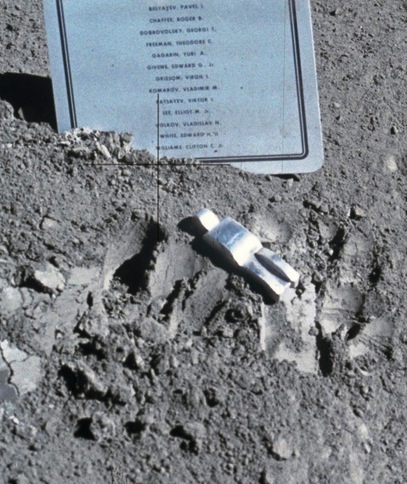
At 12:18 a.m. Greenwich Mean Time on Aug. 2, 1971, Commander David Scott of Apollo 15 placed a 3 1/2-inch-tall aluminum sculpture [by artist Paul Van Hoeydonck] onto the dusty surface of a small crater near his parked lunar rover. At that moment the moon transformed from an airless ball of rock into the largest exhibitionku-xlarge space in the known universe. Scott regarded the moment as tribute to the heroic astronauts and cosmonauts who had given their lives in the space race. Van Hoeydonck was thrilled that his art was pointing the way to a human destiny beyond Earth and expected that he would soon be “bigger than Picasso.”

In reality, van Hoeydonck’s lunar sculpture, called Fallen Astronaut, inspired not celebration but scandal. Within three years, Waddell’s gallery had gone bankrupt. Scott was hounded by a congressional investigation and left NASA on shaky terms. Van Hoeydonck, accused of profiteering from the public space program, retreated to a modest career in his native Belgium. Now both in their 80s, Scott and van Hoeydonck still see themselves unfairly maligned in blogs and Wikipedia pages – to the extent that Fallen Astronaut is remembered at all.

And yet, the spirit of Fallen Astronaut is more relevant today than ever. Google is promoting a $30 million prize for private adventurers to send robots to the moon in the next few years; companies such as SpaceX and Virgin Galactic are creating a new for-profit infrastructure of human spaceflight; and David Scott is grooming Brown University undergrads to become the next generation of cosmic adventurers. Governments come and go, public sentiment waxes and wanes, but the dream of reaching to the stars lives on. Fallen Astronaut does, too, hanging eternally 238,000 miles above our heads.
About that plaque next to the tiny sculpture:

On August 1, 1971, Fallen Astronaut was placed on the Moon by the crew of Apollo 15, along with a plaque bearing the names of eight American astronauts and six Soviet cosmonauts who had died:

Scott, Commander of the Apollo 15 mission, noted that “Sadly, two names are missing (from the plaque), those of Valentin Bondarenko and Grigori Nelyubov.” He explained that because of the secrecy surrounding the Soviet space program at the time, they were unaware of their deaths. Also not on the plaque are two US Air Force astronauts who died in 1967, Michael James Adams, in an X-15 accident and Robert Henry Lawrence, Jr., the first African American astronaut and part of the Manned Orbiting Laboratory Program, in a training accident. They are remembered on the Space Mirror Memorial.
The Fed’s Tiny Taper

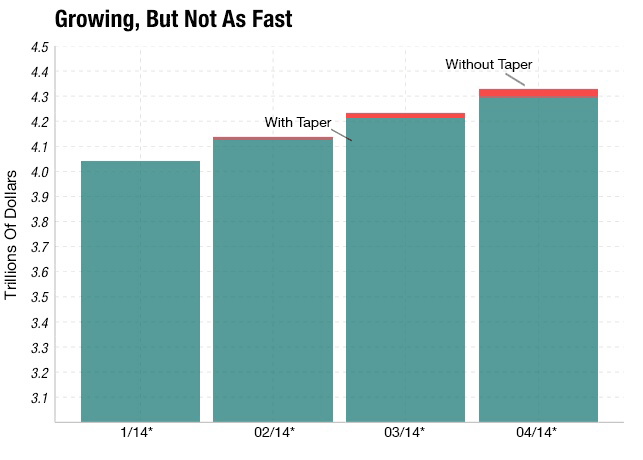
Planet Money graphed it. They had to start their chart at $3 trillion because otherwise “you wouldn’t even be able to see it”:

The Taper

Matthew O’Brien approves of the Fed’s decision:

[T]he Fed will “taper” its purchases from $85 to $75 billion of bonds a month. And it will keep doing so in $10 billion increments next year as long as the recovery stays on track. But it will try to inject just as much monetary stimulus as it’s taking out by strengthening its promises. The Fed now says it will likely keep rates at zero “well past” the time unemployment falls below 6.5 percent, especially if inflation stays below its 2 percent target.

Markets approved. Stocks jumped, bonds didn’t fall, and expectations of future rates barely budged. In other words, Bernanke finally convinced markets that tapering isn’t tightening, even though he said it was a few months ago. Neat trick.

Daniel Gross’s take:

[T]he Fed isn’t really putting on the brakes. It is just taking its foot off the gas pedal a tiny bit. And as Bernanke passes control of the steering wheel to Janet Yellen, it’s still going at a very rapid clip.

Cassidy comments on the Fed’s other announcement, “that it would most likely keep interest rates at their current record-low levels even after the unemployment rate falls below 6.5 per cent—a figure it had previously identified as a possible threshold for rate hikes”:

That was a shift in the dovish direction. As if to emphasize it, Bernanke insisted that the taper itself did not signal a move toward a more restrictive policy, saying, “This is not intended to be a tightening…. We do not think there is an inflation problem, or anything like that.” To the contrary, Bernanke stressed that he and his colleagues were concerned about the inflation rate being too low: it’s currently running at about one per cent, well below the Fed’s target of two per cent. The Fed chairman even raised the prospect of the central bank further loosening its policy stance, saying, “If inflation does not show signs of returning to its target, we will take appropriate action.”

It was a bit like a mother warning a child that she would gradually reduce the number of bags of M&Ms he could eat every week, but, at the same time, reassuring the boy that his supply of Snickers bars would be uninterrupted, and might even be stepped up if he started to lose weight.

Ezra wishes that Congress had worked with Bernanke instead of working against him:

There’s an alternate history of the last three years in which Bernanke held rates low and Congress used the opportunity to rebuild America’s infrastructure, passed a huge tax cut for businesses that hire new workers, helped state and local government reinvest after the vicious cuts forced by the recession, and wiped out the payroll tax until further notice. That’s a world where millions more Americans have jobs today. And it’s a world Bernanke did everything he could to help Congress create.


A&E Cannot Bear Very Much Reality

ABC's "Good Morning America" - 2013

I have to say I’m befuddled by the firing of Phil Robertson, he of the amazing paterfamilias beard on Duck Dynasty (which I mainly see via The Soup). A&E has a reality show that depends on the hoariest stereotypes – and yet features hilariously captivating human beings – located in the deep South. It’s a show riddled with humor and charm and redneck silliness. The point of it, so far as I can tell, is a kind of celebration of a culture where duck hunting is the primary religion, but where fundamentalist Christianity is also completely pervasive. (Too pervasive for the producers, apparently, because they edited out the saying of grace to make it non-denominational and actually edited in fake beeps to make it seem like the bearded clan swore a lot, even though they don’t.)

Now I seriously don’t know what A&E were expecting when the patriarch Phil Robertson was interviewed by GQ. But surely the same set of expectations that one might have of an ostensibly liberal host of a political show would not be extended to someone whose political incorrectness was the whole point of his stardom. He’s a reality show character, for Pete’s sake. Not an A&E spokesman. So here’s what he said – which has now led to his indefinite suspension (but he’ll be in the fourth season, apparently, which has already wrapped):

“Everything is blurred on what’s right and what’s wrong … Sin becomes fine. Start with homosexual behavior and just morph out from there. Bestiality, sleeping around with this woman and that woman and that woman and those men … “Don’t be deceived. Neither the adulterers, the idolaters, the male prostitutes, the homosexual offenders, the greedy, the drunkards, the slanderers, the swindlers—they won’t inherit the kingdom of God. Don’t deceive yourself. It’s not right … “

This is a fascinating glimpse into the fundamentalist mind. You’ll notice that, for the fundamentalist, all sin – when it comes down to it –  starts with sex. This sexual obsession, as the Pope has rightly diagnosed it, is a mark of neurotic fundamentalism in Islam and Judaism as well as Christianity. And if all sin is rooted in sex, then the homosexual becomes the most depraved and evil individual in the cosmos. So you get this classic statement about sin: “Start with homosexual behavior and just morph out from there.”

This emphasis is absolutely not orthodox Christianity. There is nothing primary about sexual sin as such in Christian doctrine. It sure can be powerfully sinful – but it’s not where sin starts. And to posit gay people as the true source of all moral corruption is to use eliminationist rhetoric and demonizing logic to soften up a small minority of people for exclusion, marginalization and, at some point, violence.

If you think I’m hyperventilating, ask yourself what the response would be if in talking about sin, Phil Robertson had said, “Start with Jewish behavior …” The argument would be totally recognizable, once very widespread, and deeply disturbing. What we’re seeing here – and it’s very much worth debating – is how fundamentalist religion seizes on recognizable, immoral minorities to shore up its own sense of righteousness. You can gussy it up – but it’s right there in front of our nose.

Then Robertson says something that tells us nothing except he has never had an honest conversation with a gay person about what it is to be gay.

He simply assumes that all men must be heterosexual, and that making themselves have sex with another man must be so horrifying it mystifies him:

“It seems like, to me, a vagina—as a man—would be more desirable than a man’s anus. That’s just me. I’m just thinking: There’s more there! She’s got more to offer. I mean, come on, dudes! You know what I’m saying? But hey, sin: It’s not logical, my man. It’s just not logical.”

No, it isn’t logical if it were a choice for a straight guy. But it isn’t. All we’re seeing here is the effect of cultural isolation. The only thing I find objectionable about it – and it is objectionable – is the reduction of gay people and our relationships to sex acts. Mr Robertson would not be happy – indeed, rightly be extremely offended – if I reduced his entire family life and marriage to sex with a vagina.

But look: I come back to what I said at the beginning. Robertson is a character in a reality show. He’s not a spokesman for A&E any more than some soul-sucking social x-ray from the Real Housewives series is a spokeswoman for Bravo. Is he being fired for being out of character? Nah. He’s being fired for staying in character – a character A&E have nurtured and promoted and benefited from. Turning around and demanding a Duck Dynasty star suddenly become the equivalent of a Rachel Maddow guest is preposterous and unfair.

What Phil Robertson has given A&E is a dose of redneck reality. Why on earth would they fire him for giving some more?

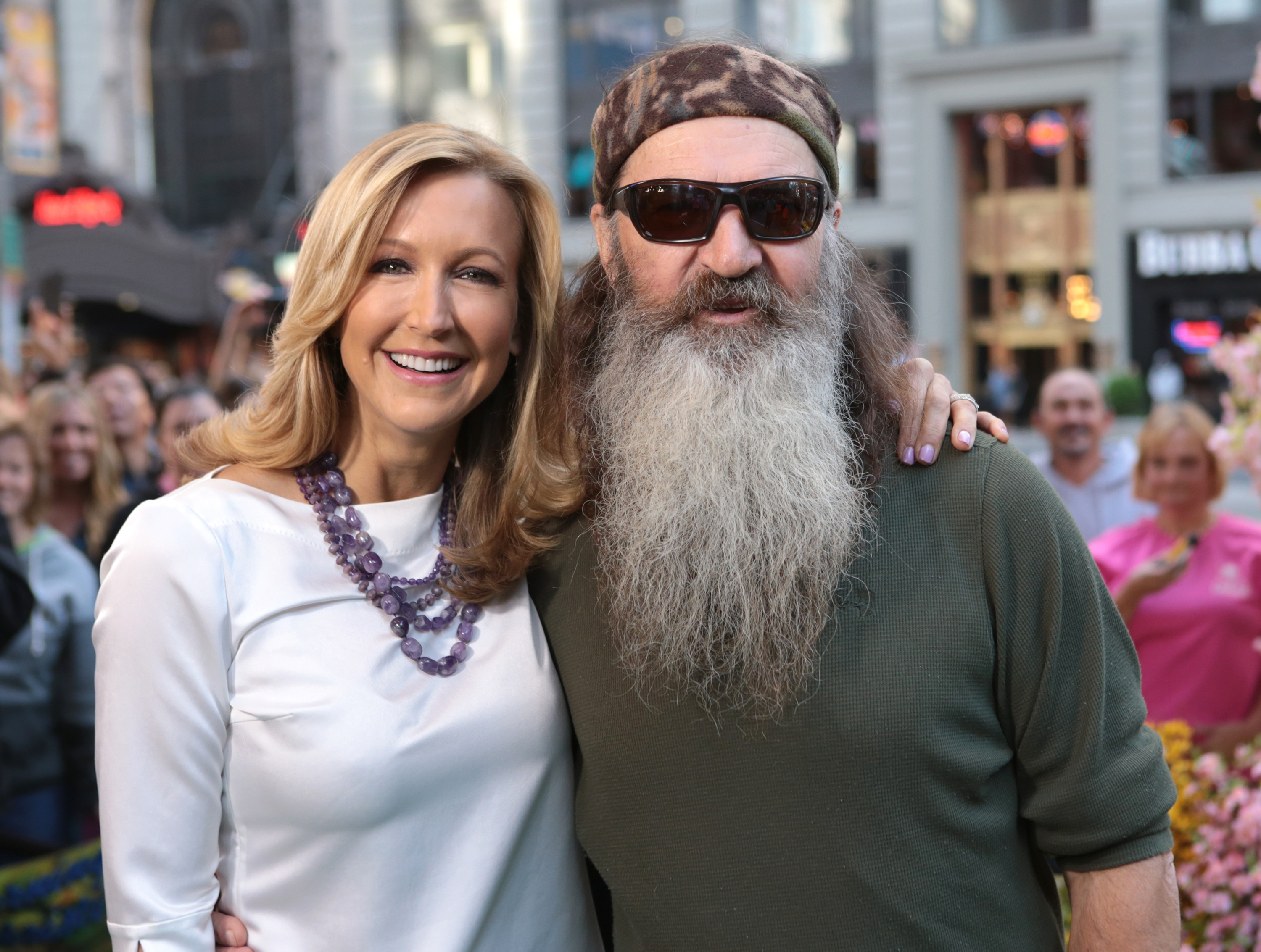
(Photo: Phil Robertson of ‘Duck Dynasty’ as a guest on ‘Good Morning America,’ 5/7/13, airing on the ABC Television Network. By Fred Lee/ABC via Getty Images.)

What If Fewer Young People Buy Insurance?

Sarah Kliff summarizes a new report from Kaiser:

If young adults (those under 35) were 25 percent less likely than the rest of the population to sign up for Obamacare, they would represent 33 percent of exchange enrollees — rather than 40 percent. This means there would be fewer young people to subsidize older insurance subscribers. To make up that difference, the experts estimated, insurers would need to increase premiums by a terrifying … 1 percent. Yes, exactly 1 percent.

Levitt, Claxton and Damico also tested a scenario where young adults are half as likely as older shoppers to enroll. In that case, the younger enrollees would make up only a quarter of the exchange market. Premiums would fall 2.5 percent short of covering subscribers.

And that kinda makes the whole death-spiral argument a bit of a red herring, no? Kilgore comments:

If these numbers are accurate, the widespread assumption (particularly among happy Republicans) that there’s nothing ahead for exchange enrollees beyond “sticker shock” forever could give way to the expectation that Obamacare will eventually be self-stabilizing, at least for most enrollees.

Not everything in the ACA was as incompetent as the website. Adrianna McIntyre identifies more reasons to stay calm:

For the market to unravel, you need fundamentally broken risk pools, not a bad year chalked up to a bad website. Considerable time and resources have been invested in the ACA (see also: the industry bending over backward to accommodate the administration’s mercurial deadlines).

And market power is at play here, too. The new exchanges represent a pretty substantial slice of the potential individual market consumer base; the more enrollees an insurer has, the more power it wields for negotiating prices with providers. Exiting the exchange is likely to be accompanied by a pretty substantial blow to that market power.

There’s one last crucial variable: we don’t actually know what level of risk the insurers baked into their premiums. Obviously they couldn’t anticipate website woes on the scale that we’ve observed in the last three months, but I find it hard to believe that they’d draw up projections that assume a perfectly balanced risk pool from the start. Call me crazy, but something makes me think that actuaries are better at hedging than the blogosphere.

Telling The NSA What’s Good For It

An advisory committee report (NYT) released yesterday encourages Obama to reform the NSA. Amy Davidson provides an overview:

The thirty-page executive summary might be further condensed to a few sentences: Don’t do things just because you can. Tell people what the rules are. Remember that “security” doesn’t just mean chasing terrorists—it “refers to a quite different and equally fundamental value,” spelled out in the Fourth Amendment: “The right of people to be secure in their persons, houses, papers, and effects, against unreasonable searches and seizures.” Stop shutting down debate by muttering about a “balance” that needs to be struck between security and freedom—they are not on opposite sides of the scale. Start thinking about privacy.

Eli Lake highlights key recommendations. Such as:

The review group recommends more stringent standards for protecting the privacy of foreign nationals. For example, it says U.S. monitoring communications of foreigners should not be based on their political or religious beliefs; should not be used to gain trade secrets; and must be “directed exclusively at protecting national security interests of the United States or our allies.” In addition the review group’s recommendations say the U.S. government should apply the Privacy Act of 1974 to foreign nationals as well as U.S. citizens. The nearly 40-year old law requires U.S. government agencies to protect personal information from U.S. citizens and not share it within the government.

Ambers points out other important bits. Third on his list:

The controlling metaphor for privacy should not involve balance; it should involve risk. One hears the voice of panel member Cass Sunstein in the following sentence: “Before they are undertaken surveillance decisions should depend (to the extent feasible) on a careful assessment of the anticipated consequences, including the full range of relevant risks. Such decisions should also be subject to continuing scrutiny, including retrospective analysis, to ensure that any errors are collected.”

Benjamin Wittes calls this “a really awkward document for the Obama administration”:

The President, after all, has stood by the necessity of the Section 215 program and objected to legislative proposals to curtail it. Then the White House handpicks a special review group, and it kind of pulls the rug out from under the administration’s position. The review group concludes “that the information contributed to terrorist investigations by the use of section 215 telephony meta-data was not essential to preventing attacks and could readily have been obtained in a timely manner using conventional section 215 orders.” It also reflects skepticism that the program functions as a kind of insurance policy, “alleviating concern about possible terrorist connections…” Ouch.

Allahpundit speculates about Obama using the report to change course:

There’s no way, really, for him to suddenly change his mind and claim that he’s spontaneously reconsidered everything he said before in defense of the program. But if his handpicked panel floats a few ideas for him, he can portray himself as the can-do executive who took the problem seriously enough to closely investigate it and then listened to his experts when they urged him to change course in a few ways. He conducted a fact-finding mission, by delegation, and now his opinion has changed in a few particulars. What a champ.

Drum bets that few of these recommendations will make it through the political process:

How much of this will survive the president and Congress? I’d like to say I’m optimistic, but I’m not, really. These recommendations are useful but modest, and I suspect that Congress will whittle them down even more.

Crowley zooms out:

It remains to be seen which of the panel’s recommendations President Obama might adopt — and how much change a Congress where the NSA has powerful allies will enact. But if the NSA’s wings are clipped, it will be another step in America’s steady march away from its post-2001 wartime footing, one that has accelerated dramatically, if quietly, in Obama’s second term.

Finally, Conor uses the report to defend Snowden:

If a government employee or contractor leaks classified information to the press, and the result is a judicial finding that the government has violated the Fourth Amendment, multiple pieces of bipartisan reform legislation circulating Congress, and a review for the president that suggests reforms to multiple secret programs, what do you call the leak? I call it whistleblowing.

Cheating Death Taxes

Zachary R. Mider shines a spotlight on the GRAT, “one of a handful of common devices that together make the estate tax system essentially voluntary”:

Hundreds of executives have used the technique, SEC filings show. These tax shelters may have cost the federal government more than $100 billion since 2000, says Richard Covey, the lawyer who pioneered the maneuver. That’s equivalent to about one-third of all estate and gift taxes the US has collected since then. The popularity of the shelter, known as the Walton grantor retained annuity trust, or GRAT, shows how easy it is for the wealthy to bypass estate and gift taxes. Even Covey says the practice, which involves rapidly churning assets into and out of trusts, makes a mockery of the tax code. “You can certainly say we can’t let this keep going if we’re going to have a sound system,” he says with a shrug.

Sheldon Adelson, one of the many tax dodgers cited by Mider, has saved $2.8 billion using the GRAT. The Bloomberg editorial board is not pleased:

In its current form, the estate tax requires the rich to pay a 40 percent levy on wealth they leave to their heirs, after an exemption of $5.25 million (rising to $5.34 million in 2014). That’s the theory, anyway. In practice, for the wealthiest families, the estate tax is largely optional. … The Tax Policy Center estimates that only 3,780 households (0.14 percent of all estates) will owe any estate taxes this year. Their average payment will be $3.8 million on estates worth $22.7 million – an effective rate of 16.6 percent.

Keep in mind, too, that most wealth escapes tax as it accumulates. Appreciation of property, securities and art isn’t subject to capital-gains tax until the assets are sold. When they are passed along, much of this unrealized profit remains untaxed, thanks to the optional estate tax. The oft-repeated charge that estate taxes amount to double taxation is doubly wrong. Congress ought to close the GRAT and other loopholes.

And it might note that the voluntary estate tax exemplifies a wider issue: The U.S. tax code is insanely complicated. This favors the rich because, unlike ordinary taxpayers, they can afford to find loopholes amid the complexity. Simpler tax systems are fairer – and they distort decisions less.

Christmas Hathos Alert

A reader invites us to “celebrate our Lord’s Birth with these assholes, who set a new standard for Hathos”:

Another sees red:

This absolutely awful Christmas “card” has been making the rounds.  Many people think it’s funny and cute, and they’re more interested in the physical attributes of the wife and husband.  But at the end of the day, it’s a freaking plug for their new business. Absolutely awful.

Update from a few readers defending the couple:

Wow, some of your readers are real tight asses.

My wife and I watched this and thought it was hilarious and we didn’t give a shit that they plugged their business. One observation I would offer to many of your readers is that it’s easy to find fault in things on the Internet and to criticize. Try just sitting back and enjoying something without trying to pick it apart or make ad hominem attacks about people none of us know personally. I realize that it’s hard to keep quiet, especially when we have the ability to express ourselves in so many different ways. But I think we all (and I’m including myself in this) need to try to be a little more patient, a little more accepting, and a little more tolerant, especially during this time of year.

Another adds:

As a resident of the Research Triangle, I think you are being a little hard on the Holdernesses (Holderni?).  First off, on a technical note, the video admits it is a shameless plug – I thought being self aware disqualified one from hathos? Second, Penn is one of the few bearable local anchors to watch in Raleigh-Durham.  He is a little hipper and edgier than the standard local news schlock, and he wears his stations perennially low rankings with a degree of resignation and panache.  I don’t know that this disqualifies one from a hathos tag, but jeez, some context may help. (Also contextual is the huge HUGE deal that having a movie filmed in RDU was for the area. I think someone who lived it could be forgiven for blowing it out of context).

See all of our Christmas Hathos from years past here.

The New Precious Metals

Plumer worries about the availability of elements used in high-tech manufacturing, some of which are irreplaceable:

Situations vary widely. Some elements do have easy substitutes. For instance, 54 percent of the world’s palladium is used as a catalyst to control emissions from vehicle exhaust. But if we ran short of palladium, we could still swap in platinum and get similar results. Or: Roughly 88 percent of the world’s titanium is used to create white pigment for paints, plastics, and paper. But in a pinch, we could substitute talc.

Other metals, however, have no ready substitutes. Rhodium is used as a catalyst to control nitrogen-oxide emissions from cars. Right now, there’s no alternative in the event of a shortage. Or: About 90 percent of the world’s supply of manganese is used as a deoxidizing and desulfurizing agent in steel production. Again, no substitute. That’s not to say it’s impossible to imagine a substitute — materials scientists are clever and markets are good at adjusting to shortages. Never say never. The study notes that there’s plenty of ongoing research into things like advanced composite materials. But substitution can be a slow process and performance can suffer in the meantime.

Stephen Leahy warns that vast quantities of “e-waste,” not enough of which is getting recycled, are making future shortages ever more likely:

E-waste is already a big problem. According to a new report, in 2012, every man, woman, and child in the US hauled a 66 lbs. bag of e-waste to the curb. That’s six times more than someone in China, and ten times the average Indian’s haul. “E-waste is exploding. I hope people will re-think their purchases of e-toys, tablets, and such this Christmas,” said not a particularly-grinchy Ruediger Kuehr, the Executive Secretary of the Solving the E-Waste Problem Initiative, which did the forecast. “Re-think” means consider where the device is going to end up when its day is done.

Lily Hay Newman focuses on the environmental consequences of e-waste, especially in the developing world:

E-waste is an environmental and health concern because it can cause heavy metals and other toxic substances to contaminate soil and water. Additionally, people looking to recover precious metals or other parts sometimes scavenge and break down devices that were not disposed of properly, and in the process they can release toxins into the air. As the Guardian points out, Interpol also released a statement last month indicating that e-waste from industrialized countries is being illegally unloaded on developing nations. Interpol is initiating criminal investigations into 40 companies, citing agent reports that for every three containers being checked on their way out of the EU, one holds some type of illegal e-waste. Exporting old electronics is not necessarily illegal if they are being repurposed or reused in some way, but Interpol says that much of the “exporting” going on is really tantamount to dumping.

Keeping An Eye On India, Ctd

A reader responds to a recent post:

As someone who has spent a long time living in, watching, and studying China and it’s rise, I certainly see Oliver Turner’s point on China. But I think he is perhaps overstating the case a bit. The reason that the US is more concerned with China’s rise than India’s – and I would argue that it is actually most concerned with the rise of all military competition in Asia (or at least it should be) – is that the US has major security guarantees with many of China’s neighbors: South Korea, Japan, Taiwan. Any conflict started between China and any of those countries would necessarily be met with some kind of US response. If India were to become entangled with any of it’s neighbors (another conflict with Pakistan for example), it would certainly be a cause for concern, but the US would not be immediately required to join the conflict.

From a reader born in India:

Oliver Turner has really no idea what he is talking about.  He is comparing India and China based on percentage of GDP spent on military expenditures.  He must be wetting his bed worrying about South Sudan which spends over 10% (the highest, according to the source he quotes). In absolute numbers there is no comparison:

India $43 billion USD vs China $164.5 USD!  And if you closely follow Indian military matters, you know that about 25% of their allocated capital budget is returned to the treasury every year due chronic procurement delays. (2012 GDP: $1,825 billion USD, 2.4% of that is $43 billion USD) vs China (2012 GDP: $8,227 billion USD, 2% of that is $164.5 billion USD.  My source for the 2012 GDP figures is here.)

This sort of the deliberate hocus-pocus by an apparently smart person like Turner leads me to believe that he wants to make a point that is not supported by the numbers.  So he massages it till it looks like something else. But the crux of the reason that China’s spending is scary and India’s is not, is alluded to in Turner piece.  China throws it money and military capability around, and it makes its neighbors nervous.  And its military has a very prominent role in its government, economy and policy affairs.  None of which are true for India’s military where the democratic government keeps a very tight control over it.

Are Storms Gaining Speed?

dish_hurricane

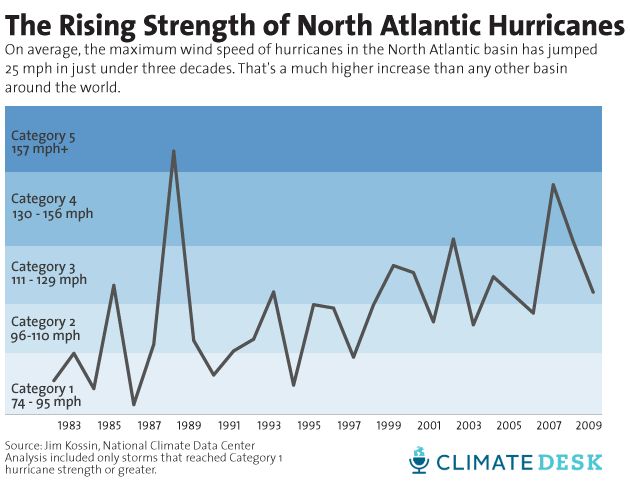
Chris Mooney flags a new report from hurricane expert Jim Kossin of the National Climatic Data Center:

Kossin and his colleagues at NCDC created a 28-year record of storm images across the world’s seven hurricane basins, from 1982 to 2009. Then they used a computer algorithm to compute each storm’s maximum strength, removing human error and unpredictability from the equation. The result? The scientists found that globally, hurricane wind speeds are increasing at a rate of a little more than two miles per hour per decade, or just faster than six miles per hour over the entire period.

There are some key caveats, though, the biggest being that the trend they found was not statistically significant at usually accepted levels. (For nerds: the p value was 0.1). But there were strong and significant trends in some hurricane basins of the world, especially the North Atlantic (the region encompassing the Caribbean, Gulf of Mexico, and open Atlantic north of the equator), where storms have been strengthening at the rate of nearly nine miles per hour per decade (see chart above). But other basins offset that, including the western North Pacific, which showed a negative trend.

The punch line, then, could hardly be called overwhelming. But as Kossin explains, that may be precisely what you expect to see once you’re finally analyzing the troublesome hurricane data reliably. These results, after all, are quite consistent with the idea that the signal of hurricane intensification might be just now emerging from the “noise” of natural climate variability. “What we’re observing could very easily fit into an assumption of this greenhouse gas forced trend in the tropics and the effect that it has on tropical cyclone intensity,” says Kossin.