The Year Of Francis

Americans agree with Time:
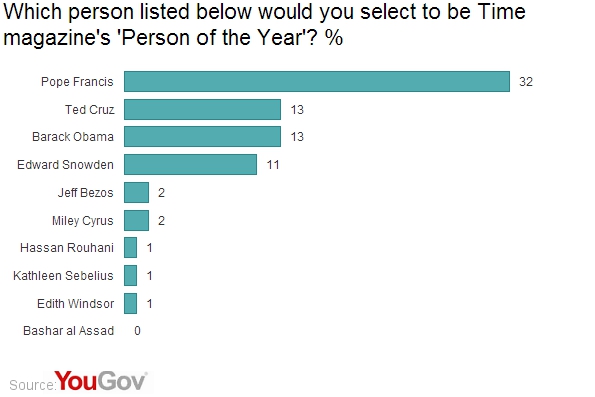
Person Of Year

Even The Advocate named Francis as their person of the year:

As pope, he has not yet said the Catholic Church supports civil unions. But what Francis does say about LGBT people has already caused reflection and consternation within his church. The moment that grabbed headlines was during a flight from Brazil to Rome. When asked about gay priests, Pope Francis told reporters, according to a translation from Italian, “If someone is gay and seeks the Lord with good will, who am I to judge?”

The brevity of that statement and the outsized attention it got immediately are evidence of the pope’s sway. His posing a simple question with very Christian roots, when uttered in this context by this man, “Who am I to judge?” became a signal to Catholics and the world that the new pope is not like the old pope.

Sean Bugg dissents, while I simply reel at the gay community’s embrace of a Pope. I mean: 2013 was a huge year for marriage equality – but also for gay-Catholic relations? What have I, what have I, what have I done to deserve this? Candida Moss is another Doubting Thomas:

[W]e have yet to see the kinds of doctrinal tinkering the media has attributed to him.

When it comes to the hot-button cultural issues that animate the Rush Limbaughs of the world, nothing has changed. Francis has been clear that the church’s position on abortion is not up for discussion, and he recently excommunicated Father Greg Reynolds of Melbourne, Australia, presumably for officiating at unsanctioned gay marriages. This pope may be extraordinarily compassionate, but he still enforces church order.

Damon Linker makes similar points:

Unlike his predecessors, Francis holds an apparently sincere belief in dialogue, bridge-building, conciliation, and the adjudication of differences. It seems important to him to appear cheery, tolerant, cosmopolitan. He has made respectful, open-minded statements about the members and beliefs of other Christian churches, as well as about Jews, Muslims, and even atheists.

But in every case where Francis has reached out to those who disagree with him, he has done so while indicating that his own beliefs grow out of Catholic bedrock. In the same airborne news conference during which he made headlines for seeming to counsel against damning gay priests, he responded dismissively to a question about women’s ordination, stating bluntly, “That door is closed.”

But Linker ends up softening his argument somewhat:

Even as Francis’s gestures make headlines, the Church does not think in terms of news cycles or election cycles, but rather in terms of centuries. A new Pope appoints the bishops, archbishops, and cardinals who will govern the Church of the future and in turn elect the next Pope, who will then make his own appointments, and so on, down through the decades. It may seem crazy to progressive Catholics that they’ll likely have to wait another 100 years for their Church to declare the use of condoms to be morally licit or to permit a woman to celebrate Mass. But something has to set the wheels of change in motion, and that just might be the modest but vital reform that Pope Francis ends up being remembered for most of all.

I think Damon is wrong about contraception. The highest authorities in the church argued exactly that almost fifty years ago – that condoms and the pill were licit. It was an over-reaching papacy that quashed it unilaterally. And undoing that over-reach is arguably the core goal of Francis’ pontificate.

Exeunt The Theocons, Ctd

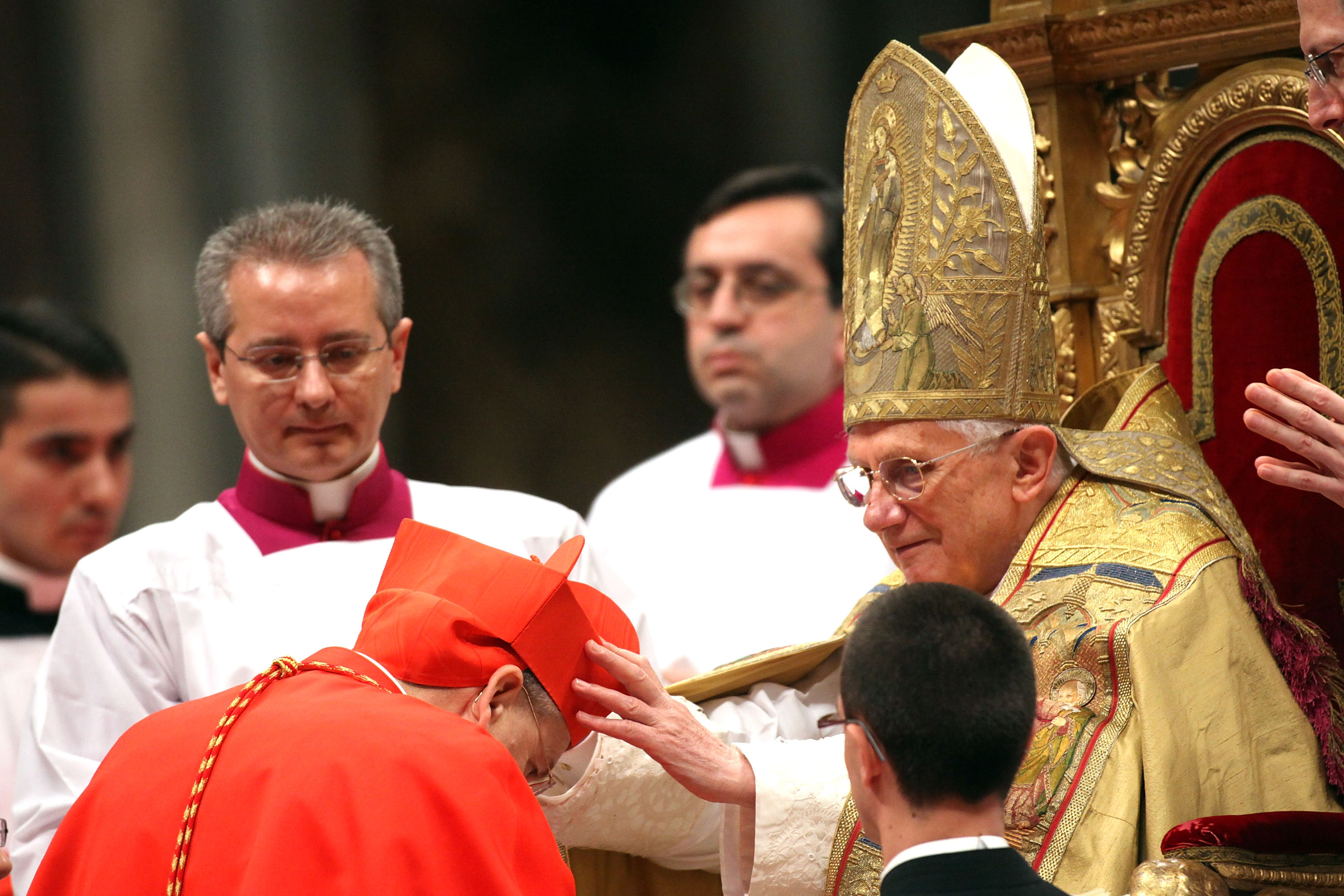
Pope Benedict XVI Appoints New Cardinals At The Vatican

My take is here. Pierce praises the Pope’s latest actions:

This is smiling Pope Francis’s declaration of war against the legacies of the institutional theological reactionaries who preceded him in office. Both John Paul II and Benedict salted the world’s dioceses with hardbars like Bishop Raymond Burke, guaranteeing that their ideas would plague us long after they died or, in Benedict’s case, retired. Francis has wasted no time in rooting out these nasty walking land mines. Monkeying with the Congregation for Bishops is a serious business. It is a clear attempt to restructure the entire Church bureaucracy to fit your ideas, and it’s what good Pope John did 50 years ago.

Dreher’s view:

American conservative Catholics who defend Pope Francis keep saying that Francis is truly orthodox, despite the fact that the liberal US media love him. Maybe they’re right. But the further we go into this pontificate, the more I wonder if liberals understand something about Pope Francis that conservatives do not. The Advocate‘s editors, for example, probably don’t expect Francis ever to endorse same-sex marriage, or even gay sexuality; if they do expect this, they’re delusional. But they have every reason to hope that Francis will undermine the Church’s formal opposition to same-sex marriage and the broader gay-rights agenda. I think the Advocate made a savvy choice, frankly.

David Gibson look ahead:

In February, Francis will have two more important opportunities to make his mark: His Council of Cardinals will give him a blueprint for reforming the Curia, and a few days later, he will appoint his first batch of new cardinals — some of the men who may one day gather to elect Francis’ successor and chart a new course or follow the one he is laying out.

(Photo: New cardinal Raymond Leo Burke, Archbishop of St. Louis, receives the biretta cap from Pope Benedict XVI in Saint Peter’s Basilica on November 20, 2010 in Vatican City, Vatican. Burke was just removed from Pope Francis’ Congregation of Bishops. By Franco Origlia/Getty Images.)

The Politico Premise

The magazine of the website has a somewhat classic, fifth-year piece on how a president can get his mojo back – or if a nine-point decline in the polls in one year is an irretrievable position in a second term. What’s interesting is that, in order to sustain this narrative, you have to describe a scenario which would be success, so as to contrast it with what pundits would call failure. And so we get this sentence:

The next six months could be decisive: If the president can’t move past the Obamacare debacle to reset the agenda through executive action and targeted legislative campaigns on climate change, immigration and the minimum wage, he might never be able to regain his footing.

Now maybe Glenn Thrush is correct and these are the areas in which to judge this presidency over the next year. But it seems likelier to me that these are merely the areas in which the Beltway will try to judge his presidency, because they can posit something that should have happened that hasn’t. But, in reality, much has already been set. If the ACA survives and sticks and even works, then the next three years will not be about “moving past” the Obamacare debacle, but about making sure that near-universal access to healthcare is now standard for the US. By any measure in history, that would be a seismic achievement, a watershed in the social history of the United States. But within the Politico timeline, it means close to nothing at all. Ditto a potential detente with Iran – which will be decided in the next year or so. Again, if a comprehensive deal is achieved and sticks, the Middle East is transformed, and the full response of the Obama presidency to the crime of 9/11 – and the acute religious polarization that followed – will become clearer. But again, this defining event isn’t even in the sight-lines of Politico at all.

And what does a “targeted legislative campaign” mean?

If the GOP House wants to, it can stop anything the president wants – and it has, again and again and again and again. So is he going to sneak through a raise in the minimum wage? C’mon. Immigration reform, meanwhile, is still on the table, the president has clearly taken the side of reform, while the GOP has doggedly resisted any constructive change at all. And the Politico question of the next year is: what can Obama do to somehow make this happen? Surely the apposite question is what can the GOP do to make this issue less of a threat to their standing as a national party? And the odds there are that in the run-up to the next general election, the first real internal pressure will come to bear on the Congressional GOP on the issue. And if reform then gets passed in Obama’s final year, that will count against him?

Look: I know we have to churn out copy and I do so myself on a daily basis. But sometimes, what’s striking about Washington is how the long-term shifts in policy and culture we are now going through are almost perfectly mismatched with the press’ ever-more-intense short-term perspective.

Is This Tweet An Ad?

And you thought native advertizing was just for what used to be called magazines. The truth is: following the Peretti-fueled takeover of journalism by public relations, social media is now fast becoming a blur of p.r. and, you know, real messages from real people. The growth is staggering:

Native social advertising is growing significantly faster than social display, with native revenue growing 77% this year, according to the fall update to BIA/Kelsey’s U.S. Social Local Media Forecast. The native category is expected to generate $2.4 billion this year, up from $1.4 billion in 2012, driven primarily by the surge in social media activity across mobile platforms, the firm says … Social display ad revenue in the U.S. will grow from $4.3 billion in 2013 to $6.8 billion in 2017, or 12.6% annually, according to the forecast. During the same period, native social advertising — propelled by the category’s main players, Facebook’s Sponsored Stories and Twitter’s Promoted Tweets — will more than double, from $2.4 billion to nearly $5 billion, a 20.3% annual growth rate.

If that pace continues, there may be no old-school advertizing left: just countless tweets and posts created by corporations to sell things. Good luck finding out where the real world begins.

The Boycott Kabuki

The American Studies Association has voted to endorse an academic boycott of Israel:

The resolution approved by a plurality of ASA members cites as a rationale the lack of “effective or substantive academic freedom for Palestinian students and scholars under conditions of Israeli occupation” and calls for the association to boycott Israeli higher education institutions, which are described as being “a party to Israeli state policies that violate human rights and negatively impact the working conditions of Palestinian scholars and students.”

And we’re off! Goldblog asks why Israel is being singled out:

Another approach of the American Studies Association would be to study the reporting of such organizations as Human Rights Watch and Amnesty International, as well as make lists of the countries that violate human rights on a regular basis (100 or so come to mind with minimum effort) and boycott them. Still another direction would be to boycott institutions in the U.S., which is occupying Afghanistan and conducting assassination campaigns in five or six countries around the world. Many members of the American Studies Association teach at institutions that receive research funding from the Pentagon. The most appropriate response by these academics might be to ban themselves from the conferences they organize and cease to read their own papers.

Scott McConnell defends targeting Israel:

A corollary to this point is that America, because of its “special relationship” with Israel, has a particular obligation to stand up against the injustices Israel is responsible for.

Beinart weighs in:

This is the fundamental problem:

Not that the ASA is practicing double standards and not even that it’s boycotting academics, but that it’s denying the legitimacy of a democratic Jewish state, even alongside a Palestinian one. I don’t think that position is inherently anti-Semitic, but I do think it’s profoundly misguided. Britain is not illegitimate because it has a cross on its flag and an Anglican head of a state. Germany is not illegitimate because its immigration policy favors members of a dominant ethnic group. Jews deserve a state that takes a special interest in their self-protection, just like Palestinians do. And disregarding both peoples’ deep desire for such a state is not a recipe for harmonious bi-nationalism (if such a thing even exists); it’s a recipe for civil war.

That’s not just my view. It’s the view of the most popular Palestinian leader alive, Marwan Barghouti, who said earlier this year that, “If the two-state solution fails, the substitute will not be a binational one-state solution, but a persistent conflict that extends based on an existential crisis.”

Chait sees the boycott backfiring:

The ASA buoyantly predicts its boycott will pressure Israel into ending its occupation. I predict the opposite effect. In recent years, the context of the American debate has changed markedly, as Jewish liberals have grown openly frustrated and angry with hawkish Israeli governments. The ideological and generational split has created a novel opportunity for critics of Israel’s occupation. Absurdly discriminatory academic boycotts make anti-occupation (but not categorically anti-Israel) liberals — like, say, J Street — forget what’s so terrible about the occupation and remember what’s so terrible about the anti-Zionist left. It’s the best news Netanyahu has had in months.

But Matthew Kalman suggests that the ASA boycott could also backfire and help the Palestinian leadership:

“No, we do not support the boycott of Israel,” [Palestinian President Mahmoud] Abbas told reporters [at Mandela’s memorial last week]. “But we ask everyone to boycott the products of the settlements. Because the settlements are in our territories. It is illegal…But we don’t ask anyone to boycott Israel itself. We have relations with Israel. We have mutual recognition of Israel.” It wasn’t quite a denunciation of the BDS [boycott, divestment and sanctions] campaign, but the remarks threatened to transform the boycott from its self-image as the principled projection of native Palestinian policy to the bastard foreign child of freelance troublemakers. …

One of the motivating factors behind John Kerry’s current push for a peace agreement between Israel and the Palestinians is the belief of U.S. and European officials sympathetic to Israel that the BDS campaign is beginning to make inroads that will, left unchallenged, begin to nibble away at mainstream support for Israel in the democratic world. From Abbas’s point of view, this surely should be good news and strengthen his hand in the current peace talks, helping to speed up their glacial progress.

And the beat goes on.

The Wizard Who Wasn’t

Kathryn Hughes reviews a new book debunking the historicity of Merlin, the English wizard. “He is, in fact, a big fat hoax, made up by a writer who had run out of things to say and was getting desperate”:

“Geoffrey of Monmouth” sounds as if he should be a bank manager of scrupulous honesty. A man you could imagine wanting to count the daily takings twice. In fact, he was a 12th-century churchman who pulled off a textual forgery bigger than anything dreamt up by Macpherson or Chatterton at their most high-handed.

By the 1130s Geoffrey clearly felt that he was getting too big for the Marches and decided to do something that would make the world take notice. His bright idea was to write a History of the Kings of Britain. Into the slightly dull chronicle of battles and land grabs he embedded a big dollop of fiction about a character called Merlin, doing that classic thing of passing off his work as a translation of a long-lost ancient text. According to this confection, Merlin was a boy magician at the court of Vortigern, king of the Britons. Later, as an adult wizard, Merlin changes Uther Pendragon’s appearance so that he can sleep with the wife of the Duke of Cornwall. Out of this moment of magical pandering King Arthur is conceived. But Merlin, in Geoffrey’s version, doesn’t hang around to act as twinkly tutor to the marvellous boy. You have to wait until Thomas Malory, writing on the brink of the Renaissance, before you get the whole lovely dreamscape that is Camelot. …

It is, though, what happens next that is really extraordinary. Having got himself embedded in everyone’s consciousness as the maker of Britain, Merlin then managed to slip the leash and started popping up in European chronicles as a kind of international Mr Fixit. In the Italian tradition he morphs into a sibyl and hands out helpful hints on the future of Tuscany and Lombardy. In France he becomes a kind of Time Lord, able to advise Julius Caesar on some of his more troubling dreams while simultaneously urging an Muslim king to convert to Christianity. He even becomes a bit of a romantic hero, succumbing to a doomed obsession with wily Vivien, a story that would be revisited more than six centuries later by Tennyson in his Idylls of the King.

Update from a reader:

Is this author serious? It is news that Geoffrey of Monmouth lied when he claimed to have based his Historia regum Brittaniae on an ancient British text? Geoffrey’s deception was well known in the twelfth century, let alone in later years. (See William of Newburgh’s Historia rerum Anglicarum.) And one has to wait until Sir Thomas Malory – in the fifteenth century – for the full story about Merlin to emerge? Has this author ever heard about Robert of Boron, who represents Merlin as advising Arthur and comes up with the story of the sword in the stone, in 1200? Or of the Vulgate Cycle Merlin of the thirteenth century, which Thomas Malory basically translated? Yes, people like Alfred Lord Tennyson may have preferred to read Malory because Le Morte d’Arthur is in English, but there were three centuries of Arthurian romances written in French – with all of the central legends developed between the 1180s and the 1230s – before Malory got around to picking up a pen.

A Wobbly Witness Stand

Lara Bazelon discusses the problem of false eyewitness testimony, which puts more innocent people in prison than you might think:

[A]ccording to Brandon Garrett, a law professor at the University of Virginia and the author of Convicting the Innocent, eyewitness misidentifications have played a leading role in nearly 75 percent of 250 convictions overturned by DNA evidence between 1989 and 2010. In more than one-half of those exonerations, the eyewitnesses start off unsure, a “glaring sign” of potential trouble as Garrett puts it, yet appear to become increasingly certain over time. This often corresponds with police practices like suggestive photo arrays, lineups, and even well-intentioned comments like “Good job!” after a witness makes an identification, however tentative. All of this can cause “contamination” of memory, Garrett says so that “there is no way to know after the fact whether the eyewitness could have actually picked the person with any degree of confidence.” …

[C]ourts, prosecutors, and juries routinely take eyewitness testimony at face value. Garrett describes as “toothless” the standard the Supreme Court set in 1977 for admitting eyewitness identifications as evidence: “Even in cases with eyewitnesses who were drunk, half blind, observing someone at night, from a distance, it is almost impossible to find examples where appellate judges say it was error” to allow jurors to hear their testimony, he says.

Update from several readers:

In her article, Bazelon identifies what is a serious flaw in the criminal justice system in the US, but she is pointing to what is only one part (eyewitness testimony) of the larger problem that is police and prosecutorial misconduct.

We all saw how police and the local District Attorney in Sanford “investigated” the killing of Trayvon Martin as a justifiable homicide, allowed Zimmerman to wash evidence from his hands, etc. So it was not surprising (though a sickening miscarriage of justice) that the murderer walked free. Eyewitness testimony in that case also was conflicted and unreliable, but for different reasons. But in the end, Kash Register, the wrongly convicted innocent man in Bazelon’s story, was exonerated by, wait for it …. eyewitness testimony that was ignored and not followed up on by the police and prosecutors.

Another:

This was one of my favorite episodes of This American Life. It directly relates to a reader update on police malpractice. In the case of this episode, it was accidental.

The first act is about a cop who was absolutely convinced that a woman committed a crime, and then after revisiting the case years down the road discovered it was his fault that she confessed.  He now gives presentations to police departments to educate cops not make the same mistakes he did.

The second act is about a guy who everyone in town believed (and some still believe despite another man being convicted of the crime) he was guilty, but he never allowed the cops to interview him.

Another:

In response to your post, I thought y’all might enjoy Dr. Elizabeth Loftus’ plenary talk from the Psychonomic Society’s 2013 annual meeting on memory and false memory. She is one of the, if not THE, pioneers in this area of research. Her talk was really great – she covered faulty eyewitness testimony, did a small example of studies of this nature with the audience, and talked about her more recent research on testimony from a period of great stress. She worked with SERE participants and their doctor and it’s fascinating. Here’s the link to the whole video. It shows her presentation side by side. For the mini study example, see around 27:10. For the SERE discussion, see around 37:30. For her discussion on doctoring political memories, see around 48:30. Finally, she talks about implanting false memory, and it’s terrifying (around 53:30). She poses the question of whether this type of research is leading is in an ethical direction.

The Merry Metropolis

Daniele Quercia examines what city-dwellers like and dislike about their surroundings:

With colleagues at the University of Cambridge, I worked on a web game called urbangems.org. In it, you are shown 10 pairs of urban scenes of London, and for dish_londongardensquareeach pair you need to choose which one you consider to be more beautiful, quiet and happy. Based on user votes, one is able to rank all urban scenes by beauty, quiet and happiness. Those scenes have been studied at Yahoo Labs, image processing tools that extract colour histograms. The amount of greenery is associated with all three peaceful qualities: green is often found in scenes considered to be beautiful, quiet and happy. We then ran more sophisticated image analysis tools that extracted patches from our urban scenes and found that red-brick houses and public gardens also make people happy.

On the other hand, cars were the visual elements most strongly associated with sadness. In rich countries, car ownership is becoming unfashionable, and car-sharing and short-term hiring is becoming more popular. Self-driving cars such as those being prototyped by Google will be more common and will be likely to be ordered via the kind of mobile apps similar to the ones we use for ordering taxis nowadays. This will result into optimised traffic flows, fewer cars, and more space for alternative modes of transportation and for people on foot. Cities will experience transformations similar to those New York has experienced since 2007. During these few years, new pedestrian plazas and hundreds of miles of bike lanes were created in the five boroughs, creating spaces for public art installations and recreation. And it’s proved popular with local businesses too, boosting the local economy in areas where cyclists are freer to travel.

(Photo of London garden square via Charlie Dave)

An Icon On The Edge

Twenty years after MTV first aired Nirvana: Unplugged, Andrew Wallace Chamings revisits the “unforgettable document of raw tension and artistic genius.” He remarks that “there is no way of listening to Unplugged in New York without invoking death; it’s in every note, but that doesn’t mean that it’s not a masterpiece”:

[Their rendition of Lead Belly’s “Where Did You Sleep Last Night”] ranks among the greatest single rock performances of all time. All night, Cobain, while never quite able to hide his anxiety—sniping at band mates, grimacing and grasping at half smoked cigarettes—has remained definitely present and in control. That is, until the very end, when he briefly loses it.

For the final line, “I would shiver the whole night through,” Cobain jumps up an octave, forcing him to strain so far he screams and cracks. He hits the word “shiver” so hard that the band stops, as if a fight broke out at a sitcom wedding. Next he howls the word “whole” and then does something very strange in the brief silence that follows, something that’s hard to describe:

He opens his piercingly blue eyes so suddenly it feels like someone or something else is looking out under the bleached lank fringe, with a strange clarity. Then he finishes the song. When Neil Young first watched the performance, he described that final note of Cobain’s as “Unearthly, like a werewolf, unbelievable.” Four months later Cobain would quote Young in a scrawled letter to “Boddah,” his imaginary childhood friend, before shooting himself in the head with a shotgun at his Seattle home on Lake Washington Boulevard: “It’s better to burn out than to fade away.”

Judy Berman also can’t shake the feeling of tragedy:

Watching Unplugged for the first time in at least a decade, I was surprised at how different it felt to me as an adult — as someone who, while still a Nirvana fan, is no longer half-consciously displacing truckloads of adolescent loneliness and alienation onto a dead rock star. It’s not that it’s a “worse” performance than I remembered; the acoustic constraint alone imposes a mood of hushed intimacy that is entirely different from the loud, chaotic live shows Nirvana was known for. The wrenching string arrangements, the Meat Puppets guest appearance, the covers that transformed great David Bowie and Vaselines and Leadbelly songs — all are powerful. But still, what comes across to me in Cobain’s performance, and especially in his interactions with the audience, is not so much sorrow or wistfulness as flatness and detachment. Until the last two songs, “All Apologies” and “Where Did You Sleep Last Night,” which truly do reverberate with emotion, Unplugged shows us that performer from Cobain’s suicide note — the one who is struggling to connect with his audience but can’t shake the feeling that he’s punching a clock as he takes the stage to greet them.

Exeunt The Theocons

The modest Vatican shake-up announced today is striking for a couple of reasons. The first is that the arch-conservative American, Raymond Burke, is no longer a member of the Congregation of Bishops, which has great influence on finding the future leaders of the church. Burke is, after Dolan, the most reactionary of the American bishops, and an architect of the very Benedict XVI policy of putting social and sexual issues at the obsessive forefront of the church’s mission. Only last week, he gave an interview to the hardline Catholic EWTN television channel, saying of the new Pope:

“One gets the impression, or it’s interpreted this way in the media, that he thinks we’re talking too much about abortion, too much about the integrity of marriage as between one man and one woman. But we can never talk enough about that.”

Oh yes you can, as the Pope has explicitly said. Burke is, like Benedict, a fan of ornate vestments and has aired the possibility of denying communion to politicians who do not follow to the letter the hierarchy’s views on faith and morals. It seems to me that the latter is one reason for his being sidelined. If you want to know why, read Evangelii Gaudium, section 47:

The Church is called to be the house of the Father, with doors always wide open. One concrete sign of such openness is that our church doors should always be open, so that if someone, moved by the Spirit, comes there looking for God, he or she will not find a closed door. There are other doors that should not be closed either. Everyone can share in some way in the life of the Church; everyone can be part of the community, nor should the doors of the sacraments be closed for simply any reason. This is especially true of the sacrament which is itself “the door”: baptism. The Eucharist, although it is the fullness of sacramental life, is not a prize for the perfect but a powerful medicine and nourishment for the weak. 

The second reason for this shake-up being notable is an absence. Where is Cardinal Dolan? How odd is it that the Cardinal of New York is basically a non-entity in Francis’ church. Francis has picked another American, Seán Patrick O’Malley, to be part of his new council of eight global cardinals, and has also picked Archbishop Wuerl, a pragmatist in Washington DC, for the Congregation of Bishops. Dolan? Nowhere to be seen.

Know hope.