Beyoncé’s Marketing Minimalism

Last Friday, Beyoncé stunned her fans and even the music industry by dropping her new album exclusively on iTunes for download, selling 80,000 copies within three hours and reportedly causing the online store to crash. In the first three days, sales hit 800,000. Angela Watercutter considers what Beyonce’s brilliant move means for the future:

She announced the album, posted a “Surprise!” on Instagram and gave fans enough material to keep them busy for days. Then she dropped the mic. Thanks to whatever death-to-snitches plan she had in place, word of the album never got out and nothing leaked. Even the NSA can’t keep a secret that well. In the annals of minimal-marketing marketing, it was a pretty smart move, particularly for an artist who is obsessively discussed on social media but engages with it selectively. (She has pretty active Tumblr and Instagram accounts, but hasn’t tweeted to her 13 million followers since August.)

Of course, this wouldn’t work for every artist. Only someone with albums as highly anticipated as Beyoncé’s can do this. Like her husband Jay Z, who can pretty much guarantee one million people will download his album via a Samsung app, she knows people are going to find her record no matter how she promotes it. So why not let everyone else spread the gospel for you? Or, as one smart tweet put it, “Beyoncé doesn’t need publicity. Publicity needs Beyoncé.”

It’s all very selfie and instagrammy. And perfect. Claire Suddath notes the precedent set by Radiohead and David Bowie, who also released music online with minimal promotion:

But there’s a difference between what Radiohead and David Bowie did and what happened today: Beyoncé is still considered a pop star, and pop music relies heavily on the traditional marketing machine sponsored by record labels. The stars begin with a hit single, hopefully follow it up with another hit single, release an album and perform at some heavily watched live event like the Grammys or on American Idol, launch a world tour, and then reap the profit. They leave it to the rock stars and hip-hop artists to experiment with free downloads and unofficial mixtapes.

Beyoncé is changing all that. Her new album doesn’t have an obvious hit single (her last one, 4, didn’t have one, either) but that seems to be by design. Beyoncé is a polished work of electronic-inspired dance pop—peppered with Jay-Z and Blue Ivy cameos—yet it’s made for a listening world dominated by curated playlists rather than preprogrammed, Clear Channel-style broadcasts. This is the work of an artist who’s graduated beyond the usual pop star marketing machine and started making music that’s free of the three-and-a-half minute hook-heavy formula that makes a big hit. And by forcing everyone to pay $15.99 for the album now, she might be more successful because of it.

James West argues that “this may well be one of the most climate-friendly major studio releases yet”:

Purchasing “Beyoncé” on iTunes instead of as a CD could result in a greenhouse-gas-emissions savings of between 40 and 80 percent, according to a 2009 study for Intel and Microsoft by researchers from a group drawn from Carnegie Mellon University, Lawrence Berkeley National Laboratory, and Stanford.

“I Have Had It With Long-Form Journalism”

So claims James Bennet, editor of The Atlantic. Not actual long-form journalism – just the word:

[I]n the digital age, making a virtue of mere length sends the wrong message to writers as well as readers. For when you don’t have to print words on pages and then bundle the pages together and stick postage stamps on the result, you slip some of the constraints that have enforced excellence (and provided polite excuses for editors to trim fat) since Johannes Gutenberg began printing books. You no longer have to make that agonizing choice of the best example from among three or four—you can freely use them all. More adjectives? Why not? As a writer, I used to complain that my editors would cut out all my great color, just to make the story fit; as an editor, I now realize that, yes, they had to make my stories fit, and, no, that color wasn’t so great. The editors were working to preserve the stuff that would make the story go, to make sure the story earned every incremental word, in service to the reader. Long-form, on the Web, is in danger of meaning “a lot of words.”

This is a particularly ripe moment to rethink our terminology (and I should own up to the fact that I still lapse into using the dreaded term myself) because deeply reported narrative and essayistic journalism is suddenly all the rage. Far from fading away, it shows signs of an energy and imagination not seen since the heyday of New Journalism.

Of course James is right. The word “longform” seems to take one of our pleasures and make it one of our duties. But you can see why it has new luster in our listicled, tweeted age. It’s shorthand for “thoughtful”, for writing that is not just typing, or blogging or tweeting. And there is something newly liberating about that – especially when it is not constrained, as long-form almost always was, by the sharp constraints of print on paper. I would say that about a quarter of my work as an old-style magazine editor was trimming pieces to fit. It was great not to have that distracting obsession any more, as I worked on the latest piece for Deep Dish.

But mere length, as Bobbie Johnson notes, is not a good thing in itself, as any honest reader of the pre-Tina New Yorker would have sometimes told you:

If word count is your only yardstick, then it becomes stupendously easy to write really bad long-form. We’ve all read enough overwrought, overlong pieces to know that length is absolutely no measure of quality.

At the same time, long-form is also attached to a certain form. A lot of this sort of writing adopts a particular tone of voice: a sort of detached, flat, word-heavy sound that makes everything sound like a PBS documentary. It’s not a tone I really enjoy, so often draining the emotion from stories and filling it up instead with a sad pomposity. It’s like when you hear a great poet read their most vibrant work out loud and they choose to deliver it in a passionless, intellectual monotone.

The way I see it, though, long-form is not about length or form, but about a mindset. Both the author and the reader come together with one ambition: to weave a story that sucks everybody right in and doesn’t let go until it’s finished. The best long-form is bewitching, captivating and deep — regardless of how long it takes you to get to the end. I’ve read pieces just a few hundred words long that feel more like long-form than others that ramble into the thousands.

Cleaning Up The Soap Industry

The FDA has admitted that antibacterial soap is probably no better than regular soap – and may even be bad for you:

In a draft rule that will be published Tuesday in the Federal Register, the agency calls for manufacturers of consumer antibacterial products to begin providing data that shows the ingredients are both safe for daily use, and also more effective than plain soap and water. Deep in the 137-page rule, it also raises the issue that’s most interesting to me: whether the routine use of these products causes bacteria to develop resistance against the active ingredients, and against antibiotics as an unintended side effect.

Kiera Butler relays scientists’ concerns over triclosan, the most common ingredient in antibacterial products:

[T]here is strong evidence that anti-bacterial soaps contribute to antibiotic resistance. In 2004, a team of University of Michigan researchers found that exposing bacteria to triclosan increased activity in cellular pumps that the bugs use to eliminate foreign substances. These overactive excretory systems “could act to pump out other antibiotics, as well,” says Stuart Levy, one of the study’s authors and a leading researcher on antibiotic resistance at the Tufts University School of Medicine. That’s a problem, since troublesome bacteria like streptococcus, staphylococcus, and pneumonia are already evolving defenses against our best weapons. Worse, there aren’t enough new drugs in the production pipeline. Over the past 15 years, the FDA has approved just 15 newantibiotics—in the preceding 15 years, it approved 40. The World Health Organization now views antibiotic resistance as “a threat to global health security.” And while triclosan’s contribution to the problem hasn’t been adequately studied, Levy believes it could be “significant.”

Keep Your Fictional Character Off My Daughters!

Citing a Pew study that found that men with daughters were more likely to be Republicans, Douthat attempts to draw a lesson from fiction:

The next round of research may “prove” something completely different about daughters and voting behavior. But as a father of girls and a parent whose adult social set still overlaps with the unmarried, I do have a sense of where a daughter-inspired conservatism might come from, whatever political form it takes. It comes from thinking about their future happiness, and about a young man named Nathaniel P. This character, Nate to his friends, doesn’t technically exist: He’s the protagonist in Adelle Waldman’s recent novel of young-Brooklynite manners, “The Love Affairs of Nathaniel P.” …

And lurking in Waldman’s novel, as in many portraits of the dating scene (ahem, Lena Dunham, ahem), is a kind of moral traditionalism that dare not speak its name — or that can be spoken of only in half-jest, as when the novelist Benjamin Kunkel told Traister that the solution was “some sort of a sexual strike against just such men.” Because Kunkel is right: One obvious solution to the Nathaniel P. problem is a romantic culture in which more is required of young men before the women in their lives will sleep with them.

Chotiner read the study differently; he doesn’t think it’s as flattering of conservatism as Ross makes it out to be:

How to phrase this gently?

The impulses behind social conservatism often stem from a desire to control the sex lives of women. (It is surely not a coincidence that nearly every conservative religious tradition places a disturbing amount of emphasis on women’s sexuality.) And we know that the thought of one’s precious daughter having sex is enough to cause nonsense from even liberal men like President Obama. (His joke about using drones against possible suitors was a true low.) So it’s no surprise that having a girl around, one who MUST be protected, would spark conservative thinking.

Kilgore is unimpressed with the implication that being protective of his daughter leads a man to adopt a certain set of political positions:

It seems from Douthat’s analysis that if you favor, say, the Affordable Care Act or legalized abortion you implicitly favor perpetual sex-without-commitment for young men. I must have missed that line in the Liberal Litmus Test last time I signed it. Conversely, I don’t see a whole whole about the Republican (or for that matter, the “social conservative”) agenda that’s going to solve the problem of “Nathanial P.” Will deregulating Wall Street make him more interested in marrying and propagating? How about a war with Iran? Are SNAP benefits his kryptonite? And will taking away the reproductive rights of the women he exploits turn him around?

Jessica Grose piles on:

Just like Douthat, I have a daughter. I assume that one day she will have some bad relationships, and some fun relationships, and some great relationships, and she’ll learn from those experiences, even if her feelings get hurt. Actually, I don’t just assume that. I want that for her. And if, in the course of all these relationships, she meets a dreaded Nathaniel P.-type (lord knows her mother did), I believe she will have the strength to deal with rejection, because adult people should have that kind of strength regardless of their gender. I’m not looking (or voting) to protect my daughter from life’s disappointments. I’m just preparing her for them.

Dreher agrees with Ross:

Frankly, I worry about the romantic culture that awaits all three of my children, but I especially worry about the kind of men who will court my daughter, given the pornification of our culture. Will they respect her? Do they even know what it means to respect a woman? Will my daughter have friends who will support her in upholding the high standards with which she was raised, or will they pressure her to succumb to the goatishness of young men, because everybody does it.

Marc Tracy asks Adelle Waldman herself what she thinks of Douthat’s theory:

Waldman said she was “flattered” that Douthat cited her novel, and was also not a little thrilled “that people would talk about it as if it has bearing on reality. I didn’t want to write about some strictly literary universe.” But she didn’t join him in his conclusion. “Women are often told that whether a relationship succeeds or fails is their fault—that they did something wrong, whether it’s by not holding out or holding out for too long or just their general behavior,” she explained. “That does more harm to women’s well-being.”

Naked On The Interwebs

forgot-your-password-12-800

Your LinkedIn password could be making the rounds in European galleries:

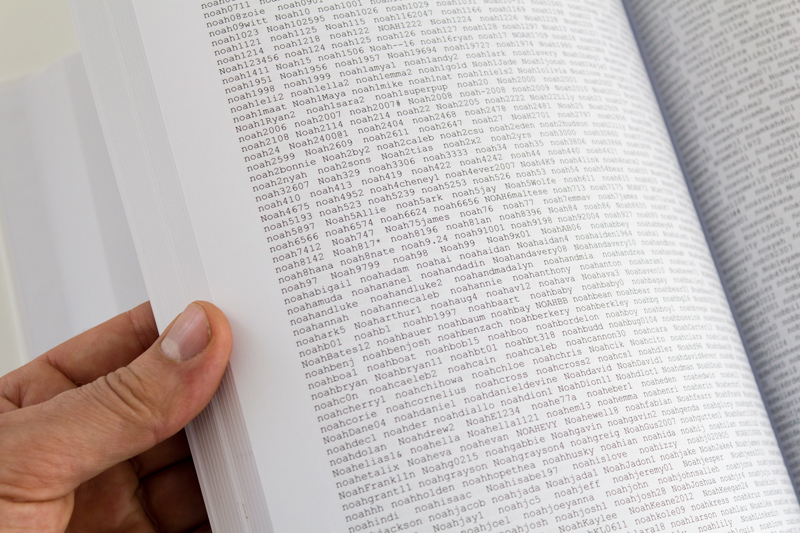
Forgot Your Password is a set of eight books containing some 4.7 million passwords that were leaked in June 2012. Visitors to the exhibit, which has toured Europe and is currently residing in [artist Aram] Bartholl’s native Germany, are invited to look through the volumes to see if their password is inside. Each password is arranged alphabetically and presented without its linked username(s).

Brian Merchant admits that his own password is probably on view:

I have an account on LinkedIn that I access a couple times a month to click the big yellow Accept button when prompted by all kinds of people I’ve never met nor will likely ever hear from again. If I lost my password, or got signed out somehow, it’d probably be months before I bothered to request a new one. As such, I certainly never changed my password in the wake of last year’s hacking event. This is kind of Bartholl’s point:

we maintain a half-ignorant, mostly cavalier attitude towards things like social media profile security – we just assume hackers and stolen passwords won’t effect us, and usually, they don’t. Your LinkedIn password is probably in this guy’s binder, after all, and nothing’s happened to you yet.

Or maybe it has. Two million more accounts were just hacked this week, and the media wants you to be sure yours wasn’t one of them. And that’s an interesting question reared here: what does it mean, exactly, that your personal information has been open to the public for over a year now? After all, we’re outraged that the NSA might have it stored somewhere too – we’re not wrong to be, either – but the dissonance between that anger and our lack of interest in where our passwords and data are at any given time is worth exploring.

(Photo by Aram Bartholl)

Making Money Off Stolen Phones

It’s not just the thieves:

A recent attempt by Samsung to pre-load Absolute’s LoJack app – software embedded in the firmware layer that assists device owners in either retrieving or disabling lost or stolen devices – was flatly rejected by the major American carriers, according to San Francisco District Attorney George Gascón. Such kill switches have been touted by law enforcement officials nationwide, who believe the inclusion of the technology in all phones would help curb phone theft. Gascón has been a vocal supporter, and along with New York Attorney General Eric Schneiderman, launched a campaign aimed at curbing smartphone theft.

So why would phone companies object to kill switches?

Gascón says carriers are more concerned about protecting their insurance premiums, a claim he says is based on emails between Samsung and mobile providers in which the latter reject the standard use of kill switches. “These emails suggest that the carriers are rejecting a technological solution so they can continue to shake down their customers for billions of dollars in (theft) insurance premiums,” Gascon told the AP. “I’m incensed. … This is a solution that has the potential to end the victimization of their customers.”

The theory is that once thieves become aware that expensive smartphones won’t work if they’re stolen, the market for stolen phones will dry up, as San Francisco Police Department spokesman Albie Esparza explained. Legally requiring kill-switches is a tactic that’s worked in Australia, Esparza said, to the tune of reducing phone theft by about 25 percent. “Adding kill switch technology to phones would definitely help reduce the number of thefts,” Esparza said. “When you kill the phone, there’s no longer an aftermarket.”

Fournier Digs In

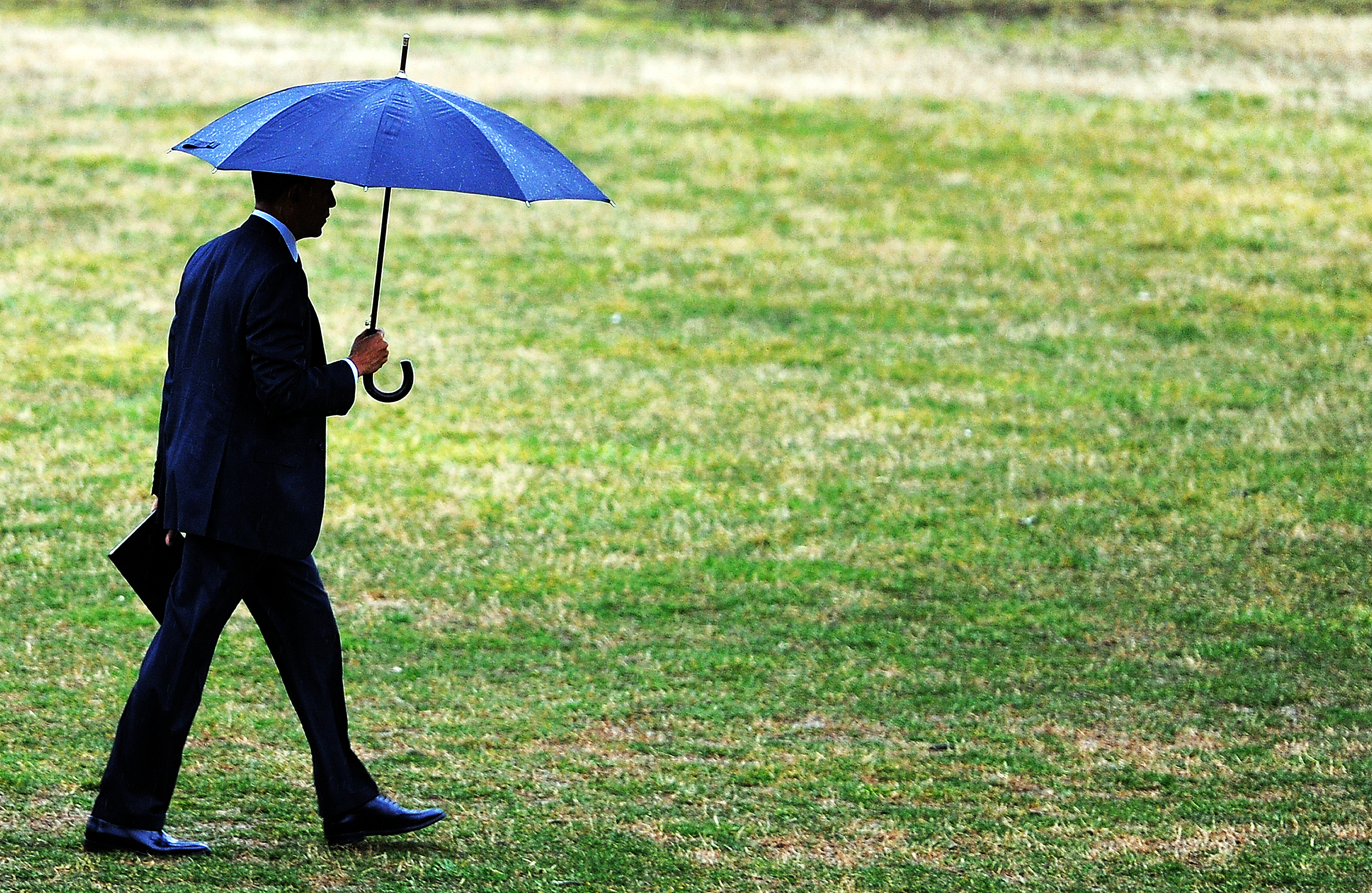
US President Barack Obama uses an umbrel

Like many other veterans of the Village, the former McCain supporter, Ron Fournier, has never liked the Obama era. Its implicit repudiation of so much that came before still rankles many in the capital’s permanent chattering and political class. And so Fournier’s dogged and constant attempts to drag this presidency to the low levels of its predecessor are not exactly surprising. But the latest is a classic, down to its melodramatic title: “This Is The End Of The Presidency.” The thesis is that Bush and Obama are essentially the same failures in the same way and for the same reasons. And when the analogies are laid out as an analogy as far as it can … well, it’s so preposterous and lazy an argument it beggars belief.

Here’s the gist of Fournier’s Obama-Is-Bush absurdity in its various stages. Obama, like Bush, allegedly began his second term by going far out on an ideological limb. If only Obama had listened to Fournier! The president would never have supported immigration reform (even though it was temporarily deemed even by Republicans as the sine qua non if they were ever to win the White House again). He would have presumably abandoned the healthcare reform that had already been passed and had been at the center of a furious campaign. He would have chosen to “spend [his] political capital wisely, taking advantage of events without overreaching,” as Fournier brilliantly suggested a year ago in a far-seeing column of surpassing prescience and non-falsifiable vagueness.

So he would have seized on Sandy Hook by proposing a moderate package of gun control, with overwhelming public support, right? Wrong! He shouldn’t have done that either! What should he have done? Er, hard to tell from Fournier’s column, which simply lumps together random things he doesn’t like about Obama and compares them with random things that everyone now concedes were dreadful under George W. Bush.

But what Obama shouldn’t have done is

rub Republican faces in defeat. Obama forced his rivals to accept higher taxes on the wealthy. It was his prerogative; he won the election. And he set the tone for a harsh and humiliating 2013.

Let’s just unpack that a little, shall we? If Obama had done nothing at the end of 2012, tax rates would have gone up dramatically on most Americans, with revenues increasing by almost 20 percent, as the Bush tax cuts’ self-imposed expiration finally arrived (after their massive failure to create growth and a massive success in creating unprecedented debt). Obama – in an act of overbearing hubris – only let the tax cuts expire for a tiny proportion of Americans earning more than $400,000 a year, halving the total tax increase and concentrating it only among the very rich, whose wealth and incomes had exploded since 2000. On spending, the sequester remained in place, keeping government spending at levels tighter than in almost every previous recovery’s, very much including Reagan’s. Here’s the impact on the deficit of this and other measures that Obama agreed to, from the Wall Street Journal:
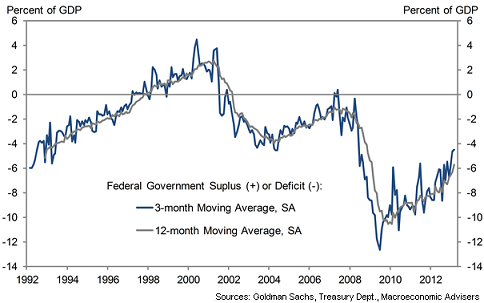
deficits0413Talk about liberal over-reach! This decision to prevent much larger automatic tax rises and to reduce spending and the deficit by these amounts during a still-lingering downturn is what Fournier regards as rubbing “Republican faces in defeat.” Seriously.

But Fournier is not done yet. Both Bush and Obama had first term “successes” that turned to defeat in their second term. Bush’s first term success was – wait for it – the Iraq War, whose core casus belli Bush had lied about. And so obviously the analogy with Obama is to the ACA, a first term success some of whose provisions Obama had also lied about.

How does one note that a war that killed more than a hundred thousand people, and destroyed America’s moral credibility and global power is not really in the same universe as a health reform law, modeled on a Republican governor’s, that, so far, has done nothing but provide access to health insurance for many, forced some to buy more expensive and comprehensive coverage, frustrated millions by being launched on a faulty website, and possibly already arrested soaring healthcare costs? I guess it’s possible to see both things as equivalent – a brutal, lost war and a fledgling overhaul of the country’s healthcare system. But I think most sane people not captive to Beltway narratives would beg to differ.

But then, according to Fournier, both Bush and Obama failed to cop to errors! Yes, Obama had that brutal press conference where he owned up completely to failure on Healthcare.gov, and beat himself up again and again in apologizing. But that, according to Fournier, wasn’t any better than Bush’s flailing around in the obvious catastrophe of Iraq, keeping Rumsfeld until 2006, and dithering until the mid-terms gave him the courage to do something more tangible than wait and watch. Again: I simply beg to differ. The difference between Obama’s response to error and Bush’s is the difference between night and day.

Ditto the difference between partisan Democrats keeping after Bush in 2005 (while never voting to curtail his war and acquiescing in most of its abuses) and the near-pathological attempt to destroy Obama by Republicans in 2013. What was stunning this year was the revelation that the GOP was prepared to wreck the entire global economy and the credit of the US government, if it could get them one small political edge over a re-elected president. This negotiating tactic was a new level of extremism, as Americans rightly understood. And if Obama had won the same Republican support for healthcare reform that Bush had from Democrats on Iraq, the last five years would have been much, much different. Or was that Obama’s fault as well?

All these critical, central facts for the last five years do not fit anywhere in Fournier’s analysis. And the truth is: nothing this president has done compares even faintly with the damage wrought by his predecessor. Bush exploded the deficit in a time of growth; Obama has cut it dramatically in a time of near-depression. Bush gave us two disastrous wars; Obama has largely ended both, and set in process diplomatic initiatives in Syria, Iran and Israel-Palestine that, if successful, can defuse potential new ones. Obama has tackled a huge domestic problem – the accessibility and cost of healthcare – which Bush allowed to fester and on which the current GOP has no policies except a return to the disastrous status quo ante. Bush initiated the first ever American-run program of torture of prisoners. Obama ended it. Bush presided over the worst breach of national security since Pearl Harbor. Obama killed Osama bin Laden and decimated his forces on the ground in Afghanistan and Pakistan. Bush presided over the total collapse of the free market system in the US; Obama has painstakingly rebuilt it.

If you exclude all this context and focus on superficial Washington games and tropes, you can maybe concoct a theory of the past five years that makes Fournier’s analysis seem plausible. It’s just that you have to erase the actual events from your brain and your memory.

It tells you a lot about Washington that doing that will make you the editor of National Journal.
North Korea’s Unusual Candor

BR Myers analyzes the recent purge of Kim Jong Un’s uncle, Jang Song-thaek, noting an unprecedented level of disclosure in the post-purge propaganda:

North Korea had prided itself on complete unity ever since the establishment of a “unitary ideology” in 1967. When the regime warned against subversive behaviors it resorted to cartoons with animal figures rather than admit to actual internal disunity. Power struggles elsewhere were gloated over as evidence that only North Korea had leaders whose greatness stood above dispute. The benevolent charisma of the leaders was said to be so irresistible that even representatives of enemy states, like Jimmy Carter and Kim Dae Jung, succumbed to it. And now the North Koreans find out that Kim Il Sung’s own son-in-law and Kim Jong Il’s right-hand man was engaging in crimes since the 1980s? Yet they are still expected to believe in the infallibility of Kim Jong Il’s choice of successor?

How Myers sees the North Korean regime:

[I]t is a race-oriented, militaristic state with socialization of assets. But the militarization of a peace-time society cannot be sustained without the perception of an ongoing national emergency. North Korea has shown that this perception can be maintained through limited conflicts and crises, without engaging in all-out war. … As I see it, North Korea cannot cease being a military-first state without losing all reason to exist. To ask the regime to disarm is to ask it to commit political suicide. Once you’ve grasped that, you realize that neither sticks nor carrots are going to keep the regime from continuing to arm itself, and continuing to look for the tension that is its lifeblood. And that’s when you start to get really worried.

Abraham M. Denmark speculates on the meaning of the purge:

[I]nstability at home could translate to more belligerence abroad. Many North Korea watchers believe that past acts of aggression, including limited-scale attacks against South Korea, reflected Kim’s attempts to demonstrate strength and resolve in the face of foreign opposition in order to burnish his domestic reputation—especially with the military. This suggests that 2014 may be a difficult year with North Korea, with the potential for military attacks and nuclear tests in the offing.

Museums In The Age Of Selfies

3705898967_b2268c78ab_b

Eric Gibson thinks overzealous smartphone users are ruining the museum experience:

Rather than contemplating the works on view, visitors now pose next to them for their portrait. In pre-digital photography the subject was the work of art. Now it is the visitor; the artwork is secondary. Where previously the message of such images was “I have seen,” now it is “I was here.”

If visitors now regard a museum’s treasures as mere “sights,” they might come to regard the institution itself in a similar vein—not as a place offering a unique, one-of-a-kind experience but just another “stop” on a crowded itinerary, and as such interchangeable with any other. At the very least, it’s hard to see how this new culture of museum photography can fail to undermine the kind of long-term visitor loyalty to museums toward which so many of their public engagement efforts are directed. On the one hand, the visitor who makes an emotional connection with a work of art is likely to return. On the other hand, I can’t imagine there are many tourists who, having once had themselves snapped propping up the Leaning Tower, feel compelled to do so again.

Jillian Steinhauser begs to differ:

[T]he obvious point Gibson has missed is that people are often taking pictures because they’re excited about art. They came because they wanted to see it with their own eyes. And they’re using their cameras and smartphones as a form of interaction – we live, after all, in the age of mechanical reproduction, not the age of aura.

Did we lose something in the exchange? Probably. But that doesn’t mean we should throw up our hands completely. The way we understand and process art has changed – you can take it home with you, blow it up on your computer screen, remix it in Photoshop, Snapchat it to your friends – in part because the way we understand nearly all cultural production has changed.

(Photo of Anish Kapoor’s Untitled by Leo Reynolds)

Blame It On Obamacare, Ctd

The ACA is getting scapegoated. Suderman expects this to continue:

The instinct for the White House and its defenders will be to protest that most of these changes in employer coverage are a longstanding part of the existing market, that they happened before Obamacare, and that the law isn’t the cause of every health insurance woe in the nation. Obamacare, they’ll say, is responsible for the part of the system that’s getting better, not the part that’s staying bad.

But Democrats will have a hard time selling this argument to a skeptical public. Partly because it sounds awfully self-serving, taking all the credit and none of the blame. Partly because the impression has already sunk in that Congress doesn’t understand the real-world effects the health care law is having. But mostly, however, because President Obama has already lied about who the health law will affect, and how. For lots of Americans, it won’t be easy to trust the president or his party on the subject again.

Philip Klein makes related points:

Given that the law was sold as a way to fix a broken health care system, rightly or wrongly, the law is going to be blamed for any persistent problems.

It’s impossible for Americans to sort out whether a given change took place as a result of the law or whether it would have happened anyway. If they don’t like a change to their health care situation that occurred after a giant new law went into effect, they’re going to blame that giant new law.

If I were a vulnerable Democrat incumbent in 2014, I wouldn’t want to pin my re-election hopes on being able to convince angry voters that changes that they hate would have happened with or without the health care law. “Correlation doesn’t equal causation” is not exactly a winning campaign slogan.

Barro thinks this is why the GOP hasn’t come up with a real alternative to the ACA:

Liberals chose to reform health policy despite the political risks, because their political coalition includes the people who are most extensively screwed by the health policy status quo. Conservatives have decided that cynicism is a better political strategy, for the reasons Klein inadvertently lays out. They’re probably right on the politics, but that’s nothing to be proud of.