
The View From Your Window Contest: Winner #184

vfyw_12-14

A reader writes:

No San Jose-style giveaways this week, I see. We have a sea of McMansions in a relatively flat valley, mountains in the distance, and a cat. This could be any of a number of recent boomtowns in the American West. Or perhaps somewhere in Alberta. But I’m going to go with my first impulse, which was the outskirts of Las Vegas, specifically Henderson, NV, looking to the east. The terrain looks right and I believe they’ve had some record breaking cold lately (hence the dusting of snow). Hopefully the evergreen trees in front of a few houses are merely misdirection.

Another:

It’s been a long time since I’m made a guess, just because so many of the recent contests have been so damn difficult, but I figured I’d give this one a chance. Snow cover, relative lack of trees (particularly out in the distance past the development), large tracts of newly constructed suburban housing … it definitely suggests a city with a booming economy somewhere in the dry Mountain West. All the major cities in Utah and Colorado are immediately disqualified because the mountains in the background would be much, much taller. Billings, Santa Fe, Albuquerque, and Grand Junction don’t have the right kind of hills in the background. Boise is really the only city that fits all of the criteria, so I’m going with that.

Another:

I’m guessing this is Pocatello, Idaho. The mountains in the distance look very much like the area pocatelloand the town sits in a kind of bowl-like valley surrounded by them. How do I know Pocatello? I’m a documentary TV producer and I went through with a Pakistani crew and a host, who is “the Julia Roberts” of Pakistan. We went to meet and interview a pair of Pakistani immigrant doctors who live in Pocatello and have become local legends for their work in the community. That said, Pocatello is not the most exciting place in the world. Its main claim to fame is having its city flag voted the ugliest in the United States.

Seen to the right. Another reader:

With two holiday parties to go to today, unfortunately I don’t have time to look for the address, but that sure looks a lot like Tuscon. This picture nicely illustrates how that city looks like something straight out of The Martian Chronicles.

Another:

I give up. I’m stumped. I spent my entire PTO day yesterday trying to find this place and focused on Colorado and Utah with no luck. I figured the leaves off the trees and the new construction it was Denver or Colorado Springs or Salt Lake City.  Let’s go with Colorado Springs.

And I’m 3% sure the cat’s name is Mr. Phipps.

Update from the photo submitter:

HA! No. The cat’s name is Romeo:

photo 3(1)

The boy earned that named because he loves hard, guards the house against those slanderous squirrels, and is more than a bit impulsive.

Another reader gets punny:

Thanks to the huge spoiler in the photo this week. I want to be the first to state the obvious: this is obviously Kathmandu.

Another:

I have ceased to be amazed by people guessing these locations. That said, this one strikes me as nearly impossible.

It could be virtually any large subdivision in the American West (or even Appalachia, I guess, but I think not). I’ll guess a suburb southwest of Denver, call it the “Valley Enclave” subdivision of the neighborhood in Littleton, CO that is around 39.569771, -105.155785. Facing Southwest from somewhere around 30 Mountain Pine Drive.

Anyway, I also wanted to pass along my thanks for continuing to blog over the weekend. It must be taxing to post what is nearly 24/7. Wanted you to know it’s appreciated. Especially by a law student in the middle of exams who needs a distraction.

The Dish team is indeed indomitable. Another reader:

Nice picture. Lots of two story track homes, Western US style, evergreen trees in the front yards, relatively barren hills in the backgroun. Must be a large Western US suburb close to lower mountain ranges. Guessing Highlands Ranch or Aurora in Colorado, sitting next to the Southern Denver ranges.

It’s the former. Another gets it:

Fresh pow on the foothills … cookie cutter houses packed in like sardines … looks like Highlands Ranch, Colorado!

Another notes, “This is where the shooter in yesterday’s school shooting lived.” One of several schematics from an impressive reader:

fig1

A previous winner writes:

We’re looking at the eastern edge of the Rockies from the West Denver suburb of Highlands Ranch, which shares a zip code with Littleton, CO. In fact, Google Maps kept alternately telling me the address is in Highlands Ranch and Littleton. (And therefore near Arapahoe and Columbine – a news article on Friday’s shooting mentioned that a home in Highlands Ranch was searched.)

My dad immediately recognized Colorado, which is good because I probably would have started in Idaho or something. This image of HR I found helped a lot, as the mountains match the section found to the far right of the contest pic.

I think the picture was taken from [the correct address, redacted at the submitter’s request]. A vast scene of subdivisions is a nightmare! Different subdivisions have different styles so I could rule out several neighborhoods. We were near a corner on the left, and my best reference was the alternating pattern of rectangular roofs and asymmetrical roofs – see below. Note the approximate location of the cat seen in the contest pic:

roofs

Another previous winner also got the correct address and adds:

When I first saw this week’s view, I thought, “no, it couldn’t be, could it?” I grew up in the western suburbs of Denver (shout out to Lakewood!), and the sight of the foothills blanketed in fresh snow brings back many fond memories. Now a Minnesotan, I wish we had a little more vertical terrain to go along with the snow, ice and cold that keeps us company for a good part of the year.

Off I went to see if I could confirm this was in fact the sight of the same hills. It is amazing what you can do with two thumbs and an iPad! Scanning the 3D satellite images, I looked for the signature of the two well-defined ridge lines and the starkly contrasted southeast slope face that show up in the right third of the view.

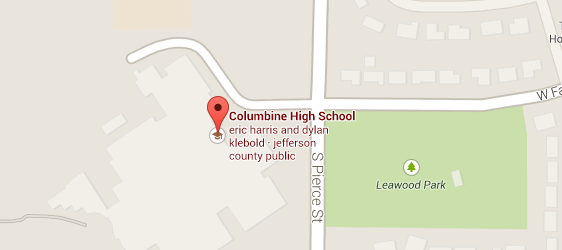
After a few minutes working from Boulder south, I found what looked to be a match. Given the proximity and angles, I first thought that Columbine may be the town – fitting as a bookend to go along with the one-year anniversary of Newtown:

image

(Side note: it doesn’t seem right to me that the attackers – no mention of the victims – get their names listed alongside the place mark for Columbine High School on Google Maps – how can we change this?)

But the sight lines for the hills didn’t work for Columbine; instead it was clearly neighboring Highlands Ranch and its relatively new subdivisions that aligned.
Of the three non-winners who correctly guessed the exact address this week, one of them has participated in five times as many contests as the other two, so he wins the prize this week:

Between the look of the hills, the snow, and the sprawl, I immediately recognized this week’s photo as the Front Range foothills as seen from the southern Denver-area suburbs, looking southwest. I grew up in those hills just a little bit west of what you can see in the photo.

A couple minutes of scanning the foothills with Google Earth found the exact hills in the photo, then I moved NE until I saw some neighborhoods with houses facing the right direction and enough sprawl between them and the hills to be a potential location of the shot. The first neighborhood I checked wasn’t quite right, but the second was a match. I would consider this house to be a part of Highlands Ranch, but according to Google Maps, the address of the house is [redacted address].

And it wouldn’t be a window contest with a creepily accurate entry from Doug Chini:

VFYW Highlands Ranch Actual Window Marked - Copy

This one comes with a bit of deja vu. It was only last April that I was flying through the Alps near Rohrmoos looking for the distinctive mountains in VFYW #148, and now nine months later we get a similar search. Thankfully, this new set of peaks was much easier to find. This week’s view comes from Douglas County, Colorado. It was taken at [redacted address] in the Denver suburb of Highlands Ranch and looks southwest along a heading of 220.48 towards the Front Range of the Rockies. A best estimate for time and date would be December 9th at 8:33 AM (or perhaps December 5th). Attached is a marked bird’s eye view looking toward the mountains, an external shot of the window, and an interior view of the actual home office/alcove where the pic was snapped:


VFYW Highlands Ranch Interior Window Clean - Copy

The submitter of the contest photo wrote:

This is the view from my home office in Highlands Ranch, Colorado. We are in unincorporated Douglas County just south of Littleton. We were the focus of school reform this past election. We lost again to the conservative reformers.  But this is our home too and we’ll keep fighting for our kids and their teachers.

The Dish covered the school board election here. The submitter follows up:

Thank you for using my picture. To help narrow the win, if needed, the address is [redacted address]. Of course, this is a home address so please don’t publish. The view is looking west and a little south out over the western part of Highlands Ranch. Chatfield and Roxborough are between the window and the foothills.

A little more to add. I know the more urban of your readers will suck their teeth at this vast sea of suburbia. That is ok. I was that person too at one point. We’ve been here now for nearly ten years and I’ve never been happier anywhere else. When family from San Francisco or Seattle visit they wonder where the “there” is located. I laugh it off and kick rocks, but the truth of the matter is that this vast ‘burb is where my friends live. It is where my kids are growing up and it is where I fall in love my wife over and over and over again in between grocery shopping, car loops, and the rec center swimming pool. Besides, downtown Denver is like 20 minutes away for when we want to get all cultured up.

On a sad note, the most recent school shooting happened only eight miles to the north from where this picture was snapped. In fact, due to our intense feelings about the Douglas County School Board (oppose) and the reputation of Arapahoe High (top-notch), we tried mighty hard to get a house that fed to AHS. We failed in that endeavor. It is our sincere hope that the kids and their families at AHS will find healing and love in the days and years ahead. I wish there was more that we, that I, could do to ensure that nothing like this could happen anywhere again to any child.

(Archive)
A Troublesome Truth About Europe’s Muslims

Muslim-survey

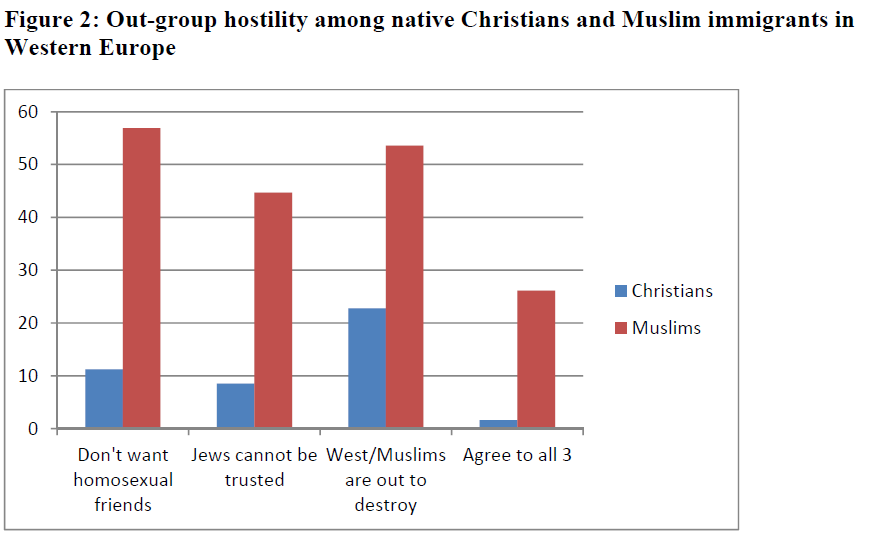
Erik Voeten points to a survey revealing that ample majorities of Muslims living in several Western European countries hold fundamentalist religious views, such as that there is only one acceptable interpretation of the Quran and that it supersedes the laws of the country in which they live:

This study is bound to attract ample media attention (it already has) and will be seen as a verification for political parties with extreme views, such as Geert Wilders’s PVV in the Netherlands. This is not an issue per se, facts are facts, however uncomfortable they may be, and from what I can tell, this is a professional survey (technical report here) done by a reputable academic scholar. Indeed, the survey was conducted in 2008, and the researchers appear to have waited until now to publicize these findings. Nevertheless, I wished that the publication of a sensitive survey like this would be partnered with a bit more information. For example, I could not even track down country-specific marginals for the main survey questions and key analyses in the article come without tables or graphs.

Still, the finding that 54 percent of Muslims in these six Western European countries believe that the West is out to destroy Muslim culture can hardly be ignored.

A Dutch newspaper, Trouw, cites Arabist Jan Jaap de Ruiter who argues that Muslims have a tendency to give “socially desirable” answers to survey questions. Even if this is true, I’d still be very concerned that the apparent socially desirable answer is that Jews should not be trusted and that the West is out to get Muslims. An added concern is the absence of generational differences in the survey responses; suggesting that this is not an issue that is likely to go away any time soon.

Cas Mudde downplays the survey:

In the end, the main question is: What does this all mean? Most media only report [Ruud] Koopmans’s warning against the intolerance of Muslim fundamentalism. However, in a very nuanced conclusion, he also stresses that religious fundamentalism should not be equated with support for, or even engagement in, religiously motivated violence, and emphasizes that Muslims constitute only a small minority of West European societies. Hence, “the large majority of homophobes and anti-semites are still natives.”

Rachel Gillum responds to the survey with one finding that Muslims in America are no worse than Christians:

Just over 57 percent of the general American population believes that “right and wrong in U.S. law should be based on God’s laws,” compared to 49.3 percent of U.S.-born Muslims and 45.6 of foreign-born Muslims.  About a third of each group believes that society should not be the one to determine right and wrong in U.S. law.  Such numbers reveal that the general American population is more fundamentalist than the average European, and that Muslim Americans are less fundamentalist than European Muslims, according to the Koopmans study.

She tries to explain the difference:

The bulk of Muslim immigrants in the U.S. today arrived during or after the 1990s, the large majority pursuing economic opportunities and advanced degrees. Muslim immigrants in the U.S. are thus just as wealthy as, and tend to be better educated than, the average American. This high-skilled migration flow to the U.S. stands in contrast to the low-skilled labor immigration that Western Europe attracted following World War II to help rebuilding efforts. More immigrants were later admitted into European countries to meet rapid economic growth, allow family reunification and provide asylum.  Muslims in Western Europe have had significant issues with poverty and integration, making up around 20 percent of the low-income population, compared to 2 percent among U.S. Muslims.

The Campaign To Sell Obamacare

The insurance industry is preparing a massive Obamacare ad campaign. Benen remarks upon it:

If the industry expected the Affordable Care Act to collapse – or at a minimum, struggle badly for the foreseeable future – insurers would wait on the sidelines. If the industry expected “Obamacare” to succeed, they’d quickly get in the game, competing for consumers’ business before their rivals could snatch up prospective customers. Now that insurers are poised to spend a half-billion dollars in advertising, it appears the industry is confident the system will prevail. To hear Republicans tell it, “Obamacare” is in some kind of death spiral, from which there is no recovery. In reality, the ACA reached its nadir a month ago, and is bouncing back quite nicely.

Krugman is on the same page:

Now, some people will see this as bad news. Obamacare is just going to add to insurer profits! And it will indeed make money for the likes of Aetna and Wellpoint. In an ideal world, this wouldn’t be happening: single payer would clearly have been a better system. But it wasn’t going to happen. This was the health reform we could get — and when it works, as the big money now believes it will, it’s going to make a huge, positive difference to millions of lives.

Ezra comments:

The fact that the insurers are launching their campaigns is … independent confirmation that HealthCare.Gov is rapidly improving. Major insurers are virtually the only group aside from the federal government that has real visibility into the functioning of Obamacare’s digital architecture. They know what the pace of enrollment looks like, and how many 834s are being correctly generated, and whether angry customers are calling their help lines. They know there are still problems even if the Obama administration is downplaying them. But if they think the system is sound enough to begin driving people to it that’s good evidence that the improvements are real.

Sargent chimes in:

What’s striking is that this comes even as the absolute certainty among Republicans that the law cannot do anything other than fail spectacularly — indeed, that this has already happened — has only hardened. The New York Times reports that a whole batch of Republicans who were unseated in 2012 are running again for Congress explicitly because they believe Obamacare’s failure has given them an opening — and that they have replaced their previous focus on other issues with a single minded focus on the law.

Our Octopi In The Sky

Katherine Harmon Courage, author of Octopus! The Most Mysterious Creature In the Sea, suggests that the “new impressively oblivious (or riotously self-mocking) [National Reconnaissance Office] logo that adorned a rocket carrying U.S. spy satellites is actually not a bad choice, as metaphors go.” She elaborates on the “sinister-looking octopus perched atop Earth”:

[I]f one were to pick a mascot to represent such a broad-reaching project, the octopus is an excellent choice. For one, the octopus is one of the slinkiest, crafty creatures out there (and not in the macramé sense). As an invertebrate, an octopus can squeeze an arm—or even its whole body—into some impossibly small and unlikely spaces. … Unlike our arms, which are locked into hard joints and confined by bones, the octopus’s arms are muscular hydtrostats—the same material as our tongues. This means they can stretch and deform and squeeze while maintaining an overall volume. Need to quietly sneak out of a tank through the water outflow? No problem. Want to reach an arm into a tiny crack to get some food. Already done. Asked to crawl into your internet provider’s datacenter? Theoretically a snap.

These animals are also perhaps the stealthiest creatures, able to vanish into nearly any natural setting.

This camouflaging ability, which can involve changing color, texture and luminosity in a matter of milliseconds, has frustrated researchers and predators and often proves deadly for the octopus’s desired lunch. But it would make them awfully good spies. If they lived on land, one could be sitting on your floor right now and you wouldn’t even know it. In fact, the U.S. military is already funding research to try to decode this camo—and replicate it for our purposes with nanotechnology.

Josh Lowensohn touches on a history of octopus iconography:

It’s not the first time the US has used an octopus to get the point across, though it comes as the country is under close scrutiny — especially by technology companies — for its privacy policy. The US used imagery of an octopus wrapping tentacles around the world as part of propaganda during the cold war, depicting Joseph Stalin as a giant red octopus, stretching from country to country. The imagery has also been used to vilify imperialism, especially of England in the late 1800s.

Previous Dish on the wonders of the octopus here, here, here, and here.

Tense Times In Turkey

Christopher de Bellaigue provides a pessimistic update on the country since the Gezi Park protests that made headlines last summer:

A vindictive authoritarianism is taking hold of Turkey. To the prime minister’s supporters this is regrettable but necessary; many I have spoken to think that the protest at Gezi Square was organized by foreign agitators, and that the protesters should have been crushed more harshly than they were. In a democracy, these people believe, the will of the majority is determined at the ballot box and then carried out. This, they say, is what had been happening quite successfully until the liberals, realizing they were too few to win an election, turned to seditious activities instead. The idea that the beliefs of liberal minorities should be legally protected and might actually have an influence on policymaking has not been accepted by the government, which claims to speak for the majority. …

Erdoğan has encouraged a species of conservatism that is now the dominant mode of life throughout Turkey. The culture is pietistic, implicitly anti-Alevi, and materialistic. This last factor is new, for until quite recently virtue was associated with austerity and self-reliance; now the faithful demand rewards in this world in the form of high-performance cars, iPads, and so forth—acquired using the family credit card.

But Claire Sadar sees Erdoğan’s iron fist slipping:

The AKP has been making some insane policy threats lately.  These statements have (justifiably) caused an uproar from many Turks and Turkey watchers.  However, I think we all need to take a step back and consider the possibility, or probability, that despite their current vice-like grip on Turkish politics, the neither Erdoğan nor the AKP in general have the power or mandate to carry through with many of these proposed “reforms.”  It is too early to predict the long-term consequences, but Erdoğan’s antics seem to be backfiring and causing even some former supporters to question his leadership.

The first piece of good news is that Erdoğan is not going to get his wish to become the first American-style President of Turkey anytime soon.  The commission tasked with reforming the current constitution, which was created by the generals in the wake of 1980 military coup, has fallen apart.  The AKP had already agreed in August not to push for a presidential system to be included in the new constitution.  Turkey still desperately needs a more liberal constitution but the AKP does not seem to be ready to make the concessions needed to make this happen.

Previous Dish on the situation in Turkey here, here, here and here.

A Minimal Minimum-Wage Hike, Ctd

Several readers are piling on this one:

Not that I ever had second thoughts about resubscribing to the Dish next month, but if there was ever a question, your first reader’s response reconfirmed why your endeavor is important not only for journalism, but also just for human decency – because you treat your interns like humans, and not simply economic units. I was particularly dismayed when the guy wrote:

I personally know at least a dozen seniors in high school and freshmen in college who would jump at the opportunity to work with me for nothing, let alone $3 per hour or $5 per hour. All of the ancillary skills and benefits would far outweigh any wage they may earn. Yet, the minimum wage laws prevent this from happening.

The only thing preventing this clown from hiring these students and paying them a livable wage is his own greed. Maybe there is room for a student minimum wage that’s lower, to allow for greater experience-gaining. But the sad reality of today’s economy is that there are also many people who are working in these low-wage jobs as a daily reality of their lives.

Another:

One of the striking features of this businessman’s argument is his lack of economic perspective. From his view as an owner, any dollars spent on labor are simply flushed down a gigantic economic toilet. Yet, while economists argue about whether the minimum wage increases or decreases overall levels of employment, there is near-universal agreement that raising the minimum wage increases the size of the whole economic pie (i.e., the overall GDP). His analysis shows a lack of awareness that the increased wages to workers are either invested or spent on taxes, goods, and services – which ultimately allows other companies to hire workers. He seems totally unaware that creating a regulatory environment that promotes hiring people into jobs that are so unproductive that they cannot produce $8 per hour in economic value is not a path to national prosperity. He sees the economy through some narcissistic lens of “receivables good, payables bad,” without realizing that everyone’s accounts receivables are someone else’s accounts payables and vice versa. The economy is not a business.

Meanwhile, the businessman takes issue with his earlier critics:

Your readers continue to show tremendous economic illiteracy. Let’s examine the first response you posted:

[I]f he could pay two teens $5/hour or three teens $3/hour, why can’t he afford to pay one teen $7.50/hour – or even the $15/hour implied by three teens at $5/hour? Since he won’t suffer with three, two, one or no hires, as he says, the minimum wage should make no difference. So why the discrepancy? Well, that would probably be because he’s completely full of crap.

This is a simple problem that my 10-year-old can solve. I’ll kindly illustrate:

Three teens – Bob, Steve, and Mike – are looking for work. They have few-to-no skills but are desperate to learn. Each can add additional profit to the bottom line of my business. Bob’s skills can generate additional profit of $2 per hour. Steve’s skills can generate additional profit of $5 per hour. Mike’s skills can generate additional profit of $7 per hour. At what wage would I, as an economically literate business owner, hire each of them individually?

If you’re the above Dish reader, you’d say $7.50 or even $15 per hour. And you’d be quickly out of business.

The correct answer is that I’d hire Bob for any wage under $2, Steve for any wage under $5, and Mike for any wage under $7. If there were no minimum wage law, I as a successful business owner would gladly hire all three at these wages. All three would be employed and begin to learn some valuable skills. But there is a minimum wage law. And the law says I must pay a minimum wage of $7.25. At $7.25 per hour, it is no longer profitable to hire Bob, Steve or Mike.

Instead, I hire Mary. Mary is a skilled assistant with years of experience in the financial services industry. She knows the business and can add value on day one. She can add incremental profit to my business of $20 per hour and will accept a wage of $15 per hour. The $15 per hour she demands is above the minimum wage, so it is legal for me to hire her. In addition, it is below the $20 additional profit she will bring to my firm, so hiring her is also profitable.

Only a total idiot would hire any of the teens at $15 per hour. And to answer your reader: no, I am not completely full of crap. I simply understand Economics 101.

As for your second reader: he is simply trying to kiss up to Andrew by trying to add to the “epistemic closure” files. What could one man know compared to professional economists with centuries of combined training who have spent decades studying this question? I’ll gladly answer. This one man knows and understands business. He is simply proving false the argument that the minimum wage does not kill jobs.

The above example is a real-world example that exists in my business today, although I’ve simplified the numbers. And that is the real-world effect of minimum wage. It protects the skilled worker at the expense of unskilled workers.

As surely as the sun rises, so does the minimum wage kill jobs. That is why the teen unemployment rate is so high. That is why unskilled minorities have such a high unemployment rate. That is why jobs are shipped overseas. I don’t care how many decades and how many centuries of experience professional economists have. They are simply playing upon the economic illiteracy of the majority of the population.

Another reader:

Your very successful financial advisor may need to go back to school. The US Dept. of Labor carves out teen workers from the usual requirements for the minimum wage:

A minimum wage of not less than $4.25 may be paid to employees under the age of 20 for their first 90 consecutive calendar days of employment with any employer as long as their work does not displace other workers. After 90 consecutive days of employment, or when the worker reaches age 20 (whichever comes first), the worker must receive at least the federal minimum wage.

In addition to being a very successful cheapskate, he/she hasn’t bothered to spend 30 seconds investigating the minimum wage laws.

Another looks abroad for more perspective on the issue:

Perhaps the financial planner who won’t hire teenagers at a higher minimum wage, and those who endorse an increase in the minimum wage, could be satisfied by a system like Australia’s. That country’s minimum wage for those over 21 is $16.37 AUD per hour, but it drops by a percentage year by year for people younger than 21 until those under 16 receive 36.8 percent of the minimum wage for adults. Here’s a chart showing the breakdown:

Screen Shot 2013-12-16 at 4.52.16 PM

Another asks:

My challenge to the minimum-wage boosters is: what is the optimum minimum wage level? Why not raise it to $20/hour? Or $50/hour?

Let’s understand the historical basis for minimum-wage laws. They were meant to protect unionized labor from competition. Unions want to suppress wage competition from the underemployed, who would gladly bid wages lower in competition to win employment. No sane economist denies this or that minimum wage laws decrease the quantity of labor-hours paid for by employers, ceteris paribus. The rational arguments in favor of the minimum wage are based on static, wealth-redistribution analysis that show that the share of total income earned by the lowest quartile of wage earners will increase. In other words, the gains in earnings by those that keep their jobs exceeds the losses in earnings by those who lose their jobs.

So the optimum minimum wage according to a rational minimum-wage supporter would be one that redistributes the most to the lowest cohort of the income scale. However, from a dynamic perspective, the effect on long-term economic growth by minimum wages could actually harm the long-term well-being of these workers if job creation is stifled, as it surely will be.

What Broke The Government?

Francis Fukuyama argues that a primary driver of inefficiency and dysfunction in the American government is the outsize role of courts and legislatures in controlling functions normally performed by executive bureaucracies:

The decay in the quality of American government has to do directly with the American penchant for a state of “courts and parties”, which has returned to center stage in the past fifty years. The courts and legislature have increasingly usurped many of the proper functions of the executive, making the operation of the government as a whole both incoherent and inefficient. The steadily increasing judicialization of functions that in other developed democracies are handled by administrative bureaucracies has led to an explosion of costly litigation, slow decision-making and highly inconsistent enforcement of laws. The courts, instead of being constraints on government, have become alternative instruments for the expansion of government. Ironically, out of a fear of empowering “big government”, the United States has ended up with a government that is very large, but that is actually less accountable because it is largely in the hands of unelected courts.

Meanwhile, interest groups, having lost their pre-Pendleton Act ability to directly corrupt legislatures through bribery and the feeding of clientelistic machines, have found new, perfectly legal means of capturing and controlling legislators. These interest groups distort both taxes and spending, and raise overall deficit levels through their ability to manipulate the budget in their favor. They use the courts sometimes to achieve this and other rentier advantages, but they also undermine the quality of public administration through the multiple and often contradictory mandates they induce Congress to support—and a relatively weak Executive Branch is usually in a poor position to stop them.

All of this has led to a crisis of representation. Ordinary people feel that their supposedly democratic government no longer reflects their interests but instead caters to those of a variety of shadowy elites.Ordinary people feel that their supposedly democratic government no longer reflects their interests but instead caters to those of a variety of shadowy elites.

Drum recommends the essay but quibbles:

There’s not much question that lobbying has exploded over the past half century, nor that the rich and powerful have tremendous sway over public policy. But do powerful interest groups really have substantially more influence in the United States than in other countries? Or do they simply wield their power in different ways and through different avenues? I’d guess the latter. Nonetheless, even if America’s powerful are no more powerful than in any other country, the fact that they wield that power increasingly via Congress and, especially, the judiciary might very well make their influence more baleful.

Andrew Sprung adds his thoughts:

Are other developed democracies better equipped to deal with today’s challenges, such as galloping inequality and slow growth? I imagine that fans of the U.S.’s highly participatory and less-than-majoritarian democracy, like, say, Jonathan Bernstein, would have something to say about that.

In Fukuyama’s telling, the three causes of democratic decay — undue power of interest groups, legislation through the courts, and vetocracy — feed on each other. Interest groups like recourse to the courts; the courts have further empowered interest groups; the courts themselves remain one powerful veto point in our legislative process. In this relatively short piece, however, it remains unclear why we’ve arrived at implied crisis now — why our system has muddled through to adapt to past challenges but now seems stuck. That may be a matter of degree: past reforms have been forced by crisis. But here Fukuyama seems to imply that Constitutional reform — a fundamental change in our structure of government — might be required if the U.S. is to address current challenges effectively.

Will China Spark Another Space Race?

Annalee Newitz applauds the Chinese:

Yutu, similar to rovers like Curiosity on Mars, is the first robotic observer to be deployed on the Moon in roughly three decades — and it’s a first for China, which has now taken the next step on its path into the Space Age. CNSA [the China National Space Administration] will be sharing all the data it gathers with scientists in other nations. This is truly a time to put aside national interests, and celebrate the international achievements of scientists and explorers working together to make new discoveries in space.

David Cyranoski details why scientists “around the world are excited by the possibilities”:

Carle Pieters of Brown University, in Providence, Rhode Island, responded to the news of the location in an email to a lunar community group. “Terrific! That landing site is in some of the unsampled young hi-ti [high titanium] basalts!” she said, referring to the relatively late-forming magmatic rock that scientists hope will hold clues to the Moon’s evolution. The landing success was followed about seven hours later with more celebration when Yutu, the “Jade Rabbit” rover, drove off the lander via a ramp. The six-wheeled, 140-kilogram [309-pound] machine is due to carry out a three-month tour of the Moon’s surface. Its most important challenge, [chief scientist Jun] Yan says, will be to use its deep-probing radar – capable of reaching 100 meters below the surface – to survey the composition of shallow subsurface and lunar crust. The next milestone, Yan says, will be analyzing the composition and distribution of minerals on the surface with it infrared spectrometer and alpha particle X-ray spectrometer.

Becky Ferreira is impressed by the sophistication of the venture:

[T]he Chinese have made no secret of their ambition to achieve leadership in outer space, and Chang’e-3 is a compelling piece of evidence that the country is not messing around. China expects to launch a permanent space station in roughly seven years, followed by a manned moon landing during the 2020s.

Space exploration advocates, damaged as we are by decades of watching lofty goals fail to pan out, are right to be skeptical of such claims. Even so, the sophistication of the Chang’e-3 genuinely speaks to the nation’s dedication to more aggressive space exploration. For example, in addition to being China’s first soft-lander, the Chang’e-3’s is equipped with a lunar-based ultraviolet telescope (LUT) and an extreme ultraviolet imager (EUV). These instruments make it the world’s first moon-based observatory.

And while some commentators disapprove of the Chinese government spending so much on the venture, Alex Berezow sounds a little envious:

It may be tempting for Americans to think, “Been there, done that.” However, China is now envisioning the very same sort of ambitious megaprojects that the US once dreamt of more than 50 years ago, when President John F. Kennedy urged America to “commit itself to achieving the goal … of landing a man on the moon and returning him safely to the earth.” For instance, China hopes to mine the moon for natural resources and to use it as a staging ground for further space exploration, although some believe the former goal is unrealistic because the cost is likely to exceed the value of the materials.

Still, China’s wild-eyed aspirations are inspiring. It should make us yearn for the days when we, too, thought we could do anything. But those days now seem so long ago.

Meanwhile, Glenn Harlan Reynolds notes that if China wants to make a territorial claim, “there’s not a lot to stop them.” But that doesn’t mean he’s worried:

If the Yutu rover finds something valuable, Chinese mining efforts, and possibly even territorial claims, might very well follow. And that would be a good thing.

What’s so good about it? Well, two things. First, there are American companies looking at doing business on the moon, too, and a Chinese venture would probably boost their prospects. More significantly, a Chinese claim might spur a new space race, which would speed development of the moon. The 1960s space race between the United States and the old Soviet Union saw rapid progress in space technology. We went from being unable to put people in Earth orbit to landing men on the moon and returning them safely to earth, repeatedly, in less than a decade. It happened so fast because each nation was afraid the other would get there first.

What Does “Slut-Shaming” Mean Anyway?

Callie Beusman argues that “the term is deployed basically every time someone does or says something not completely celebratory about sex” and is now just “a nebulous blob of a buzzword”:

[I]n accusing someone of slut-shaming a public figure, you dismiss their tone as judgmental and not sex-positive. You characterize them as prudish and a bad or backwards feminist and, as such, you don’t deign to engage with the content of what they’re saying. All this talk of “slut-shaming” causes us to plow blindly through nuance and to get worked up over distracting trifles. When we tell women that it’s ignorant or old-fashioned to feel uncomfortable with over-sexualized depictions of women in the media, we lose sight of the context in which those depictions take place. Because of this, the way we tend to talk about “slut-shaming” can be harmfully reductive.

Saying that feminist discomfort with commoditized sexiness is automatically “shaming” encourages a “you’re either with us or against us” logic. It facilitates sweeping value judgments:

i..e, Lady Gaga’s thong is either good for women or it’s bad for women; Miley Cyrus’ naked music video is either empowering or objectifying. But there’s power in recognizing that a specific performance of sexuality can be at once subversive and pandering: yes, a pop star’s decision to wear a thong and twerk and flaunt her sexuality can be a celebration of the female body and of female sexual agency; yes, it can be an inspiring rejection of the misogynistic notion that women should behave chastely and “appropriately” in the public sphere.

However, such decisions occur in a very specific context. The entertainment industry has a history of commoditizing female sexuality and objectifying women in order to market the idea of sexual availability. When Miley Cyrus, Lady Gaga, Rihanna, Ke$ha, Nicki Minaj, Katy Perry, et. al. make overtly sexual music videos and put on blatantly erotic performances, it’s both a reaction against prohibitive, oppressive attitudes about female sexuality and a canny response to the established fact that (young, heterosexual, female) sex sells. We don’t have to choose between Team Empowerment and Team Oppression in reacting to that.

Is Polygamy Headed For The Supreme Court?

In a lawsuit brought by Kody Brown, star of the reality show Sister Wives, a federal judge in Salt Lake City on Friday struck down part of Utah’s 1973 anti-bigamy law, finding that while a man does not have the right to legally marry multiple women, the state cannot prevent cohabitation with multiple “wives” as a religious practice. Lyle Denniston explains the ruling:

Judge Waddoups drew some inspiration for his ruling from the Supreme Court’s 2003 decision in Lawrence v. Texas, declaring a constitutional right of adult same-sex couples to engage in private sexual conduct.  But he said he could not rely directly and fully on that ruling, because the Tenth Circuit has given it a narrow reading. Instead, the judge relied mainly upon a 1993 decision, Church of the Lukumi Bablu Aye v. Hialeah, a ruling that barred government interference with the religious rituals of animal sacrifice of the minority faith, Santeria.  From that decision, Judge Waddoups found a requirement that the Utah law’s ban on religious cohabitation could not survive a “strict scrutiny” analysis.

While the state law’s ban on cohabitation with another person is formally neutral as written, the judge said it nevertheless is not neutral in its actual operation in banning religious cohabitation. That portion of the 1973 state law discriminates against cohabitation only when it is practiced by those who do so as a matter of religious faith, the judge said. The state of Utah, the judge noted, does not prosecute those who engage in cohabitation as an act of adultery — that is, a married person having intimate relations with a person who is not the spouse.  The state thus threatens prosecution only for those who cohabit as a religious activity, according to the judge.

David Copel expects the case to go to higher courts:

It would not be surprising if the case were appealed to the Tenth Circuit, and Judge Waddoup’s opinion seems careful to color within the lines of the Tenth Circuit’s cases interpreting (rather narrowly) the aforesaid modern Supreme Court cases. Should the Browns prevail in the 10th Circuit, the case seems a good candidate for the Supreme Court. The Tenth Circuit has several anti-polygamy decisions within the past few decades, and Judge Waddoups worked hard to distinguish them. Whether the 10th Circuit will consider the distinctions persuasive remains to be seen.

It is important to remember Brown v. Burnham in no way establishes a constitutional right to plural marriage. Nor does the Brown decision challenge ordinary state laws against adultery. Rather, the decision simply strikes down an unique state law which defined cohabitation as “bigamy.” Even then, the statute might have been upheld but for the government’s policy of reserving prosecutions solely for cohabitators who for religious reasons considered themselves to be married to each other under God’s laws, and who fully conceded that they were not married under the civil law of the state.

Mataconis analyzes the ruling’s implications:

Does this mean that the Browns should be permitted to take the next step and established a legal polygamous marriage that would be entitled to the same legal benefits that two-person marriage is throughout the United States? That is, admittedly, a more difficult question. Recognizing a marriage legally ends up creating a whole host of rights and obligations under state and Federal law that may not translate well to multiple person marriage. That, however, is a practical observation rather than a principled one. It’s also a question for another day because it’s not one that the Browns are raising, even if it will be one that conservative critics of the decision will raise as they react to this decision.

Anticipating another argument that many on the right will likely make in response to this decision, it strikes me that this decision is only tangentially related to the issue of same-sex marriage. It’s related in the sense that the 14th Amendment arguments regarding the rights of people to live their private lives and consensual obligations free from state interference are issues in both situations, and also in the sense that the Utah law against “religious cohabitation” clearly treats a certain class of people differently in violation of the Equal Protection Clause.

However, it’s unrelated in the sense that the arguments for same-sex marriage are merely seeking to extend to gay and lesbian couples the same rights and legal privileges already granted to opposite sex couples, whereas this case seeks to attack a provision of Utah law specifically punishing people for their religious beliefs. Indeed, for the most part, there is very little in this opinion that would be applicable outside of Utah and outside of the specific facts of this case. So, when you see the “slippery slope” crowd worrying that the next step along the road is, as Professor Bainbridge puts it, the legalization of adult incestuous marriage or the end of laws against incest themselves, you can largely dismiss it as little more than political rhetoric.

Tobin is also on that slippery slope:

While gay marriage advocates have sought to distance themselves from anything that smacked of approval for polygamy, Waddoups’s ruling merely illustrates what follows from a legal trend in which longstanding definitions are thrown out. The inexorable logic of the end of traditional marriage laws leads us to legalized polygamy. Noting this doesn’t mean that the political and cultural avalanche that has marginalized opposition to gay marriage is wrong. But it should obligate those who have helped orchestrate this sea change and sought to denigrate their opponents as bigots to acknowledge that the end of prohibitions of other non-traditional forms of marriage follows inevitably from their triumph.

Dreher foresees “the collapse of Christianity as the basis for Western society”:

Waddoups calls a 19th-century Supreme Court ruling banning polygamy “racist” and “orientalist,” because it asserted that Christianity’s teaching on marriage is superior to the polygamous arrangements that some Africans and “Asiatics” (presumably this means Arab Muslims) live by. This is an important point, it seems to me. If Christianity and the Christian moral and societal framework is no longer viewed as normative in laws governing sexual practice, then the slippery slope to legalizing polygamy is here. We already know from the Lawrence ruling that the state may not regulate private consensual sexual conduct; if the principle that privileging Christian marital norms is impermissible is accepted, by what standard do we prevent polygamy? I suppose you could say it harms society in some way, but this judge rejected that argument. Scalia’s Lawrence dissent was correct.

Eugene Kontorovich, on the other hand, praises Waddoups for his “courageous civil rights ruling”:

Most sexual liberties decisions going all the way back to Griswold v. Connecticut come at a time when the relevant practices have won very broad acceptance, especially among the educated elites. Not so with polygamy, which is quite far from the lives of the elites, and is opposed by a Baptists and bootleggers coalition of religious conservatives (bad for the “traditional family,” smacks of Mormonism) and secular liberals (bad for women, smacks of Mormonism). The judge will make few friends with his ruling. Editorialists will not liken it to great civil rights breakthroughs. It will surely be overturned, with conservative judges fearing an expansion of substantive due process, and liberal ones fearing a backlash. And that is what makes it brave, whether right or wrong.