Tropical Diseases In The US

800px-Mattiparkkonen_Aedesaegypti

They’re making a comeback:

“It’s so sad,” says Peter Hotez of Baylor College of Medicine, who founded the US’s first dedicated school of tropical medicine in 2011. He estimates that Chagas [disease], worms and other diseases typically associated with the developing world could afflict some 14 million impoverished people in the US. “They are called neglected tropical diseases,” says Hotez. “But in reality, this is about poverty, not climate.”

Worryingly, both situations are getting worse.

In 2008, Hotez made initial calculations of the number of cases in the US for several NTDs, most of which still stand as the best estimates available. Updated work on two parasites, however – Trichomonas vaginalis and Toxoplasma gondii – shows that many more people have the infections than was thought five years ago.

Much is specific to minority communities: 29 per cent of black American women carry T. vaginalis, versus 38 per cent of women in Nigeria. In the US, black women are 10 times as likely as white or Hispanic women to have the parasite, which increases the heterosexual spread of HIV and boosts the risk of a low-birthweight baby. Highly sensitive diagnostic tests were recently developed, and trichomoniasis can be cured with one oral dose of a common drug, metronidazole. But the startling prevalence of the disease suggests neither test nor treatment is routinely used.

Meanwhile, about 8 million people have Chagas disease worldwide, mostly very poor people across Latin America. In the US it mainly affects Hispanic communities. “Kissing bugs” that live in cracks in poor housing pass it to people by defecating while sucking their blood.

(Photo: An Aedes aegypti mosquito – the sort that caused Dengue fever outbreaks in Florida and Texas this summer – bites a human. By Matti Parkkonen.)

The UN vs Drug Reform

The United Nations’ International Narcotics Control Board is upset with Uruguay for legalizing marijuana. Julio Calzada, one of the architects of the new law, holds firm:

We feel that we’re acting within the spirit of the treaties. They provide for different methods, so long as they contribute a solution to the drug problem and aim to improve public health. … Uruguay is a sovereign country, with an elected parliament and a strong democratic tradition, so we’re going to continue with this policy in accordance with our sovereign and democratic rights.

Uruguay’s president is also fighting back:

Mujica dismissed the criticism as a double standard, pointing out that the U.S. states of Colorado and Washington have already legalized weed and that both of the states’ populations individually exceed Uruguay’s 3.4 million inhabitants. “Do they have two discourses, one for Uruguay and another for those who are strong?” Mujica asked.

Under the new law, the government will grow and sell marijuana, but Raul Gallegos wonders about the logistics:

The government has talked about charging $1 per gram of cannabis in order to price traffickers out of the market. Senator Lucia Topolansky, [President Jose] Mujica’s wife, has said the state may provide “cloned seeds,” which allow for a traceable type of plant, to best identify legal pot from the illegal kind. If making quality marijuana available cheaply sounds too good to be true, it probably is. “The costs of production will be higher so the only way to match” illegal pricing “will be a subsidy,” Senator Jorge Larranaga, an opponent of the law, argued in the National Party’s magazine.

The new pot-growing clubs may find costs far too high as well. Uruguay’s law puts a cap on 45 members per club. Laura Blanco, president of Uruguay’s Association of Cannabis Studies, has called this an “expensive proposition when it comes to sharing the cost burden, above all the fixed costs.”

Keating suggests that Uruguay’s legalization will spark a regional trend:

The move has been heavily criticized by neighboring Brazil and Argentina as well as the United Nations. But it’s also being watched closely in a region fed up with years of brutal and seemingly pointless drug violence. Much to Washington’s dismay, Latin American leaders—notably Otto Pérez Molina of Guatemala and Laura Chinchilla of Costa Rica—have been talking openly about the possibility of legalization. Unless Uruguay’s experiment turns into a complete fiasco, other countries are likely to follow its lead soon.

The Computers You Grew Up With

B 145 Bild-F077948-0006

David Banks maps his life through the gadgets that thrilled him as a young nerd in the 1980s and 1990s. On his family’s first computer, the IBM 5150:

[W]hat I remember most about it was how mechanical it was: All the different, almost musical sounds it made when it was reading a floppy or printing something on its included dot-matrix printer. The spring-loaded keys on its impossibly heavy keyboard made the most intriguing sound; when all ten fingers were on that keyboard it sounded like a mechanical horse clacking and clinking. My favorite part of the computer was when you’d turn it off and it would make a beautiful tornado of green phosphorus accompanied by a sad whirling sound. It sounded like this almost-living thing was dying a small death every time you were finished with it. I loved killing that computer.

Why it’s difficult to abandon even the crappiest phones:

I find myself imprinting a small portion of my love for people onto the device that connects me to them. When I switch phones I get a pang of nostalgia. Not for the phone itself, but for the news I got on it. The anxious moments I stared at it waiting for a crush to text me; the bizarre friendship I made with someone who also owned the Motorola PEBL; the phone I used to tell my parents I was engaged. These are intimate moments that are about people, but are mediated through these tiny devices.

(Photo: A child with an IBM 5150 in April 1988. By Engelbert Reineke)

Blame It On Obamacare

Sam Baker points out that “just because something is happening and Obamacare exists doesn’t mean it’s happening because Obamacare exists”:

The Affordable Care Act has become the go-to scapegoat for just about everything people don’t like about health care, if not in the economy overall. The law is being blamed for trends, economic incentives, and basic realities that it did not create and that were part of the health care system long before President Obama was even elected.

There’s not a big difference between “how Obamacare works” and “how health insurance works”—and that, health experts said, is what makes the law such a convenient target.

Drum chimes in:

Obamacare has been a boon for employers and insurers who want to cut back their health benefits but don’t want to take the blame for it. They just blame Obamacare instead.

Yuval Levin suspects that recent actions by the administration are intended to shift blame back to the insurers:

My guess, and it is just that, is that the administration has taken these steps because their internal projections at this point suggest some kind of disastrous replay of the politics of October and November in January, and this time they are intent on getting people to blame the insurers instead of the administration. I think that’s very unlikely to work, but it’s not hard to see why they would be desperate to try.

A Ruling In Favor Of Majority Rule

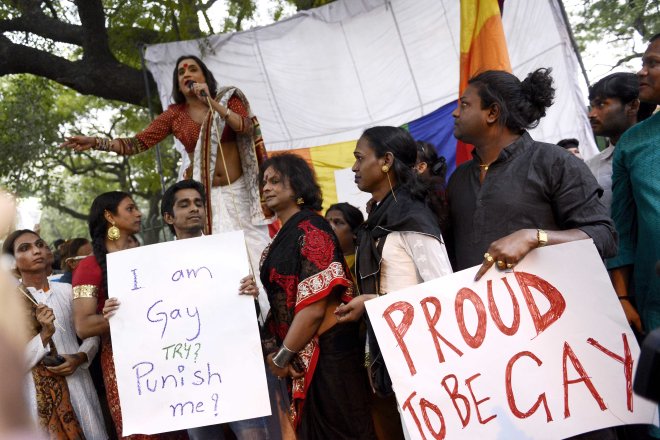
Gay rights activists take to streets in Delhi

Chanakya Sethi analyzes India’s shameful court decision re-criminalizing homosexuality:

The majority passes a law that the minority believes discriminates against it. The minority goes to court seeking relief from the majority. But because the minority group constitutes a “minuscule fraction of the country’s population,” the court will defer to the will of the legislature—that is, to the will of the majority. That, in short, is how the court wrapped itself in the flag of judicial restraint and overturned a lower court decision that had struck down the country’s sodomy laws as unconstitutional.

Kaushal v. Naz Foundation was supposed to be India’s Lawrence v. Texas, the U.S. Supreme Court’s path-breaking decision striking down state anti-sodomy laws. Instead Kaushal is already being described in the Indian press as the country’s Dred Scott or Plessy v. Ferguson: “moments of deep national shame, blots on the judicial record, examples par excellence of judges at their very worst,” as one op-ed put it.

Shivam Viz provides more details on the basis of the decision:

In the end, the court’s decision rested heavily on two dubious assertions. The first was that homosexuals in India were too small in number to constitute a “class,” and could therefore not be subject to discrimination. “What is a bisexual?” Justice Mukhopadhyay wondered aloud during one hearing; when he was given an answer, he stated with confidence that they too were not a “class.” Though it was shown that Section 377 has been used mainly to prosecute gay men, the court’s judgment maintained that the prohibition against “unnatural” sex could apply even to marital relations, and was therefore non-discriminatory.

The second main element of the court’s decision—which refers, not incidentally, to “the so-called rights of LGBT persons”—was an assertion of judicial restraint. The proper venue to debate this law, Justice Singhvi said during one hearing, is the Indian Parliament. There was not a little irony to these declamations, because the Indian Supreme Court is renowned for its judicial activism: in recent years, it has forcefully intervened in a great many legislative matters, and Justice Singhvi himself has been a vocal defender of such activism.

The final judgment makes it clear that the issue was not restraint per se, but the judges’ belief that the criminalization of homosexuality did not cause sufficient harm to justify any action from the court. The Parliament should feel free to strike the law down, they suggested, but the Supreme Court need not do so.

Nitin Rao discusses India’s view of individual rights :

We need to understand that India has always valued groups and “society” over the individual. For example, if somebody is playing music very loudly in a bus, it would likely be seen as an aggressive action to request that they wear earphones. In a country where 90 percent of marriages are arranged marriages, romantic relations are seen as a decision made by families, rather than individuals.

The horrific 2012 gang rape of a 23-year-old intern in Delhi highlighted how the concept of individual rights still has a long road ahead to acceptance. After the horrific public sexual assault, a national discussion erupted in the media in which womens’ groups had to explain that the victim is not to blame. Sadly, India’s great balkanization by religion and caste has created an environment where group rights take precedence over individual ones.

Likewise, LGBT rights are not seen as individual rights in India. Once again, the country is sadly choosing to treat life and liberty, not as being unalienable rights, but instead as matters to be judged based on clout, numbers, and “contribution to the community.”

(Photo: On December 11th, 2013, the LGBT community of New Delhi, India protests against the Supreme Court order making gay sex a punishable offense. By M Zhazo/India Today Group/Getty Images)


Fighting HIV Without Condoms, Ctd

A reader writes:

I’m a PhD student in virology at the University of Pennsylvania, and while I certainly don’t intend to (or need to) lecture you about HIV, your post contained a subtle inaccuracy of great importance. You wrote that “middle-class gay men can suppress the virus indefinitely with the cocktail.” It’s true of course that viral load can be suppressed and that life expectancies of HIV+ individuals on strict HAART regimens are close to, if not completely, normal, but that’s not the same as saying that anti-viral therapy will keep you healthy. HIV-associated neurological disorders (HANDs) are a significant problem among HIV+ individuals (up to 50% of cases in the US) and are only partially preventable and treatable by HAART. I’m sure you know people who suffer or have suffered from HAND, and I don’t want your blog to become a place where people go to learn that just because anti-retroviral therapy is highly effective, that there are no consequences of HIV infection as long as you have money and/or insurance. (I’m including links to some more papers on this topic: here, here, and here.)

Another asks:

Isn’t there a possibility that a HIV positive man might be reinfected with a new strain of virus and cause his current HIV drug regimen to fail? I thought there was always that risk.

Nope. Another quotes me:

“Bareback sex feels better for both partners.”

You’ve made similar statements before, in even less compromising terms. (“Infinitely better” I think?) And, well, you’re wrong. Maybe for some people, maybe even for most, but not all. I honestly have no preference either way, not even in terms of convenience. A condom adds a bit of hassle up front, but it saves my partner a whole lot of cleanup, so it seems like a draw there. Certainly no difference in sensation. I understand why barebacking would be fetishized – the subject is so wrapped in danger and mystery and taboo thoughts that of course some people will turn it into a kink. Humans are really good at turning things into kinks! But that doesn’t mean they can’t be used very happily by lots of people.

Another reader:

In addressing whether condom use should continue to be encouraged, you wrote, “The more important goal is for HIV-positive men to have sex mainly with other HIV-positive men, restricting the virus to a pool of the already infected.” When I met my husband in 2005 years ago, he had already been HIV positive for many years. I was (and still am) HIV negative. Sero-sorting is all very well and good in theory, and I’m sure that many people – like yourself – have successfully worked out their lives that way. In my case, I wasn’t going to let a virus cheat me out of an intelligent, funny, caring man.

Questioning Covert Conflict

Jeremy Scahill’s film and book project Dirty Wars: The World is a Battlefield examines US military policy abroad, with special attention to covert operations.  Last month, Stephen Moss reviewed the film:

The extent of the US military’s covert operations and the amount of “collateral damage” are shocking; the film shows that even US citizens have been the victims of non-judicial executions; and the argument that the war on terror is ultimately unwinnable because indiscriminate killings radicalise whole populations is persuasive. “Somehow, in front of our eyes, undeclared wars have been launched in countries across the globe; foreigners and citizens alike assassinated by presidential decree; the war on terror transformed into a self-fulfilling prophecy,” Scahill laments at the end of the film. “How does a war like this ever end, and what happens to us when we realise what was hidden in plain sight?”

Tom Gallagher elaborates on the book’s contents:

A book called Dirty Wars will naturally have no shortage of nasty stories.

One of the worst occurred on February 12, 2010, when US forces arrived in the Afghan village of Gardez, shot up a party celebrating the naming of the newborn son of an Afghan police officer and killed the father and six others, including two pregnant women. After a failed cover-up — during which family members reported seeing “U.S. soldiers digging the bullets out of the women’s bodies” in order to support a fabricated story that the women had been found already bound, gagged and executed when the Americans arrived — the U.S. military staged a very public meeting in which JSOC [Joint Special Operations Command] Commander Admiral William McRaven personally apologized for the atrocity to Hajii Sharabuddin, the head of the household. The story disappeared from the headlines and the war went on. Several months later, however, Scahill met with Sharabuddin who told him that “now we think the Americans themselves are terrorists.” You didn’t see that part on the nightly news.

Reviewing the film in June, Steven Boone expressed desensitization to some of what the camera captured:

We’ve been here before. Popular documentaries like Michael Moore’s “Fahrenheit 9/11” did their best to demonstrate that foreign kids suffering or perishing because of disastrous U.S. policy are “just like our kids.” Given the incessant, almost automatic dismissal of such murders of children in this country—by pundits, Congress members, White House press secretaries, American generals, soldiers, and average Joes and Janes—it’s hard to see any meaningful difference between the folks who danced in the streets when the towers fell and Americans who find collateral damage offensive only when the collateral is American. Casual dehumanization of foreigners has become the norm everywhere. It’s as if 9/11 rolled back the world clock a century.

Scahill, Rowley and co-writer David Riker (creator of the classic neo-neorealist indie “La Ciudad”) do their part to attack this backwardness at the root. Clear and graphic images of the piles of dead children a U.S. drone strike left in a Yemeni field say so much more than (to cite a quietly outrageous moment early on) a general smugly, idiotically speculating that a pregnant Afghan woman our soldiers gunned down might have been a combatant. (“I’ve been shot at by women.”)

A recent interview with Scahill is here.

The Place Race

We recently aired concerns that Google is acquiring a monopoly on mapmaking. Adam Fisher evaluates the “Wikipedia of mapping,” OpenStreetMaps (O.S.M.), as a “potential challenger to Google’s cartographic hegemony”:

Today, Google’s map includes the streets of every nation on earth, and Street View has so far collected imagery in a quarter of those countries. The total number of regular users: A billion people, or about half of the Internet-connected population worldwide. Google Maps underlies a million different websites, making its map A.P.I. among the most-used such interfaces on the Internet. At this point Google Maps is essentially what [Silicon Valley visionary] Tim O’Reilly predicted the map would become: part of the information infrastructure, a resource more complete and in many respects more accurate than what governments have. It’s better than MapQuest’s map, better than Microsoft’s, better than Apple’s.

“You don’t see anybody competing with Google on the level or quantity of their mapping today,” says [OpenStreetMaps founder Steve] Coast, who now works as a geographic-information professional. But, he adds, “that’s because it’s not entirely rational to build a map like Google has.” Google does not say how much it spends on its satellite imagery, its planes, its camera-equipped cars, but clearly it’s an enormous sum. O.S.M., by contrast, runs on less than $100,000 a year. Google’s spending is “unsustainable,” Coast argues, “because in the long run, this stuff is all going to be free.”

The O.S.M. map data is free now — but using it comes with a catch. Any improvement, or any change at all, that a developer makes to O.S.M.’s map must be sent back to O.S.M. It’s a clever tactic, forcing competitors of Google Maps to choose between fighting Google alone or joining a coalition that, if it prevails, will ensure that no private company will ever be able to establish a mapping monopoly.

Going Where The Winnable Seats Are, Ctd

Obama And Keyes Hold Final Debate For Illinois Senate Race

A reader disagrees with Kevin Mahnken:

With all due respect, our form of government is a “representative democracy,” meaning that those who run the government “represent” us.  I don’t believe you can represent the people if you do not know the people and you cannot know the people if you don’t live with those people. Our government was not set up to vote on various policies or ideologies, it was set up to “represent” the will of the people. There are too many people out there who just want to be professional politicians and don’t care about where they are, they just want the power of being elected.  This stinks and does a disservice to our form of government.

Another disagrees:

I was interested to read Mahnken’s belief that carpetbagging is a good thing.  The reality is, Clinton and now Scott Brown are examples of politicians moving into areas with similar character and make-up to a place they’re actually from.  In Hillary’s case, New York was a cosmopolitan place full of movers and shakers like DC had been for the previous 8 years, and Kennedy likewise was moving from one Eastern Seaboard state to another.  Brown seems to be going a little further, but he’s still in New England.  Not a radical departure.

Another:

I applaud Mahnken for defending, in principle, the idea of carpetbagging. I agree that sometimes the truly best person for the job may be the candidate who happens to be from somewhere else, geographically speaking. I think where the Scott Brown example is more problematic is that he isn’t just a candidate who happens to be from another place; he is a defeated candidate from another place. Many New Hampshire voters are probably more reluctant to vote for him because he was a failed candidate in Massachusetts, not simply because he’s from Massachusetts.

(Photo: Democratic candidate for U.S. Senate from Illinois Barack Obama and his Republican rival Alan Keyes prepare to debate on October 26, 2004. By Scott Olson/Getty Images. From Wikipedia: On August 8, 2004 – with 86 days to go before the general election – the Illinois Republican Party drafted Keyes to run against Obama for the U.S. Senate, after the Republican nominee, Jack Ryan, withdrew due to a sex scandal, and other potential draftees (most notably former Illinois governor Jim Edgar and former Chicago Bears coach Mike Ditka) declined to run. The Washington Post called Keyes a “carpetbagger”  since he “had never lived in Illinois.” When asked to answer charges of carpetbagging in the context of his earlier criticism of Hillary Clinton, he called her campaign “pure and planned selfish ambition”, but stated that in his case he felt a moral obligation to run after being asked to by the Illinois Republican Party. “You are doing what you believe to be required by your respect for God’s will, and I think that that’s what I’m doing in Illinois”.)

Prepping For Productivity

Steven Poole is skeptical about an ever-growing “cult of ‘productivity'”:

In the vanguard of “productivity” literature and apps was David Allen’s “Getting Things Done” (GTD) system, according to which you can become “a wizard of productivity” by organising your life into folders and to-do lists. The GTD movement quickly spread outside the confines of formal work and became a way to navigate the whole of existence: hence the popularity of websites such as Lifehacker that offer nerdy tips on rendering the messy business of everyday life more amenable to algorithmic improvement. If you can discover how best to organise the cables of your electronic equipment or “clean stubborn stains off your hands with shaving cream”, that, too, adds to your “productivity” – assuming that you will spend the time that is notionally saved on a sanctioned “task”, rather than flopping down exhausted on the sofa and waking groggily seven hours later from what you were sternly advised should have been a power nap of exactly 20 minutes. If you need such “downtime”, it must be rigorously scheduled.

The paradox of the autodidactic productivity industry of GTD, Lifehacker and the endless reviews of obscure mind-mapping or task-management apps is that it is all too easy to spend one’s time researching how to acquire the perfect set of productivity tools and strategies without ever actually settling down to do something. In this way, the obsessive dream of productivity becomes a perfectly effective defence against its own realisation. As Samuel Johnson once wrote: “Some are always in a state of preparation, occupied in previous measures, forming plans, accumulating materials and providing for the main affair. These are certainly under the secret power of idleness. Nothing is to be expected from the workman whose tools are for ever to be sought.”

Update from a few readers:

As someone who’s practiced GTD for about 15 years (and it is a practice that takes years to perfect), I can say that Steven Poole gets it wrong.

It’s not about doing more, scheduling every minute, calling everything “work.” It’s a pretty ingenious method of accounting for everything – stuff you’d normally put on a to-do list and stuff that you normally store somewhere in your brain – that you’ve committed yourself to so you can make wise decisions about what you value and how you want to spend your time. The result is often that you do get more done. But just as often you become free to not do anything because you can relax, knowing you haven’t spaced out on something important.

The big thing I’m wrestling with right now is looking at everything on my lists and making myself say “no” or “later” far more often. The system has really made it possible for me to take a good hard look at just how overcommitted I’ve let myself become.

Another:

You can’t post about productivity, GTD, etc without mentioning Merlin Mann.  He coined the popular term “inbox zero,” which the Dish has covered a bit, and wrote a very popular productivity blog, 43Folders, during the aughts, but has since stepped back from that venture to be highly critical of the “productivity porn” industry.  Merlin now does a popular weekly podcast at 5by5.tv/b2w, where he talks somewhat about GTD principles, but mainly focuses on how to help people actually do creative work, rather than talk about the tools for doing creative work, which can be a highly attractive sideshow.

Previous Dish on “inbox zero” here and here.