Tomasky encourages liberals to write the South off – and he starts off in Moore Award territory:
It’s lost. It’s gone. A different country. And maybe someday it really should be. I’ll save that for another column.
Until that day comes, the Democratic Party shouldn’t bother trying. If they get no votes from the region, they will in turn owe it nothing, and in time the South, which is the biggest welfare moocher in the world in terms of the largesse it gets from the more advanced and innovative states, will be on its own, which is what Southerners always say they want anyway.
Democrats are arguably doing their best in at least 20 years in three of the five most populous southern states.
President Obama won Florida two consecutive times. In 2008, Obama was the first Democratic presidential candidate to win in North Carolina since Jimmy Carter in 1976. Even as Obama lost the Tar Heel State in 2012, Democratic House candidates there won a majority of the vote. Not only was Obama the first Democrat to win Virginia since 1964, but the state has two Democratic senators for the first time since 1973, and Terry McAuliffe was the first gubernatorial candidate of either party to win the governorship when his party held the presidency since 1973.
So maybe people really mean Democrats are hopeless in the Deep South? That’s a bit harder to rebut. Then again, you’re also talking about just a handful of states.
Trying to shift the entire Democratic Party so its center of opinion is equal to that in South Carolina or Mississippi would be a bad idea. But accepting a diversity of candidates, with national Democrats willing to support centrists or mild conservatives in conservative states, is good politics that costs the rest of the party little. Those moderate candidates won’t be favorites to win in Alabama or Oklahoma in normal times. But they give the party a chance to capitalize when circumstances allow it.
And Cassidy finds evidence that the South is still in play:
[Demographer William] Frey notes flatly that “there has been a surge of new minorities to the South.” And he points out that it is combining with another monumental shift. The historic northward migration of African-Americans has now reversed course, turning into “a wholesale evacuation from the North—to largely prosperous southern locales,” such as the suburbs of Atlanta and Charlotte. According to Frey, this shift “encompasses all blacks, but it is most prominent among the young, the well-educated, and retirees. The greatest growth surges are occurring in economically prosperous areas of the South … and all signs point to a continuation of the trend.”
In brief, the longterm outlook doesn’t look hopeless for Democrats. By appealing to minorities new and old, plus Southern white liberals (yes, they still exist) and white moderates, particularly women, who feel alienated by the G.O.P., the Democratic Party can still put together a viable electoral coalition and, in years more favorable than 2014, hope to make some headway. Despite the recent shift toward the Republicans, the Democrats have demonstrated that they can succeed in places like Kentucky, which still has a Democratic governor, as well as in North Carolina and Florida.
The “cromnibus” spending bill currently making its way through the Congressional duodenum contains some discouraging news for the 70 percent of DC residents who voted to end prohibition in the capital last month:
The sweeping omnibus appropriations bill includes a provision that appears to prohibit the District of Columbia from spending any taxpayer funds to carry out marijuana legalization. It does not, however, affect a separate decriminalization measure passed by the City Council this spring, and leaves the city’s medical-marijuana infrastructure intact. The exact meaning of the language, which Republicans and Democrats appeared to be interpreting differently, will be more clear when the House and Senate Appropriations Committees issue full reports explaining the legislation’s implications.
House Republicans had been pushing for language in the bill that would have upended legalization, decriminalization, and medical marijuana. But negotiators whittled the language down to target only the most recently passed initiative, which has yet to be implemented. The omnibus spending bill must be passed by Dec. 12 to avoid a government shutdown, so even those opposed to the measure are unlikely to scuttle the bill’s passage because of the high stakes involved if the omnibus fails.
Still, there may be a loophole allowing the initiative to proceed:
The text of the bill says no funds “may be used to enact any law, rule, or regulation to legalize or otherwise reduce penalties associated” with recreational use of drugs illegal under federal law. “Some advocates I’ve spoken with aren’t so sure” the bill blocks legalization, Marijuana Majority chairman Tom Angell told The Huffington Post. “It all hinges on the definition of the word ‘enact.'” Angell explained that the question is whether Initiative 71, which voters approved in November legalizing recreational marijuana, should be considered “enacted” on Election Day, or whether “enacting” means the District Council transmitting the initiative to Congress for review, which has not yet occurred.
“I’ve heard good arguments on either side,” Angell said, “and I think it’s up in the air now, especially since press reports from earlier on Tuesday quoted unnamed congressional staffers as saying the bill would allow D.C. to move forward with legalization. Ultimately, it may take a court case to decide what ‘enact’ means.”
As a constitutional matter, the Congress can set policies for the District of Columbia, but this is an awful move. No vote on marijuana reform, just override the voter-approved measure by inserting language into a gigantic spending bill. Isn’t it interesting that such tactics never seem to be used to downsize the federal government and reduce its powers? Why not zero out the budget for the DEA or the Export-Import Bank?
“How’s that going to play politically?” Allahpundit asks:
Well, per last month’s exit polls, a majority of voters nationally favor legalizing marijuana — but that majority has dropped seven points, from 58 percent to 51 percent, since last year. Maybe the 2013 number is an outlier or maybe, as more states vote to legalize, voters think the shift is happening too fast. Only 31 percent of self-identified conservatives support legalization, so the GOP should be fine with its older, more right-wing base, even if that means irritating libertarians and younger adults. As for Washingtonians, they can still enjoy the drug publicly for now provided they can get their hands on it, which, if you’re unwilling to buy from a gang member, isn’t easy to do: If I’m not mistaken, the nearest state where sales are legal is Colorado, some 1,500 miles away.
Advocates are planning to march from the Justice Department to Capitol Hill tonight in protest. Not all of the news is bad, though: the bill also blocks the DoJ from meddling in states that have legalized medical marijuana. Phillip Smith notes the potential consequences of this provision:
If the omnibus budget bill is approved, the spending curb could well halt several pending federal criminal cases, including the case of the Kettle Falls Five, who are being prosecuted in Washington, a state where not only medical but recreational marijuana is legal, for growing medical marijuana within state guidelines. It would also severely cramp the style of the DEA, which has conducted hundreds of over-the-top aggressive raids in medical marijuana states. And it could mark an end to numerous civil asset forfeiture cases brought by US Attorneys in California against dispensaries in Berkeley, Oakland, San Francisco, and Orange County.
It’s also smart politics, unlike the baffling move to overturn the will of Capital residents. Chris Ingraham flags a new poll showing widespread public support for the federal government butting out of this issue and leaving it for the states to decide:
That’s one of the conclusions of a survey on marijuana legalization recently commissioned by Third Way, a centrist think tank. Similar to other recent polling, the survey found Americans split on the question of full legalization, with 50 percent supporting versus 47 percent opposed. But the poll found that six in ten respondents said that states, and not the federal government, should decide whether to legalize marijuana. And 67 percent of Americans said Congress should go further and specifically carve out an exemption to federal marijuana laws for states that legalize, so long as they have a strong regulatory system in place.
In short, there’s a lot of nuance here. “Even 21% of those opposed to legalization for recreational use still agreed Congress should pass” a waiver policy for the legalization states, according to the report. The waiver approach isn’t without precedent: Congress issues waivers to states all the time.
On Monday, the Justice Department issued updated guidelines (pdf) to federal law enforcement agencies on profiling – be it by race, nationality, gender, or sexuality. But advocates of reform aren’t quite cheering, because the guidelines aren’t binding on state or local police and include some pretty broad exceptions:
“It’s better than the Ashcroft guidance, but it doesn’t go far enough,” said the ACLU’s Laura Murphy, referring to the directives issued during the Bush administration in 2003 by Attorney General John Ashcroft. Murphy said in a phone interview she had been hopeful the Obama administration would go further in cracking down on profiling of Latino and Muslim travelers (among other groups) by the TSA at airports.
In making “routine or spontaneous law enforcement decisions,” federal authorities may not use profiling “to any degree,” except if they are given a specific suspect description. In all other activities, however, the guidelines say that federal authorities may use race and other characteristics as factors “only to the extent that there is trustworthy information, relevant to the locality or time frame, that links persons possessing a particular listed characteristic to an identified criminal incident, scheme, or organization, a threat to national or homeland security, a violation of federal immigration law, or an authorized intelligence activity.”
Federal agents enforcing immigration law are still allowed to profile “in the vicinity of the border”, though it’s not clear what that means, so the guidelines don’t really address one of the most controversial uses of racial profiling:
Border agents have come under intense scrutiny for testing the limits of its use of force tactics, including using the border search exemption of the Fourth Amendment to justify searches that have nothing to do with the border. A 2008 guidance document has allowed agents to search individuals at the border who carry in electronic devices such as laptops and cell phones without “reasonable suspicion of a crime or without getting a judge’s approval.” On more than one occasion, federal investigators used their border search authority as a means to investigate U.S. citizens to get around violating the Fourth Amendment.
The guidelines would likely have little effect in Arizona, where the anti-immigration state law colloquially known as the “show me your papers” law is still enforced. Immigration advocates have long charged that Arizona police officers disproportionately and indiscriminately pull over members of the Latino community. In October, a cop threatened to “kill” or “shoot” a Latino man pulled over for a traffic violation.
Ian Thompson is pleased that the DoJ added protections for gay and trans victims of profiling, but he’s disappointed that they don’t really have any teeth:
The largest national survey of transgender people to date found that 22 percent of respondents who have interacted with the police reported harassment by law enforcement due to bias, with substantially higher rates (29-38 percent) reported by respondents of color. As important as it is that this guidance is explicitly LGBTQ-inclusive, the failure on the part of the Justice Department to fully extend it to state and local law enforcement agencies, as recipients of vast amounts of federal funding, is a significant omission.
Jazz Shaw criticizes the guidelines, casting doubt on whether racial profiling exists in the first place:
This is one of those areas where common sense is overwhelmingly trumped by politics in both government and in the coverage of the subject in narrative journalism outlets. I’ve spoken to more than a few cops in New York on the topic (including a couple of relatives, just for full disclosure) and the message is pretty consistent. It’s not always a matter of race so much as location, but particularly in New York City the two are often impossible to split apart. But the short version of the police line of thinking on this is that you do the “hard policing” (as it has often been referred to on CNN) in the places where the crime is. And where is that?
It’s not surprising that John Yoo dismisses the Senate’s report and remains convinced that torture got us bin Laden:
The Feinstein report alleges that other sources had already provided the name of the courier independently. But the CIA’s rebuttal — signed by Obama’s appointee Director John Brennan — makes clear this information “was insufficient to distinguish him from many other Bin Laden associates until additional information from detainees put it into context and allowed CIA to better understand his true role and potential in the hunt for Bin Laden.”
The CIA is right. While it may have had the courier’s name, it had hundreds if not thousands of possible Al Qaeda agents in its files. Only the interrogations pinpointed his importance.
We are told, say, that a prisoner recognized a photograph of an important person that happened to be shown to him after the prisoner was tortured, and that helped the CIA put together a piece of a puzzle. To call THAT a success of the program is to imply that there was no reason to think that the prisoner would have provided the same information at the same time if he had not been tortured, and that the pre-torture rapport built by the interrogators and the captors remained intact. The CIA rebuttal goes out of its way to suggest that there is no way to know that what would have happened. An epistemological question is what one CIA officer put it.
But it should not have to be!
If the program is a success, there should be many examples where a detainee was presented with the same questions before and after “enhanced interrogation” and only provided the valuable, accurate intel after the fact. Here, absence of evidence is evidence of absence, precisely because we can say with near certainty that the detainees provided extremely valuable information before being tortured — information that, had these prisoners been truly trained to resist interrogation, they would not have easily gotten up.
Greenwald objects to the debate over torture’s effectiveness. But Drezner thinks it’s worthwhile:
The “very mushy middle” might have moral qualms about torture, but still think it’s justified in extreme circumstances. It’s possible they’ve come to this conclusion based on “24” and “Zero Dark Thirty” rather than any real policy debate. The point is, these are the people who need to be persuaded that even in extreme circumstances, torture is useless because it doesn’t work at extracting useful information. It is through developing a public consensus on this issue that a norm starts to take effect — and, hopefully, policy practitioners internalize that belief.
Torture is absolutely wrong and absolutely useless, and demonstrating the truth of both statements will make clear how completely bankrupt its defenders’ arguments really are. Proving that torture achieves nothing except the cruel degradation of human beings takes away the only argument its defenders have left. It would obviously be better if no one were willing to offer a defense for something as abhorrent as torture, but we know very well that quite a few people are prepared to do that so long as they can dress up what they’re defending in euphemisms and false claims about its efficacy. The point of insisting on torture’s uselessness is to strip away the remaining falsehoods that its defenders use to conceal the ugly reality of what they are defending.
Former CIA director Michael Hayden uses the DOJ not bringing charges against any interrogators as evidence of the CIA’s innocence:
John Durham, a special independent prosecutor, over a three-year period investigated every known CIA interaction with every CIA detainee. At the end of that the Obama administration declined any prosecution. [In 2012, the Justice Department announced that its investigation into two interrogation deaths that Durham concluded were suspicious out of the 101 he examined—those of Afghan detainee Gul Rahman and Iraqi detainee Manadel al-Jamadi—would be closed with no charges.] So if A is true how does B get to be true? If the CIA routinely did things they weren’t authorized to do, then why is there no follow-up? I have copies of the DOJ reports they’re using today. The question is, is the DoJ going to open any investigation and the DoJ answer is no. You can’t have it both ways. You can’t have all this supposed documentary evidence saying the agency mistreated these prisoners and then Barack Obama’s and Eric Holder’s Department of Justice saying no, you’ve got bupkis here.
This is evidence that Obama’s weakness and vacillation on the question of torture has done great damage. Hayden is using the Obama DOJ’s own white-washing report to minimize the war crimes in the Senate report. One of the ironies in this, of course, is that Hayden has been criticizing the Senate Report’s failure to interview the CIA torturers themselves, even though the Durham investigation legally precluded that for three years. But the Senate Report had an obvious alternative to such interviews: it had the CIA’s own internal documents, its very internal conversations, in which it is perfectly clear that as they were practicing torture, they knew what they were doing could not be described by anyone as “humane”. These documents alone are more than sufficient proof of the claims made in the report. They are definitive. More to the point, no documents were included from any other source – either to buttress or to contradict the findings. But in the Durham “investigation”, the torturers were interviewed but not the victims – a clearly rigged process designed to exculpate the war criminals.
There should, in my mind, be no debate about prosecutions for war crimes. Seriously, can you imagine the US opposing such prosecutions if they were in a foreign country? Besides, the US’ clear international and domestic legal obligations admit of no exception for the prosecution of those credibly accused of torture – let alone of those, like Cheney, who have openly bragged about it. It specifically bars any exception in the case of national emergency. Not to prosecute because of such an emergency is therefore to end the Geneva Conventions – which is what Obama has effectively done. He must not be let off the hook for that fateful step – and what it does to the core meaning of the United States.
From now on, the US is a human rights violator of the first order under international law, a rogue state that has explicitly tortured innocent people and never held anyone legally responsible. I know that sounds terribly harsh. But how is it untrue? And to refuse to prosecute war crimes is to condone war crimes. Not burglary or robbery – but the gravest crimes against humanity that we can imagine. The perpetrators walk among us, many still in the CIA, and some holding presidential Medals of Freedom. Whatever absurd self-congratulations about this report, we should be in no doubt that this makes us no better in this respect than some South American junta before the transition to democracy.
And the fact that we are the most powerful country on earth makes this about much more than just us. It casts a dark and long shadow over humanity. It makes torture everywhere more likely, and more pervasive. It legitimizes evil. It removes from us any moral standing when it comes to Americans being tortured by these very same techniques – as they already have been in Syria, and as they will be in the future. When an American prisoner is tortured by an enemy power in the future, we will have no grounds to complain. Can we just face up to that instead of engaging in so much avoidance and denial? We didn’t just break Iraq; we broke the very structure of basic human rights that this country fought two world wars to establish.
Eric Posner thinks it’s “plain that CIA agents who tortured detainees, and higher government officials who authorized torture (up to President Bush), violated the law.” But he argues that convictions would be nearly impossible:
[T]he CIA agents were told by government lawyers that the law permitted them to use waterboarding and other coercive techniques. And they were acting in the arena of national security, under conditions of great uncertainty about the extent of their powers. The Obama administration has used a legal doctrine called the state secrecy privilege to prevent victims of torture from using evidence of torture in civil actions against government officials. If secrecy concerns driven by national security justify constraints on civil actions, then they justify constraints on criminal actions as well.
David Luban agrees that the “cases would be nearly impossible to win and terrible to lose”:
The law requires proof that interrogators intended to inflict severe pain or suffering. But since the Justice Department’s discredited torture memos assured them that the suffering was not “severe,” it would be nearly impossible to prove that interrogators met the legal test of intent.
Attorney General Holder announced in 2012 that a special prosecutor who investigated 101 cases found that “the admissible evidence would not be sufficient” to convict beyond a reasonable doubt. Perhaps he felt that crucial evidence would have disclosed state secrets, or concluded that victim testimony by accused terrorists would never convince an American jury.
The greatest danger of jury trials would be a string of “patriotic acquittals” of defendants who would say they acted to save American lives, which would create terrible pro-torture precedents to haunt us for years.
That’s by far the best argument against doing so, along with much deeper partisan divisions and political polarization. I see the logic of it – but it is based on an acquiescence to and appeasement of evil.
It also means that countless torture victims – even completely innocent ones – are doubly assaulted: not only did these human beings endure unimaginable suffering, but they are now deemed beneath even a modicum of justice. This is why not prosecuting is such a grave decision. In what other context would we ever decide that an individual who tortured an innocent person to death should receive no legal consequences for it? I submit that it would be inconceivable. That such acts are protected if they are committed by those entrusted with all the might of government power and coercion makes this all the more chilling. By not prosecuting, we are creating an incentive for such awful things to be done again. We are empowering the Leviathan to torture prisoners in future knowing it can get away with anything.
Far from ensuring that these awful crimes never happen again, Obama has all but ensured that they will. That will be part of his legacy: the sounds of a torture victim crying in the dark, and knowing that America is fine with it. It is, in that sense, the end of America as much of the world has known it. As someone who has chosen this country because I revere it and love it so, it breaks my heart, and tears incessantly at my soul.
Lawyers for Gitmo detainees, especially for the recently released Abu Wa’el Dhiab, argue the method used for force-feeding hunger-strikers amounts to to torture. Given the apparent use of force-feeding as torture in the past, that claim should receive renewed attention.
Brian Merchant discovers that rectal feeding is “a century-old technique that rose to prominence during World War I”:
It was invented by an American surgeon named John Benjamin Murphy (the apparatus is called the Murphy Drip to this day), and was used to both deliver drugs and to keep patients hydrated when they lost use of their mouth.
Over the course of the century, as physicians became more skilled at administering intravenous therapy, the Murphy Drip fell out of regular use. In a 2010 article in the journal Emergency Nurse, the author notes that while rectal rehydration is still occasionally used in Chinese medicine to administer herbal remedies, “With the widespread use of intravenous infusions in contemporary emergency nursing, some might question whether there is a place for proctoclysis.”
Even if one accepts the highly dubious notion that anyone believed “rectal feedings” were a legitimate means of nourishing someone, there was no reason to consider such extreme measures in the first place. The rule of thumb in medicine is “if the guts works, use it,” meaning that it’s best to use the stomach to hydrate a patient if it’s functioning properly. There is no indication that these detainees couldn’t have had tubes inserted into their stomachs through their noses for the purposes of feeding them, assuming that respecting their right to refuse food had already been thrown out the window. For hydration, an IV would have been effective, as CIA medical officers conceded.
What those same medical officers acknowledge is that using the rectum to hydrate prisoners (which would, in contrast to feeding, at least work) was an effective means of behavior modification. These procedures weren’t undertaken because they were necessary. They were done to give a thin patina of ersatz legitimacy to what is otherwise flagrant sexual assault. The details differ but the intent is the same as in a high-profile case of police brutality.
A reader imagines the response to this news:
The phrase “rectal feeding”, which I for one have never heard before (has anyone?), is what will ensure the viral power of the Senate Committee report. Whatever it takes I guess.
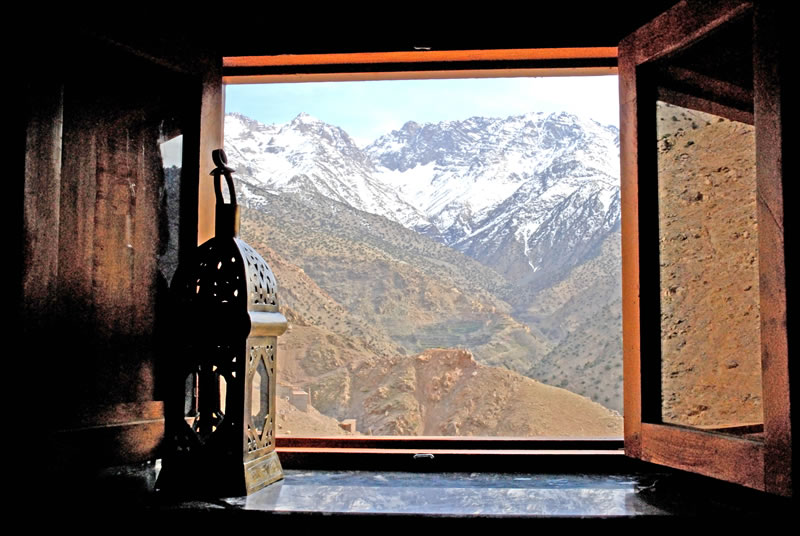
Based on the hinges of the window: Time Square Hilton. Room 420.
Or a remote island?
I’ve never been to Cape Verde, but this is definitely it.
A more qualified shot-in-the-dark:
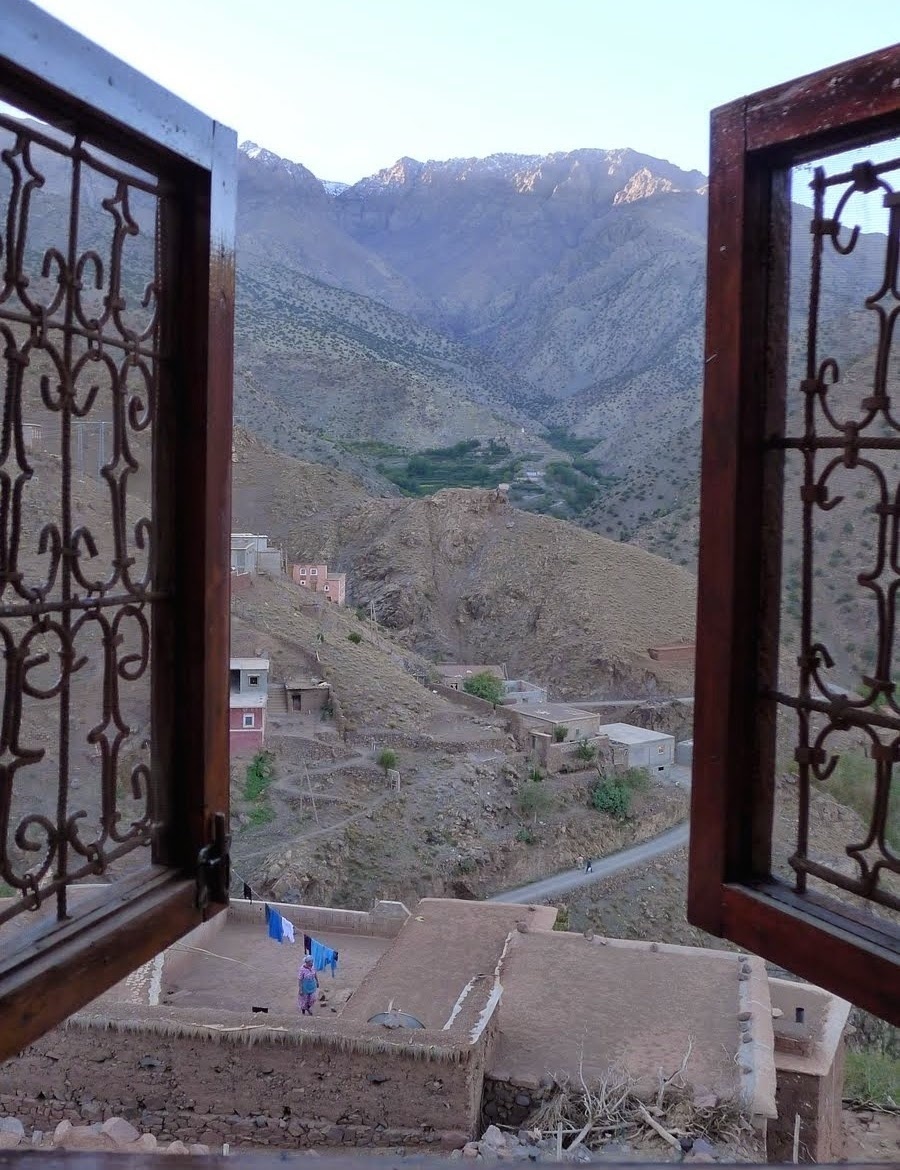
You’re like a cat with prey – one week you give me a window that practically shouts its location from the rooftops, then today you give us this. No signs, no cars, no recognizable buildings. What are the clues? Desert-y mountains, a woman on a roof, a satellite dish (maybe?), the grate on the shutters. I was going to guess the Elqui Valley in Chile, only because I’ve been there and the mountains look a lot like the ones in the photo. But Chile is too prosperous, I think, to still have mud buildings. So I’m going with Huarpa, Peru, because the landscape is similar.
Bastards.
Or somewhere in Asia?
Unfortunately, I suspect it’s actually nearby to Jalalabad, but the relative paucity of photos means that’s about as close as I’m going to get. The mountainside combined with the lack of trees and the mud brick construction puts it somewhere around the Himalayas. The mud brick construction plus the funky window bars puts it square in Afghanistan somewhere. (Pakistan and Tajikistan tend to more modern construction.) For a largish city, Jalabad looks like the closet match to an area which has water (from a river), and enough moisture to grow trees on the hillsides and allow mud brick construction, but otherwise so dry that the high parts of the hills are just rock and sand.
Kabul is likely too flat and probably has better construction. And there’s an FOB in Jalalabad …
Another from that country:
Just a guess, but this feels like the Panjshir Valley to me. The topography screams Afghanistan (as I’m sure many of your military readers will agree). Given the condition of the road and the absence of any concertina wire or security barriers, I would assume the image comes from a relatively peaceful province. Moreover, the fertile valley in the background looks like somewhere in the eastern part of the country. It could also be Kunar, but my gut says Panjshir.
Or India?
OK, high mountains, south flank of the Himalayas, that is a pretty wide area. Not Muslim, judging by the colorful clothing, so scratch Srinagar and points West in the Karakoram and Hindu Kush. Probably taken by a Westerner in a small guest house or such, more likely to be found on Lonely Planet than TripAdvisor, so maybe an intrepid traveler or and MSFer on R&R. Plenty of such types in Ladakh, so should be close. Road looks paved and there are hints of large electricity pylons, so could be on the road to a hydro dam. So without checking every hydro plant from Srinagar to Thimphu I will settle on Alchi, Jammu and Kashmir, India.
Another is sure it’s Yemen:
I suppose it’s unfair that I immediately recognized this the moment I saw it, since I lived there for several years in the 1960s. This looks like Taizz used to look, before it exploded as a city. Since I see no terraced gardens in this picture, I assume it’s from the northern part of the country, not too far from the capital Sanaa, where the Houthis reign. This poor country has been devastated by the US’s drone strikes, along with so many other things reign.
Another nails the right country as well as the mountain range:
I’ll eat my shoe if this isn’t the Central High Atlas region of Morocco, near/in the Toubkal National Park (Jebel Toubkal is the highest mountain in north Africa). From the valley vantage point looking up into the snow-capped peaks, I’m going to guess the Berber village of Ouirgane, with many lovely old riads where one can stay while hiking in the mountains. This could be a view from the Dar Tassa, but I wouldn’t stake my life on it. I spent several wonderful years as a Peace Corps volunteer in Morocco, though my site was in the more heartbreakingly desolate Anti-Atlas mountains seen here.
Guesses were all over the map this week:
This embed is invalid
And a surprising number of readers knew the right country right away:
When I saw the photo I instantly knew it was Morocco. I visited Marrakech almost 15 years ago and I still have fond memories of that lovely country. I was traveling solo and spent a few days traveling in the Atlas mountains in a Land Rover full of Belgian women. We had an amazing time, seeing several casbahs, Ait Ben Haddou and bouncing down the high Atlas road to Ouarzazate (still my favorite place name ever). I need a good couscous and tagine now!
Another:
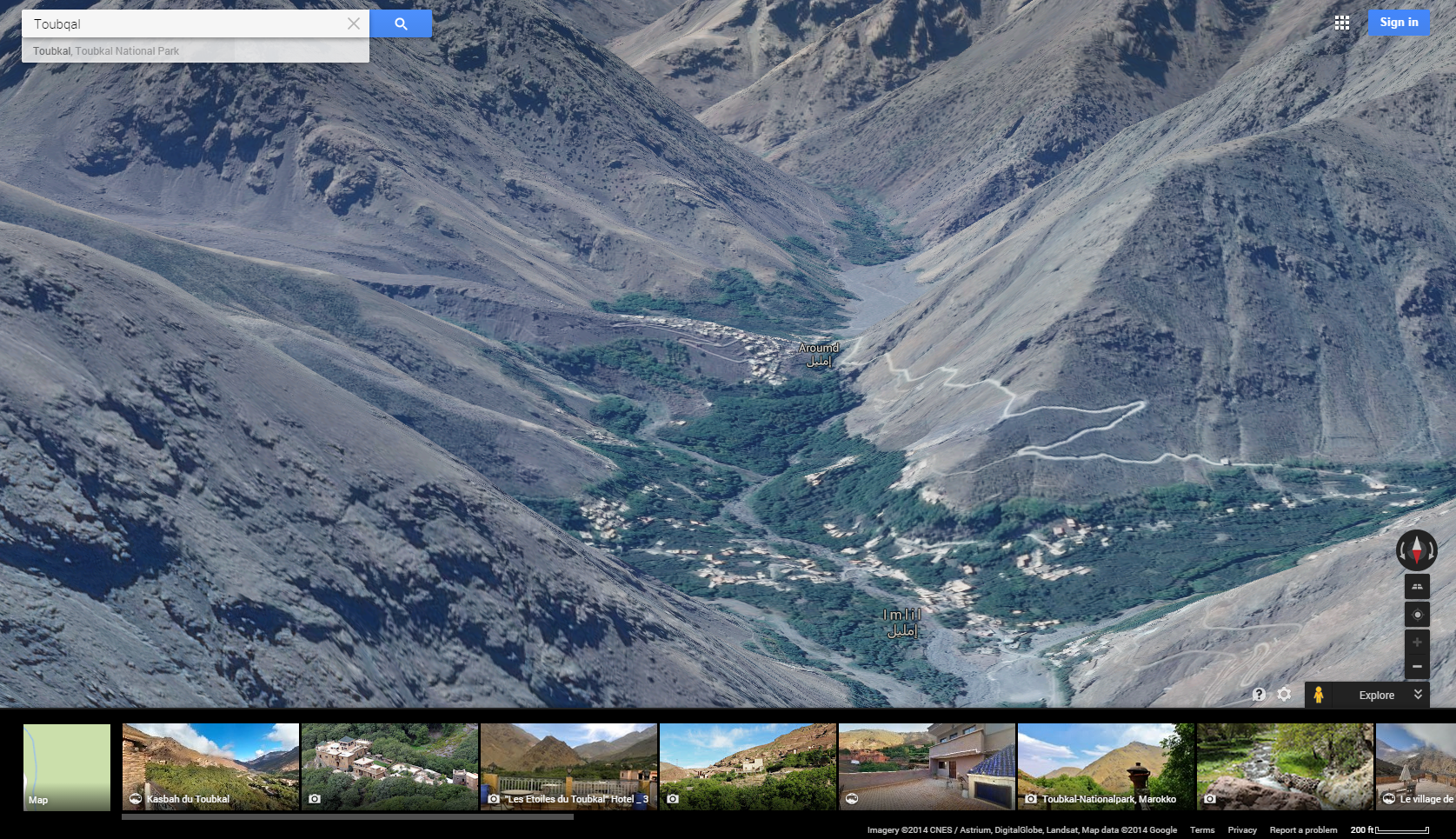
I was a Peace Corps volunteer in Morocco, and this looks like the High Atlas region of that country. I’d say the photo was taken near Mount Toubqal, the highest peak in Morocco. It looks like there is a small village between the window and the peak, and after poking around Google Maps for a little while, I’d say the photo was taken in Imlil, Morocco. I’m going to go one further and say that the patch of green in the foreground is Aroumd, Morocco. I’m not sure about this “Aroumd” place… In Google Maps, you will note that although the English says, “Aroumd,” the Arabic still says “Imlil.” Anyway, I’d say the best chance at capturing the view in the photo is on the West side of town, looking in the same direction as this Google Maps image:
I’ve been following your contest for a long time – too long to have any confidence of winning. Maybe I will at least make into your blog post as an “also-ran.” My parents would be so proud!
Another narrowed it down using a key clue:
The landscape screams one of four places – the Moroccan Atlas, the Zagros Mountains of western Iran, northern Yemen, or the Af-Pak borderlands. The seemingly unveiled woman is typical of the Berber people of the Atlas, so I’m going with Tafraoute, Morocco, a wonderful collection of villages south of Marrakesh. Where exactly amongst those villages this picture was taken, I have no idea – no doubt others will be more precise.
Bad luck found this guesser of Tacheddirt:
Sadists. You wait until I move house, to a diabolical cable modem that doesn’t work so I’m hopping around the attic trying to get 3G. That’s when you transport me to a place I think I know: hiking the wondrous trail to Tacheddirt, whose Wikitravel entry baldly states “The only way is by foot, no roads exist. The village isn’t very big anyway.” Whoever wrote that has no soul. Like me, moaning about modems instead of the disastrous floods that occasionally hit the High Atlas.
Well, I did find similar windows in the Gîte Iabassene further east of Tacheddirt (h/t salimr at summitpost.org) But instead of hurling my now-wheezing phone against the wall, I will leave it to your army of fenestrophiles to DNA the laundry on the nearby rooftop. Still, thanks for the memories of a magical place and the last time I had no internet for a week, though then it was willingly.
Incorrect guesses don’t get more specific than this one:
Aaack! One of those photos that you can probably only solve by having been there, but I’m taking a stab at it anyway.The window grill screams Morocco. The wide white window trim on the visible buildings plus the mud brick construction of the nearest building backs this up. The mountains, most likely the High Atlas chain. Currently very popular with the trekking set.
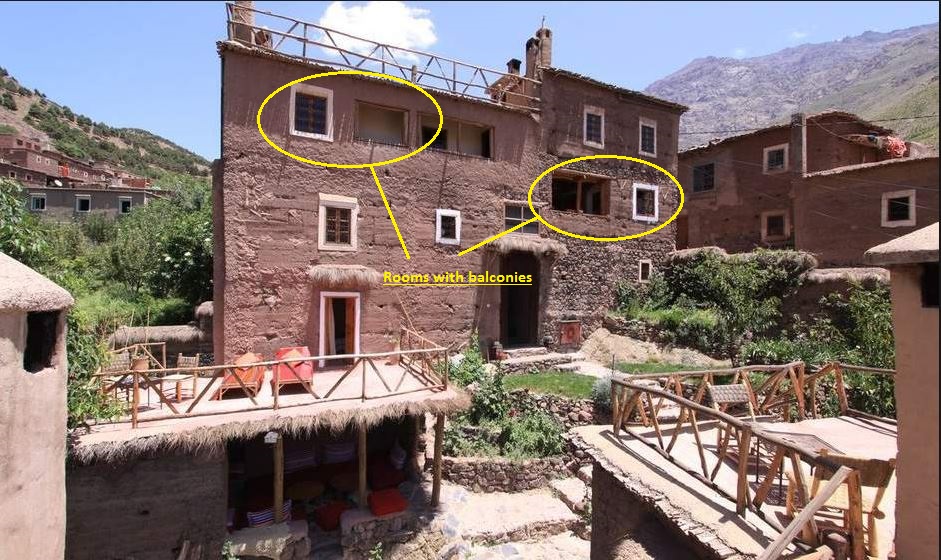
After a couple hours looking through the different hotel guest photos of the guesthouses and hotels in the valleys leading to the High Atlas from Marrakesh, I finally decided that this was taken from the Yan Room of the Douar Samra guesthouse. Why? Based entirely on the photo to the right, whose window grill matches the grill in the photo you posted. According to their website, this room is in the main house and has a balcony.
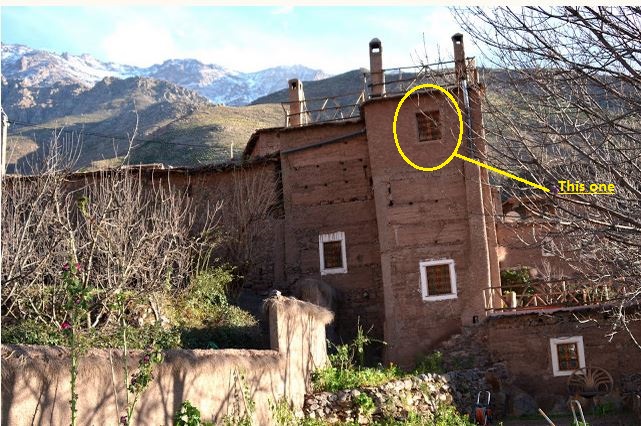
But it doesn’t seem to be taken from either of these, since the terraces below don’t show up, so it is probably taken from a side window. I’m guessing it is this window right here:
Looking forward to seeing how close (or far off) I was.
Not far at all. A former winner nails the village and lodge:
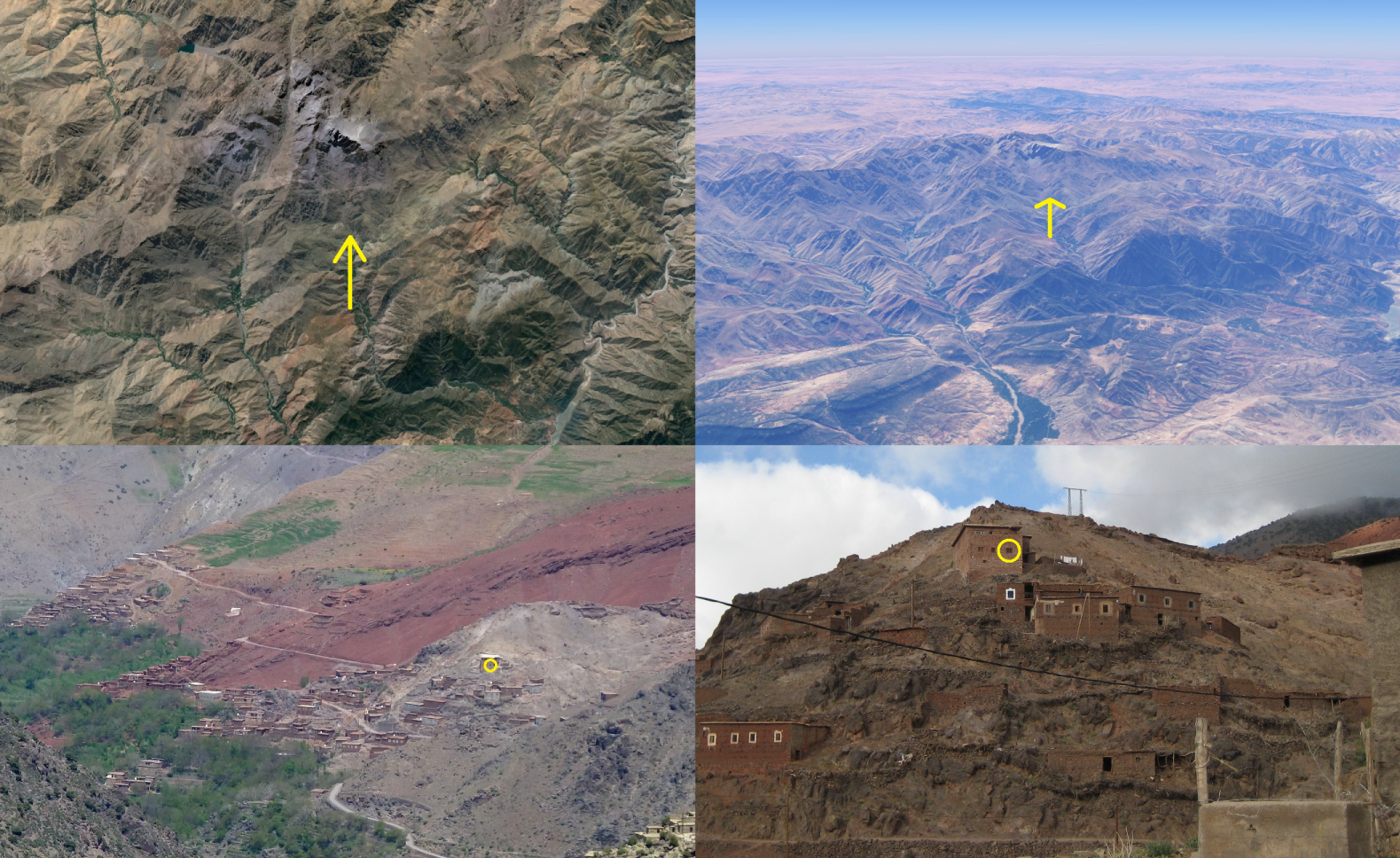
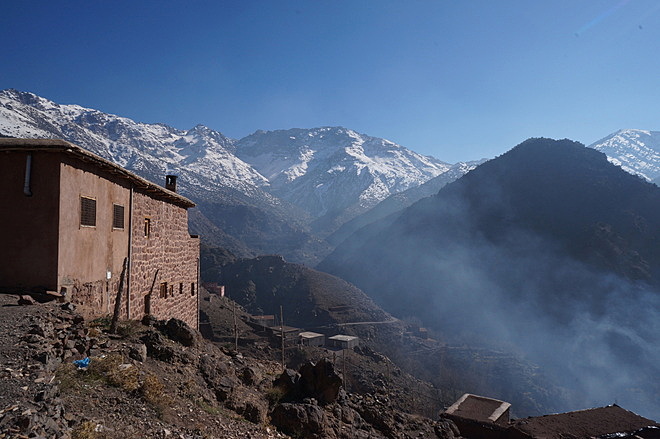
It looks rather tough, doesn’t it? But if you get a rough idea of where to look (a mountain region near the Sahara desert), and search for some distinctive feature (for me it was the peculiar power-line), it isn’t that hard to find, after all. This week’s picture was taken from the south side of the Azzaden Trekking Lodge, in the village of Aït Aïssa, Azzaden Valley, some 50 kilometers south of Marrakesh, Morocco. Here it is:
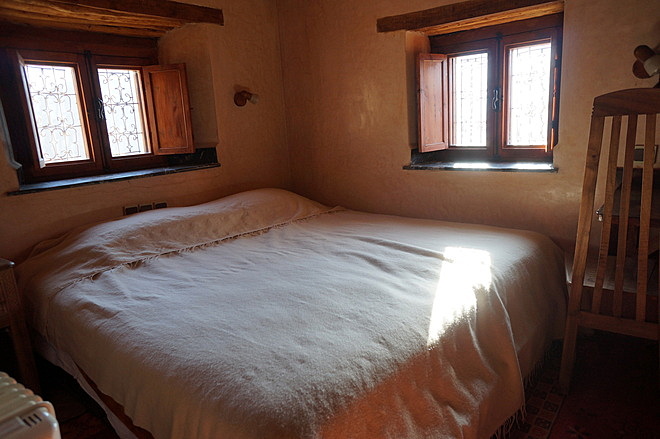
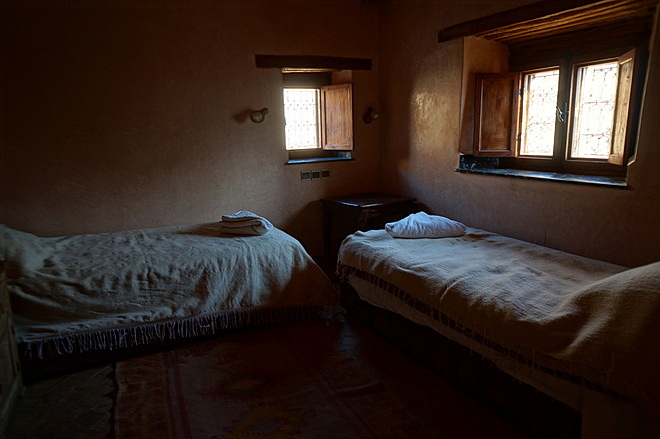
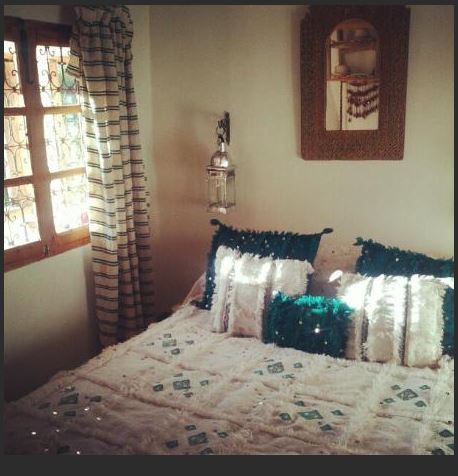
And here is the view from one of the rooms (maybe the same as this week’s picture?):
These more difficult contests really demonstrate how truly gifted some of our veterans have become. This one has been playing at Grand Champion level for a long time:
The contest view is from the southern façade of Azzaden Trekking Lodge (aka Toubkal Lodge) in the valley of Azzaden, Toubkal National Park, Morocco, and faces the Toubkal Massif of the Atlas Mountains. The lodge is affiliated with the Kasbah du Toubkal Hotel in Imili which is located in a neighboring valley and is more widely known. The scenery, villages, and wheat terraces of the area are ridiculously stunning.
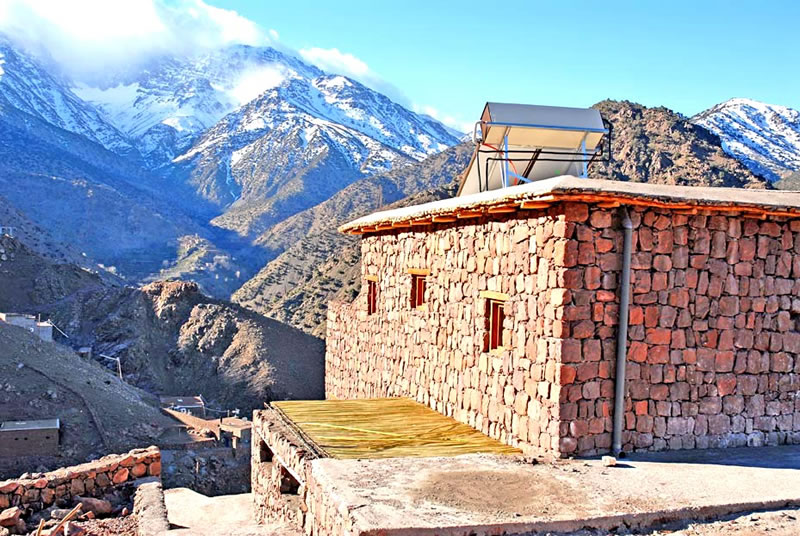
The construction and architecture of the earthen, stone, wooden, and grass house in the foreground of the contest view are fortunately quite distinct. Searches for earthen structures in Africa narrowed the possibilities to the higher altitude regions of Morocco and the northern Sahara and, from there, to the Toubkal National Park region. The prominent ridge outcrop in the contest window proved to be the clinching clue when I recognized it in an older photograph taken from the lodge’s terrace. Finding the lodge on Google Earth took longer given the scarcity of place names available for the area, but eventually the relative locations of the valleys, the mountain peaks, roads, and various structures fell into place.
I am guessing that the contest window is one of three windows on the first (lower) floor of the lodge because the view appears lower than those in photographs taken from the second-story terrace (which is most of them). I decided to go with the western-most of the three because it seemed the one most likely to capture the contest photograph’s view of the western side of sprawling house directly below the lodge.
This search was a treat. Thank you.
Another:
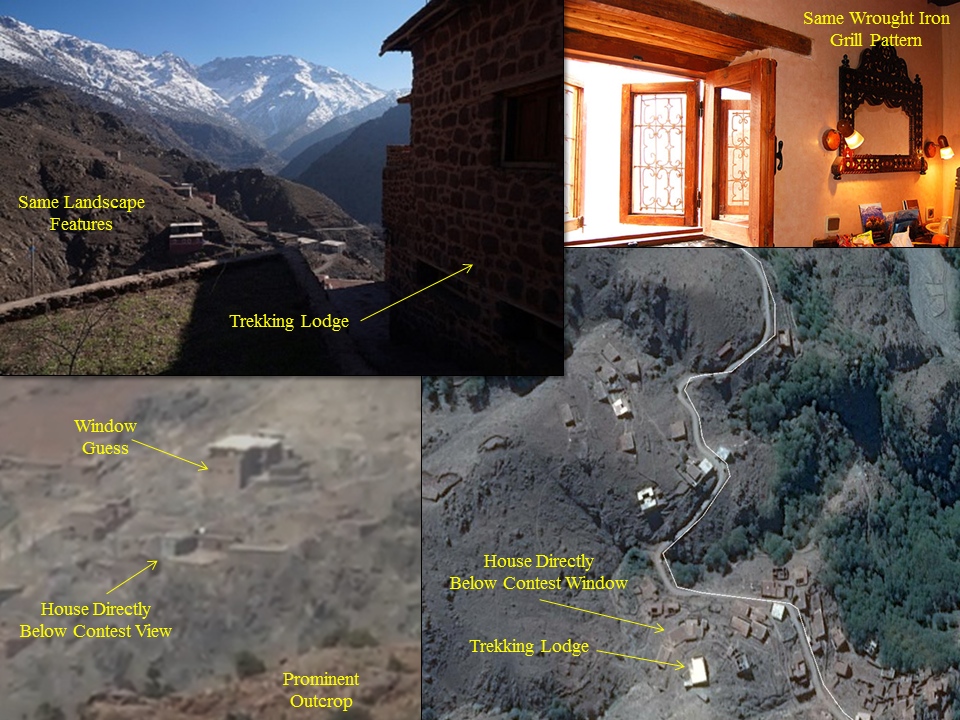
Great contest this week. The contest view comes comes from the Azzaden Trekking Lodge in the Azzaden Valley. The lodge is in the village of Aït Aïssa, Al Haouz Province, Morocco. No street address this week. Best guess on location is 31°08’02.3″N 7°58’28.7″W at 5950 ft in elevation. Jebel Toubkal, the highest peak in the Atlas Mountains, dominates the view out the window.
Online maps do not offer enough detail to determine the village’s name. The closest village they identify is Tizi Ouseem to the south of Aït Aïssa. A tour company offers this map that made it possible to discern the name by comparing the distances to, and following the valley paths from, Tizi Ouseem and Imlil.
With Aït Aïssa pinpointed, it was time to find the gite or lodge with the contest window. The distinctive metal work on the windows (example here), the angle of the view towards Jebel Toubkal and the road below each offered great clues leading to the Azzaden Trekking Lodge. Attached is a comparison of the overhead view with the contest picture.
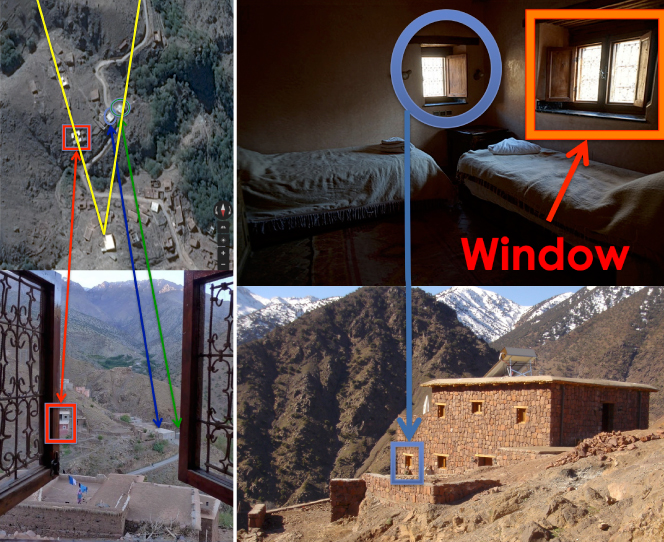
Once at the lodge, however, the exact window was hard to find. First, the window is on the south wall but I could only find exterior photos showing the east and north walls and the west wall. Second, the interior shots are difficult to make out and three sets of windows did not match. This window is too narrow and has the metalwork’s pattern on left and right panes reversed. This photograph shows almost the same view of the mountain but the window lacks metalwork. And these windows in the lodge’s southwest corner are also slightly off.
But this window looks just right. It is in the southeast corner below the top level terrace. Attached is a picture highlighting the contest window. It shows the room’s interior and where in the lodge it is based on a photo of the east wall:
Wow. Meanwhile, Chini tries to play coy:
I give up. I can’t find it. I’m resigned. Defeated. Shattered. I’ve looked everywhere, from one end of the internet to the other. Just when I thought I’d tracked an answer down, poof, it turns out to be something else. Think this image shows the building? No dice, Chini. That look like a good angle? Figured wrong, Butch. Sigh.
So I have to leave things where they are; I simply can’t find a good, close up image of the southern face of the Kasbah de Toubkal Trekking Lodge in Morocco’s Azzaden Valley where this week’s view was shot. The exact coordinates of 31° 8’2.47″N, 7°58’29.03″W in the village of Ait Aissa and these overhead and exterior views will have to suffice:
This week’s winners are a relatively new husband-and-wife team:
So my wife and I have come up with the location the past two weeks, and we were looking forward to this week’s View. And from the first moment I knew it just had to be Morocco, near the Atlas Mountains. So then I spent the next 3 or 4 hours looking at countless hotel websites, especially in and around Imlil. And then, finally, my wife found the shutters! At the Azzaden Trekking Lodge in the village of Aït Aïssa in the Azzaden Valle, a five or six hour trek from Imlil. The lodge is owned by – or associated with – the famous Kasbah du Toubkal in Imlil. The Lodge has three rooms, all of which appear to have similar shutters. I’ve decided that this room picture is the room with the View’s shutters:
Anyway, after four hours of searching – and as much as I enjoy it – it’s now way too late to continue this. Also, Obama is about to appear on the Colbert Report and I’m not going to miss that! So no more pretty pictures or Google maps with circles and arrows, But I did love this tour video of the trekking lodge:
Fantastic job. It was a honeymoon view:
As a frequent enjoyer of VFYW in contest and non-contest form, I thought I’d take a minute to submit this recent, especially fortunate view that I had from the Azzaden Trekking Lodge in the village of Ait Aissa, Morocco, in the Atlas Mountains near Mount Toubkal, the tallest mountain in North Africa. My wife and I spent our honeymoon in October travelling around Morocco, and we hiked from the town of Imlil, where many of the backpacking routes start and end, to Ait Aissa to get even more away from it all. We were there during the Feast of the Sacrifice, Eid al-Adha, where many people were back home for the holidays from Marrakesh and other cities and at night the sounds of singing and games echoed around the valley.
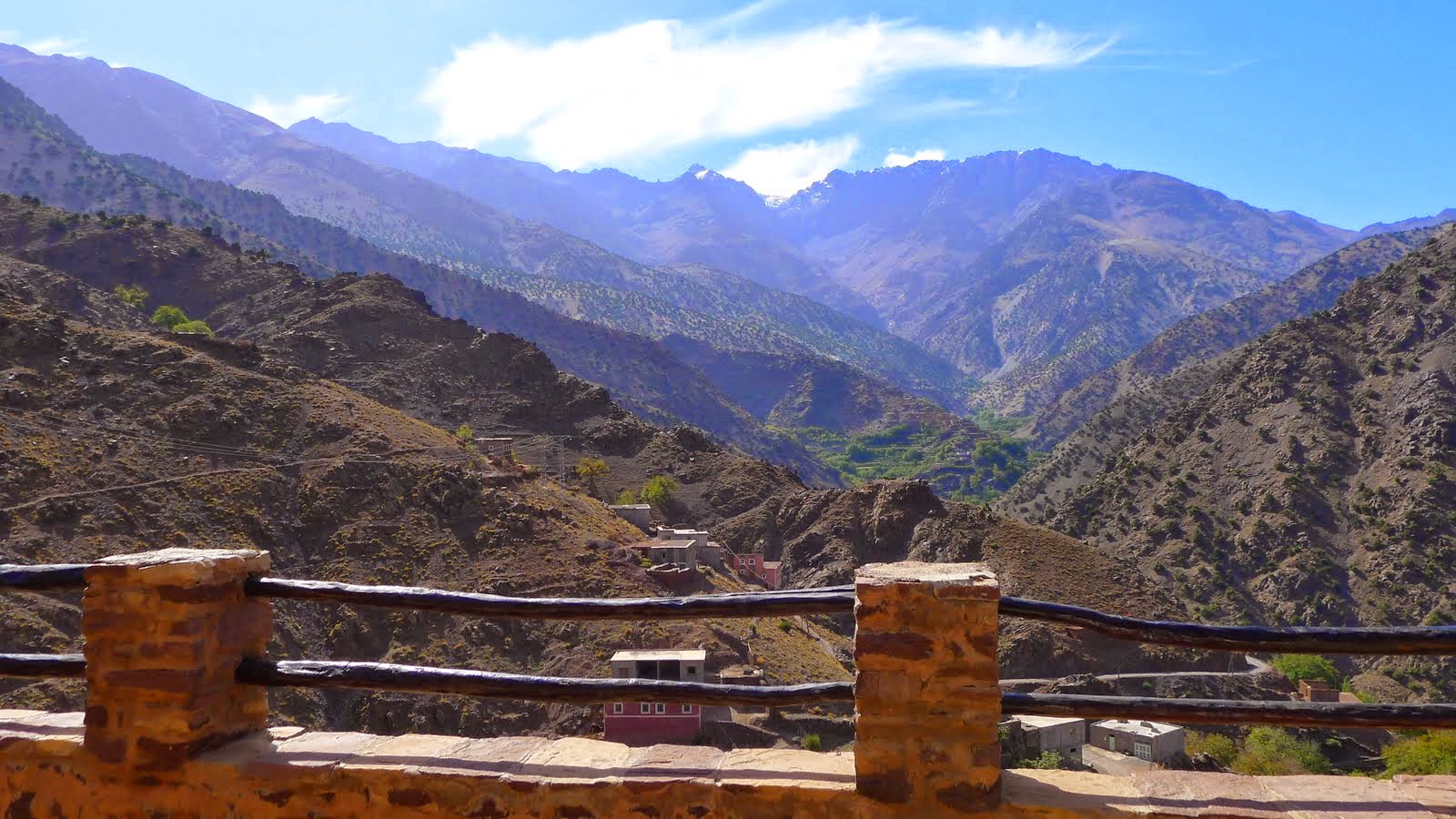
Here are a couple more shots, one from the terrace of the Azzaden lodge looking roughly in the same direction as the lodge, “up” the valley:
And another from the terrace looking across the valley to the village on the other side (sorry, don’t know the name of it):
Also, I would be remiss if I didn’t mention the friendliness and hospitality of all of the Berber people we came across during our stay in the Atlas mountains, in particular our trekking guide Ibrahim. His father and brother are also guides and so maybe someone reading the Dish will come across them one day! It was a real pleasure being there and I’d definitely recommend a visit.
For a Conde Nast Traveller write-up of the lodge, check out this PDF.
The spectacle of the president’s granting pardons to torturers still makes my stomach turn. But doing so may be the only way to ensure that the American government never tortures again. Pardons would make clear that crimes were committed; that the individuals who authorized and committed torture were indeed criminals; and that future architects and perpetrators of torture should beware. Prosecutions would be preferable, but pardons may be the only viable and lasting way to close the Pandora’s box of torture once and for all.
The logic is faulty; interrogators who use torture in the future will expect to be pardoned just like their predecessors.
Whether you call non-prosecution a “pardon” or not, it amounts to the same thing. But what is most odd is that a civil libertarian believes that the president should tar people as criminals without giving them the benefit of a trial. Romero, like the supporters of torture, do what people always do when Congress or the courts can’t, or won’t, do what they want. They turn to the president and demand executive action.
Jonathan Bernstein, on the other hand, advocates for pardons:
This step is critical to keep the issue from becoming partisan, with Democrats being against torture and Republicans allowing it. If torture is to remain banned, it’s going to take reviving the consensus of the elite against it that was broken in the Bush administration. Pardons take care of the legal jeopardy part for the officials; generous pardons might lessen their reputations as bad guys.
A final step has to be a truth and reconciliation commission to detail what happened and how counterproductive it was.
Julia Azari puts such pardons in historical context:
Like Ford’s pardon of Nixon, the act of pardoning would also acknowledge the wrongdoing, even while closing off the possibility of punishment. At the same time, it would depart from the logic that has informed many other politically visible pardons: while breaking from the past, it would acknowledge his opponent’s – not his own party’s – legitimate role in the polity despite serious transgressions. In the current political climate, that might actually be a radical move.
My core problem with this is that a pardon should only be given if the recipient has expressed remorse. Not only have Bush and Cheney and Tenet and Rumsfeld and Hayden expressed no remorse, they have aggressively defended their record, embraced the value of torture, lied about its effectiveness and refused even to acknowledge its appalling amateurism, gross miscarriages of justice and even deaths. There is no way such unrepentant war criminals can be pardoned against their will.
We have a rogue party in this country – a rogue party unlike any other in the West. There isn’t a single political party in the Western world that supports torture, except the GOP. There has never been a political party in American history that has openly supported torture. You cannot and must not appease this tendency. It is a deep threat to our democracy and to our way of life. By allowing the executive branch to do anything it wants, outside of any reasonable interpretation of the law, beyond any moral concerns, and to contract out torture sessions to amateurs is so egregious attack on the rule of law and the West that it cannot be tolerated, let alone pardoned.
Obama’s record in all this is a disgrace – a moral, political act of sustained cowardice and co-optation. It would be compounded by any attempt to formally pardon the guilty for crimes for which there is no statute of limitations and which place the US outside the norms of civilization. It would, moreover, destroy what’s left of the Geneva Conventions, turning their imperative for prosecuting war criminals into an actual pardoning of them. I’m ashamed of living in a country where this is even considered as an option.
Data shows that popular opinion on the use of torture by the U.S. government has subtly shifted since 2004, when Pew Research Center began polling Americans on the subject. Pew asked whether torture used against suspected terrorists to gain important information is justified, finding a majority of respondents (53 percent) said torture could never or only rarely be justified. But over the next five years, public opinion slowly reversed.
By November 2009, a slight majority of Americans said for the first time that torture could sometimes be justified. In Pew’s 2011 report — its most recent — 53 percent said the U.S. government’s use of torture against suspected terrorists to gain important information can often (19 percent) or sometimes (34 percent) be justified, marking a turnaround from 2004.
But Aaron Blake finds that not all polling is in agreement:
Pew in 2011 showed 24 percent of Americans said torture should “never” be used — little-changed from the 25 percent who said that same in 2009. But also in 2009, a Washington Post-ABC News poll showed Americans were actually about evenly split on torture, with 48 percent saying it could be used “in some cases” and 49 percent saying “never.”
The reason for the even split? Probably because people were given just two options rather than four. And so people who might otherwise say torture should “rarely” be used are temped to say “never,” because they really don’t like the idea of it. … So in sum, depending on how you ask the question, support for using torture in at least some cases — even rare ones — has polled at 70 percent-plus, around 50 percent, and also at just 38 percent.
First, thanks for the live blogging yesterday. It was exhausting to read and I’m sure much more so for those on the Dish team slogging through what is a very depressing report. Days like this make my subscription worth it.
Last night, Congress finally agreed on a spending bill to fund the government for the next year. Digging into the bill I found this on pg. 1353:
10 PROHIBITION ON THE USE OF TORTURE
11 Sec. 7066. (a) None of the funds made available in
12 this act may be used to support or justify the use of tor-
13 ture, cruel, or inhumane treatment by any official or con-
14 tract employee of the United States Government.
It is utterly depressing that we need to include this in a law dictating how taxpayer funds will be used, but as the torture report release makes clear, it is absolutely necessary.
Another is bewildered:
I’m trying to understand why Obama won’t own the report now, and why his administration has resisted its release. Did he want to keep all tools available to current and future executive administrations? Is his administration being held hostage by the CIA? Does he want to stand back and let Congress and the American people work through this without his entering the debate and unleashing Republican rage even more?
I think Obama is a great president and human being, so I am really trying to understand why he seems to be choosing the wrong side of history here. I hope there’s an explanation, but it’s an increasingly small hope.
Another has had enough:
I am disgusted after reading about how Obama is a shill of the CIA and refuses to follow through on transparency in government. He should give the Nobel Peace Prize back. He truly does not deserve it.
Another gives props to Obama’s former presidential rival:
Unfortunately, so far most of the response on the right has been how political the report is, and that it’s just Democrats being mad at losing the Senate (as if this report hadn’t been in the works for a long time), and how torturing people was OK, because, you know, terrorists! I am pleasantly surprised to find myself in agreement with John McCain, something that hasn’t happened in a long time. If he has credibility on anything, it is this, and at least thank god he is speaking up in defense of the report.
Will this cause problems for the US? Perhaps. But, when you’ve done something wrong (and this has all been so very wrong), it’s better to ‘fess up, take your licks, and try to move on. Burying this longer will not make it go away and undo damage that, IMHO, has already been done. Exposing this will allow us to move on, and hopefully, eventually, regain some moral high ground that we have sadly lost.
Another is more pessimistic:
I wish I had some insightful analysis that I could offer, but all I thought as I read of these atrocities was, “It won’t matter. It won’t matter. It won’t matter.”
The report won’t even cause a ripple in this country’s view of torture. If anything, it’s liable to strengthen the position that any and everything is justified, because look at what they did and continue to do to us. To feel outraged, you must view the torture in a vacuum, free of its associations with September 11. And I guarantee you that will NEVER happen. The apologists won’t let it happen, and certainly those who conducted and authorized it will never let it happen.
Add to that the political view that it was released by Democrats in their waning days of Senate power, on the day the Republicans had hoped to grab headlines by humiliating Gruber in front of Congress, and there you have it. The report is at once groundbreaking and astounding – and completely irrelevant if not outright damaging to its own intents and purposes.
I have a feeling we’re about to see, over the next few days (if the story even lasts that long, which in itself is telling), just how far we’ve fallen from our lofty heights. Osama bin Laden must be smiling from his watery grave.
More despair from a reader:
I never truly had my heart broken. Until today.
My father was born here in the States but grew up in Eastern Europe. He lived his childhood on the wrong side of the lines in World War II. The Nazis kicked him out of his bed and made him sleep in the barn with the animals. The Russians came in after the war and eventually turned his village into an artillery range.
He and his brother came back to the States as foreigners in their own land. He got a job, raised his brothers, found a girl and had a family of his own. He was a union man, a Democrat and a fierce anti-communist. He used to wear my brother and me out with stories of his childhood and coming back to America.
He would talk about the Nazis and the Partisans and the Russians. He was a young boy, so he was often insulated from what was happening around him, but not always. In his experience, the Nazis were terrible and the Russians were worse, but America was different. The stories often ended the same way. “What a country!” he’d say as we rolled our eyes and turned back to the TV.
I just can’t reconcile that his America is capable of such barbarism. To annex the tactics of the Nazis is inconceivable.
Perhaps if the masterminds had spent any time in an actual war zone instead of hiding behind a plum Air National Guard assignment or multiple college draft-deferrals. Perhaps then, they would have understood how gravely they betrayed the very America they claimed to defend.
It feels like the America my father loved so dearly died today. And I am heartbroken.
Another anguished reader zooms out:
I’m having trouble recalling a more depressing month. There’s something about the grand jury decision in Ferguson, the grand jury decision in Staten Island, and the release of the torture memo today that feel weighty – and for me, connected. Obviously the events in Ferguson and Staten Island have brought us to a critical moment, one that begs our attention to racial injustice, police brutality, the militarization of our police forces, and the profound inequities of our criminal justice system. There’s been – rightly – much ink spilled these issues in the last several weeks, and hopefully more in the weeks to come.
But with the release of the torture report, I can’t help but think (and hope) that we might be reaching an even broader convergence – one that shines light on the cost of American “security,” at home and abroad. The cost of the wars on drugs and terror – and the unchecked expansion of police powers that have come with – have wrought havoc on our budget, our laws, our moral credibility, our international standing, and of course the lives of people like Eric Garner, Mike Brown, and Gul Rahman.
I don’t have any hope that the incoming Republican Congress is going to do anything about it, of course. We will all be lucky if they don’t make it worse. But what a wasted opportunity for true conservative reform if they don’t. It’s time we shortened the leash, lest the dogs run away from us. Maybe they already have.



 The Dish