Languages The Internet Doesn’t Speak

Keating notes that the web will play a key role in determining which of the world’s languages survive:

It’s not news that we’re currently in a period of mass linguistic extinction. One of the world’s languages falls out of use about every two weeks, and about half of those remaining are in danger of extinction this century. But Andras Kornai of the Hungarian Academy of Sciences believes these numbers actually understate what’s happening by failing to account for the fact that very few of the world’s languages are developing any presence online. …

All in all, Kornai’s survey on languages online estimates that at most 5 percent of the world’s 7,000 active languages will be capable of ascending. It’s fair to wonder just how much of a tragedy this really is: While we’re losing some local identity, more people around the world are now able to communicate with one another than ever before. It is safe to say, however, that we’re at something of a key turning point in the history of culture.

Caitlin Dewey remarks on efforts to keep these languages alive:

Plenty of organizations, including Wikipedia and the Alliance for Linguistic Diversity, have devoted resources to that cause: The ALD has a massive crowd-sourced encyclopedia of endangered languages, complete with sample texts in tongues such as Nganasan (500 speakers, Russia) and Maxakali (802 speakers, Brazil). Wikipedia has an “incubator” to encourage projects in new languages (or very old ones). Kornai thinks the Wikipedia project has potential — in fact, he argues that endangered languages need a core of digital fanatics, like Wikipedia moderators or educational app developers, to survive.

But that isn’t enough to keep a fading language viable in the long term, particularly if there’s another, more dominant language that’s easier for people to use online. Even if you have a killer Cherokee wiki, for instance — which, it turns out, some people do — you’re not necessarily going to be able to Google or Facebook or tweet in that language.

Lazy Charity

Ken Stern urges us to do our homework and get smart about donations:

In 2010 Hope Consulting, a San Francisco–based consultancy, undertook one of the most comprehensive surveys ever of donor habits. It found that two-thirds of all donors report doing no research at all on their charitable contributions each year, and just 5 percent do two or more hours of research. On average, Americans spend about four times as long to research television purchases (four hours) and eight times as long researching computer purchases (eight hours) than they do with more expensive investments in charities (one hour). Indeed, some of the latest research suggests that Americans may subconsciously avoid finding out the facts in fear of undermining the “warm glow” they get from giving.

Instead of doing research, Americans give out of habit: Almost 80 percent of all gifts are labeled as “100 percent loyal,” meaning most people give to the same familiar brands year after year. Donations flow to alma maters, or to a friend’s charity, or to the charity that is easiest to give to through work. That’s a big reason why the list of America’s largest charities has remained remarkably inert over the last 40 years—because they’re rewarded for familiarity rather than any measure of effectiveness or innovation.

Among his advice:

Go for a high-impact donationThis might sound like it’s from the “No Kidding” Academy of Donor Advice. But in fact only a small subset of donors—representing 16 percent of all donors and 12 percent of all donations—define themselves as “high impact,” supporting the charities that create the most social good.  The rest fall into categories such as “Repayers,” who give to their alma maters, “Personal Ties,” for people who give to their friends’ organizations, or “Casual Givers,” who give to well-known nonprofits through payroll deductions or who buy a table at a charity event. All these reasons for giving are completely unrelated to rewarding the most effective charities. Until you think and act like a high-impact donors, you’ll get less than what you pay for.

Have We Given Up On The Syrian Rebels?

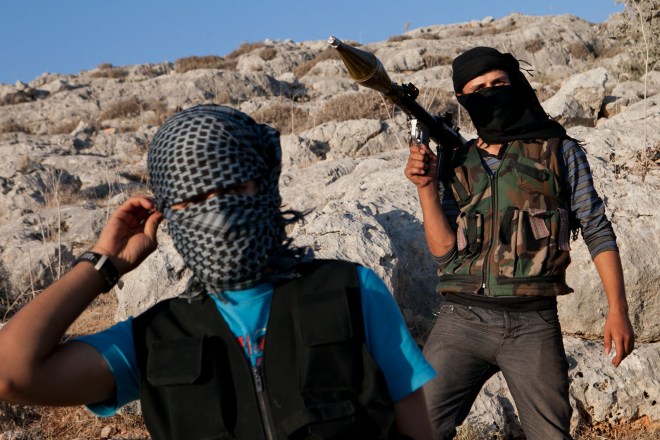
SYRIA-UNREST-IDLIB

The US and Britain have suspended aid to rebels in northern Syria after learning that the warehouses holding the supplies have been taken over by jihadists. With that in mind, Dan Murphy eulogizes Obama’s Syria policy:

That it was on life support has been clear for a long time. But with the routing of the US-backed Free Syrian Army (FSA) from its headquarters recently by Islamist rebel fighters, the plug should be pulled. The US can insist that its suspension of non-lethal aid (and a trickle of weapons) to the FSA via a group called the Supreme Military Council (SMC) is temporarily all it wants, but the momentum now belongs to Islamist rebels who are as hostile to US interests as they are to those of Bashar al-Assad. Meanwhile, Assad’s military has won a series of victories around Damascus and Syria’s second city, Aleppo, and its evolving alliance with the Lebanese Shiite military Hezbollah has strengthened both sides. …

What are the options going forward for a real US strategy in Syria – where the conflict continues to cast a shadow of destabilization over Lebanon, Iraq, Jordan, and to some extent Turkey?

None particularly obvious. Direct military involvement is so unlikely as to not worth being considered. A major outreach to the non-Al Qaeda Islamists, coupled with a major diplomatic effort to convince the Saudis to arm-twist their clients into compromise? Perhaps that’s a way forward – though it would mean the US is supporting a group that is pushing Sunni hegemony in Syria, a country with meaningful Christian, Shiite, and Alawite minorities. The US government’s mantra of support for democracy would seem to preclude that.

What else? No good options are left. In retrospect, the US might have held its nose and armed moderate rebels that could stand up to the Islamist armies. But the rebels friendly to US interests were never very obvious or well organized. The notion of a national level “Free Syrian Army” with meaningful command and control at anything beyond the local level has been mostly aspirational.

Bob Dreyfuss agrees:

It’s pretty much a complete and total collapse of the American efforts to back opposition to Assad, whose own forces have put together a string of military victories since the spring, retaking important strongholds and using aid from Russia, Iran and the Lebanese Shiite group, Hezbollah, to do so.

Tony Blinken, the top White House foreign policy official and former aide to Vice President Joe Biden, told a conference that the radicalization of the conflict and the strength of the Islamists might convince everyone involved from the outside to seek a peace accord. But a closer reading of Blinken’s comments seemed to indicate that he was suggesting that Russia would feel compelled to lessen its support for Assad because it fears that the Islamist rebels—who include a number of extremist Chechen fighters who’ll try to wreak havoc in Russia when they return. …

Fact is, the United States and Russia have a joint interest in suppressing and eliminating the Islamist rebels. And that’s it. One danger is that Saudi Arabia, which is apoplectic about the impending US-Iran accord and which is equally angry about the US-Russia diplomacy over Syria, may be pouring funds into the non–Al Qaeda Islamist radicals, such as the Islamist Front, just to give the United States a black eye. If so, Washington had better read the riot act to Riyadh.

Gayle Tzemach Lemmon faults Obama’s inconsistency for the disarray:

All along, President Obama’s hesitancy has called into question what, exactly, American policy is and was in Syria. In the summer of 2011, Obama said that the  “time has come for President Assad to step aside.” Yet, the actual policy of the U.S. in Syria has looked more like containment than regime change. Joint Chiefs Chairman Gen. Martin Dempsey this year publicly recommended using the military to keep the conflict from spreading outside of Syria, but not to intervene with direct military force. The administration’s decision this fall to abort military strikes in favor of negotiating a deal with Assad to destroy his chemical weapons stockpiles only furthered that impression.

“It is not at all clear what our objective is,” says Amb. Dennis Ross, who served as special advisor on Iran for Secretary of State Hillary Rodham Clinton. “Without an objective you can’t identify what are the appropriate means to mobilize. We don’t have any leverage.”

Ross sees our engagement in Syria evolving into a counterterrorism policy:

For his part, Ross says that the threat of foreign fighters plus the desire to avoid boots on the ground make counterterrorism an increasingly possible path. “We have been very reluctant to use force. CT means many different things, including training those forces we can support. It also means drones. We do that in Yemen against al-Qaeda. Are we headed toward that in Syria? Could be.”

But that again, Ross argued, raises the question of what exactly is America’s aim in Syria? Is it to keep the country together and fulfill the June 2012 Geneva Declaration’s goal of creating a “transitional governing body” that “would exercise full executive powers?” Or is it simply to protect the United States from the potential threat posed by extremist fighters energized by the battle to oust Assad? “CT is still a means, not an objective,” he said.

Update from a reader:

It just amazes me that we’re still seeing articles basically trying to figure out how exactly the US screwed up the whole Syria problem. Because that implies that we actually at some point had a real possibility at deciding how it would turn out. Why anybody would think that after the experiences of the past decade is just unfathomable to me. We waltzed into two different nearby countries and basically ran them for years, and we still couldn’t do much to dictate the conditions of those countries. If that sort of engagement doesn’t give us a real say about things, than why should we expect that a lighter intervention would be any more successful?

For various long-term and complicated reasons, the region is a giant political/sectarian/religious mess being fought over by a bunch of people who could not care less about the interests or desires of the US. Nothing we can do will change that. More decisiveness by Obama wouldn’t have changed that. Sure, we could go in and remove Assad if we really wanted, but even that wouldn’t give us much of a say on how the country ended up being run in the long term.

There were never any good options for the US here. There was no winning strategy waiting to be discovered. People just need to accept that things happen in the world that even the might US military can’t control.

Amen.

(Photo: Fighters loyal to the Free Syrian Army (FSA) pose with their weapons in a location on the outskirts of Idlib in northwestern Syria on June 18, 2012. By D. Leal Olivas/AFP/Getty Images)

Running Against Their Own Ideas

Chait watches as Republicans “turn from denouncing the health-care law for its lack of high-deductible insurance to denouncing the health-care law for its high-deductible insurance”:

Insurance plans with low premiums and high deductibles were a major centerpiece of conservative health-care thinking. Until quite recently, conservatives seemed to believe that Obamacare prevented such plans from existing, which was totally false. As they’ve come into existence, conservatives have transitioned seamlessly into denouncing these plans for their horrible, high deductibles.

Episodes like this one have grown so familiar that they’ve lost all capacity to surprise. Conservative health-care-policy ideas reside in an uncertain state of quasi-existence. You can describe the policies in the abstract, sometimes even in detail, but any attempt to reproduce them in physical form will cause such proposals to disappear instantly.

Drum piles on:

Republicans have spent years claiming that their preferred health care solution involves a combination of high-deductible health plans and tax-free HSAs. The idea is that your HDHP handles catastrophic illnesses, while the money you use for routine medical care isn’t taxed, which puts it on a par with employer health care. But their idea of “high deductible” has always been on the order of a few thousand dollars. A bronze plan under Obamacare typically has a deductible of $5,000 or more ($10,000 or more for a family). And while Obamacare doesn’t feature tax-free HSAs, it does feature annual premiums with much of the cost offset via tax credits. Conservatives will never admit this (and maybe not liberals either), but the end results aren’t really all that dissimilar.

Jonathan Cohn looks at where conservative and liberal health care policies diverge:

 “Giving consumers the choice of narrower physician networks and higher deductibles, in exchange for lower premiums, is a good thing,” [Avik] Roy says. “The problem with Obamacare is that people are trading narrower networks and higher deductibles for higher premiums. And that’s because of all the other stuff that Obamacare does to the insurance market.”

Precisely. The real difference between left and right now is the “other stuff” Obamacare does to the insurance market. And what’s that other stuff? It’s “guaranteed issue” and “community rating”—the requirements that insurers sell to anybody, regardless of pre-existing condition, with varying rates or benefits. It’s the creation of a minimum standard for coverage, so that all plans must cover at least 60 percent of the typical person’s medical bills and include a set of “essential health benefits” from hospitalization to mental health to rehabilitative services to maternity care. It’s the availability of generous tax credits, available to people with incomes as high as four times the poverty line and worth thousands of dollars a year in some cases. And it’s the individual mandate—the requirement that people pay a fine if they decline to get coverage when it is both available and affordable.

Ezra wonders what healthcare policies Republicans could possibly support:

One option was for Republicans to build as many of their ideas into the Affordable Care Act and force Democrats to take partial responsibility for these hideously unpopular, but fairly reasonable, ideas. They didn’t do that. Then Democrats picked some of the ideas up anyway. So Republicans again had a chance to focus their fire on the parts of the law they hated — like the Medicaid expansion — in the hopes of moving the health-care system in the direction they prefer. Instead, they’re aiming at the least popular policies in the law — which just so happen to also be the exactly policies that they support.

We’ll see whether Obamacare withstands the onslaught. But either way, once the assault is over, what kind of health policy will Republicans be left with? How can they propose anything that will cancel plans or raise deductibles or tighten networks? How can they propose anything at all?


The Reality Of Serious Weight Loss, Ctd

A reader writes:

I read with some consternation the reaction of one of your readers to the admonition by a physician that there is no “healthy obesity”.  It is worth pointing out that contrary to your reader’s unsupported assertion, clinical data does not support the idea that obesity in the absence of metabolic abnormalities (high blood pressure, high cholesterol, diabetes, etc.) is as safe as being normal weight.  Specifically, a recent systematic review and meta-analysis (that is, an analysis that looked to combine data from multiple independent studies) appeared in the Annals of Internal Medicine (here is the link to the abstract). The study combined eight studies that looked at 61,386 people in all and found that otherwise healthy obese individuals had about a 25% increased risk for death or cardiovascular events (heart attacks and strokes) compared to healthy normal weight individuals.  To quote the conclusion: ” Compared with metabolically healthy normal-weight individuals, obese persons are at increased risk for adverse long-term outcomes even in the absence of metabolic abnormalities, suggesting that there is no healthy pattern of increased weight.” [emphasis mine] Here‘s a NYT blog entry on the study.

I am very sympathetic to your reader’s assertion that eating healthily and exercising regularly doesn’t always result in weight loss, and the reader is certainly correct that doing those things will result in health independent of whether it affects weight loss.  I also cringed at the way the physician reader’s tone.  But he is also correct; all else being equal, an obese person is at increased risk for bad health outcomes.

Another reader is much more blunt:

That obesity is tied to many terrible and debilitating physical aliments is not merely opinion, and to point to the very few healthy exceptions to this norm is not an argument worth a damn.  And unfortunately, too few doctors even bother to make the recommendation to lose weight to their patients anymore, opting instead to prescribe drugs like statins or insulin, or surgical therapies, like gastric bypasses.  Why some overweight people think taking a palmful of drugs with potentially dangerous or even deadly side-effects or having part of their guts chopped out is more desirable than losing some weight through managing their eating habits and exercising regularly is mind-boggling.  Weight loss is not a complicated process, but it does mean the dieter cannot continue to eat like a spoiled child.  It means denying oneself everything one wants to eat, yes, okay, so suck it up or accept the fact that you are making a trade off: chose self-indulgent eating or health, mobility, and extended lifespan.

But I sigh because for anyone to claim obesity doesn’t matter or isn’t the health burden it actually is is ludicrous.  My own health has been greatly improved through weight maintenance and regular exercise.  I have been able to reverse my strong family history of heart disease – my father, who did not exercise or watch his weight, had a triple bypass by my age whereas my current risk of heart disease is rated extremely low.  Meanwhile, one of my siblings who disregarded proper weight management and regular exercise has also had a triple bypass. Sorry, but obesity and sloth make a huge negative impact on one’s health and anyone who argues otherwise is just nuts.

Another looks beyond health problems:

People who are obese may not have the issues that are often correlated with it, but there’s something to be said about the social impact and your ability to be mobile. I’ve lost 120lbs in about two years so far and I’ve seen both sides of this issue. The fact was, I was getting winded going up two flights of stairs. People wouldn’t sit next to me on the bus. Jokes were made at my expense. I could barely sit in seats and booths at restaurants. So if I didn’t have diabetes, heart disease, or high blood pressure, all of this would be okay?

After my weight loss I’m seeing doors open up to me. I’m getting solicited by men, and at my job I am getting more recognition for my hard work. They’re even talking about letting me travel; something they’ve never brought up to me before my weight loss.

Whether this is right or not is certainly a discussion, but at this moment it is the reality. Why artificially limit yourself in these ways because you want to convince yourself being obese is healthy somehow? It sounds like surrender.

Ask Rick Doblin Anything: What About Bad Trips?

In today’s video, Rick outlines the assorted dangers of psychedelic drug use:

In a followup video, Rick explains why he doesn’t think a history of mental illness should exclude someone from the potential benefits of psychedelic therapy:

Rick’s previous videos are here. From his bio:

Rick Doblin, Ph.D., is the founder and executive director of the Multidisciplinary Association for Psychedelic Studies (MAPS). He received his doctorate in Public Policy from Harvard’s Kennedy School of Government, where he wrote his dissertation on the regulation of the medical uses of psychedelics and marijuana and his Master’s thesis on a survey of oncologists about smoked marijuana vs. the oral THC pill in nausea control for cancer patients. His undergraduate thesis at New College of Florida was a 25-year follow-up to the classic Good Friday Experiment, which evaluated the potential of psychedelic drugs to catalyze religious experiences.

His professional goal is to help develop legal contexts for the beneficial uses of psychedelics and marijuana, primarily as prescription medicines but also for personal growth for otherwise healthy people, and eventually to become a legally licensed psychedelic therapist. He founded MAPS in 1986, and currently resides in Boston with his wife and three children.

Our extensive coverage of the spiritual and therapeutic benefits of psychedelics is here (or, in chronological order, here). Our full Ask Anything archive is here.

Saving Antibiotics For The Sick

Cow

The FDA wants to curb the use of antibiotics on livestock. The drugs are heavily used because they increase animal growth for reasons not fully understood. McArdle supports the move:

Antibiotic resistance is a growing problem that endangers many of the medical miracles we now take for granted. Antibiotics are effectively a scarce resource; we should be husbanding them to cure disease, not to make our steak 15 percent cheaper. That said, don’t think that this solves the problem. When I wrote a piece about antibiotic resistance for the Atlantic, I expected to get easy quotes from experts on the scurrilous waste of feeding penicillin to pigs. But none of the experts I talked to were willing to say that this was a huge part of the antibiotic-resistance problem. Most resistance isn’t evolving on farms, where very few of us spend any time; to be sure, we eat meat from those farms, but cooking should kill off most of the resistant bacteria. Most cases of antibiotic-resistant bacteria come from hospitals, people who have been in hospitals, or tuberculosis patients who stop taking their drugs as soon as they feel better.

Kent Sepkowitz makes related points:

Though admirable, the FDA’s action should not distract from the larger issue at hand: yes, we are giving too much antibiotic to pigs, but the real issue is that humans have been so piggish about prescribing and requesting and gobbling antibiotics—in hospitals and doctor’s offices and drive-through urgi-centers and through the mail. We are addicted as a nation not just to opiates but to antibiotics—and as with other addictions, sooner than later, the party always ends.

Maryn McKenna notes that the FDA’s announcement has no teeth:

This plan is not legislation, nor a regulation; it is entirely voluntary. (Hence the “shoulds” above rather than “musts.”) If you look at the Guidance document itself, it is prominently labeled “Contains Nonbinding Recommendations,” and also says: “This guidance … does not create or confer any rights for or on any person and does not operate to bind FDA or the public.” Companies have 90 days to signal to the FDA whether they agree to follow this plan. Could they defy the agency and continue to sell their products for growth promotion? Probably they could; but the FDA has promised to make transparent which companies sign up and don’t, apparently counting on public pressure to get companies to move.

Dina Fine Maron is pessimistic about compliance:

The bigger news today is that FDA also issued a proposed rule that would force animal producers to obtain veterinary oversight to use certain antibiotics. Essentially, farms would need a prescription to use these drugs in animal feed. It would be a step in the right direction – if it survives the comment period intact.

Tom Philpott weighs in:

[T]here’s little distinction between giving animals small daily doses of antibiotics to prevent disease and giving them small daily doses to make them put on weight. The industry can simply claim it’s using antibiotics “preventively,” continuing to reap the benefits of growth promotion and continue to generate resistant bacteria. That’s the loophole.

But the document released Wednesday delivers five pretty specific guidelines on how “prevention” should be defined, including that antibiotics prescribed preventively should be “targeted to animals at risk of developing a specific disease,” i.e., not given willy-nilly to “prevent” the theoretical possibility of some hypothetical disease. It adds: “FDA would not consider the administration of a drug to apparently healthy animals in the absence of any information that such animals were at risk of a specific disease to be judicious.” That’s the strongest statement I’ve seen from the FDA on the prevention loophole.

(Photo  by Jeroen Bennink)

Dreaming Of A White Santa

Responding to the on-air rant by Megyn Kelly insisting that both Santa Claus and Jesus Christ were “white men,” Aisha Harris points out that “Santa isn’t real”:

Zahra_-_St_NicholasSanta is loosely based on Saint Nicholas, a fourth-century Greek bishop known for secret gift-giving. But while the names “St. Nicholas” and “Santa Claus” are often used interchangeably, modern-day Santa hardly resembles his supposed inspiration, who was depicted as tall and thin and, you know, Greek. He did not have a workshop in the North Pole nor eight faithful reindeer. Santa as we know him today is the result of wild imaginations and creative input from many people across centuries, including, as I noted in my piece, Washington Irving and Clement Clark Moore. He’s utterly divorced from his religious and historical roots.

Alyssa provides more history:

Santa Claus is frequently depicted as a white guy today precisely because of what Kelly said we absolutely must not do: “revise it in the middle of the legacy of the story.”

As part of the long process of formalizing a celebration of the birth of Christ–which includes shifting the purported date of Jesus’ arrival in the world to midwinter to coopt pagan observances and then suppressing said observances–Saint Nicholas gets mashed up with other figures. These include Sinterklass, who may be a variation of the Norse god Odin, and who’s part of holiday observances in places as varied as the Netherlands and Greece. Father Christmas, the British character, has analogues in South America, most European countries, and the Caucuses. And this isn’t even including characters like Zwarte Piet, who’s part of Christmas folklore in Netherlands, Luxembourg and Belgium, who is, wait for it, of African origin.

In the United States, many people and organizations have contributed to our modern conception of Santa Claus’ physical appearance, including the the political cartoonist and muckracker Thomas Nast, the White Rock Beverage company which used him to sell mineral water, and Haddon Sundblom, who drew Santa Claus for Coca-Cola’s famous 1930s advertising campaign.

Poniewozik’s take:

Relying on the historical argument to prove or disprove whether Santa is white is essentially insane. Because, and I’m going to go out on a limb here, but I will argue that once you give the guy a workshop of magical elves, eight tiny flying reindeer, and the ability to distend his corpulent body down a billion chimneys in a night, historical verisimilitude no longer obtains. Santa–avert your eyes, kids–is a fictional character, and as such, can plausibly be represented and colored any damn way you want him. (Or her! Yeah, I said it.) To say that he “is just white” because that’s the way fictional pictures of him have mostly appeared is to say that your pictures and traditions are solely legitimate, authentic, the cultural default. (A message that seems aimed not so much at the kids as at an audience of adult viewers terrified of cultural change in Obama’s America.)

(Painting of Saint Nicholas via Wikimedia Commons)

Boehner Grows Some

Cillizza ponders Boehner’s dressing down of Tea Party PACs:

While many within the Republican establishment will applaud Boehner, McConnell and Ryan for their willingness to take on the tea party, the fight is not without potential negative consequences for them. While the tea party is not as popular — even among Republicans — as it once was, in low turnout GOP primaries it remains a force to be reckoned with. And, with seven of the 12 Republican incumbents in the Senate set to face a primary challenge from their right, there will ample opportunity for groups like the Club For Growth, Heritage, Americans for Prosperity and the Senate Conservatives Fund to prove that crossing them is a very bad idea.

Look to the May 20 primary fight between McConnell and businessman Matt Bevin and the June 3 race between Mississippi Sen. Thad Cochran and state Sen. Chris McDaniel to see whether the new confront-the-conservative-groups strategy can work.

Sargent’s perspective:

There are all kinds of reasons why this has happened. As Danny Vinink points out, Boehner now has incentives for refusing to bow to the Tea Party, from the fact that Paul Ryan is now on his side, to the need to prevent chaos governing from taking the focus off Obamacare. (Here’s a case where absolute GOP certainty that the health law will fail over time and shower the GOP with nonstop riches has produced positive results.) Meanwhile, Brian Beutler argues persuasively that, by refusing to budge in the last shutdown and forcing a GOP cave, Obama finally drove home to House Republicans the limits of what sabotage governing can accomplish, leaving Boehner with little choice but to tell the sabotage governing brigade to take a hike.

Allahpundit is somewhat surprised:

I did not expect that this lame budget deal would be Boehner’s red line for tea-party criticism. But maybe it had to be that way. If he’d slammed them in October, when Cruz and Lee had galvanized the base against the bete noire of O-Care, it might have cost him his gavel. The stakes are lower now — he proved he was willing to shut down the government for a conservative cause, everyone understands that any budget deal with Democrats will vary only in shades of badness, and enough people have tuned out of the news in December that there won’t be any grand revolt against him. If he wants to throw down the gauntlet to groups like the Club for Growth and FreedomWorks, now’s as good a time as any.

Weigel joins the conversation:

The only question is whether Boehner is running a wonderful distraction or whether this really does represent a move to make the Professional Right less relevant. The reason Paul Ryan had to flog this deal, and Boehner couldn’t, was that the right stopped respecting Boehner years ago. In the summer of 2011, in December 2012, when he tried to save his party some face and pass big spending bills without Democratic votes, a rump of his members refused to get him across the 217-vote line. Over time this emboldened more members, who philosophically agreed with the easily lampooned right-wingers, and Boehner was denied dozens of Republican votes on his measures.

First Read’s take on Boehner’s comments:

This is the aspect that frustrates so many non-Tea Party Republicans. They have the Democrats agreeing to the premise of “what should we cut,” not “what should we spend.” Sure, conservatives think Democrats aren’t as fervent about cutting spending as they are, duh! But the fact they have Democrats agreeing to look for spending cuts is a fundamental philosophical chance right now. The conservative movement just doesn’t know how to declare victory; it’s akin to caring more about the margin of victory in a football game than simply the victory itself.

Obama’s Betrayal On Torture

It is one thing not to prosecute war crimes – even though failure to do so violates the core of the Geneva Conventions. It is another not even to allow the public airing of what actually happened in America during the Bush-Cheney era, even though the findings have been reached exhaustively, at vast public expense and under bipartisan auspices. What on earth is Obama afraid of? That the CIA will revolt and refuse to do its job? That John Brennan’s friends will squirm uncomfortably in the face of their own complicity in barbarism? W. Paul Smith calls on the administration to release the damn report already:

This week marks the one-year anniversary of the Senate Select Committee on Intelligence’s adoption of a sweeping 6,300-page study detailing the CIA’s post-9/11 detention, rendition, torture and interrogation program. But the public has yet to see one word of it. That’s because, even though it deals with some of the most important and contentious issues this country has grappled with in recent years, the entire report remains classified.

Here’s what we do know about the report:

First, it is almost certainly the most exhaustive, detailed investigation of the CIA torture program to date. The committee spent more than three years researching the program, including reviewing six million pages of documents.

Second, according to senators who have seen it, the report includes a damning indictment and repudiation of the longstanding claims that torture and ill treatment led to accurate and actionable intelligence.

Conor chimes in:

[T]he Obama Administration, which promised voters that it would be the most transparent in history, has bowed to pressure from a faction within the CIA to keep secret the most thorough accounting we have of the agency’s lawless, immoral behavior during the Bush years. In doing so, Team Obama makes it less likely that we learn the lessons of CIA torture, and more likely that America tortures again one day.