How Anti-Christian Is Fox News?

It has been fascinating lately to watch Fox News go after the Pope for reiterating long-standing Catholic and Christian doctrine about the false god of materialism. By echoing Jesus’ insistence that you cannot know the kingdom of Heaven if you are bound up in wealth and possessions, the Pope drew charges of Marxism (which is anathema to Christians for the same reasons that unrestrained market capitalism is) and engaging in politics (from a channel that has long insisted that Christianity cannot and should not be relegated to the private sphere). Maybe it’s because they have not subjected their own views to anything passing as critical engagement for so long that they have forgotten that Christianity is deeply, profoundly opposed to any system of government that values human beings by the material wealth they create. The worship of money that you see in the incoherent rants of Stuart Varney or Larry Kudlow has no place whatever in Christian thought – and remains a daily assault upon it.

Now comes Megyn Kelly with a flat assertion that “Jesus was a white man, too.” Let’s go to the clip, which has now become famous in the world of Stewart and Colbert:

Now it’s clear this was an ad lib, not really thought through, so we should cut Kelly some slack. But she’s wrong on two levels – wrong because Jesus was not a Northern European white person, but a Middle Eastern Jew. And as a Middle Eastern Jew under the Roman empire, Jesus was at the bottom of the heap in the power-structure of his time. And that’s the point. The Messiah came from the lowest rung, not the highest. The comfort that white people feel when they are a majority in a democratic society is about as far away from Jesus’ experience of the world as it is possible to get.

She’s also wrong in even considering the color of Jesus’ skin – something unmentioned in the Gospels – as relevant. Of the great Pauline statements about Christianity, the following is among the most thrillingly liberating:

There is neither Jew nor Gentile, neither slave nor free, nor is there male and female, for you are all one in Christ Jesus.

The categories of race, of gender, and of social class are abolished in the Christian vision. This doesn’t mean they cease to exist as part of the world, for reasons of biology and social construction. But it does mean that Christians will never seek to underline these distinctions, to build a politics out of them, or to identify a nation according to them. Some on the left do this, as do some on the right. But Christians shouldn’t.

When you absorb the constant racial undertones on Fox, and its constant worship of the god of money, when you absorb their long list of fears about the “other”, whether immigrants or gays or the poor, when you recall their glee at the torture of human beings, or their passion for the death penalty, you can’t help but wonder if they are not one of the most powerful forces against Christianity in our culture. They have competitors out there, but Roger Ailes is never satisfied with being Number Two, is he?

Dissents Of The Day

A reader quotes me:

Let me place a bet with Friedman: Daley will never have a sexual relationship with a woman again, because his assertion that he still fancies girls is a classic bridging mechanism to ease the transition to his real sexual identity. I know this because I did it too.

Wow, Andrew, that’s strikingly arrogant of you. After all the conversations you’ve hosted on bisexuality, I’m amazed you would be so black-and-white and presumptuous about it. There’s no call to be so instantly dismissive of others’ own declarations of their sexual preferences. If and when Daley admits he’s in it for the cock only, then you can trumpet your own theories about bridges and men’s simpler sexuality.

Let me rephrase my bet with Friedman. Check in in ten years’ time. As for airing discussions in which male bisexuality is regarded as widespread as female bisexuality, of course we air such threads. Part of the point of this blog is to push back against my own views with those of readers and other writers, studies and stories and the irreplaceable role of human narrative. But it doesn’t mean I am totally persuaded. I absolutely believe in male bisexuality, its integrity as an identity, its total validity as a sexual orientation. I just believe it’s much less common than female bisexuality, for reasons to do with nature, rather than nurture. I know this enrages some liberals, just as other views of mine enrage conservatives. I didn’t mean to constrain Tom Daley’s future life in any way, and perhaps I was too glib in writing what I wrote. But it remains what I think. Another reader:

“I know this because I did it too.” That’s precisely the problem, Andrew. What you think of as a point of argumentative strength is actually analytical weakness. You’re extrapolating from your own experience, with no actual ability to live Tom Daley’s experience. Now I think that is a very natural response, as you came of age in a time when homosexuality was something to be ashamed of. The pain and frustration of that, I’m sure, colors your perception of any man who claims to have sexual attraction to both sexes. I have no doubt there have been many men who have claimed to be bisexual out of a desire to avoid the stigma of being gay. But insisting that any individual must necessarily be an example of that is a cruel thing – even if you turn out to be right.

I don’t think my overall response to Tom Daley could be fairly called cruel. Another:

You snappily respond to Ann Friedman: “Not much evidence of fluid sexuality among men there, is there?” Hmmm, why would that be?  After all, it’s not as if there’s any real COST to men admitting to fluid sexuality, is there?

And another:

Let me say first off that I appreciate the amount of coverage you’re giving to bisexuality, and that I’ve really enjoyed reading the “What’s A Bisexual Anyway?” thread. I know you get this a lot, but your willingness to have an ongoing discussion about a subject like bisexuality is why I’m a subscriber. But your latest post on Daley made me see red! In response, I’d like to quote from the chapter on bisexuality in Dan Savage’s most recent book, American Savage.

Savage has long been accused of biphobia because of his past statements that male bisexuality doesn’t exist, a belief he admits was based on a now-discredited study. (Discredited, I should add, by the same researcher who led the initial study). In a chapter called “Mistakes Were Made,” Savage makes the point that yes, “many gay men briefly identify as bisexual during their coming-out processes” but that “bisexuality is not a phase for bisexuals” (emphasis in original):

I can see now why this is all so enormously frustrating for bisexual men. Many gay men think all bisexual guys are lying because a lot of men who claim to be bisexual are lying. But it’s not bisexual guys who lie about being bisexual. It’s gay men like me … who lie about being bi. And what do we do after we stop lying about being bi? We insist that all bisexual guys are liars because we were liars.

I know you’re not accusing Daley of lying; I’m sure you think that he genuinely believes that he still fancies girls. But if you add “to themselves” to “lying,” the point still stands.

By the way, the reason that new study got different results? They made the participation criteria more stringent by restricting the sample only to men who actually exhibited bisexual behavior, i.e. excluding gay men, like you and Dan Savage, who were in a “transitional” phase.

Lastly, I’d like to add my perspective as an out bisexual woman in the LGBT community: I’ve encountered so much prejudice and disbelief surrounding bisexuality that I’m not surprised when bisexuals who are actually in same-sex relationships don’t feel safe identifying as bi, and prefer to allow everyone to assume they’re gay. Although this contributes to our invisibility, for some it might seem a better option than being rejected by the very community that is supposed to support us, especially if you’ve already been rejected by your family and straight friends. Also, I think this situation is probably worse for bisexual men, because while bi women may be accused of “experimenting,” bi men are actually accused of being cowards or liars.

By the way, Dan discussed that study and bisexuality in general for one of our Ask Anything videos. Another reader:

I love you, Andrew, but: bullshit. Daley is in love with this man, and there is a chance – a small chance, but a chance nonetheless – that he will spend the rest of his life with him. If that happens, and he does not ever have sex with another woman, and he still says he is bi, he is still bi. Likewise if he just never meets another woman he wants to have sex with before he finds the right person (who happens to be a man) to settle down with, which is also possible. Likewise if he is sexually bi but romantically oriented towards men and doesn’t enjoy casual sex outside of a committed relationship.

I could keep going, but my point is this: sexual orientation is not defined by behavior. There are straight men who have the occasional homosexual or even homoromantic experience. Those men aren’t straight, but they aren’t gay either. There are gay men who remain closeted their whole lives and sleep with and even marry women. Those men are still gay. There are straight and gay and bi men who remain celibate for whatever reasons. They are still who they are.

One more:

I’m a 37-year-old man, and in the past year, I’ve come out to many family members and friends as bisexual. I started incorporating men into my fantasies when I was 12 or 13, and they’ve been present there ever since. And sometimes, indeed, I feel such a strong desire for sex with another man that I do wonder if I’m just fooling myself; I’ve certainly still got some latent shame and self-directed homophobia. But other times, the urge to be with a man recedes considerably.

On the other hand, I almost always want to have sex with women, and my fantasies usually specifically focus on me going down on them. My sense is that eating pussy is about the least gay thing I could be jerking off about.

Of course, that’s just me. What’s more interesting to me is that in the past couple months, I’ve had conversations with two different guys around my age who are openly gay. Both expressed interest in having sex with a woman, especially as part of a three-way with another guy. One said most of the porn he watches is of straight sex. These are not men who are figuring out their orientation; these are guys who’ve been dating and in relationships consistently with other men for years. So their sexuality seems kinda surprisingly fluid to me.

I’m betting against your confident prediction. I think homophobia has done a far more pervasive and pernicious job of repressing a lot of men’s desires than even you give it credit for. In fact, I think that because male sexuality is, as you put it, “much cruder, simpler and more binary,” we could see a small explosion in the popularity of same-sex hookups among men in the not-that-far-out future. Not all men, of course. But dudes wanna get off, and as it increasingly becomes OK for them to get each other off, I think they’ll take advantage of that.

Finally, I’d be interested in seeing whether women’s reported reactions to man-on-man sex have changed at all. Whereas twenty years ago it seemed like women had no interest in such a thing, I’ve met a number of them lately with “watch two dudes getting it on” on their sexual bucket list. And I think for a lot of bi or curious guys, that sort of “permission” is also a big deal.

I’ll be as fascinated as my reader in seeing how things shake out. Or don’t.

Would You Like Some Shame With That?

Joshua Gans cites research supporting the idea that ordering food on the Internet increases sales by reducing customers’ embarrassment:

A group of four management professors—Avi Goldfarb, Ryan McDevitt, Sampsa Samila, and Brian Silverman—has undertaken a project to measure the effects of social embarrassment in retailing. In a paper—which they weren’t too embarrassed to subtitle “An Embarrassment of Niches?”—they examined situations in which a shift in retail practice reduced human interaction and observed consequent changes in purchasing behavior. Their findings are surprising: Even in situations where the potential for social embarrassment would appear to be low, fear of embarrassment led consumers to sublimate their true desires, whether for a rarefied French wine or a pizza with extra bacon. The first case the authors document was a late 1980s change in Swedish liquor retailing that led to stores being moved from an “ask a clerk to retrieve a bottle” model to a “self-service” format. It turned out that, not only did removing a layer of human interaction spike sales (by 20 percent) but it also led to a shift in those sales toward a large number of difficult-to-pronounce drinks…

Was this fear of embarrassment or just a matter of convenience in communication?

It is hard to know for sure in the Sweden example. But two decades later, when an undisclosed pizza chain (similar to Domino’s, but with a regional focus) offered a new way of ordering online, embarrassment was more clearly in play. Order online and you remove the need to talk to a human over the phone or at a counter. You might think that this change would merely be more convenient, but wouldn’t materially affect the food you order. Then I thought about what my typical “conversation” with a pizza website might sound like:

“Umm, ok I’d like one Margarita pizza and a BBQ Chicken with pineapple. Oh no scratch that, can I have half the BBQ Chicken with pineapple and the other half with peppers. And I’d like the Margarita pizza to have a thin crust and, wow, what is a four cheese mushroom pizza? I’ll have one of those but can you remove the goat’s cheese … wait, does that work with this coupon?”

Suffice it to say, something usually holds me back from making such a speech to a fellow human being.

Children Who Can’t Prove They Were Born

UNICEF reports (pdf) that one in three kids under five around the world – almost 230 million children – has no birth certificate. Ryan Jacobs explains the ramifications of growing up undocumented:

Living without any proof of your existence can be a major challenge. The associated paperwork is often necessary to secure healthcare, education, and other basic rights. And children who don’t have identification are also left at higher risk of displacement, exploitation, and human trafficking. In the chaos of war or disaster, reuniting children separated from their family can be difficult, if not impossible, without proper documentation. And with no formal proof of age, marriage, military service, and employment may all become a reality much sooner than appropriate.

The problem is particularly acute in India, where 71 million children under the age of five go undocumented by the government. Though India leads the world in sheer number of uncounted children, its rate of birth registration—at 41 percent—means that the civil administration there is actually outperforming the bureaucracies in many of the other countries mentioned in the report. Somalia, for example, does not record the existence of a staggering 97 percent of its young children.

Noah Rayman talks to a UNICEF official about what can be done to solve this problem:

Already, UNICEF is working with the Ugandan government to create a mobile system that lets newborns be registered in a matter of minutes and, in the eyes of authorities, brings the children into existence. In Kosovo, where the roughly 5% of unregistered newborns come from some of the country’s most marginalized communities, Kochi’s Innovation Unit developed a way to use mobile phones to allow social workers to report unregistered births. In Nigeria, similar technology allowed the government to register an additional 8 million previously unregistered children over a 15-month period.

Must We Defend Human Rights Everywhere?

John Allen Gay asks whether it makes strategic sense for the US foreign policy to concern itself with how other countries treat vulnerable minorities:

Those who advocate a prominent role for human rights in American foreign policy usually embrace a common argument—that disrespect for human rights at home is a warning sign that a country will promote instability beyond its borders, while countries pushed to respect human rights will behave more constructively. Thus, for instance, the Rwandan genocide was followed by a bloodletting throughout the African Great Lakes region, with the Rwandan government (drawn from the side of the victims) an active sponsor of violence in neighboring states. Thus, Saudi Arabia rules repressively at home and supports Islamic extremism abroad. Thus, Nazi Germany went from Kristallnacht to launching a continental war and an international campaign of genocide.

Yet human rights remain separable from international aggression.

Even a human-rights-free approach to international security is plausible—for example, if the United States were to ignore domestic human-rights violations altogether, but respond forcefully and resolutely to aggression across borders, the world would surely not come to an end. And human rights certainly deserve a role in U.S. foreign policy. Our closest allies share our values; relations with allies that don’t are testier and more reversible. We would like to think of ourselves as a force for good in the world, and our global leadership is strengthened when other states see us as a lawful, fair and generally benevolent power. Yet that doesn’t mean that we must make human rights a central priority, and it certainly doesn’t mean that we should be willing to put vital interests like stopping the spread of nuclear weapons on equal footing with them.

The City Of “Joyful Apocalypse”

Andrew Butterfield strolls through the National Gallery’s exhibit Facing the Modern: The Portrait in Vienna 1900, reporting that the show “offers a strong sense of the melancholy, the introspection, and the desperation that were characteristic of Vienna in that era”:

The first items in the show are Beethoven’s death mask and a post mortem painting of his hands Egon_Schiele_050turning grey and blue, and among other pictures in the room is von Amerling’s painting of his wife on her death bed (1843). Even the one seemingly triumphant picture here, von Amerling’s large and resplendent portrait of Cäcilie Freiin von Eskeles (1832), although depicting her dressed in luxurious clothing and posed in front of a red velvet curtain like a Baroque princess, emphasizes the keen sorrow of her gaze. Despite her wealth and status, like nearly everyone else in the room, she is shown alone with her sad thoughts.
The theme of painful solitude was everywhere in the culture of the city at the time. Indeed, the catalog of the 1905 exhibition spoke of today’s “isolating times”; and just two years later in his book, Vienna, Herman Bahr, referring both to artists of the past such as Beethoven and Waldmüller, and of the present such as Mahler and Klimt, wrote, “Real people are always kept in a cage of immense loneliness [in Vienna].” …

The most powerful image of dematerialization in the entire show is Egon Schiele’s haunting picture of his wife Edith, expiring from the Spanish Flu. Drawn in loose lingering lines of charcoal, she is turning to wisps of smoke right in front of you. Only her sad and penetrating eyes remain fixed in the slowly spinning cloud of disappearance. Schiele himself died of the flu three days later, on October 31, 1918—Halloween—the same day that the Austro-Hungarian Empire was dissolved. Halloween is an apt terminus of the show, for in a sense the entire exhibition is a danse macabre that begins with the Funeral March of Beethoven’s Third Symphony and ends with Mahler’s Kindertotenlieder. The somber music reaches its devastating climax in a gallery that includes not only Schiele’s image of his wife, but also Klimt’s drawing of his dead infant, and a posthumous portrait by Gyula Benczur of the beautiful but insane Empress Elisabeth, who was assassinated by an anarchist in 1898.

(Image: “Die Mutter” by Egon Schiele via Wikimedia Commons)

The Science Of Waking Up

Maria Konnikova presents research into “sleep inertia” – the reason why we’re all so miserable in the morning – and what can be done about it:

When [neuroscientist Kenneth] Wright asked a group of young adults to embark on a weeklong camping trip, he discovered a striking pattern: before the week was out, the negative sleep patterns that he’d previously observed disappeared. In the days leading up to the trip, he had noted that the subjects’ bodies would begin releasing the sleep hormone melatonin about two hours prior to sleep, around 10:30 P.M. A decrease in the hormone, on the other hand, took place after wake-up, around 8 A.M. After the camping trip, those patterns had changed significantly. Now the melatonin levels increased around sunset—and decreased just after sunrise, an average of fifty minutes before wake-up time. In other words, not only did the time outside, in the absence of artificial light and alarm clocks, make it easier for people to fall asleep, it made it easier for them to wake up: the subjects’ sleep rhythms would start preparing for wake-up just after sunrise, so that by the time they got up, they were far more awake than they would have otherwise been. The sleep inertia was largely gone.

Wright concluded that much of our early morning grogginess is a result of displaced melatonin—of the fact that, under current social-jetlag conditions, the hormone typically dissipates two hours after waking, as opposed to while we’re still asleep. If we could just synchronize our sleep more closely with natural light patterns, it would become far easier to wake up.

It wouldn’t be unprecedented. In the early nineteenth century, the United States had a hundred and forty-four separate time zones. Cities set their own local time, typically so that noon would correspond to the moment the sun reached its apex in the sky; when it was noon in Manhattan, it was five till in Philadelphia. But on November 18, 1883, the country settled on four standard time zones; railroads and interstate commerce had made the prior arrangement impractical. By 1884, the entire globe would be divided into twenty-four time zones. Reverting to hyperlocal time zones might seem like it could lead to a terrible loss of productivity. But who knows what could happen if people started work without a two-hour lag, during which their cognitive abilities are only shadows of their full selves?

Why The Safety Net Matters

Poverty Rates

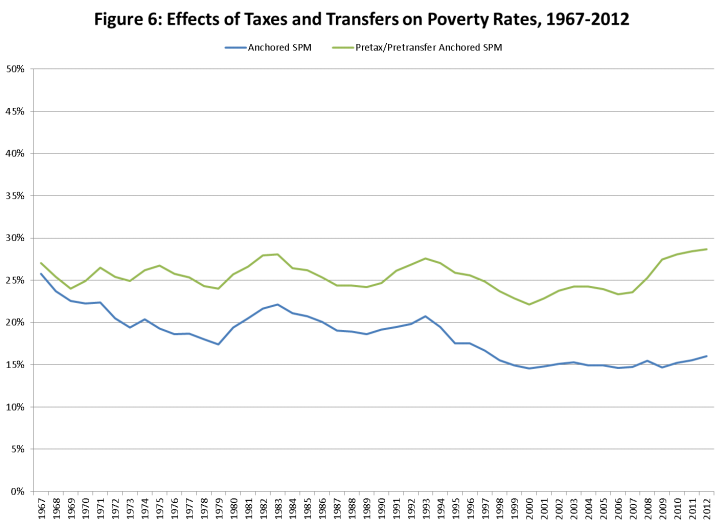
A new study (pdf) assesses the effects of anti-poverty programs over the past 45 years. Emily Badger comments:

If you’re a working mom of two making $18,000 a year, just below the poverty line, the government doesn’t consider in its own poverty rate whether the food stamps and rental subsidies it gives you effectively help pull your family above that threshold. To address this, the Census Bureau began to roll out in 2011 a supplemental poverty measure, a revised tool that tries to take these non-cash benefits into account (alongside other essential family costs). The supplemental measure, though, is primarily a resource for the curious. It’s not used in official poverty statistics or policy-making.

Researchers at Columbia University’s Population Research Center, however, have used it to make a powerful point about the real impact of all these government programs. Christopher Wimer and colleagues took the new supplemental threshold and carried it back in time, adjusting the 2012 supplemental poverty line for inflation … Take away those programs, and the poverty rate would have actually inched up from 1967 to 2011.

Brad Plumer sees the above chart in the context of the Great Recession:

There are a couple of ways to read this chart. One, if you don’t include safety-net programs, then poverty has actually risen from 26 percent in 1967 to 29 percent in 2012. There are more people dependent on safety-net programs to stay out of poverty than ever before. Or here’s another view: The green line shows that poverty rates would have soared during the most recent recession if there were no safety-net programs in place. But as the blue line shows, the poverty rate actually stayed fairly constant. The expansion of food stamps, unemployment insurance, and the Earned Income Tax Credit blunted a lot of misery.

Vauhini Vara adds:

Some politicians on the left might resist a measure that shows that poverty is much lower than it used to be: couldn’t this minimize the problem and make it harder to gain support for new anti-poverty programs? But it also may show that some anti-poverty programs of the past several decades appear to have achieved what they were meant for—which, one expects, should come as good news to everyone.

Giving Diplomacy A Chance

The Senate won’t be passing new sanctions against Iran:

A deal in the Senate to impose additional sanctions on Iran has fallen apart, as Senate Democrats accede to requests from President Obama to delay new legislation while world powers negotiate a nuclear deal with Iran.

Earlier this week, Colin H. Kahl made the case that more sanctions would be counterproductive:

Suppose the Majles, Iran’s legislature, passed legislation tomorrow, over Rouhani’s objections, declaring that Iran would resume and escalate its nuclear activities in six months’ time if Washington failed to live up to its Geneva commitments and agree to a final deal that fully respects Iran’s nuclear rights. …

Suppose further that when asked by an Iranian reporter whether this legislation risked undercutting diplomacy, speaker of the Majles Ali Larijani pooh-poohed the notion, assuring the media that this in no way violates the terms agreed to in Geneva. After all, Larjani would say, “Iran is doing nothing now. We are simply creating a sword of Damocles as leverage to ensure the Americans live up to their end of the bargain and accept a final agreement that respects Iran’s red lines.”

How would U.S. lawmakers view such a move? Would they see it as consistent with the letter and spirit of Geneva? Would it enhance American support for diplomacy? Would the threatened Iranian escalation be helpful to Obama as he works to convince skeptics on Capitol Hill of the need to back continued negotiations and support future compromise? Or would it put the administration on the defensive, confirm the worst American suspicions about Iranian intentions, complicate diplomacy and make a confrontation over the nuclear program more likely?

Recent Dish on Iran here and here.

Losing A Taste For The Past

In Swann’s Way, the taste of a madeleine famously transports Proust’s narrator to the realm of childhood reverie.  Borrowing a page from the novel, Julian Baggini decided to spend “a day eating only as I had done around the age when I started secondary school,” reproducing the cuisine of Britain in the 1970s and early ’80s:

By dinner time I was losing my appetite for self-experimentation. This time I cooked a 1970s-style spaghetti bolognese, topped with dried ‘Italian cheese’ from a drum. It could, quite rightly, no longer be called Parmesan. Cooking it brought back some memories: the patient waiting for onions to soften, the pink mince browning and breaking up into very small bits and the meaty smell as it did so, the sauce reducing and getting a greasy sheen. But when I actually ate it, it was underwhelming.

Changing habits mean changing perceptions.

Having discovered more interesting dishes, my bolognese is now a bland meat sauce, not a reassuring dose of comfort food. Philosophers and psychologists disagree about whether we should say the taste or the taster has changed, but whatever the answer the whole experience of tasting is certainly very different. When I was a child, I positively liked all of these foods, and now I don’t: if you can’t recapture that pleasure, then you can’t recapture what it felt like to eat them.

It is like standing in someone else’s shoes while still being you. Context frames every experience and so, if your life changes, you can never go back to how it once was. That’s why, as the American wine writer Michael Steinberger puts it in Au Revoir to All That (2009), gourmands eager to revisit great meals will be disappointed: ‘trying to recreate memorable moments at the table is often a recipe for heartache’.

My Proustian day brought back some forgotten memories, but the emotions it stirred in me were mainly negative, a kind of pity for the culinary dreariness of my childhood, as well as a kind of guilt for feeling that I now stand above it, superior and elevated. I was hardly transported back. It strikes me as sad that I cannot look back with straightforward joy at things that made me happy at the time. And there’s something almost humbling about this, a reminder that I was literally made out of that stuff, no matter what I do differently now.

Previous Dish on Proust’s eating habits here.