The Misery Of Miscarriage, Ctd

A reader writes:

I thought the thread was dead, but apparently not. I’m glad, because I want to share my story. I started this email almost three weeks ago with my adopted five-day-old son on my lap, but then I saved it in my drafts folder thinking that I couldn’t write about my miscarriages or the adoption. Now that the 15-day waiting period has ended and our son can no longer be taken back by his birth mother, I’m ready to talk about my experience.

I read the New Yorker miscarriage piece with horror a few weeks ago because we were anxiously awaiting the birth of our baby. The birth mother is a healthy young woman, and I was pretty sure the baby would turn out OK. What I wasn’t so sure about was whether or not she would change her mind and close the door on our dream.

My husband and I experienced our first miscarriage in fall of 2004. My last, the twelfth, occurred in January 2012.

We stopped trying to conceive because my doctor said that my advanced maternal age and my clotting disorder would kill me if I somehow managed to stay pregnant and deliver the child. Words cannot adequately describe the part of my psyche that has been damaged by these losses. I did not understand the depth of the wound until a few days into motherhood when I suddenly realized that I am perfectly, gloriously happy being a parent. Even the worst of motherhood – the sleepless nights, the endless round of needs to meet, the mountains of laundry, the silly bickering with an equally tired spouse – have little impact as I look at my newborn son’s face.

Our birth mother chose us as the parents for her unborn child on our 11th wedding anniversary, and though I try not to read too much into portents and signs, I can’t help but think that something special happened that day. Our long years of suffering and waiting were not erased, but they were eased. A therapist once told me that someday I would wrap my miscarriages up into the birth story of my firstborn, and for a long time, I clung to that idea. But I am finding that the truth is more complicated and subtle. Those lost pregnancies are still with me every moment. They remind me of the gift that is my child, and they keep me focused on parenting with joy and compassion. And, so, even if I could forget the misery that is miscarriage, I wouldn’t. The miscarriages have strengthened me immeasurably.

As a final note, I used to sort of despise the Sunday churchy content, but now I’ve begun to look forward to it. I find the break from worldly, political matters is a nice way to spend my day of rest. Getting into a contemplative headspace is useful to me, and I hope at some point you’ll include some of the spiritual work in the subscribers-only portion of the site – maybe a particularly good interview or some other philosophical piece.

A long essay on Pope Francis is in the works.
Hersh vs Obama, Ctd

Earlier this week, Sy Hersh questioned whether Assad actually launched the Syrian chemical weapons attack. Eliot Higgins pushes back:

Hersh … discusses the possibility that the sarin was produced by Jabhat al-Nusra, the al Qaeda-affiliated group that’s fighting Assad. I asked chemical weapons specialist Dan Kaszeta for his opinion on that. He compared the possibility of Jabhat al-Nusra using chemical weapons to another terrorist attack involving sarin: the 1996 gassing of the Tokyo subway by the Aum Shinrikyo cult.

“The 1994 to 1996 Japanese experience tells us that even a very large and sophisticated effort comprising many millions of dollars, a dedicated large facility, and a lot of skilled labor results only in liters of sarin, not tons,” Kaszeta said. “Even if the Aug. 21 attack is limited to the eight Volcano rockets that we seem to be talking about, we’re looking at an industrial effort two orders of magnitude larger than the Aum Shinrikyo effort. This is a nontrivial and very costly undertaking, and I highly doubt whether any of the possible nonstate actors involved here have the factory to have produced it. Where is this factory? Where is the waste stream? Where are the dozens of skilled people — not just one al Qaeda member — needed to produce this amount of material?”

Joanna Paraszczuk and Scott Lucas pile on:

Hersh also does not examine how insurgents could fire multiple chemical warheads on opposition-controlled towns like the West Ghouta Moadamiyyat ash-Sham. That town, one of the first places that started to demonstrate against the Assad regime over two years ago, has been under a tight regime siege for over a year and is literally surrounded by key regime military strongholds. It is right next to the Mezzeh Military Airport, the site of fierce fighting between regime and insurgent fighters, and just south of the 4th Armored Division base, Sumarieh residences, and key police housing. So while it is easy to see how regime forces could fire on Moadamiyyat ash-Sham from outside the town — indeed, the regime is firing conventional weapons at the town on a daily basis — it would be practically and logistically impossible for insurgents to fire at short-to-medium range from outside the town.

Nor does Hersh bother to examine motive. Why would insurgents fire multiple chemical weapons at Moadamiyyat ash-Sham, a strategically-important opposition-controlled town that had resisted a siege for almost a year at the time of the August 21 attacks? Who would want to weaken the town by causing mass casualties and mass panic?

The Recession Hasn’t Ended For Everyone

unemployment

Matthew O’Brien wishes Congress would deal with long-term unemployment:

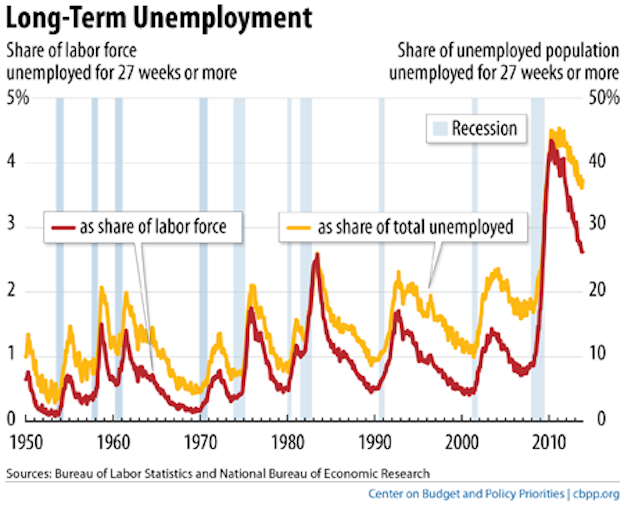
It’s been over four years since the recovery officially began, but it still feels like a recession to most people. Maybe that’s because with three unemployed people for every job opening, things are still as bad as they ever got last recession. Not that Washington has paid much attention the past few years. It’s been too preoccupied with short-term deficits to care about long-term unemployment. That was obvious when a Congressional hearing in April about people out of work for six months or more drew all of … one senator at the start. And it is even more obvious now with the latest budget deal.

Michael Strain explains why we should care:

People derive so much of their identity and of their moral core from being able to work. It’s how people provide for their families, express creativity, gives you a sense of purpose. There are all these moral and spiritual and psychological benefits to working. So if you want to ask how society is doing broadly, certainly the economics are important, but more important is whether this society is functioning in a way that people can live the fullest life possible and can maximize their potential. And right now, for these 4 million folks, we’re failing.

Yglesias suggests ways to help the unemployed:

One is direct government hiring of the long-term unemployed to do some kind of public service work. Making this happen would require you to go outside the standard civil service and federal contracting frameworks, which obviously neither civil servants nor federal contractors are going to like. But it has the job-creating punch of a major war without all the death and destruction. The other is relocation assistance. The metropolitan areas of Bismarck, Fargo, Grand Forks, Sioux Falls, Ames, Iowa City, Lincoln (Neb.), Midland, Burlington, Mankato (Minn.), Logan, Rochester (Minn.), Billings, Dubuque, Morgantown, Odessa, Rapid City, Omaha, Waterloo (Iowa), Columbia (Mo.), and St. Cloud all have unemployment rates below 4 percent … Grant programs to connect the long-term unemployed with job opportunities on the Plains and offer financial assistance for relocation could do a lot of good.

Suzt Khimm reports on the situation:

Advocates for the unemployed say they’re not surprised by the difficulties they’re facing on Capitol Hill. “We’ve known from the beginning this was going to be an uphill battle,” says Judy Conti, federal advocacy coordinator for the National Employment Law Project. And there is one fallback solution for Democrats if Congress doesn’t act before the end of the year: Unemployment benefits can be restored retroactively, as they were in 2010.

Chart from the CBPP.

Ask Rick Doblin Anything: Talking Personally About Psychedelics

In today’s video from Doblin, he explains how his own experiences with psychedelic drugs have influenced him and his work:

[vimeo 81738328 w=580]

In a followup, he explains what his family makes of his work as a psychedelic researcher, including a moving story about doing MDMA while visiting his grandmother and a funny story about his daughter’s experience with the DARE program:

[vimeo 81737285 w=580]

His previous videos are here. Some background:

Rick Doblin, Ph.D., is the founder and executive director of the Multidisciplinary Association for Psychedelic Studies (MAPS). He received his doctorate in Public Policy from Harvard’s Kennedy School of Government, where he wrote his dissertation on the regulation of the medical uses of psychedelics and marijuana and his Master’s thesis on a survey of oncologists about smoked marijuana vs. the oral THC pill in nausea control for cancer patients. His undergraduate thesis at New College of Florida was a 25-year follow-up to the classic Good Friday Experiment, which evaluated the potential of psychedelic drugs to catalyze religious experiences.

His professional goal is to help develop legal contexts for the beneficial uses of psychedelics and marijuana, primarily as prescription medicines but also for personal growth for otherwise healthy people, and eventually to become a legally licensed psychedelic therapist. He founded MAPS in 1986, and currently resides in Boston with his wife and three children.

Our extensive coverage of the spiritual and therapeutic benefits of psychedelics is here (or, in chronological order, here).

Democrats Should Run On Obamacare?

Maybe:

[T]op Democratic pollster Stan Greenberg – having just done extensive polling in 86 competitive House districts — is advising Dems they should go on offense over the Affordable Care Act. The key finding: Even though voters in the battlegrounds have extreme doubts about the law, they still prefer implementing it to the GOP stance of repeal. And after a month of crushingly awful press for Obamacare, opinions on this matter in the battlegrounds have barely budged since October.

Going on the offensive would be long overdue and desperately needed. Tomasky predicts that “HealthCare.gov is going to be a net plus for Obama and the Democrats”:

[M]y bet is based on a lot more than enrollment numbers. It’s based on the numbers of people who are benefiting and will benefit from aspects of the law. These aren’t in the thousands. They’re in the millions. About 70 million citizens will enjoy free—free—preventive care for a range of services that typically weren’t covered at all before or at best were covered and required a co-pay. About half of them are Medicare recipients (= old people = voters). Preventive care, as you may know, is something our system hasn’t been doing very well. Now it will.

More than 100 million Americans live with what the insurance companies would define as pre-existing conditions. Over these next few months, as their symptoms flare up or especially if they worsen, requiring lengthy hospital stays and intense treatment, they’re going to be seeing that they don’t have to fret about money or whether they’re going to continue to be covered anymore. Mental-health coverage is going to be improved dramatically for up to 60 million Americans. Nearly 7 million senior citizens are going to find in the coming months that they’re no longer screwed by the doughnut-hole prescription-drug problem that was created by the Bush Medicare Part D law of 2003 and corrected by Obamacare. It is saving these 7 million seniors an average of $1,000 a year, which for many of these folks is probably a reasonable chunk of their income

The Man Who Made The Deal

GOP caucus

Chait acknowledges the role Paul Ryan played:

The Ryan-Murray deal will likely pass, despite opposition from the professional conservative movement, because it’s tiny enough to be uncontroversial while helping Republican leaders avert serious internal problems with the budget process. Ryan has given it his blessing, and as one Republican leadership aide puts it, “Paul Ryan is the Jesus of our conference.”

Albert R. Hunt sees the deal hurting Ryan’s chances for the presidency:

The budget compromise further complicates Ryan’s presidential ambitions. The deal, which still faces a tough slog in the House, has infuriated some anti-government conservatives and would be used against Ryan in any Republican presidential contest. Senator Marco Rubio of Florida, a likely presidential aspirant, came out against the deal almost immediately after it was announced.

Collender also expects Ryan to take a hit:

Yes, I know that many are giving House Budget Committee Chairman Paul Ryan (R-WI) high fives for putting the deal together. But there’s little doubt that he has hurt his credentials with the tea party wing of the GOP and it is critical to anyone who wants to run for president some day as Ryan supposedly wants to do. Ryan committed at least three sins in the eyes of the tea partiers: He collaborated with the enemy when he compromised with Patty Murray, he agreed to things that some tea parties are calling tax increases and he agreed to higher spending than would occur have occurred without the deal. Still don’t agree? Watch how many tea partiers, or representatives and senators with tea party primary challengers, vote against the deal.

Weigel sighs:

Because the Beltway press can’t see a leaf flutter off a tree without asking how it will affect the next presidential election, Ryan’s brokering role here is inspiring some “did Ryan hurt himself in 2016?” columns. The existence of Chris Christie as a popular, centrist-looking figure with ties to major GOP donors is more harmful to Ryan than any political choices the budget chairman could possibly make. Still: No, the Tea Party (or whoever) won’t be angry at Ryan because the budget didn’t touch the benefits that older voters paid into for years.

(Photo: House Budget Committee Chairman Paul Ryan, R-Wisc., during a news conference where republican leaders discussed the new budget proposal on December 11, 2013. By Douglas Graham/CQ Roll Call)

Unpacking The Budget Deal

Howard Gleckman parses the bill that the House will vote on today. He notes that it “effectively would do nothing to reduce the deficit—the stated goal of many Republicans—or stimulate economic growth—the wish of many Democrats including President Obama”:

However, it would break—temporarily at least– the cycle of fiscal brinksmanship that has largely paralyzed Washington. The constant threat of government shutdowns—and the reality of one last fall—created uncertainty in the business community, made it impossible for the Federal Reserve to begin slowing its bond buying program, and completely disrupted other policymaking. If this deal is accepted, there will be no more shutdowns until at least October, 2015.

Cassidy zooms out:

[P]erhaps the most stark reminder of how things have changed in Washington over the past few years is to look at the revised spending figure for discretionary spending in fiscal 2014—the one agreed upon by Ryan and Murray, which includes the give-backs from the sequester. It’s $1.012 trillion. (This number doesn’t include mandatory spending on Medicare, Social Security, or interest payments on the national debt.) That’s slightly more than the Republican negotiators wanted. But as Stein and Linden point out in a chart accompanying their analysis, it’s twenty-seven billion dollars less than Ryan proposed in his 2011 budget, which, at the time, was widely agreed to be so draconian it was unrealistic.

Neil Irwin’s analysis:

What matters is that under the deal, fiscal policy still be a drag. It just will be less of a drag than it would be otherwise.

Economists at Barclays, for example, now think that tighter federal spending will reduce the overall growth rate in 2014 by 0.25 percent, not the 0.5 percent they estimated previously. In other words, at a time of high unemployment, falling deficits and low interest rates, budget-cutting is still making the economy worse than it otherwise would be. But with this deal, Washington policy will be less counterproductive than it otherwise would be.

Philip Klein has reservations:

The actual numbers of the deal are less significant than the fact that the deal is undermining sequestration, which had been touted as Republicans’ biggest success in limiting government spending since gaining control of the House in 2010. If, in response to pressure from defense industry lobbyists and other special interest groups, Republicans and Democrats have agreed to undo sequestration for the next two years, why should conservatives be confident that they won’t do the same thing two years from now?

Reihan defends the defense spending tweaks:

The biggest and most important aspect of this package is that it spares the military from poorly-designed front-loaded cuts that might severely degrade U.S. capabilities. These is a reasonable long-run case for defense austerity, but sequestration actually protects the spending that needs to be reformed most (virtually all costs associated with personnel) while targeting important capital investments. It’s amazing that congressional conservatives need to be reminded of this, but rival powers are making substantial investments in precision-guided munitions and other technologies that are designed to counter the U.S. military’s traditional approach to projecting power. If we do not make investments of our own, our ability to defend our interests will deteriorate much faster than you might think. This is not a joke. One gets the strong impression that Paul Ryan understands that this is not a joke.

Yuval Levin supports the agreement:

By now even the people who argued most fervently for insisting on defunding or repealing Obamacare in the last budget battle have acknowledged they didn’t really believe that could happen in such a fight. Simply doing it over won’t change the players or the circumstances, however much we might wish we could change both, and won’t advance the conservative cause.

A deal that keeps in place 92 percent of the sequester, replaces the rest (and adds more savings) with fairly durable mandatory savings and other small reforms, and avoids the tax increases the Democrats want would, I think, advance that cause a little.

Daniel Gross tries to look on the bright side:

An increase of $45 billion in spending isn’t exactly New Deal 2.0. We still don’t have a much-needed infrastructure spending bill. And Congress, even as it giveth, will taketh away: extended unemployment benefits for those hit hard by the recession are set to expire in January. Since the deal excluded an extension of those benefits, about 1.3 million people are set to lose a vital form of income support in a matter of weeks. Food stamps have already been cut, and congressional Republicans are hell-bent on cutting them further. The combination of those two actions will reduce the spending power of those at the lower rungs of the income ladder, and will negate a portion of the gains reaped from easing the sequester.

Even so, we should applaud this very small-bore deal. After a few years in which Washington has exerted a malign force on demand, it is showing signs of becoming a neutral force. We’ll take what we can get.

India Takes A Step Backwards

India

Yesterday, as we noted in our FOTD, India’s Supreme Court overturned a ruling legalizing gay sex, leaving it to Parliament to decide on the issue. Sonal Bhadoria’s reaction:

The verdict has been shocking on many levels. Firstly, landing a major blow to India’s claim of being a country with a modern outlook, the fact a law made by Britishers in the 1860′s has been upheld in 2013 makes for a strange sentence. Secondly, with many countries now equating gay equality with the rights for same-sex marriage, the Supreme Court ruling puts India back in the company of most nations in the Islamic world and many African countries which criminalise homosexuality. The only country in South Asia where gay sex is now legal is Nepal. “It is highly embarrassing for the country because now we will be among the dirty dozens of the world,” said Narayan, the lawyer from the Alternative Law Forum.

Gwynn Guilford notes that an “obvious factor keeping homosexuality illegal in many of these countries is Islam”:

Take for instance the countries that punish gay sex with death: Mauritania, Sudan, Saudi Arabia, Iran, Yemen, and parts of Nigeria and Somalia. Some—Nigeria, Sudan and Somalia—inherited British colonial anti-gay laws. But they too instituted the death penalty long after independence—most in the last 40 years—in line with Islamic sharia law. Many of the other 76 countries with severe anti-gay laws are also Islamic states.

India, however, isn’t. And before the British invasion, it was much more tolerant of homosexuality. So why would India and so many other ex-colonial countries cling so tightly to the moral whims of Victorian Englishmen that were never their own?

One reason might be that morality codes give governments a way to build a national identity around shared values, often as a foil to permissive Western countries. But a more prosaic one is that anti-gay laws are also a handy way to fortify state control (as is now happening in Russia).

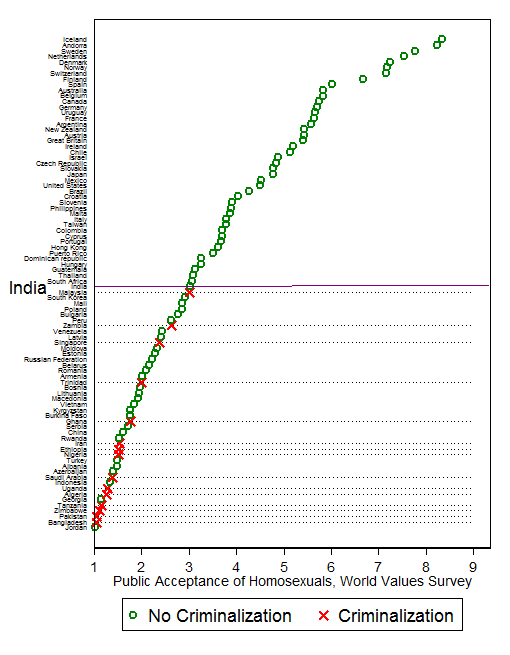
Erik Voeten made the above chart showing that India is now the most gay-friendly country where homosexuality is criminalized:

One concern is, of course, that if international precedents indeed matter, then other courts may use the Indian case as a precedent for their own decisions to preserve criminalization or overturn previous decisions to decriminalize.

A broader concern that I have is that I have not been able to detect evidence that decriminalization by itself  moves public opinion towards greater acceptance. This creates a risk of backlash: there are countries that have policies that are more liberal than supported by their publics, perhaps because they implemented those policies in response to international social or material pressures. Indeed, we see evidence of such backlash in several of the countries with green dots in the graph that are on the low end of the public acceptance spectrum, including Russia.

Jim Burroway joins the discussion:

“Retrograde” seems to be the most common expression Indians are using to describe today’s decision. Protests have broken out in the financial capital of Mumbai. Observers doubt that India’s government will take up repeal of Section 377 anytime in the foreseeable future. Parliament is currently hopelessly deadlocked, much like our Congress. Elections are coming up in May, and the socially conservative Hindu nationalist Bharatiya Janata Party (BJP) are seeing gains in the polls as it is.

Chandrahas Choudhury also doubts that India’s lawmakers will reverse the ruling:

The more realistic hope is that the judgment passed today by Justice G.S. Singhvi on his last day in office will on appeal be referred to a larger bench of judges, which will once again uphold the 2009 ruling. That judgment had held that Section 377 of the IPC “was based on a conception of sexual morality specific to [sic] Victorian era,” that it had been struck down inEngland as far back as 1968, and that it violated many fundamental rights guaranteed by the constitution, including the right to privacy and to equality before the law. …

Today’s judgment notwithstanding, the eventual legalization of homosexuality in India is inevitable. At least in the realm of the public sphere, if not that of the law, the gay-rights movement has made remarkable and permanent advances in the last two decades. And at least in large sections of urban India, the culture of shame and silence that attached itself to homosexuality in the past has been to a great extent broken down.

Making Peace With Violence

TNC defends Mandela’s refusal to denounce necessary bloodshed:

Offered the chance to be free by the avowed white supremacist P.W. Botha if he would renounce violence, Mandela replied, “Let him renounce violence.” Americans should understand this. Violent resistance to tyranny, violent defense of one’s body, is not simply a political strategy in our country, it is taken as a basic human right. Our own revolution was purchased with the blood of 22,000 nascent American dead. Dissenters were tarred and feathered. American independence and American power has never rested on nonviolence, but on the willingness to do great—at times existential—violence.

Perhaps we would argue that Malcolm X, Mandela, and King were wrong, and that states should be immune to ethics of nonviolence. But even our rhetoric toward freedom movements which employ violence is inconsistent. Mandela and the ANC were “terrorists.” The Hungarian revolutionaries of 1956, the Northern Alliance opposing the Taliban, the Libyans opposing Gaddafi were “freedom fighters.” Thomas Friedman hopes for an “Arab Mandela” one moment, while the next telling those same Arabs to “suck on this.” The point here is not that nonviolence is bunk, but that it is is bunk when invoked by those who rule by the gun.

In the shadow of our conversation, one sees a constant, indefatigable specter which has dogged us from birth. For the most of American history, very few of our institutions believed that black people were entitled to the rights of other Americans. Included in this is the right of self-defense. Nonviolence worked because it conceded that right in the pursuit of other rights. But one should never lose sight of the precise reasons why America preaches nonviolence to some people while urging other people to arms.

She’s Having My Baby … In Bangalore

Jennifer Kirby explores the motivations and challenges of American would-be parents who seek to conceive using surrogates in foreign countries:

India is one of a few countries, though perhaps the most popularized, where commercial surrogacy is legal. The country emerged as a “hotspot” in part because of lower costs and laws passed in 2002 allowing commercial surrogacy. In the U.S., surrogacy can cost between $80,000 and $150,000, while in India it ranges from $20,000 to $60,000, depending on the types of services and the clinic. That amount rarely includes unforeseen expenses like surrogate hospitalizations, or the basic travel costs such as flight and hotel stay. Yet those “savings can be the difference between being a parent and not being a parent for a lot of people,” says Kathryn Kaycoff Manos, founder of Global IVF, a resource for fertility tourists…

Surrogacy in India is largely unregulated, though the Indian Council of Medical Research is moving toward greater control, including the registration of clinics, says Hari Ramasubramanian, a lawyer who founded the Indian Surrogacy Law Centre. An estimated 2,000 foreign babies are born to Indian surrogates each year, according to research in the forthcoming book Patients With Passports: Medical Tourism, Ethics, and Law, by Harvard law professor I. Glenn Cohen. A recent study by Sama, a resource group for women and health in India, concluded about 3,000 clinics offer surrogacy services to foreigners, generating more than $400 million per year for the economy; the Confederation of Indian Industry analyzed data that put India’s commercial surrogacy even higher, at more than $2 billion.

But tighter restrictions may alter the scope of India’s surrogacy tourism. In July 2012, the Indian Ministry of Home Affairs ruled that foreigners needed medical, not tourist, visas to pursue surrogacy. The ministry limited those visas to straight couples who’ve been married at least two years, and who come from countries that also permit surrogacy. The rule change amounted to a bar on singles, gay, and unmarried couples, and on those circumventing their home laws to have children. Though the ministry relaxed regulations so foreigners who had already begun surrogacy in India could complete the process, the Indian government began enforcing the new rules this fall, Ramasubramanian says.

Enter Thailand and the Mexican state of Tabasco, two places where surrogacy clinics now cater to international singles and couples—particularly same-sex couples.