Does A Company Have Religious Rights? Ctd

Ramesh contends that the ACA violates “our statutory right to act on our religious beliefs”:

Up until 2012, no federal law or regulation required employers to cover contraception (or drugs that may cause abortion, which one of the cases involves). If 2011 was marked by a widespread crisis of employers’ imposing their views on contraception on employees, nobody talked about it.

What’s actually new here is the Obama administration’s 2012 regulation requiring almost all employers to cover contraception, sterilization and drugs that may cause abortion. It issued that regulation under authority given in the Obamacare legislation. The regulation runs afoul of the Religious Freedom Restoration Act, a Clinton-era law. That act says that the government may impose a substantial burden on the exercise of religious belief only if it’s the least restrictive way to advance a compelling governmental interest. The act further says that no later law should be read to trump this protection unless it explicitly says it’s doing that. The Affordable Care Act has no such language.

Amy Davidson has argued against that line of thought:

Hobby Lobby is arguing that it counts as a person whose religious expression, according to the Religious Freedom Restoration Act of 1993, shouldn’t be “substantially burdened” by a law unless there is a “compelling government interest.” (Adam Liptak has written about how this draws on the dubious logic of Citizens United.) But the burden of complying is missing and the compelling interest is clear. The owners of Hobby Lobby aren’t the ones taking Plan B.

The government, in a reply to the company’s SCOTUS filing, quoted the opinion of a judge who, writing about a related case, said that the mandate would not “encourage (the corporations’) employees to use contraceptives any more directly than they do by authorizing (the corporations) to pay wages.” The government, meanwhile, heavily underwrites the entire employer-insurance system through its tax treatment of the money that companies spend on health care. (As my colleague John Cassidy argues, a lot of this would be simpler if Obamacare had been more radical, introducing a single-payer system.) The government also has an interest in women being healthy and having fair access to the care they need.

Scott Lemieux joins the conversation:

One argument that has been made again and again by supporters of the legal challenges is that the religious consciences of employers are being burdened so that employees can get “free” contraception. But this is an erroneous argument that misapprehends the basic concept of employer-provided health insurance. Contraception provided by health insurance isn’t “free,” it’s earned. Companies get substantial taxpayer subsidies for partly paying employees in health insurance instead of cash. In exchange, this insurance has to be comprehensive enough to provide value to the employee. Women getting basic health-care needs covered by insurance they’re receiving as compensation are not receiving any kind of free ride.

This point underscores just how weak the legal challenge to the mandate is. The employers in question are claiming that there’s a major religious freedom issue at stake depending on whether employees obtain contraception through direct wages or through the insurance employers get tax benefits for paying employees with instead. But there isn’t. The “burden” imposed by the mandate is utterly trivial, and the argument that it violates RFRA should be rejected by the Supreme Court.

Meanwhile, Edward Zelinsky believes “this entire controversy is unnecessary”:

The tax law contains devices for reconciling the religious concerns of employers like Hobby Lobby with the policy of expanding medical coverage: health savings accounts (HSAs) and health reimbursement arrangements (HRAs). The current regulatory exemption from the contraception mandate should be amended to include for-profit employers and to exempt from the federal contraception mandate employers (both non-profit and profit-making) who maintain HSAs or HRAs for their respective employees. Compromise along these lines would respect the genuinely held views of religious minorities while implementing the federal policy of broadening access to health care.

Previous Dish on the court case here.

The Rise And Fall Of Dan Choi

US-JUSTICE-GAY-MILITARY

Gabriel Arana has a long, pull-no-punches profile of the DADT activist and Iraq veteran. One of Choi’s darkest moments was at his trial earlier this year for chaining himself to a White House fence in 2010:

Dan called four witnesses to testify, then showed a video of his Rachel Maddow interview. While it played, he wept. “The defense rests!” he announced, putting his head down on the table and throwing up his arm. The judge called for a recess; Dan lay on the floor and shouted obscenities. In the afternoon, the prosecution delivered a brief closing argument. Dan gave a 40-minute speech. Raving and disjointed, it was a broken mirror of the life story he had told six months earlier. When the judge found him guilty and fined him $100, Dan cried out, “I refuse to pay it. Send me to jail!” Instead, friends took him to the emergency room of Washington, D.C.’s VA Medical Center, where he was admitted to the psychiatric ward.

The trial laid Dan bare. His passion. His penchant for inflamed rhetoric. His ability to attract followers. His solipsism. His vulnerability. On a few occasions, Dan has told me the trial was a plea for help. “I didn’t know what to do with myself after ‘don’t ask, don’t tell’ was repealed,” he says. Other times, he finds his nerve. “I just want them to apologize to me in open court—that’s all.”

I knew Dan, if not as well as many others. Every time I saw him, I told him to find some solace outside of the struggle, to get some peace of mind, to take care of himself. I feel terrible I didn’t do more. I know how one’s personal life can become besieged by a cause. For more than a decade, marriage and military activism consumed me, even as I was psychologically traumatized by the hatred other gay activists directed toward me and consumed by the stories of pain and self-destruction so many gay men confided in me. If you believe, as I did, that this was a transcendent moral calling, it became harder and harder to put limits on how it took over your life. I talked with Dan about this – especially about absorbing the suffering and pain of so many who looked to you for some kind of help. How do you say no? How do you say: this is where the struggle ends and my life begins?

This is the challenge for anyone trying to create change. I am luckier than Dan in some respects. I have a therapist of great skill and compassion; I have a faith that always imposed a spiritual check on my own narcissism; I have and had friends of surpassing loyalty and love and honesty; I found a husband who anchored me, and empowered me and kept me from self-harm. I see in Dan a human being whose passion for others in the end occluded his own sense of self. He forgot that happiness is an option – indeed that our struggle is about extending the full pursuit of happiness embedded in the Declaration of Independence. Alas, as time went by, I found myself consumed with work and too easily forgot my comrade on the battlefield. And when we did meet – sometimes randomly on the street – he seemed too far gone to reach any more.

Arana’s conclusion:

A few things I am certain of. Washington can make people, even those who fight for human rights, lose their humanity. It gets covered up with talking points, strategy, branding. At the height of Dan’s celebrity, few in the repeal movement pulled him aside and said, “All this doesn’t matter more than you do. Let’s go home.” Maybe that’s because he’d cut himself loose from the people who cared enough to tell him he was losing himself—people like Grace, Isaac, Sandra, William Cannon, Sarah Haag-Fisk, and Laura Cannon.

None of this is to say Dan would have listened. He had fallen in love with his own martyrdom. He had conflated activism with celebrity.

Dan’s story runs in my head like an episode of E! True Hollywood Story. He starts out naïve and precocious. He rises. He succumbs to the pressure—all those interviews, rallies, fan letters, expectations. But instead of playing out on Bravo or in the pages of Us Weekly, it played out on MSNBC and in The Advocate. What I have to keep reminding myself is that by speaking when no one else would, Dan Choi did a good and courageous thing, and in part because of it, gays and lesbians can now serve openly in the military.

(Photo: Former US Army Lt. Dan Choi, a gay rights activist and opponent of ‘Don’t ask Don’t Tell’, arrives at the E. Barrett Prettyman Federal Courthouse on March 28, 2013 in Washington, DC. The former Iraq War vet and graduate of West Point was going to trial to face charges that stem from a November 2010 arrest for chaining himself to the White House fence to protest “Don’t Ask, Don’t Tell.” By Brendan Smialowski/AFP/Getty Images)

Checking Obamacare’s Vitals

McArdle feels that the law is still in bad shape:

The administration has given up on success, as it might once have defined it. The object is no longer 7 million people signed up through the exchanges, with 2.7 million of them young and healthy, and the health-care cost curve bending back toward the earth. It is to keep the program alive until 2015. The administration’s priorities are, first, to keep Democrats from undoing the individual mandate or otherwise crippling the law; second, to keep insurers from raising premiums or exiting the marketplace; third, to tamp down loose talk about the failures on the exchanges; and, only fourth, to get to the place where it used to think it would be this year, with lots of people signed up for affordable insurance. It is now measuring the program’s success not by whether it meets its goals, but by whether it survives at all. And all of its choices are oriented toward this new priority.

But, as Beutler points out, repeal gets harder every passing day:

In the months ahead Republicans will squeeze every drop of political juice they can out of every Obamacare failure and hardship they can unearth or spin into existence. But the goal won’t be repeal. It will be to channel the right’s Obamacare obsession into voter turnout in 2014 — at which point millions of people will be insured and the law will be unrepealable.

Chait declares that there “is no existential threat to Obamacare”:

So what are we fighting about? How smoothly the law operates, and how many customers it manages to enroll by the end of Obama’s term, are open questions. Likewise up for debate is whether Obama’s approval ratings will recover. But these are not fundamentally questions about the life or death of Obamacare. They’re about how much political pain Democrats in Congress must endure. We’re not fighting over health-care policy. We’re fighting about the midterm elections.

First Read’s advice:

[W]hat you’re likely to see over the next several days are mostly anecdotes and spin. Democrats will point to examples of Americans having success with the website (and there are more and more of those). And Republicans will point to examples of continued problems (and those still exist). But to gauge if the website is truly better, there are two things to watch for in the next two weeks. One, are the insurance companies and government beginning to air their multi-million TV ad campaigns? “The big tell of if/when people finally believe it’s working is when you see the states, insurance companies, etc., restart their ad buys and outreach programs that they put on hold to drive people to the site,” a Democrat paying close attention to health care’s implementation told First Read. Two, are skittish Democratic politicians — especially those from red states — a little less skittish than they were last month? Or more skittish? That will be another tell.

Laszewski’s bottom line:

Maybe, however haltingly, we are finally getting to the main event. The day when people can get a good idea for themselves just what value Obamacare presents for them. The premiums, the deductibles and co-pays, as well as the provider networks. Not just the people who are now uninsured or have had their policy canceled, but also those who don’t need Obamacare today but think they might someday. All of them voters focused on finding out for themselves what this Obamacare thing really is.

The View From Your Window Contest: Winner #182

vfyw_11-30

Not a lot of entries for this week’s difficult view. One reader:

Not much to go on except rooftop architecture and the river.  Based on my limited knowledge of both, I guess Riga, Latvia.

Another:

Halifax, Novia Scotia – unmistakeable. Unless I’m mistaken.

Another is more confident:

That clearly looks like Glasgow. After last week’s contest highlighted the tiebreaker rules, I’m going to accrue an unbeatable number of previous guesses in the event I do actually try and wind up tied!

Another is super confident:

Any graduate of the University of Wisconsin in Madison will recognize this view of the campus, with the yellow Stock Pavilion on the right, Liz Waters Hall in the upper distance and Lake Mendota on the left. The iconic peninsular Picnic Point juts out into the lake from the left. Harder to pinpoint the window from which the shot was taken, but probably somewhere in Van Hise Hall, the tallest building on campus.

Another:

I like to guess at images that look like somewhere I’ve been, rather than using all the technology other readers do. So, it looks like Tarrytown to me, with the Hudson River in the background.

A few others also guessed upstate New York. Or further north:

My wild guess is Quebec City, somewhere north of downtown and close to the river. That could be the Manoir Ste-Genevieve in the far distance, just to the left of the yellow house, and the peninsula could be Sinte-Petronille.

One reader had a lot of ideas:

The architecture reminds me of Germany, but the buildings are too new and the density is too low for Germany. The landscape seems Laurentian Forest, with a glacial lake or inlet, so maybe upstate New York, Quebec, New England, or upper US Midwest? Alaska or British Columbia? The buildings in the background could be timeshares – a resort town?

Another settles on the correct side of the Atlantic:

I have no wherewithal to defend this, but Amiens, France is my hunch. Spent a few similarly grey days there almost eight years ago while “studying” abroad.

Another:

This one seems pretty likely to be in northern Europe somewhere, but it seems a little too plain for Germany, so I thought it might be in the eastern side. Started looking at Prague, another place I’ve always wanted to visit, and it is so charming I never got around to looking at anywhere else. You can even street view in the zoo there! And the public art is amazing.

Another heads in the right direction:

The architecture screams Germany – particularly the yellow building with the gabled roof. Looks like northern Germany, Schleswig-Holstein, which isn’t particularly hilly except around the Holsteinische Schweiz, which also has lakes. Without knowing the exact location, it could easily be Kiel. Butcould also be Ratzeburg, Flensburg, any number of places. I’ll go for Plön.

Another gets much closer:

This has to be Oslo. It’s an image full of Nordic gloom, but also prosperous bourgeois architecture and a dramatic fjord. Not sure of the neighborhood, but my guess would be Nordstram, just to the east of the center of the city.

Another gets a similar hunch:

Just feels like southern Norway on a fjord.  Colors of buildings and roofs are similar to those seen in the area.  No pictures pop up in a quick search – so I’ll just lay my marker on Oslofjord, and let the pros dig deeper.

Enter the pro:

This week’s view comes from Lidingo Island on the outskirts of Stockholm, Sweden. The picture was taken from the fifth floor of the Scandic Foresta Hotel, possibly room 507, and looks north by northwest along a heading of 342.68 degrees:

Chini-VFYWC-182-pics

It was room 509, not 507 – you’re really slipping, Doug. Meanwhile, only one other reader guessed even the correct country. The entirety of her entry:

Stockholm – Sweden – Europe

Close enough for a win this week. From the submitter:

Great to see my window photo used in the contest for the second time – the first was Contest #5, of the midnight sun over Tromso, Norway. Also exciting to see two of my windows from one trip; later in the day I took the photo, I flew to Beijing, where I took the photo you used from the Summer Palace.

As I wrote when I sent this week’s photo, it’s from room 509 at the Scandic Hotel Foresta, on the island of Lidingö in the Stockholm suburbs. From the Street View that contestants surely will find, the building appears to have only four stories. This is because the hotel is a sprawl up the hill from the historic castle-like Villa Foresta. The modern wings have made this a conference hotel. I was there to speak at a transgender health conference. So, if instead of a room number you get a circled window, I believe it is the top floor window visible in the Street View. The Foresta sign is quite visible as one crosses the bridge to Lidingö, and the hotel borders the well-known sculpture garden and museum of Carl Milles – the Millesgården, so this should be a more recognizable view than last week.

By the way, the Foresta had perhaps its most famous guests when the Beatles stayed there at the height of Beatlemania in 1964:

(Archive)

What The Hell Is Happening In Ukraine?

UKRAINE-UNREST-POLITICS-EU-RUSSIA-KIEV

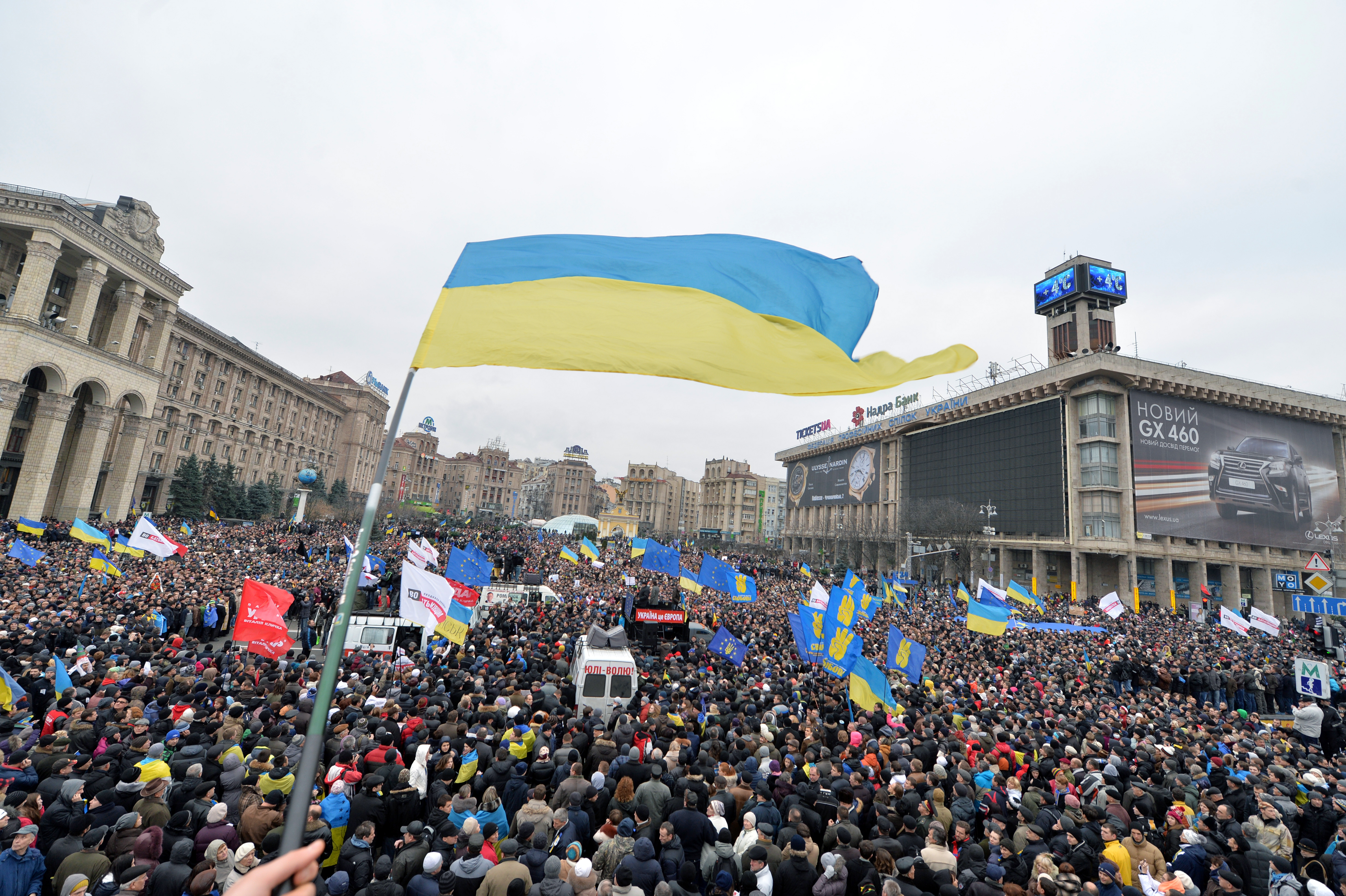
President Viktor Yanukovich turned down an EU trade agreement, under pressure from Moscow, to do a deal with Russia instead. Over the past several days, hundreds of thousands of Ukrainians have protested the decision. Frum warns against letting Putin strong-arm Ukraine back into Russia’s sphere of influence:

Since Putin’s entry into power, Russia minus Ukraine has sought to influence and corrupt the democracies of Europe. A Russia that reintegrated Ukraine would possess the power — like the Soviet Union of old — to intimidate and bully democratic Europe. Russia minus Ukraine can aspire to become a normal nation state, a democracy, even a liberal democracy. A Russia that holds Ukraine by force must forever be a militarized authoritarian regime, a menace to its own people as much as to the rest of the European continent and the democratic world. Upholding Ukrainian independence is thus a deep concern, not only to the Ukrainians, but to all the free countries of Europe — and thus to the United States, free-Europe’s security and trading partner.

Larison pushes back:

Ukrainian political independence is not imperiled, and European security certainly isn’t. Ukraine’s economic dependence on Russia would not have been ended by the EU’s association agreement, and it was this dependence that ultimately made it impossible for Ukraine to finalize the agreement over Russian opposition. More to the point, as Mark Adomanis points out, “the idea that Ukraine is the secret to some geopolitical great game is anachronistic nonsense.” The only thing at stake in this dispute is whether Ukraine opted for a closer relationship with the EU at very high short-term cost or accepted something very much like the status quo for the foreseeable future. It’s just not that dramatic or significant for any countries except Ukraine and perhaps its immediate neighbors. The “future of the European continent” definitely does not hang in the balance.

Julia Gray analyzes the situation:

[W]hat’s primarily in the balance is Ukraine’s image. The company a country keeps can change its reputation, as I’ve argued. Reputations can, of course, translate into material gains – greater access to capital on financial markets, if portfolio investors perceive you to be more likely to honor your debt obligations.  I’ve shown that international agreements can often serve as a seal of approval  to portfolio investors.

This particular case is no exception.

Caught between one club it doesn’t particularly want to join (the Russian-led customs union) and another that won’t let it come much closer (the EU), Ukraine is currently taking heat from both sides as well as in the international press. Tying itself to the EU might make Ukraine look more attractive on the international front in the long term, but if Russia cuts Ukraine off, the short-term economic consequences could be devastating – particularly since it’s far from clear that Ukraine can get any closer to the EU than it already is. At the same time, any further crackdowns on protesters will only make them seem less like a country that belongs in Europe.

Daisy Sindelar looks at the personalities leading the massive “EuroMaydan” demonstrations:

Some Maydan protesters are motivated by their longing for the West. Others, like nationalist Oleh Tyahnybok, are motivated by the loathing of the East. Tyahnybok is the 45-year-old head of Ukraine’s Svoboda (Freedom) political movement, which stormed Kyiv’s city administration building on December 1 and has since called for a national strike. “A revolution is starting in Ukraine,” said Tyahnybok, who has accused Russia of “waging virtual war” on Ukraine; he has called for a visa regime with Russia and argued against the introduction of Russian as a second state language.

Tyahnybok, who has had a long, slow-growing career, may also see the protests as a political opportunity. Tyahnybok first entered parliament in 1998 and eventually won reelection as a member of Viktor Yushchenko’s Our Ukraine bloc. But his nationalist views eventually saw him ousted from the bloc, and have routinely set back his political progress, with critics regularly accusing him of anti-Semitism.

Mary Mycio wonders whether Yanukovich can maintain control:

When fear of a strongman begins to melt, so does his power. Seeing hundreds of thousands of protesters on the streets of Kiev may have emboldened members of the country’s elite to begin to move against the president. Ukraine’s rapacious oligarch’s may—for the first time—have found common ground with their increasingly impoverished compatriots in getting rid of a tyrant. The next telltale sign will be if the oligarchs—or their media monopolies—begin to call for new elections or political consensus in parliament that freezes out Yanukovich. What would have been unthinkable a short time ago could now be in the offing. Five members of parliament associated with Lyovochkin have quit Yanukovich’s party. There are rumors that at least 20 more may be ready to follow. Pressure from the street might make all the difference.

Leonid Bershidsky notes that “Putin is watching the Kiev events with apprehension”:

The raw power of the Ukrainian protests could re-energize the Russian opposition movement, which he successfully quashed last year. “The events in Ukraine resemble a pogrom rather than a revolution,” Putin said. “The opposition is trying to topple the legitimate authorities. These are well-prepared actions.”

Putin is wrong about the preparation. What’s happening in Ukraine is a spontaneous outpouring of indignation with a rotten, corrupt, bungling regime very much like Russia’s own. The main difference is that high oil prices provide Russia’s leaders with enough money to keep opposition at bay, while Ukraine is nearly bankrupt. If Russia’s already stagnant economy falters, Moscow could see similar outbursts.

Ioffe doubts that Russia will follow in Ukraine’s footsteps. Among her various reasons why:

Russia is a police state; Ukraine is…not quite. According to Bloomberg, Russia is the most heavily policed country in the world, Ukraine is 12th on the list. (The U.S. is 32nd.) Moreover, the security services have much more political power in Russia than they do in Ukraine. This is in part why, when a cry went up about police brutality, the Kiev police chief resigned (though his resignation wasn’t accepted). When this happened in Moscow, in May 2012, injured policemen were rewarded for their suffering with apartments and the unarmed protesters who attacked them were arrested and hauled to trial.

Drezner looks at the bigger picture:

It seems highly unlikely that the current Ukrainian government will resort to massive repression at this point — which means the worst-case scenario is that Ukraine doesn’t join either economic bloc.  The only way this ends as a win for Putin would be if he was able to use force to seize control — or coerce the Ukrainian security apparatus to do the same.  I seriously doubt that he is either willing or able to pull off such a coup d’etat

Stepping back, let this be an important lesson about the limits of economic power.

(Photo: An opposition rally packs Independence Square in Kiev on December 1, 2013. Some 100,000 Ukrainians chanting ‘Revolution!’ swarmed the central Kiev square Sunday in a mass call for early elections meant to punish President Viktor Yanukovych for rejecting an EU pact. By Sergei Supinsky/AFP/Getty Images)

The Frontrunner, On Paper

U.S. Governors Attend Summit On Jobs At U.S. Chamber Of Commerce

Nate Cohn talks up Scott Walker:

Scott Walker, the battle-hardened governor of Wisconsin, is the candidate that the factional candidates should fear. Not only does he seem poised to run—he released a book last week—but he possesses the tools and positions necessary to unite the traditional Republican coalition and marginalize its discontents. Walker has the irreproachable conservative credentials necessary to appease the Tea Party, and he speaks the language of the religious right. But he has the tone, temperament, and record of a capable and responsible establishment figure. That, combined with Walker’s record as a reformist union-buster, will appeal to the party’s donor base and appease the influential business wing. Walker’s experience as an effective but conservative blue state governor makes him a credible presidential candidate, not just a vessel for the conservative message. Equally important, his history of having faced down organized labor and beaten back a liberal recall effort is much more consistent with the sentiment of the modern Republican Party than Jeb Bush’s compassionate conservatism.

Altogether, Walker has the assets to build the broad establishment support necessary for the fundraising, media attention, and organization to win the nomination. He could be a voter or a donor’s first choice, not just a compromise candidate.

But he has a charisma and charm deficit of almost comic proportions. Larison rolls his eyes at the speculation:

Like Pawlenty, Walker is being touted as a serious consensus candidate for Republicans because he doesn’t seem to have much competition for the role, and he is being elevated to top-tier status long before he deserves to be almost solely on the grounds that he was elected in a traditionally Democratic state. Unlike Pawlenty, he cannot yet even boast of being re-elected in such a state. Pawlenty’s candidacy famously had no discernible rationale except that his name wasn’t Romney, but at the moment a Walker candidacy would seem to have even less of a reason to exist. The argument for Pawlenty was that he would be able to combine his working-class background and evangelical Christianity with a quasi-populist agenda that would separate him from the rest of the field, but as we discovered this was never a very good argument. The argument for Walker is even less compelling, and it amounts to little more than the fact that he isn’t any of the other likely candidates.

Update from a reader:

And then there’s this, which honestly I think is a little overblown, but still truly ham-handed and tone-deaf:

The War On Christmas may actually be happening this year, but it’s being waged by an unlikely culprit: Wisconsin Gov. Scott Walker (R). Last week, Walker’s campaign sent an email encouraging supporters not to buy gifts for their children and to use that money instead to support his reelection effort. “Instead of electronics or toys that will undoubtedly be outdated, broken, or lost by the next Holiday Season, help give your children the gift of a Wisconsin that we can all be proud of,” the email read. [Here] is the email in full.

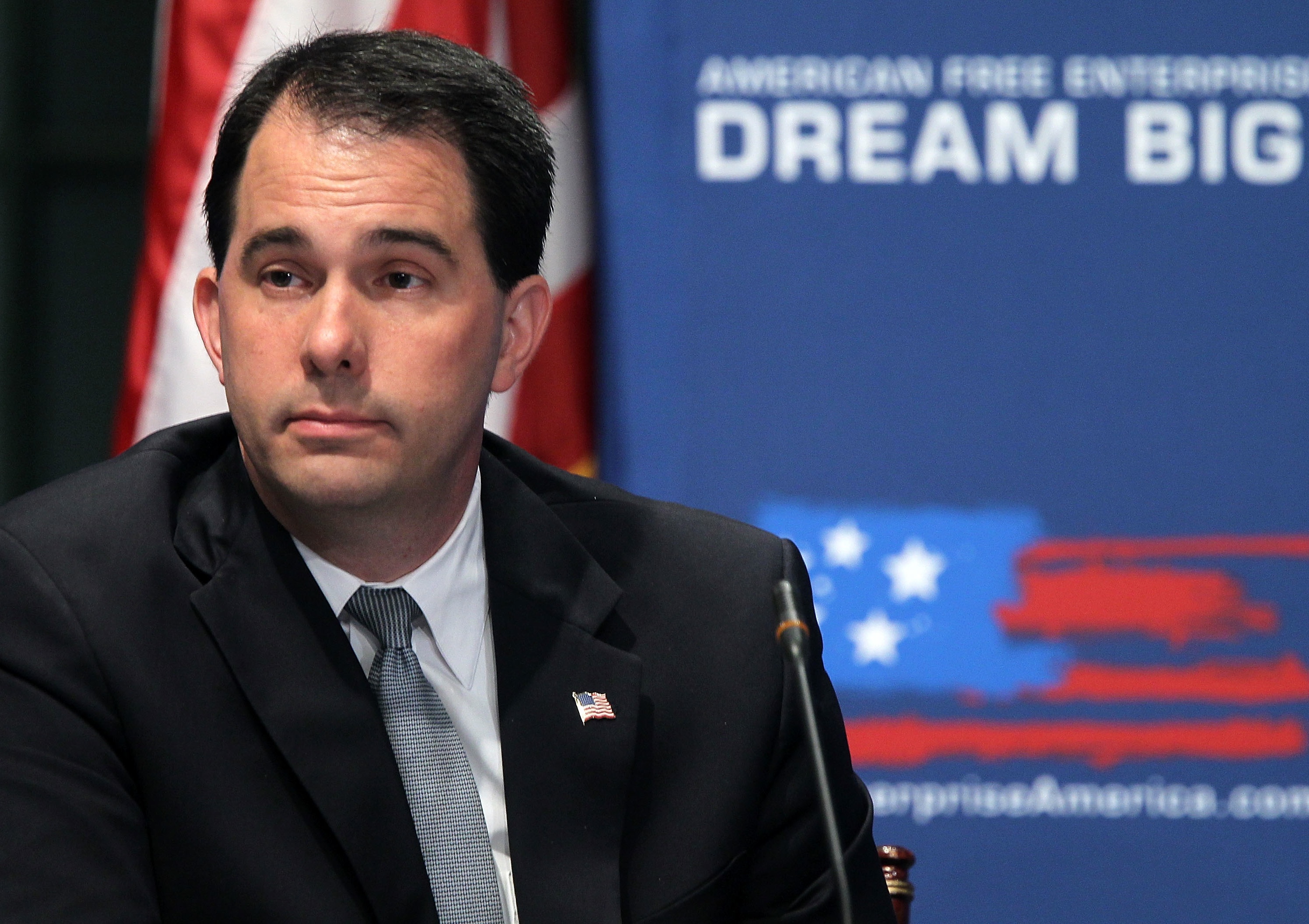
(Photo: Wisconsin Governor Scott Walker listens during the 2011 Governors Summit of U.S. Chamber of Commerce in Washington, DC on June 20, 2011. By Alex Wong/Getty Images)

Women Are The Future Of Catholicism

800px-Tolentino_Basilica_di_San_Nicola_Cappellone_14

In his Evangelii Gaudium, Francis wrote, “The reservation of the priesthood to males, as a sign of Christ the Spouse who gives himself in the Eucharist, is not a question open to discussion, but it can prove especially divisive if sacramental power is too closely identified with power in general.” If you see the priesthood as just one element of power within the Church – and circumscribed to men alone merely by virtue of historical artifact (the Gospels) or a theological metaphor (Christ as the groom to the Church as bride) – then I suppose this makes some sense. But that is emphatically not what the priesthood as traditionally meant. It has meant absolute authority and power, unequaled in any parish, and only constrained  by bishops and cardinals.

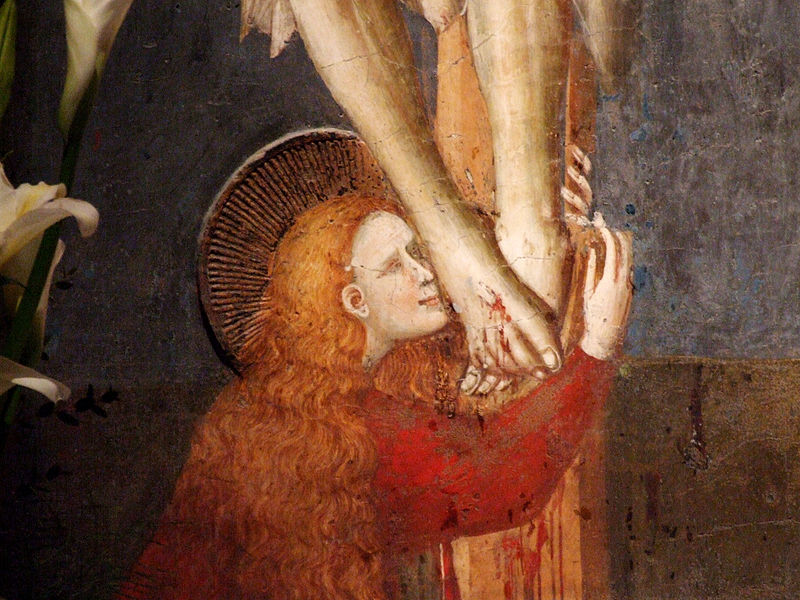
The Pope has spoken of women as the future of the Church. I couldn’t agree more. Their long, ignored, demeaned sacrifices and pastoral and educational and maternal role in the living church signifies how much more could be achieved if the female genius were released from the chains of misogyny and prejudice in the future. But without opening up the priesthood, Francis must surely propose some transformative administrative change to reflect that potential: female cardinals, for example? Perhaps an all-female curia to balance the worker-bees of the all-male priesthood? Or a re-imagined all-female diaconate? To balance out the all-male priesthood, we need, it seems to me, an all-female position of equal power. We need a Mary and a Mary Magdalen to balance Peter and John.

Erin Saiz Hanna makes a different point:

Where Francis misses the mark is suggesting that women are seeking ordination simply as means to gain power. While women’s decision making and leadership is certainly vital, the fact of the matter is women are called by God to serve alongside their brother priests. For a pope who seems so in tune with the marginalized, how does he not see that women are weeping and yearning for justice in the church? How can his sense of social justice not extend to the women of the church and their capacity for ordained ministry?

By including women as priests, the church would model Jesus’ radical example of equality and solidarity with women. It would also have a powerful and positive impact on a world stunned by economic crisis and continually reeling from sexism, racism, homophobia and other forms of oppression.

Douthat reads the Pope very differently:

The suggestion here, addressed to all readers but especially to a certain kind of dissenter, is that there may be space for reform — for a fuller “recognition” of women within the church, and a fuller share in ecclesiastical “decision-making” — within the limits imposed by a male priesthood.

Which suggests, in turn, that a plausible mission for liberal Catholicism in the age of Francis would be to identify such areas of reform, where the church could move in their direction without overturning settled doctrine, rewriting capital-T Tradition, or betraying the clear language of the gospels.

The role of women in church governance is one such place. The possibility of ending the rule of celibacy (or at least expanding the exceptions), highlighted today by my colleague Bill Keller, is another. The possible changes being bruited to the rules surrounding communion for remarried Catholics is a potential third example. And no doubt there are more.

For my own part — if liberal Catholics don’t mind a little advice from a conservative — I think the first area is by the far the most promising, since it offers a way for the church to say, in effect, “yes and no” to the cultural revolutions of the 1960s and 1970s: Yes to the dignity of women, yes to their further empowerment, but no to the idea that this dignity and empowerment depends on jettisoning Catholic (and biblical, and New Testament) ideals about sex and chastity, male-female difference, the indissolubility of marriage and the elevated place of celibacy in Christian life.

I’d be eager for a conciliation on the lines Ross lays out: a meaningful, transformative, reform within the tradition rather than from outside it.

Picking The Poor Kids Last, Ctd

A reader writes:

I want to add a couple of wrinkles that play a role in poor kids getting less access to organized sports. In my town, athletics at the middle-school level were eliminated in 2002 as a result of draconian budget cuts brought on by the post 9/11 recession.  And “C team” athletics were also cut at the high-school level.  Now, 11 years later, this means the only kids who get to play a sport without paying exorbitant fees are highly talented high-school kids.  Younger kids either have to join a club team or play pick-up games.  Greenya raises the obvious problem for poor kids in relation to the cost of those club teams.

But I’m guessing you will get readers who will write to you and say “poor kids can go play at the local empty lot/playground/etc.”  I would point out that life in impoverished neighborhoods is often not safe, and while parents living in poverty may not be able to provide lots of athletic opportunities to their kids, they can provide safety by keeping them close to home.

This means that there are fewer opportunities today for pick-up games than when I was a kid and was allowed to roam the streets all day in the summer. I played lots of pick-up games as a free-lunch-eating kid in elementary school, until my classmate was violently raped by a new neighbor.  Then my folks found lots of reasons to keep me at home, and my interest in sports was redirected to books.  It changed how my friends and I were raised, and I can’t help but think safety concerns play a role in how other kids in dangerous neighborhoods are raised as well.  I know today, I wouldn’t let my own kids be out of the house for a three-hour baseball game at the park without an adult I trusted supervising them, largely because of fears based in my childhood.  And I know that among my peer group, I am not alone.

And I honestly think this is part of the allure of video gaming, especially for families of the working poor. If my kid is playing a video game at home, I’m pretty certain he is safe from the dangers of the world.

The End Of DIY DNA Testing? Ctd

Razib Khan doubts that the FDA going after 23andMe will have long-term consequences:

Genotyping whole genome sequencing services are soon going to be as ubiquitous as white bread. The likelihood that the FDA would ban you from reading your raw results seems low. Rather, their concern is when a firm like 23andMe interprets those results. The glaring weakness in an aggressive strategy against interpretative services is that there will always be firms such as 23andMe, and there’s no reason that they need to be based out of the United States. Not only that, but there are open-source desktop applications, such as Promethease, that provide many of the same results by combining individual raw data with public peer-reviewed literature, if less slickly than 23andMe. To truly eliminate the public health threat that the FDA is concerned about, the U.S. government would have to constrict and regulate the whole information ecology, not just a strategic portion of it, from scientists distributing research about genetic variants, to international genome sequencing firms returning raw results on the cheap.

In hindsight I suspect that the FDA targeting 23andMe is going to seem rather like the RIAA shutting down Napster. The data is coming. The institutions designed to protect the public from fraud need to think more about empowerment rather than engaging in fiat paternalism.

He fleshes out his argument in a more recent post:

Dan MacArthur is probably right that personal genomics enthusiasts overestimated how involved the average person on the street was going to want to get in terms of their own interpretations of returned results. The reality is that even genetic counselors can barely keep up. Someday the field will stabilize, but this is not that day. But overall the information overload is going to get worse and worse, not better, and where the real upside, and game-changer, will be is in the domain of computational tools which helps us make decisions with a minimum of effort. A cartoon model of this might be an artificial intelligence which talks to you through an ear-bud all day, and takes your genomic, epigenomic, and biomarker status into account when advising you on whether you should pass on the dessert. But to get from here to there is going to require innovation. The end point is inevitable, barring a collapse of post-industrial civilization. The question is where it is going to happen. Here in the United States we have the technology, but we also have cultural and institutional road-blocks to this sort of future. If those road-blocks are onerous enough it doesn’t take a genius to predict that high-tech lifestyle advisement firms, whose aims are to replace the whole gamut of self-help sectors with rationally designed applications and appliances, will simply decamp to Singapore or Dubai.

Personal genomics is a small piece of that. And 23andMe is a small piece of personal genomics. But they are not trivial pieces.

Holocaust Hero Or Collaborator?

Mark Lilla reviews the latest film from Claude Lanzmann, The Last of the Unjust, which is based on extended interviews with Benjamin Murmelstein. Murmelstein was the infamous head of the Judenrat, or council of Jewish elders, who worked with Nazi leaders in running the Theresienstadt concentration camp. One fascinating feature of the documentary is that Murmelstein eventually wins Lanzmann over, arguing that his actions “were intended to beat the Nazis at their own game”:

If Eichmann’s strategy was to create in Theresienstadt a model ghetto that would distract world attention from the mass murders committed elsewhere, Murmelstein’s was to maintain that illusion so the camp and its inmates could not be destroyed without setting off an alarm.

If one accepts the soundness of this strategy, his actions appear in a different light. Rules had to be strictly, even brutally enforced to ensure that the Nazis did not transform the ghetto into an extermination camp. To keep the place from succumbing to a typhus epidemic he secretly had all the inmates forcibly vaccinated, denying food to those who refused, so the place appeared healthy. The seventy-hour work week was essential because, at the time he instituted it, the Nazis were worried more about shortages than about world opinion, and Murmelstein wanted the ghetto to appear economically indispensible. “Survival through work,” he says, was his version of the Nazi camp motto “Freedom through work.”

Lilla doesn’t quite buy the defense:

Keeping his camp running efficiently and in the public eye saved it as an institution, but also meant that victims could be processed more efficiently on their way to Auschwitz-Birkenau and other places east. Murmelstein, like everyone in the camp, did not learn about Auschwitz until 1944, but no one was ignorant of the fact that transport nach Osten meant unspeakable suffering and nearly certain death. At times, he speaks as if preserving the ghetto was an end in itself, never considering, as Hannah Arendt had suggested, that less efficiency might have meant fewer deaths overall. In the judgment of Holocaust historian Saul Friedländer, “objectively the Judenrat was probably an instrument in the destruction of European Jewry.” “But,” he added, “subjectively the actors were not aware of this function.”