Did Healthcare.gov Meet Its Deadline?

uptime

The administration’s new report (pdf) claims it did. Kliff worries about the problems we can’t see:

If the system’s front end works as smoothly as the Obama administration says it does, that means more applicants will get to the back-end functions of HealthCare.gov, where the insurance company needs to know who signed up for their product. We know a lot less about how prepared those systems are for a possible flood of enrollments and how they will perform in the coming weeks.

Suderman shares Kliff’s concerns:

Given its history, the administration’s claims have to be taken with a cargo ship full of salt—especially since there’s no good way to independently confirm that the website is working as well as the administration claims. You just have to take their word for it.

Even if the website appears to be working on the user end, there’s no guarantee that less visible functions are performing adequately. Insurers have been reporting dropped or incorrectly transmitted enrollment data since the exchanges launched. And according to The New York Times, the repair team prioritized front-end fixes for consumers over accurate insurance-company connections. So the site might appear to be working just fine, until you try to actually use the insurance that you thought you purchased.

Garance explains the above chart:

[T]he Department of Health and Human Services released a report that detailed just how badly the site was functioning in October and early November. According to the Healthcare.gov Progress and Performance Report, the site was offline more than it was online in at the start of November … Zients said uptime in October was similar to what was seen in that first week of  November. That means that by the time President Obama spoke in the Rose Garden on October 21 to urge people to use a 1-800 number instead of Healthcare.gov, the site had been functionally offline the majority of the time during its first three weeks.

Philip Klein puts the uptime numbers in perspective:

What information HHS did provide its new report isn’t very impressive if the comparison is with a typical commercial website rather than against the basket case that was healthcare.gov in October. For instance, an HHS chart – which Zients boasted about – shows system uptime now at 95.1 percent (excluding scheduled maintenance), which compares to 42.9 percent a month ago. But, the industry standard is for websites to be available for users 99.9 percent of the time. Anything below that is considered a failure and 95.1 percent is a disaster.

Bernstein replies:

Overall, I think his criticisms of the consumer experience are not unreasonable, but probably mostly irrelevant; most state DMVs had terrible service, but very few people decided to pass on getting a license because of it. On the other hand, the back-end problems…that’s the critical question, and I agree with him (and Kliff) that we just have very little idea of what’s going on — and there’s a scary possibility that no one will know what’s going on until more people get through the system (which should happen in the next few weeks).

Ezra Klein weighs in:

[H]ere’s what’s indisputable: HealthCare.gov is improving, and fast. Or, to put it differently, HealthCare.gov will be fixed. In fact, for most people, it is probably fixed now, or will be fixed quite soon.

The repair job is likely proceeding quickly enough to protect Obamacare from the most severe threat to its launch: Democrat-backed legislation unwinding the individual mandate or other crucial portions of the law. So long as people can actually purchase insurance through the federal exchanges, congressional Democrats are likely to support the basic architecture of the legislation they passed in 2010.

Republicans realize the Web site is quickly improving, and are planning a multi-phase attack on the law’s other disruptions. There are the insurance cancellations, of course, but there also going to be people who happily buy new insurance only to find their doctor isn’t covered, and there will be people who end up paying higher premiums in the new market, and there will be employers who raise deductibles to keep from paying the 2018 tax on high-value insurance plans, and so on.

Avik Roy attacks the premium prices:

Yes, the website will improve over time. But the cost of insurance on the website will not. And the cost of insurance for everyone else is also going up. And many of the law’s “winners”—mainly low-income people qualifying for subsidies—already vote Democrat, if they vote at all.

If anything, Americans are only beginning to become aware of the fact that they will pay more for health insurance under Obamacare. “I was all for Obamacare until I found out I was paying for it,” said one Californian when she first saw her bill. The President and his Democratic allies have been assuring Americans that they will see no changes to their health coverage under the law. That isn’t true. And one year from now, we’re likely to see voters make their dissatisfaction known.

And Jonathan Cohn has questions:

One more lingering—but very substantial—issue is the status of people who tried to apply during the first few weeks, when the system was at times barely functional. Many of those people essentially got stuck at some point in the process and have been unable to complete the process since. Administration officials said that reaching out to those people, so that they can finish applications and obtain insurance in time for January 1, is at the top of their to-do list.

Will the administration succeed, so that these people get coverage in time? Will those 834 problems be addressed in time, so that people can actually use their insurance successfully? Will new problems materialize in the coming weeks, as more and more people try to use the system?

Those are among the very big questions that remain unanswered—and will for at least a few weeks.
The Pope And The American Right

Pope Francis Visits Sardinia

I borrow the title of the post from Ross Douthat who has a typically nuanced take on the subject. Maybe it’s best to start with where we agree. Pope Francis’ criticism of the market as the core relationship between human beings is not in any way new in Catholicism. Nor is it some form of ideological leftism. It’s simply an orthodox call to remind us of our fundamental duty to the poor and the sick and the vulnerable, our manifest obligation to treat every human we encounter with dignity and worth – both personally and through the social structures we democratically assent to. It is primarily something that only each human soul can accomplish: social justice cannot replace interpersonal caritas, as some theocons have long rightly argued. The former is accomplished via the latter. And yes, a Pope’s treatment of social and economic matters is not doctrinally dispositive. There is room for dissent here, and prudential disagreement in good conscience.

Of course, the theoconservatives were among the last to allow any prudential, conscientious disagreement with papal pronouncements when they held sway in the Vatican. Those of us who dissented on priestly celibacy or the civil equality of homosexual persons or the ban on all contraception or the new and extremist doctrine on end-of-life issues were routinely dismissed as outside the fold. But as the theoconservative project, like the neoconservative one, lies in rubble and manifest failure, there’s no need for tit-or-tat now that the papal shoe is on the other foot (and no longer Prada).

There is, for example, little doubt that the free market has brought more wealth, comfort and health to Israeli Prime Minister Benjamin Netanyahu Meets With Pope Francismore human beings than any other form of economic model in human history. The last 300 years have improved our material lot more than the previous 200,000. Socialism is a grim failure of a system, communism even worse. But what all these systems have in common is a materialist vision of what makes human life worth living. That’s not a criticism in particular. Most such systems do not have within their remit a deeper understanding of human existence, a grounding in something other than prosperity. A Catholic, however, has exactly that grounding, which enables us to examine all such systems from different, higher ground.

And the way in which market capitalism has become a good in itself on the American right is, well, perniciously wrong. As soon as a system ceases to be a means to a human good, and becomes an end in itself, it has become a false idol. Perhaps the apotheosis of that idol worship was the belief – brandished on the degenerate right in the past decade or two – that markets are self-regulating. Of course they’re not, as Adam Smith would have been the first to inform you. Another assumption embedded on the American right is that more wealth is always a good thing. The Church must say no. This is a lie. Wealth is a neutral thing above a certain basic level of non-drudgery. Above that, it can be an absolutely evil, deceptive thing, distorting human souls, warping their dignity, vulgarizing their character. An American right that worships at the altar of both free markets and material wealth, and that takes these two idols as their primary goods, is not just non-Catholic. It is anathema to Catholicism and to the Gospels.

The neoconservative version of American exceptionalism is equally anathema to Catholicism. No country on earth is any more inherently moral than any other. It may achieve great things in advancing human good, as the US has clearly done. But as soon as you identify one country with all human good, and believe that its model, let along its divine providence, is dispositive for the whole of humankind, you are also worshiping a false God. It is that self-worship that allows a country to commit evil and justify it. Torture is such an evil. The American justification of it by the false doctrine of exceptionalism is something the Devil would have celebrated as a great triumph in the Screwtape Letters. And the American Catholic right’s acquiescence to it – including the last Pope’s – is a dark and indelible strain.

This is a critique of English exceptionalism as well, of course, and of colonialism as the purest expression of national self-love. It applies to the lie of communism as well as a global panacea- and to all systems that seek to impose a human set of ideas on mass populations by force of law, and that deny the innate dignity and equality of all of us. So yes, much of the right’s critique of communism, fascism, social democracy and the secular hubris of progressivism endures. But we must add to it the panacea of capitalism.

So in the spirit of conversation, let us get specific about two key issues now on the table: healthcare and Iran.

Now it seems to me that the Church is rightly neutral about the means of achieving the end of universal care. It is not a single-payer Church or an Obamacare Church. But it cannot and is not neutral in any way when it comes to the core moral imperative that each individual in our society, especially the most vulnerable, be able to get care in the wealthiest country on earth. In so far as the Republican party is absolutely indifferent to the millions of Americans without health insurance, in so far as they have relentlessly opposed one feasible plan for universal insurance without offering an alternative that could achieve the same thing, the Republican party simply cannot be supported by Catholics right now. Now there are good-faith proposals for a conservative approach to universal healthcare, as we’ve discussed on the Dish, so this critique does not apply to them. But it sure does apply to the GOP leadership.

Similarly on Iran, there is plenty of space within Christian realism to worry that our current attempt at engagement is foolish, that the Iranian regime is not susceptible to change or any peaceful presence in the world. But to refuse even to try and test the possibility of peace – which seems to be the neoconservative position – is clearly against Church teachings to seek peace at all times whenever possible. Pre-emptive war is just as anathema to Catholic “just war” teaching, as, of course, is torture. How much time have theo-conservatives spent this past decade examining the crime of the Iraq war and the evil of torture? I suspect the Pope’s answer would be: not nearly enough. And it’s high time they did.

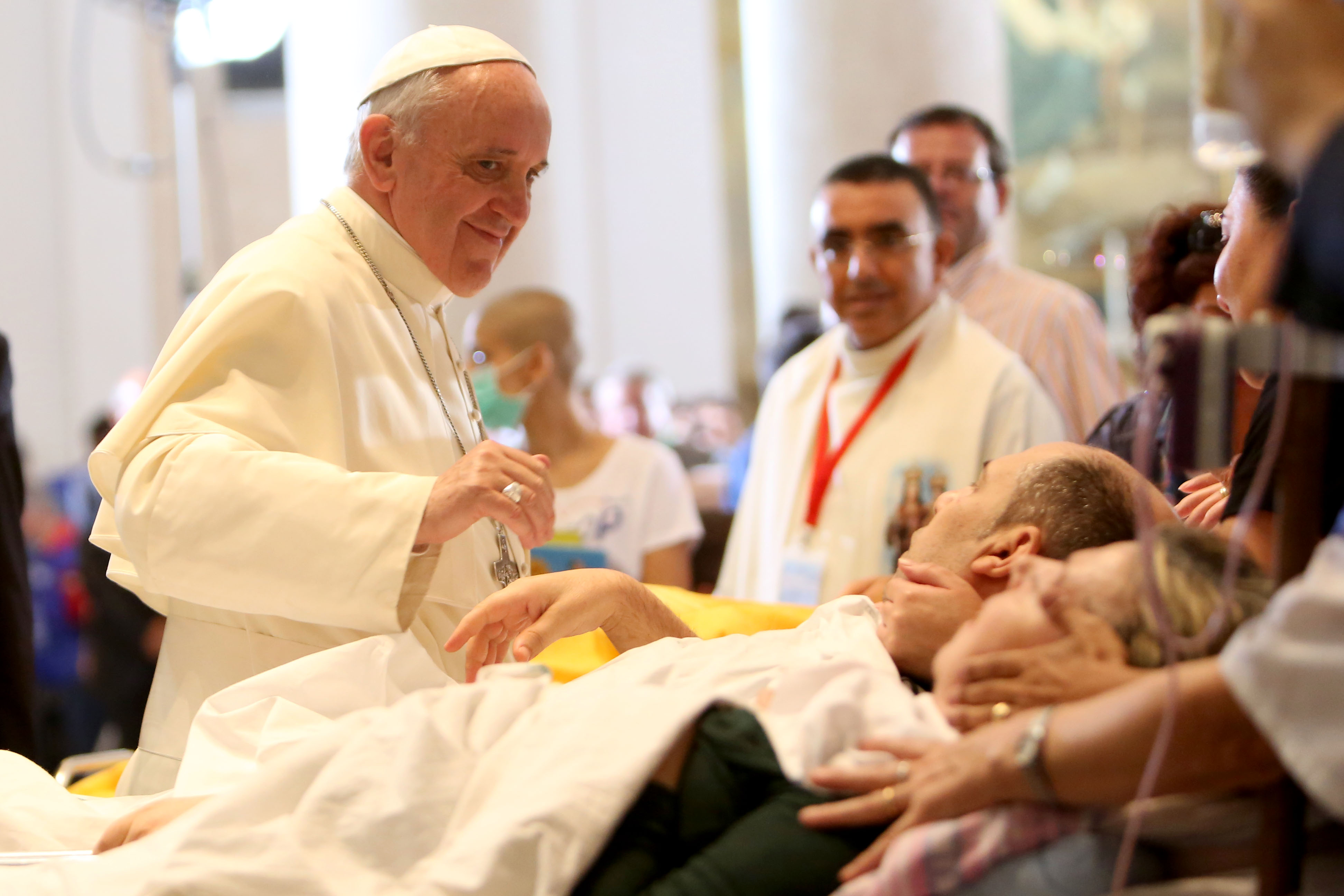
(Photos. Top: The Pope visits the sick on September 22, 2013 in Cagliari, Italy. By Franco Origlia/Getty Images. Right: Pope Francis receives Israeli Prime Minister Benjamin Netanyahu in a private audience at his library on December 2, 2013 in Vatican City, Vatican. By Vatican Pool/Getty Images.)

The Fathers Of Left And Right

In an excerpt from his new book The Great Debate, Yuval Levin traces the lineage of today’s liberals and conservatives back to the political divide between Thomas Paine and Edmund Burke:

The fundamental utopian goal at the core of Paine’s thinking—the goal of dish_paine liberating the individual from the constraints of the obligations imposed upon him by his time, his place, and his relations to others—remains essential to the left in America. But the failure of Enlightenment-liberal principles and the institutions built upon them to deliver on that bold ambition and therefore on Paine’s hopes of eradicating prejudice, poverty, and war seemed to force the left into a choice between the natural-rights theories that Paine thought would offer means of attaining his goal and the goal itself. In time, the utopian goal was given preference, and a vision of the state as a direct provider of basic necessities and largely unencumbered by the restraints of Paine’s Enlightenment liberalism arose to advance it. …

Today’s left, therefore, shares a great portion of Paine’s basic disposition, but seeks to liberate the individual in a rather less quixotic and more technocratic way than Paine did, if also in a way that lacks his grounding in principle and natural right.

Thus today’s liberals are left philosophically adrift and far too open to the cold logic of utilitarianism—they could learn from Paine’s insistence on limits to the use of power and the role of government. Today’s right, meanwhile, shares a great deal of Burke’s basic disposition, but seeks to protect our cultural inheritance in a less aristocratic and (naturally, for Americans) more populist way than he did, if also in a way that lacks his emphasis on community and on the sentiments. Today’s conservatives are thus too rhetorically strident and far too open to the siren song of hyperindividualism, and they generally lack a nonradical theory of the liberal society. They could benefit by adopting Burke’s focus on the social character of man, from Burke’s thoroughgoing gradualism, and from his innovative liberal alternative to Enlightenment radicalism.

Levin’s critique of liberalism is powerful and to be expected. But what makes his book much more interesting is his truly trenchant critique of his fellow conservatives as well. And it is a critique well-taken. I’d be much tougher on them, but this book is a tonic for a new discourse.

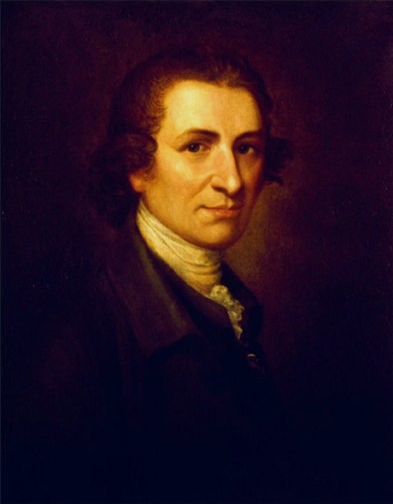
(Image of Matthew Pratt’s Portrait of Thomas Paine, 1785-1795, via Wikimedia Commons)

A Dark Cloud Over Our Heads?

Tom Chatfield isn’t enamored with data cloud technology:

Rights – and content creators’ lack of them – lie at the heart of cloud storage’s worst dangers, something connected in turn to the underlying nature of cloud storage. … The moment you hit upload, you’ve given away almost every right you might expect to possess over what’s “yours”. Instead, the entitlements and obligations you’re left with will be spelled out in the terms of an almost-certainly-unread licensing agreement with the company who own a service – and who, in most cases, will award themselves the ability to do pretty much anything legal they see fit with your material.  Depending on the country that a company’s servers are located in, moreover, a government will also reserve certain privileges regarding your information: looking inside your old emails without a warrant, perhaps, in the case of US; or locking you up for insulting the monarch in Thailand.

Is there a way out? Maybe:

SocialSafe is a company founded on the belief that the dire warnings about cloud technologies really are true. In [company founder Julian] Ranger’s words, “lack of privacy through inadvertent self-harm (over-sharing) and through third-party data aggregation will cause greater and greater harm over the years as people cannot leave their past behind them” – and that’s before you get onto data loss, theft, fraud, and the wholesale shutting down of online services.

The service SocialSafe currently offers is the automatic copying of all your cloud content to your own computer – to be held by you no matter what happens online, and browsed or analysed at your own convenience. The service covers the gamut of social media, from Twitter to Facebook via Instagram and LinkedIn. But by the end of next year, it plans to cover categories of data ranging from purchase histories and utility bills to financial and health data – and, Ranger hopes, towards an eventual model where you yourself own your personal data library, and can “decide to make it available in parts you decide, for purposes you agree with.”

Previous Dish on cloud dominance here. Update from a reader:

It’s possible to build online systems that don’t allow tracking. Cryptographers have worked out schemes to do this. A guy named David Chaum invented a cryptographic protocol for making blind signatures that helps a lot, and he built an EZpass-like toll collection system that couldn’t track drivers.

We don’t make tracking hard or impossible for three reasons. First, for the people who build Internet services, it’s harder and it costs more. A lot of stuff we’ve already built – the web, email, chat services – would have to be rearchitected to foil tracking. That’s a really big, expensive job.

Second, tracking people is a big part of the business model of several important companies now. Google and Facebook wouldn’t have business models without tracking. Data collection is behind some of the biggest fortunes in the world now. Those folks aren’t going to just walk away from their incomes.

Third, the government really wants to track everyone. Because protecting privacy is expensive, difficult, and bad for business, it won’t happen without regulation, and the government has no interest in protecting people’s privacy.

I look at it like this. When the first wave of industrialization hit, it created really bad environmental and labor problems. We lived with them for a long time, then we started to push back through government regulations. Those problems have been mitigated in rich countries, but not everywhere.

This current wave of industrialization has bad side effects as well. It’s eating everyone’s privacy. Right now, we’re all blissed out on the benefits of the tech. I have a device in my pocket that lets me search through most of the world’s information. That’s pretty cool. And the screw hasn’t really turned yet on the problems – we haven’t had the inevitable wave of scandals that will come when some political party uses the security infrastructure to punish their opponents yet, we haven’t had corporations smearing their competitors by leaking personal info, etc. All of that will come.

When it does come, we’ll have big fights about taming the new industrial concerns like Google, certain business practices will be heavily regulated or banned, new tech will be deployed to solve these problems, etc. Eventually, the average voters will win out over the big money. But it’s way too much work, way too costly, and way too threatening to important business models to put any fixes in place until average people have begun to feel genuinely threatened. We’re still some distance from that point.

Glimpsing Gehry

dish_gehry

Peter Aspden profiles the famed architect:

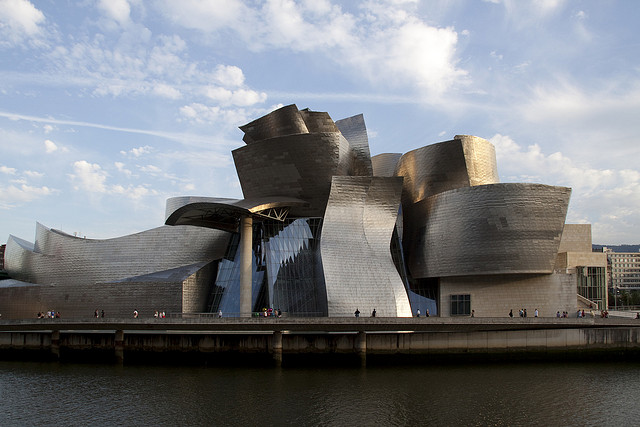
Gehry’s spectacular buildings – the most famous being the Guggenheim Museum in Bilbao and the Disney Concert Hall in Los Angeles – are said by his critics to overwhelm the environment in which they appear. His signature style – call it “metallic-sensual” for short – is, they say, repetitive and disrespectful of local context. He designs buildings by scrunching up pieces of paper. He enjoys his celebrity, and his patrons enjoy the association with what has become one of the world’s leading cultural brands. Need a new museum? Call Frank Owen Gehry on the Starchitect Hotline. Colour supplement coverage and urban regeneration guaranteed, cultural credibility cemented.

All of those criticisms have always struck me as misguided, or malicious, or just plain daft.

(The scrunching of the paper appeared as a joke in Gehry’s cameo on The Simpsons.) But that loaded epithet “starchitect” evidently stings. “You know, journalists invented it, and now they use it to damn us,” he continues in his defensive overture to our talk. I love his architecture, I say with honesty, and in the hope that the discordant theme will blow over. … Mention of the Guggenheim has a mellowing effect. “Somebody told me, a political type, that that building helped to change the political climate in the Basque country,” says Gehry. “They wanted me to do the same for their country!” he says with a little laugh. (He won’t reveal which country.) “Once it was built, this separatist movement that was trying to find its own identity suddenly had its own icon. There was something to be positive about that wasn’t there before. That’s what I was told.” He sounds slightly embarrassed by the magnitude of the claim. “I never thought of it like that.”

(Photo of Gehry’s Guggenheim Museum in Bilbao, Spain via Flickr user ahisgett)

Taking Control Of Your Dreams

Dorian Rolston visits a workshop run by Stephen LaBerge, one of the pioneering researchers of lucid dreaming:

The very existence of lucid dreams has been widely debated. According to prevailing theory, areas of the brain that generate self-reflection and govern rational thought throttle down as dreams start up. As our slumber deepens, we lose our short-term memory and self-awareness and, as a consequence, can’t spot the non sequiturs that fill our dreams, or even locate the actual position of our bodies. Only in the cold light of day, when executive functions come back online, do we realize how outlandish our dream plots are.

Lucid dreamers, by contrast, claim to be able to regain a host of daytime cognitive faculties while still dreaming. With enough practice, say proponents, people can redirect their dreams, and by so doing, at least according to LaBerge, transform their real-life narratives as well.

Rolston talks to retreat attendees about their hopes for the transformative power of lucid dreaming:

A 35-year-old software developer from Colorado Springs named Matt Winzenried says he came to [LaBerge’s workshop in] Hawaii to find the meaning of life.

About four years ago, he told me, he fell into a deep funk. He felt stifled by an overbearing boss and lackluster job. One night, while lying in bed, he heard a scuffling noise. As it drew closer, he reached under his bed for a gun but found nothing. Then something clambered up the nightstand, and Winzenried saw a furry blue creature gnashing its teeth. “That’s when I realized I was dreaming,” he says. Unexpectedly, the insight put him at ease. He felt a wave of “total acceptance and tranquility.” Winzenried was able to take control of his dream, grab the monster, and in one deep, long breath, inhale all but the creature’s skin deep into his own lungs. “There was nothing left except cloth,” he says. He awoke feeling “ready to tackle the world.”

Winzenried says that first lucid dream turned his life around. He enrolled in a personal development workshop. He got promoted. He began taking lessons in hockey and art. He started a small business. He joined Toastmasters to confront his debilitating shyness and soon became club president.

The Pope’s Economist

Despite Francis’s South American background, gestures toward liberation theology, and his new apostolic exhortation‘s critique of the “tyranny” of the market, Heather Horn argues that we shouldn’t look to Marx to understand the new pope’s approach to economics. Instead, she points us to Karl Polanyi, author of the classic counter-history of the rise of capitalism, The Great Transformation:

Economic activity, Polanyi says, started off as just one of many outgrowths of human activity. And so, economics originally served human needs. But over time, people (particularly, policy-making people) got the idea that markets regulated themselves if laws and regulations got out of their way. The free market converts told people that “only such policies and measures are in order which help to ensure the self-regulation of the market by creating the conditions which make the market the only organizing power in the economic sphere.” Gradually, as free market-based thinking was extended throughout society, humans and nature came to be seen as commodities called “labor” and “nature.” The “market economy” had turned human society into a “market society.”

In short (as social sciences professors prepare to slam their heads into their tables at my reductionism), instead of the market existing to help humans live better lives, humans were ordering their lives to fit into the economy.

How that connects to the vision of Pope Francis:

Where things get really interesting is when Pope Francis brings up the financial crisis. “One cause of this situation,” he writes, “is found in our relationship with money, since we calmly accept its dominion over ourselves and our societies. The current financial crisis can make us overlook the fact that it originated in a profound human crisis: the denial of the primacy of the human person!”

It’s nothing new to say the financial crisis came from a lack of regulation. That’s a fairly popular analysis. But what Pope Francis is saying is more Polanyan, hearkening back to the idea that the tipping point has to do with the relationship between the market and society/humanity, and which is subordinate to the other. Just as Polanyi argued that the extension of the market economy across the globe (through the gold standard) was the root cause of World War I (and you’ll have to go back to the original book for that, but it’s a beautifully, hilariously gutsy, Guns, Germs, and Steel kind of argument), Francis is arguing that failing to keep humanity at the center of our economic activity was the root cause of the financial crisis.

Because Linguistics

Stan Carey lays out an interpretation of the recent origin of using “because” as a preposition:

Neal Whitman agrees with Language Log commenters who think it could be from “Because hey”–type sentences (If life gives you lemons, keep them, because, hey, free WHY-Because-Racecar lemons), where hey functions “like an adaptor, letting you shift from the ordinary speech register to this casual and condensed register”. And then people started dropping the hey. It’s not always hey, either: take this line from the linguistically trend-setting Buffy, season 5 (January 2001): “I don’t even get how we made that guy, because, wow, advanced!” There may also be forerunners in child–parent exchanges like “Why? That’s the why” and “Why? Because.”; and in the popular insults “Because shut up” and “Because fuck you, that’s why.”

But Gretchen McCulloch isn’t so sure about Whitman’s explanation:

I’m skeptical about Neal’s “because, hey” explanation, because as I noted last year, we don’t see a lot of instances of “because noun” with any sort of additional modifier: the most canonical instances of “because noun” are with a bare noun, not a noun phrase. So, “my mouth is sore because lemons” sounds fine to me, but “my mouth is sore because free lemons” sounds a bit more marginal. Not totally unacceptable, maybe, but not the core upon which “because noun” was founded. (Stan Carey‘s examples have only 4/19 with more than a single word after “because”.)

In contrast, the modifier is crucial to the humour of the “because, hey” expression, and “because, hey” just doesn’t work in all the contexts where we find “because noun”. For example, something like “If life gives you lemons, keep them, because, hey, lemons” only works if the person you’re talking to already knows the joke or sees the value in lemons. And the example above, “my mouth is sore because, hey, lemons”, is just plain weird. The “hey” implies that the lemons are good, but the previous part of the sentence is saying that the lemons are bad, so I’m really not sure what someone could mean by saying this.

Megan Garber’s take:

However it originated … the usage of “because-noun” (and of “because-adjective” and “because-gerund”) is one of those distinctly of-the-Internet, by-the-Internet movements of language. It conveys focus (linguist Gretchen McCulloch: “It means something like ‘I’m so busy being totally absorbed by X that I don’t need to explain further, and you should know about this because it’s a completely valid incredibly important thing to be doing'”). It conveys brevity (Carey: “It has a snappy, jocular feel, with a syntactic jolt that allows long explanations to be forgone”).

But it also conveys a certain universality. When I say, for example, “The talks broke down because politics,” I’m not just describing a circumstance. I’m also describing a category. I’m making grand and yet ironized claims, announcing a situation and commenting on that situation at the same time. I’m offering an explanation and rolling my eyes—and I’m able to do it with one little word. Because variety. Because Internet. Because language.

(Image of “Because Racecar,” the inaugural “Because X” meme, via KnowYourMeme)

“Goodbye, Christ”

That’s the title of Langston Hughes’s 1932 poem that caused a scandal when it was published and that continues to provoke scholarly debate. A brief excerpt:

Goodbye,
Christ Jesus Lord God Jehova,
Beat it on away from here now.
Make way for a new guy with no religion at all –
A real guy named
Marx Communist Lenin Peasant Stalin Worker ME –

I said, ME!
Go ahead now,
You’re getting in the way of things, Lord.

Wallace Best argues that the poem has long been misunderstood, and should be considered part of the era’s “proletarian” writing about “the exploits of capitalism, how the Depression disproportionately affected the poor, and about the lives and deplorable living conditions of the working class—often with a strident critique of the religious status quo”:

“Goodbye, Christ” was not a declaration of Hughes’s commitment to Communism, nor was it a statement of his disbelief in God.

That contention is an over-simplification and a distraction. What I am arguing is that more than anything it could say about Hughes himself, “Goodbye, Christ” emerged as a perfect expression of what I call “the culture of complaint and critique” of American religion among black writers and clergy during the interwar period. In the aftermath of the Fundamentalist Modernist controversy of the 1920s, the thirties were a destabilizing time for religion in America as notions of American religious identity were being negotiated and contested. The seemingly anti-religious rhetoric of “Goodbye, Christ” doubtlessly appeared shocking to most people, but a number of black (and white) ministers from across the nation echoed the sentiments of the poem throughout the decade of the 1930s. Indeed, in many ways, the implication of their ideas (and the level of their rhetoric) eclipsed those expressed by Hughes in “Goodbye, Christ.” They critiqued and complained about the capitalist system, American churches’ alliances with capitalism, and about what they saw as an inherent insufficiency in religion itself.

Read the full poem here, or in The Collected Poems of Langston Hughes.

Holy Harmonies

Laura Davis contemplates what makes music sacred:

The Catholic Church makes its definition of sacred music pretty clear, stating in Musicam Sacram that music for the mass must “be holy, and therefore avoid everything that is secular.” It goes on to say that sacred music must also be “universal in this sense.” … I think it’s fair to say that the music has to be about God. The word sacred by definition must have to do with God or the gods, and most of the music of the contemporary worship movement fits this criterion. Perhaps then we should consider the purpose of sacred music: to function as part of the mass or service, most often as a part of worship. Worship derives from Old English weorthscipe ‘worthiness, acknowledgement of worth’. So if sacred music is intended to worship God, then such music must be of worth.

Kenan Malik suggests an alternative definition, one that operates “[n]ot so much as an expression of the divine, or as a set of rules and taboos, but, paradoxically perhaps, more [as] an exploration of what it means to be human”:

From the late medieval period on, ‘sacred’ art became increasingly humanized. The German critic Eric Auerbach called Dante, in the title of a famous study, a ‘poet of the secular world’. Dante’s Divine Comedy, despite its focus on the eternal and immutable features of heaven and hell, is at heart, Auerbach insisted, a very human exploration of this world. The human takes centre stage in The Divine Comedy, in way that had not happened previously in Christian thought. In this, Dante looks forward to the poets and artists of the Renaissance and beyond. Eventually the sense of transcendence in art came to be detached from religion entirely as in twentieth-century works such as Stravinky’s Rite of Spring or in Rothko’s paintings, in many of Barbara Hepworth’s figures or in Pablo Neruda’s love poems. It makes little sense to call such works of art ‘sacred’. There is, yet, a transcendent sensibility that links these to, say, works such as Bach’s Cantatas or Giotto’s frescoes or Dante’s Divine Comedy. To lose sense of that is to diminish both what is ‘sacred’ about sacred art and what is transcendent about much non-religious art.

(Video: performance of Bach’s cantata 184 “Erwünschtes Freudenlicht” (O welcome light of joy))