Obamacare’s Most Important Ally

The healthcare industry:

Few industry leaders want to go back to a system that most had concluded was failing, as costs skyrocketed and the ranks of the uninsured swelled.

Nor do they see much that is promising from the law’s Republican critics. The GOP has focused on repealing Obamacare, but has devoted less energy to developing a replacement. Healthcare industry officials generally view several GOP proposals, such as limiting coverage for the poor and scuttling new insurance marketplaces created by the law, as more damaging than helpful to the nation’s healthcare system.

Drum argues that the “health care industry will do everything it can to make it work, and one way or another, it’s going to work.” For this reason, Francis Wilkinson expects the law to survive:

Under the new law, government payments to hospitals for treating uninsured patients are set to decline more than $30 billion over the next decade. Hospitals had expected to recoup that loss from an increase in patients insured through Obamacare. If red states continue to oppose the law’s Medicaid expansion, hospitals in those states will suffer and clamor for relief.

At which point Republican governors can decide to A) let local hospitals decline and patients suffer, B) find state revenue to provide relief, or C) accept Obamacare’s Medicaid expansion, in which the federal government picks up the tab for three years and picks up 90 percent of the cost thereafter. (I’m guessing Door #3.)

Along the same lines, Sargent notes the insurance industry’s advertising plans:

If the federal website is mostly operational by the end of the month, it’s likely we’ll see a massive flood of advertising from insurance companies selling new plans over the exchanges. The advertising that was placed on hold may simply resume –and it may be heavily concentrated in December and the three months in 2014 leading up to the March 31st enrollment deadline.

This comes by way of Scott Roskowski, the senior vice president for marketing for TVB, the trade group for commercial broadcasters. As the Wall Street Journal reported back in August, TVB had estimated, based on expected insurance industry profits, that insurance providers were set to spend $1 billion on ads over the next two years to woo new customers shopping on the exchanges. This was seen as a boon to the law’s chances — enrollment is crucial to its success – but it was forgotten after the website crashed.

But Roskowski says TVB’s research suggests what really happened is that insurers simply moved their ad buying forward, rather than cancelling it — and that much of that shift was to the four month period from December 1st to March 31st.
Black And White Cinema

Prospero’s F.S. talks to Precious director Lee Daniels about his recent hit The Butler, a film about “a humble but talented butler who ends up serving eight successive presidents during his 34-year tenure at the White House”:

Your films feel very American for the way they concentrate on the rise and legacy of the US civil-rights movement. How well do they travel? Do other countries “get” them?

“Precious” did very well in the UK. And I hope it’s because these films are about people, not history. Similarly in “The Butler”, I saw the presidents as a backdrop to this story about a father and son, about a family trying to survive in America. I think those stories transcend race and country. I am fascinated by the human condition and by family.

There’s a moment in the film when characters criticise Sidney Poitier, the first black man to win an Academy Award for Best Actor. They suggest he ingratiated himself with white men in order to succeed. How do you feel that cinema treats African-Americans now?

I think that black cinema is having a wonderful moment. And it’s getting easier to find finance for these sorts of films, too. It’s a great thing to have made some money on “The Butler” so that we can show people that this sort of thing can be successful. But it’s interesting: I asked my son what he thought of the film. And he said: “Dad, what would mean something to me would be seeing a black Spider-Man, or Superman. When you can create a comic book character like that who is black then I will feel that you are hitting important territory.”

Alyssa considers the willingness of a white audience to engage with “black films”:

[P]art of the point of telling stories about non-white characters is to improve the variety of our storytelling, whether we’re putting new parts of familiar histories on the big screen, tossing new sorts of obstacles in lovers’ paths, or finding variations on family squabbles. But audiences are obviously capable of–and interested–in engaging with all sorts of characters whose lives are different from our own. We happily consume stories about characters who are super-rich, or even whose real estate seems out of whack what they ought to be able to afford. We embrace criminal families and gobble up the exploits of super-people. Plenty of movies that are labeled “black films” portray characters and events that have more in common with the lived experiences of most white filmgoers than the events of movies that are blithely assumed to be accessible to white audiences.

Over time, marketing decisions and the rise of studios like Tyler Perry’s, may have helped codify the idea that the simple presence of black actors in a film automatically transfers that film from one genre to another. But that division is hardly a natural one. And one of the quickest ways to break it down would be to try harder to sell movies to the audiences who ought to like them based on their content, rather than the race of the actors in question. Sell The Best Man Holiday and Think Like A Man to those of us who are burned out on the bad scripts that seem to cling to Katherine Heigl like flies. Push Red Tails not just to church groups, but to survivors of the Greatest Generation and the Boomers trying to understand their parents. And trust Steve McQueen’s arthouse pedigree to bring in everyone from people who want to feel good about themselves by engaging with history, to anyone who swoons over gorgeous shots of palmetto groves.

Allowing The HIV Positive To Save Lives

Maya Rhodan covers the HOPE Act:

Two weeks before World AIDS Day, President Obama has signed a new law that replaces a ban on using the organs of HIV positive people. It has been illegal since the 1980s to even study whether or not transplants between HIV positive people could be done safely and effectively. Under the new HIV Organ Policy Equity Act, also known as the HOPE Act, which Obama signed Thursday, researchers at the Department of Health and Human Services can begin to research best practices for organ transplants between people with HIV.

There is currently no American research on whether or not the transplants will be effective, though there was research published in the American Journal of Transplantation last March that suggested there is potential for almost 500 people on the donor list who are HIV positive to receive organs from HIV positive people every year.

Mark Joseph Stern cheers the law:

The exceedingly rare and relatively minor risk of HIV reinfection pales in comparison to the risk of dying from organ failure. Organ transplantation is highly regulated, and there’s simply no risk of an HIV-negative person accidentally receiving an HIV-positive organ. Lifting the ban will save hundreds of lives every year, increasing the pool of organs available and significantly reducing Medicare costs. For the health care community, it’s pure commonsense—which is why its most vocal Republican supporter is also a licensed physician.

The HOPE Act, in other words, is a great way to start the campaign to end absurd, politically inflicted medical biases against HIV-positive people.

The Homeless Population Is Shrinking

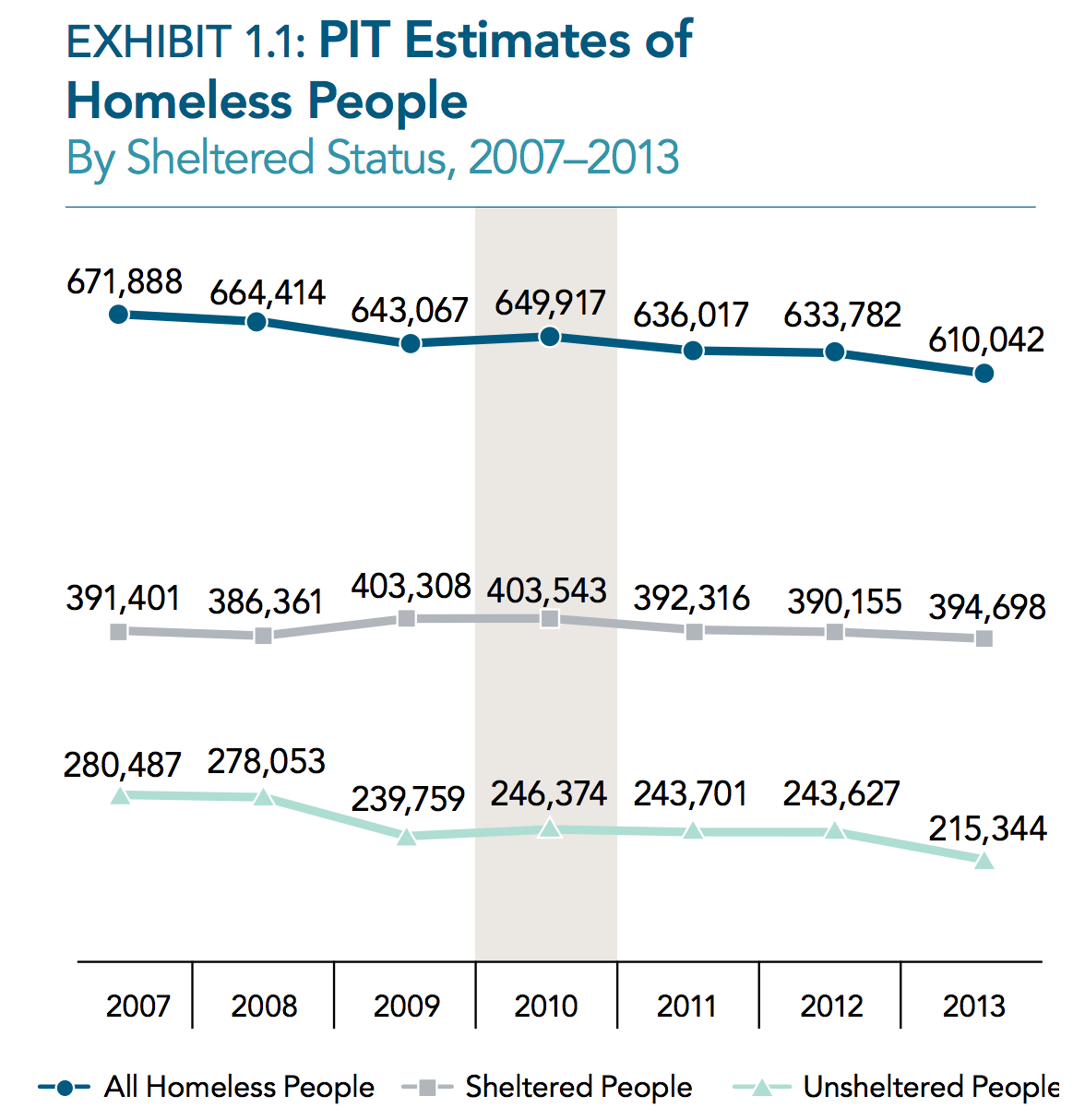
According to a recent HUD report (pdf):

Homelessness

Khimm considers the possible reasons for this decline:

Over the last 10 years, the federal government has funded more than 100,000 housing placements for chronically homeless Americans under an initiative called “Housing First” that President Bush began early in his presidency and that President Obama continued, according to Dennis Culhane, a social policy professor at the University of Pennsylvania. State and local officials across the country have now embraced such strategies.

During the financial crisis, Obama redoubled efforts to combat homelessness, putting $1.5 billion in the stimulus for programs like “rapid re-housing,” which moves people out of shelters and into permanent housing as soon as possible. With bipartisan support from Congress, Obama has vastly expanded housing vouchers for homeless veterans, whose numbers have dropped 24% since January 2010.

Plumer worries that this trend will reverse:

There were huge increases in homelessness in some cities last year. Los Angeles saw a 27 percent jump in homelessness in 2012, while New York had a 13 percent increase. (New York City’s homelessness is now at levels last seen during the Great Depression.) Those two cities alone account for nearly one-fifth of all homelessness in the nation.

The Department of Housing and Urban Development has also warned that budget cuts from sequestration could further strap various housing programs. This year, the agency is set to announce a 5 percent cut in federal funding for programs to help the homeless, due to budget constraints.

Danielle Kurtleben casts doubt on the report:

“I think the numbers are questionable,” [Maria Foscarinis, executive director of the National Law Center on Homelessness & Poverty] says. “I don’t think that they can be viewed with a lot of confidence.” Foscarinis characterizes the government’s total count of the homeless as “far off,” though she is hesitant to speculate as to what the real count might be, only that it is much higher than the government says.

A number of aspects of the report make her doubtful. One is the department’s method of counting – having localities choose a night in January (when the cold is most likely to send the homeless to shelters) and conduct their sampling. This means missing the total number of people who become homeless in a year, she says, favoring instead a “point in time” estimate. In addition, different cities might conduct their counts differently, Foscarinis says.

A HUD spokesman says the department stands by its numbers, though he adds that even the number of volunteers available to count can make a difference in a city’s estimate.

What’s Wrong With Majority Rule?

Bernstein wants to save what remains of the filibuster:

Regardless of issues and partisanship, there are a number of reasons many Senate insiders, observers and scholars tend to support a chamber that retains the influence of individual senators, but rather than go through all of those, I’ll use a shorthand argument: Have you actually looked at the House of Representatives lately? Do we really need a second body organized that way?

Scott Lemieux counters:

The problems with this argument are that 1)the Senate looking more functional is a historical anomaly, and 2)House dysfunction is not caused by its majoritarian structure. Indeed, if Tea Party House Republicans had an effective veto like they would in the Senate it’s not clear that the planet Earth would exist anymore. Certainly, there would be not only no debt limit extension but no ACA, no repeal of DADT, and no stimulus, among many other things.

Binder thinks the odds of future reforms have spiked:

Whereas the Senate’s past institutional path dependence has repeatedly put major reform out of reach, the Senate’s post-nuclear path dependence makes future reform far more easy for a cohesive and frustrated majority.  I doubt the Senate will ever “become the House,” not least because key constitutional differences between the chambers (staggered elections, state representation, six-year terms and so on) cannot be waived by majority vote.  But my hunch is that Democrats’ nuclear precedent this week reshaped the path of future reform.   To be sure, majorities must be willing to pay the costs of such reform, but those costs fell sharply and significantly this past week in the Senate.

Masket agrees with Binder that the Senate won’t become another House:

[E]ven a Senate run under uniform principles of majority rule would behave very differently and serve very different constituencies than the House would. Legislation would still receive a thorough airing prior to becoming law, and there would still be a bias against action in the federal government. The main difference would be that the minority party would be largely dealt out of the game.

Eric Posner worries about killing the filibuster:

When progressives stop cheering, they may remember that they are historical opponents of majority rule. It was “tyranny of the majority” that produced racist laws in the South or, if you want, the federal Defense of Marriage Act. Conservatives also traditionally objected to majority rule. For them the problem was the tyranny of the property-less majority that resulted in laws that repudiated debts, violated contracts, and expropriated property before the ratification of the Constitution put a stop to all of this. Along with the two-chamber structure, fear of unconstrained majorities on both sides of the political aisle explains many more features of the American political system—the presidential veto, federalism, the rise of judicial review, and, yes, the voting rules in the Senate.

He also urges readers to “remember Jim Crow in the South, and the many decades disenfranchised African-Americans spent as electoral losers.” Scott Lemieux pushes back:

[T]he Jim Crow argument misapprehends the general democratic presumption of majority rule. When we say “majority rule,” we mean that the majority is generally entitled to make law if it wins a fairelection and follows agreed-upon procedures. Jim Crow and its mass disenfranchisement, to put it mildly, are not “majority rule” in any democratic sense. And it’s worse than that, the filibuster of course was a crucial tool used by segregationists to protect their anti-democratic systems from national majorities.

Drum supports majority rule:

Majority rule is fine. It works for presidential elections, it works for the House, it works for the Supreme Court, and it works in every other country in the world. “Senate tradition” is just a euphemism for “weird historical accident,” and I’d sweep the whole rulebook clean if I could. I’m keenly aware that this means the other party can do stuff if it wins elections, and that’s OK. That’s what elections are for.

Bernstein goes another round:

The thing is that there are multiple majorities on multiple issues at any one time in any legislative chamber. What parties do is structure things so that certain majorities are allowed to express themselves — and others are suppressed (meaning that in those cases, the minority wins). That’s fine; in fact, it’s better than fine, since legislatures probably couldn’t function very well without that kind of structure. But there’s no reason to assume that the party majority is the only majority that matters, or that it’s always inherently better (and more democratic) to allow the party to determine which majorities count.

And that’s without getting into the more complex question of whether majorities should always win in a democracy. I’m strongly convinced they shouldn’t (a classic example is when an indifferent majority is opposed by an intense minority).

Meanwhile, Adam Ramey calculates that killing the filibuster wouldn’t change much.

Can We Build On This Success?

Judis hopes our deal with Iran serves as a foundation for bigger agreements:

Netanyahu and some American critics of the deal with Iran have compared it to the American agreement with North Korea in 2005, in which North Korea promised to give up nuclear weapons in exchange for economic aid. North Korea subsequently violated the agreement. But a more optimistic comparison would be to the Intermediate Nuclear Forces (INF) agreement that Ronald Reagan signed with the Soviets in 1987.

Conservatives denounced Reagan for the pact. National Review called it “Reagan’s suicide pact.” Henry Kissinger charged that it undermined “40 years of NATO.” But, of course, the treaty turned out to be a prelude not only to more comprehensive arms agreements, but to the end of the Cold War. If the United States is lucky – and luck is always a factor in international affairs – the modest deal that the United States and five other nations signed with Iran could like, the Reagan’s INF treaty, be the beginning of something much larger more important, and more welcome.

Matthew Kroenig runs through various scenarios:

[T]here is the danger that the interim deal becomes permanent. (Also in this category would be the possibility that we reach a weak “comprehensive” pact that does not go much beyond the interim arrangement). This outcome should be avoided. As long as such an arrangement is strictly enforced, it would at least prevent Iran from making the final dash to a nuclear weapon, but it would leave far too much of Iran’s nuclear infrastructure in place for comfort, amount to a de facto recognition of Iran’s right to enrich, and set a dangerous precedent for nonproliferation policy. Moreover, the tough sanctions regime now in place cannot hold forever, and over time the pressure on Iran to uphold its end of the bargain will dissipate.

Gary Samore’s view:

According to the White House, the main oil and financial sanctions against Iran will remain in place during the interim deal. No doubt, the Iranians will try to exploit the limited sanctions relief to create loopholes to evade the remaining sanctions, and the U.S. will need to enforce the remaining sanctions to maintain leverage for negotiating a final deal or another interim deal. Our ability to rally international support to ramp up sanctions will depend heavily on being able to demonstrate that Iran has reneged or cheated on the agreement or is blocking diplomatic progress. Without a credible threat to increase sanctions, I doubt Iran will make additional nuclear concessions.

Jeffrey Lewis imagines a longterm deal:

[W]hen we do get around to thinking about a final deal, I hope we’ll put a lot less emphasis on this idea of “breakout” — the Iranians quickly building a bomb before the international community can do anything about it. This seems to be the popular way to think about limiting Iran’s program. The notion is helpful, but it isn’t the most important factor or a sufficient measure of any agreement. If the Iranians are going to build a bomb, they aren’t going to do it using a declared facility to make just one. The supreme leader isn’t stupid. If he has a change of heart — or a heart attack — a Tehran hell bent for the bomb will dig a tunnel under a mountain and enrich the fissile material there.

What this means is that we should be far more interested in securing access to people and facilities like centrifuge workshops than imposing arbitrary restrictions on the program. (Try this thought experiment: what if Iran announced it was closing all its nuclear facilities but, since it had no nuclear program, had no need of anymore irksome visits from IAEA inspectors? Move along, nothing to inspect here. You wouldn’t feel at all good about that brilliant achievement, would you?)

The most important point is that the supreme leader must believe that any decision to exercise his bomb option — an option he already has, mind you — will not remain secret for very long. That will reinforce what I am sure is his sincerely held religious aversion to nuclear weapons.

Diplomacy Was Our Best Option, By Far

In response to Netanyahu’s opposition to the new Iran-US deal, Kerry argued that the deal is good for Israel:

Ben Birnbaum considers what would have happened if Israel bombed Iran:

I wrote a couple weeks ago that Netanyahu was probably reconsidering his previous decisions not to strike Iran at a time when Ahmadinejad was still the face of the Iranian regime and when Barack Obama was still concerned with re-election. But it is worth considering where Israel would be had Netanyahu gotten his way in 2010, when his cabinet first seriously debated a strike on Iran. As Ha’aretz’s Amir Oren rightly put it, “if Netanyahu and Barack’s plans between spring 2010 and spring 2011 had succeeded, Israel would now be dealing with the wounds of the first Iranian war and preparing for the second, while Iran’s efforts to build a nuclear bomb would be about to finish.”

Another top Israeli security figure recently noted to me that if the deal taking shape in Geneva were to forestall a nuclear-armed Iran for a couple of years, it would be almost as effective as an Israeli military strike—with none of the consequences, of course. Compared to the current situation, the Geneva deal does not clear that bar. But compared to where the Iranian program would be six months from now without a deal, it could come close.

Beinart dismisses Netanyahu’s complaints:

If Netanyahu and company have no better strategy for preventing an Iranian nuke, why call Obama’s deal a Munich-style surrender? Because that’s their name for any diplomatic agreement that requires Western compromise. For Netanyahu and his American allies, it’s always 1938, because if it’s not 1938 and your opponents aren’t Neville Chamberlain, then you’re not Winston Churchill. And if you’re not Churchill, you’ve got no compelling rationale for wielding power.

Marc Tracy ponders Netanyahu’s antics:

So what explains Bibi’s continued, vocal opposition? He has never seemed less powerful (and nor, not incidentally, has the vaunted “Israel lobby”). It actually happened: The Obama administration actually did the thing Netanyahu most didn’t want it to do, even if his (and ally-of-convenience Saudi Arabia’s) noisy, and totally valid, lobbying on behalf of his own country surely drove the negotiators to drive a harder bargain. There is the all-politics-is-local angle: Having just sustained a major defeat on his signature issue, Netanyahu’s Israeli rivals, on left and right, correctly smell blood in the water. He wants to ensure that the House of Representatives and the Senate—which traditionally look upon Israel’s (and Netanyahu’s) views far more favorably than the president—keep up the threat of further sanctions, which would scuttle the deal almost by definition. But so far, the talk on Capitol Hill, while extremely skeptical of the agreement, is of readying further sanctions if Iran fails to live up to its end of the deal. That is a lot different from passing sanctions now, and actually should in theory make the deal more likely to work, and to lead to a subsequent deal.

Jeffrey Goldberg, who is skeptical that a longterm deal is possible, nevertheless supports our diplomatic efforts:

[T]he U.S. might just have to walk away because there isn’t much proof that Hassan Rouhani, the putatively reformist new Iranian president, or the foreign minister, Mohammad Javad Zarif, are authorized by the Supreme Leader, Ayatollah Khamenei, to actually agree to a meaningful deconstruction of the nuclear program. Strategic pauses are fine, but actual dismantling? It seems hard to believe, for any number of reasons, the simplest one being that it is in the best long-term interest of the regime to have the means to quickly build a nuclear weapon. It’s certainly not in the interest of the regime to agree to be disarmed by the U.S., its arch-enemy and the country still often referred to as the Great Satan.

So everything that has happened over these past months may not amount to anything at all. Contra Netanyahu, who unrealistically seeks only total Iranian capitulation, it isn’t stupid for Obama to find out for sure what, if anything, the Iranians are willing to give up for good.

Hathos Alert

A quarter-century after the release of Cannibal Tours, Dennis O’Rourke’s documentary about global tourism, Rolf Potts draws a few recent parallels:

Though Cannibal Tours was never meant to be taken as comedy, its more memorable scenes have a cringe-inducing quality that calls to mind the delicious discomfort of watching Curb Your Enthusiasm or The Office. In basic narrative terms, the documentary depicts a meandering series of interactions between luxury liner tourists and the Papuans who live in various Sepik River villages. What the film lacks in plot arc, however, it makes up for in awkward tension as it probes the mutual suspicion and misunderstanding that arises when wealthy outsiders visit once-primitive communities in a far-flung corner of the world.

Potts describes the movie’s “most iconic moment” (seen above):

As the sweaty white folks wander around snapping photos and haggling for souvenirs, a handsome young Papuan tribesman speaks to an offscreen interviewer, earnestly explaining what he thinks of the outsiders. “When the tourists come to our village, we are friendly towards them,” he says, his words translated in the subtitles. “They like to see all the things in the village. We accept them here.” While he’s saying this, an elderly German woman wearing high-hitched khaki trousers and silver horn-rimmed spectacles creeps into the background, fumbles with the settings on her camera, and — oblivious to what the tribesman is saying — snaps a picture of him before scuttling back out of the frame. Upon initial viewing, this interaction seems to perfectly encapsulate the strained guest-host dynamic portrayed in Cannibal Tours: even as the Sepik native takes pains to affirm the humanity of tourists, the tourist’s first instinct is to treat him like scenery.

Watch the full documentary here, if you must.

Internet Language FTW

Prospero’s R.L.G. isn’t worrying about technology’s transformation of common parlance:

When words and phrases mutate, they do so in order to fill some niche that needs filling. Often, that change involves taking a formerly powerful word or phrase (“awesome“, “oh my god”, “what the fuck”) and turning it into a wry comment (“If you could stop tapping your foot, that would be awesome”; “My boss was in a weird mood all morning and I was like WTF?” “OMG this cheesecake is amazing.”) This is why people actually speak “OMG” and “LOL” out loud, though they are no shorter than the phrases they replace. (“WTF” takes even longer to say than “what the fuck”.) As organisms adapt to ecological niches, so do new bits of language.

What are the long-term effects of all this?

We might see language littered with ever more phrases born of keyboard brevity. Another intriguing possibility involves the rise and spread of speech-to-text technology. One quirk of these systems is that they require speakers to enunciate punctuation and other typographical manoeuvres. (Eg: “Are you coming tonight question mark;New paragraph on another point, I’d like to mention that…”) As speech recognition software improves, we might go from language designed for a tiny keyboards entering our speech (people speaking “OMG” out loud), to language designed for speech recognition software entering our speech (people speaking “new paragraph” out loud to signal a change in topic). Such spoken punctuation would probably find the same special niche function as “WTF” and “LOL” have today. “Wow, I can’t wait to read your screenplay exclamation point” would mean something quite different from “Wow, I can’t wait to read your screenplay!”—namely, semi-ironic detachment.

The Rise Of The Anti-Ads

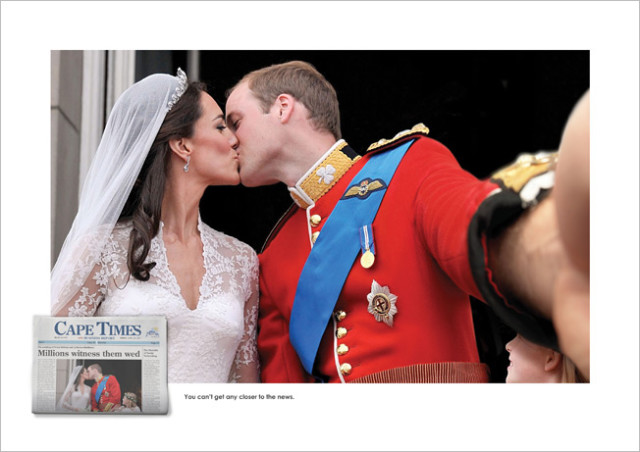
cape-times-selfies-3-640x452

Adam Corner traces how advertizing agencies co-opted anti-consumerism and irony to create more effective copy. He writes, “It seems almost quaint, now that popular culture is riddled with knowing, self-referential nods to itself, but the aim of advertising used to be straightforward: to associate a product in a literal and direct way with positive images of a desirable, aspirational life”:

Genre-subverting ads started to emerge as early as 1959, when the Volkswagen Beetle’s US ‘Think Small’ campaign began poking fun at the German car’s size and idiosyncratic design. In stark contrast to traditional US car adverts, whose brightly coloured depictions of gargantuan front ends left the viewer in no doubt that bigger was better, the Beetle posters left most of the page blank, a tiny image of the car itself tucked away in a corner. These designs spoke to a generation that was becoming aware of how the media and advertising industries worked. The American journalist Vance Packard had blown the whistle on the tricks of the advertising trade in The Hidden Persuaders (1957), and younger consumers increasingly saw themselves as savvy. Selling to this demographic required not overeager direct pitches, but insouciant ‘cool’, laced with irony.

In subsequent decades, self-aware adverts became the norm, and advertising began to satirise the very concept of itself.

In 1996, Sprite launched a successful campaign with the slogan ‘Image is nothing. Thirst is everything. Obey your thirst’. In 2010, Kotex sent up the bizarre conventions of 1980s tampon adverts (happy, dancing women, jars of blue liquid being spilt) by flashing up the question ‘Why are Tampon adverts so ridiculous?’ before displaying its latest range of sanitary products.

‘Companies try to convince you that they are part of your family,’ says Tim Kasser, professor of psychology and an expert on consumer culture at Knox College in Illinois. ‘They want to create a sense of connection or even intimacy between the viewer and the advertiser. An ad that says: “Yes, I know you know that I’m an ad, and I know that you know that I’m annoying you” is a statement of empathy, and thus a statement of connection. And as any salesperson will tell you, connection is key to the sales.’

Copyranter, from his new perch at Vice, recently examined this phenomenon on a more meta level:

The purpose of an advertising agency’s existence is to advertise things. You would think, then, that they would be great at advertising their own services. That is not the case. In fact, ad agencies, even the so-called “creative” ones, are nearly, universally terrible at it. Not just not good—terrible. They do things like create insipid videos that make you wonder why the place is still in business, or create ads that are pathetically derivative or pointless or laughable or worse—look like they were created by a 10-year-old boy. But, if you really want to show potential clients how edgy you are, you make your employees pose nude in space helmets, and without a whiff of irony call it “The Creative Influence.”

The above ads and ideas were all hatched by big or “hot” shops. Which is just sad. However, there is one agency that seems to have at least a clue: john st. in Toronto.  For several years now, john st. has released videos that perfectly mock a current advertising trend. Mocking advertising trends is like bashing a dead horse in the face. But doing it memorably and originally and as an insider is another thing.

The latest example from john st.:

Previous Dish on various advertising strategies here, here, and here.

(Image: An ad for South African newspaper The Cape Times, part of a series turning iconic photos into selfies, via Laughing Squid)