The Father Of Christian Theology

dish_paul

N.T. Wright, the Anglican clergyman and scholar, just published a 1700 page, groundbreaking exploration of St. Paul and the origins of Christianity, Paul and the Faithfulness of God. One point the book makes, and that Wright emphasizes in an interview about his book, is that Paul basically invented the notion of “Christian theology”:

For me, as for many people, ‘theology’ used to have a rather dry, abstract sound – arranging ideas in clever patterns but without much linkage to real life. With Paul all that is different. Paul was a man of action, believing that it was his God-given vocation to found and maintain communities loyal to Jesus right across a world owing allegiance to Caesar. But these communities were bound together by no social ties and indeed cut across normal social divisions. How could they be united and holy? Paul’s answer was: through prayerful, scriptural meditation on who God actually is, who God’s people are, and what God’s future is for the world. That is a kind of working definition (though I come at it in the book from several angles). These were essentially Jewish questions, but ‘theology’ in the new way Paul was doing it was something the Jewish people hadn’t needed to do – and something the non-Jewish world (for whom ‘theology’ was simply a branch of ‘physics’, the world of ‘nature’) hadn’t needed to do either. This kind of theology is a never-ending exploration – each generation has to do it afresh in its own context, and Paul gives us the tools for that rather than a set of pat ‘answers’ which mean that people don’t thereafter have to think.

Peter J. Leithart, who is making his way through the text, picks up on the same theme:

[O]ne of [Wright’s] most interesting suggestions … is that Paul gives a place to “theology” – to prayerful reflection on the nature of God and His works – that is unprecedented in either Judaism or paganism. The reason, he claims, is that Paul set about the redefine everything he inherited in terms of Jesus (this another theme from earlier work): He preached a Christological monotheism, retold Israel’s story in terms of its fulfillment in Jesus, redefined the people of God around Jesus and the Spirit, hoped for a future shaped by the death and resurrection of Jesus. In order to achieve this redefinition, he had to give a more thorough and “systematic” account of God than was common in the religions around him. Theology takes on a “symbolic role” in Paul that it never had before.

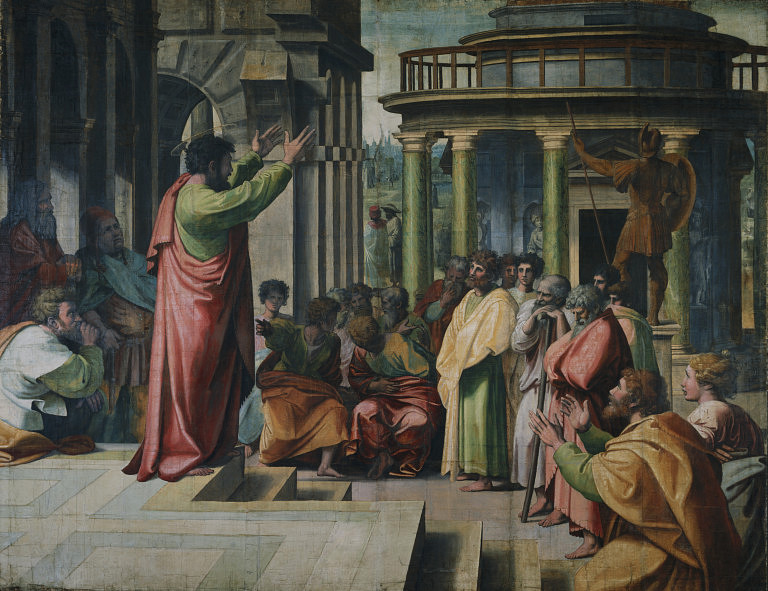
(Image of Raphael’s St. Paul Preaching in Athens, 1515, via Wikimedia Commons)

At Peace With Doubt

Kyle Cupp, author of the new book Living by Faith, Dwelling in Doubt, describes how he’s come to be thankful for his religious doubts, holding that they can “become the building blocks of faith, giving to faith its structure, shape, and power”:

I have my doubts about God, still, especially in stillness and in quietude. I probably wouldn’t make a good monk. There are times when I feel the close presence of a being I want to call God, but these experiences tend to come when I’m not looking for them, when I’ve forgotten myself: chasing my giggling children around the house, scouring one bathroom of mold and rotting caulk while my wife cleans the other, lying down with closed eyes listening to her read poetry. It’s in these simple moments that I sometimes feel as though the love I experience is bigger than I am, almost as though I’m bathed in a spirit that unites me to every love across the universe. Later I’ll make the mistake of getting all theological about God, a point at which God seems to vanish and I’m left with cold formulas that sound lofty but say almost nothing to me.

I’m not sure I’d have it any other way. God is described, ironically, with the term “ineffable,” a word that deconstructs every doctrine we formulate. It indicates the infinite distance between the words and formulas we use to describe God and whatever it is to which they refer. Between our finite words and an infinite God there’s a lot a room for uncertainty. A lot of room for doubts. An endless space for questions and conflicts of interpretation.

In a Q&A about his book, Cupp mentions that he learned early on to deal with religious ambiguity and uncertainty – he was the product of a mixed faith marriage, one parent Buddhist, the other Catholic:

If I were a character in a novel, talking a lot about the uncertainty at the heart of my faith life, the early childhood experiences of a mixed religion household and divorce would make a credible back story. The world of my home began as place of irreconcilable differences. I learned the behavior of trust from my parents, but this trust always meant believing in two people who didn’t agree on matters heavenly and earthly.  Trusting them meant living in tension. Looking back, I think I made peace with this tension. As an adult, when I’ve had my moments of doubting God’s existence or wondering whether any of the stuff said about God really corresponds to something out there, I haven’t felt an overwhelming need to get hold of final answers. You might say I’m at peace with my doubts—with the tension between belief and unbelief in my faith. It’s not that I don’t struggle, but that I feel at home in the struggle.

Dissecting Disgust

Jeanette Bicknell considers whether physical and moral revulsion are essentially the same:

According to [author of Don’t Look, Don’t Touch, Don’t Eat: The Science of Revulsion Valerie] Curtis, moral disgust evolved out of physical disgust and originally served the same purpose of infection avoidance. We need to interact with others, but we don’t want to risk contamination with their bodily fluids. So we work out a system of manners and rules so that we can interact without contamination. This is the beginning of morality, says Curtis. We are disgusted by social “parasites” just as we are by sources of (literal) disease and infection. Our disgust at immoral behavior makes us shun perpetrators, who in turn become ashamed and less likely to break moral rules in the future.

Psychologist Paul Rozin has defended a different view.

According to him, disgust is deeply connected with the ideas of contagion and contamination rather than with genuine sources of disease. For example, Rozin and his colleagues found that adults would not eat chocolate that had been formed into the shape of dog feces. The disgust aroused by poop was transferred onto the harmless (and delicious) chocolate. According to Rozin, the things that disgust us are not only those that might make us sick, but also those things that remind us of our animal nature. Humans eat, excrete, and copulate like other animals. Yet we are deeply uncomfortable with the idea that we are, in fact, animals, and like all other animals, we’re destined to die. Disgust functions as a “defense mechanism” to keep awareness of our animal nature and our mortality at bay. Once disgust is in place as a “guardian” of the physical body, it can be elicited not only by things that could make us ill, but by very different kinds of stimuli. Each human culture “co-opts” disgust, says Rozin, and projects the emotion onto people and behavior it considers immoral, even if they present no significant risk of disease.

Related Dish on the subject here.

The Logic Of Addiction

Clancy Martin believes that Michael Clune has captured it in his “terrific memoir White Out“:

Any addict can give you a hundred reasons why he should quit, tell you dozens of stories that would make any other person quit. But the decision to quit and “what would make you stop” are two very different things for the addict. Here’s how Clune—now an associate professor of English at Case Western Reserve University, and “clean for over a decade”—describes one of his own attempts to kick heroin: “(a) I had made a promise to myself to quit dope, (b) it was bad for your heart to quit too abruptly, (c) my rear window was all smashed in, and (d) if I was ever going to get moving with quitting, I needed to get high right now. Right this very second.”

“Blackout” is a metaphor for the alcoholic’s relationship with alcohol; “white out,” in Clune’s memorable phrase, is the junkie’s analogous space of cognitive emptiness surrounding the question of heroin. “I sing the song because I love the man / I know that some of you don’t understand,” Neil Young sang about heroin addicts. What the non­addict doesn’t understand, perhaps cannot ever really believe, is that a sentence like “if I was ever going to get moving with quitting, I needed to get high right now” makes sense in addict-logic.

A blackout or a white out is the brain’s way of telling the drug: You win. You’ve got the wheel. Aristotle analyzed the philosophical problem of why anyone would willingly choose an action other than the good one (first posed by Plato in Protagoras) as akrasia, and we usually translate this as “weakness of will.” But what he actually argued is that akrasia is a failure in reasoning that comes from a kind of powerlessness in the brain. Clune identifies the failure more precisely: It’s a “memory disease.”

(Video: Neil Young performs “The Needle and the Damage Done”)

Remembrance Of Things Proust

One hundred years ago this week, Proust published Du côté de chez Swann (Swann’s Way), the first volume of À la recherche du temps perdu (In Search of Lost Time). Richard Lea ruminates on what draws Proust aficionados back to the seven-volume novel again and again:

The memories that the narrator recalls over the course of seven volumes include childhood anguish in the country, an intrigue with a courtesan, a portrait of high-society entertaining, an exploration of fin de siècle gay life, a relationship doomed by jealousy and more and more and more. It’s a novel so voluminous, so capacious, so complete you can spend weeks, months or even years submerged in its crystalline waters. When you surface – gasping a little from the spectacular dénouement – you find that the world you have just left seems big enough, mighty enough to encompass the world around you, to measure up to life itself. For about a year or so after I finished Le Temps retrouvé I couldn’t read another novel without thinking Proust had written it already. It’s a universe that you are obliged to explore at the languid pace of Proust’s serpentine prose, snaking from enumeration towards explication, from description into deviation.

If you’ve attempted to crack the novel and been turned off, you’re not alone, as Adrian Tahourdin recounts:

As is well known, André Gide turned the novel down for the [literary magazine] Nouvelle Revue Française, thinking it, on the evidence of the sections he skimmed, the work of a snobbish dilettante – a decision he was to regret for the rest of his life (and a lesson to all publishers’ readers maybe); by 1918, he was writing in his Journal of “Proust’s marvellous book, which I was rereading”, almost as if in a quest for private redemption for his earlier misjudgement.

Fortunately another publisher, Bernard Grasset, stepped in. William Carter writes in his mammoth and invaluable Marcel Proust (2002) that Grasset regarded the publication of Proust’s work as a “business deal” and had tried to read it “but found it impenetrable”. He told a friend “it’s unreadable; the author paid the publishing costs”.

Colin Marshall marks the centennial by digging up a letter from a 16-year-old Proust to his grandfather, pleading for 13 francs to cover a disappointing visit to a brothel:

I so needed to see if a woman could stop my awful masturbation habit that Papa gave me 10 francs to go to a brothel. But first, in my agitation, I broke a chamber pot: 3 francs; then, still agitated, I was unable to screw. So here I am, back to square one, waiting more and more as hours pass for 10 francs to relieve myself, plus 3 francs for the pot. But I dare not ask Papa for more money so soon and so I hoped you could come to my aid in a circumstance which, as you know, is not merely exceptional but also unique. It cannot happen twice in one lifetime that a person is too flustered to screw.

Also in commemoration, The Public Domain Review has assembled a collection of works of art mentioned in Swann’s Way. Previous Dish on Proust here, here, and here.

Burying The Hatchet Job

Buzzfeed’s new books editor, Isaac Fitzgerald, made waves when he announced that the site won’t publish negative reviews:

He will follow what he calls the “Bambi Rule” (though he acknowledges the quote in fact comes from Thumper): “If you can’t say something nice, don’t say nothing at all.” … “Why waste breath talking smack about something?” he said. “You see it in so many old media-type places, the scathing takedown rip.”

Tom Scocca snarkily suggests that Fitzgerald’s background in publicity might have something to do with his editorial attitude:

Publicity is a job where you try to help people become interested in books and feel positively toward them, so that they buy books and the books’ authors feel successful and everyone enjoys things very much. In some sense, it could be argued that the publicist is the best friend that books have. Now BuzzFeed will also be a good friend to books. This is very nice news.

Eric Levenson insists that “everyone loves a good takedown,” and Paul Constant argues that “with self-publishing exploding and publishers catering to a more and more insular audience, we need negative book reviews more than ever.” Scott Lemieux finds Buzzfeed’s policy “bizarre,” writing that “opposing negative reviews as a blanket policy is just indefensible, of service to nothing but advertising revenues”:

For example, consider Dwight Garner’s review of a new book about fracking this week. It’s a fine piece of writing in itself, and for people who might consider purchasing the book the fact that it’s badly written and doesn’t make any serious effort to deal with many of the issues surrounding fracking seems worth noting. I’ve linked to it before, but consider also Ruth Franklin’s superb essay about Freedom. Again, it needs no further justification for being published than its own excellence. And beyond that, it makes valuable explicit and implicit contributions to a major ongoing debate within the culture. When critics hail the book as a masterpiece without noticing or (caring) about things like the fact that the memoir-within-the-novel written by the character we’re told again and again is a nonverbal jock is in nearly the same voice as the rest of the novel, or that the novel’s answer to the question of What Women Want is “to have sex with the thinly-veiled stand in for Jonathan Franzen,” this seems worth knowing. Particularly when one of these critics was editing the New York Times book review at the time and was facing justified criticism for gender double standards.

Maria Bustillos joins the debate, writing, “The reader who disagrees clearly and well is the greatest treasure of all. How else can we progress? What else is the point of all that hard work?”:

I find the very idea that one should “respect” the authors of books by publishing only positive reviews to be absurd. I think that, rather, the exact opposite must be true: real respect means having balls enough to publish the unvarnished results of a close reading. No adult author writes for praise alone. Surely any serious writer writes because he has an urgent message to impart, one that he hopes will be of some use to the reader. I don’t know the origin of the idea that writers are such delicate creatures, barely able to withstand public scrutiny of their genius, but it seems ever-present.

The respectful critic, then, is the critic who, to borrow [Heidi] Julavits’s phrase, “reads hard.” He brings the results of his researches, whatever they may be, to interested readers who can then take his views and use them to begin compiling their own. If we accept that the making of meaning is a collaborative process between artist and audience, then the value of honest criticism becomes immediately apparent. Dialogue is what counts: praise or blame are similarly irrelevant.

One For The Road

dish_sunset

In an engrossing mini-travelogue, Laura Barton traverses the “boulevard of broken dreams”:

When we mention that we are walking the length of Sunset [Boulevard], people look at us in disbelief, assuring us that it was not only dangerous but most definitely weird. At street level, though, you see more: an IBM laptop in a discarded takeaway box holding seven prawns; two men dancing in the back room of a salsa club; the words “Love Is What You Make It” scrawled across a wall. You catch the faded incense as you walk past the Church of the Blessed Sacrament, see Jayne Mansfield’s pink suitcase displayed in the window of the Dearly Departed Tours Office and Curiosity Shop, with a sign beside it instructing you to “note the damage”. …

To walk Sunset is to be struck not only by the deliberately outlandish characters but by the many mentally disturbed people on its sidewalks: the woman rooting through bins who growled on approach, the man masturbating in a car park, the slink-eyed souls muttering darkly to themselves on street corners. Then there was the peculiar encounter not far from the intersection with La Brea Avenue, as a normal-looking young man hurtled towards us on a skateboard.

He was bare-chested, carrying a guitar and eating an ice cream, and it was only as he drew close that we saw something fractured in his eyes. “Save us!” he barked as he skated by. “Before they all kill us!”

And if the air soured then, it was just as suddenly sweetened by the chirruping of a man sitting among the plants on the verge, his hair a tangle of ribbons and purple plastic, swigging Bud Light from a large water bottle. “I’m in the penthouse!” he called brightly. It would be wrong to say we had a conversation. He spoke as if a string had been pulled to make him talk. Why had he come to Los Angeles, I asked, and he gave a disconcerting grin. “I’m tropical, like a dolphin!” he hollered. “You don’t put it in the snow!” He propositioned us, and upon our polite refusal he launched into Carly Simon’s “You’re So Vain”. We all sang it, from start to finish, there on the sidewalk.

(Photo by Flickr user misterbutler)

The End Of Trans Fat?

The FDA is preparing to ban partially hydrogenated oils (PHOs), the major source of trans fats in processed food. Jonathan H. Adler spots an irony:

[T]here was a time when groups like the Center for Science in the Public Interest were urging fast food chains and others to replace animal fats with PHOs. So while CSPI today praises the FDA for targeting trans fats, it also celebrated decisions by fast food chains like Burger King to start using trans fat-heavy PHOs. In other words, had it not been for the food nannies, American consumption of trans fats might not have been so high in the first place.

David Harsanyi has questions:

The question you usually get in this debate goes something like this: Isn’t it government’s job to protect people from corporate malfeasance and dangerous products? Sure. But how far should government go to protect people from themselves? Trans fats are unhealthy, they aren’t hazardous. That’s a vital distinction that has been persistently muddled by groups that have spent decades trying to normalize the idea that someone else should be controlling what you eat.

Ira Stoll sees inconsistencies:

The FDA says the “trans fat” in old-fashioned margarine causes heart attacks. But plenty of other things also cause heart attacks that the Obama administration has not yet prepared to ban.

Television causes heart attacks by encouraging sitting around on the couch and watching it rather than exercising. Cigarettes cause heart attacks. The Burger King Triple Whopper Sandwich meal will give you a heart attack. Too much Ben & Jerry’s Chocolate Fudge Brownie ice cream will give you a heart attack.

Yet the FDA has it in for margarine, not for hot fudge sundaes or television or even Triple Whoppers, all of which would, under the FDA’s proposed action, remain legally available for sale, unlike margarine. … Beyond the inconsistency of it, there’s the failure to accommodate individual preferences. Margarine use in my family was a consequence in part of the Jewish religious prohibition on mixing milk and meat. If you wanted a baked potato with your steak or a chocolate chip cookie for dessert, using margarine rather than butter was the kosher approach. Other margarine consumers may be vegans for philosophical reasons involving animal rights.

Denmark imposed a strict limit on trans fats in 2003. For perspective on the current debate in the U.S., Scientific American talked to Steen Stender, a Danish trans-fat expert who lobbied for the law:

How did industry respond?

Some bakers said that what you call a “Danish” can’t be made in the right way anymore, that we can’t get it to flake in the right way. Then one baker from one of the supermarket chains found that if he used a very meticulous scheme of temperature control during incubation of the fat and other ingredients at just the right temperature and time, he could make Danishes without any trans fat. This company put up a big poster saying “Have a Danish, we are baking for your heart without trans fat.” And in no time other bakers put up signs in their windows saying, “We are baking for your heart without trans fat.” So the industry went along with this initiative.

Lipitor Can’t Carry Big Pharma Forever

The industry is increasingly focused on developing treatments for uncommon ailments:

There’s good reason for big pharma’s attraction to rare disease treatments. Revenue from these products has been outpacing sales of mainstream drugs for the last decade, a trend that’s expected to continue for the next 30 years, continuing a trend from last decade. So-called “orphan drugs” (given this moniker because they are for diseases that historically were overlooked by the big drug companies) are protected against competition from generics for seven years in the US, compared to five years for non-orphan products.

The approval process for orphan drugs is also often fast-tracked, lessening the risks of lengthy, expensive and failed developments. Since 1983, when these advantages and generous tax credits for orphan drugs were introduced in the US, an estimated 350 drugs for 200 rare diseases have been approved by the US Federal Drug Administration.  No doubt this has improved countless lives, even if Botox (originally a treatment for uncontrollable blinking and spasms, but now largely used for Cosmetic purposes) and Cialis, the erectile dysfunction product, were both originally awarded orphan status.

But John McDuling warns that trouble may lie ahead:

Insurance companies in the US are typically willing to reimburse the costs of orphan drugs, because they are by definition rarely used, they tend to address life threatening treatments, and they are often prescribed to children and young adults, two groups that are predominantly healthy and therefore usually covered. But this policy could change as more money flows into the sector, attracted by the fat profits on offer, and more rare disease treatments are unearthed.

The are rising concerns that orphan drug treatments could be driving up the costs of healthcare for everyone. Already in Europe, where health care is universal, but public finances are stretched, governments are questioning high reimbursement rates for rare disease treatments.  As the world’s biggest economy struggles to reform its own absurdly expensive healthcare system, orphan drugs could soon be in the line of fire in the US as well.

The Other Victims Of Gun Violence

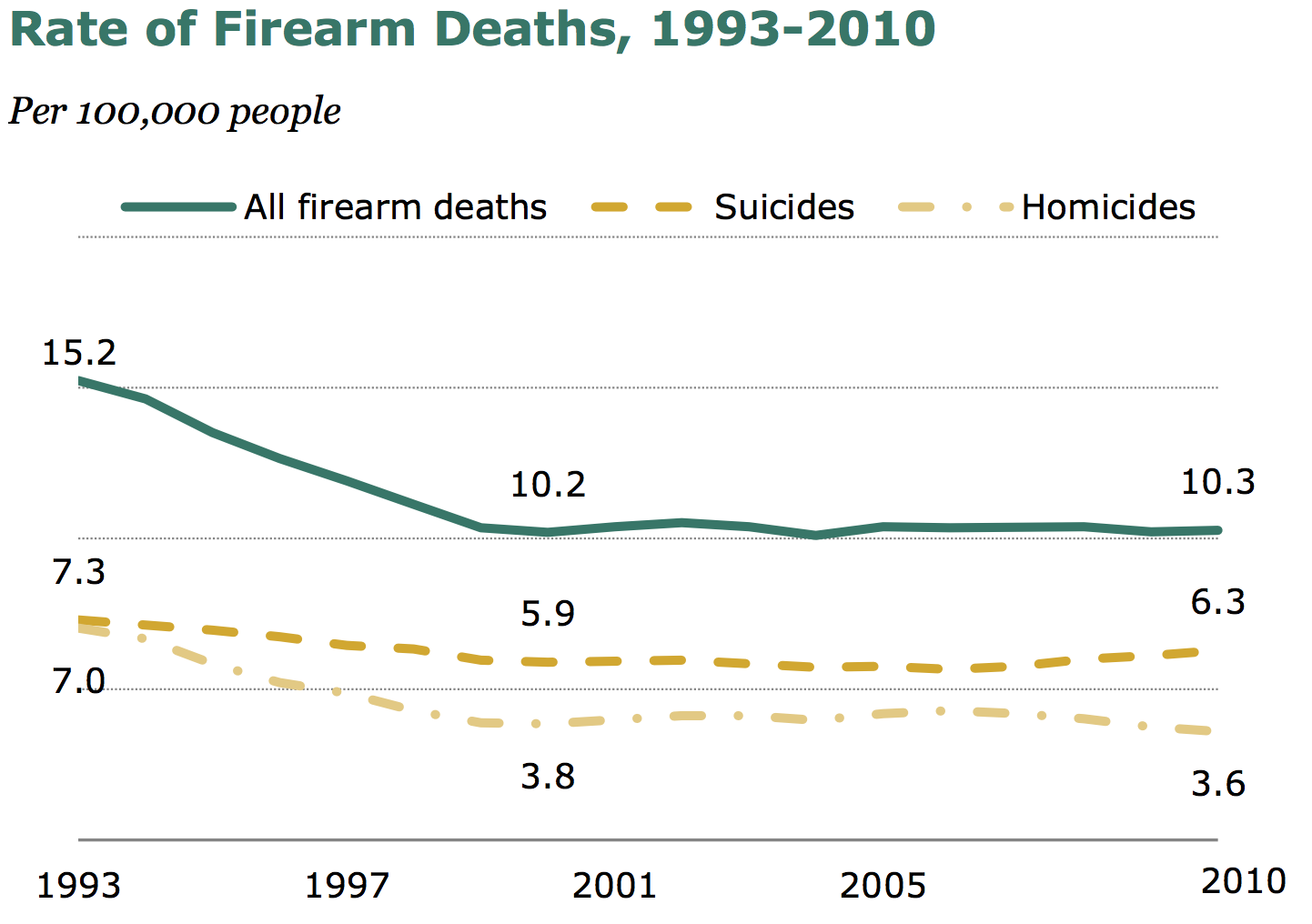
Firearm Deaths

McArdle urges people with depression to “exercise their Second Amendment right not to have a gun in their home”:

[M]any people who attempt suicide are possessed by a transient impulse. In one landmark study, the majority of people who were prevented from jumping off the Golden Gate Bridge were either alive years later or had died of natural causes …. So people who have had major depressive episodes in the past might be well advised to avoid gun ownership or put their guns in the care of a trusted friend. And folks who have recently gone through a horrible life event (job loss, bad breakup or the death of a loved one) would be well advised to get the guns out of the house until they’ve recovered from the blow.

In a recent study, Alex Tabarrok found that each 1-percent rise in gun ownership rates is correlated with a .5- to .9-percent increase in suicides. And it appears the former causes the latter:

If suicides and gun ownership were being driven by a third factor, we would expect gun ownership to be correlated with all suicides – not just gun suicide. What we find, however, is that an increase in gun ownership decreases non-gun suicide. From an economics perspective, this makes perfect sense. … Substitution among methods is not perfect, however, so when gun ownership decreases we see a big decrease in gun-suicide and a substantial but less-than-fully compensating increase in non-gun-suicide – so a net decrease in the number of suicides.

Our econometric results are consistent with the literature on suicide which finds that suicide is often a rash and impulsive decision – most people who try but fail to commit suicide do not recommit at a later date. As a result, small increases in the cost of suicide can dissuade people long enough so that they never do commit suicide.

Previous Dish on guns and suicide herehere, and here.

(Chart from Pew.)