An Opera For The Internet Age

Geoffrey O’Brien is impressed by millennial composer Nico Muhly’s new opera, Two Boys, a whodunnit set in early 2001 and centered around the intrigue of IMs:

It is hard to imagine anything less songlike than the terse and truncated utterances of an anonymous Internet chat room, or indeed of an environment less suggestive of music than the Internet itself. The Net’s openness to an infinity of destinations seems to encourage a mood of disembodiment and isolation, at least as rendered in this opera. … Two Boys challenges itself to find music in that multiconnected zone of disconnection.

The premise here—the inexplicable stabbing of a young boy by a slightly older boy he met online—is altogether grim, an anecdote (apparently, as they say in movies, “based on a true story”) that could almost serve as a cautionary tale for parents wary of their children’s computer use. The parents here are as clueless as they can be, unsurprisingly since we are at the turn of the twenty-first century, that remote period, in an implicitly drab and emotionally worn-out English urban milieu.

Anne Midgette came away less impressed:

[Muhly’s] most ambitious and innovative goal, in “Two Boys,” was to create a musical portrait of the Internet, and his best ideas came in the scenes, largely choral ensembles, where he set out to realize this, notably the chorus when Brian first enters the chat room, singing the same brief repeated phrases (“Are u there? Are u there?”) over and over, in overlapping driving patterns. Spotlights penetrated the black mesh facades of [designer Michael] Yeargan’s sets, revealing people sitting alone at keyboards, while around them the projections whirled in geometric patterns offering images of connectedness and fragmentation, images evoking helixes and atomic models and the lights of night cities seen from space, all glowing and changing and presenting the enormity and fear and exhileration of the unknown.

But the idea didn’t develop significantly, musically or dramatically or visually, beyond the first chorus, apart from the addition of elements illustrating the treacherous terrain online: Brian stumbles across a gay sex scene, adding to his mounting sense of dread and titillation and uncertainty. I don’t think Muhly quite meant to signal “Internet bad!” in such broad terms, but for all of the inventiveness of his initial idea, the opera is oddly straitlaced and old-fashioned in its depiction of online life.

Robinson Myer has more on Muhly’s ability to represent the digital world:

Here is how Two Boys represents instant messaging: Brian sits at the right side of the stage, in his room, behind his computer, and the character he’s chatting with stands at the left. Towers loom behind both of them; on the towers are the simulacra of chat windows. The words he types, and the words his companion types, appear on the towers behind both of them simultaneously. … The effect is this: We see what Brian imagines. We see the words appear on his screen, the person he imagines typing them, and the screen he imagines, too.

[Mark] Grimmer and [Leo] Warner, the designers, very much intended this. “It’s very important that the seeming reality of the situation is shown physically onstage. Brian genuinely believes he’s having these interactions with these characters,” says Grimmer. “We wanted to keep reminding people that there is something really banal about the experience of having a conversation online. It’s about letters appearing on a screen, but yet from out of that, it’s as much about imagination as it is about anything else.”


Multi-Tongued Tots

Prospero’s R.L.G. surveys research on children raised as bilingual or multilingual:

Many parents once believed that a second language was a bad idea, as it would interfere with developing the first and more important one. But such beliefs are woefully out of date today. Some studies (such as this one) seem to show that bilinguals have smaller vocabularies in each language (at early stages) than monolinguals do. But other studies (such as this one) find no vocabulary shortfall in either language. In any case, the influence of mono- or bilingualism on vocabulary size is later overtaken by the importance of education, socio-economic status, reading and writing habits. In short, there is little evidence that raising a child bilingual will hurt their primary language.

The benefits, by contrast, are both strong and long-lasting. Bilingual children as young as seven months outperform monolinguals at tasks requiring “executive function”: prioritising and planning complex tasks and switching mental gears. This is probably because monitoring the use of two languages is itself an exercise in executive function. Such studies control for socio-economic status, and in fact the same beneficial effects have been shown in bilingual children of poor families. Finally, the effects appear to be lifelong: bilinguals have later onset of Alzheimer’s disease, on average, than do monolinguals.

Previous Dish on Tim Doner, the 17-year-old boy who can speak 20 languages, here. A video profile of 12-year-old Wendy Vo, who can speak 11 languages, is seen above.

Resetting Uncle Sam’s Clocks

Allison Schrager wants the US to simplify its time zones:

This year, Americans on Eastern Standard Time should set their clocks back one hour (like normal), Americans on Central and Rocky Mountain time do nothing, and Americans on Pacific time should set their clocks forward one hour. After that we won’t change our clocks again—no more daylight saving. This will result in just two time zones for the continental United States. The east and west coasts will only be one hour apart. Anyone who lives on one coast and does business with the other can imagine the uncountable benefits of living in a two-time-zone nation (excluding Alaska and Hawaii).

She notes that our time zone system dates back to 1883 and was originally intended to make business easier for the telegraph and railroad industries:

Why stick with a system designed for commerce in 1883? In reality, America already functions on fewer than four time zones. I spent the last three years commuting between New York and Austin, living on both Eastern and Central time. I found that in Austin, everyone did things at the same times they do them in New York, despite the difference in time zone. People got to work at 8 am instead of 9 am, restaurants were packed at 6 pm instead of 7 pm, and even the TV schedule was an hour earlier. But for the last three years I lived in a state of constant confusion, I rarely knew the time and was perpetually an hour late or early. And for what purpose? If everyone functions an hour earlier anyway, in part to coordinate with other parts of the country, the different time zones lose meaning and are reduced to an arbitrary inconvenience. Research based on time use surveys found American’s schedules are determined by television more than daylight.  That suggests in effect, Americans already live on two time zones.

Intern Loans On Top Of Student Loans?

Arguing that “unpaid internships provide access only to students from wealthy families,” economist Edward Glaeser suggests making new loans available to low-income interns:

[I]t’s unrealistic to think individual private businesses will provide new skills to temporary, not-yet-qualified workers simply out of public benevolence. Throughout much of Western history, young apprentices paid to learn – either explicitly with cash or implicitly by working for little pay. … One solution might be to expand federal student loan programs to cover students taking unpaid internships, whether or not they receive college credit for them, or even recent graduates. I would set a high bar for making internships eligible for such loans, by requiring official certification of their educational quality. With a loan program in place, more widespread unpaid internships could help move young Americans toward permanent employment. Internships provide a pathway towards employment that should be encouraged – not penalized.

Jordan Weissman counters, “If you’re a broke 23-year-old, the concept of taking out debt for an unpaid internship probably sounds something like the two-headed hell-hound of your financial nightmares”:

I can sort of see how this line of thinking would develop. If you really, truly believe a dearth of skills, rather than a slow economy, is the problem hampering college graduates in today’s job market, you might see internships as a tonic. After all, Germany and other European countries run very successful apprenticeship programs that prepare young adults for careers (though those apprenticeships are paid). And if you believe the only downside to unpaid internships are the class issues, then student loans might sound like an elegant solution. We are just talking about more education. What’s so wrong with financing it?  Plenty.

To start, I’m not sure how someone can look at the state of student debt, all $1 trillion of it and change, then decide the government needs to make a whole new class of loans. Nor is it really apparent that skills are the great problem holding back BA’s, given the cyclical nature of their employment woes. Glaeser also glosses over the lack of evidence that unpaid internships regularly lead to work. … In the end, Glaeser is essentially asking government to subsidize entry level employment at for-profit companies who have realized that many young people don’t have to be paid for their work. Because that’s what internships are: work.

Which is why Dish Publishing LLC provides both pay and health insurance to our interns; good work deserves compensation. And we don’t want to cut off working-class candidates who couldn’t afford the internship otherwise. Why close ourselves off from a large segment of talent?

Update from a reader:

I wanted to write and let you know that a fairly common form of student loans for internships already exists, albeit only while you are still enrolled. I know because I had to take out a loan to afford clerking unpaid for the Orleans Public Defenders a few years ago. It’s a very desirable internship for those that are interested in public interest law (and highly recommended), an opportunity I immediately accepted.

In law school, even at a public university, I already had a lot of debt, including some from under-grad (also at a public school, in-state), so I had very little disposable income, certainly not enough to pay for rent on my lease where I went to school and also for a place in New Orleans, not to mention moving, living expenses, etc. So I took my law school’s internship class for credit over the summer while working at the clerkship. This allowed me to qualify for several thousand dollars in cost-of-living student loans to work unpaid at the public defenders office.

The loans on their own didn’t bother me so much because unlike a lot of unpaid corporate internships this was a really desirable cause, at least to me (no, I don’t mean advancing my resume), and they genuinely did not have resources to pay us. However, the class I took, like most internship credit classes, was not really educational in any meaningful way. It consisted of keeping a journal of my activities and writing a few essays about what I was learning, time I felt could have been better spent serving indigent clients/ working. In addition to the thousands in loans I took out for living expenses, I also paid several thousand dollars for this “class.” In other words, I pretty much paid the university to work for free, but I wouldn’t have qualified for the loans I needed to live unless I took the lightweight class. I would have much rather spent that money on a substantive class, not paying for an unpaid internship.

By the way, you paying your interns, and the reasons why, definitely pushed me over the edge into [tinypass_offer text=”subscribing”] very early on. I’m an avid reader of news, almost exclusively online, and this is the first and only content I’ve paid for to date (should I feel bad…?).

Why Our Brains Are So Big

Emily Esfahani Smith explains:

Brain size generally increases with body size across the animal kingdom. Elephants have huge brains while mice have tiny ones. But humans are the great exception to this rule. Given the size of our bodies, our brains should be much smaller—but they are by far the largest in the animal kingdom relative to our body size. The question is why. Scientists have debated this question for a long time, but the research of anthropologist Robin Dunbar is fairly conclusive on this point. Dunbar has found that the strongest predictor of a species’ brain size—specifically, the size of its neocortex, the outermost layer—is the size of its social group. We have big brains in order to socialize.

This helps explain why socialization is so strongly connected to our happiness:

When economists put a price tag on our relationships, we get a concrete sense of just how valuable our social connections are—and how devastating it is when they are broken. If you volunteer at least once a week, the increase to your happiness is like moving from a yearly income of $20,000 to $75,000. If you have a friend that you see on most days, it’s like earning $100,000 more each year. Simply seeing your neighbors on a regular basis gets you $60,000 a year more. On the other hand, when you break a critical social tie—here, in the case of getting divorced—it’s like suffering a $90,000 per year decrease in your income.

Milgram Misled Us

Behind the Shock Machine, a new book by Gina Perry, revisits the famous experiment by Stanley Milgram claiming that “nearly two-thirds of subjects will, under certain conditions, administer dangerously powerful electrical shocks to a stranger when commanded to do so by an authority figure”:

Perry reveals that Milgram massaged the facts in order to deliver the outcome he sought. When Milgram presented his finding — namely, high levels of obedience — both in early papers and in his 1974 book, Obedience to Authority, he stated that if the subject refused the lab coat’s commands more than four times, the subject would be classified as disobedient. But Perry finds that this isn’t what really happened.

The further Milgram got in his research, the more he pushed participants to obey. In early variations of the study, those “who resisted four times [were] classified as disobedient,” but in later iterations, especially the 20th one — notably the only variation to use female participants and thus crucial to Milgram’s claims to gender universality — “the same behavior was ignored.” In fact, Williams, the actor who played the lab coat, was only instructed to stick to the script in the first two variations, after which Milgram “tacitly allowed Williams license to improvise.” Williams forced the female participants to endure far more commands than the early male subjects, prodding one female subject 26 times before she finally gave in and was classified as obedient.

This new evidence suggests that Milgram’s female subjects may have been more likely to disobey than his male subjects. Perry also finds that in later variations, Milgram allowed Williams to ad-lib new commands. For example, at one point Williams learned from early trials that some participants had felt obligated to follow his directions in the interest of aiding Yale in its pursuit of knowledge. He then intimated to later subjects that, if they refused to follow his orders, the entire study would be invalidated. Milgram never mentioned these facts in any of his published writing.

Aside from the specific situational implications of these facts, Perry’s evidence raises larger questions regarding a study that is still firmly entrenched in American scientific and popular culture: if Milgram lied once about his compromised neutrality, to what extent can we trust anything he said? And how could a blatant breach in objectivity in one of the most analyzed experiments in history go undetected for so long?

Is Pot Legalization For White People?

Claiming that the major pot advocacy groups consist of “white, privileged and devoted marijuana smokers” who have “largely ignored” issues of race, research psychologist Carl Hart calls for the movement “to break [its] silence on this issue and make racial justice a central part of the fight against pot prohibition”:

[C]onsider a recent report by the American Civil Liberties Union showing that black people are two to over seven times more likely to be arrested for pot possession than their white counterparts, despite the fact that both groups use marijuana at similar rates. These disparities held up even when researchers controlled for household income. It’s about race, not class.

As a neuropsychopharmacologist who has spent the past fifteen years studying the neurophysiological, psychological and behavioral effects of marijuana, I find this particular effect of pot prohibition most disturbing. Each year, there are more than 700,000 marijuana arrests, which account for more than half of all drug arrests. And now, largely because of the selective targeting of African-American males, one in three black boys born today will spend time in prison if we don’t take action to end this type of discrimination.

David Simon agrees with most of Hart’s analysis but balks at that last sentence:

One in three African-American boys born today will be imprisoned at some point not because of marijuana enforcement, but because of the entirety of the drug war — and only by dealing with all of drug enforcement and its subtext of racial and class control will that trend ever abate, much less be reversed.

In fact, he argues that legalization could, perversely, “consign increasingly isolated poor people of color to the brutalities of the drug war”:

Yes, marijuana is among the least dangerous prohibited substances in the drug world. Yes, any continuing criminal arrests for its use are dysfunctional and draconian. Yes, as with any drug law, such arrests target people of color disproportionately. But accept as well that marijuana is also the most basic and fundamental place where white, middle-class and affluent America intersects with the drug war. It is the place where many, many white families of economic means and political relevance encounter even the most moderate risk to their status and future. For the majority of that cohort, it is the only place where the drug war’s rubber actually hits any stretch of suburban blacktop.

Of course, it is impossible to argue against the immediate practicalities of liberalizing marijuana use and reducing the criminal penalties such. In a country with our levels of alcohol use, no one should be incarcerated or even criminally arrested for smoking weed. But in so liberalizing this single sphere of our national drug war, the actual political isolation of the poor, and of poor people of color especially, will actually deepen. Having removed much of the white, middle-class interaction with drug enforcement from the equation, those who are championing marijuana reform and ignoring the overall disaster of the drug war will be perpetuating the fundamental and continuing injustice.

Money quote from Bill Maher’s epic rant against prohibition seen above:

But this isn’t about me. It’s about the three-quarters of a million people who are arrested for simple possession every year. And the fact that blacks are arrested at seven times the rate of whites. Which is a subtle way to suppress the black vote, because 48 states limit voting rights for convicted felons. Only two states do not: Maine and Vermont. And Maine’s black population consists of a bear.

The Case For ENDA

ENDA Support

Zack Beauchamp makes it:

[T]he core of the debate is about whether employers should have the right to determine whether their employees can be out in the workplace. It’s about replacing individual control over one’s sexual orientation and gender identity in the place where most Americans spend the vast bulk of their day with employer control.

This can’t be squared with a concern for individual rights. The employee-employer relationship grants the employer immense amounts of power over their workers, who depend on their boss’ good will for their livelihood. Allowing employers power to fire employees who come out of the closet, full stop, subjects LGBT employees to immense coercive pressure. Their most basic right to conscience, the right to express a core part of their identity, is obliterated.

Jeff Lax and Justin Phillips post the above chart, which shows state-by state support for ENDA:

Will ENDA receive the necessary votes? If senators listened to their constituents, the bill would pass overwhelmingly.

Nearly all recent opinion polls indicate that a large majority of the American public — more than 70 percent — supports efforts to make employment discrimination against gay men and and lesbians illegal. Of course, these national numbers are not what the senators are likely to care about. However, when we use national polls to estimate opinion by state, we find that majorities in all 50 states support ENDA-like legislation (note that in 1996, majorities in only 36 states supported ENDA). Today, public support ranges from a low of 63 percent in Mississippi to a high of 81 percent in Massachusetts.

But Mark Joseph Stern is unsure whether the current bill is worth passing:

No version of ENDA has been perfect. In its 2007 iteration, the bill tossed out transgender protections, leading to some truly idiotic in-fighting among gay-rights groups. This time around, the problem isn’t transphobia (yet); it’s religious liberty. The bill’s religious-exemption provision includes the usual exceptions for houses of worship and religious groups. But it also includes a startlingly broad exemption for religiously affiliated organizations that, for whatever ostensibly religious reason, dislike trans or gay people.

That exemption, designed to attract moderate Republicans’ votes, is less of a loophole than it is a blank check for blanket discrimination. Several gay-rights groups have already hoisted a red flag over the religious-liberty provision, noting that they give a “stamp of legitimacy” to anti-LGBT discrimination. They’ve noted, too, that the battle cry of “religious liberty” also mirrors conservatives’ blatantly racist attempts to slip similar exemptions into the civil rights bills of the 1960s and ’70s.

I outlined the case against ENDA last night. Unlike Stern, I favor maximal religious liberty in these cases – and maximal publicity when a gay person is fired merely for being gay.

Blumenthal vs Alterman

I haven’t managed to read Max Blumenthal’s controversial new book, Goliath, based on his reporting in Israel and the West Bank. But one reason to pick it up is the lazy hatchet job performed on it by one of the more egregiously nasty writers in America, Eric Alterman. Alterman’s critique can be read here, titled “The ‘I Hate Israel’ Handbook”, and here. I urge you to read both. Money quote:

It is no exaggeration to say that this book could have been published by the Hamas Book-of-the-Month Club (if it existed) without a single word change once it’s translated into Arabic. (Though to be fair, Blumenthal should probably add some anti-female, anti-gay arguments for that.) Goliath is a propaganda tract, not an argument as it does not even consider alternative explanations for the anti-Israel conclusions it reaches on every page.

The reason I urge you to read it all is because it’s essential background for Blumenthal’s response. It’s always a joy to see a smear artist exposed, trick by trick, con by con – and Max is relentless. To wit:

Alterman carps about the titles of several chapters in my book, claiming they were “titled to imply an equivalence between Israel and Nazi Germany.” He did not bother address the substance of the chapters, which explains the titles. The chapter titled, “How To Kill 51-jsDj2gPL._SY344_BO1,204,203,200_Goyim and Influence People” detailed a Jerusalem conference of prominent state-funded Israeli rabbis who had gathered to defend the publication of Torat Ha’Melech, a book published by their rabbinical colleagues that the Israeli paper Maariv described as “230 pages on the laws concerning the killing of non-Jews, a kind of guidebook for anyone who ponders the question of if and when it is permissible to take the life of a non-Jew.” (Among the book’s lowlights: “There is justification for killing babies if it is clear that they will grow up to harm us…”)

My chapters titled “The Night of Broken Glass” and “The Concentration Camp” detail the officially sanctioned campaign of racist incitement and violence against Israel’s population of non-Jewish African asylum seekers. The former chapter described events leading up to the night of May 23, 2012, when, after an anti-African rally headlined by leading officials from the ruling Likud Party, in which Africans were described from the stage as “a cancer,” hundreds of Jewish Israelis rampaged through African-inhabited areas of South Tel Aviv, attacking their homes and cars and literally smashing the glass of their storefront windows. “I am as afraid to live in the Israel of 2012 as any right-minded German should have been in 1938,” Aliyana Traison, the deputy editor of Haaretz, wrote at the time.

For good measure, Alterman concedes that the book is “mostly technically accurate.” I hate the bullying tactics of those suppressing a discussion of difficult subjects, so am glad to note that Blumenthal himself is not the only one shocked by the shoddiness of Alterman’s smear:

Other writers have already carefully deconstructed his tangled mess of factual errors and deceptive claims: Phan Nguyen, Corey Robin, Ali Gharib, Ira Glunts and Charles Manekin.

I’d particularly recommend Corey Robin’s dissection of Alterman’s account of Blumenthal’s conversation with David Grossman, the legendary liberal Zionist. It’s both a thorough debunking of Alterman but also a disturbing revelation about what has happened to Israel, and why it matters.

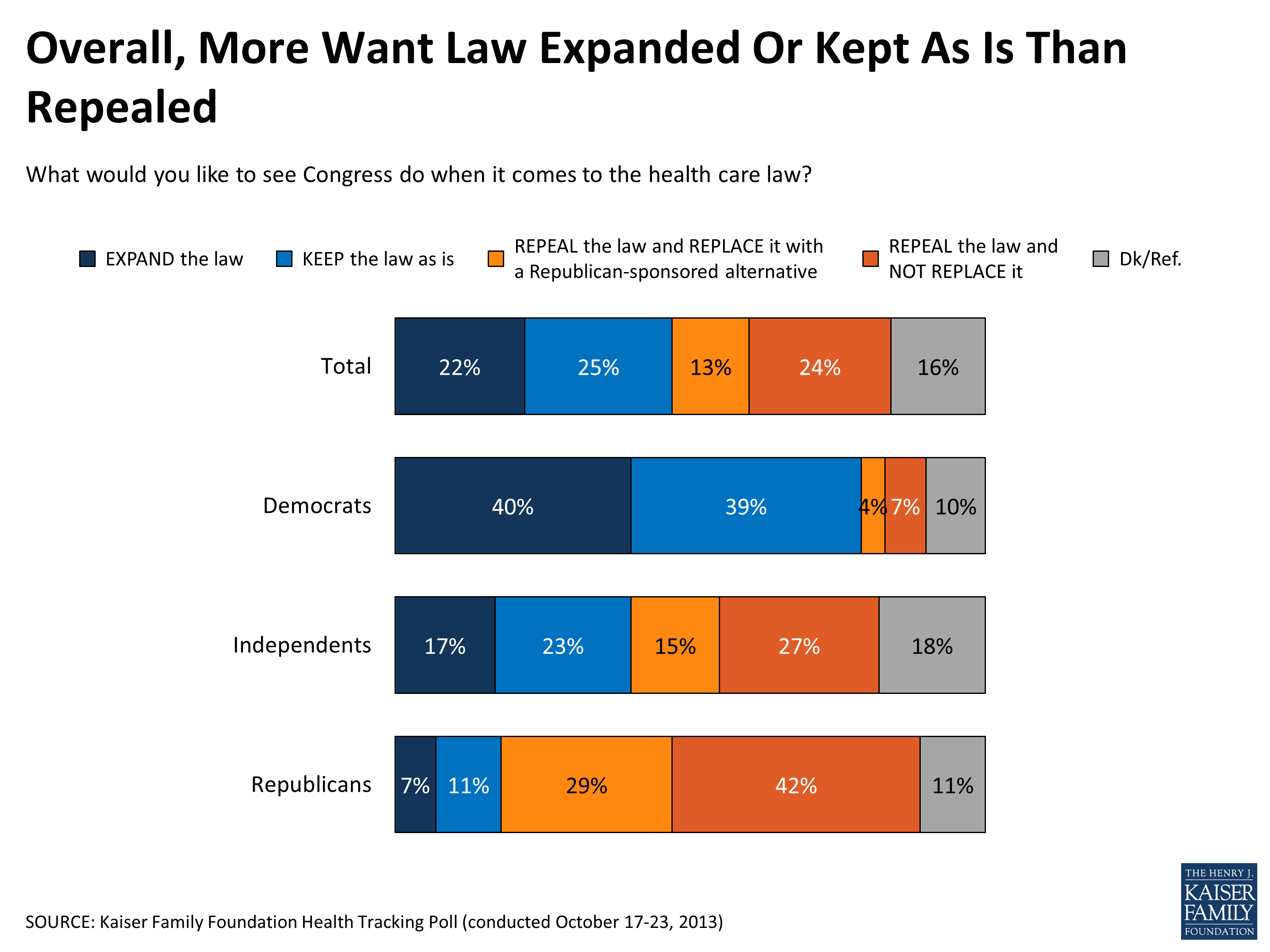
Republicans Don’t Support Replacing Obamacare

Kaiser checks in on public opinion:

Repeal Or Replace

Barro points out that only “29% of Republicans favor replacing Obamacare with a Republican alternative to Obamacare”:

Republicans spent the last two election cycles hammering Democrats for cutting Medicare. Now they are hammering the president for not letting everyone keep their old plans if they like them. The de-facto Republican health policy platform is a defense of the pre-Obamacare status quo, period, and Republican base voters are with them.

But Jonathan Bernstein argues that going back to the old system isn’t an option:

No one is ever going to kick young adults off their parents’ insurance (or change the law so that insurance companies are allowed to do it). No one is going to bring back the various limitations in pre-ACA insurance policies. Some trimming of the new Medicaid rolls might be possible. But no one — no politician who has to face reelection, at least – is going to just toss all those people off their insurance with nothing to replace it.

Beyond all this is simply the Humpty Dumpty-ness of the situation: The old system has been slowly pushed off the wall for three years now, and by this point it’s really beyond repair, whatever the merits or politics of the situation.

Kilgore chimes in:

I won’t go as far as Jonathan and say that the idea of repealing Obamacare is “dead.” His recitation of what no politician with a brain would do reminds me a lot of all those confident predictions (not by him, but by many others) that no state political leadership would be stupid or benighted or ideological enough to turn down the Medicaid expansion. And there’s also the possibility that Republicans, if they were in a position to do so, would repeal Obamacare and then quickly re-enact some of the easier and more popular provisions, like the provision allowing young adults to stay on their parents’ policies.