Can Christie Expand The Map?

I think he’s easily the most formidable GOP candidate for 2016 – on paper. Reviewing the GOP’s presidential hopefuls, a “plugged-in Republican consultant” ranks Christie #1:

Christie is in the 1 slot now and forevermore — he’s about to get huge margins in his historic reelection in a blue state –he’s the successful model for our Party (from a political perspective) and his governing success is exactly what our country needs from a fiscal perspective. He can compete in about 40 of 50 states. Who else can do that AND run as a conservative? No one.

Bouie notes that Christie is winning an impressive share of the black vote:

This isn’t a small thing; a nominee who can return the GOP to its historic performance with African American voters and other minorities, is a Christie who has done substantial damage to Democratic chances. Without the near unanimous support of blacks, Democrats have a much harder time in newly purple states like Virginia and North Carolina, as well as large swing states like Ohio and Florida.

Freedlander points out that Christie is also doing well with Latino voters. But:

Christie’s strong showing in New Jersey among Hispanics may not be enough to convince Republican bigwigs that he can do the same thing nationwide. For one thing, the Hispanic population in New Jersey, while large and diverse, is not representative of the population in the rest of the country. Only Florida boosts more Cuban-American voters, a constituency that has traditionally voted Republican (One of New Jersey’s U.S. Senators, Robert Menendez, is Cuban-American.) In 2009, Christie eked out a slight win against incumbent governor Jon Corzine and still garnered 32 percent of the Hispanic vote. For him to show broad appeal to Latinos nationwide he may have to do better than the 40 percent he is currently polling among Latinos against weak Democratic opposition.

Barro’s bottom line:

Christie’s pitch to national Republicans is that he can hold that coalition together and rocket way past 47% of the vote. The only question is whether Republicans care enough about winning to take him up on it.

How The Sabotage Of Obamacare Worked

Over the weekend, Amy Goldstein and Juliet Eilperin reported that much of Obamacare’s flaws were not due to the president’s lack of attention or focus:

On the balmy Sunday evening of March 21, 2010, hours after the bill had been enacted, the president had stood on the Truman Balcony for a champagne toast with his weary staff and put them on notice: They needed to get started on carrying out the law the very next morning. It was not ready even though, for months beginning last spring, the president emphasized the exchange’s central importance during regular staff meetings to monitor progress. No matter which aspects of the sprawling law had been that day’s focus, the official said, Obama invariably ended the meeting the same way: “All of that is well and good, but if the Web site doesn’t work, nothing else matters.”

But they also report that healthcare.gov was “was hampered by the White House’s political sensitivity to Republican hatred of the law — sensitivity so intense that the president’s aides ordered that some work be slowed down or remain secret for fear of feeding the opposition.” Andrew Sprung sees the logic of this strategy:

The dominant charge in the incompetence indictment is that political considerations drove policy. But in this case, the “political considerations” consisted of sidestepping sabotage or trying to avoid providing new fodder for it. Perhaps in some cases, fear of taking propaganda hits should not have trumped operational considerations. But that’s easy to charge in hindsight. And the “political” considerations — evading sabotage — were in service of getting the law implemented well.

… [I]t seems clear to me that Obama should have drilled deeper into the administrative structure of the website-building project. Charges that the tech project  did not have the right leadership or management structure seem well founded.  Perhaps the responsibility for failing to find that leadership can be laid at the doorstep of DeParle, or Lambrew, or Sebelius, or Obama, or all of the above.  But the decisions that Goldstein and Eilperin detail are not on their faces irrational. The damage done to the law and to the country by Republican sabotage, on the other hand, is unmistakable.

Drum adds, “No federal program that I can remember faced quite the implacable hostility during its implementation that Obamacare has faced.” Tomasky searches for a parallel:

Has there ever been a law in the history of the country as aggressively resisted by the political opposition as this? Republicans didn’t do this with Social Security. Most of them voted for Social Security. They didn’t do it with Medicare. They, and the Southern racists who were then Democrats, didn’t do it with civil rights. There was a fair amount of on-the-ground opposition to that, but it wasn’t orchestrated at the national level like this was. And when the Voting Rights Act was passed the year after civil rights, Southern states in fact fell in line quickly. Check the black voter-registration figures from Southern states in 1964 versus 1966. It’s pretty amazing.

No, to find obstinacy like this, you have to go back, yes, to the pre-Civil War era. The tariff of 1828, the Kansas-Nebraska Act, which led to the civil war in “Bloody Kansas” and ultimately to the Civil War itself.

New York I Love You, But, Ctd

tumblr_m3t473jKa61r9x0sdo1_500

A reader writes:

Sorry to hear you’re leaving New York. I have to emphasize it was a massive blunder to live in Manhattan. I live in Brooklyn and love New York, but I dread going into Manhattan at all, and I would probably kill myself if I had to spend the entirety of every day there. Incidentally, to borrow your metaphor, I think Brooklynites in general look at Manhattan as a mistress too, one kept at a safe distance, since it’s more a Glenn Close sort of mistress (exciting but exhausting to deal with, and deadly).

Another reader:

The best stand up about the reason to leave New York City by the incomparable Patton Oswalt [NSFW]:

Money quote from Oswalt:

New York is a great place to visit, don’t get me wrong. But if you live there full-time, it turns your skull into a cage, your brain into a rat, and the city is just a stick poking the rat all day.

Lou Reed, on the other hand, was more scared of Sweden:

Your relocation and Lou’s passing made me think of this scene from Blue in the Face:

Another reader:

You’re going to love leaving. My appreciation for New York deepened immensely once I got the hell out of there. Now, returning as a visitor is one of the great pleasures of my life – which is a lot more than I can say for the experience of actually calling it home.

Another:

Before you leave New York, you must see (actually hear) this:

A major audio piece, Janet Cardiff’s Forty-Part Motet (2001), will be exhibited at the Cloisters as part of the institution’s 75th-anniversary celebrations (Sept. 10-Dec. 8). Situated in Fort Tryon Park in Manhattan’s Washington Heights neighborhood, the Cloisters is assembled from architectural elements that largely date from the 12th through the 15th century. Forty-Part Motet is an 11-minute recording of the 16th-century choral composition Spem in alium numquam habui by the 16th-century English composer Thomas Tallis. The work’s title translates as In No Other Is My Hope. Forty speakers on metal stands each feature a single voice. The work features a technology called binaural sound, such that the visitor senses voices coming from very specific directions, creating a highly physical experience.

Last weekend I finally made the trek up to The Cloisters, the Metropolitan Museum of Art’s somewhat hokey collection of religious painting and architecture. It was a beautiful autumn day and the views of the Hudson from the promontory are fantastic. But it’s the “sound installation” by Cardiff that is really mind-blowing. It was so beautiful that I literally had to keep myself from openly weeping. And I wasn’t the only one. I saw tears in the eyes of many others. I’m not much on churches and organized religion, but I’m grateful to The Met for providing me with a religious experience.

Another New Yorker:

At the end of a very underrated Kevin Spacey/Danny DeVito movie called The Big Kahuna, there is a long monologue by a voice that gives advice to the audience (find it here). One of the lines is, “Live in New York City once, but leave before it makes you hard”.  Having lived here my whole life, I consider this a truism for 99% of people. It can make you hard. It is not an easy day-to-day life. There are many sacrifices to make and many others you have to accommodate. It is not for everyone.

I realize this will make a lot of your readers, and perhaps you, roll your eyes, but it really does take a different kind of person to make this place their home permanently.  I want to emphasize that is not a qualitative assessment.  The fact is, I will probably leave … but that’s due to money and family. I love living in this place. I thank god every day I live here. Sometimes I’ll be sitting on the train 40 minutes into my 2.5 mile commute and see all the different kinds of (often smelly and pushy) people and realize few places on earth give me the daily opportunities this place gives.  I realize you know all of this and it appears your initial disappointments have not grown into a permanent dislike, which is good. Also, I’ll let your comparisons between NYC and D.C. slide … for now.

I never quite understood the urge of others to take a trip to NYC; it’s far too stressful for that. Those other places, where people spread out and grow, that’s where I like to vacation.  That seems relaxing to me.  NYC is just where things get done – it’s not meant to be something else.  Most people don’t realize that. For most, this place is a cartoon before you get here and a gritty, fall to earth upon staying. For me, it’s home.

I’m sorry you don’t like living here as much as I do, Andrew.  I hope when you look back on your year here it won’t seem as bad in retrospect. I’m glad you will be visiting; we will welcome you back (but do stay out of my way on the subway … I got things to do).

Inside America’s Concentration Camps

No, not for humans. Just for pigs, courtesy of Wal-Mart, which refuses to review its support of housing pigs for their entire lives in crates so tight they cannot turn around. Many of you will be unable to watch this video – and I found it close to impossible. It has some NSFW language in it. But this is the reality we are living with and allowing to continue:

How does one describe such barbarism? In plain English:

[It] was recorded by an activist who worked undercover at Rosewood Farm in Pipestone, Minn. The video shows workers slamming piglets into concrete floors until they die, castrating them without painkillers, and roughly beating and cursing at sows. But the more egregious abuse, activists say, is standard industry practice: keeping sows in restrictive gestation crates for their entire lives.

This horror is not restricted to one rogue plant. It is widespread. Here is some footage from the largest pork producer in the US, Smithfield, showing the brutal impact of keeping pigs in gestation crates their entire lives:

Some companies have ended gestation crate confinement; others are cutting back; Smithfield says they’ll get rid of them by 2017 (after hemming and hawing on the deadline). More good news:

Nine states in the United States have banned the use of these pens, which are outlawed in the European Union, and about 60 companies – including McDonalds, Burger King and Costco – have begun to demand that suppliers stop using gestation crates. Gov. Chris Christie recently vetoed a bill to ban the crates in New Jersey, a move that may be a sign that Mr. Christie has his eyes set on certain voters in a possible 2016 run for president, Politico reported this week.

On what conceivable grounds could Christie veto a bill banning such barbarism? Pigs are close to dogs in intelligence and emotion. Would we allow puppies to be picked up by the tail and have their heads smashed into concrete? Would we allow corporations to keep a dog in a crate so small it cannot even turn around for its entire life?  It’s about time the national press began pestering Christie, Wal-Mart, the National Pork Producers Council, and all those complicit in this evil for an answer. You can email the director of communications at the NPPC, Dave Warner, to convey to him your concerns. Please no abuse. Just a polite expression of concern. He can be reached at warnerd@nppc.org.

Update from a reader:

That video you linked to about Walmart and pig-farming was truly horrible but not even remotely surprising. Bacon is very cheap in the US and this is why. This is also why I became a vegetarian since moving to the US. In Ireland, most of the beef in grass-fed and we used to get home-made sausages from our local butcher. Here, no matter where you eat, you cannot avoid the fact that you are likely to be eating an animal that has been horribly mistreated.

I have no moral objection to eating meat in general – I choose not to now because of the environment and my general health. However, I can’t see how anyone could not consider that treatment morally wrong. Incidentally, I worked in a research lab for a couple of years where we were experimenting on mice. There were very clear, very specific guidelines about what we could and couldn’t do and any procedure required the use of an anesthetic. I didn’t enjoy the job and I wouldn’t do it again but at least I knew that I was doing everything I could to minimize the suffering of the animals. And then you have what you see in that video …

The Onion Of The Seventies

Inspired by Ellin Stein’s new book That’s Not Funny, That’s Sick: The National Lampoon and the Comedy Insurgents Who Captured the Mainstream, Teddy Wayne charts the rise and fall of National Lampoon:

Congenial chuckles were not [founding co-editor Michael] O’Donoghue’s goal. “I’ve always national-lampoonconsidered comedy what you use to get people to swallow the pill, not the pill itself,” he said, along with this deathless epigram: “Making people laugh is the lowest form of humor.” He considered himself a moralist, and a livid one at that — who was still able to exert mastery over his feelings: “Rage is only interesting when it’s controlled. When you repress those emotions, you always get something artistic and interesting.” His highest-profile heirs today are Chris Rock and Louis CK, whose moral anger fuels their comedy without stepping (in Rock’s case, barely so) over the threshold of Lewis Black’s or Sam Kinison’s exhausting fury, and for whom the point is often less to get a laugh — let alone self-congratulatory applause — than to provoke thought. With O’Donoghue’s influence, and Vietnam’s escalation, the National Lampoon couldn’t help but become more political than its ivory tower predecessor [the Harvard Lampoon], attacking both the right and left for their conservatism and hypocrisy, respectively. And, as with the response to The Onion today, people loved being reminded of their flaws. …

The magazine’s circulation dwindled through the ’80s and published its last issue in 1998, but to most readers, it unofficially ended in 1980, when a vacationing [co-founder Doug] Kenney was found dead at the base of Hawaiian cliff in an apparent suicide at age 32. His death was received by his peers with equal parts sadness and gallows humor; the best line was that Kenney “had slipped and fallen while looking for a place to commit suicide.”

The NL ceded its satirical reign first, in the late ’80s, to Spy magazine, which derided the lifestyles of the rich and famous, and then, in the new millennium, to the media-oriented Onion and Gawker, the politicized Jon Stewart and Stephen Colbert, and finally to anyone with a Twitter account and a misspelled opinion. In the last two decades, the surviving brand has pumped out over thirty films, some given the NL imprimatur, many straight-to-DVD and with titles the original Lampooners would have heaved up only for parodic target practice (2007’s Homo Erectus, aka National Lampoon’s Stoned Age).

When Extremism Is No Vice

Michael Kazin argues that “sometimes, those who take an inflexible, radical position hasten a purpose that years later is widely hailed as legitimate and just.” He points to historical examples:

In the 1830s, the “moderate” way to abolish slavery in the U.S. was to compensate slave-owners and ship their former chattels, nearly all of whom were American-born, to Africa. Extreme abolitionists argued, loudly, that it was a sin to hold human beings in bondage; nothing but immediate freedom would do. “I am aware that many object to the severity of my language; but is there not cause for severity?,” asked William Lloyd Garrison. “I will be as harsh as truth, and as uncompromising as justice. On this subject, I do not wish to think, or to speak, or write, with moderation.” A little over three decades later, his principles were written into the Constitution.

Over time, certain other extremists on the left also turned out to be prophets.

Moderate authorities in politics and the media once lambasted such pioneer woman suffragists as Elizabeth Cady Stanton, militant opponents of Jim Crow like Ida Wells Barnett and W.E.B. DuBois, and early critics of the war in Vietnam like the members of Students for a Democratic Society and the Student Non-Violent Coordinating Committee. But who would now claim that only men should vote, the races should be segregated, and that it was a good idea to send more than a half a million soldiers to Indochina?

His conclusion:

[T]o vaunt moderation over extremism just signals one’s good intentions without communicating anything meaningful about the issues at stake. If you think Bill de Blasio will bankrupt New York or Ted Cruz has no sympathy for the uninsured, then make that argument and drive it home with facts. Insisting that our biggest problems would be solved if everyone crowded into the middle of the road is a lazy attempt to avoid real debate about what divides us. It’s an extreme waste of time.

Bring Back The Guillotine?

dish_guillotine

John Kruzel recommends revisiting the chopping block as a more humane form of execution than lethal injection:

Bringing back the guillotine may sound crazy, but it’s certainly better than the current alternative. It’s better for prisoners because quickly severing the head is believed to be one of the quickest, least painful ways to die. And it’s better for organ recipients because the bodies of guillotined prisoners could be more quickly harvested for viable parts, unlike organs that may become unusable after lethal injection due to hypoxemia. …

Dr. Jay Chapman, the creator of the three-drug cocktail, supports ditching his 1977 invention due to its reputation for causing slow, painful deaths. “The simplest thing I know of is the guillotine,” he told CNN in 2007. “And I’m not at all opposed to bringing it back. The person’s head is cut off and that’s the end of it.” Other doctors have stuck their necks out by protesting lethal injection on the grounds that administering it requires medical professionals to violate the Hippocratic Oath. The American Medical Association officially discourages physicians from participating in lethal injections.

The guillotine sidesteps any Hippocratic hypocrisy. The layman can operate a guillotine just as well as a doctor. As Hanni Hindi wrote in Slate some years ago, “The prisoner facing the guillotine was placed facedown on a large wooden plank, their head secured in a brace and steadied by an executioner’s assistant known as ‘the Photographer,’ who held onto their hair (or, in the case of bald prisoners, their ears). When everything was in place, a 120-pound blade was dropped from 7 feet in the air, immediately severing the prisoner’s head.” It never misses its mark.

Recent Dish on ending lethal injection here and here.

(Photo by Daryl Davis)

All The President’s Poets

On the 50th anniversary of JFK’s assassination, Adam Gopnik looks back at the way American literati mourned his death:

John Berryman wrote a “Formal Elegy” for the President (“Yes. it looks like wilderness”); Auden an “Elegy for J.F.K.,” originally accompanied by twelve-tone music by Stravinsky. Robert Lowell—who in the Second World War had gone to prison as a conscientious objector, and in the late sixties became a Pentagon-bashing radical hero—wrote to Elizabeth Bishop that the murder left him “weeping through the first afternoon,” and then “three days of television uninterrupted by advertising till the grand, almost unbearable funeral.” The country, he said, “went through a moment of terror and passionate chaos.” Lowell’s friend and fellow-poet Randall Jarrell called it the “saddest” public event that he could remember. Jarrell tried to write an elegy but could get no further than “The shining brown head.”

The death of J.F.K. marked the last time the highbrow reaches of the American imagination were complicit in the dignity of the Presidency. In Norman Mailer’s “Presidential Papers,” published the month Kennedy died, the point is that there was a “fissure in the national psyche,” a divide between the passionate inner life of America and its conformist, repressed official life: “The life of politics and the life of myth had diverged too far.” For Mailer, Kennedy’s Presidency supplied the hope of an epiphany wherein the romantic-hero President would somehow lead his people on an “existential” quest to heal this breach. It sounded just as ridiculous then, but there was something gorgeous in the absurdity.

Caption for the above video:

It was a cold and sunny day in 1961 [during JFK’s inauguration] and the 87 year old Robert Frost could not read his poem, “Dedication”, that he wrote in honor of this special day for he was blinded by the bright sun. He fumpered on the podium because he could not see it and did not know it well. Richard Nixon came and held his top hat to block the sun for Mr.Frost who was extremely old and having problems. Instead, he recited from memory an oft requested poem, “The Gift Outright.”

Fifth Grade Is Too Late For Steinbeck?

Screen Shot 2013-11-01 at 7.56.04 PM

According to English professor Blaine Greteman, this seemingly bonkers system of rating “text complexity” is coming to a school district near you:

Lexiles were developed in the 1980s by Malbert Smith and A. Jackson Stenner, the President and CEO of the MetaMetrics corporation, who decided that education, unlike science, lacked “what philosophers of science call unification of measurement,” and aimed to demonstrate that “common scales, like Fahrenheit and Celsius, could be built for reading.” Their final product is a proprietary algorithm that analyzes sentence length and vocabulary to assign a “Lexile” score from 0 to over 1,600 for the most complex texts. And now the new Common Core State Standards, the U.S. education initiative that aims to standardize school curricula, have adopted Lexiles to determine what books are appropriate for students in each grade level. Publishers have also taken note: more than 200 now submit their books for measurement, and various apps and websites match students precisely to books on their personal Lexile level.

Any attempt to quantify literary complexity surely mistakes the fundamental experience of literature.

No one has described that experience better than William Empson, whose Seven Types of Ambiguity wrote the book on literary complexity. A mathematician by training, Empson was no touchy-feely humanist, but he understood that the greatest literary language rarely made “a parade of its complexity.” He particularly admired Shakespeare’s description of trees as “Bare ruined choirs, where late the sweet birds sang,” which he explained contained “no pun, double syntax, or dubiety of feeling”:

but the comparison holds for many reasons; because ruined monastery choirs are places in which to sing, because they involve sitting in a row, because they are made of wood, are carved into knots and so forth…. These reasons, and many more relating the simile to its place in the Sonnet, must all combine to give the line its beauty, and there is a sort of ambiguity in not knowing which of them to hold most clearly in mind.

I try to teach my students to balance such complexities. But many of the smartest and best have learned the Lexile model too well. They’ve long been rewarded for getting “the point” of language that makes “a parade of its complexity,” and they’ve not been shown that our capacity to manage ambiguity without reducing it enables us to be thinkers rather than mere ideologues.

Update from a reader:

I get it, assigning numbers to books seems silly, especially when it leads to conclusions like Mr. Popper’s Penguins is “more complex” than The Grapes of Wrath. The lexile may be a perfectly good way to score “complexity” as it’s narrowly defined here. “Complexity” is just one criterion to consider when choosing books to assign to students. I doubt if any of the folks associated with the Common Core would claim that the lexile measures literary value. And to be clear, I think it’s foolhardy to have rigid rules that assign only books with certain lexiles to certain grades.

Upon graduating from high school, a student should be able to parse a simple contract or legal document. This can be tougher than reading Hemingway – and certainly a lot less pleasurable, and of less artistic value. But when choosing books for students to read, why not consider a book’s complexity, especially when there are other pedagogical goals besides the appreciation of literature?

The Case Against ENDA

No Child Left Behind

The federal bill banning workplace discrimination against gays, lesbians and transgenders is up for a vote tomorrow. Gay dad Wally Olson makes the case against it – and perhaps his strongest point is on whether it will ever be used:

Statistics from the many states and municipalities that have passed similar bills (“mini-ENDAs”) indicate that they do not serve in practice as a basis for litigation as often as one might expect. This may arise from the simple circumstance that most employees with other options prefer to move on rather than sue when an employment relationship turns unsatisfactory, all the more so if suing might require rehashing details of their personal life in a grueling, protracted, and public process.

To take a similar point on the federal hate crimes law, since it was passed in 2009, there have been two successful prosecutions under the act for anti-gay bias, so far as I can find. One was in March, 2012, in Kentucky, and the second was in Georgia last June. It may well be that neither would have been pursued without the federal law, but still. If I’ve missed any, please let me know. But two successful prosecutions in four years does not suggest a problem so vast that the federal government must be involved. If you care at all about economic liberty, it seems to me you virtually-normalhave to weigh the costs as well as the benefits.
At the same time, the private sector has forged ahead of government, acting rationally to get the best set of employees possible. The Human Rights Campaign annual report (pdf) on voluntary corporate anti-discrimination policies gives us the latest: 88 percent of Fortune 500 companies have non-discrimination policies with respect to homosexuality, and 57 percent also include gender identity in their policies. The progress in the private sector over the last ten years has been remarkable, and HRC can rightly feel proud of their work engaging corporations. But that, of course, suggests that government itself may not be the best way to protect gay employees.

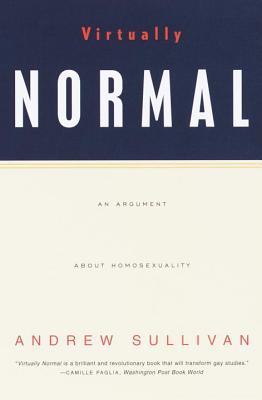
I used to be opposed tout court to such laws on libertarian grounds (and not just for gays but for everyone apart from those subjected to the unique historical burden of slavery and segregation). Virtually Normal also makes the case that the government has no right to compel private citizens not to discriminate against gays when it discriminated so perniciously against gays in civil marriage and military service. But two things have changed my mind over the years.

The first, quite simply, is that the libertarian position on such crimes is largely moot – for good and ill. The sheer weight of anti-discrimination law is so heavy and so entrenched in our legal culture and practice, no conservative would seek to abolish it. It won’t happen. And if such laws exist, and are integral to our legal understanding of minority rights, then to deny protection to one specific minority (which is very often the target of discrimination) while including so many others, becomes bizarre at best, and bigoted at worst. Leaving gays out sends a message, given the full legal context, that they don’t qualify for discrimination protection, while African-Americans and Jews and Catholics and Latinos and almost everyone else is covered by such protections. It’s foolish to stick to a principle, however sincere, in the face of this reality.

Secondly, the federal government has ceased its own discrimination policies in marriage and military service and therefore now has some small sliver of moral standing to lecture private individuals across all states. My objections twenty years ago are now moot.

Put those two developments together and I would not vote against ENDA if I, God help us, were a Senator. But I would vote for it with my eyes open. I don’t think it will make much difference in reality just as I don’t believe hate crime laws make much difference in reality. Of course that’s an empirical question and I promise readers horrified by my luke-warm support of this that I will gladly recant such skepticism if ENDA truly does lead to a flurry of successful suits across the country against anti-gay bias.

But to me, this feels a lot like a) an easy concession to Gay Inc. which has devoted almost its entire existence to this bill, b) an easy vote for a Republican trying to hold onto a marginal seat, c) an even easier way for Democrats to grandstand on the issue, even though it stands a snowball’s chance in Hell of getting through the current House. So I hope it passes. But forgive me for not cheering it on.

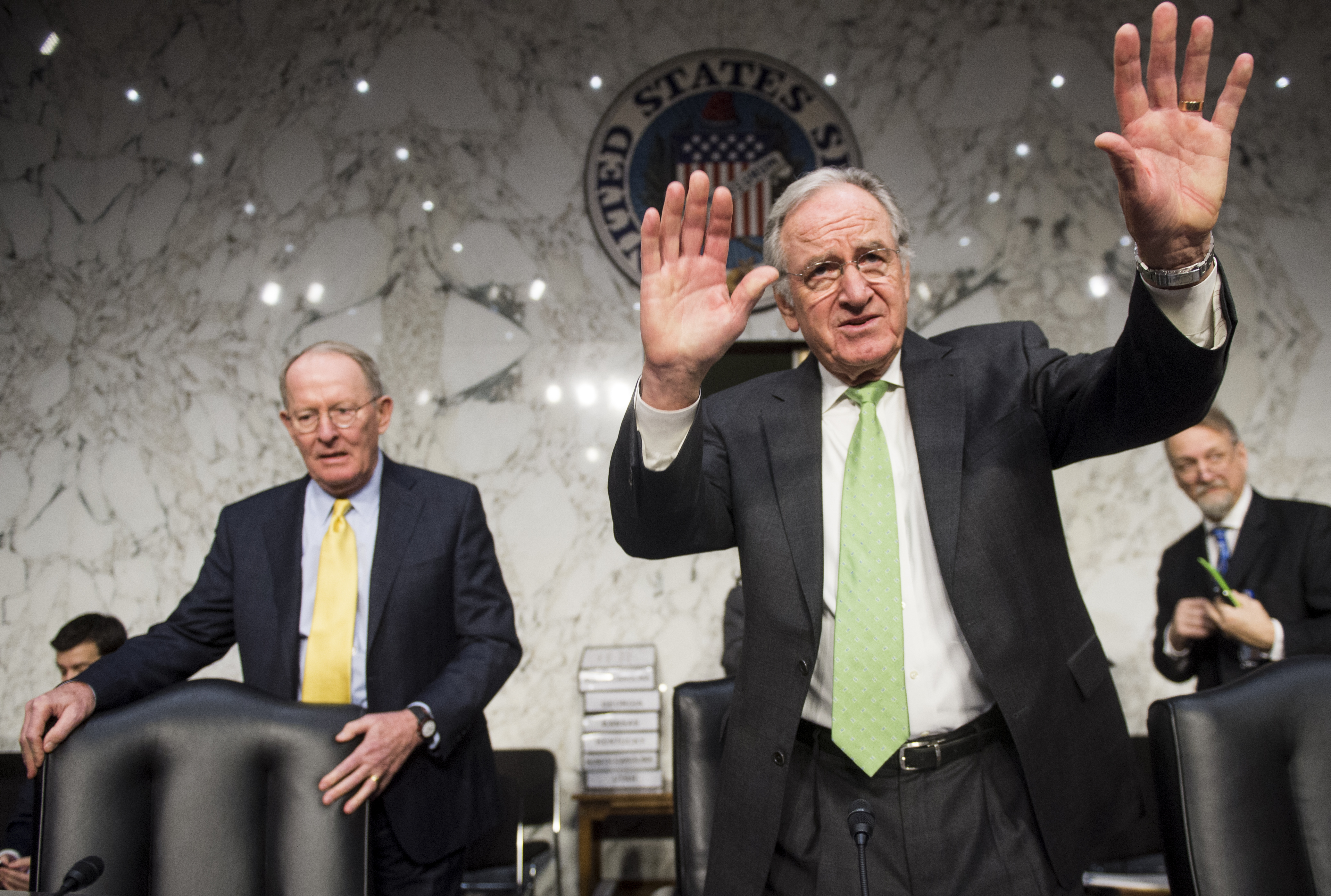
(Photo: Chairman Tom Harkin, D-Iowa, right, tries to quiet a CodePink protester calling for passage of the Employment Non-Discrimination Act on Thursday, Feb. 7, 2013. Sen. Lamar Alexander, R-Tenn., left, takes his seat. By Bill Clark/CQ Roll Call.)