Another Rogue Cop In The Drug War

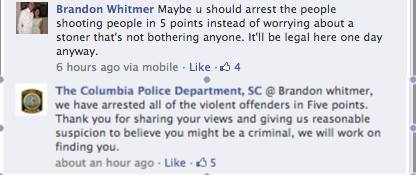
After arresting one man for possessing $40,000 worth of weed in his home, Columbia, South Carolina’s interim police chief got a little blowback from marijuana activists online. Fair enough – the to and fro of public debate. Until we get this on Facebook:

Santiago-1So someone expressing a pro-weed opinion gives the cops “reasonable suspicion” for a raid against him as well. Until we get rid of this ridiculous Prohibition, more of this kind of bullshit will continue.

An Antidote To Hitch

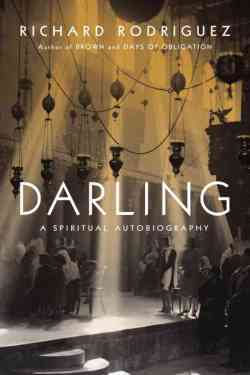
Rubén Martínez reviews Richard Rodriguez’s new book Darling: A Spiritual Autobiography and studies its place in the author’s work on race, religion and assimilation in America:

Darling offers variations on all these themes, at the same time that it takes a leap onto the post-9/11 global stage. It is also a book about the desert. To an extent about place, its more profound darlingpreoccupation is the metaphysical and mystical desert, the cradle of the spiritual trinity of Judaism, Christianity, and Islam. “My faith in a desert God makes me kin to the Jew and to the Muslim,” he writes at the outset.
But to prepare himself and his readers for the journey to Jerusalem, he first makes an inventory of the Orientalist imaginaries of his mid-20th century youth. In Sacramento’s Alhambra Theatre he sees Otto Preminger’s rendition of Palestine (Exodus, 1960) through Paul Newman’s blues: “I became a Zionist at the Alhambra Theatre.” He reads Sir Richard Burton (not the actor but the British explorer), who goes native to smuggle himself into Mecca. In his adolescence there are more substantive encounters. He apprehends the momentous transformation of Cassius Clay into Muhammad Ali, is moved by Malcolm X’s journey from Harlem to Mecca. …

Nothing can quite prepare you for what is to come, even if you’re familiar with Richard’s work. Since Days of Obligation and especially with Brown, he began to develop a lyrical yet radically digressive style that combines a syntactical elegance with narrative and referential leaps not just between chapters but within them as well. One second we are with the Catholic popes of the mid-20th century, a couple of paragraphs later Mark Twain makes it into the conversation, and in short order so do Fellini, Pasolini, and Bergman. From Jerusalem we head to Las Vegas; both deserts of course, but the initial wipe of the frame induces vertigo before he massages the material into thematic coherence. Or not. Sometimes the digression is just a digression, and sometimes a murky erudition remains just that.

Richard and I had a public conversation about his book a couple of weeks ago. It’s a dense, difficult read at times … but it rewards patience. Sometimes, he expresses something as simply and magnificently as the miraculous Pope Francis. To wit:

My brother is no less a good man for not believing in God; and I am no better a man because I believe. It is simply that religion gives me a sense – no, not a sense, a reason – why everyone matters.

The congregation does not believe one thing; we believe a multitude of hazy, crazy things. Some among us are smart; some serene; some feeble, poor, practical guilt-ridden; some are lazy; some arrogant, rich, pious, prurient, bitter, injured, sad. We gather in belief of one big thing: that we matter, somehow. We all matter. No one can matter unless all matter. We call that matter God and we are drawn to it every Sunday.

In an interview with Harper‘s, Richard describes the relationship between his religion and his writing:

I agree with Thomas Aquinas who describes the act of writing as a kind of prayer. Certainly as a person who writes every day it does seem to me that the energy, the inspiration, comes from outside of myself. Yesterday I struggled with this paragraph and nothing came. Today, the words come freely and almost seem to write themselves . . . so, like other writers, I come up with metaphors like grace and the muse and inspiration to explain how it seems that something outside my own efforts had produced the line I could not write by myself.

I don’t mean to become such a— I’ve never liked the word “piety.” And I don’t even like it when people say about me that I am a good man. I just, it makes me nervous — there’s a kind of domestication about such praise. For myself, I prefer the raggedness of my life of faith. I like to consider Andy Warhol a saint, one of the great saints of my lifetime. And I look for God in places like, you know, gay bars, where maybe no one else expects to find Him, in the dark.
Does Assimilation Mean Disintegration?

Jonathan S. Tobin is troubled by the recent Pew survey showing how secular American Jews have become:

Screen Shot 2013-10-30 at 12.05.05 AMIncreasingly, secular Jews have come to see any effort to define group identity in ways that include some but exclude others as distasteful and even hateful. This helps explain the most shocking of the Pew findings: More than a third of those Jews polled said belief in Jesus—the one point that all Jews had once been able to agree was something that put you outside the Jewish tent—should not be deemed a disqualifier. How can this be? Simple: It is just an extreme manifestation of the logic governing the inclusion doctrine.

The very idea that Jewish identity involves drawing lines—lines as seemingly insignificant as who may be a voting member of a synagogue and who may receive honors during services—is itself the problem for many Jews. The non-observant American Jewish mind-set is increasingly uncomfortable with the notion of drawing any boundaries around Jewish identity. And that mind-set has been ironically justified by the organized Jewish community’s breathless pursuit of those [intermarried Jews] who have already chosen to place themselves outside the lines.

Dreher draws a lesson for his fellow Christians:

While we certainly have incomparably more cultural cushion, as Tobin notes, our people are being assimilated too by secularism, via religious indifferentism. Fifty years ago, there was a lot more cultural pressure to affiliate with a church. You felt that you should, that it was the right thing to do. That’s long gone. In a free society in which there is no serious penalty, social or otherwise, for not being Christian, you have to give people a reason to want to be a Christian. As we’ve observed in this space, no church has found the solution to waning Christianity (see Pew’s study on the “Rise Of The Nones”), though the Jewish experience seems to confirm the idea that a religion that does not offer something meaningfully distinctive from the mainstream will not endure. If you fling open the windows of the Church to the world as it is today, you run the real risk of the winds blowing your house down.

Or bringing in the fresh air that makes it inhabitable. It’s a difficult line to tread, but Pope Francis seems to be doing just fine with it.

“Make Your Soul Grow”

In 2006, students at Xavier High School in New York City wrote to Kurt Vonnegut as part of an assignment from their English teacher, Ms. Lockwood. The literary legend wrote back:

I thank you for your friendly letters. You sure know how to cheer up a really old geezer (84) in his sunset years. I don’t make public appearances any more because I now resemble nothing so much as an iguana.

What I had to say to you, moreover, would not take long, to wit: Practice any art, music, singing, dancing, acting, drawing, painting, sculpting, poetry, fiction, essays, reportage, no matter how well or badly, not to get money and fame, but to experience becoming, to find out what’s inside you, to make your soul grow.

Seriously! I mean starting right now, do art and do it for the rest of your lives. Draw a funny or nice picture of Ms. Lockwood, and give it to her. Dance home after school, and sing in the shower and on and on. Make a face in your mashed potatoes. Pretend you’re Count Dracula.

Here’s an assignment for tonight, and I hope Ms. Lockwood will flunk you if you don’t do it:

Write a six line poem, about anything, but rhymed. No fair tennis without a net. Make it as good as you possibly can. But don’t tell anybody what you’re doing. Don’t show it or recite it to anybody, not even your girlfriend or parents or whatever, or Ms. Lockwood. OK?

Tear it up into teeny-weeny pieces, and discard them into widely separated trash recepticals. You will find that you have already been gloriously rewarded for your poem. You have experienced becoming, learned a lot more about what’s inside you, and you have made your soul grow.

God bless you all!

Kurt Vonnegut

Surprised By Joy, Again And Again

In an interview with Christianity Today, Rowan Williams, who recently wrote a book about C.S. Lewis’s Narnia series, ponders the enduring popularity of the scholar, novelist, and Christian apologist. One reason he offers? Lewis was “very good at depicting something about joy”:

If you look at an extraordinary episode in The Voyage of the Dawn Treader, where Lucy finds herself reading a story in a magical book, when she puts the book down she can’t remember the details of the story. She just knows that it’s the best thing she’s ever read, the most enriching and beautiful thing she’s ever encountered. As she’s talking to Aslan afterward she says, “Will you tell me that story again?” Aslan says, “One day I shall tell it to you forever.” It’s that kind of moment where you realize that Lewis has got hold of something that very few writers do manage to crystallize, a sense of absolute immersion in the richness of the moment.

It comes across in The Screwtape Letters, which still read very well, when the one, old devil says to the younger devil that God’s great secret is that he’s a pleasure lover at heart. At the heart of it is joy. That’s Lewis all over.

Williams describes Lewis’s emphasis on joy as anything but naive:

A good deal of Lewis’s life, of course, was marked by enormous stress and great suffering. It’s not as if he had an unchallenged life. Some of the emotional force of his writing does come from his being a motherless child, looking back to that sort of magical world before the suffering broke in—and we all have a little bit of that in us.

But what he does with it then, instead of making it a cozy, backward-looking thing, he unites it to all of these great moral challenges, the challenge of facing up to yourself, the challenge of going on being faithful in prosaic ways day by day. It’s really only by doing the next thing—being faithful in small particulars—that you come to this joy. It’s not magic; it’s not nostalgia. It’s a very fine balance that he deals with remarkably.

So when he comes to write about his wife’s death in A Grief Observed, which is, for many people, the most extraordinary and challenging of all his books, it’s as if you know anything he says about joy or hope is hard won. It’s really something that’s come to him not by glib formulations or easy answers. He really has fought for it.

Previous Dish on C.S. Lewis here and here.

Can We Really Be Friends With Dogs?

Reviewing Gary Borjesson’s Willing Dogs and Reluctant Masters, Diana Schaub suggests it’s possible. Reaching back to ancient philosophy, she points to one reason why – the “spiritedness of dogs”:

This spiritedness, which the Greeks called thumos, is the key to their higher capacities. According to Plato, spiritedness figures in our souls as well, situated between appetite and reason. In the well-ordered human soul, spiritedness allies itself with reason in order to govern desire (as when you muster your willpower to keep to your wise New Year’s resolutions). Aristotle says that spiritedness “is the capacity of soul by which we feel affection,” and also anger, for spiritedness is quick to defend what it loves against attack or injustice. Spiritedness can lift the self out of its narrow confines, expanding the boundaries of “one’s own.”

Thumotic individuals will risk their self-preservation for the sake of larger goods:

one’s property or territory, one’s family, one’s fellows, even intangibles like dignity and honor that have become integral to one’s self-conception. Spiritedness is precisely the dog-like part of the soul: loving, loyal, and fiercely protective. Because spiritedness is only fully itself when “it stands in a twofold relation, above appetite and below reason,” Borjesson concludes that wolves and higher primates are at best “proto-spirited.” Of the brute creation, only dogs — by virtue of their alliance with us — can experience the spiritedness that listens to reason and rises above the promptings of pleasure and pain. Dogs become ethical beings through their capacity to pay attention, to care about praise and blame, and to obey. While not themselves rational, they are willing to follow our lead. Man and dog together instantiate the tripartite soul.

Recent Dish on friendship here, here, and here.

Dumbing Down Religion?

T.M. Luhrman, the Stanford anthropologist, recently published essays sympathetic to the religious practice of “speaking in tongues” and to American evangelicals’ penchant for portraying a “personal, intimate God.” Leon Wieseltier responds with a withering critique, describing Luhrman as “peddling another intellectual argument for anti-intellectualism, another glorification of emotion in a culture enslaved to emotion”:

Luhrmann not only studies tongues, she also endorses tongues: “Speaking in tongues might actually be a more effective way to pray than speaking in ordinary language.” The difficulty is that God cannot be adequately captured in language. Religious thinkers since Philo have been wrestling with the incomprehensibility of any concept of the deity that appropriately honors its sublimity. Luhrmann proposes that we give up and babble. “As a technique,” she explains, “tongues capture the attention but focus it on something meaningless (but understood by the speaker to be divine).” Myself, I would rather my nonsense not be sacred and my sacred not be nonsense. “There’s plenty here to alarm secular liberals,” she writes, invoking the stereotype that is designed to embarrass all skepticism. Actually, there’s plenty here to alarm religious conservatives, too.

Many of the world’s great religious traditions have consecrated themselves to the ideal of spiritual articulateness, and to the discovery of valid propositional content for the substance of faith. All this, for Luhrmann, is only “abstract and intellectual,” when it is merely the natural activity of thinking creatures who seek.

“The role of belief in religion is greatly overstated,” Luhrmann declares, “as anthropologists have long known.” Who gave anthropology the last word? This is like saying that the role of beauty in art is greatly overstated because there is so much ugliness in art. My fellow Americans, there are questions that do not allow of empirical answers! I leave aside the place of ideas in the evangelicism that Luhrmann adores. Are we really suffering from a surfeit of thoughtful belief? Have we been neglecting our felicity? “Secular liberalism,” with its demand for the justification of metaphysical opinions, has more to offer religion than the immediate gratifications of a credulous joyriding.

Luhrmann responds by defending the deeper spiritual meaning of “speaking in tongues”:

Wieseltier himself writes chidingly that “God cannot accurately be captured in language.” That is the point. When those who use a sacred language whose words they do not understand—speaking in tongues, but also chanting or reciting prayers in Hebrew, Arabic or Avestan—those words connect them to a God beyond understanding, a God for whom their words fall short. Many of those who pray in tongues prefer to say that they are “praying in the spirit.” One woman in the American evangelical church I studied told me that when she prayed in the spirit, she felt that she joined an angelic chorus that, most of the time, she could not hear. A woman in Ghana explained that she preferred to pray in tongues because those words had not been sullied by ordinary humans. “I am not communicating with any man.” Praying in this way reminds people that the God they reach for is sacred.

Now, to be honest, did I—raised Unitarian in an orthodox Jewish neighborhood—once think that speaking in tongues was pretty odd? Of course. I grew up moved by the sound of ancient language, but when I first encountered tongues, it seemed like babble. Yet I also think that some of the things I do for my own well-being—running hamster-like on a treadmill while watching figure skating reruns—look pretty peculiar to others, too. That’s the anthropological point. We’re all pretty odd to each other, and at its heart, life is mystery.

Dispatches From Paradise

Rhys Southan surveys the growing genre of memoirs written by people who claim, through near-death experiences, to have glimpsed heaven and returned to tell the tale.  Southan notices that “[o]ne of the major problems with the heaven-and-back literature, at least for those looking to it for inspiration and hope, is that none of the people who have been there agree about what it’s like”:

One possible conclusion is that none of these people actually went to heaven. Call this the Hitchens/Harris/Challies view. It certainly has an intuitive appeal. For one thing, if they’re all sure they went to heaven, and they know that for instance you can or cannot see God’s face, why aren’t they criticizing the obvious frauds who either couldn’t or could? That they don’t all ferociously debate each other implies insecurities about their own visions.

Another possibility is that only one of them went to heaven, but then who to believe?

My money would be on either [Proof of Heaven author] Eben Alexander or [Waking Up in Heaven author] Crystal McVea. Both of them were skeptics before going to heaven, which makes them somehow more credible than a professional reverend like Oden Hetrick or the pastor’s son Colton Burpo who recounts his trip to heaven with the cold affectless demeanor of a psychopath. … Or it may be that there is no one definitive heaven because heaven is what each of us wants it to be. …

But there is another possible explanation for these inconsistencies that would answer the skeptical Christian’s concern that these books undercut the primacy of faith. Maybe God shows every visitor different heavens and tells them to write about these conflicting characters, activities, and landscapes because he’s up to his old mysteriousness business. Does God want to hint to us that heaven is really real, while teasing our craving for evidence by sending us garbled, contradictory messages about what’s actually there – forcing us to rely on faith again after all? Oh God, you sneaky devil you.

One Strange Bird

Reviewing Kansas City Lightning: The Rise and Times of Charlie Parker by Stanley Crouch, Adam Shatz applauds the surprisingly dark first volume of the biography, writing that “each page is haunted by the demons that brought down the man known as Bird”:

The myth of Charlie Parker is that he was self-taught. In fact, as Crouch writes, he studied with a man named Alonzo Davis, an heir to a tradition of conservatory-trained black teachers who had “tattooed their knowledge on the brain cells of many young musicians who went on to shape the evolution of vernacular Negro American music.” Parker seems to have acquired a rapid—and highly exaggerated—sense of confidence on his horn. He was hardly married when he began to stay out all night in clubs, asking to sit in with local musicians when he only knew how to play “Lazy River” and “Honeysuckle Rose.” …

Parker began to find his voice on the alto, and to learn how to listen and respond “in digital time” to other musicians: the art that, as Crouch emphasizes, lies at the heart of his genius as an improviser. But he also discovered the pleasures that would kill him.

According to Crouch, Parker was first prescribed morphine around 1937, after a car accident in which he broke his ribs. A few months after [his wife] Rebecca became pregnant with their son Leon, he invited her to watch as he inserted a needle in his arm, then left for the night. That scene, chillingly described by Crouch, left Rebecca in little doubt about where his loyalties stood. Soon afterward she found a letter from another woman under his pillow; he asked her to return it at gunpoint. He gave her crabs and stole from her. When she miscarried their second child, he flushed it down the toilet. The family doctor told her that if he continued to use heroin, he would live no more than eighteen to twenty years: an accurate prediction.

Back in March, Mike Springer dug up the above video, “the only [known sound film] of him playing live, rather than synching to a prerecorded track”:

The performance is from a February 24, 1952 broadcast on the pioneering DuMont Television Network. The full segment begins with a brief ceremony in which Parker and [Dizzie] Gillespie receive awards from Down Beat magazine, but the clip above cuts straight to the music: a performance of the bebop standard “Hot House,” composed by Tad Dameron around the harmonic structure of Cole Porter’s “What Is This Thing Called Love?”

Update from a reader:

The quote you ran about Charlie Parker’s heroin use made it sound (eventually) recreational. But that’s not my understanding. As per this link, his drug use wasn’t merely subsequent to breaking some ribs, but following a spine injury. I have a spine disease which can, at times, be quite painful. I can easily sympathize with some one who tries to manage his pain with whatever drug, and find condemnation of that management to stem from a lack of comprehension of the challenges that real chronic pain can present.

Imagine having teeth continually pulled without anesthetic. Now try to play an instrument or do math or do anything that requires concentration while enduring that pain. If Parker required heroin to do what he did, hats off to him. He changed the world.

Pioneers Of Sexology, Ctd

In light of the recently revived interest in sexologists William Masters and Virginia Johnson – subjects of Showtime’s new series Masters of Sex – Jesse Bering calls attention to lesser-known sex researchers, such as Kurt Freund:

A prodigious theorist and researcher, Freund’s main claim to fame was his invention of the erection-detection machine (otherwise known as the “penile plethysmograph”). … In the early 1950s, Freund—a Holocaust survivor who’d somehow managed to avoid being deported to the concentration camps altogether during the Nazi occupation—was approached for help with a queer sort of problem by the Czechoslovakian army. Straight recruits were pretending to be gay to avoid their compulsory military service. It occurred to Freund that a soldier’s single dumb erection to a pretty naked lady, or the lack of one thereof, would betray his hidden sexual orientation. The specifics have gotten more complicated in the decades since his original erection-detection machine was patented, but the basics of the procedure have remained largely the same:

A man sits down in a chair, his penis is connected to an erection gauge that can pick up very subtle changes in penile tumescence (it’s so sensitive that it can detect a blood-volume increase of less than one cubic centimeter, which most men wouldn’t even experience consciously), and he’s then shown randomized images of nude models representing distinct erotic categories. The scientist, meanwhile, measures what’s happening with the man’s own equipment as these photographs appear.

A far cry from its initial purpose, Freund’s machine is today used mostly in forensic studies, ascertaining pedophilia in men arrested for sex crimes involving children.