Whence The Ouija?

The creators of the possessed board had to scare their way to a patent:

[T]he chief patent officer demanded a demonstration—if the board could accurately spell out his name, which was supposed to be unknown to [investor Elijah] Bond and [his sister-in-law Helen] Peters, he’d allow the patent application to proceed. They all sat down, communed with the spirits, and the planchette faithfully spelled out the patent officer’s name. Whether or not it was mystical spirits or the fact that Bond, as a patent attorney, may have just known the man’s name, well, that’s unclear, Murch says. But on February 10, 1891, a white-faced and visibly shaken patent officer awarded Bond a patent for his new “toy or game.”

How it works:

Ouija boards work on a principle known to those studying the mind for more than 160 years: the ideometer effect. In 1852, physician and physiologist William Benjamin Carpenter published a report for the Royal Institution of Great Britain, examining these automatic muscular movements that take place without the conscious will or volition of the individual (think crying in reaction to a sad film, for example). Almost immediately, other researchers saw applications of the ideometer effect in the popular spiritualist pastimes. In 1853, chemist and physicist Michael Faraday, intrigued by table-turning, conducted a series of experiments that proved to him (though not to most spiritualists) that the table’s motion was due to the ideomotor actions of the participants.

How Many Will Have Policies Cancelled?

Lizza asks Jonathan Gruber, a key architect of Romneycare and Obamacare:

Gruber broke down the A.C.A. “winners” and “losers” for me. About eighty per cent of Americans are more or less left alone by the health-care act—largely people who have health insurance through their employers. About fourteen per cent of Americans are clear winners: they are currently uninsured and will have access to an affordable insurance policy under the A.C.A.

But much of the current controversy involves the six per cent of Americans who buy their own health care on the individual market, which the A.C.A. has dramatically reformed. Gruber argued that half of these people (three per cent of all Americans) will have little change to their polices. “They have to buy new plans, but they will be pretty similar to what they had before,” he said. “It will essentially be relabeling.”

The other half, however, also three per cent of the population, will have to buy a new product that complies with the A.C.A.’s more stringent requirements for individual plans. A significant portion of these roughly nine million Americans will be forced to buy a new insurance policy with higher premiums than they currently pay. The primary reason for the increased cost is that the A.C.A. bans any plan that would require a people who get sick to pay medical fees greater than six thousand dollars per year. In other words, this was a deliberate policy decision that the White House and Congress made to raise the quality—and thus the premiums—of insurance policies at the bottom end of the individual market.

Avik Roy, a staunch Obamacare critic who has cherry-picked facts in the past, claims that roughly a third of Americans will lose their current coverage. He bases this on quotes from a June 2010 edition (pdf) of the Federal Register, which publishes notices from government agencies:

“The Departments’ mid-range estimate is that 66 percent of small employer plans and 45 percent of large employer plans will relinquish their grandfather status by the end of 2013,” wrote the administration on page 34552. All in all, more than half of employer-sponsored plans will lose their “grandfather status” and get canceled. According to the Congressional Budget Office, 156 million Americans—more than half the population—was covered by employer-sponsored insurance in 2013.

Another 25 million people, according to the CBO, have “nongroup and other” forms of insurance; that is to say, they participate in the market for individually-purchased insurance. In this market, the administration projected that “40 to 67 percent” of individually-purchased plans would lose their Obamacare-sanctioned “grandfather status” and get canceled, solely due to the fact that there is a high turnover of participants and insurance arrangements in this market. (Plans purchased after March 23, 2010 do not benefit from the “grandfather” clause.) The real turnover rate would be higher, because plans can lose their grandfather status for a number of other reasons.

How many people are exposed to these problems? 60 percent of Americans have private-sector health insurance—precisely the number that Jay Carney dismissed. As to the number of people facing cancellations, 51 percent of the employer-based market plus 53.5 percent of the non-group market (the middle of the administration’s range) amounts to 93 million Americans.

When Buildings Go Bad

Ettington_Park_-_geograph.org.uk_-_1230701-1

Architectural historian Keith Eggener ponders haunted houses past and present:

When Americans portray haunted houses, they usually look something like Hill House [in 1963’s The Haunting] – old, dark, full of turrets and dead-eyed windows, rambling and eerily picturesque. It’s hard to imagine the cinematic Hill House – in actuality, an ancient English manor rebuilt in the mid-19th century – having ever looked new or welcoming. … Commentators have often noted that haunted house stories appeal to us by subverting our ideals of domestic tranquility and security; they are modern versions of the romantic sublime, where we watch in safety while terrible, thrilling things happen close by.

They also support American myths of egalitarianism, our conjoined attraction and aversion to aristocracy and wealth, our envy of the rich and our suspicions about how their gains were got. The lavish Victorian Gothic, Queen Anne and Second Empire haunts of popular fiction and film present the Janus face of the Gilded Age, whose ruthless corruption and relentless capitalism were excoriated by Mark Twain, Mother Jones, Upton Sinclair and other progressives. They closet the skeletons upon which great fortunes were built and reassure us that crime, though it sometimes pays very well, comes with long, nasty strings attached.

But while the classic haunted house is “hoary, dusty and timeworn, full of shadows and memories,” Eggener believes that “even in our brightly lit and efficient modern houses, we are never entirely safe from our own imaginations”:

In The Architectural Uncanny, Anthony Vidler describes how modern architects, “formed by futurism,” sought to eradicate traces of the past from their work. Old houses were to prone to manifestations of the uncanny, or unhomely – that unhealthy and “fundamental propensity of the familiar to turn on its owners, suddenly to become defamiliarized, derealized, as if in a dream.” To avoid this, Modernists cleaned house. They built glass walls to deny the shadows. They filled their buildings with light and good intentions. They removed the cellars, the attics, the bric-a-brac, “the weight of tradition and the imbrications of generations of family drama.”

The program backfired, however. Erasure of the past only created more ghosts – “the nostalgic shadows of all the houses now condemned.” The skeletal modern houses that replaced them were themselves ghostly – schematics evoking past houses, uninhabitable in the minds of many, rootless, reflective, vulnerable.

(Photo: The Warwickshire mansion that served as Hill House in The Haunting. By Richard Croft.)

The Thinking Man’s Zombie

Willa Paskin praises the French show The Returned – premiering tonight on the Sundance channel – as an eerie, contemplative alternative to the bloody orgy that is The Walking Dead:

[It’s] about people who have come back from the dead, but they neither hanker for brains nor have no brains themselves, qualities I consider definitional for zombies. The previously deceased on The Returned appear normal, sentient, seemingly healthy, as troubled by the meaning of their reanimation as everyone else around them. Unlike with zombie stories, the problem with The Returned’s resurrected is not that they are undead—it is that they are all too alive. …

The people they come back to have always changed more than the dead themselves.

A young man (the exceedingly handsome Pierre Perrier) who died the day of his wedding appears as his fiancée (a fragile Clotilde Hesme) is about to remarry. A small boy attaches himself to an isolated female doctor (Celine Sallette). A murderer comes back. The dead are connected to the living in various graceful and complicated ways that I will not spoil for you, but suffice it to say that as stately as The Returned is, I definitely wanted to know what happened next. Meanwhile, the water level in the town is dropping dramatically, the lights keep flickering, none of the newly living are sleeping very much, and everyone keeps wondering if this is a sign of the resurrection—Jesus came back from the dead once, after all—or something less reassuring. “Are we sure I’m not a zombie?” Camille asks at one point, and it is the fact of her not zombie-ness that gives The Returned its deliciously shivery quality: Zombies are scary but familiar; who knows what Camille is?

The Origins Of The American Witch

dish_halloween2

Before the 20th century, there is little historical record of a link between Halloween and witchcraft. The relatively recent association appears to be American:

It is no surprise, perhaps, that part of the answer lies with the rise of modern marketing and branding. How does one dress up as a witch for Halloween, as many thousands will be doing this 31 October? Basically you stick a black pointy hat on your head. Depictions of witches with pointy hats began to appear in children’s books in eighteenth-century England, probably inspired by earlier black steeple hats worn in stereotypic depictions of seventeenth-century Puritans. By the end of the nineteenth century the pointy-hatted witch had become a widespread image in print. It was at this moment that Salem, Massachusetts, comes into the picture. It was there that a jeweller named Daniel Low began to produce souvenir spoons depicting a witch with a pointy hat and broom. Their success kick-started the transformation of Salem into the marketing creation ‘Witch City’, and the pointy-hatted witch was replicated on numerous ‘Witch City’ products.

At the same time as this witch image was proliferating in marketing and the mass media, the nature of American Halloween custom was changing. With its roots in Irish mischief night, American youths had traditionally marked Halloween by performing such malicious acts as greasing railway tracks, smashing windows, and overturning outdoor toilets. But from the 1950s onwards the sanitised American trick-or-treat and costume bonanza we know today was beginning to spread. The remarketing of Witch City into Halloween City by local entrepreneurs from the 1980s onwards was a significant element in this transformation. “It’s America’s biggest Halloween party and you’re invited!” one promotional site proclaims today. The now inseparable link between witchcraft and Halloween was forged.

Culminating in this amazing awful scene in The Worst Witch (which you can watch in full here):

Martin Schneider shivers at the classic Halloween hathos:

Tim Curry is always inescapably Tim Curry, and in this context that’s a positive boon—he may be the only element in this brief clip that’s even halfway up to snuff. Never have I seen so many superfluous and chintzy video effects deployed in such a short span of time—innumerable green-screen effects, several completely crazy swirl transitions, who knows what the hell else. It’s truly a phantasmagoria of 80s cheese.

(Image: “Hallowe’en precautions” postcard, c. 1910, via NYPL Digital Gallery)

Obamacare’s Losers

This post from Robert Laszweski, a health industry consultant, is making the rounds. His personal health insurance policy was cancelled thanks to Obamacare:

I have been in this business for 40 years. I know junk health insurance when I see it and I know “Cadillac” health insurance when I see it.

Right now I have “Cadillac” health insurance. I can access every provider in the national Blue Cross network––about every doc and hospital in America––without a referral and without higher deductibles and co-pays. I value that given my travels and my belief that who your provider is makes a big difference. Want to go to Mayo? No problem. Want to go to the Cleveland Clinic? No problem. Need to get to Queen’s in Honolulu? No problem.

So, I get this letter from my health plan. It says I can’t keep my current coverage because my plan isn’t good enough under Obamacare rules. It tells me to go to the exchange or their website and pick a new plan before January 1 or I will lose coverage.

His alternatives are worse than what he currently has:

Now, my plan covers about everything. Never had a procedure for either my wife or myself  turned down. Wellness benefits are without a deductible. It covers mental health, drugs, maternity, anything I can think of. The new plan would have a deductible $500 higher than the one I now have and a lot more if I go “out-of-network” inside the rest of the Blue Cross national network. And, wait all you people telling me rate shock does not exist, the new far more restricted plan costs 66% more than our current monthly premium. Mr. Rate Shock got rate shocked––and benefit shocked to boot.

Frum had a similar experience:

It’s not only plutocrats and one-percenters who will find themselves worse off; not only the comparatively affluent retirees enrolled in Medicare Plus programs. Self-employed professionals who earn too much to qualify for ACA subsidies will soon discover what I have discovered: They are paying more for a worse product.

McArdle thinks supporters of Obamacare need to be careful about how they respond to these cancellation stories:

The law’s supporters have made some quite reasonable points in response — that rate shock was an unfortunate but necessary consequence of broadening coverage to people with pre-existing conditions, and it may not even affect that many people. You can’t make even the nicest of omelets without breaking eggs. And some of them did mention this at least once during the run-up to the law’s passage.

They’ve also, however, made some arguments that were, at the very least, extremely ill-considered, such as saying that the insurance people had before wasn’t “real insurance” and implying that they are too stupid to know what’s good for them. As product marketers will tell you, when customers complain about a product change, here’s what not to do: Declare that your customers are idiots who don’t understand that they didn’t actually want the thing you took away from them. If you don’t believe me, just ask the folks on the New Coke team.

There’s also a growing trend toward suggesting that either the people complaining about rate shock or their insurers are engaged in some sort of nefarious behavior. I’m pretty sure that David Frum and Bob Laszewski are neither lying nor too stupid to understand what is happening with their insurance policies, and David’s experience basically matches mine shopping on the Washington exchange — not shopping for some outside policy that might be more expensive than the marvelously cheap insurance that I’ve seen people insisting must be available on the exchanges.

It’s Hard Out There For A Writer

327939900_a752bcfdc5_o

In a much-discussed NYT essay, Tim Kreider beseeches his fellow writers to stop working for free:

A familiar figure in one’s 20s is the club owner or event promoter who explains to your band that they won’t be paying you in money, man, because you’re getting paid in the far more valuable currency of exposure. This same figure reappears over the years, like the devil, in different guises — with shorter hair, a better suit – as the editor of a Web site or magazine, dismissing the issue of payment as an irrelevant quibble and impressing upon you how many hits they get per day, how many eyeballs, what great exposure it’ll offer. “Artist Dies of Exposure” goes the rueful joke.

Harlan Ellison has a great, if somewhat excessive, rant on this:

Development economist Chris Blattman pushes back:

I feel for Kreider, but he tells only his side of the story. Writers were, to a degree, protected by costs of entry and distance and communication. That protection is falling away. This is painful and disruptive, especially because it is so abrupt. But the other sides must be told.

One is that more people get a shot at an audience than ever before, from academic development economists to North African activists to precocious 20-year olds with talent. Another side is that more people get more information and ideas at a lower price than ever before. If good writing and ideas are valuable, surely making it cheaper and more widely available is a good thing? Especially for the people in the world who before could least afford it.

I’m pinioned between these two conflicting forces. Magazine writers were coddled in luxurious greenhouses for years and in some ways, the new desert we are struggling in is a tonic against some of the mediocre crap that used to be run at endless length in what were effectively gilded guilds. And yet, the new landscape is also more of a desert than a plain. There’s almost nothing to eat unless you do something other than writing as well. Some new media patrons seem to be filling in the gaps – in nonfiction, we have Bezos and Omidyar and Hughes coming to the rescue. Others may follow. But that would be – yes, I will retire this metaphor in this sentence – a bunch of precious, gilded oases, in a still-vast wasteland, rather than a viable, renewable ecology.

What interests me is finding a way to pay writers with money that comes from readers.

It’s that simple really. The end of paper and print as the delivery system should make that feasible in principle. After all, what the old media barons used to have on their side was their unique ability to pay for all that industrial-sized printing and mailing. Now, all those costs have disappeared. So where are the new journals and magazines and blogazines, founded by writers and aimed at readers? There are many online, and at the Dish we do all we can to find and promote them. But there is as yet no viable, sustained model for them to stand on their own two feet.

But we’re trying to innovate one. I’m not saying this to ask you to [tinypass_offer text=”subscribe”] if you haven’t (but I’ll take a new subscription any time). I’m saying it because the Dish model of small, renewable subscription payments is an obvious way forward.

Companies like Tinypass have begun to make this technologically feasible. Affiliate revenue – like the Amazon revenue a blog like Brain Pickings relies on for a great deal of its income – can also help. Banner ads can also be useful – but it’s hard (and ethically tenuous) for a lone writer to both do her job and also persuade companies to sponsor her. Remnant advertizing – breakthroughs in testosterone! – can work too. Put some or all of this together and you have a model that might provide more writers with a way to make a living as writers.

In other words, what makes my own job so exhilarating – and nerve-wracking – is the chance not just to create and constantly evolve an online blogazine, but to pioneer a bit of this new writing economy. Dish subscribers already pay six full-time writers and researchers (including interns) and give everyone health insurance; in the future, we’d really like to start using this still-new model to commission and pay good money for long-form journalism. We won’t be able to help book-writers (except for promoting, examining and talking about), but we hope to be able to help nonfiction writers more generally – and not just with eyeballs. That’s why subscribing to the Dish is not just about the Dish. It’s about trying to create a new economy for writing. Think of us as an ice-breaker ship. If we can find a new passage to viable new media, many many others can follow. So, yes, I’m not going to be coy. If you care about the future of writers in this economy and want to empower them rather than potential new corporate overlords, [tinypass_offer text=”subscribe here”].

(Photo by Hamed Saber)

A Little Perspective

President Obama Visits Boston To Talk About Health Care

This morning I watched the president’s speech in Boston yesterday. It felt like a campaign rally. At first, it seemed off-key, although the combination with Sebelius’ dogged endurance of the deserved brickbats by Republican members was, I’d say, a relatively good day for the White House, which is not saying much these days.

But as I listened to the speech, it seemed to me that the president made some points that really do need to be re-made. Nothing makes me madder than a technical problem I cannot understand, let alone solve. Last night, as we were thrashing out various technical issues for the Dish, I got real testy and frustrated. So I can perfectly understand not just the frustration but the rage at healthcare.gov. I can also see why the cancellation notices for individual insurance policies because they don’t cover enough and perpetuate the free-rider problem would be maddening. Obama’s relentless repetition that if you like your plan, you can keep it, period, was bullshit, and he must have known it at the back of his mind. Trust is a very dangerous thing for a president to risk. And he deserves some shellacking for it.

At the same time, look. I’m running a small business now – and we are talking to our insurance broker about what the ACA means for us. We’re not panicking, and we may well pay less. As we go through the process, I’m going to keep you informed as to what happens. As for me, with the mother of all pre-existing conditions, I cannot express how relieved I am that having HIV will no longer carry the risk of bankrupting me, if I have to seek insurance one day on the individual market. I wonder if I would have risked going independent with the Dish without the security that, even if it all fell apart, I wouldn’t be left to the ravages of the individual market for insurance for those with chronic conditions. At a small level, it gave me some sense of security to take an entrepreneurial risk. It may be a huge boon for business for people to switch jobs or try new ventures knowing that the health insurance caveat against risk-taking is now gone.

But I’m extremely lucky and privileged. How can you put a price on the relief of struggling middle-class families whose current insurance policies can be abruptly canceled, or amended with little recourse, or those who simply cannot afford insurance at all and face not just the pain of sickness but bankruptcy as well?

I tend to agree with John Kasich who urged sympathy for “the lady working down here in the doughnut shop that doesn’t have any health insurance — think about that, if you put yourself in their shoes.” Yes, put yourself in her shoes. She’s not on TV like I am, making points. She is waiting for medical support and help for all the trials that flesh is heir to.

The ACA also offers a real chance to bend the cost curve in healthcare. At its worst, it’s a start – and something that can be worked on as time goes by. Every law can be amended. But what the ACA does at its core is bring everyone into the same boat – and a bigger pool is always better for insurance purposes. That’s both a moral and a fiscal gain. I can see how it could be amended. At some point, we might be able to get rid of the employer subsidies and expand the individual market considerably. Or we could move to a single payer. But it will force all of us to grapple with this question more directly and more practically. If you don’t see it as a panacea but as a baseline for the future, it looks better.

What I’m saying, I guess, is that we should not miss the forest for a few rotten trees. If they get the website working, if more people get to sign up, if premiums remain below what was expected … then we will have a very different debate than we are having right now. And look: this is the law. It’s not a project we can simply ignore. But it is a project we should see in perspective – which our current partisan brouhaha is obscuring.

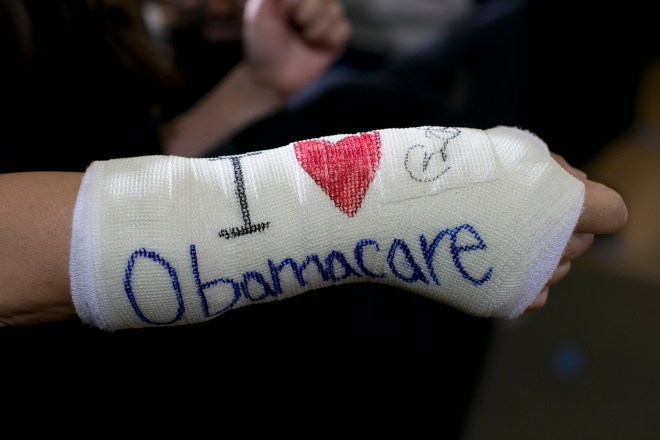
(Photo: President Obama spoke at Faneuil Hall to bolster support for his national health care law in Boston on October 30, 2013. Cathey Park, of Cambridge, displayed a cast on her broken wrist with ‘I (heart) Obamacare’ written on it. When U.S. President Barack Obama finished his speech, he shook hands with the crowd and signed her cast, next to the heart. By Yoon S. Byun/The Boston Globe via Getty Images.)

Fading Fox

Connor Simpson has some bad news for Roger Ailes:

Fox News has fallen out of favor with Republicans after two years of untouched supremacy as the party’s brand of choice across any and every medium, according to a recent YouGov survey. YouGov measures which brands are preferred by each party (Republicans, Democrats, Independents) by adding and subtracting negative feedback on a 100 to -100 scale. In 2011, Fox News led all brands [among Republicans] with 68 support points, a full 5 points ahead of the rest. In 2012, Fox News led with 64.5 support points, 1.7 points above the rest. This year? In 2013, Fox News didn’t even make the top 10.

What happened? Simpson argues the 2012 election left the network “teetering on brink of self-parody and un-truthiness”:

Public Policy Poll released in January showed a serious decline in trust during the months after the election. Only 52 percent of those who identify as “somewhat conservative,” said they trust Fox News, down from 65 percent last year. Hardline conservatives trust Fox News less, too: 13 percent said they don’t trust Fox News anymore, compared to 6 percent last year. … One can only presume this is why they’re remaking the anchor line-up with established conservative faces and bringing in giant iPads.

You Forgot South Sudan!

IMG_0376

The Dish coalition of the willing is even larger than we thought:

After seeing the map of your world readership, I thought I’d send you a note to let you know that I have read the Dish in South Sudan, one of the blank countries – albeit, several years ago, so before both you and South Sudan became independent. I was on an assignment in Juba for several weeks in 2009 and could usually manage to get online for an hour or two a day. The last site I would go to would be yours (hosted by The Atlantic at that time). I’d load it up, close my laptop and head back to my hotel, which had been built out of a shipping container. I’d go into my tiny room, pull the mosquito net around me and open up my laptop. No need for an Internet connection or even electricity: reading the Dish by my laptop battery I was able to spend 30-40 minutes catching up on news and opinions. I just couldn’t watch any videos or read stories below the fold.

I don’t know what they are reading in Juba these days and can’t help you out with Central African Republic. But you should know that your site was very helpful in making a Sudanese shipping container feel a bit more like home.

Another reader confirms our South Sudan representation for this year:

Actually, I read the Dish from South Sudan earlier this year, but I did it through a Kenya-based Satellite ISP, so my views were probably logged as originating in Kenya.

Another sent the above photo in June 2012 (which we never posted, probably because the window frame wasn’t visible):

This is what I see from the window of my “container with a view” overlooking the Nile River at Oasis Camp in Juba, South Sudan.

I’ve been trying to upload it for a couple of days.  Hope this makes it.  I will send the view looking at my window from outside if I can – it’s a lovely place, in its own way (not the rooms, but the little bar/restaurant on the riverfront is great).

BTW, I got the news of the ACA decision here on Thursday before my husband had heard it in Michigan.  I immediately got online to check out the reax of Andrew and others (my connection works much better for viewing than for attachments). Love the site – keep it up.

And keep up the great photos. We actually posted a window view from South Sudan just after it went independent in July 2011. The photographer wrote at the time:

As you’ll see from my submission, I live on the other side of the world from you. I know the East Coast is starting to wake up when your blog starts showing up in my Google Reader. I want to thank you for keeping me up to date on what’s going on in the world! I am lucky to live and work in the newest country in the world. The picture I’m submitting comes from a unit overlooking the Nile in Juba, South Sudan.

One more reader:

I have a friend heading to South Sudan in a few days. We argue politics all the time. I’ll be sure to copy a Dish link in one of my emails to her.