“The Most Destructive Force In American Politics Today”

That’s Jon Favreau’s view of the Tea Party:

Over the last few weeks, it has demonstrated again that its intent is not to shake up the establishment but to burn down the village. As a Democrat, I disagree with its policy positions, but its policy positions alone are not what make the Tea Party so dangerous. What makes the Tea Party dangerous is its members’ willful disregard for the most basic tenets of American democracy. They do not believe in the legitimacy of our president. They do not believe in the legitimacy of decisions handed down by our Supreme Court. Unlike President Obama, Harry Reid, Mitch McConnell, John Boehner, or a host of other Democratic and Republican lawmakers who grasp the basic reality of politics, they have never, not once shown a willingness to compromise on anything. Merely uttering the word is enough to draw a primary challenge.

Jonathan Bernstein adds that once “resistance to compromise itself becomes an important principle, episodes such as the shutdown are hard to prevent”:

The key point to emphasize here is that the problem with the Republican Party, or at least the problem that causes shutdowns and other such disasters, isn’t that they’re “too conservative.” If that was all that was going on, they could still reach compromises with Democrats. The problem isn’t about ideology, at least not as we conventionally think of it; it’s about willingness to compromise and to work within the political system.

Finally, Jeff Shesol dismisses the idea that there is some kind of civil war happening inside the GOP:

The extremism of our own age—Tea Party extremism—“contaminates the whole Republican brand,” as David Frum has written. And he’s right. But Tea Party extremism is not, as this implies, a betrayal of the party’s belief system. It is, instead, a crystallization, a highly potent concentrate, of the party’s belief system. The free-market dogmatism, the tax-cut catechism, the abhorrence of nuance and science and government and fact—these did not bubble up during town-hall meetings in 2010 but flow from the same deep well from which establishment Republicans like Mitch McConnell (Goldwaterites, all) have long been drinking. Frum and other sensible conservatives yearn for a Tea Party exit—maybe even an expulsion—from the G.O.P. But it cannot be expelled, because in this case the parasite is a creation—in some ways a perfection—of the host organism itself.
Sacred Ground Or Playground?

Lots of blood boiled when the above video went viral last week, showing Utah Boy Scout leaders destroying an iconic rock formation in Goblin Valley State Park:

Despite their assertions that they were concerned for the safety of others in the park after watching a family with small children pass below, the lighthearted attitude of the film paints a different picture for many as the men cheer and high-five. Utah State Parks spokesman Eugene Swalberg said Thursday he found the video disturbing and has asked that possible criminal charges be considered in the case. … A spokesman for the Boy Scouts of America called the act by two leaders disappointing and reprehensible. “We teach our 2.6 million youth members and 1.1 million adult members … the principles of ‘leave no trace.’ These principles stress a commitment to maintaining the integrity and character of the outdoors and all living things,” according to a statement from the BSA.

Michael Byrne thinks the uproar reveals a split in American attitudes toward nature:

On the one hand are dudes like this, frequently found in the Utah desert piloting 4X4s around black-stained slickrock trails, and then there’s the crowd more into hiking and quietly being awed. You know, Coors versus Dales. Or whatever. I hate even acknowledging it, but every spot of public land in the U.S. will have some version of this user divide. It goes back to old definitions of “use” I suppose, exploitation vs. preservation. Ours vs. ours to protect. It’s not that easy, of course, and they bleed together probably as much as they separate, but it’s hard not to see a rift in values. It’s a rift that leads to things like this.

How Good Are Obamacare’s Call Centers?

The president touted them in his speech today, but McArdle claims that “the computer systems at the call centers for states running the insurance exchanges are the same as the computer systems that consumers are having such a hard time with”:

A nice woman at a federal call center told me that (at least for the state of Florida, where my in-laws live) there is an alternate procedure: They can fill out a manual application in PDF format. But she also told me that it takes three weeks for that application to be mailed to your house. After you receive it, you check the application to ensure it’s accurate, and then mail it in. One to two weeks later, you will be notified of your subsidy eligibility. Then you can actually enroll in a plan, though she wasn’t quite clear on how that part would work — do you call back again?

This may work for older people who simply can’t figure out how to use computers, or for desperately ill people who have been rebuffed by the computer system . . . but so will repeatedly logging in until you finally get the system to work. It is unlikely to get loads of healthy, young, premium-paying folks to sign up for insurance and thereby make this whole thing financially viable. And by the time we’re ready to default to this option, it’s unlikely that there will be enough time to make it work.

Philip Klein ran into another, smaller problem with the call centers:

Obama encouraged Americans seeking insurance to sign up the old-fashioned way by calling 1-800-318-2596. But when I tried calling the number and followed the prompts in what I deemed the most logical manner, I got referred back to the website Healthcare.gov and its live web chat feature.

Suderman analyzes other aspects of today’s speech:

If President Obama was confident that the online exchange system was on track to be fixed in short order, that would have been the highlight of his message. It wasn’t. Indeed, much of his speech was devoted to arguing that Obamacare is more than just a website, and to explaining how people who want coverage can still enroll in coverage outside the exchanges.

Ezra’s take:

There was no clear explanation of what was going wrong. There was no timetable for when it would be fixed. Obama repeatedly said that he was angry, but he sounded ebullient. In the end, though, Obama’s speech doesn’t matter. Either the Web site will be fixed in a reasonable time frame, and the law will work, or it won’t be fixed and the law will begin to fail. The Affordable Care Act is no longer a political abstraction. It’s the law, and it will be judged not on how well politicians message it, but how much it does to improve people’s lives.

WikiLeaks On The Big Screen

In a review of The Fifth Estate, Bryan Bishop praises its “painfully underutilized” actors but feels overall that the film “fails to deliver”:

[The Fifth Estate] is clearly enthusiastic about the broader cause of exposing truth in the first place. The sequence when WikiLeaks hits its stride is a clear rallying cry: [Wikileaks spokesman Daniel] Domscheit-Berg knows that the site is changing the world for the better, and [director Bill] Condon establishes an energy that makes one want to be part of that movement. The rapid-fire phone calls and split-second decisions as editors of The New York TimesDer Spiegel, and The Guardian decide how to handle leaked documents take on the irresistible rhythm of the spy thriller — all the while the US government is portrayed as flat-footed and downright ignorant of the forces that WikiLeaks is harnessing. The thorny moral and ethical issues that develop — the tension between full transparency and the safety of intelligence agents in the field is the most prominent — are laid at the feet of Assange the man, rather than used to undercut the positive sentiment about the WikiLeaks mission itself.

In WikiLeaks’ own takedown of The Fifth Estate script, it describes the film as “irresponsible, counterproductive, and harmful.” In truth, it’s none of those things — if only for the reason that it would have to be a much more hard-nosed and effective film in order to have that profound of an effect. As it is, The Fifth Estate sits as mild, broadly accessible fare that should start a conversation amongst those that aren’t already familiar with the story — but won’t profoundly change the minds of anyone that’s been paying attention.

From a recent interview with Assange:

[Eva Gollinger]: Do you think [the film is] an attempt to discredit you and your organization?

JA: I don’t sort of look at the things that way. This film comes from Hollywood. I know the book that it was based on. The books were definitely an attempt to do precisely that. DreamWorks has picked the two most discredited libellous books out of dozens of books available for it to pick. But it’s coming out of a particular milieu about… within Hollywood and that constraints, it seems, what scripts can be written and what things would get distribution. I don’t know if that was the intent of the filmmakers. It’s certainly the result, but it’s been doing quite poorly in the reviews.

Indeed, its Rotten Tomatoes score is a dismal 39%. But contrary to Assange, Mark Kermode contends that Condon “goes out of his way to be balanced, perhaps overly so”:

Condon even gives his adversarial central character the last word, dismissing the film from the confines of the Ecuadorian embassy, telling viewers that it this is only one version of a far more complex story, urging them to find out more for themselves. While this may be philosophically admirable, it doesn’t make for great drama, and for all its simplifications and fictionalisations, The Fifth Estate feels strangely unfocused, uncertain of how to deal with its slippery enigma.

And Jessica Winter focuses on the film’s omission of the sexual assault charges against Assange:

Precisely because The Fifth Estate is not a hagiography — its takeaway is of a difficult, deeply flawed and damaged person who did good things and may continue to — it’s bizarre that the movie scrubs out the legal case that’s cast a shadow over him nearly as long as the world has known his name. In October 2010, Assange fled an interview with CNN’s Atika Shubert because she wanted to ask a perfectly reasonable question about how the sexual-assault allegations were affecting the work of WikiLeaks. “I will have to walk,” he said moments before removing his mike, “if you’re going to contaminate this extremely serious interview with questions about my personal life.” The Fifth Estate obliges Assange on this point, but the result is a film that’s not merely clean but sterile, sanitized, redacted — exactly the kind of history-making that WikiLeaks set out to dismantle.

What’s The Saudis’ Strategy?

Juan Cole is puzzled by Saudi Arabia’s rejection of a UN Security Council seat:

It is hard to know what to make of the Saudi action, which has never occurred before in the history of the UN. Perhaps King Abdullah believes that his country would get more concessions from Russia regarding Syria this way than it would without the histrionics. There are three possibilities going forward. The Saudis could rethink their reluctance, and could finally join before January 1, when their term begins. The UNSC could on the other had have a special election to replace them. Third, the UNSC could limp along with 14 members for a couple of years.

How Pillar understands the news:

A different and credible way to look at the Saudi move is as simple pique, less a matter of any calculation than of emotion and frustration at high levels, probably the level of the king. In this respect it is the result of a flawed policy-making system that does not do a good job of weeding out high-level emotion.

Maya Gebeily’s take is similar:

Somehow, I have some serious doubts that the Saudi government suddenly cares about the idea of equal representation … More likely, they’re throwing a hissy-fit about things clearly not going their way in the Middle East: rapprochement with Iran, diplomatic progress on Syria, the US dropping support for Egypt’s military, etc.

Erik Voeten floats a different theory:

Any time the council deals with a major crisis, any non-permanent member is forced to publicly take a position. This often presents a problem, especially for states  who depend on the U.S. even though the U.S. is unpopular domestically or regionally. Or, simply because the U.S. has different foreign policy interests. As the map below shows (see explanation here), Saudi Arabia often votes against the U.S. on U.N. General Assembly resolutions. But those are symbolic resolutions. It can sometimes be very convenient to remain ambiguous when things really matter. Saudi Arabia depends heavily on the U.S. for military equipment. Why upset the U.S. if there is little to gain from a seat on the Security Council? Indeed, Saudi Arabia has never before been a member of the UN Security Council!

Meanwhile, Joshua Keating argues that the Saudis would benefit little from a seat:

Other countries often covet the Council’s rotating seats both for the international prestige they confer and for the goodies—often in the foreign aid—that come with having a vote. In some cases, the benefits of council membership can even act as a kind of resource curse, encouraging irresponsible and anti-democratic behavior from governments. These factors don’t really come into play with Saudi Arabia, which isn’t exactly in need of foreign aid.

The Syria Deal Is Working

Destruction of Assad’s chemical weapons continues to run on schedule. Fisher welcomes the news:

Complying with the inspectors may well be in Syrian leader Bashar al-Assad’s interest, which is also a good explanation for why it’s succeeding. Sarin gas will not win or lose him the war; military support from Iran and diplomatic cover from Russia are far more important. So is keeping out the United States. Working with the U.N. inspectors accomplishes all of this for Assad, even if it means he has to give up his chemical weapons.

In this sense, yes, the deal probably helps Assad stay in power. But it also makes it far less likely, and perhaps someday soon makes it impossible, for him to use chemical weapons against his own people. That’s good for Syrians, although ending the war would be better. More to the point of both the deal and of the initial U.S. plan to strike Syria, it helps uphold the international norm against the use of chemical weapons. That, and not ending the war, was Obama’s clearly stated mission all along. That’s not a mission that does a whole lot to help Syrians, or much of anything to resolve Syria’s civil war, but it does at least appear to be so far achievable. And that’s something.

But security is still tenuous:

Syria is now the most dangerous country in the world for reporters:

According to the Doha Centre for Media Freedom, at least 114 journalists have died there since the spring of 2011. Among the dead are seasoned correspondents like the American Marie Colvin, who was killed in Homs in 2012, and freelancers like the Frenchman Olivier Voisin, who was wounded in February near Idlib and later died in Turkey. Meanwhile, 16 foreign journalists are officially missing, along with an untold number of fixers and translators. Because of voluntary media blackouts—enforced to avoid encouraging would-be kidnappers—the real number is almost certainly higher.

As the conflict continues, Syria is becoming more dangerous still. By one estimate, there are now more than 1,000 rebel groups operating in the country, some secular and some—such as the Islamic State of Iraq and the Levant, or ISIS—decidedly jihadist. Regime forces have pushed back the rebels in key areas, and the Free Syrian Army, or FSA, is often unable to protect reporters as it once did, or ensure safe passage through rebel-held areas. These days, most foreign journalists do only short stints inside Syria—“get in under the radar, get what you need, and get the fuck out before you get kidnapped” is how one photographer put it.

One reporter in the region is Joshua Hersh, who has this dispatch on the Alawite community:

What motivates the staunch Alawite support for the regime remains poorly understood, but it is typically characterized in monolithic and myopic terms: the Alawites, it is said, back the regime because they are the regime; its demise would be their own. But the Alawites’ support for Assad is much more complex—and harder to break. … “When we talk about the Alawites, the first thing we naturally think of is the regime, and that Bashar Assad is an Alawite, and so the fight must be about solidarity with the regime,” Aziz Nakkash, a Syrian researcher who recently published a paper about the Alawites for the Friedrich Ebert Foundation, told me when we spoke in Beirut. “But when you look inside the community, what you see is a series of personal choices. People fight because they lost a family member, or because they need the money, or—even if they don’t like fighting or the regime—because they are afraid for their own survival. It’s all about survival—for themselves and for their family, not for the sect.”

Sourcing The Matthew Shepard Story

Alyssa Rosenberg has written an atypically brutal and ad hominem take-down of Jimenez’s The Book Of Matt. She focuses on the reliability of his anonymous sources:

[T]he sourcing gets particularly weak when Jimenez tries to make the leap from suggesting that Shepard used methamphetamine to suggesting that he was dealing on a large scale. A paragraph like this one would only be remotely credible if Jimenez had done an impressive job of establishing his reportorial bona fides earlier in the book:

I recalled that a friend of Matthew from the Denver circle had said Aaron and Matthew reported to different “co-captains,” and that both young men were at risk because of what they knew about the meth trade in Wyoming — and beyond. But my own investigation suggests there were more than two co-captains operating in Laramie at the time Matthew was killed, and that these rival operators weren’t always competitors and adversaries; they cooperated when it was in their interest to do so. According to former dealing cohorts of Aaron, his Laramie-based suppliers and the “top dogs” in Matthew’s Denver circle were well acquainted and, in some instances, were friends.

But instead, given the available evidence, it comes across as demanding a laughable level of trust. And it certainly doesn’t help that Jimenez never explains what his investigation consisted of, who his sources were, and how credible they were, or make any sort of link between a potential relationship and a motivation for silencing Aaron McKinney. Is Jimenez relying on the testimony of long-term meth users, reporting on their recollections from a distance? Is he talking to dealers who might want to make themselves seem like more significant players than they are? Is he relying on court documents?

And a paragraph like this implies the structure of an organization as well as motivation for a cover-up, but in the hands of a more experienced reporter, it would only the beginning of a longer and more detailed explanation, which would be sourced to people who were at least given basic descriptions, if not pseudonyms. Savvy reporters know that a paragraph like this invites questions. Jimenez seems to regard it as a decisive conclusion. There’s no question that methamphetamine’s a big and dangerous business. But if Jimenez has the goods, he’s not even close to delivering them here.

I was struck by the anger in Alyssa’s review, especially compared with the dispassionate manner of Steve’s explanations of his reporting. But she’s right to press on this point. I too was concerned about anonymous sourcing, which is why I insisted that Steve answer the charges in our own interview series with him. He did here:

This embed is invalid


Make your own mind up given the two sources or, better still, read the book. I found much of it convincing, but perhaps my own cognitive bias against the whole issue of hate crimes affected my judgment.

But two critical parts of the Matthew Shepard myth are demolished in the book, even if you do not buy the idea that Shepard was active in selling drugs. The myth posits that McKinney and Henderson picked a stranger, Shepard, out at a bar in order to bash a gay guy. But Jimenez’s books shows very convincingly that McKinney and Shepard had known each other well before that night, shared a meth habit, and may even have had a sexual encounter. Now meth-heads do crazy things – and the notion that meth had nothing to do with the savagery of the murder, when McKinney had been on the drug for days before the crime, seems somewhat crude and counter-intuitive to me.

And there’s another myth about the book that is not true. It does not say that homophobia had nothing to do with the crime, as Alyssa falsely writes. It suggests it was indeed part of the motive, but that the case was more complicated than that. It gave us an early insight into the meth epidemic among gay men that was about to become a massive issue in the years ahead and that gay leaders were gingerly about addressing. But more importantly: the fact that this crime may have been more complicated than some felt was politically useful at the time does not detract from the fact that it was in part a homophobic attack and a horrendous crime, as more thoughtful reviews, like Aaron Hicklin’s in Out, or JoAnn Wypijewski’s in The Nation – hardly a rightwing rag. Check out Amazon readers’ reviews too, because they are not beholden to gay establishment interests. The book gets a 4.2 rating. These readers clearly don’t share Alyssa’s contempt for the book. I’m with them. But you should make up your own mind.

The Premium On Legal Weed, Ctd

Last week, Jacob Sullum worried that cannabis taxes will be too high to quash the black market. Kleiman, on the other hand, fears that pot will be too cheap:

Now that the federal government has made it clear that state-licensed production in Washington and Colorado will mostly get a pass from federal law enforcement, and now that Washington has decided to allow outdoor growing, avoiding the production bottleneck that might have resulted from the lags in local land-use approval for growing facilities, I’d expect to see much lower-than-current prices in Washington State’s commercial stores no later than next fall.

Why this could be a problem:

If cannabis prices are allowed to fall to something like their free-market levels, a very large increase in heavy use would be the likely result. Preventing that will require heavy specific-excise taxation (perhaps on a per-milligram-of-THC basis) and enough enforcement to prevent the evasion of that tax.

In other cannabis commentary, Kelley Vlahdos looks at the experiences of different towns in Colorado, which have the choice to allow or ban marijuana sales within their jurisdictions:

[W]hile many places—including other major Colorado cities, like Thorton, Westminster, and Centennial—have revolted against so-called “cannabisiness,” plenty of towns and counties are not just resigned to the new reality, but are actually embracing the “weed friendly” label. In fact, officials like Sal Pace, commissioner of Pueblo County, which plans to move forward with commercial sales, say they are happy to get the spillover business from smokeless neighbors like Colorado Springs. “Every time one of our neighbors bans it, we cheer,” Pace told the Denver Post. His people tell TAC that Pueblo is courting marijuana testing facilities and other marijuana-related commerce, and is serious about pot serving as a long-term economic driver

Eliza Gray notes that California will be keeping tabs on CO and WA:

This week, the American Civil Liberties Union announced a new panel, headed by California Lt. Governor Gavin Newsom, to draft a possible 2016 ballot measure to legalize pot in the Golden State, where an earlier attempt failed in 2010. The panel will study the implementation of Washington and Colorado’s laws to see how they might serve as a model for California, according to member and ACLU attorney, Alison Holcomb.


The GOP Hates Its Best Strategist

The Conservative Party Annual Conference

[Update: See correction below]

The Fix considers whether the GOP will heed Mitch McConnell’s advice:

McConnell’s advocacy for a sort of Republican realpolitik is, quite clearly, the right approach for his party in Congress.  The shutdown was, by any measure, a political disaster for Republicans and one that they simply cannot afford to repeat again. (We mean that literally. If Republicans forced another government shutdown over President Obama’s health-care law, it would almost certainly negate their chances of winning the Senate back in 2014 and might also jeopardize their chances of holding the House next November.) At some point, principle must give way to practicality, and now is that time for Republicans.

Of course I agree, but I still find it passing strange that McConnell is now viewed as some kind of moderate realist. I’m a little tired of bestowing the laurels of moderation on all those who only actually worked toward sanity in the very last hours before default. Many appeased insanity until that very point, which, given the economic catastrophe over the horizon, is not moderation at all.

The GOP is full of cowards – congressmen scared of primaries, leaders scared of Ted Cruz, everyone scared of Rush Limbaugh. It’s a party riven by fear, exploiting fear, and creating fear.

And McConnell is absolutely a part of that. Which is perhaps why Pareene supports the Tea Party’s efforts to oust McConnell – to heighten the contradictions and bring on the nadir we need:

The campaign to take down Mitch McConnell is insane, from a conservative perspective. McConnell is the single most effective legislator Republicans have, and he’s used his power to advance the interests of the conservative movement. … All McConnell has done is undermine and block Obama’s agenda with ruthless efficiency for five years. And he’s done so without becoming the sort of angry laughingstock Republican that normal Americans hate (and movement conservatives love). What has Ted Cruz done? What have Eric Cantor and Paul Ryan done? Rand Paul is trying to actually be the effective version of Ted Cruz, and what has he done?

So, yes, fund a primary campaign against Mitch McConnell. Definitely do this, conservatives. It will work out great. Even if Bevin beats McConnell and wins the seat, Republicans will have traded their best parliamentary weapon for another Mike Lee. Good strategy, everyone.

[Correction: In the original version of this post, I cited a quote from Mitch McConnell about Charlie Sheen from the New Yorker’s Paul Slansky’s quiz. The quote was from Rand Paul, not McConnell. The answers to the quiz were upside down and I read a b) as d). I removed the quote. Apologies for the mix-up.]

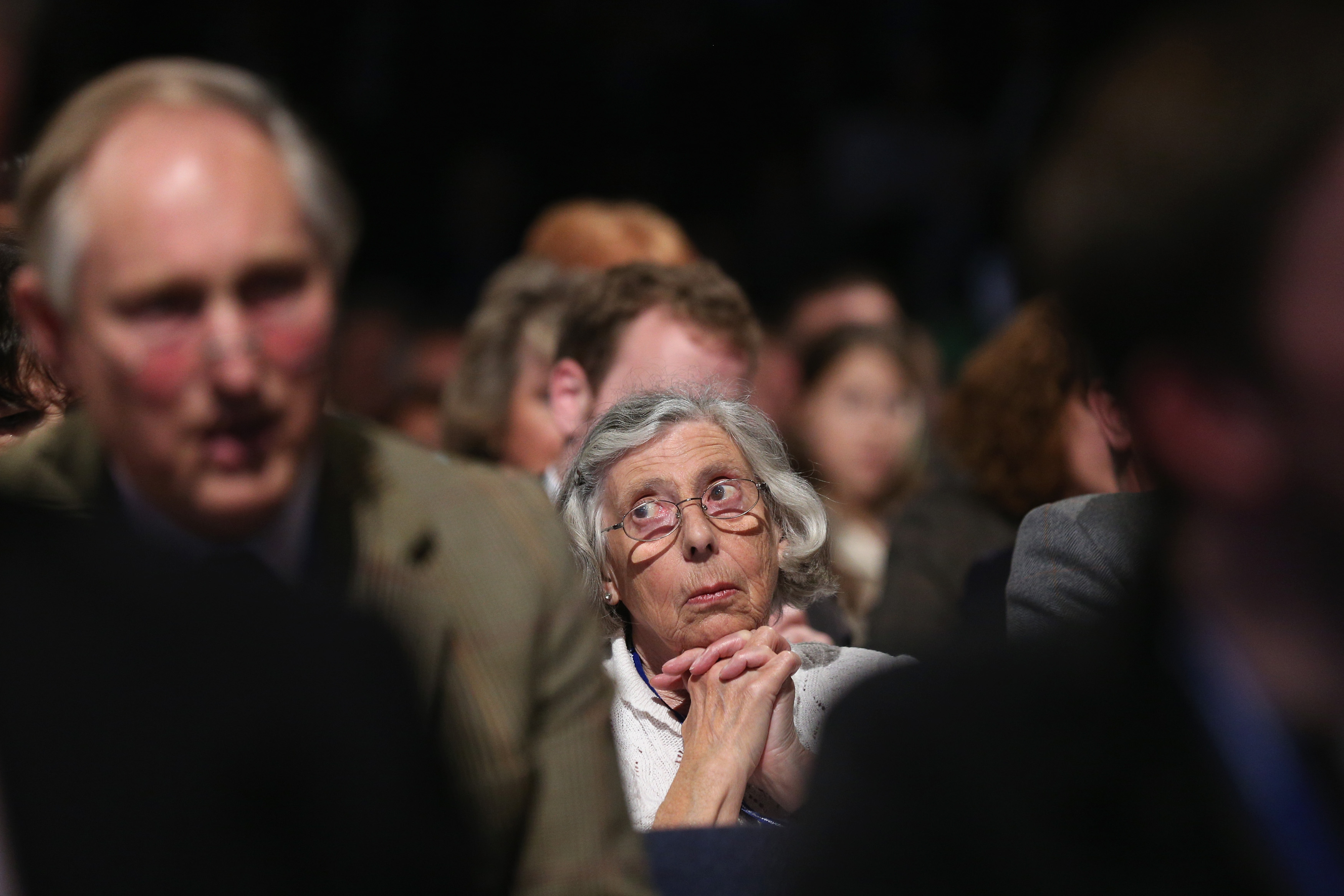
(Photo: A Mitch McConnell look-alike in Britain’s Conservative Party Conference last month. By Getty Images.)

A Disaster The Democrats Didn’t See Coming

Today the president discussed the problems with Obamacare’s exchanges:

I have to say I found his remarks far less contrite than they should have been. Where is the unqualified apology? Where is the commitment to basic accountability for this clusterfuck? Instead, we have all these positive rationalizations and excuses in a confusing technical lecture. Ezra reports that the White House was blindsided by the Healthcare.gov problems:

The problem here isn’t just technological. It’s managerial. The White House’s senior staff — up to and including the president — was blindsided. Staffers deep in the process knew that HealthCare.gov wasn’t ready for primetime. But those frustrations were hidden from top-level managers. Somewhere along the chain the information was spun, softened, or just plain buried.

The result was that the White House didn’t know the truth about its own top initiative — and so they were unprepared for the disastrous launch. They didn’t even know they needed to be lowering expectations. In any normal corporation, heads would roll over a managerial failure of such magnitude and consequence.

And perhaps heads will roll. But for now, the White House is focused on trying to make HealthCare.gov work.

Not. Good. Enough.

Obama needs to get ahead of this, and stop being as defensive as he was this morning. He does not have the credibility to sell us on the ACA when he does not cop more aggressively to his own failure to stay on top of this most important domestic initiative. Sebelius is the person most obviously responsible for the managerial – not technical – problems that have plagued this new program’s rollout.

Until someone that high up is fired, I do not believe that no one is angrier about this failure than the president. I believe that’s true – but also spin. Meanwhile, W. James Antle III wonders whether Obamacare repealers and Obamacare fixers will work together if the exchanges require legislative fixes:

The reasons liberals should want to prevent their long-awaited victory on health care reform from being turned into defeat by the haphazard implementation of a poorly constructed law are obvious. But what’s in it for conservatives? Nothing would better vindicate their case against Obamacare than the “death spiral” that would follow young people fleeing exchanges that are being flooded with the old and sick.

Yet if Obamacare undermines the entire individual health insurance market, it will make it even more difficult—and perhaps impossible—to ever implement any free-market health care reforms. In fact, single payer may loom ever larger as the only viable remaining option to an employer-based system that both conservatives and liberals would like to substantially remodel.

But for Republicans, Obamacare is not and perhaps never has been a program to favor or oppose, to reform or to abandon. It has become a doctrinal issue of paramount importance. They have not acted rationally in shaping it, as they could easily have, or in reforming it, as they could now do. They will continue a policy of sabotage – and the possibility that we could all end up in single-payer as a result is not the kind of empirical thing they can compute. It requires an analysis of costs and benefits, which they are unable to do. All they do is proclaim eternal, political truths and purge any dissenters. That’s all they know. Because actually governing – rather than controlling – the country is of no interest to them.

In a later post, Ezra assesses the efforts to fix the ACA website:

HealthCare.gov is monstrously complex. The Times reports that there’s more than 500 million lines of code — of which more than 5 million lines may need to be rewritten. And that code is interfacing with computer systems (and computer code) at the Internal Revenue Service, the Social Security Administration, state Medicaid systems, insurers like Aetna, and more. Even the best programmers would have trouble figuring out what’s going on — much less what’s going wrong — quickly.

The truth is that the Obama administration is, to a much greater extent than it would like, dependent on the very people who built HealthCare.gov to fix it. They’re the only people who know what’s going on inside the system.