Israel And The New Middle East

A reader sent me a recent column by the legendary William Pfaff syndicated in the international edition of the NYT. What he writes there would not, I bet, appear in the domestic NYT. Because what Pfaff does is debate the reality of the Middle East and weapons of mass destruction in ways almost never heard in mainstream American media – but ubiquitous abroad.

He posits two possible outcomes of recent developments. First off, he cites the so-far remarkably successful effort to find, secure and destroy the Assad regime’s chemical weapons stockpile. Incredibly as it seemed only a few months ago, we look as if we may be on the path to removing those hideous weapons from the world – a big advance in collective security. But imagine if the talks with Iran also conclude successfully – which may well happen, if they aren’t deliberately scuppered by the Christianist-AIPAC alliance in the US Congress. Then you’d have Iran’s nuclear program monitored as a civilian enterprise under the Non-Proliferation Treaty – and Obama would have helped remove WMDs from two Middle East powers, a big advance toward lowering the potential for an apocalypse in that part of the world.

But guess who that leaves as the sole WMD power in the region, with chemical and nuclear weapons not under any international supervision? Pfaff:

The conclusion of such a series of developments could be the regulation and legalization of the conventional weapon stocks possessed by Syria and Iran, leaving Israel as an outlaw not only because of its possession of weapons of mass destruction, but because of its aggressive expansion and apartheid policies with respect to the Palestinian territories and their populations.

If Syria and Iran give up their WMD potential – Israel is going to find itself extremely isolated in global opinion – even more so than today. The Israelis will not be able to argue that their WMDs are designed to deter other WMDs, since those other WMDs will have been neutralized. Israel will argue, understandably, that because of its uniquely despised existence in the region, it still requires a deterrent of huge magnitude. I’d be very sympathetic to that case. But it will be difficult to argue that and to argue that it will never give up the West Bank as well. Neither the US nor the European powers would be able to support both Israel’s retention of nuclear and chemical weapons and the continuing occupation and relentless de facto annexation of the West Bank and East Jerusalem.

I can even see a strategy where a successful conclusion to the Iran negotiations and to the Syrian chemical stockpile would increase the pressure on Israel to end its brutal occupation of the West Bank. What is Netanyahu’s strategy for dealing with that? Pfaff sees warfare against Iran as Netanyahu’s response to such advances – against US wishes. But I think that would intensify Israel’s isolation, especially if the Iranians were close to a deal – or even past one – with the West as a whole. Netanyahu is a Ted Cruz figure, but even he would not go there, I guess.

Is it therefore possible that developments in Syria and Iran could help advance a two-state solution in Israel/Palestine? Know hope.
“The Tocqueville Effect”

jwowsa1ks020ehlt19i1la

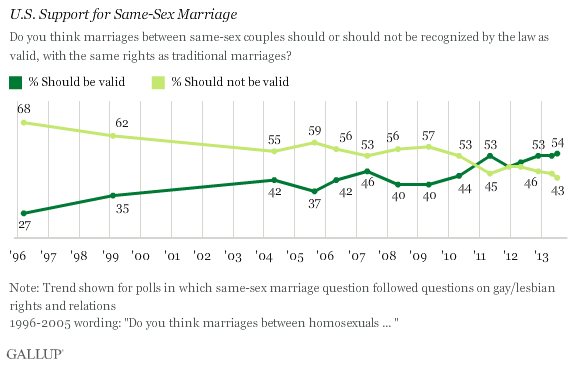
Reviewing the extraordinary progress of the marriage equality movement over the past two decades, Jonathan Rauch coins a term for how changes in public opinion tend to happen in America:

Alexis de Tocqueville, the Frenchman whose observations of America in the 1830s remain shrewdly relevant, famously remarked on Americans’ deference to majority opinion: “As long as the majority is still undecided, discussion is carried on; but as soon as its decision is irrevocably pronounced, everyone is silent, and the friends as well as the opponents of the measure unite in assenting to its propriety.” Although he exaggerates, the broad point remains true: the legitimising effect of public opinion is such that, other things being equal, majority support tends to amplify itself.

Even if I have doubts about gay marriage, the fact that most of my countrymen are on the other side weakens my resolve and impels me to acknowledge the legitimacy of their view. The difference between support at, say, 55 per cent versus 45 per cent — that is, the different between majority and minority standing — is one of kind, not merely of degree. That is not to say that opposition evaporates or crawls under a rock when it loses majority standing. But its power and relevance are greatly reduced.

Another word for this is the tipping point. But more generally, we are indeed much more susceptible to accepting things that a majority seems to have settled on. My biggest experience of this is living for part of the year in Provincetown.

It’s a small New England fishing village in outward aspect but any day-tripper there will encounter much higher levels of gay visibility than they’re used to, drag queens walking to get groceries, transgender people in front of you getting coffee, gay couples with children in strollers, and the occasional glimpse of an unexpected bare ass in leather. The day-trippers come from all-over – for whale watching, taffee-buying, dune touring or nightlife. They are predominantly heterosexual. And yet within a few minutes of awkwardness, they just accept it. Because no one is paying attention to the weirdness, you learn not to as well.

The place itself simply imposes acceptance by majority rule and the visitors immediately seem to sense that and adjust. They may feel differently if a drag queen were holding up the line at Starbucks in, say, Revere. But in the little town of widespread nonchalance toward otherness, the culture shifts almost at once. As usual, Tocqueville was onto something – long before Malcolm Gladwell.

(Polling from Gallup’s latest survey on the question.)

The Democrats Finally Grow A Spine, Ctd

Ron Brownstein notes that leading gubernatorial candidate and long-time Clintonite Terry McAuliffe has tacked liberaltarian on social issues – a once unheard-of move for Democrats in the Old Dominion:

Virginia Democrats historically have sought a cautious middle ground on such questions, largely in hope of holding culturally conservative blue-collar, evangelical, and rural white voters long considered indispensable to statewide success. But McAuliffe has repeatedly adopted liberal social positions that ensure repeated conflicts with those voters—while providing fuel to energize the Democrats’ new ‘coalition of the ascendant’ centered on minorities, the millennial generation, and white-collar white voters, especially women. … That evolution suggests Virginia Democrats have increasingly decided that failing to motivate their ‘coalition of the ascendant’ is a greater electoral risk than alienating right-leaning whites.

Brownstein sees the same dynamic playing out in other states:

[P]urple-state Democrats, such as Sen. Kay Hagan of North Carolina and Colorado Gov. John Hickenlooper, have placed the same wager as McAuliffe and aligned with the social priorities of their new coalition, even at the price of goading conservatives. That has solidified Democratic unity on previously divisive issues such as gay marriage and immigration. Yet this consensus is likely to last only if it produces swing-state victories, starting with McAuliffe’s race next month.

Kilgore also underscores the national implications of a McAuliffe win:

As the Virginia race heads to its final days, it will often be noted that in the last nine gubernatorial elections there the party holding the White House has lost (Mills Godwin’s 1973 victory was the last win by the incumbent presidential party). As I argued in a long-lost FiveThirtyEight post four years ago, there are a lot of coincidences in that data point, and it probably has more to do with Virginia political rhythms than anything happening in Washington. But it’s still going to make a T-Mac victory a very big deal.

Recent signs of spine-growing here and here.

Marriage Equality’s Latest Triumph – And Achievements Thus Far

Cory Booker Marries Same Sex Couples As NJGay Marriage Law Goes Into Effect

It’s a big day for marriage equality, as New Jersey moves forthrightly ahead. That’s another 9 million people living in a state with full marriage equality at the state and federal level – and it reveals how the US Supreme Court ruling earlier this year could affect many state courts that will have to tackle this issue in the years ahead.

But what’s striking to me is how the most promising potential presidential candidate for the GOP in 2016, Chris Christie, decided to withdraw his appeal to the court’s ruling that would have made a popular referendum on the issue mandatory. That was his somewhat disingenuous position for a long time – as if the courts and legislature were somehow not capable of performing their constitutional roles properly without a direct popular vote. No such referendums are part of New Jersey’s history – Christie’s would have been the first. So his fig leaf is gone. The most mainstream Republican possibility in 2016 will come from a marriage equality state – just as the Pope is the first to have come from a country that already has marriage equality.

This matters. Leaders who come from places where equality is working are much less hostile to gay dignity than in those places where it remains a frightening abstraction. Christie’s decision to stop resisting will help entrench marriage equality still further and force the GOP to confront whether hostility to committed homosexual relationships remains a litmus test in its presidential nomination process. If I were Christie, I’d focus on the social data we are already accumulating on the impact of marriage equality on the lives and relationships of people in the relevant states. It’s the best argument there now is. Below is a great video presentation by Lee Badgett, an economist at the University of Massachusetts-Amherst, on the strikingly positive sociological data so far in marriage equality states:

A reader sums it up:

(1) Uptake is high, and will get higher as a result of the fall of DOMA, (2) domestic partnership and civil unions were never very popular to begin with and now are falling into disuse and are likely to fade away, (3) SSM breakup rates are relatively low, but it’s early days and data are sparse, (4) straight marital behavior has not been affected.

When the lives of gay citizens have improved immensely, when the reform has proven popular among heterosexuals and homosexuals alike, and when we can observe no effect at all on heterosexual marriage, it seems to me that the anti-gay right has to either dig deeper into fundamentalist rigidity, or embrace this as the truly conservative reform it is.

(Photo: Alexander Padilla and Anthony Arenas cut a piece of cake after being married by U.S. Senator-elect Cory Booker at City Hall in the early morning hours of October 21, 2013 in Newark, New Jersey. By Kena Betancur/Getty Images.)

A Constitutional Right To Education?

Stephen Lurie makes the case for one, noting that “every country that bests us in the education rankings either has a constitutional guarantee to education or [has] ensured the right through an independent statute”:

There simply hasn’t been a movement in the US to establish the rights of children in respect to equal, free, and adequate education. … When it comes to the rights of children in education, traditional interpretation has deemed the 10th amendment sufficient to shift responsibility to the states, and the 14th amendment adequate to ensure fairness. The Supreme Court decision in San Antonio Independent School District v. Rodriguez (1973), though, ran directly counter to that logic, denying appellant claims that unequal education funding violated a fundamental right and the Equal Protection Clause. Even as America assumes the responsibility for education rests somewhere, it’s clear that the right to that education has clearly fallen through the cracks.

But even if it were possible to pass a constitutional amendment, what would that accomplish?

Besides the important ability to catalyze a national discourse on education and legitimize federal leadership, a constitutional amendment provides a vital opportunity for court challenge. As influential as the decision in Brown v. Board proved to be for de jure discrimination, relying on the 14th Amendment for equal protection has proven inadequate to ensuring de facto educational equality across race, state, and income.

When there is a constitutional guarantee to education, the report and history suggest, direct litigation can produce lasting results. If a true right is established, soft forces and hard law can begin to fundamentally alter the immense flaws of the education system nationwide. This is the exact phenomenon that plays out time and again in other countries – and particularly the ones besting American education.

Lessons In Self-Reliance

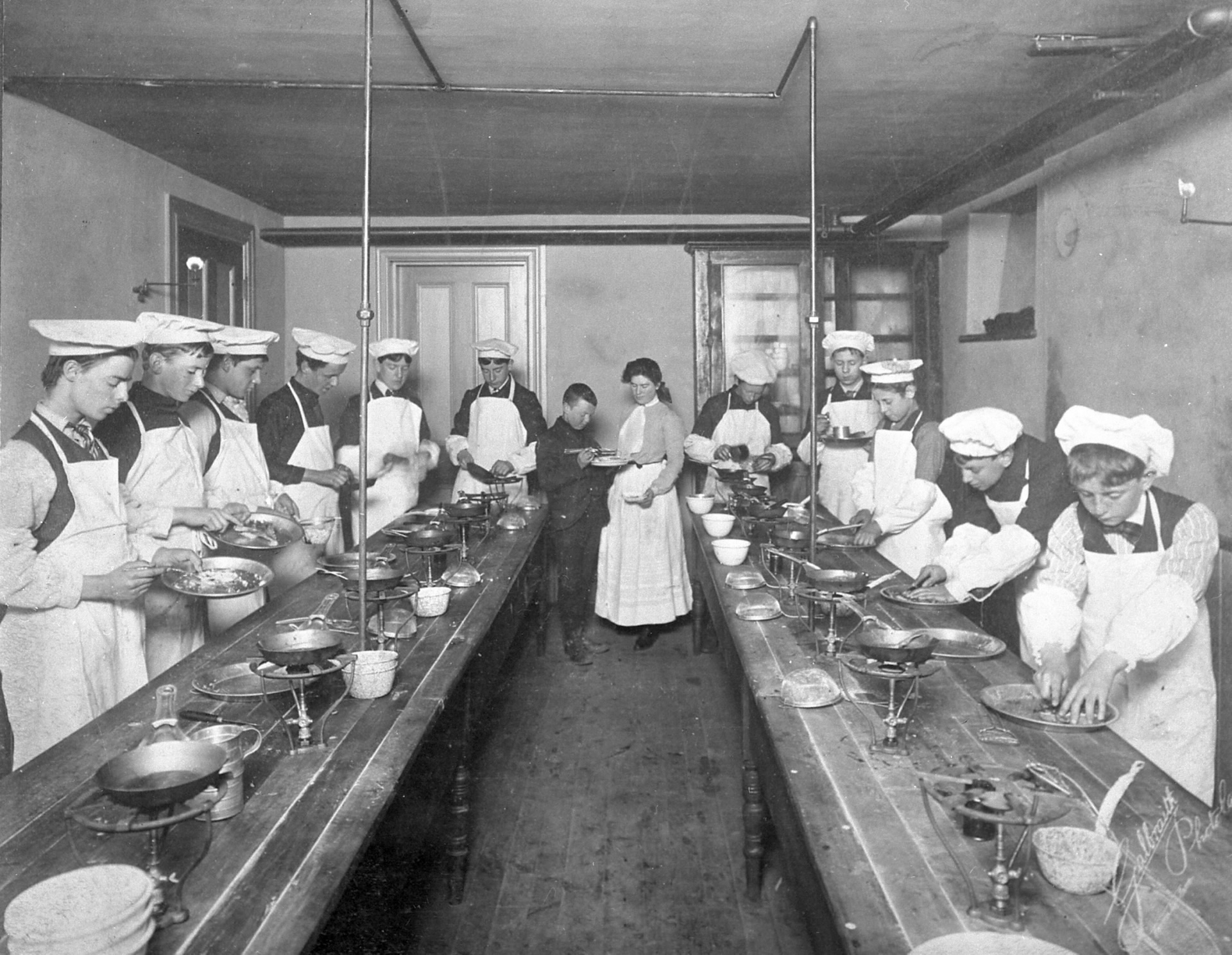
Domestic_science_class_for_boys_1906_Toronto

Ruth Graham urges young people to take home ec:

The words “home economics” likely conjure visions of future homemakers quietly whisking white sauce or stitching rickrack onto an apron. But to a handful of people thinking big about these problems, they evoke something different: a forward-thinking new kind of class that would give a generation of young people – not just women, but everyone – the skills to shop intelligently, cook healthily, manage money, and live well. The historian Helen Zoe Veit has argued that home ec has a key role to play in treating the obesity epidemic. “A beautiful way to start solving this problem would be to get more people cooking,” she said recently. “We have a blueprint of how to do this, and it’s through home economics.”

Erin Gloria Ryan is on board:

FCS [family and consumer sciences] is far from unnecessary sexist wife-prepping fluff; it’s important stuff that all students will actually, you know, use in their adult lives – not as a method of taking care of your hat-wearing husband’s babies, but to take care of themselves and separating themselves from the money and resource-wasting convenience products that rely on a helpless population to survive.

It feels good to take care of yourself! It feels good to save money by making your own food, taking care of your own home, understanding your own basic finances. Mandatory FCS with the sort of curriculum already being taught by dedicated teachers across the country could help alleviate the scourge of kidults currently stocking freezers full of Lean Cuisine and closets full of pants in need of hemming and checkbooks that have never been balanced.

Food writer Tom Philpott presses the issue:

I have witnessed firsthand the vexed state of basic cooking skills among the young. When I helped run the kitchen at Maverick Farms for seven years, I noticed that most of our interns couldn’t chop an onion or turn even just-picked produce into a reasonably good dish in a reasonable amount of time. And these were people motivated enough about food to intern at a small farm in rural North Carolina. If I had their cooking skills, I’d be tempted to resort to takeout often, just to save time.

(Photo of a 1906 “domestic science” class by Alexander W. Galbraith)

Mr. America’s Founding Father

Meet Eugen Sandow, who, in the late 19th century, turned bodybuilding into an aesthetic, rather than purely athletic, experience:

Men and women alike clamored for cabinet cards featuring Sandow in the buff, and his physique inspired the first generation of gym bunnies. As Tim Farrell wrote for Neatorama, “Sandow did more than simply shock and titillate audiences with his tiny waist and ripped muscles; he pioneered the notion of working out for the sake of aesthetics.” Sandow recognized the value of sex appeal and used it to establish one of the earliest celebrity sporting franchises from his headquarters in London, which formed the basis of modern gym culture. …

He would cover himself with white powder so that he would look more like marble, and he’d assume a pose. Then they’d close the curtain to this little box, and when they opened it again, he was in another pose. He wore tights, but he took his shirt off, and it was quite unusual in those days for a man to remove his shirt in public. He was using allusions to classical art and statuary as an alibi, an excuse for posing practically nude. But that’s what he did, and he was a huge hit among men and women.

The Pitfalls Of Rape Prevention

Emily Yoffe issues a call for women to take their own steps toward avoiding sexual assault, arguing that “the rise of female binge drinking has made [college] campuses a prey-rich environment”:

Experts I spoke to who wanted young women to get this information said they were aware of how loaded it has become to give warnings to women about their behavior. “I’m always feeling defensive that my main advice is: ‘Protect yourself. Don’t make yourself vulnerable to the point of losing your cognitive faculties,’ ” says Anne Coughlin, a professor at the University of Virginia School of Law, who has written on rape and teaches feminist jurisprudence. She adds that by not telling them the truth—that they are responsible for keeping their wits about them—she worries that we are “infantilizing women.” …

The biological reality is that women do not metabolize alcohol the same way as men, and that means drink for drink women will get drunker faster. … If female college students start moderating their drinking as a way of looking out for their own self-interest—and looking out for your own self-interest should be a primary feminist principle—I hope their restraint trickles down to the men.

Katie McDonough accuses Yoffe of writing “rape apologia”:

These arguments are offensive and damaging to victims, but they are also familiar to the point of being banal. It’s the reason why responding to them can be a challenge, because it is hard to find new ways to say the same things. Like that female sexuality or female vulnerability do not cause rape. That rape is a crime, but that being drunk is not. These things have been written before, and they will most certainly be written again.

Yoffe has plenty of good data to support her argument that binge drinking on college campuses isn’t healthy. The over-consumption of alcohol can literally kill people. What it can’t do, however, is make a woman responsible for a crime committed against her.

Emily Matchar comes to Yoffe’s defense:

The fact that Yoffe didn’t discuss men in her story is troubling. It frames rape as a women’s issue rather than an everybody issue, which I assume was not her intent. But this doesn’t make her points about women and drinking any less true. Educating women on the factors that make them vulnerable to assault is not victim-blaming. It is simply practical advice backed up by data. We tell travelers to be aware of their surroundings in unfamiliar cities to reduce the risk of mugging. We teach new drivers defensive strategies to avoid being hit by drunks and speeders. This should not be any different.

Some critics said Yoffe was merely rehashing tired, hysterical old warnings about alcohol and rape, which “all” women have already heard. Yet many available sources of information on sexual assault prevention skirt the issue of drunkenness without directly addressing it. They urge alertness and awareness: Trust your gut, walk purposefully, keep your keys handy, scan your surroundings when alone at night, note the locations of emergency phones. But these are all things that drunkenness make impossible. Why not address that directly?

Recent Dish on rape here, here, here, and here.

The Straight Dope On Lance

Jim White watches Alex Gibney’s new documentary on the fall of Lance Armstrong, The Armstrong Lie, which began production before the revelations of the cyclist’s doping. “Armstrong invited Gibney into his life on the assumption that the film-maker would seal his place in history,” he observes. “Gibney has done that”:

At the heart of the complex, sophisticated lie the rider constructed around his systematic cheating was his own ability to fib to camera. Time and again during that 2009 Tour he looks into Gibney’s lens and tells him he has never, will never, and could never embrace performance-enhancing assistance. And boy, is he good at it. Never in this history of dope control has there been a drug cheat who has voluntarily admitted their guilt before they were exposed. Until found out, Marion Jones, Michelle de Bruin, Dwain Chambers, all of them insisted their achievements owed entirely to their brilliance and hard work.

But nobody was as proficient at the fib as Armstrong. Nobody lied as often and as skilfully as he did. In Gibney’s film we see him in those 2009 press conferences taking on his detractors such as journalist David Walsh with a plausibility that, with the benefit of hindsight, beggars belief. We witness his bullying delight in humiliating those who knew the truth. We see him at his contemptible worst, hiding behind his cancer to denigrate those who dared challenge his version of himself.

Relatedly, Ashley Fetters focuses on the new book Wheelmen: Lance Armstrong, the Tour De France, and the Greatest Sports Conspiracy Ever:

Armstrong’s true story—or, at least, Wheelmen’s account of it—contains enough juicy intrigue that it’s worth pondering: In some alternate universe where Lance Armstrong was a fictional character created in a writers’ room (rather than a real person who’s disappointed millions of people), would he be looked upon with contempt or with fascination? With a few clever storytelling touches—a few glimpses of Lance’s unstable childhood in Texas here, some added emphasis on just wanting to win it for the cancer survivors there, some strategically placed flickers of truly agonized soul-searching—it’s not hard to imagine that his story might even elicit some degree of conflicted compassion.

Previous Dish on Armstrong’s public demise here, here and here.

Watterson Speaks

In only his second known interview since ending Calvin and Hobbes in 1995, the reclusive Bill Watterson discusses the role of the comic strip in an increasingly digital culture:

Where do you think the comic strip fits in today’s culture?

Personally, I like paper and ink better ch2 than glowing pixels, but to each his own. Obviously the role of comics is changing very fast. On the one hand, I don’t think comics have ever been more widely accepted or taken as seriously as they are now. On the other hand, the mass media is disintegrating, and audiences are atomizing. I suspect comics will have less widespread cultural impact and make a lot less money. I’m old enough to find all this unsettling, but the world moves on. All the new media will inevitably change the look, function, and maybe even the purpose of comics, but comics are vibrant and versatile, so I think they’ll continue to find relevance one way or another. But they definitely won’t be the same as what I grew up with.

So should we be on the look-out for a Pixar-produced Calvin and Hobbes movie?

The visual sophistication of Pixar blows me away, but I have zero interest in animating Calvin and Hobbes. If you’ve ever compared a film to a novel it’s based on, you know the novel gets bludgeoned. It’s inevitable, because different media have different strengths and needs, and when you make a movie, the movie’s needs get served. As a comic strip, Calvin and Hobbes works exactly the way I intended it to. There’s no upside for me in adapting it.

Go Comics recently made the Calvin and Hobbes archive available online.  This summer, Dish readers reminisced about the comic here, here, and here. More here.