Looking Up At Infinity

Ross Andersen ponders how generations of people have come to terms with the vastness of the sky:

When we peer into the sky’s abyssal recesses, its blank blues and deep starlit voids, we dish_shiva catch a glimpse of infinity, and, as [philosophy scholar Thomas] McEvilley says, ‘the finite mind has difficulty processing infinity.’ The psychology of this phenomenon was described best by Pascal, the 17th-century mathematician who said the starry sky made him think of time’s crushing enormity. It made him see that human life is a microsecond, beset by two eternities, past and future. ‘The eternal silence of these infinite spaces frightens me,’ he said. And who can blame him? To look at the sky is to be reminded that oceans of space and time lie beyond the reach of our minds. Who can help but feel small under it? By showing us the true scope of the unknown, the sky forces us to confront the mysterious nature of human experience. It puts us face to face with the most basic of truths — that we are all, in some sense, existentially adrift.

Humans have devised several strategies to tame this unnerving quality, none more popular than worship. It’s easy to see why.
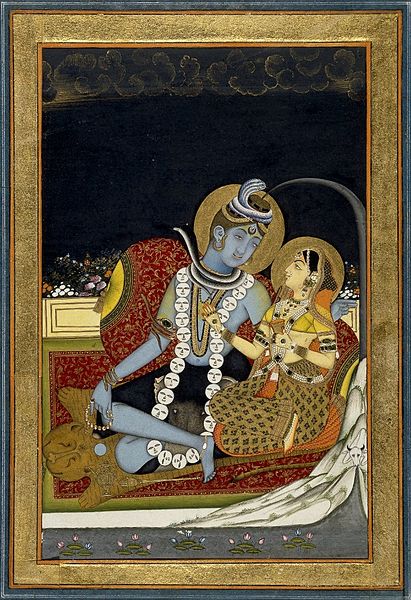
Making the sky into a humanlike God is a shortcut to making it legible. If you believe that there is a man in the sky, you can interpret its unpredictable cinema, its colour shifts and stormy whims, as symbolic messages, communications from the cosmic creator. You can graft human traits and desires onto the sky’s impenetrable infinities, and soothe yourself with the comforting notion that the great unknown resembles you in some important way. This philosophical trick is hard for the order-seeking mind to resist, because it leads to a coherent picture of the world. And so, since antiquity, sky gods have gushed from the human imagination, and several of them survive to this day.

In the West, this practice goes back to the dawn of civilisation, to the Sumerians, whose most exalted deity was the sky god Anu. The Ancient Greeks followed suit by putting Zeus, the sky-father, atop Mount Olympus, and so did the Romans, who worshipped Jupiter for centuries before converting to Christ. Eastern polytheisms had their sky gods, too. Shiva, the supreme god of Shaivism, one of Hinduism’s most ancient denominations, is often described as ‘the cosmic man’. He is typically depicted wearing a crescent moon on his head, an ornament meant to symbolise the waxing and waning of creation during time’s eternal cycles. He wears, in other words, a talisman of infinity.

(Image: Shiva with Parvati, c. 1800, via Wikimedia Commons)
The Original Meaning Of Original Sin

In an overview of Judaism and Christianity, Kenan Malik contrasts their understandings of evil and sin:

The story of Adam and Eve, and of the serpent in the Garden of Eden, was, of course, originally a Jewish fable. But Jews read that story differently to Christians. In Judaism, Adam and Eve’s transgression creates a sin against their own souls, but it does not condemn humanity as a whole, and nor does it fundamentally transform either human nature or human beings’ relationship to God. In the Christian tradition, God created humanity to be immortal. In eating the apple, Adam and Eve brought mortality upon themselves. Jews have always seen humans as mortal beings.

In the Garden, Adam and Eve were as children. Having eaten of the Tree of the Knowledge of Good and Evil, they had to take responsibility for themselves, their decisions and their behaviour. This is seen not as a ’fall’ but as a ‘gift’ – the gift of free will. As the Hertz Chumash, the classic Hebrew-English edition of the Pentateuch and Haftorahs, observes, ‘Instead of the Fall of man (in the sense of humanity as a whole), Judaism preaches the Rise of man: and instead of Original Sin, it stresses Original Virtue, the beneficent hereditary influence of righteous ancestors upon their descendants’.

The story of Adam and Eve was initially, then, a fable about the attainment of free will and the embrace of moral responsibility. It became a tale about the corruption of free will and the constraints on moral responsibility. It was in this transformation in the meaning of the Adam and Eve’s transgression that Christianity has perhaps secured its greatest influence.  The true legacy of the doctrine of Original Sin is not as an explanation of evil, but rather as a description of human nature, a description that came to dominate Western ethical thinking as Christianity became the crucible in which that thinking took place.

Taking Pride In Evil

Sam Harris believes that Islamic violence is more troubling than violence carried out by sadists or the mentally ill:

Take a moment to consider the actions of the Taliban gunman who shot Malala Yousafzai in the head.

How is it that this man came to board a school bus with the intention of murdering a 15-year-old girl? Absent ideology, this could have only been the work of a psychotic or a psychopath. Given the requisite beliefs, however, an entire culture will support such evil.

Malala is the best thing to come out of the Muslim world in a thousand years. She is an extraordinarily brave and eloquent girl who is doing what millions of Muslim men and women are too terrified to do—stand up to the misogyny of traditional Islam. No doubt the assassin who tried to kill her believed that he was doing God’s work. He was probably a perfectly normal man—perhaps even a father himself—and that is what is so disturbing. In response to Malala’s nomination for the Nobel Peace Prize, a Taliban spokesman had this to say:

Malala Yousafzai targeted and criticized Islam. She was against Islam and we tried to kill her, and if we get a chance again we will definitely try to kill her, and we will feel proud killing her.

(Video: A clip from a 2011 interview with Malala, prior to her attack. If you missed Jon Stewart’s remarkable interview with her last week, go here.)

Talmudic Technicalities

Adam Kirsch puzzles over some of the stranger interpretations of Talmudic ritual – such as the warning that drinking only two cups of wine invites demons and witchcraft – and surveys attempts by rabbis to find loopholes:

Just as the rabbis codify in great detail exactly what can and can’t be moved on Shabbat, or how tall an eruv has to be, or what time in the evening you can say the Shema, so they lay out the rules and exceptions about urinating between a wall and a palm tree. This is dangerous, they explain, “only when there are not four cubits of space between the two objects. However, if there are four cubits, we have no problem. … And even when there are not four cubits, we said there is a problem only when the demons have no other route besides that one. However, if they have another route, we have no problem with it.”

The ease with which magic and witchcraft find a place in the Talmudic worldview is, to my mind, both illuminating and compromising. For it suggests that the Talmud’s general commitment to exact measurement and correct action—the need to find out exactly how to behave in order to please God, down to the order in which you put on your shoes in the morning—is itself a kind of magical thinking. For the rabbis, Jews are the protagonists of a cosmic drama in which their every slightest action will be either rewarded or punished. There is something ennobling about this, but when the same kind of scrutiny is attributed not just to God but to demons and witches, it begins to seem oppressive and even absurd.

Which Jesus Do You Believe In?

In an interview with Mockingbird marking the American release of his latest book, Unapologetic, Francis Spufford remarks on the different ways Jesus is portrayed:

M: So not the meek, not the cool, not the Ché, not the ironic, so then, what are we missing? Who is Jesus?

FS: We’re missing the open door to a generosity which thinks that law is the very beginning of what human beings need, where calling it radical is too small. You could call it conservative and it would make just as much sense, and you would still slough it off like a skin and leave it way behind. He is somebody. He is love without cost controls engaged. He is what it looks like to love deliberately without self-protection.

Reviewing the book, Wesley Hill appreciates that Spufford doesn’t offer “another defense of Christian ideas” but instead tries “to paint a picture of what it’s like to be a believer”:

Religious sensibilities, as Spufford writes in the preface, “are not made of glass, [and] do not need to hide themselves nervously from whole dimensions of human experience.” When we talk about sin and grace and faith, we’re not entering some rarefied realm of discourse removed from everyday life. We are, Spufford contends, trying to describe the sense of guilt that keeps us up at night worrying that our mean-spirited comment at a fancy dinner party puts us in the same predicament as the guy who tears into his former drinking buddy in a bar fight. We’re trying to describe the sense of mystery and elusive presence that frightens and comforts us—or comforts by frightening us—when we listen to the lilting melodies of Mozart’s “Clarinet Concerto.”

At the heart of Spufford’s book is a long retelling of the story of Jesus, or Yeshua, that is as evocative as any I’ve read. When I sent a copy of the book to a skeptical friend, I told him, “Finishing the Yeshua chapter made me want to become a Christian all over again.”

Previous Dish on Spufford here, here, and here.

This Is Your Portrait On Drugs

In the 1950s, a researcher supplied an artist with two 50-microgram doses of LSD and asked him to sketch a series of portraits as the drug took effect:

Dan Colman provides more background:

We still don’t know the identity of the artist. But it’s surmised that the researcher was Oscar Janiger, a University of California-Irvine psychiatrist known for his work on LSD. The web site Live Science has Andrew Sewell, a Yale Psychiatry professor (until his recent death), on record saying: “I believe the pictures are from an experiment conducted by the psychiatrist Oscar Janiger starting in 1954 and continuing for seven years, during which time he gave LSD to over 100 professional artists and measured its effects on their artistic output and creative ability. Over 250 drawings and paintings were produced.” The goal, of course, was to investigate what happens to subjects under the influence of psychedelic drugs.

The mystery artist gave updates as the acid ran its course:

2 hours 45 minutes: Agitated patient says “I am… everything is… changed… they’re calling… your face… interwoven… who is…” He changes medium to Tempera. …

5 hours 45 minutes: “I think it’s starting to wear off. This pencil is mighty hard to hold.” (He is holding a crayon).

A few years ago we posted a similar series of self-portraits from Bryan Lewis Saunders, who experimented with dozens of different drugs, with fascinating results. Here is “1 ‘Bump’ of Crystalmeth”:

crystalmeth

Many more here.

Canned Laughter Has Passed Its Expiration Date, Ctd

A reader provides some great professional insight to the thread:

After reading the Dish for a couple of years and subscribing this year, I was pretty excited to see a thread that I had some knowledge of. One of the reasons that I read the blog is the seemingly endless reader expertise on almost any subject.  Even though expertise is not something that I would claim, I have worked in this field my entire adult life.

The clip of “The Big Bang Theory” that you embedded to is not a clip with no laugh track added; it is a clip with laughs removed.  You can hear the laughter briefly when it overlaps a line of dialogue. The clip is a great example of an actor’s technique of “waiting on the laughs”. They briefly delay their next line so that the audience laughter doesn’t make the next line difficult to hear. Done with skill and expertise, a cast can create a rhythm that enhances the comedic timing of a show. In this clip when they removed the laughs the pauses between the line deliveries destroys the timing and causes the actors and the scene to appear awkward and unfunny.

I have been involved in sit-coms for over 30 years and currently have several friends and a nephew who work on “Big Bang”. This is a funny show that has a live audience which genuinely laughs at the jokes. Even if it is edited to be a bit louder or quieter, or even if the laughs from the first take of a scene are applied to a different take, the laughter is real and drives the actor’s performances.

In the ’90s I worked on the HBO series “Dream On”.

At the time there were no single-camera sit-coms being made other than ours.  There were no sit-coms without laugh tracks other than ours. Despite the lack of laughs, we were a critical and audience hit. At some point FOX bought the rights to the network airing of “Dream On” but they were uncomfortable with a sit-com with no laugh track. They added one and it was a total debacle. The actors were not waiting for laughs, the timing was destroyed the jokes made un-funny and the show was quickly cancelled.

In the last few months I have worked a few days on “Anger Management,” which is shot with multiple cameras and made to look like a show before a live audience. There is no audience other than a couple dozen writers and producers who watch the filming and laugh at their own jokes. This option for filming a “live audience” sit-com is problematic because there are no independent judges as to whether or not a joke will make a non-involved audience laugh. The writers have a vested interest in their jokes inciting laughter and even if their laughter is actually recorded it tends to sound forced and fake. Most of the laughs are applied by an editor.

Bolonik reviews two new sit-coms; she doesn’t like one and likes the other. She notices less the laugh track in the one she likes and suggests that all laugh tracks be done away with because she notices more the laugh track in the un-funny show. It seems that she is objecting to the quality of the show not if it has a laugh track added. The actual problem with sit-coms is that comedy is very hard to write. Every week Hollywood employs somewhere around two thousand writers and on any day there aren’t more than maybe a hundred good writers in the entire country. Trying to pin her dislike for a show on the laugh track misses the point. It is just a bad show.

Customized E-Cigs

Meghan Neal records their rise:

Any self-respecting vaper has a PV (personal vaporizer), or Mod (personalized, or “modified” piece.) From there, you can customize basically every aspect of your vaping experience—the refillable cartridge or “tank,” atomizer or wick, nicotine level (samples at the Vaporium range from zero to 24 mg—the equivalent of a heavy smoker), mAhs (Milliamp per hour, an indicator of battery life), and the intensity of the TH (throat hit) when inhaling.

Then there’s the plethora of flavors of liquid, variously known as e-liquid, juice, e-juice, nic-juice, or ass juice if it tastes real nasty. You can vape a straight tobacco flavor, cotton candy, chocolate, or more stonerific varieties like “Hoops” and “The Dude.” Or DIY vapers will mix their own liquid recipes.

This is where vape shops come in. At first, these were places to sample flavors and try out equipment, then they brought couches and foosball tables and flatscreen TVs into the shops so you could vape in the comfort while perusing their products. Next came vape lounges with bars, cafe-style tables, juices, and snacks. And now, retail boutiques.

Economists are taking notice:

Goldman Sachs earlier this year pegged e-cigarettes as one of eight industry disruptions to watch in the coming years (others included 3-D printing and cancer immunotherapy). Goldman estimates that e-cigarette retail sales already totaled $1 billion last year and could reach $10 billion by 2020; by then it estimates e-cigarettes could account for 16 percent of the US tobacco industry’s profits. …

If e-cigs continue to grow in popularity, it could hasten the demise of traditional cigarettes. But e-cigs also promise fatter profit margins, because they are not taxed as aggressively as traditional cigarettes, nor do they have to fund legal settlements, Goldman says. Moreover, because e-cigarette devices are rechargeable, they can be sold in much the way that companies such as Gillette sell razor blades – subsidize the cost of the basic device but make a healthy profit on the cartridges. As a result, Goldman estimates that e-cig businesses could eventually achieve profit margins in excess of 50 percent, compared to 30 percent for traditional cigarette businesses currently.

The Premium On Legal Weed

Sullum fears that high taxes in Washington state will limit the market for legal marijuana and keep the state’s illicit market in business:

According to calculations by BOTEC, [Mark] Kleiman’s consulting firm, these taxes will make the retail cost of cannabis 58 percent higher than it would otherwise be, accounting for 37 percent of the price paid by consumers. One BOTEC projection, based on a production cost of $2 per gram, indicates the after-tax retail price will be $17 per gram, or $482 per ounce. Another projection, based on a production cost of $3 per gram, puts the retail price at $25.50 per gram, or $723 per ounce.

That’s a lot more than pot smokers in Washington currently pay. According to the website Price of Weed, which collects reports from marijuana consumers across the country, the average price for high-quality cannabis in Washington is $239 per ounce.

In another post, Sullum considers the fate of Washington’s medical marijuana dispensaries, which are untaxed:

The state-licensed outlets will face competition not only from ordinary pot dealers but from medical marijuana dispensaries, which are not explicitly authorized by state law but are run as cooperatives by patients and their designated providers. There are something like 200 dispensaries in Seattle, where the liquor control board plans to allow just 21 state-licensed pot shops. A.P. notes that “the City Council has passed zoning regulations for pot businesses that would require medical marijuana dispensaries to obtain a state license [which is not currently available for dispensaries] or stop doing business by 2015.” Despite assurances by supporters of I-502, Washington’s legalization initiative, that it would not affect dispensaries, it looks like the writing is on the wall. How long will state and local governments eager for marijuana tax revenue allow these untaxed, unregulated outlets to compete with government-licensed stores selling cannabis of similar quality at higher prices?

A Milestone In Kids’ Lit

A reader writes:

The bestselling children’s book and the overall top seller on Amazon right now is The House of Hades by Rick Riordan. There is a male character in the story who is forced to admit he has … a same-sex crush. When someone else finds out the secret, he is completely sympathetic and understanding. He even says, “I’ve seen a lot of brave things. But what you just did? That was maybe the bravest.”

That’s nice to see in a kids’ book series that has sold over 20 million copies.

Blogger Nevillegirl calls herself “one impressed fan”:

That is why we need LGBTQ+ representation in books – not just YA, but middle-grade and children’s books as well. We need these books earlier rather than later because there’s no set age one has to be before one realizes that one is different.