Russia’s Race Wars

Julia Ioffe describes last weekend’s violence in Moscow:

[Russia is] second only to the U.S. in the number of illegal migrants, except that it is far worse at counting them and, unlike the U.S., does not even try to keep them out. They too live abysmal, perilous lives, and they too cause tensions with the local population. And, like in the U.S., the law of the land is far, far behind the reality. In fact, it doesn’t address it at all, leaving the more extreme elements in the country to take action themselves—kind of like in the U.S. (See: Arizona.)

But the problem in Russia is that, for the local population, the tension is not an economic one, but an overtly racial one. To wit: many of the migrants from the North Caucasus are Russian citizens because the North Caucasus is part of the Russian Federation. (They are  illegal because they don’t have the special permits required to live in Moscow.) The problem with people from the North Caucasus is that they are Muslim and have dark hair and dark complexions; that is, they stand out from the Christian Slavic part of the population. On good days, people from the North Caucasus or from former Soviet republics in Central Asia inspire derision and nasty, racist slurs. On bad days, it’s really, really bad.

The Tea Party Is The Enemy Of Small Government

Daniel McCarthy examines the self-delusion of the Republican base:

[A]nyone who is psychologically satisfied by actions that in fact cost taxpayers additional money, and that are counterproductive in the public arena, really an opponent of big government? A feeling of courageous satisfaction here is perverse: it subverts the principle it’s supposed to support.

Imagine what the Tea Party would accomplish if this incident became paradigmatic: government would grow, anti-government sentiment would be discredited, and the people responsible for both would continue to applaud themselves as the only true champions of limited-government principle.

The self-defeating emotionalism of Ted Cruz’s admirers won’t allow them to think through this problem. Instead they present themselves with a false dilemma between Cruz’s counterproductive incompetence and RINO liberalism. That there could be a more intelligent strategy for limited government than merely doing what feels good never occurs to them—it’s too painful to contemplate.

Larison chimes in:

Because small-government conservatism is a harder sell than many of the alternatives, it is especially important for its advocates to make good judgments about what is possible and to make sound decisions that prove that they are capable of running a government of reduced and limited powers. Neither of these has been on display in the last few weeks, everyone can see it, and it would be senseless for anyone to offer up spin to the contrary.

The Republican Crisis And The Bush Legacy

George W. Bush Speaks At Naturalization Ceremony At Bush Presidential Center

Erick Erickson announced this week his intention to primary the GOP Senators who didn’t vote to destroy the US and global economy. Even Mitch McConnell. And sure enough, McConnell’s primary opponent now has new backing – from the Senate Conservatives Fund. Larison shoots the stupid-fish in the barrel:

Having a larger number of uncompromising Republicans in the Senate probably wouldn’t have prevented yesterday’s deal, since nearly two-thirds of the Senate GOP voted for it anyway. That’s a lot of “charlatans” to defeat. Nonetheless, if a deal had been prevented thanks to Senate Republican opposition, Republicans would just as surely have “owned” the consequences of breaching the debt ceiling as they “owned” the shutdown. Those consequences would have been significantly worse for the country, and Republicans would have to start worrying about a net loss of seats in the Senate and the House. In case Erickson missed it, this would be the opposite of advancing. In other words, he wants to punish the Republicans that averted even greater disaster for the party than the failed strategy he urged them to follow.

And yet I am unsurprised. Friedersdorf focuses on the Republicans’ allergy to compromise:

Pretending that compromise is what went wrong during the Bush years helps conservatives evade responsibility for supporting an agenda many parts of which they find indefensible in hindsight.

It permits them to blame Democrats and establishment Republicans for events they themselves only rebelled against after the fact, and to delude themselves into thinking that everything will get better if only they vehemently insist on getting their way, sans compromise, all of the time.

Who wouldn’t want to believe that’s all success takes? It’s a pretty lie that talk radio hosts find it easy to tell over and over again, despite contrary evidence, because conservatives want to believe that it’s true. Reality is much harder to face. In order to mount a comeback and wield influence in American politics, conservatives need to face their own flaws, negotiate savvy compromises with President Obama and Democrats, build credibility and momentum with small gains in the short term, persuade people of their ideas and governing vision in the medium term, and implement their agenda by winning elections rather than brinkmanship. But hard truths don’t attract a large enough audience to sustain a talk radio show.

I do think the refusal to pore over the Bush-Cheney fiasco honestly remains a major block to reform on the right. The rational ones must know that Bush’s Medicare D was far more expensive than the Affordable Care Act, and, unlike the ACA, was never budgeted. They must know that domestic spending exploded under Bush, even as he refused, unlike Reagan before him, to budge on his ruinous tax cuts. They know they cannot attack Obama’s allegedly imperial presidency without confronting the much more expansive claims for executive power made by Cheney et al. They also must know somewhere in their heads that the debt we now have was not created by Obama. he just had to manage it in the depths of the worst recession since the 1930s. The debt is a function of tax cuts we couldn’t afford, wars we couldn’t afford, a new entitlement we couldn’t afford and a recession caused by an unregulated Wall Street run amok.

And on current spending, they must know that Obama’s record – partly thanks to them – is of serious deficit reduction, year after year, from over 10 percent of GDP to just over 3 percent predicted in 2016. Because acknowledging this reality means self-criticism, they cannot do it (and I don’t mean criticism of other Republicans, but of your own responsibility for the mess). But until they engage in self-criticism, especially of the Bush-Cheney administration, they cannot get to a place where they don’t need rigid adherence to purist ideology to keep their own worldview afloat. And that’s the only place – a pragmatic, sane, constructive, reality-based place – where they can rebuild their party and their message. The longer the suppression of the truth about Bush the longer the dysfunction will last.

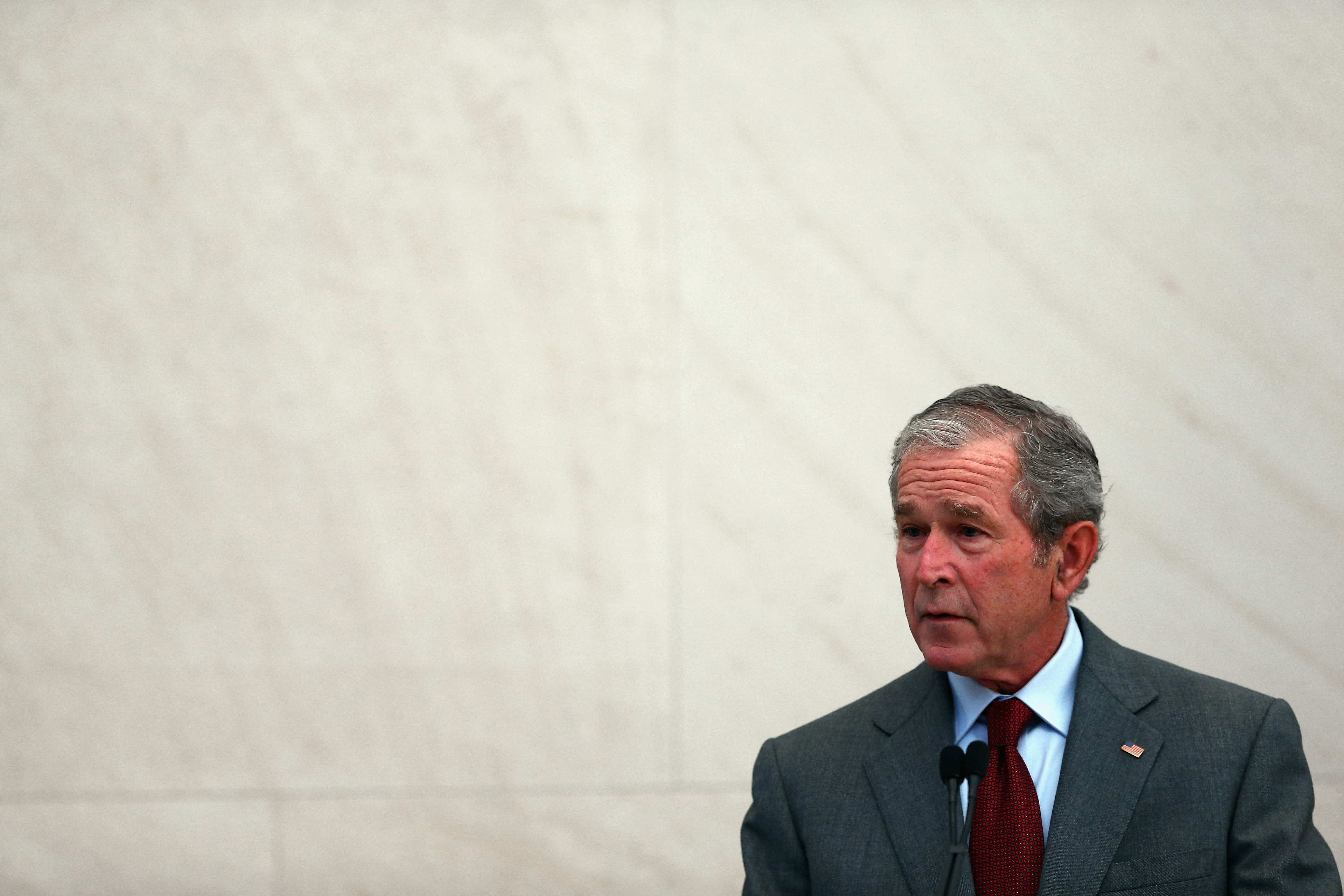
(Photo: Former U.S. President George W. Bush speaks during a immigration naturalization ceremony held at the George W. Bush Presidential Center on July 10, 2013 in Dallas, Texas. By Tom Pennington/Getty Images.)

Why Is Obama Preventing The Release Of The Senate Torture Report?

abughraibleash.jpg

It is becoming clearer and clearer that one major power-broker in Washington is resisting the release of the Senate Intelligence Committee’s allegedly devastating report on the torture program run by the Bush-Cheney CIA. That major power-broker is the Obama administration.

You might be surprised by this, given the president’s opposition to torture and abolition of it. But the evidence is at this point irrefutable – and given extra punch by the invaluable Jane Mayer, who caught a fascinating document related to the Senate confirmation this week of Stephen W. Preston, the top lawyer at the CIA., for a new post as the top lawyer for the Pentagon. Senator Mark Udall wanted to get Preston on record about his views on the CIA’s past torture program and the reasons the CIA has given to prevent the public release of the Senate report. And he did in a series of questions you can read here.

Here’s what I got from the document and Jane’s reporting. The CIA’s own current chief counsel believes the CIA lied to and misled the Congress repeatedly about its torture program:

The C.I.A. has defended its record on keeping Congress informed. In contrast, Preston, in his answers to Udall, concedes that, during the Bush years, the C.I.A. “fell well short” of current standards for keeping the congressional oversight committees informed of covert actions, as is required under the 1947 National Security Act.

In fact, Preston admits outright that, contrary to the C.I.A.’s insistence that it did not actively impede congressional oversight of its detention and interrogation program, “briefings to the Committees included inaccurate information related to aspects of the program of express interest to Members.”

More to the point, Preston flatly disagreed with the CIA’s contention that it’s impossible to know whether intelligence procured through torture could have been achieved through civilized and legal methods. He says, in fact, that it’s perfectly possible to know this – and, indeed, the Senate Report documents the counter-factuals in excruciating, specific detail – the report is over 6,000 pages long. Since the entire legal defense of torture was premised on the idea that traditional, legal methods could not have been proven as equally effective, this point is important. It could show that the entire legal rationale for torturing prisoners was based on something even the CIA’s legal counsel believes is untrue.

Check out Katherine Hawkins’ read of the same just-released document. But for me, the obvious conclusion is that the CIA is stonewalling to prevent the full extent of its responsibility for war crimes from being known. At the head of the CIA is John Brennan, whose fervent opposition to releasing the full report is well known. But Brennan answers to the president, who has urged the release of the report.

So why the hold-up? That is the question.

Why is Obama allowing Brennan to undermine Obama’s own position? Why is the president allowing the CIA to prevent the very transparency he once pledged to uphold? I don’t know. But what I do know is that it is now Obama who is the main obstacle to releasing the Senate Report on Torture. He needs to tell his CIA director to give up his struggle to keep us all in the dark. He needs to stop dithering and tell Brennan to get out of the way of the report’s release – so we can all see, digest and understand what was done, in secret, in our name.

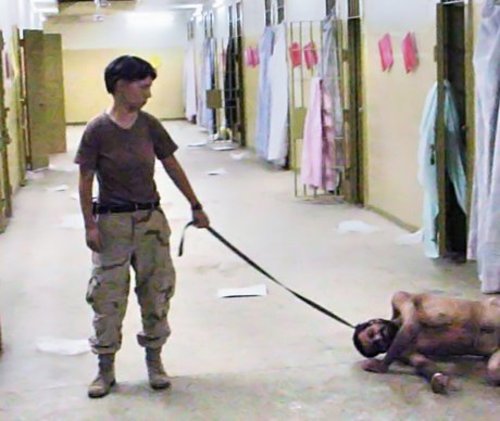
(Photo: Lynndie England demonstrating one of the CIA-approved torture techniques for breaking down the psyches of terror suspects, in US-run Abu Ghraib prison.)
The Utter Disaster Of Healthcare.gov, Ctd

Yuval Levin talked with sources in the Center for Medicare and Medicaid Services (CMS), the agency in charge of the federal health insurance exchanges. A key section of his post, which is worth reading in full:

If the problems now plaguing the system are not resolved by mid-November and the flow of enrollments at that point looks like it does now, the prospects for the first year of the exchanges will be in very grave jeopardy. Some large advertising and outreach campaigns are also geared to that crucial six-week period around Thanksgiving and Christmas, so if the sites are not functional, all of that might not happen—or else might be wasted. If that’s what the late fall looks like, the administration might need to consider what one of the people I spoke with described as “unthinkable options” regarding the first year of the exchanges.

All of the CMS people I spoke with thought the state-run exchanges are in far better shape than the federal system under their purview. But the insurers do not seem that much happier with many of those state exchanges.

Back-end data issues seem to be a problem everywhere, and some of the early enrollment figures being released by the states are not matching up with insurance company data about enrollments in those states, which suggests a breakdown in communication that is only beginning to be understood. The insurers believe that only Nevada, Colorado, Washington state, and Kentucky have what could reasonably be described as working systems at this point. Still, there is no question that on the whole the states with state-run exchanges are in better shape than those with federal ones.

Jonathan Cohn tries to look on the bright side:

[I]f these past two weeks appear to reflect poorly on the federal bureaucracy and the Administration managing it, they shouldn’t reflect poorly on health care reform itself—which, after all, has worked in Massachusetts and seems to be working in the states running their own operations. The success of states like Kentucky and New York and Connecticut and California are important for their own sake: By my count, they constitute about a fourth of the national population. But they are also important for what they show about how the law can work, once the technology piece is in place.

The Backlash Against Modern-Day America

Tea Party Views

Jelani Cobb outlines the GOP’s “Dixiecrat problem”:

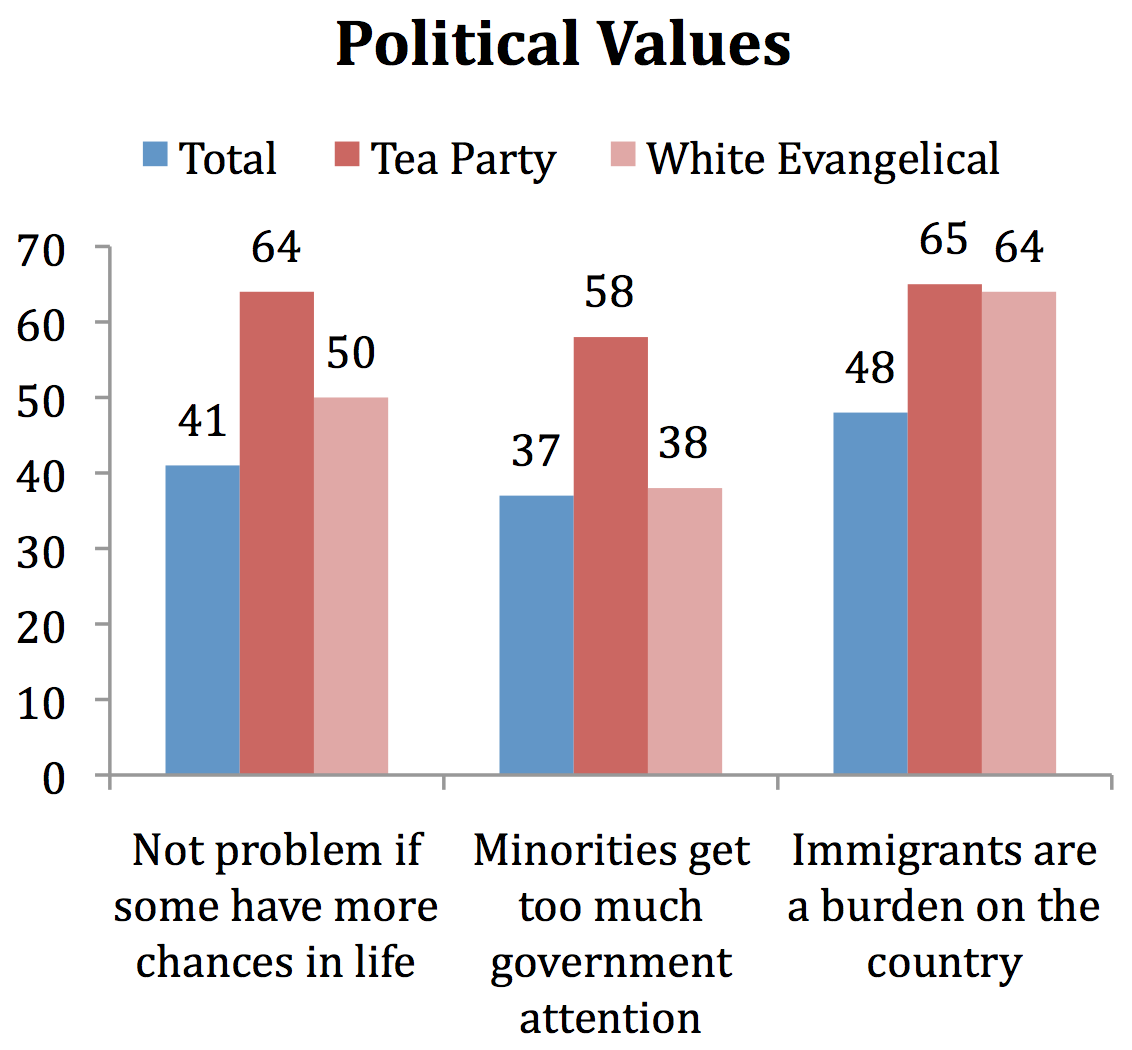
Today’s Republican Party, like the Democrats six decades ago, has had to come to terms with a demographic shift—one in which Hispanic voters are a crucial new element. We would be naïve to believe that the opposition to comprehensive immigration reform that features so prominently in current Tea Party politics is incidental to its appeal. (A 2010 survey of Tea Party supporters conducted by the Public Religion Research Institute found that fifty-eight per cent believed the government “paid too much attention to the problems of blacks and minorities”; sixty-four percent said immigrants were “a burden” on the country.) The Tea Party–inspired eruptions that have recurred throughout Obama’s Presidency represent something more complicated than a reactionary backlash to the sight of a black President; they are a product of the way he so tidily represents the disparate strands of social history that brought us to this impasse. The problem isn’t that there’s a black President; it’s that the country has changed in ways that made Obama’s election possible.

What If Obama Needs To Delay Obamacare?

Philip Klein wonders:

Obama, no doubt, wants to avoid the political embarrassment of a delay — or even the mere suggestion of one. But what happens if it’s the middle of December and enrollments are nowhere near where they need to be to make the system viable? What if, by necessity, he has to seek a delay?

The operating assumption would be that Republicans would jump at the chance to delay it. But after the past few weeks, can we really be sure that this would be the case?

It’s perfectly conceivable that if such a scenario played out, the position of the Tea Party activists and their allies in Congress would be that delaying the law for a year would be tantamount to a bailout of Obamacare.

Should Healthcare.gov fail to improve, Chait concedes that delaying the individual mandate may be necessary:

Here … is the kind of individual-mandate delay that would make sense. It would apply only to those states lacking a functioning website. (States that established their own exchanges are, in general, experiencing much better functionality than the states that boycotted their exchange and relied on the federal government to set up a site for them.) The delay would be tied to the workability of that state’s website — no reason to delay California’s individual mandate just because people in New Jersey can’t log on. And the process for making this determination would have to rest with the Department of Health and Human Services, or some other body that is trying to make the law succeed, not one that’s trying to destroy it.

Note that the individual mandate in 2014 is only a token $95 annual tax. Its main purpose is as a signaling device that everybody should get covered.

Chait is wrong about that last point:

The individual mandate’s penalty is not $95 in year one. It’s $95 or 1 percent of your taxable income, whichever is greater. So if you make $80,000 in taxable income, the penalty is $800.

The Abatement Of Cruelty, Ctd

Remaining thoughts on the popular thread:

In response to your Aussie reader suggesting kangaroo meat, there’s another very good option in Wild Pigs A Growing Problem In Berlinthe US, if a bit expensive and hard to find.  I’ve almost completely cut pork out of my diet for all of the reasons discussed, but being from North Carolina, giving up pulled pork permanently would be tantamount to treason.  It’s not common yet, but there is an alternative.

Wild boar have been exploding in numbers, particularly in Texas, for reasons that aren’t fully determined (more on that caveat to eating boar in a minute). They’re aggressive, dangerous, very damaging to local flora and wildlife, and incredibly delicious.  They’re also incredibly difficult to hunt, being fairly intelligent and swift of foot, which to me is a healthy challenge to our increasingly complacent collective backsides. Eating boar means you’re eating a gamier pork that needs to be reduced in numbers, and at the very least has lived its life in a natural environment. I’ve had wild boar sausage, and it was amazing.

The caveat, of course, is that there most certainly are boar that are intentionally released for hunts and which contribute to the problem.  We definitely need some way of distinguishing boar that’s killed in wildlife control and boar that’s killed after being intentionally released for sport, which turns the moral equation upside down.

Another zooms out:

I’ve been following your thread about how we can be more humane in killing the animals we eat.  It is fine for those of us who live in a place where we can actually get to a farmer’s market and find grass-fed beef that is killed humanely; however, I think there is a huge disconnect about how we feed the people who live in the United States who barely have access to a grocery store in their neighborhood much less barnyard raised chickens … and even if there were such a thing, they would never be able to afford to buy it.

In 1940, there were approximately 128 million people in the US and lots of family farms; now there are 308 million (probably more since that number is from the 2010 census) that we need to figure out a way to feed.  My dad had a grocery store in a small town and my aunt and uncle had a farm where they raised chickens, cattle and pigs.  In the fall, my dad and two uncles would slaughter a steer and a calf for meat for my dad to sell at his store.  And I am sorry, but when I saw my first calf with his neck cut, bleeding and stumbling around the barnyard until he fell over, I didn’t feel like that calf was treated humanely.  But I understood that that calf was going to feed a lot of people in my hometown (population 500) and at a not very expensive cost. The only expense my dad had was the slaughterhouse he took the animals to be cut up into smaller chunks so that he could store them more easily.  I can still remember the smell – a mix of blood and meat – that permeated the place.

So please tell me how, without factory farming, we are going to be able to feed 310 million people at an affordable price.  And please, if we all became vegetarians/vegans, don’t think that there wouldn’t be factory vegetable gardens (there already are in California and other farm states) and we would probably run out of arable land to feed everyone.  And if there weren’t factory cattle farms, we would quickly run out of space for meat too.

Now what we can do is regulate the hell out of them – which of course, our deregulating Congress wants nothing to do with.  Make sure that the conditions that the animals are kept in and the meat harvested are as safe as we can make it … chickens and pigs, too.  Of course that would mean adding inspectors and following up to make sure, etc. etc.  And how is that going to be accomplished?

I just think it’s really naïve to say that we can all just check out how our meat is harvested and not buy from certain suppliers and the market will force a change.  Until everyone makes enough money to put real pressure on the ranchers, meat producers, etc. it is not going to happen.

Another notes:

I wanted to comment on the research you cited on dog fMRI from the Berns lab that argues that “dogs are people” based on the fact that dogs show emotional processing that activates the caudate nucleus. In my own work I also use fMRI, and the caudate nucleus (part of the basal ganglia) is my primary research speciality.

I think that the methods for training and scanning dogs developed by Dr. Berns and his colleagues are very exciting and will lead to much greater understanding of the mind and brain of dogs. However, I think his emphasis on the caudate nucleus is very misleading. The basal ganglia in general, and the caudate in particular, are actually conserved across all vertebrate species, to a very remarkable degree; there is nothing special about dogs having a caudate nucleus, or using it to feel emotions. Stan Grillner at the Karolinska institute is a leader in the field and has found basal ganglia homologs in axolotl, lampreys, and pretty much every vertebrate ever tested. Even more impressive is recent research that found a basal ganglia like structure in the fly (drosophila)!

A goal of many scientists has historically been to try to find the special thing about our minds and brains that makes us human. Most of these (enlarged prefrontal cortex, ability to use tools) have ultimately been shown to not be unique to our species. So the lesson here might not be that dogs, specifically, are like humans – but that we humans are more closely related to other vertebrates, and even invertebrates, to a much greater degree than we appreciate. That lesson is certainly consistent with the moral argument made by Matthew Scully.

(Photo of a wild boar from Getty)

Bright Young Thing

This week the 28-year-old New Zealand writer Eleanor Catton won the Man Booker Prize for her novel The Luminaries. A summary of the book:

“The Luminaries” is set in a town called Hokitika, a Maori word that means “around and then back again”, which offers a clue to the book’s real framework. Twenty characters, every one fully formed, fill the story in 20 chapters, each half the length of the one before and offering what Ms Catton calls “a prismatic view” of events. The plot is based on the signs of the zodiac, a post-modern circular mystery that is astrologically precise and encompasses whores and drunkards, hidden gold, ships and séances, a murder and a lot of mud and bad weather.

Charlotte Higgins spoke to one of the Man Booker judges, Stuart Kelly:

[H]e said that it was [Catton’s] ability to “make the novel think in a way that the novel doesn’t do normally” that set her apart; the way that, for example, she sets astrology and capitalism into play as competing systems of dealing with the world, but at the same time has produced “a rip-roaring read”. “The prize went to the true avant-gardist,” he said. “No novel has been like this before.”

Martha Anne Toll emphasizes the author’s 19th-century influences:

[Catton’s] literary ancestry derives less from her homeland and more from the British and American giants of the nineteenth century. Catton deserves their company. Nodding to Melville, she’s nailed the tormented sea captain and the revenge obsessed “Chinaman.” With so many characters taking on false identities and trying to out-cheat each other in New Zealand’s gold rush, Catton, too, has mined the seamy underside of greed and poverty so beloved by Dickens. Like George Eliot, Catton looks behind the stereotype of the whore and the opium dealer and forces us to question where the real morality lies. By the novel’s end, every character’s initial presentation has been destabilized.

Bill Roorbach appreciates that “Catton has built a lively parody of a 19th-century novel, and in so doing created a novel for the 21st, something utterly new”:

It’s a lot of fun, like doing a Charlotte Brontë-themed crossword puzzle while playing chess and Dance Dance Revolution on a Bongo Board. Some readers will delight in the challenge, others may despair. I went both ways: always lost in admiration for this young New Zealander’s vast knowledge and narrative skill, sometimes lost in her game, wishing at times for more warmth, delighted by her old-school chapter headings (“In which a stranger arrives . . . ”  “In which Quee Long brings a complaint before the law . . . ”), puzzled by her astrology, Googling everything twice and three times, scratching my head, laughing out loud, sighing with pleasure at sudden connections, flipping back pages and chapters and whole sections for rereadings, forging ahead with excitement renewed.

In an interview with Nick Clark, Catton describes what she learned from The Luminaries:

Writing the book, Catton says, became about the quest for self-knowledge. “It explored the degree to which the knowledge of your destiny corrupts a person. A lot of the characters in the book are engaged with their own pasts. What I’ve realised – partly from The Luminaries and partly just a life lesson – is the most revealing thing you can do is to surround yourself with people unlike you. And if you’re an artist the best thing is to read things that are most unlike what you are doing.”

Going Nowhere

Timothy Noah questions why so few unemployed Americans are moving for work:

Nobody has a better reason to pick up and move than someone who can’t find a job—or at least so it would seem. But while unemployed people remain likelier to migrate than employed people, they are much less likely to migrate than in previous decades. In 1956, for example, 7.6 percent of unemployed males moved from one state to another during the previous year. Subsequently that rate fell to 7 percent (1966), 5.9 percent (1976), 5.3 percent (1986), 4.4 percent (1996), 4.3 percent (2006), and, finally, 2.7 percent (2012).

He concludes that the jobless would move to the jobs … if only they could afford to live there:

Since 2009, when the recession ended, the median price of a new house in the United States has risen 13 percent, even as median household income has fallen by about 4 percent. That doesn’t pose much of a problem for a migrating architect whose income is already well above the median, and who is likelier to have existing home equity that he can transfer to another state. But for construction workers, for example, it’s likely to be a big problem, and a reason why they can’t easily move to where the best-paying jobs are. A construction worker can generally make more money in San Francisco than in suburban Fresno. But it won’t likely be enough more to make up the difference in the relative cost of living. Indeed, few working-class people earn enough money to live anywhere near San Francisco anymore, to the point that there is now a severe shortage of construction workers in the Bay Area.